
How Do You Develop Heavy-Duty ATV Suspension for Cargo Applications?
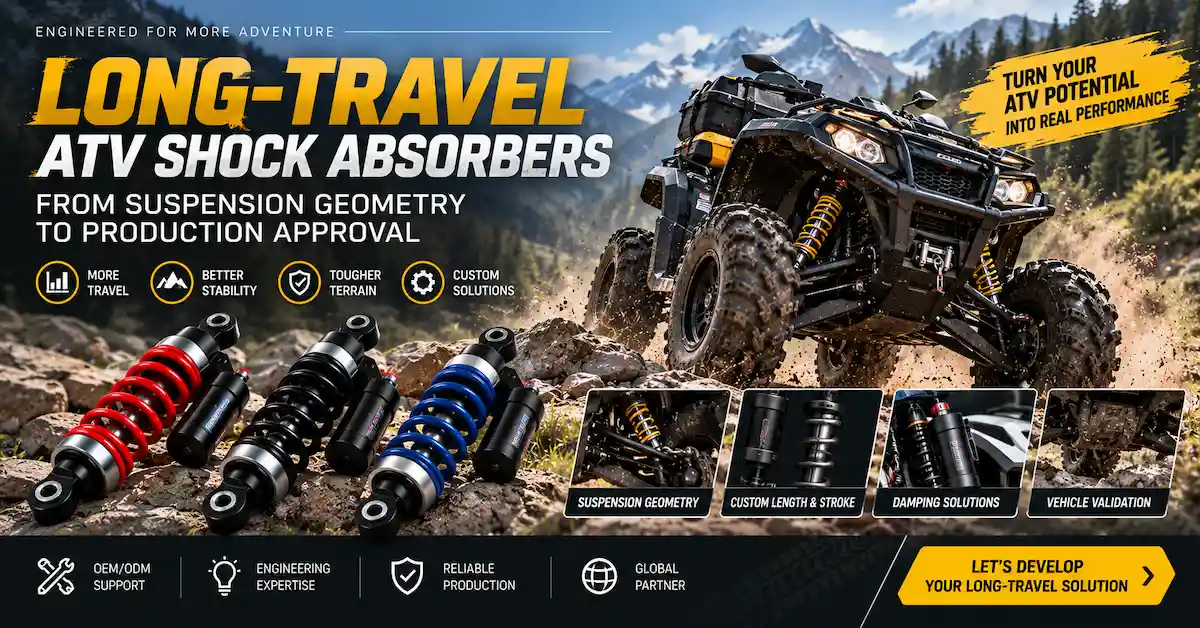
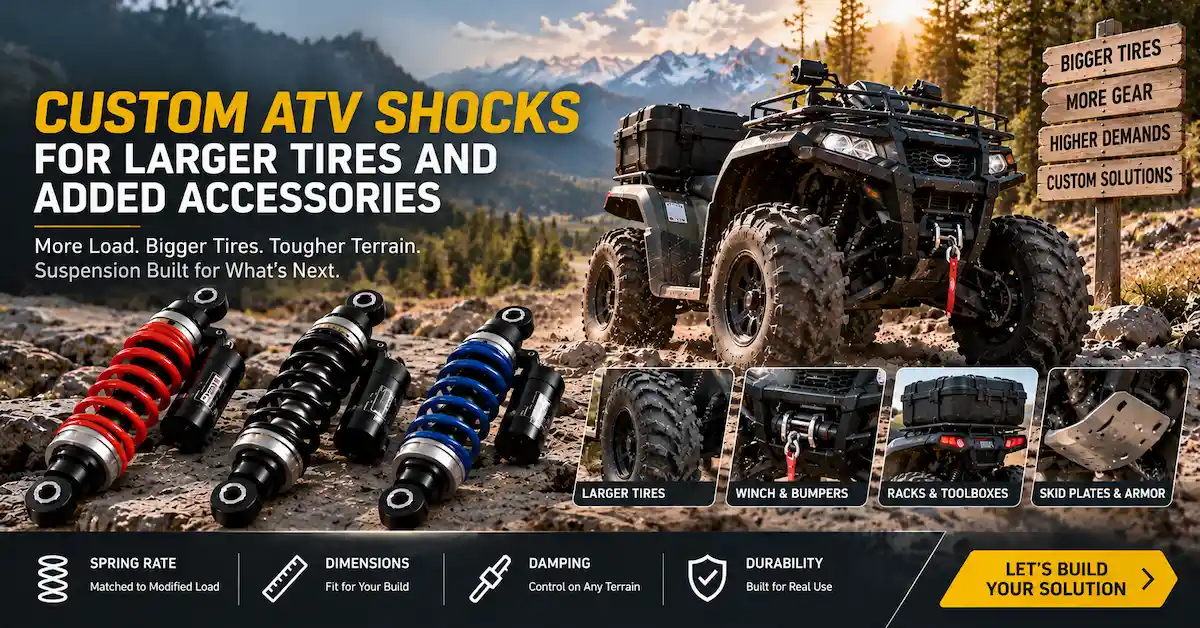
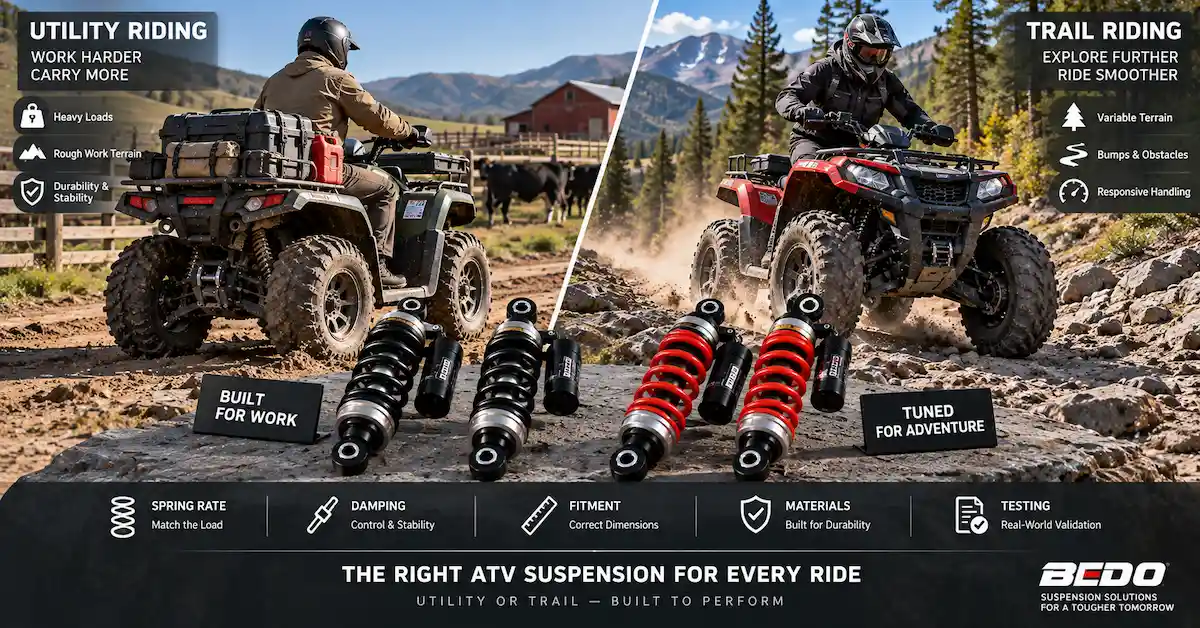
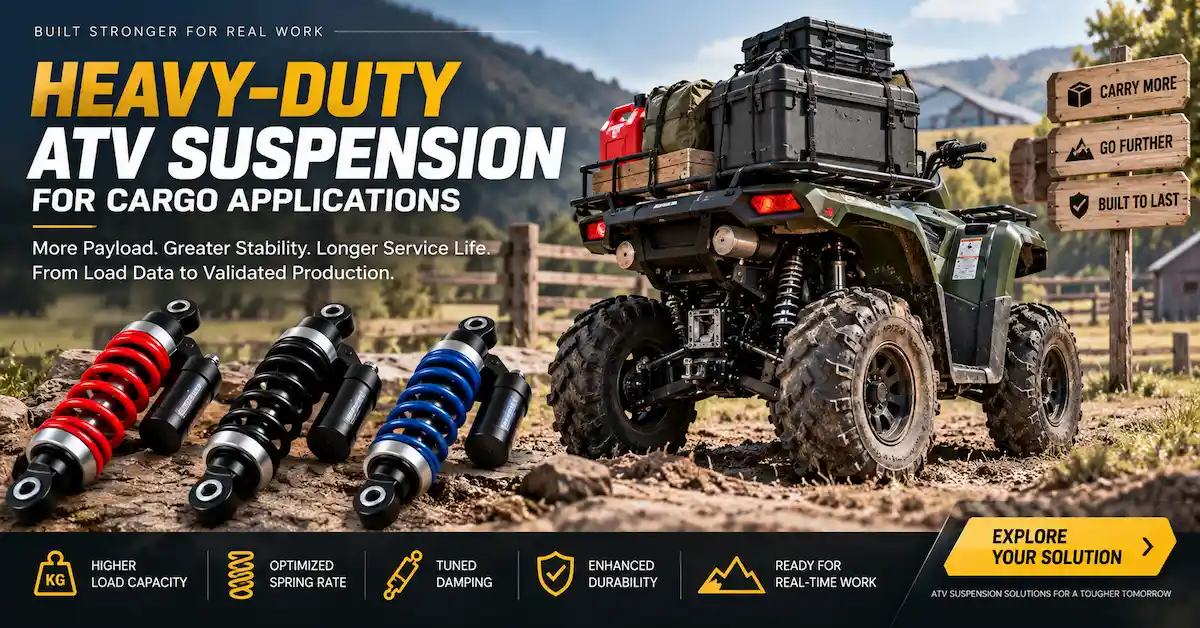
Developing heavy-duty ATV suspension for cargo use should follow a measurable engineering sequence: Operating Weight → Front/Rear Load Distribution → Sag → Spring Requirement → Available Travel → Damping → Prototype Validation → Production Control. The spring primarily supports the vehicle and cargo load, while the shock absorber controls how that loaded suspension compresses and rebounds. BEDO’s heavy-duty ATV shock absorber guide also treats “heavy duty” as an application-specific engineering requirement rather than a cosmetic description. For cargo ATVs, the goal is therefore not to find the physically largest shock or highest catalog number, but to develop a configuration that remains usable under both the intended working load and the lighter condition encountered after cargo is removed.
Define the Cargo Application Before Choosing the Shock
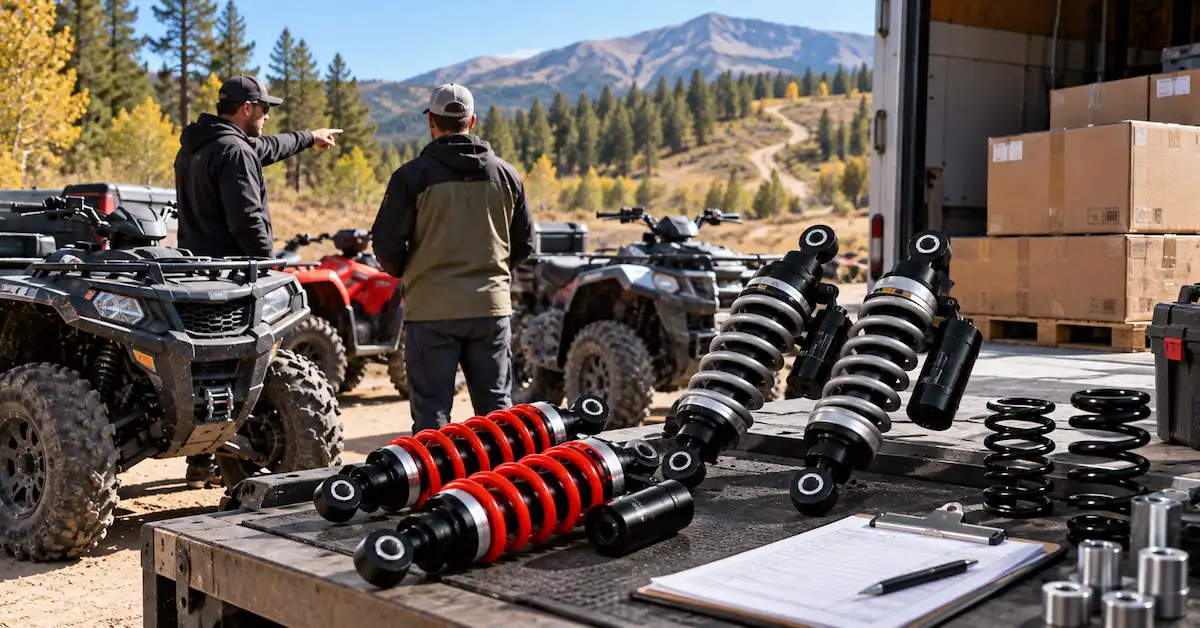
Start by describing what the ATV actually carries. Farm tools, spraying equipment, hunting gear, service boxes, fencing supplies, recovery equipment, batteries, front winches, rear cargo racks, and permanently installed work accessories all create different load distributions. Two vehicles can carry the same additional mass but place very different loads on the front and rear suspension depending on where that mass is mounted. A 30 kg front-mounted accessory should therefore not be treated as equivalent to 30 kg positioned behind the rear axle. Whenever practical, measure loaded front and rear axle weights rather than relying only on total vehicle mass.
Your development brief should also separate permanent load from variable cargo. A winch or fixed toolbox changes the base vehicle every time it operates, whereas seed bags, tools, or supplies may only be carried for part of the working day. BEDO’s low-volume shock development guidance specifically asks buyers to provide vehicle weight, payload, suspension position, terrain, and performance goals because these factors determine the actual suspension requirement. (bedoauto.com)
| Development input | What the buyer should provide | Why it matters |
|---|---|---|
| Vehicle platform | Make, model, year, variant, front/rear position | Defines the base application |
| Empty operating condition | Vehicle, rider, permanent accessories | Establishes baseline suspension load |
| Typical cargo | Normal tools, supplies, equipment,and their locations | Represents daily working condition |
| Maximum intended cargo | Highest approved working condition within vehicle limits | Defines upper validation condition |
| Front/rear axle loads | Measured values where available | Improves spring and damping decisions |
| Terrain | Farm road, gravel, mud, field, rocky trail, work site | Defines suspension movement demands |
| Existing problem | Excessive sag, bottoming, bouncing, harshness, slow recovery | Gives engineering a measurable target |
| Current suspension | Dimensions, spring data, preload, damping,reference sample | Provides starting configuration |
| Order plan | Prototype, pilot quantity, repeat demand | Defines development and production scope |
Do Not Confuse Cargo Capacity with Vehicle Payload Approval
A suspension supplier can develop shocks and springs around a defined working condition, but an upgraded suspension should not be used to justify exceeding the ATV manufacturer’s published payload, rack, towing, passenger, or structural limits. Suspension is only one part of the vehicle system. Tires, wheels, frame, racks, braking, steering, driveline, and mounting structures may have their own limits.
For an OEM development program, define the suspension target inside the approved vehicle operating envelope. If the ATV is a new vehicle platform rather than an aftermarket modification, the vehicle manufacturer should establish the system-level load limits separately from the shock supplier’s component development work.
Use Sag to Determine Whether the Existing Spring Still Supports the Load
Sag is one of the most practical measurements for a cargo project because it shows how much suspension movement has already been consumed before the ATV reaches a bump. Establish a consistent full-extension reference, then measure the suspension in at least three conditions: the vehicle with permanent equipment, the normal working load, and the highest intended working load. Keep the measurement references, tire pressures, rider position, fuel state, and cargo arrangement consistent.
If cargo causes excessive settling, the ATV may lose useful compression travel and ground clearance before it reaches rough terrain. However, simply increasing preload until the vehicle appears level is not always the correct answer. BEDO’s adjustable-shock guidance explains that preload changes the spring’s starting condition but does not change the inherent rate of a linear spring. When the working-load range is outside what the existing spring can reasonably support, spring development becomes necessary. (bedoauto.com)
Develop Spring Rate Around Both Loaded and Unloaded Conditions
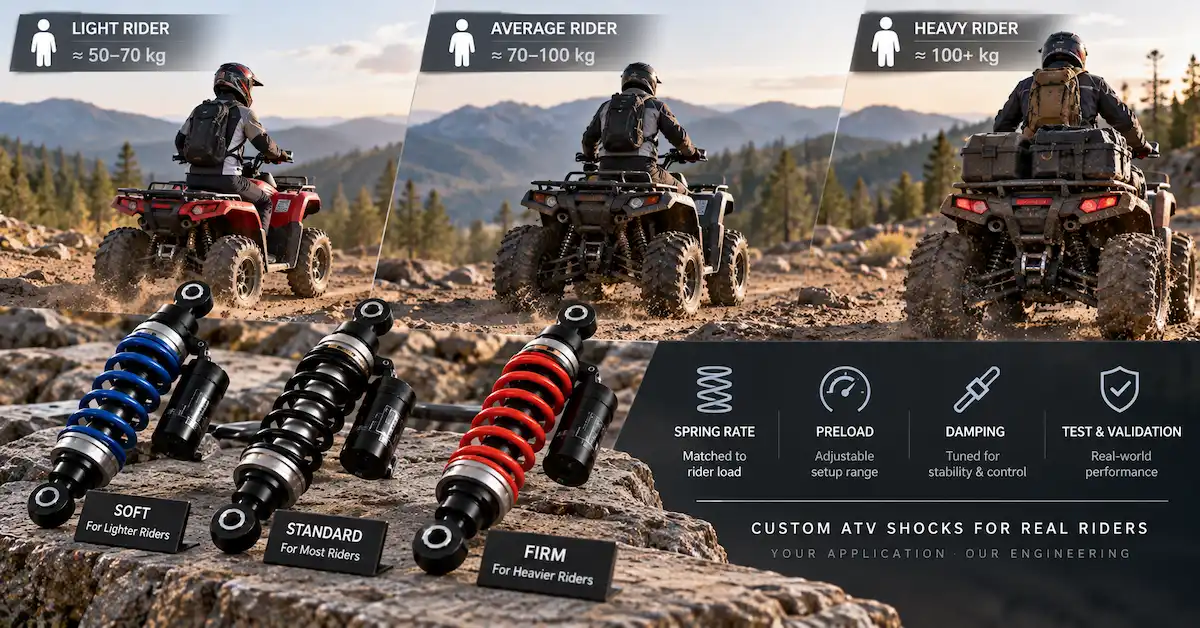
A cargo-focused spring must provide sufficient support when the ATV is carrying equipment while avoiding an unnecessarily harsh response when the cargo is removed. This is one reason why selecting the “stiffest available spring” is a poor development method. The engineering team should consider vehicle weight, payload, suspension geometry, motion ratio, desired sag, available travel, terrain, and acceptable behavior across the intended load range.
For a linear spring, spring rate describes the additional force required for a unit of compression. The supplier should provide it with a complete unit such as N/mm or lb/in, together with any necessary load–deflection information. Avoid converting an unexplained catalog marking directly into a cargo or rider-weight recommendation.
BEDO’s heavy-duty ATV guidance identifies application-specific spring rate as one possible characteristic of a heavy-load suspension, but also includes mounting strength, sealing, oil capacity, bushings, body strength, and damping among the potential considerations. That reinforces an important purchasing point: heavy-duty ATV suspension is a complete application specification, not just a stronger coil spring.
Evaluate Shock Travel Before Trying to Increase Load Support
A stiffer spring can improve load support, but it does not create additional suspension travel. Measure the shock at the required extended and compressed positions and verify how much usable movement remains at the loaded operating position. Also check surrounding clearance throughout the intended suspension movement.
Cargo-mounted components can create new interference risks. A rear storage box, auxiliary tank, battery tray, or modified rack can change the packaging around the shock and spring. If the vehicle uses modified control arms, lift components, or different wheel/tire assemblies, shock length and stroke should be reviewed with the complete suspension geometry rather than adjusted independently.
BEDO’s custom development material emphasizes that mounting size, stroke, spring rate, damping force, and load range must be matched together; a shock that looks correct externally may still fail to install or perform correctly if these parameters are mismatched. (bedoauto.com)
Tune Compression and Rebound After the Spring Requirement Is Defined
Once the spring provides appropriate support, damping should be developed around how the loaded suspension moves. Compression damping controls resistance as the shock compresses under weight transfer, bumps, ruts, and impacts. Rebound damping controls how quickly the suspension extends after that compression.
A utility ATV carrying cargo may need controlled chassis movement during slower work maneuvers while still absorbing sharp terrain inputs. The terms “low-speed” and “high-speed” compression, where such adjustment is used, refer to damper movement speed rather than vehicle speed. A slowly moving farm ATV can still generate rapid suspension movement when it hits a rut or rock.
Rebound also matters when cargo is added. Too little control can allow repeated bouncing after an impact; too much can prevent the suspension from recovering quickly enough between successive bumps. The correct damping specification should therefore be validated with the selected spring and the actual cargo condition rather than selected from a catalog force number alone. BEDO’s adjustable-shock engineering content explicitly connects spring rate, payload, suspension geometry, available travel, terrain, and damping development.
Compare Existing BEDO Shocks as Engineering Starting Points, Not Cargo Ratings
BEDO’s AU_HSA_01 and AU_HSA_03 demonstrate why existing shock specifications can be useful for dimensional screening but should not be interpreted as automatic cargo ratings. Both are published as rear ATV/UTV shocks with 130 mm effective stroke, 10 mm upper/lower mounting-hole diameters, internal gas chambers, oil–gas separation, and fixed damping. Their other specifications differ. (bedoauto.com) (bedoauto.com)
| Published specification | AU_HSA_01 | AU_HSA_03 |
|---|---|---|
| Installation position | Rear | Rear |
| Total length | 465 mm | 445 mm |
| Effective stroke | 130 mm | 130 mm |
| Cylinder outer diameter | 38 mm | 42 mm |
| Upper/lower mounting-hole diameter | 10 / 10 mm | 10 / 10 mm |
| Upper/lower mounting width | 32 / 32 mm | 30 / 35 mm |
| Published rebound force | 2000 N | 2700 N |
| Published compression force | 650 N | 350 N |
| Adjustable damping levels | None | None |
These figures do not establish that AU_HSA_03 is automatically better for heavier cargo because one published damping number is higher, nor that AU_HSA_01 is suitable for a specific payload. Damping values must be interpreted with test conditions, vehicle geometry, spring specification, and intended use. The product pages also list spring fields using “LBS” without a distance denominator, so obtain the complete spring-rate unit before using those values for engineering comparison.The page term “total length” should likewise remain unchanged until a dimensioned drawing confirms its reference points.
Decide Whether Fixed or Adjustable Shocks Fit the Cargo Program
A fixed-damping shock can be suitable when the vehicle has a predictable load and operating environment. An adjustable configuration becomes more useful when the same ATV regularly moves between light and heavy operating conditions, provided the adjustment range has been engineered and users receive clear setup instructions.
Potential adjustment functions can include spring preload, rebound damping, compression damping, or combinations of these features. However, additional adjusters also increase product complexity, manufacturing control requirements, cost, and the need for user guidance. More adjustment clicks do not automatically mean a better cargo shock. BEDO’s adjustable off-road shock supplier guide specifically notes that adjustment cannot compensate for an incorrect spring rate and should be selected around the vehicle and target application.
Define Heavy-Duty Materials and Components Through Requirements, Not Appearance
A thicker-looking body, brightly colored spring, or external reservoir may create a heavy-duty appearance, but these features do not by themselves establish load capability. For a cargo project, request the specification for critical materials and components relevant to the selected design. Depending on the project, this may include shock body, piston rod, mounting eyes, bushings, spring seats, seals, spring material, reservoir components, hoses, and surface treatments.
BEDO describes possible heavy-duty engineering considerations such as stronger mounting parts, body strength, improved sealing, oil capacity, heat management, more durable bushings, and corrosion-resistant finishes. These are design possibilities rather than a declaration that every catalog shock includes every feature. Your project specification should state which are actually required and how they will be verified.
Build Quality Control Around the Approved Cargo Configuration
Quality control should follow the final approved configuration rather than rely only on generic factory inspection.For heavy-duty ATV suspension, useful controls can include incoming component inspection, dimensional checks, spring verification, assembly cleanliness, oil and gas filling control where applicable, mounting-interface measurements, leakage checks, damping verification, identification, and final packaging inspection.
For an adjustable product, add checks for adjuster operation, repeatability, minimum and maximum positions, and the relationship between settings and measurable damping response. For repeat orders, the supplier should be able to connect the product code, drawing revision, approved spring and damping specification, inspection records, and production batch.
BEDO’s engineering-capability guidance describes a development path of Vehicle Requirements → Engineering Analysis → Prototype Development → Testing Feedback → Production Control, which is the right way to think about cargo suspension quality: inspection should confirm the product defined during engineering, not simply confirm that a shock was manufactured. (bedoauto.com)
Validate at Minimum, Typical, and Maximum Working Loads
A prototype should be evaluated at more than one cargo condition. For a useful cargo program, create at least three representative states: minimum working load, typical daily load, and maximum intended load within the vehicle’s approved limits. If the ATV operates with a removable front or rear attachment, add a test condition representing that equipment.
The validation plan may include fitment, sag, remaining compression and rebound movement, spring behavior, damping response, leakage, mounting integrity, temperature behavior where relevant, repeated-bump performance, and real-vehicle operation. The exact test methods and limits should be defined before testing begins.
Avoid validating only the maximum cargo condition. A setup that supports a heavy load can still be unsuitable when the vehicle returns empty. The development target should therefore describe acceptable performance across the intended operating window rather than prove that the suspension can merely hold the heaviest configuration.
Use Prototype and Small-Batch Production Before Scaling the Order
Cargo suspension development can involve several rounds of spring and damping changes, so moving directly from an initial sample to large-volume production creates unnecessary inventory risk. BEDO supports small-batch OEM/ODM suspension projects that allow buyers to confirm fitment, adjust spring rate, evaluate damping, and test real working conditions before scaling. (bedoauto.com)
A practical development route is:
Cargo Requirement → Engineering Review → Prototype → Vehicle Testing → Revision → Pilot Batch → Production Approval → Repeat Production
This staged approach is particularly useful for agricultural ATVs, utility fleets, specialty work vehicles, and private-label products because the buyer can validate both technical performance and production repeatability before committing to larger inventory.
Confirm MOQ, Production Capacity, and Lead Time by Configuration
BEDO describes support for small-batch and low-volume shock absorber development, but the exact minimum quantity, production allocation, sample timing, and repeat-order lead time need to be confirmed for each project. A custom cargo spring, special damping setting, mounting revision, finish, or private-label package may affect commercial conditions differently.
Instead of asking only “What is your MOQ?” request separate information for the prototype stage, pilot batch, first production order, and repeat orders. Also ask whether minimum quantities apply by shock model, spring specification, color, damping version, or packaging configuration. For lead time, separate engineering review, sample preparation, revision, testing, production, and shipping. This gives procurement a realistic project schedule instead of one headline number that mixes development and manufacturing.
Control Development Cost by Freezing the Right Requirements Early
The biggest cost risk is often not the unit price but repeated specification changes.If the cargo range, mounting geometry, spring target, or validation requirements change after prototypes are already built, the project may require additional samples, testing, fixtures, or engineering work.
Ask the supplier to separate recurring product cost from engineering, samples, testing, tooling or fixtures where required, private-label packaging, and freight. Compare quotations only when they refer to the same technical revision and scope. BEDO’s low-volume OEM model is useful for this stage because buyers can move through prototype and small-batch validation before larger production commitments rather than absorbing development uncertainty in a full-volume order.
Prepare an Order-Ready Heavy-Duty ATV Suspension Brief for BEDO
Ningbo Bedo Auto Parts Co., Ltd. manufactures shock absorbers and springs and provides customized suspension support for ATV and other off-road applications. Its published capabilities include sample analysis, shock customization, spring matching, prototype manufacturing, damping development, testing support, small-batch production, and OEM production support. (bedoauto.com)
For a cargo project, send BEDO the vehicle platform, front/rear installation position, unloaded and loaded operating weights, cargo locations, axle loads where available, existing suspension measurements, reference samples or drawings, terrain, current suspension problems, intended cargo range, and purchasing forecast. If only an existing shock is available, BEDO also supports sample-based shock absorber customization, but the sample should be accompanied by real vehicle and load information rather than treated as the full specification.
Frequently Asked Questions
1. Does a cargo ATV always need a stiffer spring?
No. The spring should be selected around actual vehicle load, load distribution, suspension geometry, desired sag, and available travel. A very stiff spring may support cargo but produce poor behavior when the vehicle is lightly loaded. The correct spring should be validated across the intended working range.
2.Can preload alone create heavy-duty ATV suspension?
Not always. Preload can change the installed starting position of the spring and may compensate for moderate load variation within an approved range, but it does not change the rate of a linear spring. Significant cargo increases may require a different spring specification. (bedoauto.com)
3. Should cargo weight be divided equally between four shocks?
Do not assume an equal distribution. Cargo location, wheelbase, suspension geometry, vehicle design, and permanent accessories affect how the additional load reaches the front and rear axles. Measured axle loads provide a better development input where practical.
4. Can I select heavy-duty ATV shocks by damping force alone?
No. Published damping force is only one part of a shock specification and must be interpreted with test conditions, spring characteristics, suspension geometry, vehicle load, stroke, and intended use. A larger force number does not automatically mean higher cargo capacity.
5. Do cargo applications require adjustable damping?
Not necessarily. A fixed-damping product can work well when load and use are predictable. Adjustable suspension may be valuable when operating loads or terrain vary widely, but the adjustment range must be engineered and the user needs appropriate setup guidance.
6. Can BEDO develop a cargo shock from an existing sample?
Yes. BEDO describes sample-based development covering dimensional review, mounting analysis, spring matching, damping development, prototype production, and subsequent production preparation. Vehicle load, terrain, and target improvements should be submitted with the sample. (bedoauto.com)
7. Should a cargo suspension upgrade increase the ATV’s published payload limit?
No. A suspension change should not be treated as authorization to exceed the vehicle manufacturer’s published structural, rack, towing, tire, or payload limits.Develop the suspension within the approved operating envelope of the vehicle.
8. How should a prototype be tested for cargo use?
Evaluate representative unloaded, typical-load, and maximum intended working-load configurations. Check fitment, sag, remaining travel, spring behavior, compression and rebound control, leakage, mounting integrity, and representative real-world terrain according to agreed acceptance criteria.
9. Is small-batch production useful before a full cargo suspension launch?
Yes. Small-batch production allows buyers to validate fitment, spring rate, damping, production consistency, and real vehicle behavior before committing to larger inventory. BEDO specifically supports this development model for off-road suspension projects. (bedoauto.com)
10.What information should I send when requesting a quotation?
Provide the ATV model, installation position, unloaded and loaded vehicle conditions, cargo weights and locations, axle loads where available, shock dimensions, existing sample or drawing, terrain, performance problem, desired improvement, sample quantity, and expected production quantity. This gives the supplier enough information to evaluate both the technical and commercial scope.
Conclusion
Developing heavy-duty ATV suspension for cargo applications should begin with real operating conditions rather than a generic “heavy-duty” shock. Determine the unloaded and loaded vehicle states, measure front/rear load distribution where practical, evaluate sag and remaining travel, select the spring around the intended working range, tune compression and rebound damping with that spring, and validate the vehicle at representative cargo conditions before production. BEDO supports customized shock absorbers, suspension springs, sample analysis, prototype development, damping optimization, and small-batch manufacturing for ATV and other off-road projects. To develop a cargo-specific setup, contact BEDO with your vehicle details, cargo weights and locations, drawings or reference samples, suspension measurements, terrain, and purchasing plan so the appropriate heavy-duty ATV suspension configuration can be reviewed before pilot and volume production.