
Why a Dirt Bike Shock Absorber Is a Setup Problem, Not Just a Part Number
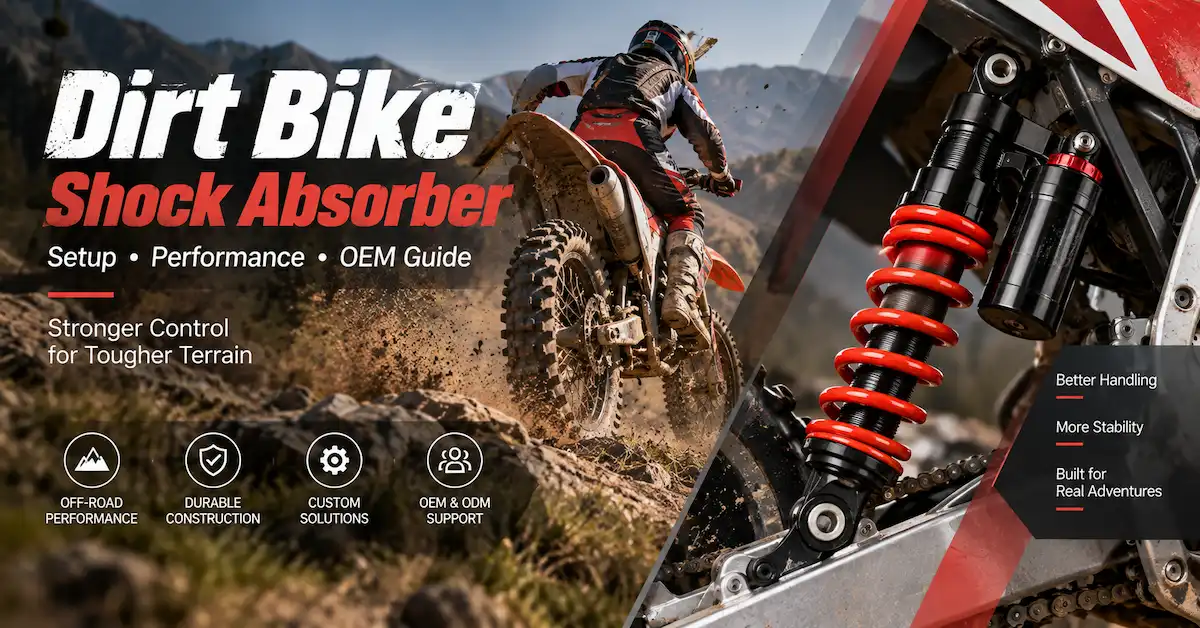
A Dirt Bike Shock Absorber operates in one of the most demanding suspension environments found on a lightweight vehicle.
A dirt bike may repeatedly encounter:
- jump landings;
- braking bumps;
- roots;
- rocks;
- deep ruts;
- sand;
- mud;
- sharp edges;
- rapid acceleration and braking;
- repeated high-frequency suspension movement.
The same motorcycle may also be ridden by people with very different:
- body weight;
- riding gear;
- skill level;
- speed;
- riding style.
This makes dirt bike suspension development fundamentally different from simply finding a shock absorber with the correct eye-to-eye length.
A shock may physically fit the frame and still perform poorly because the complete setup does not match:
- rider weight;
- spring rate;
- linkage ratio;
- shock stroke;
- compression damping;
- rebound damping;
- terrain;
- thermal load.
For motorcycle OEMs, aftermarket brands, distributors, and private-label buyers, this is an important distinction.
The product being sourced is not just a shock absorber.
The real product is a controlled suspension setup for a defined operating window.
BEDO already covers broader dirt bike suspension component upgrades in its dirt bike suspension upgrading guide. This article goes deeper into how a Dirt Bike Shock Absorber should be specified and validated around the rider and the motorcycle.
What Makes Dirt Bike Rear Suspension Different From Normal Road Use?
Road motorcycles and dirt bikes may use similar suspension principles, but their duty cycles are very different.
A road motorcycle often experiences relatively controlled suspension movements around:
- road irregularities;
- braking;
- acceleration;
- cornering.
A dirt bike can move through a much larger portion of available suspension travel repeatedly and at high shaft speeds.
Rapid Compression Events
A motocross landing can create a large compression event in a very short period.
The shock must control the movement without allowing the rear suspension to collapse through its travel too quickly.
Rapid Recovery
After compression, the suspension must return quickly enough to be ready for the next terrain input.
If rebound is too slow, the rear suspension can remain partially compressed through a series of bumps.
If rebound is too fast, the rear may feel loose, kick upward, or become difficult to control.
Repeated Heat Generation
Repeated damping work generates heat in the hydraulic system.
The important question is not only whether the shock works when cold.
It is whether the Dirt Bike Shock Absorber maintains predictable behavior after sustained riding.
Contamination
Mud, water, sand, and dust can affect:
- piston-rod surfaces;
- seals;
- adjusters;
- spring coating;
- mounts.
This means dirt bike suspension design must consider durability as well as damping.
Start With the Complete Riding Mass
One of the most useful inputs for developing or selecting a Dirt Bike Shock Absorber is the actual riding mass.
Do not consider only motorcycle dry weight.
The suspension responds to the complete operating system.
This may include:
- motorcycle;
- rider;
- helmet;
- boots;
- protective equipment;
- hydration pack;
- tools;
- fuel;
- other riding equipment.
A 65 kg rider and a 100 kg rider can place very different demands on the same rear suspension.
For an aftermarket product, the supplier should understand the intended rider-weight range.
For an OEM motorcycle platform, the target rider range should be defined during development.
Rider Weight Should Influence Spring Selection Before Damping Tuning
The rear spring provides the primary static support for the motorcycle and rider.
If the spring is substantially too soft, the bike may:
- sit too low;
- use excessive travel before a bump occurs;
- bottom more easily;
- alter chassis attitude.
If the spring is too stiff, the bike may:
- ride too high;
- feel harsh;
- struggle to use available travel;
- reduce compliance over small terrain.
This is why damping should not be used to compensate for a major spring mismatch.
A useful development sequence is:
Rider & Bike Mass → Spring Rate → Sag / Ride Height → Base Damping → Fine Tuning
This order separates static load-support problems from motion-control problems.
Sag Is a Diagnostic Tool, Not a Universal Number
Sag helps engineers and riders understand how much suspension travel is being used by the motorcycle and rider before dynamic terrain inputs begin.
However, buyers should be careful with universal sag claims.
The appropriate target depends on:
- motorcycle geometry;
- rear-wheel travel;
- linkage design;
- intended use;
- manufacturer development target.
For B2B development, the important point is not to copy one number from the internet.
The important point is to create a bike-specific target range and validate it consistently.
Useful Sag Questions
When evaluating a Dirt Bike Shock Absorber, ask:
- What is the unloaded ride position?
- What is the bike position under its own weight?
- What is the position with the target rider?
- Is preload being used excessively to reach the desired position?
- Is the spring rate appropriate for the rider range?
If very large preload changes are required just to achieve acceptable chassis attitude, the spring itself may need review.
Spring Preload and Spring Rate Are Not the Same Thing
This distinction is often misunderstood.
Spring rate describes how much additional force is required to compress the spring by a given amount.
Preload changes the installed condition of that spring.
Increasing preload can alter:
- ride height;
- sag;
- initial suspension position.
It does not convert a fundamentally soft spring into a higher-rate spring.
For a dirt bike product line, this has commercial implications.
If a brand intends to serve riders across a wide weight range, possible strategies include:
- one standard spring;
- optional spring rates;
- rider-weight spring packages;
- application-specific SKUs.
Trying to cover every rider using preload alone may create poor suspension setups at the extremes.
Suspension Linkage Changes What the Shock Actually Experiences
A Dirt Bike Shock Absorber does not necessarily move the same distance as the rear wheel.
Many motorcycles use linkage systems that create a relationship between:
- wheel travel;
- swingarm movement;
- shock stroke.
This relationship can change through the suspension travel.
As a result:
100 mm of shock movement does not automatically equal 100 mm of wheel movement.
This matters when buyers try to customize:
- shock stroke;
- overall length;
- ride height;
- long-travel suspension.
Increasing shock stroke without understanding linkage and geometry can create:
- mechanical interference;
- excessive linkage travel;
- tire clearance problems;
- unexpected chassis geometry.
For drawing- or CAD-based development, the manufacturer should evaluate the shock within the complete rear-suspension mechanism.
Motion Ratio Influences Effective Spring and Damping Behavior
The suspension linkage also changes how wheel forces are transmitted into the shock.
This means a spring rate that works on one motorcycle may not behave the same way on another bike with different linkage geometry.
The same principle applies to damping.
Two shocks with similar external dimensions can require different internal settings because their motorcycles have different:
- leverage ratios;
- wheel travel;
- mounting positions.
For OEM projects, this is why copying a visually similar shock absorber is rarely enough.
Compression Damping Controls How the Suspension Uses Travel
Compression damping controls resistance as the shock compresses.
On a dirt bike, compression events may come from:
- jump landings;
- braking bumps;
- square-edge obstacles;
- rocks;
- deep ruts;
- whoops.
Too little compression control can allow the rear suspension to move through its travel too quickly.
Typical symptoms may include:
- frequent bottoming;
- excessive chassis movement;
- poor support during hard riding.
Too much compression damping can create:
- harshness;
- reduced terrain compliance;
- poor rear-wheel contact;
- rider fatigue.
The objective is not maximum damping.
The objective is controlled use of the available travel.
Rebound Damping Determines How Quickly the Shock Is Ready for the Next Impact
After compression, the spring pushes the suspension back toward extension.
Rebound damping controls how quickly this happens.
If rebound control is too low, the rear can:
- return too quickly;
- bounce;
- kick;
- feel unstable.
If rebound damping is too strong, the suspension can:
- recover too slowly;
- remain lower after repeated bumps;
- lose available travel for the next obstacle.
This second condition is especially important in:
- braking bumps;
- whoops;
- repeated roots;
- high-frequency trail terrain.
The suspension needs enough recovery speed to reset between impacts.
BEDO discusses compression and rebound separately in its damping testing guide, which is useful when defining OEM development targets.
Low-Speed and High-Speed Compression Should Not Be Confused With Motorcycle Speed
For advanced adjustable dirt bike shocks, buyers may see:
- low-speed compression;
- high-speed compression.
These terms refer primarily to damper-shaft movement speed rather than vehicle road speed.
A motorcycle traveling slowly can still create a high-speed shock event when the rear wheel strikes a sharp obstacle.
Low-speed compression is more closely associated with slower suspension motions such as:
- chassis pitch;
- gradual load transfer;
- slower compression movements.
High-speed compression becomes relevant during rapid shaft movement from sharp impacts.
For B2B buyers, the important question is not:
Does the shock have high-speed compression adjustment?
The better question is:
Does the target motorcycle and rider actually benefit from independent adjustment, and has that range been validated?
Heat Management Matters During Motocross and Enduro Use
A shock absorber converts suspension movement into hydraulic resistance.
That work generates heat.
During aggressive or extended riding, increasing oil temperature can influence damping behavior.
The development goal should therefore include damping consistency through the intended duty cycle.
High Thermal Demand Applications
Heat management becomes more important in:
- motocross;
- hard enduro;
- long rough trails;
- repeated whoops;
- high-speed off-road riding.
Reservoir Architecture
Reservoir configurations can provide additional oil/gas system volume and packaging options.
However, a reservoir alone does not guarantee high performance.
The complete specification still depends on:
- piston design;
- oil/gas separation;
- damping configuration;
- spring;
- vehicle geometry.
BEDO's motorcycle shock product range includes reservoir-type rear shock configurations that buyers can review through the motorcycle suspension product section when discussing a dirt bike development project.
Damping Fade Should Be Evaluated Under a Representative Duty Cycle
A shock that feels correct during the first minute of testing may behave differently after repeated hard use.
A useful validation plan can compare:
- cold behavior;
- normal operating behavior;
- behavior after extended repeated impacts.
The objective is not to chase zero thermal change.
The objective is to define an acceptable performance window for the motorcycle.
This is especially valuable for premium aftermarket products where consistent damping is part of the brand promise.
Dirt Bike Terrain Should Influence the Setup Window
There is no universal best Dirt Bike Shock Absorber setting.
Different terrain requires different suspension priorities.
| Application | Typical Priority | Main Shock Consideration |
|---|---|---|
| Motocross | Landing control, repeatability | Compression + rebound balance |
| Enduro | Wide terrain range | Compliance + recovery |
| Rocky trail | Traction, sharp-impact control | Compliance and rebound |
| Sand | Stability and repeated motion | Support + consistency |
| Forest trail | Roots, ruts, mixed speeds | Recovery and traction |
| Recreational off-road | Comfort + control | Broad usable setup |
| Racing | Rider-specific tuning | Adjustment and repeatability |
This does not mean every discipline needs a completely different shock architecture.
It means the target use should influence the tuning range.
Motocross Requires Landing Support Without Destroying Small-Bump Compliance
Motocross shocks often need to handle:
- jumps;
- hard braking;
- repeated acceleration;
- rough track surfaces.
A common development challenge is balancing:
- bottoming resistance;
- small-bump compliance.
If the setup is tuned only for maximum landing resistance, the motorcycle may become harsh through smaller terrain.
A high-quality shock should use the available suspension travel progressively rather than simply feel stiff.
Enduro Demands a Wider Operating Range
Enduro riding can combine:
- slow technical sections;
- roots;
- rocks;
- faster open terrain;
- climbs;
- descents.
This creates a wider range of suspension events.
A Dirt Bike Shock Absorber developed for enduro may therefore need a broader compromise between:
- comfort;
- traction;
- impact support;
- heat consistency.
For aftermarket brands, this is an important product-positioning decision.
A motocross-focused rear shock should not automatically be marketed as the ideal solution for every enduro rider.
Rider Skill Level Also Changes the Requirement
Two riders of identical weight can use the same bike very differently.
An expert rider may:
- ride faster;
- brake harder;
- land larger jumps;
- generate higher suspension velocities.
A beginner may prioritize:
- comfort;
- predictability;
- compliance.
For OEM development, it can be useful to define the intended rider profile:
- entry-level;
- recreational;
- advanced;
- competition.
This creates a more realistic target than simply labeling the shock “performance.”
Fixed vs Adjustable Dirt Bike Shock Absorbers
Adjustable shocks can provide meaningful tuning flexibility.
Possible adjustments include:
- spring preload;
- rebound damping;
- compression damping;
- high-speed compression;
- low-speed compression.
However, more adjustment is not automatically better.
| Configuration | Advantage | Risk | Best Fit |
|---|---|---|---|
| Fixed damping | Simple, controlled | Limited rider tuning | Entry-level / replacement |
| Rebound adjustable | Useful recovery tuning | Requires setup knowledge | Mid-level performance |
| Compression + rebound | Broader tuning | More complexity | Advanced aftermarket |
| Multi-adjustable | Wide setup range | Cost/support burden | High-end performance |
The correct adjustment strategy depends on the target market.
A youth or entry-level bike may benefit more from a well-developed fixed setup than a complicated shock with several poorly understood controls.
More Clicks Do Not Automatically Mean Better Performance
A shock with 25 adjustment positions is not automatically superior to one with fewer positions.
For OEM and aftermarket buyers, the important factors are:
- usable total range;
- predictable direction;
- repeatability;
- consistency between units;
- practical baseline.
A wide click count with almost no meaningful damping change creates little customer value.
The same issue was covered in BEDO's broader adjustable shock absorber tuning guide.
Build a Baseline Setup Before Offering Adjustment
Every adjustable Dirt Bike Shock Absorber should have a logical baseline.
The baseline should represent the expected setup for:
- target motorcycle;
- target rider weight;
- normal terrain.
This gives:
- dealer technicians;
- riders;
- warranty teams;
a common starting reference.
Without a baseline, user adjustment becomes random.
For private-label products, instructions should clearly explain:
- adjustment direction;
- baseline position;
- tuning steps.
Common Dirt Bike Rear Shock Symptoms and What They Suggest
Vehicle symptoms can help guide development feedback.
| Symptom | Possible Direction to Investigate |
|---|---|
| Bottoms on landings | Spring, sag, compression, travel |
| Kicks upward after bump | Rebound too fast / spring interaction |
| Packs down in whoops | Rebound too slow |
| Rear feels harsh | Spring, preload, compression |
| Poor traction | Rebound/compression balance |
| Excessive sag | Spring/preload/load |
| Damping changes after long riding | Thermal consistency |
| Oil leakage | Seal/rod/assembly |
| Noise at mount | Bushings/mounting/hardware |
These are diagnostic directions, not automatic conclusions.
A symptom should be investigated under controlled conditions.
Do Not Tune Several Variables at the Same Time
If a prototype has:
- new spring rate;
- new compression damping;
- new rebound damping;
and all three are changed at once, it becomes difficult to identify which modification produced the result.
A better development method is controlled iteration.
For example:
- establish correct spring range;
- confirm sag;
- tune base compression;
- tune rebound;
- refine adjustment window.
This produces more useful engineering feedback and reduces unnecessary prototype rounds.
Development From an Existing Dirt Bike Shock Sample
A physical sample is useful when the buyer does not have complete original data.
The supplier can evaluate:
- overall length;
- stroke;
- mounting dimensions;
- spring dimensions;
- body size;
- reservoir position;
- adjuster configuration.
However, a sample cannot reliably communicate everything about:
- internal valving;
- damping curve;
- spring rate;
- oil specification;
- gas pressure;
- actual motorcycle behavior.
For this reason, sample-based development should also include the intended improvement.
Instead of saying:
Copy this Dirt Bike Shock Absorber.
A stronger brief is:
Use this sample as the fitment reference, but improve landing support for a heavier target rider while maintaining traction over repeated braking bumps.
That turns copying into engineering development.
BEDO's dirt bike OEM sourcing guide explains the additional information required beyond physical sample dimensions.
Drawing and CAD Data Become Important When Geometry Changes
Drawings are valuable for:
- controlled dimensions;
- mounts;
- tolerances;
- product identification.
CAD becomes more valuable when the project involves:
- new motorcycle frame;
- new linkage;
- reservoir packaging;
- increased travel;
- changed mount position.
Not every aftermarket shock needs full motorcycle CAD.
The engineering input should match the level of change.
A Practical Dirt Bike Shock Absorber Development Workflow
For OEM or private-label development, a structured process can reduce risk.
Step 1 — Define Motorcycle and Rider
Document:
- motorcycle type;
- bike mass;
- target rider range;
- riding discipline.
Step 2 — Confirm Geometry
Record:
- shock length;
- stroke;
- mounts;
- linkage information where available.
Step 3 — Define Spring Strategy
Establish:
- target spring rate;
- optional rider-weight variants if needed.
Step 4 — Establish Base Damping
Develop an initial compression and rebound setup.
Step 5 — Produce Prototype
Build the controlled development configuration.
Step 6 — Set Sag and Baseline
Confirm the motorcycle starts testing from a repeatable setup.
Step 7 — Test Representative Terrain
Use conditions matching the product's intended market.
Step 8 — Record Specific Feedback
Avoid vague comments such as “too hard.”
Step 9 — Revise One Area at a Time
Separate spring and damping decisions.
Step 10 — Freeze Approved Specification
Control:
- spring;
- damping;
- dimensions;
- finish;
- adjuster baseline.
Step 11 — Pilot Batch
Confirm production repeatability.
Step 12 — Release Production
Move to normal manufacturing only after consistency is demonstrated.
How to Test a Dirt Bike Shock Absorber Prototype
A complete validation plan can include several layers.
Static Setup
Record:
- ride height;
- sag;
- preload position;
- rider weight.
Fitment
Confirm:
- mounts;
- clearance;
- full extension;
- compression range.
Bench Evaluation
Where applicable, evaluate:
- compression behavior;
- rebound behavior;
- adjustment response.
Vehicle Testing
Use real terrain.
Observe:
- landing support;
- traction;
- recovery;
- harshness;
- bottoming;
- chassis stability.
Extended-Duty Testing
Evaluate whether damping changes after sustained use.
Environmental Evaluation
Consider:
- mud;
- dust;
- water;
- corrosion exposure.
BEDO discusses development and production validation more broadly in its shock absorber testing guide.
Test Feedback Should Be Reproducible
A development comment such as:
Rear feels strange.
has little engineering value.
A useful test report should include:
- rider weight;
- spring;
- preload;
- damping settings;
- terrain section;
- speed range;
- symptom.
For example:
At the target rider weight, the rear recovers too slowly through four consecutive braking bumps after the midpoint of the test section.
This gives the engineering team something specific to investigate.
Production Consistency Matters as Much as the Prototype
For a B2B buyer, one excellent Dirt Bike Shock Absorber is not the final product.
The final product is the complete production batch.
Important production controls may include:
- overall length;
- stroke;
- mounting dimensions;
- spring identification;
- damping configuration;
- adjuster function;
- leakage;
- rod movement;
- surface finish.
If an aftermarket brand sells pairs of identical motorcycle models over several years, repeat-order consistency becomes part of brand quality.
Pilot Production Is Important for Performance Products
Performance-oriented shocks usually contain more configuration variables than basic replacement products.
A pilot batch can reveal:
- incorrect spring installation;
- damping variation;
- adjuster inconsistency;
- finish variation;
- labeling errors.
BEDO's small-batch OEM/ODM suspension guide explains why a smaller production stage can reduce risk before full-volume manufacturing.
Product Identification Should Prevent Setup Mix-Ups
If a brand sells different Dirt Bike Shock Absorber versions for:
- rider weight;
- motocross;
- enduro;
- standard/heavy-duty;
each SKU should be clearly identifiable.
Control may include:
- product code;
- spring code;
- damping revision;
- label;
- packaging.
A technically correct shock shipped under the wrong application label still creates a customer problem.
What Drives Dirt Bike Shock Absorber Cost?
Cost depends on more than physical size.
Key drivers can include:
- shock architecture;
- reservoir configuration;
- adjustability;
- spring specification;
- damping complexity;
- machining;
- material;
- seals;
- surface treatment;
- testing;
- prototype quantity;
- production volume.
A simple fixed-damping replacement shock should not be compared directly with a multi-adjustable high-performance product.
Buyers should normalize technical scope before comparing quotations.
What Should a Dirt Bike Shock Absorber RFQ Include?
For a serious B2B project, include:
- Motorcycle model or project code
- Engine/category range
- Rear suspension layout
- Bike operating weight
- Target rider weight range
- Rider equipment allowance
- Shock extended length
- Compressed length
- Stroke
- Upper mount
- Lower mount
- Linkage information where available
- Wheel travel
- Existing spring rate
- Existing preload baseline
- Existing damping configuration
- Intended terrain
- Rider skill level
- Current suspension problem
- Target improvement
- Required adjustment functions
- Existing sample availability
- Drawing/CAD availability
- Prototype quantity
- Validation requirements
- Private-label requirements
- Packaging
- Estimated production volume
A better RFQ creates a better technical discussion.
How BEDO Supports Dirt Bike Shock Absorber Development
BEDO supports customized suspension products for motorcycle and other off-road applications.
A dirt bike project can begin from:
- an existing rear shock sample;
- 2D drawings;
- CAD data;
- motorcycle information;
- rider/load requirements;
- spring and damping targets.
Buyers can review BEDO's existing motorcycle and suspension products, learn more about development capabilities through About Us, or submit technical information through the Contact Us page.
For buyers that are still defining the broader suspension product range, BEDO's dirt bike suspension upgrading guide provides supporting information on springs and related suspension components.
FAQ
What is the most important factor when selecting a Dirt Bike Shock Absorber?
There is no single factor. Rider weight, spring rate, suspension linkage, shock stroke, sag, compression damping, rebound damping, terrain, and riding level should be considered together.
Does rider weight affect Dirt Bike Shock Absorber setup?
Yes. Rider weight changes suspension load and can affect spring selection, sag, ride height, and damping requirements.
Should a heavier rider only increase preload?
Not always. If the spring is significantly too soft, increasing preload alone may not provide an appropriate setup. The spring rate should be reviewed.
What is the difference between spring rate and damping?
The spring supports the motorcycle and rider. Damping controls the speed of suspension movement during compression and rebound.
Why does a dirt bike rear shock pack down through repeated bumps?
One possible cause is excessive rebound damping, which can prevent the suspension from recovering quickly enough between consecutive impacts. Spring, terrain, and setup should also be checked.
Why does the rear of a dirt bike kick after bumps?
Possible causes include insufficient rebound control, spring interaction, or an unsuitable setup. The symptom should be tested under repeatable conditions before changes are made.
Are adjustable Dirt Bike Shock Absorbers always better?
No. Adjustable shocks offer tuning flexibility, but a correctly developed fixed setup may be more appropriate for entry-level or standard replacement markets.
Does a remote or external reservoir automatically improve performance?
No. Reservoir architecture is only one part of shock design. Spring rate, damping, oil/gas management, geometry, and vehicle setup still determine performance.
Should a dirt bike shock be tested when hot?
For demanding motocross, enduro, or extended off-road use, evaluating damping consistency after representative repeated suspension work can provide useful development information.
What should I send BEDO for a custom dirt bike rear shock project?
Provide the motorcycle application, rider-weight range, shock dimensions, spring information, suspension linkage or wheel-travel information where available, terrain, current performance problems, target improvement, sample or drawings, and expected production volume.
Conclusion
A Dirt Bike Shock Absorber should be developed around the complete rider-and-motorcycle system, not selected by dimensions or stiffness alone. Spring rate, sag, linkage, compression, rebound, heat, terrain, and rider level all influence how the rear suspension performs.
For an OEM, aftermarket, or private-label dirt bike suspension project, send your shock sample, drawings, motorcycle data, rider-weight range, and performance targets through the BEDO Contact Us page for technical review and development.