
Why Off Road Shock Absorbers Need a Lifecycle Strategy
Off Road Shock Absorbers rarely operate in a clean, constant environment.
Depending on the vehicle, they may repeatedly face:
- rocks and sharp impacts;
- corrugated roads;
- mud and standing water;
- dust and sand;
- high vehicle loads;
- repeated compression cycles;
- outdoor storage;
- changing temperatures;
- longer operating periods.
For B2B buyers, the important question is not only:
Does the shock perform well when new?
It is also:
Does the approved shock continue to behave predictably after real off-road use, and can later production batches reproduce the same result?
This shifts the buying discussion from initial product appearance to lifecycle reliability.
BEDO's current off-road suspension product range provides different shock and spring configurations, but the correct lifecycle plan still depends on the actual vehicle and operating environment.
Service Life Is Not One Universal Number
Buyers often ask:
How long should an off-road shock absorber last?
There is no responsible universal answer.
Service life can change significantly with:
- vehicle weight;
- spring rate;
- suspension geometry;
- shock stroke;
- damping force;
- terrain severity;
- driving speed;
- operating duration;
- environmental contamination;
- maintenance;
- component protection;
- manufacturing consistency.
A lightly used recreational ATV may place very different demands on a shock from a loaded utility UTV operating daily on rough farm roads.
For procurement purposes, it is more useful to define:
Operating Condition + Duty Cycle + Failure Criteria
than to ask for one generic lifespan claim.
What Usually Causes Off-Road Shock Performance to Degrade?
Shock performance can deteriorate for several different reasons.
| Risk Area | Possible Result | Buyer Observation |
|---|---|---|
| Seal wear | Oil leakage | Wet or oily shock body |
| Rod damage | Seal wear / friction | Scratches, corrosion |
| Heat buildup | Damping change | Performance fades during long use |
| Contamination | Seal damage | Mud/sand around rod area |
| Spring deterioration | Sag/load change | Lower ride height |
| Mount wear | Movement/noise | Knocking or looseness |
| Coating damage | Corrosion | Rust/exposed metal |
| Internal variation | Poor control | Different feel between units |
| Wrong application | Premature failure | Repeated warranty complaints |
A shock failure should therefore be investigated as a system problem, not immediately classified as one defective component.
1. Oil Leakage Is a Symptom, Not the Root Cause
Oil around a shock absorber often triggers an immediate replacement decision.
That may be necessary, but buyers should also determine why leakage developed.
Possible contributing factors include:
- seal damage;
- scratched piston rod;
- corrosion;
- contamination;
- incorrect assembly;
- excessive side loading;
- damaged mounting geometry;
- repeated extreme suspension movement.
A returned shock can therefore provide useful information about both component quality and vehicle application.
What to Record
When leakage is reported, document:
- shock position;
- vehicle model;
- operating hours or usage;
- environment;
- rod condition;
- seal area;
- mounting condition;
- production batch.
This transforms a warranty return into engineering data.
2. Piston-Rod Condition Directly Affects Seal Life
The piston rod repeatedly passes through the sealing system.
Its condition can affect:
- friction;
- sealing;
- oil retention;
- smooth movement;
- contamination resistance.
Typical rod risks include:
- scratches;
- stone damage;
- rust;
- bending;
- damaged surface finish.
BEDO's off-road suspension component factory guide discusses piston-rod material, straightness, finish, hardness, and protective treatment as important manufacturing considerations.
For muddy, sandy, or wet applications, buyers should inspect rod condition rather than only the visible shock body.
3. Mud and Sand Create More Than a Cleaning Problem
Mud can hold moisture against components.
Sand and grit can act as abrasive contaminants.
Together, they can affect:
- rod surfaces;
- dust seals;
- mounting joints;
- adjusters;
- spring coatings;
- exposed threads.
A product that survives one muddy ride may still develop problems after repeated contamination cycles.
For this reason, harsh-environment validation should consider not only shock performance but also what happens after repeated exposure and cleaning.
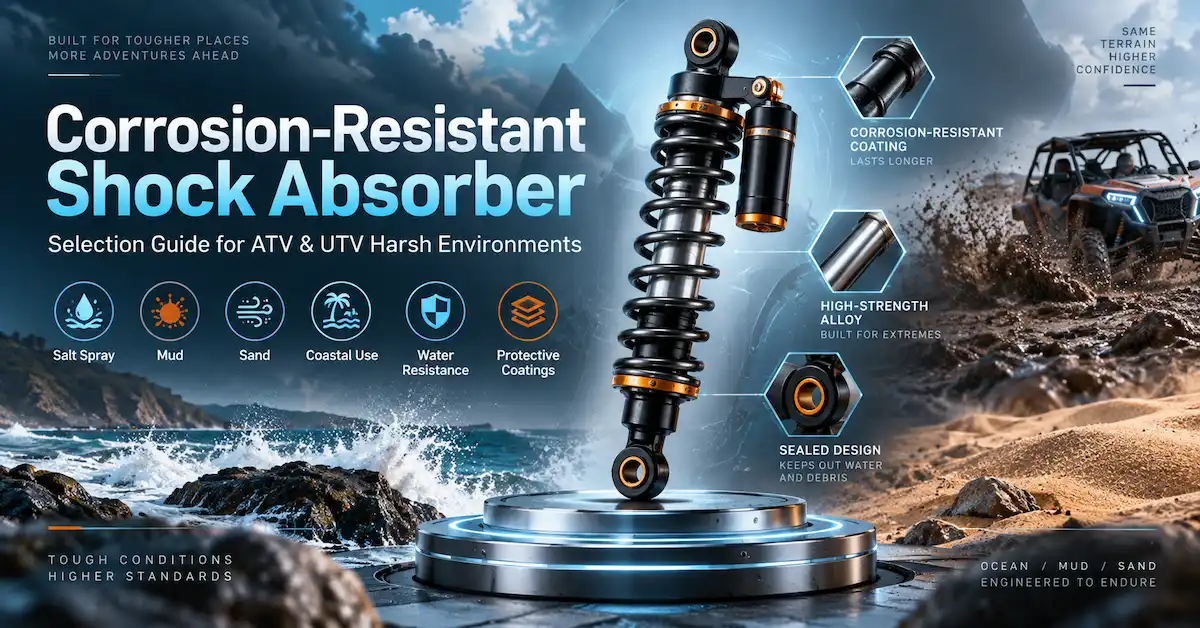
4. Corrosion Can Become a Functional Failure
Rust is often treated as a cosmetic complaint.
In off-road suspension, corrosion can eventually affect:
- piston rods;
- threads;
- mounting eyes;
- adjusters;
- spring surfaces;
- reservoir hardware.
Corrosion risk increases in applications involving:
- beaches;
- coastal regions;
- snow;
- road salt;
- wet farms;
- outdoor storage.
A sourcing specification should identify which surfaces require protection instead of simply stating “anti-rust.”
BEDO's extreme-terrain shock absorber guide also treats environmental exposure, sealing, heat, and durability as connected off-road requirements.
5. Heat Can Change Damping Behavior During Long Use
Shock absorbers convert suspension movement into hydraulic resistance.
Repeated movement generates heat.
Heat generation may increase with:
- high suspension-cycle frequency;
- rough terrain;
- heavy loads;
- higher speeds;
- long operating periods;
- strong damping forces.
The important B2B question is not simply whether the shock survives high temperature.
It is whether damping remains sufficiently consistent through the required operating period.
A shock that performs well during the first few minutes but changes significantly later may create inconsistent vehicle behavior.
Short Testing Can Miss Long-Duty Problems
A short manual compression check can confirm basic movement.
It cannot reproduce:
- repeated trail impacts;
- long utility shifts;
- high-frequency corrugations;
- high ambient temperature;
- heavy loaded operation.
When long-duration performance matters, the development plan should include testing appropriate to the actual duty cycle.
BEDO's shock absorber testing guide distinguishes dimensional checks, damping evaluation, leakage, durability, temperature-related validation, vehicle testing, and pilot-batch verification.
6. Spring Sag Can Be Mistaken for Shock Failure
The coil spring and damper perform different jobs.
The spring supports the vehicle.
The shock controls movement.
If an off-road vehicle gradually sits lower, investigate:
- spring condition;
- spring rate;
- preload;
- vehicle weight;
- added accessories;
- cargo.
Replacing the damper with another unit using the same unsuitable spring may not solve the problem.
A useful field diagnosis therefore separates:
Ride-height problem
from
motion-control problem
before replacement decisions are made.
7. Mounting Wear Can Create Noise and Side Load
Off-road suspension mounts experience repeated movement and impact.
Inspect:
- bushings;
- sleeves;
- bolts;
- mounting eyes;
- mounting width;
- alignment.
Loose or worn mounting components can create:
- knocking;
- unwanted movement;
- misalignment;
- additional side load on the shock.
A buyer may incorrectly classify this as an internal shock failure.
For repeat complaints, inspect the complete mounting system.
Create a Practical Off-Road Shock Inspection System
B2B buyers, fleet operators, and aftermarket brands can divide inspection into three levels.
Level 1 — Visual Condition
Check:
- oil leakage;
- corrosion;
- damaged coating;
- bent components;
- spring damage;
- loose hardware;
- rod scratches.
Level 2 — Installed Vehicle Condition
Check:
- ride height;
- left/right balance;
- sag;
- mounting movement;
- clearance;
- abnormal noise.
Level 3 — Performance Condition
Evaluate:
- excessive bouncing;
- bottoming;
- slow recovery;
- harsh compression;
- changing performance during longer use.
This approach makes field reports more consistent.
What Should Be Checked After Severe Terrain Use?
After unusually severe off-road use, inspect the suspension for changes rather than waiting for complete failure.
Useful checks include:
- new leakage;
- damaged rod surface;
- spring coating chips;
- mounting looseness;
- reservoir/hose damage where applicable;
- impact marks;
- changed ride height;
- abnormal movement.
The objective is not to replace parts unnecessarily.
It is to identify early changes before they create secondary damage.
Field Returns Should Be Treated as Data
For distributors and OEM buyers, returned parts can provide valuable information.
Instead of recording only:
Shock failed.
Use a standardized failure report.
Vehicle Information
- vehicle model;
- year/version;
- front/rear position;
- modifications.
Operating Conditions
- terrain;
- vehicle load;
- operating duration;
- approximate speed range;
- weather/environment.
Failure Information
- leakage;
- corrosion;
- noise;
- sag;
- broken component;
- damping change.
Product Traceability
- part number;
- batch;
- date code if used;
- supplier reference.
Evidence
- photographs;
- video;
- measurements;
- returned sample.
Once multiple returns are collected in the same format, patterns become easier to identify.
Random Failure vs Repeating Failure
One failed shock does not automatically prove a design problem.
But repeated failures with similar symptoms deserve structured investigation.
| Pattern | Possible Direction |
|---|---|
| One isolated damaged unit | Impact/installation/random defect |
| Same batch, same problem | Production consistency |
| Multiple batches, same application | Specification/application mismatch |
| Only heavily loaded vehicles | Load/spring/damping issue |
| Only wet/coastal market | Environmental protection issue |
| Failure after long continuous use | Duty-cycle/heat issue |
| Only modified vehicles | Geometry/load change |
This kind of segmentation is far more useful than treating every return identically.
Do Not Change Several Variables at Once
When correcting an off-road shock problem, avoid uncontrolled redesign.
If a prototype has:
- a new spring;
- different damping;
- new rod;
- new coating;
- new mount;
all at once, it becomes difficult to determine which change solved—or created—the problem.
Where practical, engineering revisions should clearly identify:
- what changed;
- why it changed;
- what test verifies the change.
This supports better revision control and future repeat production.
Prototype Testing Should Target the Known Failure Mode
If the field problem is leakage, validate sealing and rod-related risks.
If the problem is bottoming, review:
- spring support;
- sag;
- stroke;
- compression behavior.
If damping fades during long operation, test under a representative extended-duty condition.
If corrosion is the problem, define environmental exposure and acceptance criteria.
This is more useful than requesting “all available tests.”
Development Testing, Pilot Validation, and Production QC Are Different
These three stages solve different problems.
Development Testing
Asks:
Does the design work?
Pilot-Batch Validation
Asks:
Can the factory reproduce it consistently?
Production QC
Asks:
Does normal production remain within the approved requirements?
Treating these stages as interchangeable can increase cost without improving control.
BEDO's shock absorber testing before mass production guide explains this distinction in more detail.
What Should Be Frozen After Approval?
Once Off Road Shock Absorbers have passed development validation, the controlled production reference should identify relevant items such as:
- product code;
- drawing revision;
- extended/compressed length;
- stroke;
- mounting interfaces;
- spring specification;
- damping configuration;
- adjustment baseline where applicable;
- reservoir configuration;
- finish;
- hardware;
- packaging.
Later production should not quietly substitute a “similar” spring, coating, or internal setup if those items affect approved performance.
Why Batch Consistency Matters More Than One Excellent Sample
A hand-selected sample can perform well.
The commercial product is the production batch.
For OEMs and distributors, important questions include:
- Are critical dimensions repeatable?
- Is spring specification consistent?
- Is damping consistent?
- Are seals assembled correctly?
- Is coating quality stable?
- Does the pilot batch match the approved prototype?
A supplier should be evaluated on its ability to reproduce approved performance, not only on its ability to make one impressive prototype.
How to Build a Failure-Prevention Specification
A useful specification can connect every known field risk with a control.
| Field Risk | Specification / Control |
|---|---|
| Wrong fitment | Controlled dimensions/drawing |
| Bottoming | Load, sag, spring and stroke validation |
| Bouncing | Rebound evaluation |
| Harsh response | Spring/compression review |
| Leakage | Seal/rod/assembly control |
| Corrosion | Material and finish requirement |
| Heat-related fade | Duty-cycle validation |
| Mount damage | Mount/interface review |
| Batch variation | Pilot batch + production QC |
This converts field experience into measurable supplier requirements.
Replacement, Repair, or Engineering Revision?
The correct response depends on the cause.
Replacement
Appropriate when:
- the product is worn or damaged;
- specification remains correct;
- vehicle configuration is unchanged.
Repair or Service
May be possible on some shock architectures, but serviceability must be confirmed for the specific product.
Do not assume every shock is rebuildable.
Engineering Revision
More appropriate when:
- failures repeat;
- vehicle load changed;
- geometry changed;
- environmental exposure was underestimated;
- damping is unsuitable;
- original specification is incorrect.
This distinction prevents buyers from repeatedly replacing a component that is fundamentally mismatched to the vehicle.
What Should Buyers Ask an Off-Road Shock Supplier?
For lifecycle reliability, ask:
- What vehicle/load data do you need?
- How do you confirm shock dimensions?
- How are spring specifications controlled?
- How are compression and rebound configurations approved?
- How are rods and seals inspected?
- How is leakage checked?
- How are harsh-environment requirements documented?
- What development tests apply?
- How is a pilot batch validated?
- How is the approved revision controlled?
- How are production batches checked?
- How should field returns be documented?
BEDO's custom suspension development files guide provides a useful framework for organizing vehicle data, drawings, operating conditions, performance targets, and approval requirements before development begins.
What Affects the Lifecycle Cost of Off Road Shock Absorbers?
Unit price is only one part of sourcing cost.
The real cost can also include:
- warranty replacements;
- freight;
- labor;
- vehicle downtime;
- distributor claims;
- inventory write-offs;
- technical investigation;
- brand reputation.
A cheaper shock that repeatedly fails in the target application may have a higher total cost than a properly specified product.
For B2B purchasing, compare:
Purchase Cost + Failure Risk + Warranty Cost + Repeat-Supply Stability
rather than unit price alone.
When Is Custom Development Worth Considering?
Custom development becomes more relevant when:
- existing shocks repeatedly fail;
- the vehicle has non-standard weight;
- accessories change axle load;
- suspension geometry changes;
- terrain is unusually severe;
- duty cycle is longer than standard recreational use;
- corrosion exposure is high;
- the buyer needs better control of spring or damping behavior.
BEDO supports development from samples, drawings, CAD, and application requirements. Its sample-and-specification customization guide explains why a physical reference and measurable technical requirements should be used together.
How BEDO Supports Off-Road Shock Projects
BEDO develops and manufactures suspension products for ATV, UTV, motorcycles, electric motorcycles, and other off-road or specialty vehicles.
Depending on the project, buyers can discuss:
- existing samples;
- vehicle/load information;
- dimensions;
- drawings and CAD;
- spring specifications;
- damping requirements;
- environmental exposure;
- prototype validation;
- small-batch production;
- OEM/ODM requirements.
More company and technical information is available on the BEDO About Us page.
FAQ
How long do Off Road Shock Absorbers last?
There is no universal service-life number. Vehicle weight, terrain, suspension geometry, duty cycle, contamination, temperature, product specification, and manufacturing quality all affect durability.
What are common signs of off-road shock wear?
Possible signs include leakage, changed damping behavior, repeated bouncing, slow recovery, corrosion, abnormal noise, damaged rod surfaces, or inconsistent vehicle ride height.
Does oil leakage always mean the shock must be replaced?
Not automatically. The cause and shock architecture should be assessed, but continuing oil loss can affect damping and requires investigation.
Can mud damage a shock absorber?
Repeated mud and grit exposure can contaminate external surfaces and increase wear risks around rods, seals, mounts, and adjusters.
Why does shock performance change after long rough-road use?
Repeated suspension movement can generate heat, and damping consistency may change if the shock structure is not suited to the duty cycle.
Is sag caused by a worn shock absorber?
Not necessarily. Sag often involves spring rate, spring condition, preload, or vehicle load.
Why should returned shocks be traced by production batch?
Batch information helps buyers determine whether a problem is isolated, production-related, or linked to a broader application mismatch.
Should every production shock undergo every development test?
Not necessarily. Development validation, pilot-batch checks, and routine production QC serve different purposes.
Can all off-road shocks be rebuilt?
No. Serviceability depends on product architecture and must be confirmed for the specific shock.
When should an off-road shock be redesigned instead of replaced?
Redesign is worth considering when the same problem repeats because vehicle load, geometry, terrain, duty cycle, environmental conditions, or performance requirements exceed the original specification.
Conclusion
Off Road Shock Absorbers should be managed as lifecycle components, not judged only by how they perform when new. Leakage, rod wear, corrosion, heat, mounting condition, spring behavior, and field-failure patterns can reveal whether the issue is normal wear, production variation, or an application mismatch.
For OEM or aftermarket projects with recurring shock problems, send vehicle data, failure evidence, drawings, and returned samples through the BEDO Contact Us page for technical review and suspension development.