
Why Diagnose the ATV Before Replacing the Shock
An ATV Shock Absorber affects how suspension movement is controlled, but not every suspension complaint is caused by the damper itself.
When an ATV:
- bounces after a bump;
- sits too low;
- bottoms out;
- feels unusually harsh;
- leans to one side;
- makes knocking noises;
- shows oil around the shock;
- becomes unstable with cargo;
the obvious reaction is often:
“Replace the shock absorber.”
That can be the correct decision, but it can also lead to replacing a good damper while leaving the actual problem unresolved.
The cause may instead be:
- incorrect spring rate;
- excessive vehicle load;
- preload setup;
- insufficient suspension travel;
- worn mounting bushings;
- incorrect shock dimensions;
- damaged seals;
- mismatched compression damping;
- mismatched rebound damping;
- changed tire or accessory weight.
For B2B buyers, this distinction matters because a wrong diagnosis can become a repeated sourcing problem across an entire product batch.
Before ordering another ATV Shock Absorber, diagnose what the vehicle is doing, when it happens, and under what load.
Buyers can review BEDO's existing ATV and UTV suspension products while comparing the current vehicle configuration with available or custom shock solutions.
Quick ATV Shock Absorber Symptom Checklist
Use vehicle behavior as the starting point.
| Symptom | Possible Cause | First Check |
|---|---|---|
| Repeated bouncing | Low rebound control / worn damper | Rebound behavior and leakage |
| Excessive sag | Spring/load mismatch | Ride height, load, spring |
| Bottoming | Soft spring, limited travel, damping | Sag, stroke, compression |
| Harsh ride | Stiff spring, excessive damping | Load, spring rate, preload |
| Slow recovery | Excessive rebound damping | Repeated-bump response |
| Oil around shock | Seal or rod problem | Leakage location and rod |
| Knocking noise | Mount/bushing/hardware | Upper/lower mounts |
| Uneven left/right ride | Spring/shock variation | Pair comparison |
| Poor control with cargo | Load mismatch | Loaded vehicle condition |
| Corrosion | Environment/finish issue | Rod, spring, mounts, body |
This table is a diagnostic starting point, not a final failure diagnosis.
Several symptoms can have more than one cause.
Understand What the Spring and Shock Actually Do
A useful diagnosis begins by separating two suspension functions.
The Spring Supports the Vehicle
The spring influences:
- ride height;
- sag;
- load support;
- available compression travel;
- how much the vehicle settles under weight.
If an ATV sits too low under cargo, changing damping alone may not solve the underlying load-support problem.
The Shock Controls Movement
The damper controls how quickly the suspension moves.
Two important directions are:
Compression — when the suspension moves inward under a bump or load transfer.
Rebound — when it extends after compression.
This means an ATV can have the correct spring but poor damping, or good damping but the wrong spring.
Diagnosing the two independently avoids unnecessary part replacement.
For a deeper explanation of the relationship, see BEDO's ATV spring rate and shock performance guide.
Symptom 1: The ATV Keeps Bouncing After a Bump
Repeated bouncing is one of the clearest reasons to inspect the ATV Shock Absorber.
A correctly controlled suspension should compress over an obstacle and then return without continuing to oscillate excessively.
Possible causes include:
- insufficient rebound damping;
- internal damper wear;
- oil loss;
- gas-pressure problems;
- incorrect damping specification.
However, do not diagnose damping from one stationary “push test” alone.
Observe the vehicle under real conditions.
Ask These Questions
- Does bouncing happen front or rear?
- Does it happen only at a certain speed?
- Is the ATV loaded or unloaded?
- Did the behavior change gradually?
- Is there visible leakage?
- Are both left and right shocks behaving similarly?
For an OEM or aftermarket project, test observations should be recorded in a repeatable condition.
“Too bouncy” is subjective.
“Rear suspension rebounds twice after a large compression event with the vehicle at defined operating weight” is much more useful engineering feedback.
Symptom 2: The ATV Sits Too Low
Excessive sag is often blamed on the shock absorber, but the spring deserves immediate attention.
Possible causes include:
- spring rate too low;
- spring fatigue;
- insufficient preload;
- excessive cargo;
- heavier accessories;
- incorrect vehicle specification.
Examples of added load include:
- racks;
- storage boxes;
- winches;
- bumpers;
- larger tires;
- tools;
- hunting equipment;
- agricultural equipment.
If the ATV only sits low after a new cargo system or accessory installation, replacing the damper with another unit using the same spring may not solve the problem.
Measure Before Changing Parts
Record:
- unloaded ride height;
- normal rider condition;
- typical cargo condition;
- maximum operating load.
This allows a supplier to understand whether the issue is primarily spring support or damping.
Symptom 3: The Suspension Bottoms Out
Bottoming means the suspension reaches the end of its usable compression movement too easily.
Possible causes include:
- excessive load;
- insufficient spring rate;
- excessive sag;
- insufficient stroke;
- low compression control;
- incorrect shock dimensions.
Do not automatically solve bottoming by installing the stiffest available spring.
A very stiff spring may reduce bottoming but create:
- poor small-bump compliance;
- harsh ride;
- reduced traction;
- limited suspension use.
A better diagnosis asks:
Is the vehicle using too much travel because it begins too low, or because movement is insufficiently controlled during impacts?
Those are different problems.
Symptom 4: The ATV Feels Too Harsh
Harshness is another symptom often blamed on “bad shocks.”
But several conditions can create a hard ride:
- excessive spring rate;
- excessive preload;
- too much compression damping;
- insufficient suspension travel;
- incorrect mounting geometry;
- vehicle being much lighter than the suspension was designed for.
A heavy-duty setup designed for cargo may feel unnecessarily stiff on an unloaded recreational ATV.
This is why phrases such as:
- heavy duty;
- racing shock;
- performance shock;
should not replace actual specification matching.
The correct suspension should be matched to the intended operating window.
Symptom 5: The Shock Returns Too Slowly
If the suspension compresses repeatedly but fails to recover fast enough between obstacles, excessive rebound damping may be part of the problem.
This condition can cause the suspension to progressively operate deeper in its travel during consecutive bumps.
The result may feel like:
- reduced compliance;
- harshness over repeated terrain;
- limited available travel;
- poor wheel response.
This is different from low rebound damping, which can create excessive bouncing.
BEDO's compression and rebound damping guide explains why both directions should be evaluated separately.
Symptom 6: Oil Appears Around the Shock
Visible oil can indicate a sealing or rod-related issue.
Inspect:
- piston rod;
- seal area;
- shock body;
- reservoir connections where applicable;
- surrounding contamination.
Not every trace of moisture automatically proves severe failure, but continuing oil loss can reduce damping consistency.
Potential contributing factors include:
- seal damage;
- worn rod surface;
- contamination;
- corrosion;
- stone impact;
- assembly issues.
For vehicles used in mud, sand, or wet environments, rod protection and sealing deserve particular attention.
Symptom 7: The Shock Makes a Knocking or Clicking Noise
Noise does not always come from the internal damper.
Before replacing the shock, inspect:
- upper mounting eye;
- lower mounting eye;
- bushings;
- bolts;
- spacers;
- mounting width;
- surrounding suspension parts.
A shock with incorrect mounting width can create unwanted movement even if its damping function is normal.
Loose hardware can produce similar symptoms.
This is why complete fitment verification matters before a bulk replacement order.
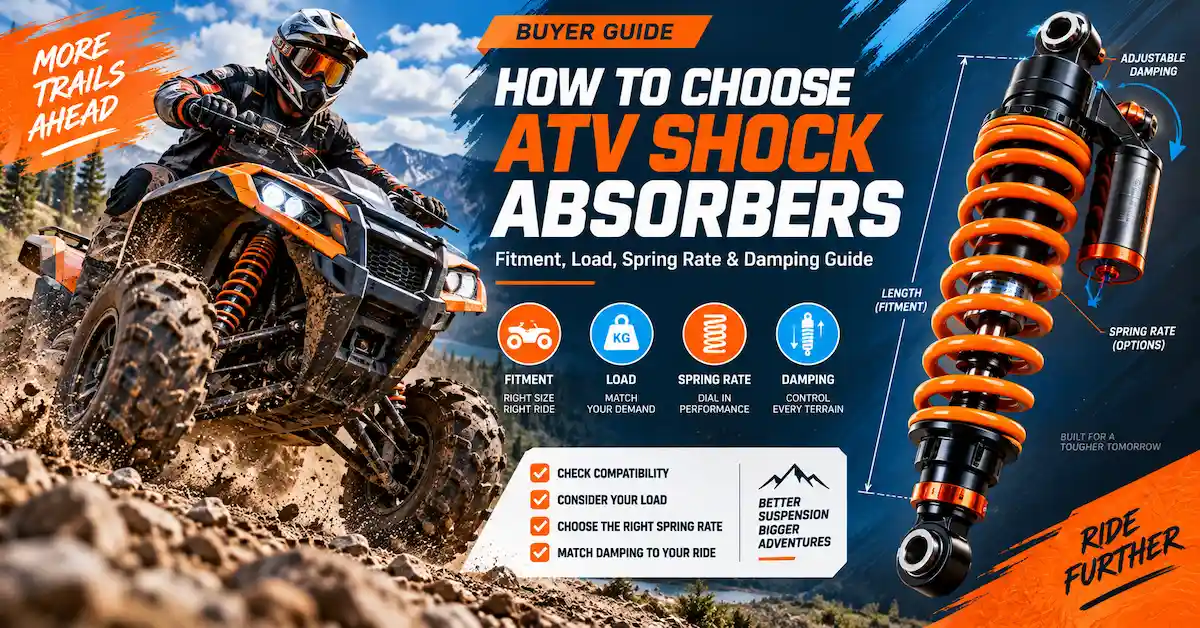
BEDO's ATV shock absorber fitment guide covers mounting dimensions, compressed and extended length, stroke, and installation checks.
Symptom 8: One Side of the ATV Sits or Behaves Differently
Left/right differences may indicate:
- spring variation;
- preload difference;
- damaged shock;
- gas or oil loss;
- bent components;
- uneven cargo;
- worn suspension joints.
For a production-quality investigation, compare both sides under the same vehicle condition.
Record:
- installed spring;
- preload setting;
- ride height;
- shock part number;
- production batch;
- visible damage.
For OEM and distributor programs, pair consistency becomes an important QC issue.
A perfect single sample does not guarantee consistent paired performance across a production batch.
Symptom 9: Performance Changes Only When Cargo Is Added
This is a strong sign that the suspension specification should be evaluated under real operating weight.
A vehicle may perform well with only a rider and become unstable after adding:
- passenger;
- tools;
- cargo;
- equipment;
- accessories.
Potential effects include:
- increased sag;
- reduced remaining stroke;
- stronger compression events;
- faster energy return from the spring;
- changed handling balance.
The supplier should know both unloaded and loaded conditions before recommending a revised ATV Shock Absorber.
Symptom 10: The Shock Is Rusting or Corroding
Corrosion may begin as an appearance issue but can become functional when it affects:
- piston rods;
- mounting points;
- adjusters;
- springs;
- threads;
- seals.
The operating environment matters.
ATVs used in:
- beaches;
- coastal regions;
- farms;
- mud;
- snow;
- wet forests;
may need stronger environmental protection.
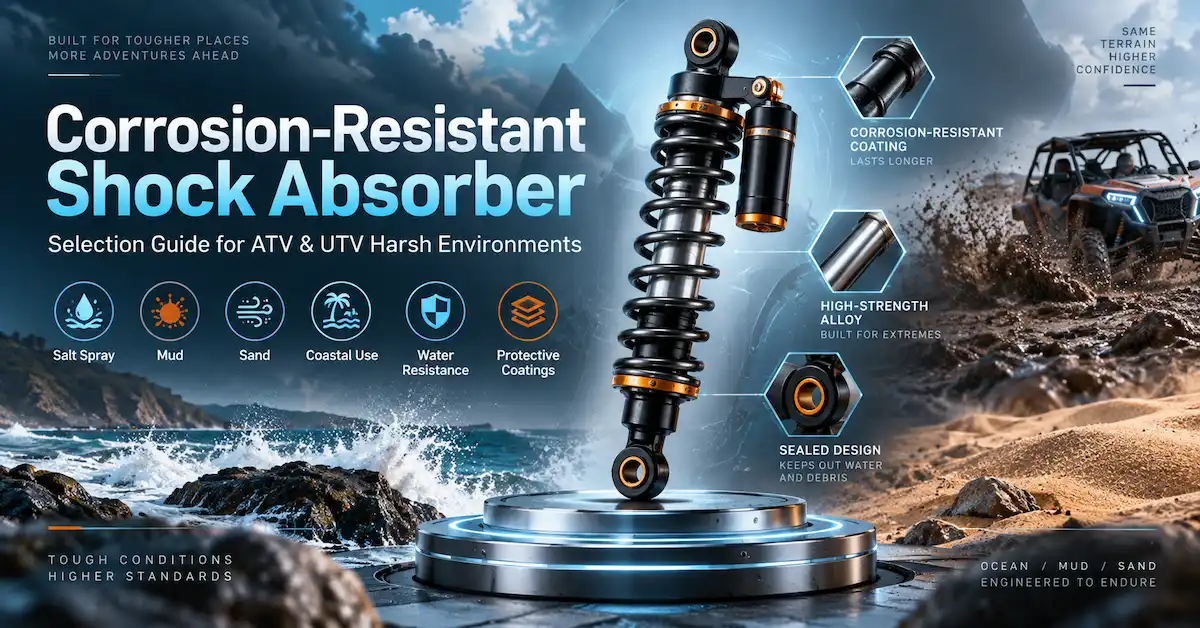
For harsh applications, see BEDO's discussion of corrosion-resistant ATV and UTV shock requirements.
Repair, Replace, Retune, or Redesign?
Once the symptom is understood, decide the correct action.
| Situation | Likely Action |
|---|---|
| Damaged seal or oil loss | Repair or replace |
| Wrong spring for load | Change spring specification |
| Incorrect damping | Retune or replace shock |
| Incorrect mounting dimensions | Replace/redesign |
| New vehicle load | Re-evaluate spring and damping |
| Larger tires/accessories | Reassess suspension setup |
| New OEM vehicle | Develop vehicle-specific shock |
| Private-label upgrade | Custom development |
| Batch inconsistency | Supplier/QC investigation |
| Corrosion failure | Review materials and finish |
This prevents a common purchasing error:
using replacement parts to solve an engineering-specification problem.
When a Standard Replacement ATV Shock Absorber Is Enough
A standard replacement can be appropriate when:
- original vehicle configuration has not changed;
- original suspension behavior was acceptable;
- the current component is simply worn or damaged;
- fitment is already verified;
- load remains within the intended range.
In this case, the buyer's main priorities are:
- correct dimensions;
- matching mounts;
- stable quality;
- repeatable damping;
- reliable supply.
When Custom Development Makes More Sense
Custom development is more appropriate when the buyer needs to change the vehicle's suspension behavior.
Typical triggers include:
- heavier cargo;
- different rider range;
- larger tires;
- modified geometry;
- poor original damping;
- different terrain;
- new vehicle platform;
- aftermarket performance differentiation.
BEDO supports shock absorber development from samples, technical specifications, drawings, CAD, and application requirements. Buyers can review the sample-and-specification customization process when the existing ATV Shock Absorber is being used as the starting reference.
What Should You Measure Before Ordering a Replacement?
Do not send only:
“I need a 400 mm ATV shock.”
At minimum, confirm:
| Measurement | Why It Matters |
|---|---|
| Extended length | Maximum shock extension |
| Compressed length | Full compression fitment |
| Stroke | Available damper movement |
| Upper hole diameter | Mount compatibility |
| Lower hole diameter | Mount compatibility |
| Upper mounting width | Correct interface |
| Lower mounting width | Correct interface |
| Spring dimensions | Packaging/load support |
| Reservoir position | Clearance |
| Body diameter | Installation clearance |
Also provide:
- ATV model;
- model year;
- front/rear position;
- vehicle weight;
- rider load;
- cargo;
- tire size;
- operating terrain.
The more complete the data, the lower the risk of ordering a shock that bolts on but does not work correctly.
How B2B Buyers Should Document an ATV Shock Problem
For distributors, OEMs, and aftermarket brands, technical complaints should be recorded consistently.
A useful failure report can include:
Vehicle Information
- model;
- production year;
- vehicle configuration;
- modifications.
Shock Information
- model or part number;
- production batch;
- installation position;
- mileage or operating hours.
Operating Condition
- rider/passenger load;
- cargo;
- terrain;
- speed range.
Symptom
- bouncing;
- bottoming;
- sag;
- leakage;
- noise;
- corrosion;
- harshness.
Evidence
- photographs;
- measurements;
- videos;
- ride-height data;
- returned sample.
This creates better feedback for both purchasing and engineering teams.
Why Failure Samples Are Valuable
A returned shock absorber is more useful when the supplier receives context.
Simply sending a failed unit may reveal physical damage, but it may not explain:
- vehicle load;
- terrain;
- installation;
- duration of use;
- modifications.
Pair the failed sample with vehicle information.
For recurring problems, compare several returned units to determine whether the issue is:
- application-related;
- random damage;
- batch-related;
- specification-related.
This is far more useful than treating every warranty return as an isolated incident.
How to Verify a Revised ATV Shock Absorber
When a supplier proposes a revised shock, test the problem that originally triggered the change.
For example:
Original problem: excessive bottoming under cargo.
Validate:
- ride height under cargo;
- sag;
- available travel;
- compression behavior;
- unloaded ride.
Do not approve the revised product simply because it feels “firmer.”
A Useful Validation Sequence
Original Symptom → Revised Specification → Prototype → Same Test Condition → Compare Results
Keeping the test condition consistent makes feedback more meaningful.
Why Small-Batch Validation Matters
After a prototype works, the next question is repeatability.
A small batch can help determine whether:
- dimensions remain consistent;
- spring specifications are stable;
- damping behavior is repeatable;
- finish remains consistent;
- assembly quality is controlled.
For new or corrected ATV suspension programs, BEDO's small-batch OEM/ODM suspension guide explains why pilot production can reduce risk before full-scale orders.
What Quality Checks Matter After a Shock Redesign?
Production checks should reflect the reason for the redesign.
If the problem was fitment:
- inspect mounting dimensions;
- inspect compressed/extended lengths.
If it was load support:
- control spring specification;
- verify installation setup.
If it was leakage:
- inspect seals;
- rod condition;
- assembly;
- pressure retention.
If it was damping:
- control approved internal configuration;
- verify functional consistency.
Quality control becomes more useful when it is linked directly to known product risks.
Cost: Why the Cheapest Replacement Can Become Expensive
For a distributor or brand, ATV Shock Absorber cost is not just unit price.
A lower-priced component can become expensive if it causes:
- returns;
- warranty claims;
- repeated shipping;
- technical support;
- poor reviews;
- lost distributor confidence;
- repeated inventory replacement.
A stronger sourcing comparison should consider:
Unit Cost + Failure Risk + Return Cost + Supply Stability
This does not mean the highest-priced shock is automatically best.
It means price should be compared only after the specification and quality requirements are equivalent.
What Should Be Included in an ATV Shock Absorber RFQ?
For a replacement or corrective project, include:
- ATV make and model
- Model year
- Front or rear position
- Existing shock part number
- Extended length
- Compressed length
- Stroke
- Mounting-hole diameters
- Mounting widths
- Vehicle curb weight
- Rider/passenger load
- Cargo/accessory load
- Tire size
- Current spring information
- Current damping information
- Terrain
- Observed problem
- Photos/videos
- Existing sample availability
- Target improvement
- Prototype quantity
- Production volume
The key item is observed problem.
Do not only tell the manufacturer what product you have.
Tell them what the vehicle is doing incorrectly.
How BEDO Supports ATV Shock Absorber Development
BEDO works with ATV, UTV, motorcycle, electric motorcycle, and other off-road suspension applications.
Depending on the project stage, development can begin with:
- an existing ATV Shock Absorber;
- drawings;
- CAD;
- measurements;
- vehicle data;
- load conditions;
- suspension symptoms;
- performance targets.
Buyers can review BEDO's product range or learn more about its suspension development capabilities on the About Us page.
FAQ
How do I know if my ATV Shock Absorber is bad?
Common signs include repeated bouncing, oil leakage, poor damping control, abnormal noise, uneven suspension behavior, or a clear change from previous performance. However, spring, mounting, load, and geometry problems should also be checked.
Does ATV sag mean the shock absorber has failed?
Not necessarily. Excessive sag often relates to spring rate, preload, vehicle load, or spring condition rather than damping alone.
Why does my ATV bottom out?
Possible causes include excessive load, insufficient spring support, too much sag, limited travel, or inadequate compression control.
Why is my ATV suspension too stiff?
Potential causes include excessive spring rate, excessive preload, strong compression damping, limited travel, or a suspension specification intended for a heavier vehicle.
Does oil on the ATV Shock Absorber mean it must be replaced?
Visible oil should be inspected carefully. Continued leakage can reduce damping performance, but the exact repair or replacement decision depends on the shock design and damage condition.
Can larger tires affect ATV shock performance?
Yes. Larger or heavier tires can change unsprung mass, suspension loads, clearance, and overall vehicle behavior.
Can I replace an ATV shock using only its extended length?
No. Compressed length, stroke, mounting-hole diameter, mounting width, spring dimensions, and installation clearance also matter.
Should I replace the spring and shock together?
Not always. First identify whether the problem comes from load support, damping, or both.
When should I choose a custom ATV Shock Absorber?
Custom development is useful when load, geometry, terrain, vehicle modifications, or target performance differ from standard applications.
What should I send a manufacturer when an ATV shock has a problem?
Provide vehicle information, shock specifications, load conditions, terrain, symptoms, measurements, photos/videos, and preferably the failed or reference sample.
Conclusion
An ATV Shock Absorber should be replaced only after identifying whether the real problem is damping, spring support, fitment, mounting, load, or component damage. A clear diagnosis prevents buyers from repeatedly ordering parts that do not solve the vehicle's actual suspension problem.
For OEM, aftermarket, or distributor projects, send your vehicle data, measurements, operating conditions, and reference sample through the BEDO Contact Us page for technical review and development.