
Why Should OEM Buyers Verify a China Shock Absorber Supplier Before Cooperation?
When searching for a China shock absorber supplier, many buyers face an important question:
Is this company a real factory or only a trading company?
For OEM suspension projects, supplier verification is critical because shock absorbers directly affect:
- Vehicle performance
- Safety
- Product reliability
- Development timeline
- Long-term supply stability
A supplier may present attractive products and competitive prices, but OEM buyers need deeper information before starting cooperation.
A reliable China shock absorber factory should have:
- Real production capability
- Engineering support
- Prototype development ability
- Quality control systems
- OEM project experience
For ATV, UTV, motorcycle, and specialty vehicle projects, choosing the right manufacturing partner can reduce development risks and improve product consistency.
Bedo Auto focuses on customized suspension solutions, supporting shock absorber development, suspension spring customization, prototypes, and OEM production.
Explore the Shock Absorber Products for available solutions.
Factory vs Trading Company: What Are the Main Differences?
Understanding the difference between a manufacturer and a trading company is the first step in supplier verification.
| Evaluation Factor | Real Factory | Trading Company |
|---|---|---|
| Production facilities | Own manufacturing capability | Usually depends on suppliers |
| Engineering communication | Direct with technical team | Usually indirect |
| Product modification | Faster response | Depends on external factory |
| Quality control | Direct management | Limited visibility |
| Prototype development | Stronger capability | Depends on partner |
| OEM cooperation | More suitable | Varies by supplier |
A trading company is not always unsuitable, but OEM projects usually require closer technical communication and production control.
For customized suspension products, working directly with a manufacturer often improves:
- Development efficiency
- Technical accuracy
- Production consistency
How Can You Verify Whether a China Shock Absorber Supplier Owns a Factory?
Before cooperation, buyers should check several key factors.
Check the Factory Location
A real manufacturer should have a clear production location.
Verify:
- Factory address
- Production area
- Manufacturing facilities
- Office and factory relationship
A company that only provides an office address may require additional verification.
Review Production Equipment
A professional shock absorber factory should have relevant production capability.
Check whether the supplier has equipment for:
- Component processing
- Shock absorber assembly
- Spring production
- Testing processes
- Quality inspection
Production equipment provides stronger evidence than product pictures.
Request Factory Photos and Videos
Useful verification materials include:
- Production line videos
- Equipment photos
- Assembly process
- Employee working areas
- Finished product inspection
The goal is to confirm that the supplier actually controls manufacturing.
Conduct Factory Audits
For larger OEM projects, buyers may consider:
- Online factory inspection
- Third-party audit
- On-site factory visit
Factory verification helps confirm:
- Production capacity
- Quality systems
- Manufacturing processes
How to Evaluate a Supplier’s Manufacturing Capability?
A reliable suspension supplier should understand the complete production process.
Shock Absorber Manufacturing
Evaluate whether the supplier understands:
- Shock body production
- Piston rod processing
- Internal components
- Assembly process
- Final testing
Suspension Spring Capability
For suspension systems, spring quality is equally important.
Check whether the supplier can manage:
- Spring forming
- Heat treatment
- Spring rate control
- Load testing
Quality Control Process
A professional factory should have inspection procedures for:
Incoming Materials
Including:
- Metal materials
- Springs
- Seals
- Purchased components
Production Process
Including:
- Machining accuracy
- Assembly control
- Process inspection
Final Product
Including:
- Dimension inspection
- Leakage testing
- Functional checking
How to Check Engineering Capability Before OEM Cooperation?
OEM buyers should not only evaluate manufacturing capacity.
Engineering capability is equally important.
CAD and Drawing Support
A capable supplier should be able to work with:
- 2D drawings
- 3D CAD files
- Existing samples
- Technical specifications
Engineers should understand:
- Dimensions
- Tolerances
- Mounting design
- Manufacturing feasibility
Prototype Development Ability
A reliable OEM supplier should support:
- Sample production
- Design adjustment
- Testing feedback
- Product improvement
Prototype capability shows whether the supplier can support new product development.
Technical Communication
During development, suppliers should be able to discuss:
- Spring rate
- Shock stroke
- Damping characteristics
- Mounting structure
- Vehicle application
A supplier that cannot explain technical details may not have sufficient engineering capability.
What Documents Can Help Verify a China Suspension Factory?
Documents can provide additional confidence.
Useful information includes:
- Business registration information
- Factory introduction
- Production photos
- Quality documents
- Inspection records
- Product specifications
- OEM project references
However, documents alone are not enough.
The most reliable verification combines:
Documents + Factory Evidence + Engineering Communication + Product Evaluation
How to Evaluate Previous OEM Experience?
A supplier with OEM experience usually understands:
- Development processes
- Customer requirements
- Product changes
- Production consistency
Ask potential suppliers:
- What vehicle applications have you developed?
- Do you support custom suspension projects?
- Can you produce prototypes?
- How do you manage product revisions?
Relevant applications may include:
- ATV
- UTV
- Motorcycle
- Electric vehicles
- Specialty vehicles
How Can Buyers Test a Supplier Before Large Orders?
Before committing to mass production, OEM buyers can reduce risks through smaller validation steps.
Start With Prototype Development
The process may include:
Requirement → Prototype → Testing → Approval → Production
Prototype validation helps confirm:
- Product fitment
- Performance
- Manufacturing feasibility
Request Trial Orders
Small production batches can help evaluate:
- Product quality
- Delivery performance
- Communication efficiency
- Production consistency
Common Signs of a Trading Company Instead of a Factory
Buyers should pay attention to possible warning signs.
Only Showing Product Images
A real manufacturer should usually be able to provide:
- Factory information
- Production evidence
- Technical explanations
Unable to Discuss Technical Details
Warning signs include inability to explain:
- Spring selection
- Damping adjustment
- Manufacturing process
- Product improvement
Cannot Support Customization
A manufacturer should be able to discuss:
- Drawings
- Samples
- Engineering changes
- Prototype development
Avoiding Factory Verification
Suppliers unwilling to provide:
- Factory videos
- Online inspection
- Production information
should be evaluated carefully.
Why Choose Bedo Auto as Your Shock Absorber Manufacturing Partner?
Bedo Auto supports OEM customers with suspension development and manufacturing solutions.
Capabilities include:
- Shock absorber manufacturing
- Custom suspension development
- Suspension spring customization
- Drawing review
- CAD evaluation
- Prototype production
- Engineering improvement
- Quality control
The company supports customers developing:
- ATV suspension
- UTV suspension
- Motorcycle suspension
- Specialty vehicle suspension
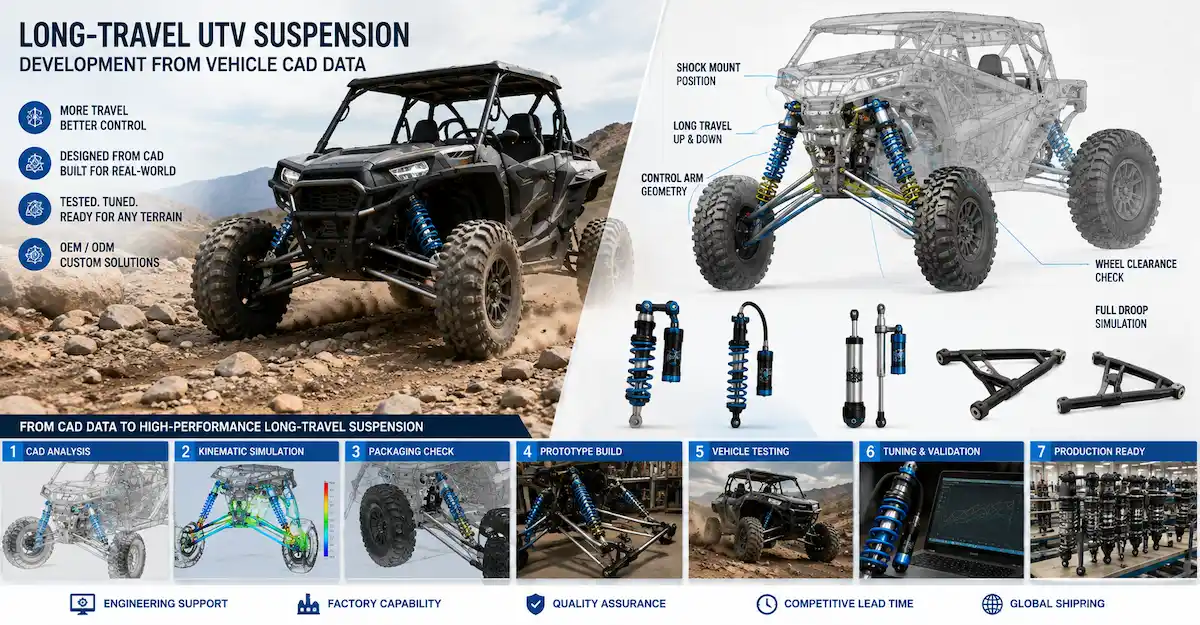
The development process includes:
Requirement Analysis → Engineering Review → Prototype → Testing → Production
Explore:
What Should OEM Buyers Ask Before Choosing a Supplier?
Before cooperation, prepare questions about:
- Factory ownership
- Production capability
- Engineering team
- Prototype support
- Quality control
- OEM experience
- Testing methods
- Production capacity
- Lead time
- Customization ability
A professional supplier should provide clear answers and technical support.
FAQ
How can I verify whether a China shock absorber supplier is a real factory?
Check factory location, production equipment, engineering capability, manufacturing process, quality control, and OEM experience.
What is the difference between a factory and a trading company?
A factory directly controls production and engineering, while a trading company usually depends on external manufacturers.
Should I visit a China shock absorber factory before ordering?
For large OEM projects, factory visits or online audits can help confirm production capability.
How do I check whether a supplier has real production equipment?
Request factory videos, equipment photos, production demonstrations, or third-party inspections.
Can a trading company support OEM shock absorber development?
Some trading companies can support projects, but direct factory cooperation usually provides better technical communication and production control.
What questions should I ask a shock absorber supplier?
Ask about manufacturing capability, OEM experience, prototype support, testing methods, and quality management.
How do I verify a supplier’s engineering capability?
Evaluate their ability to review drawings, work with CAD files, develop prototypes, and provide technical recommendations.
What documents should a real shock absorber factory provide?
Useful documents include company information, factory details, product specifications, quality records, and inspection information.
Why is factory verification important for OEM projects?
It reduces risks related to quality problems, delivery delays, communication issues, and unstable supply.
How can I test a supplier before mass production?
Start with prototype development or trial orders before moving to larger production quantities.
Conclusion
Verifying a China shock absorber supplier before OEM cooperation is an important step in reducing development and production risks.
A reliable manufacturing partner should demonstrate:
Factory Capability + Engineering Ability + Production Control + OEM Experience
The best supplier-selection process is:
Supplier Search → Factory Verification → Prototype Development → Testing → Mass Production
For ATV, UTV, and specialty vehicle projects, choosing a real suspension manufacturer with engineering capability helps ensure better product quality, smoother communication, and long-term supply reliability.
Bedo Auto supports OEM suspension projects through shock absorber customization, engineering development, prototype production, testing support, and manufacturing solutions.