
For many distributors and private-label brands, the answer is yes.
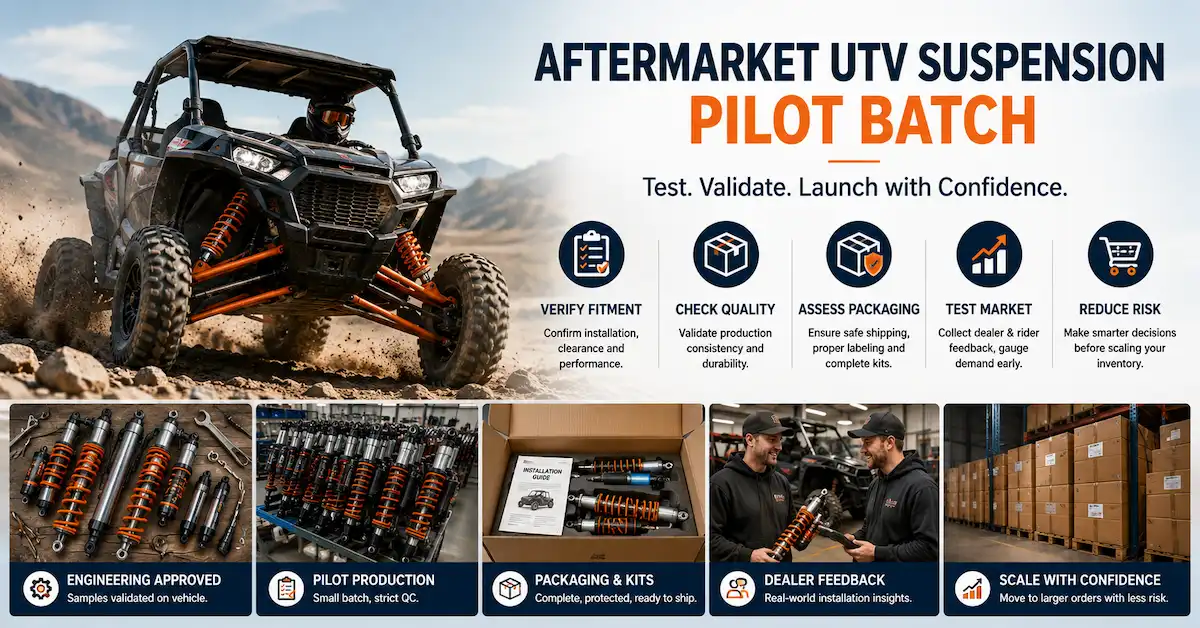
An aftermarket UTV suspension pilot batch creates a controlled step between approving a few engineering samples and placing a much larger commercial order.
That step matters because a prototype and a sellable product are not exactly the same thing.
A prototype can prove that a shock fits a vehicle and that the spring and damping direction are acceptable. A pilot batch asks a broader question:
Can the complete product be produced, packed, installed, sold, documented, and supported consistently?
That includes more than suspension performance.
It can expose issues involving:
- Production variation
- Mounting hardware
- Left/right identification
- Packaging protection
- Labels and barcodes
- Installation instructions
- Dealer questions
- Vehicle fitment
- Customer expectations
- Inventory planning
- Replacement-part support
For an aftermarket brand, those details affect launch risk just as much as the shock itself.
What Is a UTV Suspension Pilot Batch?
A pilot batch is a limited production run made after the main prototype specification has been approved but before the buyer commits to broader inventory.
It is different from both a prototype and full production.
| Stage | Main Question |
|---|---|
| Engineering prototype | Does the suspension design work? |
| Confirmation sample | Did the revision solve the identified issues? |
| Pilot batch | Can the complete product be produced and launched consistently? |
| Larger production order | Can the approved commercial specification be scaled? |
The exact size of a pilot batch should depend on the project.
There is no universal quantity that fits every aftermarket suspension launch.
A distributor launching one shock kit for one vehicle platform has different needs from a brand preparing several front/rear configurations across multiple models.
The better question is:
What quantity is large enough to expose commercial and production issues without creating unnecessary inventory risk?
A Pilot Batch Should Not Replace Prototype Testing
Do not use a pilot batch to discover basic suspension engineering problems that should have been resolved earlier.
Before a pilot order, the buyer should already have reasonable confidence in:
- Shock dimensions
- Mounting
- Spring specification
- Ride height
- Shock stroke
- Bump and droop compatibility
- Basic damping direction
- Vehicle behavior
- Reservoir or hose packaging where relevant
If those fundamentals are still uncertain, continue prototype development.
The previous guide on UTV suspension prototype testing explains how fitment, sag, bump, droop, load, terrain, damping, and revisions should be checked before production approval.
A useful sequence is:
Prototype → Vehicle Test → Revision → Confirmation → Pilot Batch → Commercial Validation → Larger Order
A pilot batch works best when engineering risk has already been reduced.
Why Is a Pilot Batch Useful for Aftermarket UTV Suspension?
Aftermarket buyers face a problem that OEM vehicle manufacturers do not always face in the same way.
The product has to work outside your own development workshop.
It may be installed by:
- Dealers
- Independent workshops
- Distributors
- End customers
- Rental operators
- Off-road accessory shops
Those installers may have different tools, skill levels, vehicle conditions, and expectations.
A product that seemed straightforward to your engineering team may generate unexpected questions in the market.
A small commercial run lets you see those questions before they affect a much larger quantity of stock.
What Risks Can an Aftermarket UTV Suspension Pilot Batch Reduce?
A good pilot batch can help reduce several types of launch risk.
Fitment Risk
A suspension may have been developed using one vehicle.
The aftermarket may contain vehicles with:
- Production-year differences
- Trim differences
- Different wheels and tires
- Added accessories
- Previous modifications
- Different original suspension variants
The pilot stage can help confirm whether the fitment description is accurate enough.
Do not broaden compatibility claims simply because two vehicles look similar.
Production-Consistency Risk
One prototype does not show batch consistency.
A pilot run lets the buyer compare multiple production-intent units.
Check whether the parts remain consistent in:
- Dimensions
- Mounting hardware
- Springs
- External finish
- Reservoir position
- Hose orientation
- Labeling
- Packaging
The objective is not to find tiny cosmetic differences that have no functional consequence.
The objective is to confirm that the product being delivered matches the approved specification.
Packaging Risk
Suspension products are relatively heavy and contain components that can be damaged by poor internal packaging.
A pilot shipment can reveal:
- Shock-to-shock contact
- Scratched springs
- Damaged adjusters
- Bent packaging inserts
- Loose hardware
- Missing accessory bags
- Weak outer cartons
- Confusing kit organization
Packaging should be evaluated after actual transport, not only when the box leaves the factory.
Installation Risk
The supplier and product developer already know how the kit works.
A first-time installer does not.
Pilot users may reveal problems such as:
- Instructions are unclear
- Front and rear components are easy to confuse
- Hardware identification is poor
- Adjustment baseline is not explained
- Reservoir mounting is unclear
- Hose routing is ambiguous
- Required original hardware is not identified
That feedback can improve the launch package.
Inventory Risk
A larger order ties up more capital.
If the market response is weaker than expected, the buyer can be left holding suspension stock for a vehicle platform that moves slowly.
A pilot launch gives purchasing teams early information about:
- Actual sell-through
- Dealer interest
- Customer questions
- Product positioning
- Price resistance
- Popular vehicle fitments
It does not guarantee future demand, but it gives you more evidence than a forecast alone.
Who Should Strongly Consider a Pilot Batch?
A pilot batch is particularly useful for several buyer types.
New Aftermarket Suspension Brands
If this is your first UTV suspension launch, you are testing more than the product.
You are also testing:
- Supplier communication
- Packaging
- Logistics
- Instructions
- Dealer response
- Warranty workflow
- Reordering
A large opening order increases exposure across all of those areas.
Existing Distributors Entering a New UTV Category
An automotive or powersports distributor may already understand inventory and dealers but still be new to UTV suspension.
A pilot can help determine which questions dealers actually ask.
Private-Label Buyers
Private-label products add another layer of details:
- Branding
- Labels
- Packaging
- Product names
- Part numbers
- Manuals
- Barcodes
The pilot run can confirm that the branding system works before a larger production release.
Buyers Launching a New Vehicle Fitment
Even an experienced suspension company can benefit from a smaller run when the product targets a new UTV platform.
The vehicle application is new.
That makes market fitment feedback more valuable.
When Might a Separate Pilot Batch Be Less Necessary?
Not every reorder needs a new pilot stage.
If the buyer is purchasing an unchanged product with:
- An established production specification
- Proven fitment
- Previous commercial sales
- Stable packaging
- Stable supplier process
- No significant component change
then another pilot may add little value.
Likewise, a minor packaging-text correction does not necessarily require the same technical validation as a change to spring rate, shock length, damping, or mounting hardware.
Pilot planning should be proportional to the change.
What Should Be Frozen Before the Pilot Batch?
A pilot order should not begin with an unstable product specification.
Before release, document what is supposed to be produced.
That may include:
- Product part number
- Drawing revision
- Front/rear designation
- Extended length
- Compressed length
- Shock stroke
- Mount dimensions
- Spring specification
- Preload baseline
- Damping specification
- Adjustment baseline where relevant
- Reservoir configuration
- Hose configuration
- Finish
- Included hardware
- Labeling
- Packaging
- Installation material
The buyer and supplier should be discussing the same version.
If the sample approved during vehicle testing is Revision C, the purchase order should not leave the production version ambiguous.
How Should I Inspect a Pilot Batch?
Do not inspect only one box.
The purpose of the pilot is to understand the run as a small batch.
A practical review can cover several layers.
Product Identification
Confirm:
- Correct SKU
- Correct front/rear kit
- Correct branding
- Correct revision
Dimensions
Compare production-intent parts against the approved specification.
Relevant measurements depend on the design but may include:
- Extended length
- Mounting dimensions
- Bushing dimensions
- Hardware dimensions
Spring and Shock Configuration
Check whether the correct:
- Spring
- Preload reference
- Shock body
- Adjuster
- Reservoir
- Hose configuration
has been supplied.
Assembly and External Condition
Inspect for:
- Visible damage
- Leaks
- Loose components
- Damaged threads
- Finish issues that affect acceptability
- Incorrect assembly orientation
Packaging
Confirm every kit contains the required:
- Shocks
- Springs where separate
- Mounting hardware
- Brackets
- Instructions
- Labels
- Accessory items
The exact checklist should come from the approved product configuration.
Should I Vehicle-Test Parts From the Pilot Batch?
For a new product launch, it can be useful to install production-intent units rather than assuming that approval of the earlier engineering prototype is enough.
The goal is not necessarily to repeat every development test from the beginning.
It is to confirm that the production-intent product still represents what was approved.
Potential checks include:
- Installation
- Ride height
- Basic road or terrain behavior
- Adjustment function
- Clearance
- Noise
- Hardware compatibility
If the pilot units differ materially from the prototype specification, investigate before launch.
Do not solve the problem by quietly changing the website description.
Should Dealers Test the Pilot Batch?
Selected dealers can be valuable pilot users because they see the product differently from the manufacturer.
They may notice:
- Difficult installation steps
- Missing hardware
- Confusing instructions
- Vehicle-year questions
- Customer objections
- Adjustment questions
Ask for structured feedback rather than:
“Did you like the shocks?”
Better questions include:
- Which vehicle and year did you install them on?
- Did every mounting point fit correctly?
- Was any additional hardware required?
- Was the installation guide clear?
- Were the baseline settings understandable?
- Did anything contact the chassis or tire?
- What questions did the customer ask?
- Was the packaging easy to identify and handle?
This turns dealer feedback into useful launch data.
What Should I Learn About Market Demand?
A pilot launch can provide an early commercial signal.
Track:
- Number of dealer inquiries
- Number of actual orders
- Which fitment receives interest
- Time to sell initial inventory
- Questions before purchase
- Reasons buyers decline
- Requests for alternative spring or shock configurations
- Repeat dealer demand
Do not treat a small pilot as statistically perfect market research.
But it can reveal obvious mismatches between your original assumptions and buyer behavior.
For example, you may expect customers to care primarily about adjustability while dealers repeatedly ask about load support.
That insight may change how the product page should be positioned.
Pilot Batch vs Large First Order
| Decision Factor | Pilot Batch | Large Initial Order |
|---|---|---|
| Inventory exposure | Lower | Higher |
| Fitment learning | Easier to correct early | Problems affect more stock |
| Packaging revision | Easier | More costly after production |
| Dealer feedback | Can influence next order | Often arrives after inventory is committed |
| Supplier-process validation | Useful | Higher consequence if inconsistent |
| Unit economics | May be less favorable | Can improve with scale |
| Launch speed | May add one stage | Can move directly to larger stock |
| Commercial risk | More controlled | Higher commitment |
A pilot is therefore not simply an extra purchase step.
It is a risk-management decision.
Does a Pilot Batch Always Cost More Per Unit?
It can.
Smaller runs may not have the same production economics as larger orders.
But unit price should not be the only calculation.
Consider the cost of discovering a problem after a large order:
- Repackaging
- Rework
- Replacement hardware
- International return freight
- Dealer complaints
- Customer support
- Unsold inventory
- Brand damage
- Delayed launch
A slightly higher pilot-unit cost can still make commercial sense if it helps prevent a much larger correction.
The procurement question should be:
What is the cost of learning now compared with the cost of correcting later?
What Should Be Different Between Prototype and Pilot Packaging?
Prototype packaging only needs to protect development samples adequately.
Retail or distributor packaging may need to do more.
Depending on the sales model, the pilot can validate:
- Outer carton strength
- Internal protection
- Part separation
- Hardware bags
- SKU labels
- Front/rear identification
- Barcode placement
- Installation guide
- Adjustment guide
- Dealer information
Avoid adding unsupported technical claims simply because the packaging needs more marketing content.
Anything printed on the box can become part of the buyer's expectation.
Should I Launch the Pilot Batch Online?
A controlled launch can be useful if your goal is to observe real purchasing behavior.
You can limit the first release to:
- Selected dealers
- Existing customers
- One marketplace
- One geographic market
- One fitment group
The best approach depends on your distribution model.
The key is to make the pilot measurable.
Know:
- Where the units went
- Which vehicle they were installed on
- Whether they sold
- What questions appeared
- Whether returns occurred
- Why returns occurred
A pilot batch with no feedback loop is simply a small order.
How Should Returns Be Analyzed?
Do not record only “customer returned item.”
Separate reasons.
Possible categories include:
- Wrong vehicle fitment selected
- Installation difficulty
- Missing hardware
- Packaging damage
- Noise
- Ride preference
- Spring/load mismatch
- Customer expectation mismatch
- Cosmetic concern
- Unrelated vehicle issue
That distinction matters.
A fitment-description problem may require a website change.
A hardware problem may require a packaging change.
A spring mismatch may require a new technical variant.
A customer who simply ordered the wrong model does not automatically indicate product failure.
What Should Trigger a Pilot-Batch Revision?
Not every comment requires redesign.
Prioritize issues based on severity and repeatability.
High-Priority Issues
Examples include:
- Incorrect fitment
- Mechanical interference
- Missing critical hardware
- Repeated leakage
- Unsafe clearance
- Wrong spring or damper specification
- Incorrect production revision
These should be resolved before scaling.
Medium-Priority Issues
Examples might include:
- Installation instructions need clarification
- Labels are confusing
- Hardware organization can improve
- Packaging protection is inadequate
These can still materially affect launch quality.
Preference Feedback
Examples include:
- Customer wants another spring option
- Dealer prefers a different finish
- Some buyers want more adjustability
These may become future variants rather than reasons to stop the existing product.
When Should I Move From Pilot Batch to Larger Production?
Do not use sales volume alone.
Before scaling, ask whether the pilot has answered the main risk questions.
A practical release review can include:
| Area | Question |
|---|---|
| Fitment | Did the intended vehicles install correctly? |
| Suspension | Did production-intent parts behave as expected? |
| Quality | Was the batch consistent with the approved specification? |
| Packaging | Did the product arrive protected and complete? |
| Installation | Could dealers/customers install it without recurring confusion? |
| Market | Is there enough evidence of demand to justify more stock? |
| Returns | Are any repeated technical issues unresolved? |
| Supplier | Were revisions, labeling, packaging and communication controlled? |
| Documentation | Is the final commercial specification clear? |
If major unresolved technical problems remain, increasing the order quantity simply increases exposure.
Should I Pilot Every Suspension Variant?
If several variants differ meaningfully in engineering, do not assume that validation of one automatically proves all others.
Examples include:
- Different spring rates
- Different shock lengths
- Two-seat vs four-seat versions
- Utility vs recreational tuning
- Standard vs remote-reservoir version
- Different mounting configurations
The extent of pilot validation should reflect how different the products actually are.
If only the packaging language changes, extensive suspension re-testing may not be necessary.
If the spring, damping, stroke, or fitment changes, the technical risk is different.
How Does a Pilot Batch Help a Private-Label Brand?
Private-label buyers carry an additional reputation risk.
The customer sees your name, not the supplier's.
Before scaling, check:
- Logo accuracy
- SKU structure
- Box labeling
- Product labels
- Manuals
- Warranty/contact information
- Included components
- Retail presentation
A private-label launch should be treated as a complete product system.
The shock itself can be correct while the commercial package remains unfinished.
What Should I Send the Supplier Before Ordering a Pilot Batch?
A strong pilot RFQ should clearly state what has already been approved and what the pilot needs to confirm.
Include:
Product Information
- Approved prototype revision
- Product drawing or specification
- Vehicle application
- Front/rear configuration
- Spring specification
- Damping configuration
- Adjuster or reservoir requirements
Pilot Objectives
Explain what you want to validate,such as:
- Production consistency
- Dealer installation
- Packaging
- Private-label branding
- Fitment
- Market response
Commercial Requirements
Provide:
- Pilot quantity
- Number of SKUs
- Packaging requirements
- Branding
- Labeling
- Destination market
- Expected future volume
Inspection Requirements
Tell the supplier which items need to be checked before shipment.
Do not wait until the goods are finished to define what is important.
A Better Pilot-Batch RFQ
Instead of:
“Please quote 50 UTV shocks with our logo.”
send something more useful:
“We have completed prototype testing for our aftermarket rear UTV shock kit and want to discuss a pilot production batch before the wider launch. The approved drawing and spring/damping specification are available. The pilot should validate production consistency, packaging, private-label identification, dealer installation and vehicle fitment. Please confirm what production and QC information you need from us before quotation.”
That tells the supplier that this is not merely a price inquiry.
It is a controlled commercial-launch stage.
How Can Bedo Auto Support an Aftermarket UTV Suspension Project?
If you are preparing an aftermarket UTV suspension pilot batch, organize the project around the approved vehicle and shock specification first.
Before pilot production, buyers can review the UTV suspension customization requirements to confirm that vehicle, load, dimension, CAD, terrain and performance information has been properly defined.
If the suspension is still at sample stage, complete UTV suspension prototype testing before moving into a commercial pilot run.
Distributors and private-label buyers can also review the aftermarket UTV suspension supplier guide when evaluating sourcing, fitment, repeat orders and supplier cooperation.
For an active project, the Bedo Auto contact page can be used to submit your vehicle application, approved suspension specification, pilot requirements, branding and expected production volume for project-specific discussion.
FAQ
Should I order a pilot batch before launching aftermarket UTV suspension?
For a new product, fitment, supplier, or private-label program, an aftermarket UTV suspension pilot batch can be a useful way to validate production consistency, packaging, installation, fitment and early commercial response before committing to more inventory.
What is the difference between a prototype and a pilot batch?
A prototype validates the design. A pilot batch evaluates whether the approved design can be produced and introduced commercially in a controlled small run.
How large should a UTV suspension pilot batch be?
There is no universal quantity. The batch should be large enough to cover the key fitments, channels and commercial questions you need to validate without creating unnecessary inventory exposure.
Should the pilot batch use the final packaging?
Preferably, use production-intent packaging when packaging is one of the launch variables you need to validate. This can reveal protection, labeling and kit-organization problems before scale-up.
Do I need to test pilot-batch shocks on vehicles again?
For a new launch, confirming production-intent parts on representative vehicles can help verify that the commercial units remain consistent with the approved prototype.
Can dealers participate in the pilot launch?
Yes. Selected dealers can provide useful feedback on installation, fitment questions, packaging, instructions and customer objections.
What should I inspect in a UTV suspension pilot batch?
Check product identification, key dimensions, spring and shock configuration, hardware, external condition, packaging, labels, instructions and consistency with the approved specification.
Should I order a large batch if the prototype performed well?
Prototype performance is important but does not automatically validate packaging, production consistency, market demand or dealer installation. The decision depends on your risk tolerance and how proven the product and supplier already are.
What feedback should I collect after the pilot launch?
Collect vehicle fitment, installation, dealer questions, customer feedback, returns, packaging issues, sales response and any repeated technical concerns.
When is the product ready for a larger production order?
Scale when the major fitment, technical, production, packaging and commercial risks identified for the pilot have been resolved and the approved production specification is clearly documented.
Conclusion
An aftermarket UTV suspension pilot batch is not necessary because small orders are inherently better.
Its value comes from what you learn before committing to scale.
A well-managed launch sequence looks like this:
Prototype → Testing → Technical Approval → Pilot Production → Fitment Check → Packaging Check → Dealer Feedback → Market Feedback → Revision → Larger Production
For a distributor or private-label brand, this creates a practical checkpoint between engineering confidence and commercial commitment.
If the suspension is still changing technically, stay in prototype development.
If the product is technically approved but the production process, packaging, dealer installation, or market response is still unproven, a pilot batch can provide useful evidence.
And if the product, supplier, fitment and commercial process are already well established, the need for another pilot becomes much smaller.
The important point is not to add another step automatically.
It is to decide what risks are still unknown.
Then size the pilot around those questions.
That makes the first commercial order more than inventory. It turns it into a controlled validation stage before your aftermarket UTV suspension launch is scaled.