
How should a buyer build a UTV suspension parts kit for different loads?
Direct answer: build a UTV suspension parts kit around a defined vehicle, load profile, suspension position, and approved bill of materials. Start by separating empty, normal passenger, cargo, towing, and accessory conditions. Then map the shock absorbers, springs, mounts, bushings, sleeves, spacers, hardware, and packaging that belong to each configuration. A kit is ready for quotation when the interfaces, spring support, damping target, fitment limits, validation route, and quantity stages are clear.
The correct kit is not the largest list of parts. It is the smallest controlled combination that solves a defined use case and can be installed, identified, tested, reordered, and supported. This guide gives OEM buyers, distributors, modification brands, and fleet operators a way to plan UTV suspension parts without mixing incompatible revisions or assuming that one heavy-duty component covers every payload.
UTV buyers often search for “UTV suspension parts” when they actually need one of several different outcomes: a replacement kit, a cargo-load package, a passenger-comfort setup, a lift or tire modification, a private-label product line, or a complete OEM suspension BOM. The procurement work changes with the outcome. A catalog definition may be enough for a replacement part; a load-specific kit needs vehicle data and validation.
Define the kit's job before naming its parts
A kit should be described by its intended use, not only by the components inside the carton. “Heavy-duty UTV kit” is incomplete without the load, terrain, duty cycle, and vehicle condition. “Passenger kit” needs the number and position of occupants and the expected cargo. “Lift kit shock” needs the modified geometry and travel boundaries. The kit name should help the channel identify the approved application and the limits of the product.
| Kit objective | Typical buyer | Key engineering question | Evidence before release |
|---|---|---|---|
| Replacement kit | Distributor, repair shop, fleet service. | Does the part match the exact vehicle and position? | Model/year, position, dimensions, hardware, sample fitment. |
| Passenger-load kit | Vehicle brand, dealer, recreation distributor. | Does it preserve ride height and control with passengers? | Passenger states, axle/corner loads, spring and damping validation. |
| Cargo or utility kit | Fleet, farm, industrial, commercial operator. | Does it support repeated cargo without using all travel? | Cargo location, duty cycle, spring support, repeated-use inspection. |
| Modified-vehicle kit | Modification shop, aftermarket brand. | Does it work with lift, tires, wheels, and accessories? | Modified geometry, clearance, travel, installation and field test. |
| Private-label kit | Regional wholesaler, online brand, importer. | Can the technical product be identified and replenished? | Released BOM, SKU, package, instructions, complaint process. |
| OEM platform kit | UTV manufacturer or vehicle developer. | Can every part transfer from prototype to repeat production? | Drawings, BOM, inspection, validation, change control, production records. |
The UTV suspension parts FAQ covers broad buyer questions. This article narrows the intent to kit architecture: how to turn a broad parts search into a defined package for a load profile and purchasing program.
Map the UTV load profiles that the kit must cover
A UTV can change significantly between curb, one driver, full passengers, cargo, towing, and accessory conditions. Record the mass and location of the change rather than relying on a maximum payload number. A rear cargo box, roof, winch, plow, spare tire, battery, tool cabinet, or enclosure can move the center of mass and alter front/rear or left/right loading.
Empty and curb condition
Record the vehicle as delivered with production tires, wheels, fluids or battery, and standard equipment. Measure ride height, sag, axle loads, and available travel. This establishes a baseline for a replacement or upgrade but should not be the only condition used for a commercial kit.
Normal operating condition
Define the configuration that represents most customer use. Include the normal driver or operators, passengers, daily cargo, tools, and accessories. For a fleet or utility program, this condition may be more important than the maximum condition because it drives most ride and handling decisions.
Maximum routine condition
Define the highest load that will occur regularly, where it is carried, how often it occurs, and the terrain or speed associated with it. Do not confuse an emergency transport limit with a normal calibration target. A suspension kit does not increase the approved payload of the chassis, axles, tires, brakes, or frame.
Special or seasonal condition
Snow equipment, spraying systems, racks, cabs, winches, batteries, and rear seats may be seasonal or optional. If the load difference is large, choose between an adjustable setup, a different spring, or separate kit SKUs. Record the condition in the package and product description so the customer does not assume universal coverage.
| Load-state record | Minimum data | Effect on UTV suspension parts |
|---|---|---|
| Front and rear axle load | Measured or clearly marked estimated value. | Determines spring support and front/rear balance. |
| Corner load | Left/right values where possible. | Reveals uneven accessory mass or side-to-side setup. |
| Passengers | Number, assumed mass, seating position. | Changes pitch, sag, and ride-height demand. |
| Cargo | Mass, location, frequency, and restraint. | Controls rear spring, available bump travel, and stability. |
| Towing | Tongue load, attachment, route, and frequency. | Creates sustained rear load and pitch effects. |
| Duty cycle | Hours, surface, speed, impacts, cleaning, and environment. | Sets the durability and heat context for shocks and hardware. |
Build the UTV suspension parts BOM
The kit BOM should be readable by engineering, purchasing, quality, warehouse, installer, and customer service. List the parent assembly and every item that affects fitment, load path, movement, service, or identification. Do not treat the hardware as an afterthought; a sleeve or spacer can determine whether the shock is aligned and whether the customer can install it.
| BOM group | Fields to control | Common purchasing mistake |
|---|---|---|
| Shock absorber | Position, lengths, stroke, body, mount, spring seat, reservoir, adjustment, damping revision. | Ordering by model name or length without the mount and revision. |
| Suspension spring | Rate/load points, free length, wire/coil geometry, preload, seat, finish, tolerance. | Substituting a similar spring to meet quantity or appearance. |
| Bushing and sleeve | Hole, installed width, outer diameter, compression, articulation, material and hardness requirement. | Using a sleeve that fits the bolt but not the bracket stack. |
| Spacers and washers | Thickness, stack order, contact face, chamfer, quantity, left/right identity. | Leaving installation-critical spacers to the installer. |
| Bracket or adapter | Offset, holes, angle, load path, material/process proposal, finish, clearance. | Copying a visual bracket without full-travel review. |
| Fasteners | Size, grade or requirement, coating, pack quantity, torque responsibility. | Assuming the original vehicle bolt is always included or compatible. |
| Packaging and instructions | Part number, application, position, hardware, language, barcode, revision. | Packaging a technically correct part with the wrong fitment claim. |
Give the BOM a product-line status: quoted, sample, fitted, validated, pilot, released, or replenishment. Link the kit to the vehicle and load profile. If the same shock body is used across two kits but the spring, hardware, or package differs, record the common and unique lines explicitly.
Compare public UTV shock references without treating them as a kit
BEDO's public ATV/UTV shock pages provide a concrete example of why a kit needs a controlled BOM. The following values are published reference fields for two rear configurations, not a universal UTV suspension parts package. They are useful for initial comparison and RFQ discussion.
| Reference field | AU_HSA_02 public listing | AU_HSA_04 public listing | What the kit buyer must still confirm |
|---|---|---|---|
| Application shown | Rear ATV/UTV reference | Rear beach ATV/UTV reference | Actual vehicle, position, model year, and load profile. |
| Total length / stroke | 395 mm / 80 mm | 345 mm / 80 mm | Compressed length, motion ratio, bump stop, and clearance. |
| Spring rate | 250 LBS | 225 LBS | Spring convention, tolerance, preload, and application load. |
| Rebound / compression | 3000 N / 550 N | 3000 N / 350 N | Speed, temperature, setting, tolerance, and target behavior. |
| Mounting holes | 12 mm upper/lower | 10 mm upper/lower | Fastener, sleeve, bushing, width, offset, and articulation. |
| Mounting widths | 40 mm upper / 32 mm lower | 32 mm upper / 30 mm lower | Vehicle bracket, stack order, hardware, and package contents. |
| Damping | Fixed damping listed | Fixed damping listed | Whether fixed damping suits the kit's load and terrain range. |
The AU_HSA_02 product page and related public reference show why two visually similar rear shocks cannot be merged into one kit by category. The different length, spring, damping, hole, and width fields need different fitment rows or an engineering justification for commonality.
Public-data boundary: the reference values above come from public BEDO product content. They do not prove a UTV payload rating, durability result, universal fitment, current revision, MOQ, lead time, packaging, or certification. Confirm those fields for the requested kit before making a commercial claim.
Choose a kit structure: replacement, upgrade, or platform family
A product manager should decide how the kit will be sold and supported before finalizing the BOM. A replacement kit aims to restore an approved vehicle condition. An upgrade kit changes a defined aspect such as load support, travel, or adjustment. A platform family uses controlled common and unique components across several applications. Each structure needs different labels and validation.
| Kit structure | Best fit | Key control | Risk if mixed |
|---|---|---|---|
| Vehicle-specific replacement | Repair channel and direct-fit distribution. | Model/year/position and exact hardware. | Incorrect vehicle claims and returns. |
| Load-specific upgrade | Cargo, passenger, fleet, or accessory use. | Load state, spring, damping, travel, and stated limit. | “Heavy duty” becomes an unbounded promise. |
| Modification package | Lift, tire, wheel, or geometry changes. | Modified hard points, clearance, bump/droop, and installation method. | Static fit but poor dynamic travel or interference. |
| Platform family | OEM or distributor portfolio. | Commonality matrix, SKU revision, and release status. | One successful SKU is incorrectly extended to others. |
| Service kit | Replacement bushings, sleeves, spacers, or hardware. | Parent-shock revision and compatible contents. | Similar-looking parts are mixed across generations. |
Validate the kit as an installed system
Static installation review
Check the shock, spring, mounts, bushings, sleeves, spacers, brackets, and fasteners on the actual UTV. Verify orientation, alignment, hardware engagement, ride height, sag, tire and body clearance, steering, full bump, full droop, articulation, reservoir position, and service access. Record the vehicle revision and accessories.
Load-state review
Repeat the critical checks with empty, normal, cargo, passenger, and special accessory loads. Measure front and rear ride height and available travel. Observe whether the spring stays seated, the shock reaches an unintended hard stop, or a bracket or hose moves into contact.
Dynamic review
Use representative surfaces, speeds, turns, braking, acceleration, slopes, repeated bumps, and cargo conditions. Record the spring and damping configuration, tire pressure, driver, load, temperature, and route. Separate fitment problems from performance complaints and installation issues.
Pilot repeatability
Compare multiple pilot units for length, mount, spring, damping, leakage, appearance, hardware, label, and package. A single handmade sample can prove a concept but not production consistency. Link each result to the same drawing, BOM, and revision that purchasing will use.
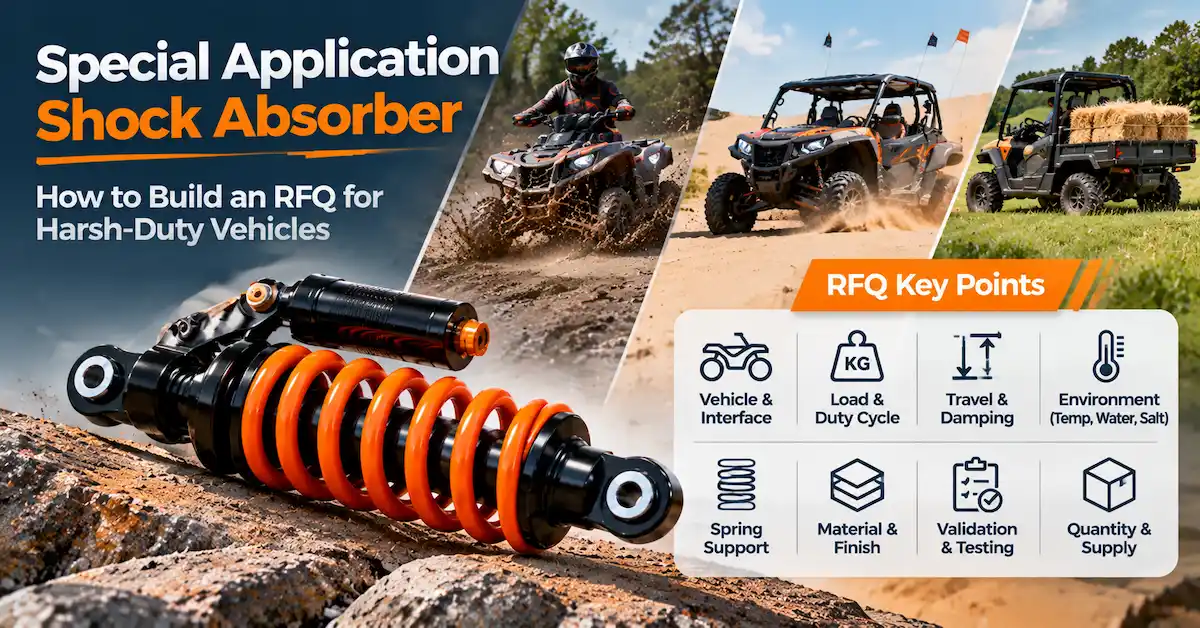
Prepare a UTV suspension parts RFQ
| RFQ section | Buyer input | Supplier response |
|---|---|---|
| Vehicle | Make, model, year, market, position, platform revision, stock/modified state. | Existing, adaptable, or new-development classification. |
| Load and duty | Passengers, cargo, towing, accessories, axle/corner loads, terrain, speed, hours. | Spring/damping basis and open assumptions. |
| Parts scope | Shock, spring, bushing, sleeve, spacer, bracket, fastener, package, instructions. | Proposed BOM, common/unique items, and compatibility risks. |
| Geometry | Lengths, stroke, mounts, width, holes, angle, motion ratio, clearance. | Drawing/CAD review and measurement gaps. |
| Validation | Fitment, load, performance, durability, inspection, and acceptance criteria. | Sample and pilot plan, records, and responsibility. |
| Commercial | Sample/pilot/production quantities, forecast, branding, package, destination. | Stage cost, MOQ, lead time basis, packaging, change terms. |
Use the UTV suspension customization data guide to prepare vehicle inputs. Send the finished package through the official BEDO contact page and ask for a row-by-row response. This makes it possible to compare suppliers on technical scope and evidence rather than only on a unit price.
Decide which UTV parts can be shared across a kit family
A UTV product line can share some components, but commonality must follow evidence. A common shock body may still need a different spring, mount, damping setting, hardware set, or package. A common spring may suit two curb configurations but not the same passenger and cargo load. A shared part number can simplify purchasing while creating service and fitment risk if the application boundary is not explicit.
| Potentially shared item | Conditions to compare | Release decision |
|---|---|---|
| Shock body | Envelope, travel, pressure, heat, mount, load path, service, and clearance. | Share only when the complete assembly remains suitable for each application. |
| Spring | Axle/corner load, motion ratio, ride height, preload, seat, payload, and fatigue use. | Use one spring only when the load and setup range are supported. |
| Mount hardware | Hole, width, sleeve, bushing, offset, articulation, bolt, and bracket. | Keep separate lines when any interface or load direction differs. |
| Reservoir bracket | Vehicle hard points, hose route, movement, heat, impact, and service access. | Share only after packaging review through full travel. |
| Packaging | Contents, position, fitment, language, label, barcode, and market claims. | Share artwork only when the technical and application identity is shared. |
| Service kit | Parent revision, bushing/sleeve dimensions, hardware, and instructions. | Link every kit to the compatible shock revision. |
Record shared components and unique components in the master BOM. If a change affects a shared item, review every affected SKU before approval. This is the practical difference between a family architecture and a collection of visually similar UTV suspension parts.
Control cost, MOQ, and launch timing by kit stage
The commercial basis changes as the kit moves from feasibility to repeat production. Engineering review, sample work, custom springs, special mounts, fixtures, packaging, testing, and low-volume setup may be separate from the finished unit price. A buyer should request a staged quotation rather than ask for one universal MOQ or one delivery date.
| Stage | Buyer decision | Commercial question |
|---|---|---|
| Feasibility | Is the application and parts scope understandable? | What information review and assumptions are included? |
| Sample | Can the proposed kit fit and answer the engineering question? | What is included in the sample, and which items remain provisional? |
| Pilot | Can several kits be produced and installed consistently? | Which drawing, BOM, inspection, and package definition controls the pilot? |
| Market test | Can the channel sell and support the defined application? | What label, instructions, returns, and feedback process are required? |
| Repeat production | Can the same kit be reordered by revision? | What quantities, packaging, change-notification, and lead-time basis apply? |
Ask suppliers to state when the lead-time clock starts and which approvals can stop it. A package artwork delay, missing vehicle measurement, unapproved spring, or unconfirmed hardware can affect the schedule even when the production process itself is ready. A staged forecast gives the manufacturer useful planning information without turning a preliminary estimate into a promise.
Frequently asked questions
What are UTV suspension parts?
They can include shock absorbers, springs, mounts, bushings, sleeves, spacers, brackets, fasteners, and related service or packaging items. The correct scope depends on the vehicle and kit purpose.
Can one UTV suspension parts kit fit several models?
Only when each model has verified geometry, load, travel, spring, damping, clearance, hardware, and validation evidence. Similar model names are not enough.
Does a heavier spring make a complete heavy-duty kit?
No. A kit also needs suitable damping, travel, mounts, hardware, clearance, and a stated load condition. Suspension changes do not increase the vehicle's legal or structural payload rating.
Should a kit include bushings and sleeves?
Include them whenever they control installation width, alignment, articulation, or service. List them in the BOM and package rather than leaving them as an installer assumption.
Why do public UTV shock references have different mounting widths?
Different applications use different vehicle brackets and load paths. Mounting width, hole, sleeve, and offset must be matched to the actual vehicle.
How do I compare two UTV suspension parts suppliers?
Send the same BOM and load profile, then compare proposed configuration, evidence, validation, packaging, MOQ, lead time assumptions, change control, and price scope.
What data is needed for a cargo UTV kit?
Provide cargo mass, location, frequency, axle or corner loads, passengers, terrain, speed, duty cycle, current symptom, ride-height target, and available travel.
Can BEDO supply a private-label UTV kit?
The website presents OEM, custom, and private-label-related capabilities, but the exact kit, branding, packaging, quantity, and production scope must be confirmed in a project review.
What is the difference between a sample and a pilot kit?
A sample answers an engineering question. A pilot kit tests repeatability, installation, package contents, and the released definition across more than one unit.
What should I send for a UTV suspension parts quotation?
Send vehicle, load, duty, geometry, parts scope, sample/drawing, validation, quantity, packaging, destination, forecast, and open questions. Ask the supplier to identify assumptions.
Conclusion
UTV suspension parts should be purchased as a controlled kit only after the buyer defines the use case, load profile, BOM, fitment, spring and damping target, validation route, packaging, and revision. The public BEDO references show why length, spring, damping, holes, and mounting widths must be compared together. A careful kit structure protects the installer, distributor, purchasing team, and vehicle program from mixed parts and unsupported “heavy-duty” claims.
Review the BEDO shock absorber category, prepare the UTV kit RFQ, and send it through the official contact page for project-specific product, sample, packaging, and commercial confirmation.