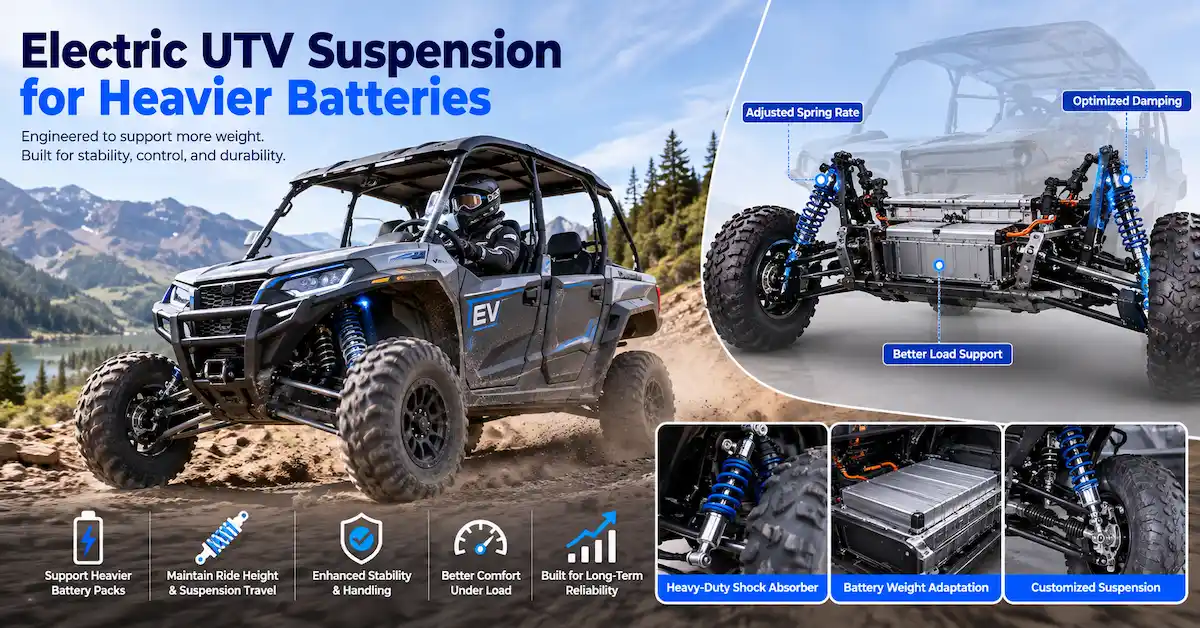

What Should a Suspension System Manufacturer Actually Provide?
A Suspension System Manufacturer should provide more than a catalog of shock absorbers and springs.
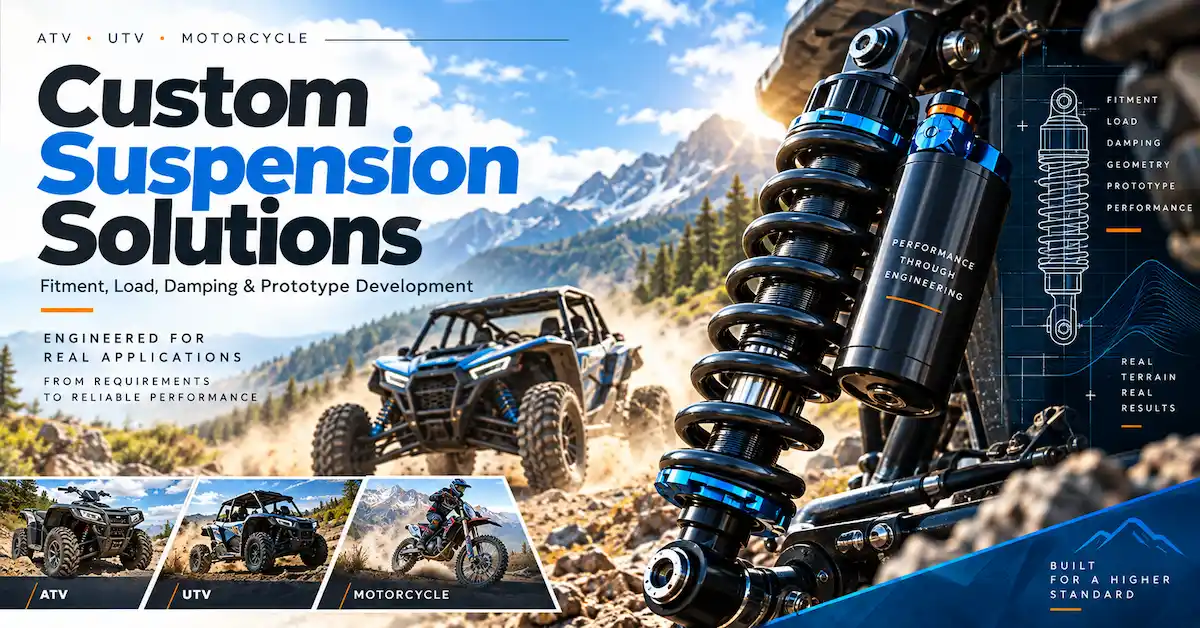
For OEM ATV, UTV, motorcycle, electric motorcycle, and specialty-vehicle projects, buyers often need a supplier that can understand the vehicle application, review technical information, develop or adapt suspension components, build prototypes, respond to testing feedback, and transfer an approved specification into repeatable production.
This distinction matters because many suspension projects do not begin with a finished part number.
They may begin with:
-
a new ATV or UTV platform;
-
an existing shock absorber that performs poorly under load;
-
a drawing or 3D CAD file;
-
a physical reference sample;
-
a modified vehicle;
-
a requirement for larger tires;
-
a private-label suspension product;
-
a vehicle with excessive sag or bottoming;
-
a need for different compression or rebound behavior.
In these situations, buying “a similar shock absorber” may solve the dimensional problem without solving the vehicle problem.
A manufacturer serving technical OEM projects should therefore connect:
Vehicle Requirement → Suspension Specification → Prototype → Validation → Production
BEDO's guide to selecting a suspension engineering partner explains this difference between simply supplying components and supporting the complete development process.
Who Is This Type of Manufacturer Best For?
Not every buyer needs a vehicle-specific suspension development program.
A standard product may be sufficient when:
-
the original configuration is unchanged;
-
the replacement specification is already confirmed;
-
vehicle weight remains within the original range;
-
mounting dimensions are known;
-
spring and damping behavior already meet the target.
A more capable suspension manufacturer becomes valuable when important requirements are still open.
ATV and UTV OEM Manufacturers
These buyers may need support with:
-
front and rear shock specifications;
-
load support;
-
suspension travel;
-
spring rate;
-
damping;
-
mounting interfaces;
-
prototype testing;
-
production validation.
Off-Road Vehicle Brands
Brands often need vehicle-specific performance rather than a generic replacement product.
Requirements may include:
-
heavy-duty suspension;
-
recreational suspension;
-
adjustable damping;
-
custom spring rates;
-
unique appearance;
-
branded packaging.
Aftermarket Suspension Brands
These buyers may need:
-
model-specific fitment;
-
performance differentiation;
-
private labeling;
-
multiple vehicle applications;
-
controlled repeat orders.
Importers and Distributors
Their main concerns may be:
-
stable quality;
-
product coverage;
-
supplier reliability;
-
packaging;
-
repeatability;
-
MOQ;
-
product documentation.
Vehicle Modification Companies
Modified vehicles may introduce:
-
larger tires;
-
different ride height;
-
more vehicle weight;
-
cargo systems;
-
changed suspension geometry;
-
different shock mounting positions.
These changes can turn a simple replacement project into an engineering project.
Suspension Manufacturer vs Parts Supplier: What Is the Difference?
A parts supplier and an engineering-oriented manufacturer can both supply components, but they do not necessarily provide the same project value.
| Capability | Parts Supplier | Engineering-Oriented Manufacturer |
|---|---|---|
| Standard catalog products | Yes | Yes |
| Sample reproduction | Sometimes | Usually |
| Drawing review | Limited | Important |
| 3D CAD review | Limited | Project dependent |
| Vehicle application review | Limited | Essential |
| Spring development | Limited | Application based |
| Damping development | Limited | Application based |
| Prototype development | Basic | Structured |
| Testing feedback revision | Limited | Part of development |
| Small-batch validation | Not always | Often important |
| Production revision control | Basic | Essential for OEM |
| Long-term technical support | Product based | Project based |
For a straightforward replacement order, a component supplier may be enough.
For a new vehicle or custom suspension project, buyers should look for a manufacturer capable of understanding why the product needs to change, not only what dimensions need to be copied.
Start Manufacturer Selection With the Vehicle Application
Before evaluating a Suspension System Manufacturer, define the vehicle first.
Important information includes:
-
vehicle type;
-
model or project code;
-
suspension position;
-
curb weight;
-
loaded weight;
-
passenger count;
-
cargo load;
-
tire size;
-
accessories;
-
typical terrain;
-
intended use.
For example, two UTVs can use shocks of similar length while operating under completely different conditions.
One may be a light recreational vehicle.
Another may carry passengers, tools, and cargo over farm roads every day.
Their suspension requirements should not automatically be identical.
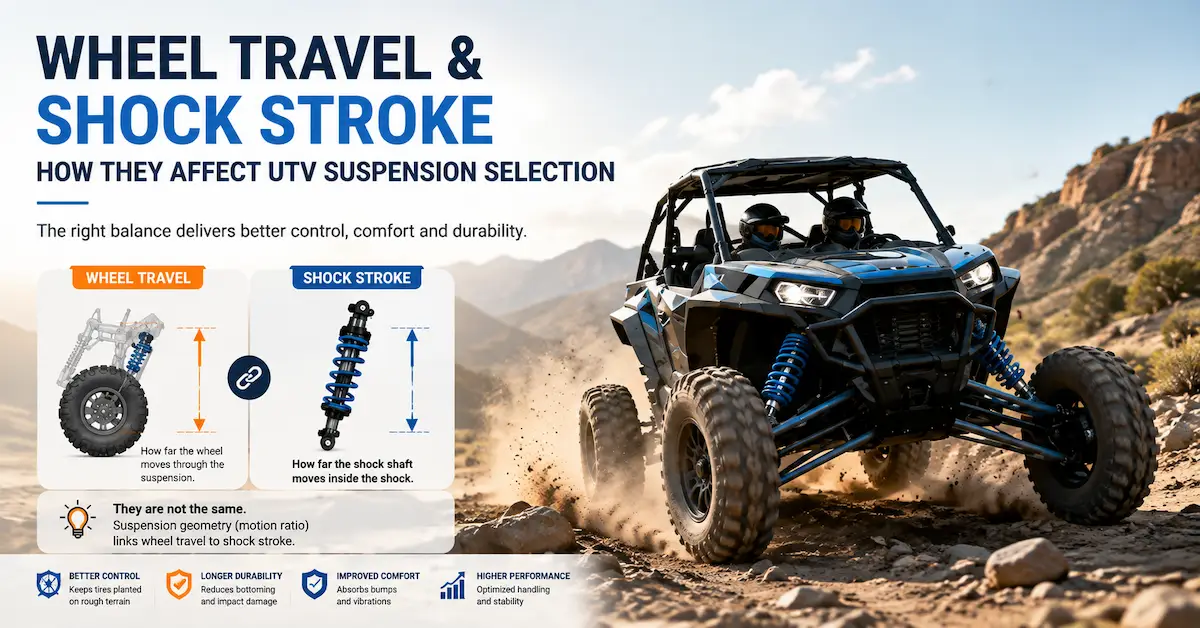
Fitment Requires More Than Shock Length
One of the most common sourcing mistakes is comparing suspension products using only overall length.
A technically complete fitment review should consider several dimensions.
| Fitment Parameter | Why It Matters |
|---|---|
| Extended length | Defines maximum shock extension |
| Compressed length | Helps prevent interference at full compression |
| Effective stroke | Determines usable damper movement |
| Upper mounting dimensions | Controls installation |
| Lower mounting dimensions | Controls installation |
| Hole diameter | Must match mounting hardware |
| Mounting width | Prevents incorrect interface fit |
| Spring envelope | Must clear surrounding components |
| Reservoir position | Requires sufficient packaging space |
| Body clearance | Prevents interference during suspension movement |
For OEM development, these values should be controlled using drawings, samples, CAD, or verified vehicle measurements.
BEDO's drawing-based suspension development guide discusses why engineering drawings should be reviewed together with vehicle application, load, mounting, spring, and damping requirements rather than treated as isolated dimensions.
Spring Rate and Damping Should Be Evaluated Separately
Professional suspension sourcing requires a basic distinction between load support and motion control.
Spring Rate
The spring supports vehicle weight and influences:
-
ride height;
-
sag;
-
available travel;
-
load capacity;
-
suspension response.
A UTV carrying passengers and cargo may need a different spring solution from the same vehicle operating almost empty.
Compression Damping
Compression damping controls shock movement as the suspension compresses.
It affects how the vehicle responds to:
-
bumps;
-
terrain impacts;
-
rapid load transfer;
-
larger compression events.
Rebound Damping
Rebound damping controls extension after the shock has compressed.
Too little rebound control can allow repeated bouncing.
Too much rebound resistance can prevent the wheel from recovering fast enough between repeated terrain inputs.
A manufacturer should therefore avoid reducing suspension development to statements such as:
“We will make the shock harder.”
A better engineering discussion asks whether the problem comes from:
-
insufficient spring support;
-
excessive compression movement;
-
insufficient rebound control;
-
limited stroke;
-
incorrect geometry;
-
or a combination of factors.
Can the Manufacturer Work From Samples, Drawings, and CAD?
Different projects begin with different levels of technical information.
A capable custom suspension manufacturer should be able to identify what can and cannot be determined from each input.
Existing Sample
A physical sample can provide information about:
-
dimensions;
-
mounting structure;
-
spring configuration;
-
packaging;
-
basic product architecture.
However, a sample does not automatically explain the target improvement.
If the original suspension performs poorly, copying it exactly only reproduces the existing problem.
2D Drawing
A controlled drawing may define:
-
dimensions;
-
tolerances;
-
interfaces;
-
part relationships;
-
critical requirements.
It is especially useful for production control.
3D CAD
CAD can help with:
-
installation packaging;
-
reservoir position;
-
component clearance;
-
suspension layout;
-
vehicle integration.
Vehicle Data
Vehicle and application data explain why the component needs certain characteristics.
This is particularly important for:
-
spring rate;
-
damping;
-
load support;
-
terrain-specific requirements.
Before engineering begins, buyers should organize these inputs into a controlled package. BEDO's custom suspension development files guide explains how drawings, CAD, samples, vehicle information, test requirements, and commercial details can be combined for project evaluation.
What Should the Prototype Process Look Like?
A prototype should be treated as an engineering validation stage, not simply a smaller production order.
A typical process is:
1. Requirement Review
Confirm:
-
vehicle application;
-
current problem;
-
target improvement;
-
load conditions;
-
terrain;
-
available technical data.
2. Initial Engineering Review
Evaluate:
-
shock geometry;
-
mounting;
-
spring requirement;
-
damping requirement;
-
packaging;
-
customization scope.
3. Prototype Manufacturing
Produce the development version using the agreed specification.
4. Fitment Validation
Confirm:
-
installation;
-
clearance;
-
mounting alignment;
-
full extension;
-
full compression;
-
available travel.
5. Vehicle Testing
Evaluate relevant factors such as:
-
ride height;
-
sag;
-
load support;
-
bottoming;
-
rebound behavior;
-
handling;
-
leakage;
-
temperature-related behavior.
6. Engineering Revision
Update the design based on specific test feedback.
7. Final Approval
Freeze the approved:
-
drawing;
-
dimensions;
-
spring specification;
-
damping specification;
-
components;
-
finish;
-
label;
-
packaging.
The final approved configuration should become the production reference.
Why Small-Batch Production Matters Before Scaling
One successful prototype does not automatically prove that a supplier can reproduce the product consistently.
A pilot or small-batch stage can reveal issues related to:
-
dimension consistency;
-
assembly variation;
-
coating;
-
spring variation;
-
leakage;
-
packaging;
-
real-world fitment;
-
production documentation.
For new OEM/ODM programs, this stage can reduce the risk of moving directly from one approved sample into a large purchase order.
BEDO's small-batch OEM/ODM suspension guide describes small-batch production as a way to validate dimensions, spring requirements, damping, finish, and batch consistency before larger production.
What Quality Control Should a Suspension System Manufacturer Have?
Quality control should cover more than final appearance.
Incoming Components
Depending on product design, inspection may involve:
-
tubes;
-
piston rods;
-
springs;
-
seals;
-
bushings;
-
machined components;
-
mounts;
-
reservoir parts.
Dimensional Inspection
Important dimensions may include:
-
extended length;
-
compressed length;
-
stroke;
-
mounting width;
-
mounting-hole diameter;
-
spring dimensions;
-
body dimensions;
-
reservoir position.
Assembly Control
Important production controls may include:
-
cleanliness;
-
seal installation;
-
valve assembly;
-
oil filling;
-
gas charging;
-
tightening;
-
preload;
-
alignment.
Finished Product Checks
The completed shock may require checks for:
-
oil leakage;
-
pressure loss;
-
rod movement;
-
adjustment function;
-
finish quality;
-
mounting condition.
BEDO's off-road suspension component factory guide identifies dimensional control, assembly control, leakage inspection, and production consistency as important elements in suspension manufacturing.
How Should Buyers Compare Suspension Manufacturers?
Do not compare suppliers using price alone.
Use a structured supplier evaluation.
| Evaluation Area | Questions to Ask |
|---|---|
| Vehicle understanding | Does the manufacturer ask how the vehicle will actually be used? |
| Technical communication | Can engineering requirements be discussed clearly? |
| Drawing capability | Can controlled drawings be reviewed? |
| CAD capability | Can installation and packaging data be evaluated? |
| Sample development | Can an existing shock be analyzed? |
| Spring capability | Can load conditions be connected to spring requirements? |
| Damping capability | Can compression and rebound requirements be discussed independently? |
| Prototype process | Is there a defined build-test-revise cycle? |
| QC | Are critical characteristics inspected? |
| Revision control | Can the approved design be frozen for production? |
| Small batch | Can the supplier support validation before scaling? |
| Production supply | Can the approved specification be reproduced consistently? |
The strongest supplier is not necessarily the supplier offering the most options.
It is the supplier that can explain which requirements matter for your project and why.
Common Sourcing Risks
Risk 1: Selecting a Manufacturer by Product Photos
Similar-looking shock absorbers can have different:
-
internal structures;
-
dimensions;
-
spring specifications;
-
damping;
-
materials;
-
quality consistency.
Better approach: compare controlled technical requirements.
Risk 2: Providing Only a Vehicle Model
Model information may not capture:
-
model year;
-
modification;
-
cargo;
-
accessories;
-
tire changes.
Better approach: provide actual vehicle configuration.
Risk 3: Focusing on Price Before Specification
Suppliers may quote different technical scopes under apparently similar products.
Better approach: define the product first, then compare equivalent quotations.
Risk 4: Skipping Prototype Validation
A shock can fit physically but still perform poorly.
Better approach: validate fitment and vehicle behavior before production approval.
Risk 5: Changing Specifications Without Revision Control
Informal changes create confusion between engineering, purchasing, and production.
Better approach: maintain approved drawings and revision numbers.
Risk 6: Assuming the First Sample Represents Mass Production
Prototype craftsmanship does not automatically guarantee batch consistency.
Better approach: review pilot-batch quality before scaling.
What Affects Suspension Manufacturing Cost?
A reliable Suspension System Manufacturer cannot give one universal price for every custom project.
Cost depends on:
-
existing product vs new development;
-
product architecture;
-
shock size;
-
spring requirements;
-
damping requirements;
-
adjustability;
-
reservoir configuration;
-
drawing completeness;
-
CAD review;
-
sample analysis;
-
prototype quantity;
-
testing scope;
-
number of revisions;
-
surface finish;
-
branding;
-
packaging;
-
production quantity.
A standard shock with a color change and logo is fundamentally different from a vehicle-specific suspension development project.
That is why buyers should first establish the technical and commercial scope.
What Should Be Included in a Suspension RFQ?
A detailed RFQ reduces assumptions and makes quotations easier to compare.
Include:
-
Vehicle type
-
Vehicle model or project code
-
Front or rear position
-
Vehicle curb weight
-
Maximum loaded weight
-
Passenger load
-
Cargo load
-
Tire and wheel configuration
-
Extended shock length
-
Compressed shock length
-
Stroke
-
Mounting-hole diameter
-
Mounting width
-
Existing spring information
-
Existing damping information
-
Drawings
-
CAD files
-
Reference samples
-
Typical terrain
-
Current suspension problem
-
Target performance
-
Prototype quantity
-
Branding requirements
-
Packaging requirements
-
Estimated production volume
BEDO's OEM suspension RFQ guide explains why vehicle application, geometry, spring and damping data, customization, validation requirements, and commercial scope should be defined before buyers compare quotations.
How BEDO Supports Suspension Development Projects
BEDO focuses on suspension products for ATV, UTV, motorcycle, electric motorcycle, and other off-road or specialty-vehicle applications.
Its current product and development scope includes shock absorbers, suspension springs, customization, sample-based development, drawing review, CAD-related engineering support, prototypes, small-batch projects, and OEM/ODM production support.
Buyers can first review BEDO's current suspension products to determine whether an existing configuration may suit the project.
For projects requiring deeper customization, the development route can progress from:
Application Review → Engineering Review → Prototype → Testing → Revision → Approval → Production
More company and technical information is available on the BEDO About Us page.
FAQ
What is a Suspension System Manufacturer?
A Suspension System Manufacturer develops or manufactures suspension products such as shock absorbers, springs, and related components for vehicle applications. Engineering-oriented manufacturers may also support drawings, samples, prototypes, performance development, and OEM production.
What is the difference between a suspension manufacturer and a suspension parts supplier?
A parts supplier may primarily sell existing components. A manufacturer supporting OEM development may also review vehicle requirements, drawings, CAD, samples, spring specifications, damping, prototypes, testing feedback, and production control.
Can a suspension manufacturer develop products from my drawings?
Yes, provided the supplier has the engineering and manufacturing capability to review the drawing, identify missing requirements, develop prototypes, and transfer the approved design into production.
Can I develop a suspension product from an existing sample?
Yes. A sample can be measured and analyzed as a physical reference. Buyers should also provide the vehicle application and any performance problem they want to improve.
What vehicle data should I provide?
Important data may include vehicle weight, loaded weight, passenger and cargo conditions, tire configuration, suspension position, dimensions, terrain, and target performance.
Why are spring rate and damping both important?
The spring primarily supports load and influences ride height, while damping controls suspension movement. A suitable suspension setup requires these functions to work together.
Should I order prototypes before mass production?
For a new or modified suspension specification, prototypes allow buyers to verify fitment and performance before approving larger production quantities.
Why is small-batch production useful?
A small batch helps confirm whether the approved prototype can be reproduced consistently under normal manufacturing conditions.
What should I check during a factory evaluation?
Review engineering capability, drawing/CAD handling, prototype process, spring and damping support, production controls, QC, revision management, and repeat supply capability.
How do I request a suspension quotation?
Send a structured RFQ containing vehicle data, dimensions, drawings or samples, load conditions, performance requirements, customization scope, prototype requirements, and estimated production volume.
Conclusion
Choosing the right Suspension System Manufacturer means looking beyond price and basic fitment. OEM buyers should evaluate engineering support, spring and damping capability, prototype validation, quality control, and repeat production consistency.
For ATV, UTV, motorcycle, or specialty-vehicle projects, prepare clear vehicle data, drawings or samples, load conditions, and target performance before requesting a quotation. Submit your project details through the BEDO Contact Us page for technical review.