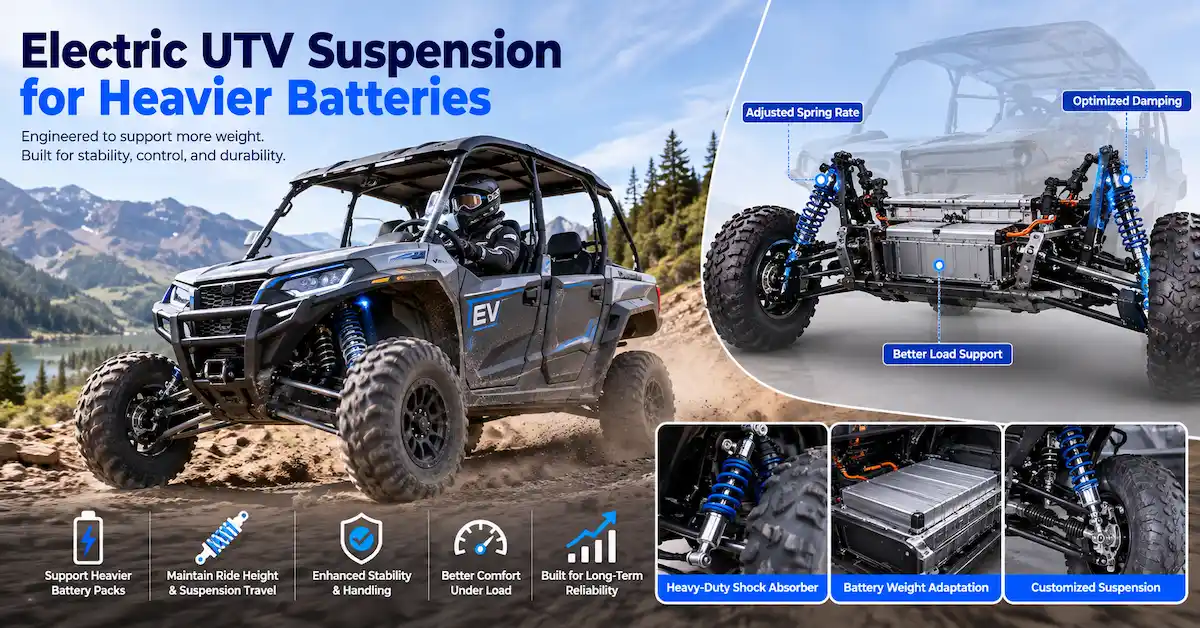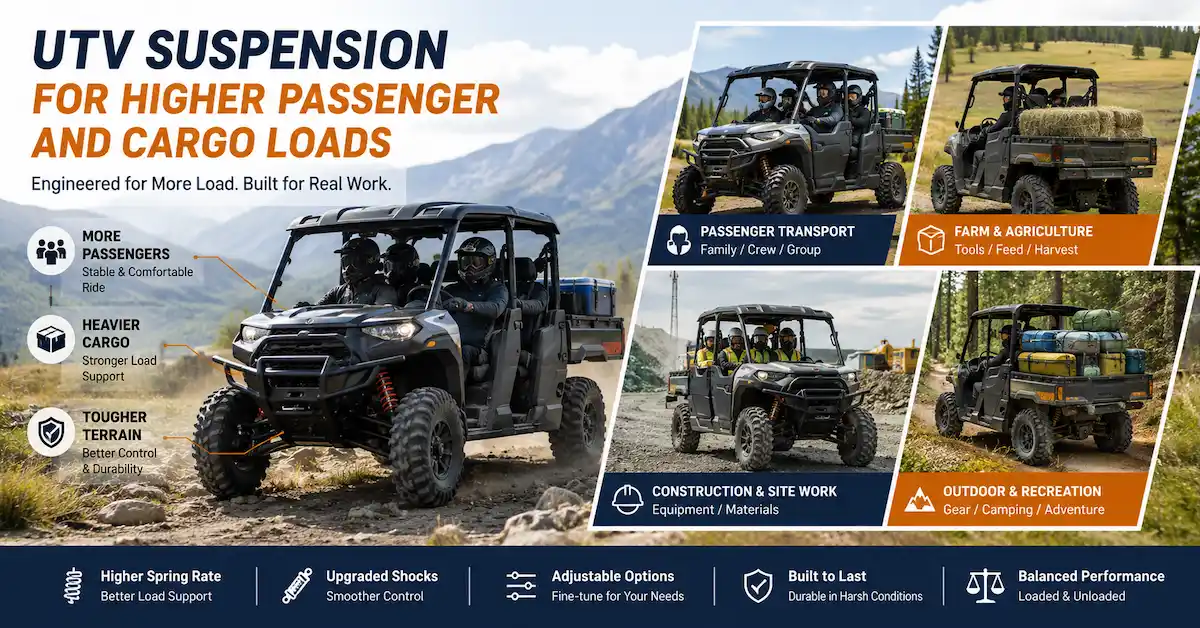

When comparing fixed vs adjustable UTV shock absorbers, the main question is not whether one design is universally better. The real question is how much suspension tuning the vehicle needs during actual operation.
A fixed shock absorber normally uses a damping specification established during development and does not allow the end user to significantly change that damping externally.
An adjustable shock allows one or more suspension parameters to be changed, depending on its design.These may include:
- Spring preload
- Rebound damping
- Compression damping
- Combined compression and rebound adjustment
- High- and low-speed compression adjustment on more advanced designs
The basic selection logic is:
Stable Vehicle Configuration → Fixed Damping May Be Enough
Changing Load or Terrain → Adjustable Damping May Add Value
However, buyers should first define exactly what “adjustable” means. A shock with an adjustable spring collar is not necessarily an adjustable-damping shock.
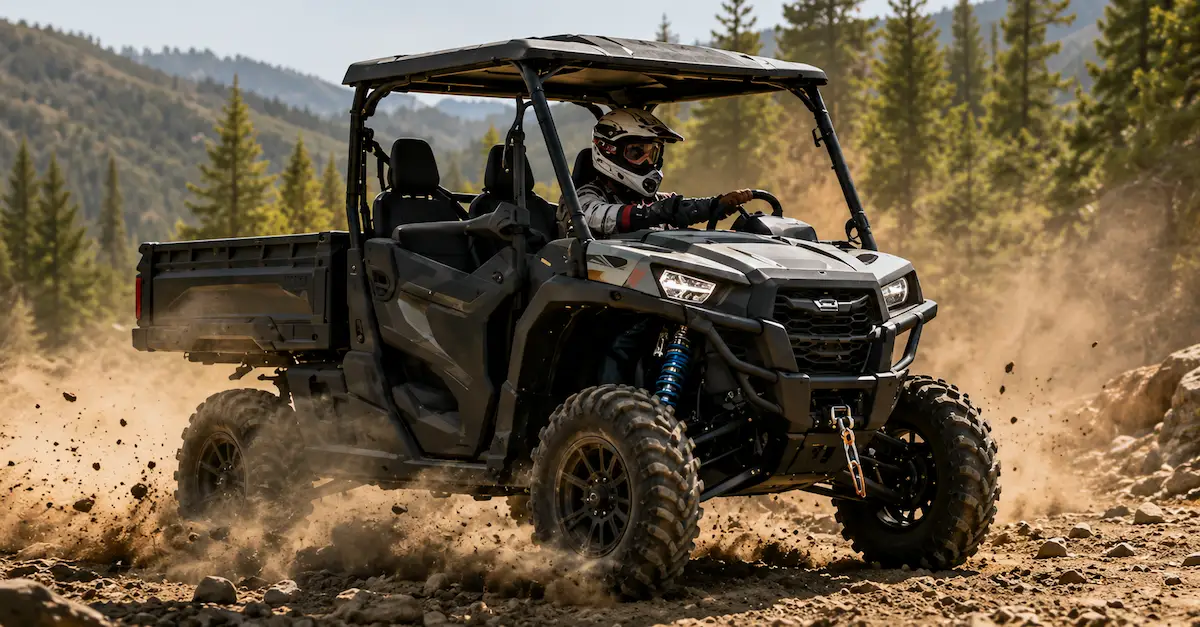
Quick Comparison: Fixed vs Adjustable UTV Shock Absorbers
| Factor | Fixed UTV Shock | Adjustable UTV Shock |
|---|---|---|
| Damping setting | Preset | User-adjustable depending on design |
| Setup complexity | Lower | Higher |
| Operator tuning | Limited | Greater |
| Load variation | Best for predictable conditions | Better suited to changing conditions |
| Terrain variation | Best for defined use | More flexible |
| Misadjustment risk | Lower | Higher |
| Cost structure | Usually simpler | Usually higher |
| Maintenance considerations | Simpler configuration | More components and settings |
| OEM tuning | Can be custom-valved | Can combine base tuning with adjustment |
| Best fit | Stable applications | Variable or performance-oriented applications |
The important point is that fixed does not mean poorly engineered, and adjustable does not automatically mean better performance.
A correctly developed fixed shock can outperform a poorly selected adjustable shock on a vehicle with a clearly defined operating condition.
What Is a Fixed UTV Shock Absorber?
A fixed UTV shock absorber uses a predetermined damping configuration.
Once the internal valving and damping characteristics are established, the driver generally cannot make significant external damping changes.
For an OEM project, that fixed setting can still be developed around:
- Vehicle weight
- Front and rear axle loads
- Spring rate
- Shock dimensions
- Suspension geometry
- Passenger load
- Cargo load
- Terrain
- Intended vehicle speed
This distinction matters.
Fixed damping does not necessarily mean generic damping.
A supplier can potentially develop a project-specific damping specification and then keep that specification fixed for production.
For many commercial UTV applications, this can be an effective approach because every production vehicle leaves with the same suspension setup.
When Are Fixed UTV Shocks a Good Choice?
Fixed shocks are particularly relevant when the vehicle's operating conditions are predictable.
Utility UTVs With Consistent Loads
Consider a work UTV that normally operates with:
- One driver
- Similar equipment
- Similar cargo
- Similar terrain
If the operating weight varies very little, a properly developed fixed shock may provide the required suspension behavior without adding adjustments the customer rarely uses.
Fleet Vehicles
Fleet operators often value predictable setup.
Examples may include:
- Property maintenance vehicles
- Agricultural fleets
- Industrial utility vehicles
- Resort transportation
- Facility service vehicles
If different drivers operate the same vehicle, reducing unnecessary suspension adjustments can also reduce the risk of inconsistent settings.
Entry-Level or Cost-Sensitive UTV Programs
For an OEM brand developing a vehicle where:
- Target cost matters
- Application is clearly defined
- End users do not require suspension tuning
a fixed shock can simplify the product specification.
The decision should still be based on engineering requirements rather than simply choosing the lowest-cost shock.
What Is an Adjustable UTV Shock Absorber?
An adjustable UTV shock absorber gives the operator or technician a way to modify part of the suspension setup after the shock has been manufactured.
But there are several different types of adjustment.
Preload Adjustment Is Not the Same as Damping Adjustment
This is one of the most important distinctions for buyers.
A threaded spring collar may allow the spring preload to be adjusted.
Preload can influence:
- Static suspension position
- Sag
- Ride height within an appropriate range
But preload does not directly change the internal compression or rebound damping characteristics.
Therefore:
Preload-Adjustable ≠ Fully Damping-Adjustable
When requesting a quotation, buyers should specify exactly which adjustment they need.
What Does Rebound Adjustment Do?
Rebound damping controls how quickly the suspension extends after being compressed.
An adjustable rebound system can allow users to change suspension recovery behavior.
This can matter when vehicle conditions change because of:
- Different spring rates
- Different payloads
- Different terrain
- Different driving styles
Too little rebound control may allow excessive oscillation.
Too much rebound damping can make it difficult for the suspension to recover quickly enough between repeated terrain inputs.
The goal is not maximum rebound resistance.
The goal is controlled recovery.
What Does Compression Adjustment Do?
Compression damping influences how the shock responds while compressing.
It may affect:
- Impact absorption
- Body movement
- Bottoming resistance
- Suspension support
- Rough-terrain behavior
Compression adjustment can be useful when one UTV operates under significantly different conditions.
For example:
Condition A: one driver on relatively smooth terrain.
Condition B: multiple passengers and cargo on rough terrain.
One fixed damping setup may need to compromise between these two conditions.
An adjustable solution can provide more tuning flexibility.
Do I Need Both Compression and Rebound Adjustment?
Not necessarily.
More adjustment creates more tuning possibilities, but it also introduces:
- More components
- More setup decisions
- More user education
- Greater risk of incorrect settings
- Potentially higher product cost
An OEM should not specify multiple adjustment functions simply because they appear more premium.
A better question is:
Which operating variable cannot be adequately handled by the standard suspension specification?
If the main issue is changing vehicle load, one adjustment strategy may be enough.
If the vehicle is performance-oriented and faces large variations in terrain, speed, load, and driver preference, additional adjustment may become more valuable.
Which Shock Is Better for Changing Payloads?
Adjustable shocks can offer advantages when payload varies significantly.
Consider a utility UTV used in three conditions:
- Driver only
- Driver plus passengers
- Driver plus passengers and cargo
The suspension load can change substantially between these scenarios.
The buyer should evaluate:
- Sag
- Spring rate
- Preload range
- Compression control
- Rebound control
- Remaining shock travel
However, adjustable damping cannot compensate for every load problem.
If the spring is fundamentally unsuitable for the vehicle's operating weight, turning a damping adjuster does not solve the spring-rate mismatch.
A useful engineering principle is:
Spring rate supports the load; damping controls how that supported load moves.
Fixed vs Adjustable Shocks for Heavy Payload UTVs
Heavy-payload applications should not automatically be specified with adjustable shocks.
First determine:
- Empty vehicle weight
- Loaded vehicle weight
- Front axle load
- Rear axle load
- Spring requirements
- Static sag
- Available compression travel
If the UTV operates near the same heavy load every day, a properly engineered fixed setup may work well.
If the UTV repeatedly changes between light and heavy operating conditions, adjustability may provide greater flexibility.
The decision sequence should therefore be:
Load Range → Spring Requirement → Travel → Damping Requirement → Need for Adjustment
not:
Heavy Vehicle → Adjustable Shock
Which Is Better for Different Terrain?
Terrain variation is another reason buyers consider adjustable UTV shocks.
Relatively Consistent Terrain
Fixed damping may be appropriate for vehicles mainly used on:
- Farms
- Industrial sites
- Property maintenance routes
- Predictable work roads
Highly Variable Terrain
Adjustment becomes more attractive when the vehicle regularly changes between:
- Smooth trails
- Rocky sections
- Washboard surfaces
- Larger bumps
- Faster off-road operation
An adjustable shock can allow suspension behavior to be tuned within the available adjustment range.
But the base shock specification still has to be correct.
An adjustment knob cannot compensate for:
- Incorrect shock dimensions
- Insufficient travel
- Wrong spring
- Poor mounting geometry
Are Adjustable Shocks Automatically Better for Off-Road UTVs?
No.
This is a common purchasing mistake.
An adjustable shock is only useful if:
- The vehicle needs the adjustment.
- The adjustment range is appropriate.
- The operator understands how to use it.
- The underlying spring and shock specifications are correct.
For some UTVs, repeatable fixed damping is more valuable than additional adjustment.
For others, especially vehicles that experience large variations in load, terrain, or performance requirements, adjustability can provide meaningful flexibility.
The right question is not:
Which shock has more features?
It is:
Which shock architecture solves the vehicle's operating problem?
How Do Fixed and Adjustable Shocks Affect OEM Product Positioning?
The choice can also depend on the market position of the UTV.
Work-Oriented Utility Vehicle
Buyers may prioritize:
- Reliability
- Predictable behavior
- Simple operation
- Cost control
A fixed or minimally adjustable configuration may be appropriate.
Premium Utility UTV
Customers may expect:
- Load flexibility
- Better tuning control
- Greater suspension adjustability
An adjustable shock can contribute to the product specification if the function provides real value.
Performance or Recreational UTV
Suspension tuning may be a stronger selling point.
Buyers may evaluate:
- Rebound adjustment
- Compression adjustment
- Reservoir configuration
- Spring setup
- Adjustment range
The suspension architecture should follow the application, not simply the marketing position.
Does a Reservoir Mean the Shock Is Adjustable?
No.
A reservoir shock and an adjustable shock are not the same thing.
A reservoir relates to shock architecture and fluid/gas management.
An adjustment mechanism relates to the user's ability to change damping behavior.
Depending on design, a reservoir shock may be:
- Fixed
- Compression-adjustable
- Rebound-adjustable
- Multi-adjustable
Buyers should therefore avoid specifications such as:
We need reservoir adjustable shocks.
Instead, define separately:
- Reservoir requirement
- Adjustment requirement
- Adjustment type
- Vehicle performance requirement
What Should UTV Distributors Consider?
For aftermarket distributors, the decision differs slightly from an OEM vehicle-development project.
A distributor should consider the end customer's ability to select and tune the product.
Fixed Shocks May Suit
- Simple replacement programs
- Broad utility markets
- Customers seeking straightforward installation
- Applications with stable specifications
Adjustable Shocks May Suit
- Premium aftermarket programs
- Enthusiast markets
- Variable-load utility applications
- Customers who actively tune their vehicles
For private-label programs,distributors should also consider:
- Installation instructions
- Adjustment instructions
- Recommended baseline settings
- Product differentiation
- Replacement parts
- Packaging
- Application compatibility
Adding adjustment creates sales potential, but it can also create additional customer-support requirements.
Fixed vs Adjustable UTV Shocks: Cost and Risk Comparison
| Purchasing Factor | Fixed Shock | Adjustable Shock |
|---|---|---|
| Product complexity | Lower | Higher |
| Adjustment components | Fewer | More |
| User setup | Minimal | Required in some applications |
| Misadjustment risk | Low | Higher |
| SKU positioning | Standard | Premium/custom |
| Engineering requirement | Still important | More tuning variables |
| After-sales education | Lower | Higher |
| Application flexibility | Lower | Higher |
OEM buyers should compare quotations only after defining the same technical scope.
A fixed shock and an adjustable shock should not be compared on unit price alone if their:
- Internal design
- Spring specification
- Damping functions
- Materials
- dimensions
- Testing requirements
- Adjustment mechanisms
are different.
What Suspension Data Should I Give a UTV Shock Supplier?
High-quality technical information produces a much better quotation than simply asking for “adjustable UTV shocks.”
Provide the supplier with:
Vehicle Information
- UTV model or new vehicle platform
- Vehicle curb weight
- Wheelbase
- Front axle weight
- Rear axle weight
Operating Loads
- Driver weight assumptions
- Passenger requirements
- Cargo weight
- Permanent accessories
- Typical and maximum working conditions
Existing Shock Information
- Extended length
- Compressed length
- Shock stroke
- Mounting dimensions
- Spring dimensions
- Spring rate if known
- Photographs
- Existing samples
Application Information
Explain:
- Terrain
- Vehicle speed range
- Utility or recreational use
- Load variation
- Current suspension problem
Required Adjustment
Be specific about whether you need:
- Preload adjustment
- Rebound adjustment
- Compression adjustment
- Multiple damping adjustments
This is much more useful than simply requesting a “fully adjustable shock.”
What Questions Should I Ask Before Choosing Adjustable UTV Shocks?
OEM buyers should ask:
- Which parameter does each adjuster control?
- What operating problem is the adjustment intended to solve?
- Does the spring specification remain suitable throughout the expected load range?
- What is the recommended baseline setting?
- How large is the usable adjustment range?
- How should prototypes be evaluated?
- Can adjustment settings be documented for production vehicles?
- Will end users require setup instructions?
- Does the added complexity provide enough value for the target market?
These questions shift the conversation from product features to engineering results.
When Should an OEM Choose Fixed Shocks?
Fixed damping is a strong candidate when:
- Vehicle weight is stable
- Payload variation is limited
- Terrain is predictable
- User tuning is unnecessary
- Consistent fleet behavior is important
- Cost and simplicity matter
- A validated damping specification already performs well
One major advantage is repeatability:
Develop the correct setting once, then reproduce the same suspension specification across production vehicles.
When Should an OEM Choose Adjustable Shocks?
Adjustable shocks become more relevant when:
- Payload changes substantially
- Passenger configurations vary
- Terrain varies significantly
- Drivers require suspension tuning
- The vehicle serves both work and recreational use
- Premium suspension functionality supports product positioning
- Prototype testing shows one fixed damping specification requires too much compromise
In these cases, the goal should be a useful adjustment range—not simply the largest number of adjustment clicks or functions.
Can a Fixed Shock Still Be Custom Developed?
Yes.
This is particularly important for OEM buyers.
A custom shock does not have to be externally adjustable.
The supplier can evaluate the vehicle and develop a fixed specification around:
Vehicle Data → Spring Selection → Shock Dimensions → Damping Target → Prototype → Vehicle Test → Revision → Production
For a stable vehicle platform, this may provide a simpler final product while still using project-specific engineering.
How Should Prototype Testing Compare Fixed and Adjustable Shocks?
When both options are under consideration, test them under the same vehicle conditions.
Useful configurations include:
| Test Condition | What to Evaluate |
|---|---|
| Driver only | Baseline ride and control |
| Normal passenger load | Sag and chassis balance |
| Typical cargo | Load control |
| Maximum realistic load | Remaining travel and stability |
| Smooth terrain | Comfort and response |
| Rough terrain | Compression and wheel control |
| Repeated bumps | Suspension recovery |
For adjustable shocks, document the setting used during each test.
Otherwise, comparing test results becomes difficult.
The process should be:
Baseline Setting → Vehicle Test → Controlled Adjustment → Re-Test → Record Result
Avoid changing several adjustments at once because it becomes harder to understand which change produced the result.
How Bedo Auto Can Support a UTV Shock Project
For a UTV shock absorber project, buyers can provide vehicle information, shock dimensions, load conditions, existing samples or drawings, and the suspension behavior they want to improve.
Depending on the project, the engineering discussion can focus on:
- Fixed or adjustable shock architecture
- Spring requirements
- Shock dimensions
- Preload requirements
- Compression damping
- Rebound damping
- Vehicle load variation
- Prototype evaluation
- OEM or private-label requirements
For a custom project, the most useful inquiry is not:
“How much is an adjustable UTV shock?”
A stronger RFQ is:
“Our utility UTV operates between a light driver-only condition and a heavier passenger-plus-cargo condition. We need to evaluate whether a fixed damping setup or an adjustable shock would provide the better balance between ride quality, load control, cost, and user operation.”
That gives the supplier a real engineering problem to evaluate.
What Should I Include in an RFQ?
For faster project evaluation,send:
- UTV application
- Vehicle curb weight
- Front/rear axle loads
- Passenger capacity
- Cargo range
- Typical terrain
- Existing shock dimensions
- Spring information
- Current suspension problem
- Required adjustment functions
- Shock drawings or CAD if available
- Prototype quantity
- Expected order quantity
- OEM/private-label requirements
A good RFQ should define the vehicle problem first and the shock feature second.
That helps prevent unnecessary cost and improves the probability of receiving a technically relevant proposal.
FAQ
Are adjustable UTV shocks better than fixed shocks?
Not always. Adjustable shocks provide more tuning flexibility, while a correctly developed fixed shock can be better for stable vehicle loads, predictable terrain, fleets, and applications where users do not need suspension tuning.
What is the main difference between fixed and adjustable UTV shock absorbers?
A fixed shock uses predetermined damping characteristics, while an adjustable shock allows certain settings, such as compression or rebound damping, to be changed depending on the shock design.
Is preload adjustment the same as damping adjustment?
No. Preload primarily changes the spring's installed condition and can influence sag or ride height. Compression and rebound adjusters change damping behavior.
Do heavy-load UTVs need adjustable shocks?
Not automatically. A UTV operating at a consistent heavy load may work well with correctly selected springs and fixed damping. Adjustable shocks become more useful when the load changes substantially.
Are adjustable shocks better for changing terrain?
They can be. Adjustment can help adapt suspension behavior to different terrain, but only when the underlying spring rate, shock travel, geometry, and base damping specification are appropriate.
Can fixed UTV shocks be custom tuned for an OEM vehicle?
Yes. A fixed shock can be developed with a project-specific spring and damping specification even though the end user cannot externally adjust the damping.
Does a reservoir shock always have damping adjustment?
No. Reservoir design and damping adjustment are separate features. A reservoir shock can be fixed or adjustable depending on its architecture.
What adjustment should I choose for a utility UTV?
The answer depends on the problem being solved. Buyers should first identify load variation, terrain, spring requirements, sag, shock travel, and desired suspension behavior before specifying rebound or compression adjustment.
What are the disadvantages of adjustable UTV shocks?
Potential disadvantages include higher complexity, higher cost, greater setup requirements, and the possibility that users select unsuitable settings.
What information should I send a UTV shock absorber manufacturer?
Send vehicle weight, axle loads, passenger and cargo requirements, terrain, existing shock dimensions, spring information, current suspension problems, desired adjustment functions, drawings or samples, and expected production quantity.
Conclusion
Choosing between fixed vs adjustable UTV shock absorbers should begin with the vehicle's operating conditions rather than the number of features on the shock.
For vehicles with stable weight, predictable terrain, and limited tuning requirements, a properly developed fixed shock can provide a simple and repeatable solution.
For vehicles that regularly experience substantial changes in payload, passenger count, terrain, or performance requirements, adjustable shocks can provide useful flexibility when the adjustment functions are correctly selected.
The most effective decision process is:
Vehicle Application → Load Range → Terrain → Spring Requirement → Shock Travel → Damping Requirement → Need for Adjustment → Prototype Testing → Final Specification
For OEM buyers, the key principle is simple:
Choose adjustment only when the vehicle has a real condition that needs to be adjusted.
A well-specified fixed shock is better than unnecessary adjustability, while a properly engineered adjustable shock can be valuable when one UTV must perform well across several significantly different operating conditions.