
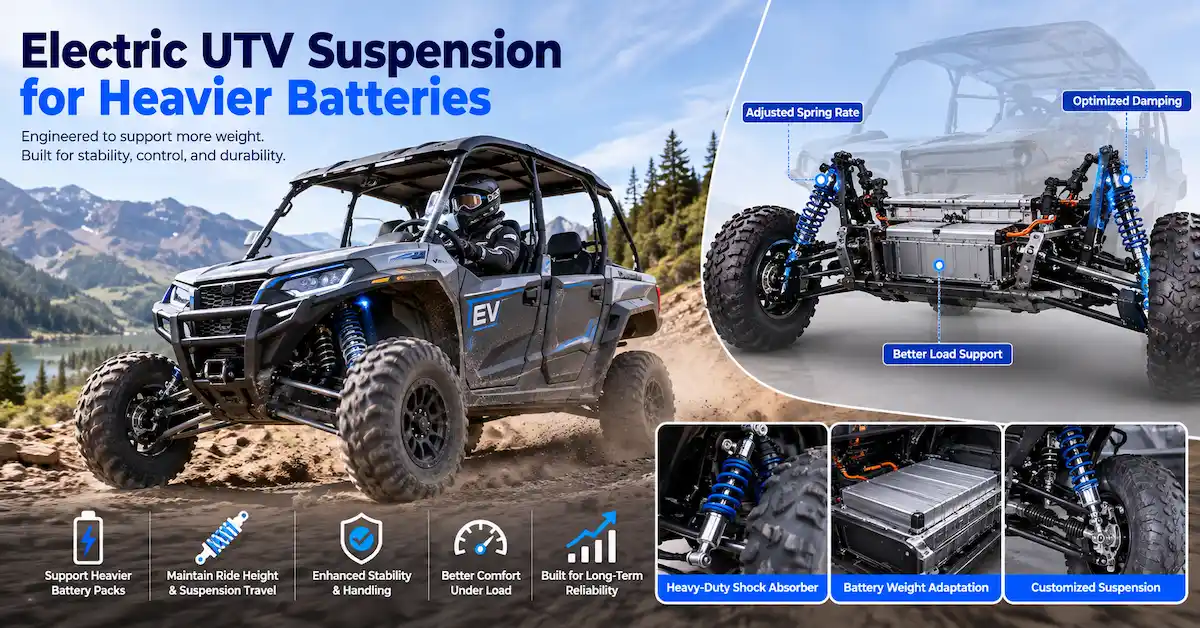
A heavier battery pack can require changes to electric UTV suspension for heavier batteries because battery mass becomes part of the vehicle’s permanent operating weight.
The added mass can increase suspension sag, reduce ride height, consume available shock travel, change front/rear axle loads, and alter how the vehicle responds to bumps, braking, acceleration, and rough terrain.
The correct solution is not automatically:
Heavier Battery → Stiffer Spring
A better engineering process is:
Battery Weight & Position → Vehicle and Axle Loads → Sag → Spring Rate → Shock Travel → Damping → Vehicle Validation
Depending on the vehicle, the required change may involve:
- Different front or rear springs
- Revised preload
- Different shock damping
- Shock dimension or travel review
- Front/rear suspension rebalance
- Prototype validation
The suspension should be matched to where the battery mass is carried and how the complete electric UTV operates—not simply to the battery’s total weight.
Why Does a Heavier Battery Pack Affect Electric UTV Suspension?
Battery mass differs from many other UTV loads because it is usually permanent.
Cargo may be present on one trip and removed on the next.
Passengers may vary from one driver to a full vehicle.
The battery pack, however, normally remains on the vehicle during every operating condition.
This means a heavier pack changes the UTV’s baseline suspension load.
Possible effects include:
- Increased curb weight
- Increased static spring compression
- More suspension sag
- Lower ride height
- Less available compression travel
- Changed front/rear weight distribution
- Different damping requirements
- Different chassis response over terrain
A useful relationship is:
Heavier Battery → Higher Permanent Vehicle Mass → More Static Suspension Load → Spring and Damping Re-Evaluation
This is why an electric UTV suspension project should begin with the complete vehicle, not with a shock absorber catalog.
Battery Weight Alone Is Not Enough
Suppose an OEM buyer tells a suspension supplier:
The new battery weighs 180 kg.
That information is useful, but it is not enough to determine the suspension specification.
The supplier should also understand:
- Previous battery weight
- New battery weight
- Battery mounting position
- Vehicle curb weight
- Front axle weight
- Rear axle weight
- Passenger capacity
- Cargo requirements
- Permanent accessories
- Suspension geometry
| Vehicle Data | Why It Matters |
|---|---|
| Original battery weight | Establishes the previous baseline |
| New battery weight | Shows the permanent mass increase |
| Battery position | Determines front/rear influence |
| Vehicle curb weight | Defines the new baseline vehicle mass |
| Front axle load | Indicates front suspension demand |
| Rear axle load | Indicates rear suspension demand |
| Passenger load | Adds operating mass |
| Cargo load | Defines real working conditions |
| Suspension geometry | Influences spring and shock behavior |
Battery weight tells you how much mass was added; axle load tells you which suspension has to support it.
Why Does Battery Position Matter?
Two battery packs with identical weight can affect suspension differently if they are installed in different locations.
Rear-Biased Battery Position
A battery positioned toward the rear may increase:
- Rear axle load
- Rear spring compression
- Rear suspension sag
- Rear shock static compression
This may make the rear suspension the primary area requiring evaluation.
Central Battery Position
A centrally mounted pack may distribute additional mass more evenly between the front and rear axles.
However, both ends of the suspension should still be checked.
Front-Biased Battery Position
A forward-mounted battery can increase:
- Front axle load
- Front spring compression
- Front suspension sag
This may affect steering-related chassis behavior as well as suspension travel.
The correct engineering logic is:
Battery Position → Axle Load Change → Suspension Requirement
rather than:
Electric UTV → Stronger Rear Shocks
Does a Low-Mounted Battery Eliminate Suspension Concerns?
No.
A low-mounted battery can help reduce the vehicle’s center-of-gravity height compared with placing the same mass higher in the chassis.
But lower placement does not remove the added weight.
The suspension still has to support the battery mass.
This distinction is important:
Center of Gravity and Suspension Load Are Related but Different Engineering Issues.
A battery can be positioned low in the chassis and still:
- Increase suspension sag
- Reduce available shock travel
- Require different spring support
- Change damping requirements
For this reason, battery packaging and suspension development should be evaluated together.
Should Front and Rear Axle Loads Be Measured Again?
If battery weight or battery position changes significantly, rechecking axle loads is highly useful.
Ideally, compare several conditions.
Original Vehicle Configuration
Measure or estimate:
- Front axle weight
- Rear axle weight
Vehicle With the New Battery
Measure:
- New front axle weight
- New rear axle weight
Real Operating Condition
Add:
- Driver
- Passengers
- Typical cargo
- Permanent accessories
Then review the axle weights again.
This helps determine whether the suspension change should focus on:
- Front springs
- Rear springs
- Both ends
- Damping only
- A broader suspension redesign
Total vehicle weight tells you how much mass the vehicle carries. Axle load tells you where that mass reaches the suspension.
Does a Heavier Battery Require a Higher Spring Rate?
Possibly, but not automatically.
Spring rate should be evaluated if the heavier battery causes:
- Excessive static sag
- Reduced ride height
- Insufficient compression travel
- Frequent bottoming
- Poor vehicle support
If the Spring Is Too Soft
Possible problems include:
- Permanent sag
- Reduced ground clearance
- Excessive suspension compression
- Frequent bottoming
- Reduced usable shock travel
If the Spring Is Too Stiff
Possible effects include:
- Harsh ride
- Reduced wheel compliance
- Poor tire contact on rough surfaces
- Excessive chassis shock
- Poorly balanced suspension
The correct target is not maximum stiffness.
The correct spring rate should support the new permanent vehicle mass while preserving the suspension movement needed for real operation.
Can Preload Compensate for Heavier Batteries?
Preload may help with a moderate weight change, but it has limits.
Depending on the suspension design, preload can be used to:
- Restore some ride height
- Adjust static suspension position
- Fine-tune vehicle stance
However, preload does not make an incorrectly selected spring universally suitable.
If the new battery creates a significant permanent weight increase and the suspension requires excessive preload to return to an acceptable ride height, the spring rate itself should be evaluated.
A useful rule is:
Preload can correct suspension position within a useful range, but it should not hide an incorrectly matched spring.
Excessive preload can also affect:
- Suspension droop
- Ride compliance
- Available adjustment range
Does Damping Need to Change After Battery Weight Increases?
It should be evaluated.
Increasing battery mass changes more than static suspension position.
The heavier vehicle can also carry more kinetic energy during movement, which may change the way the chassis behaves over:
- Bumps
- Rough terrain
- Braking
- Acceleration
- Repeated suspension events
If spring rate also changes, damping compatibility becomes even more important.
The useful engineering relationship is:
Vehicle Mass Change + Spring Change → Damping Review
How Does Compression Damping Affect a Heavier Electric UTV?
Compression damping controls how quickly a shock absorber compresses.
It can influence:
- Impact response
- Body movement
- Bottoming tendency
- Wheel control
- Rough-terrain behavior
A heavier battery may move the suspension deeper into its travel before the vehicle encounters a bump.
This can change the operating demand placed on the shock absorber.
However, heavier mass does not mean compression damping should simply be increased to the maximum.
Too much compression damping may cause:
- Harsh impacts
- Poor wheel compliance
- Reduced comfort
- Poor rough-terrain response
Compression damping should be considered together with vehicle mass, spring rate, suspension geometry, speed, and terrain.
Why Does Rebound Damping Matter?
Rebound damping controls how quickly the suspension extends after compression.
It affects:
- Wheel recovery
- Tire contact
- Body control
- Repeated-bump stability
If a heavier battery requires a stronger spring, the spring may return the suspension differently from the original setup.
Insufficient rebound control can contribute to:
- Repeated bouncing
- Poor chassis stability
- Uncontrolled wheel movement
Too much rebound damping can also prevent the suspension from recovering efficiently between repeated bumps.
For this reason, spring and damping specifications should be treated as a system.
Why Can Shock Travel Become a Problem?
The shock absorber may have the same physical stroke before and after the battery change, but the usable travel can change.
Imagine that the original suspension sits near the middle of its working range.
After installing a heavier battery, additional static sag pushes the shock farther toward the compressed position.
The total shock stroke has not changed.
But:
Available Compression Travel Has Decreased
Important dimensions to evaluate include:
- Extended shock length
- Compressed shock length
- Shock stroke
- Static position with battery installed
- Remaining compression travel
- Available droop
A suspension that supports the heavier battery but leaves too little usable shock travel is still incorrectly matched.
Can Heavier Batteries Reduce Ground Clearance?
Potentially.
If the new battery produces additional spring compression, the chassis may sit lower.
This can reduce:
- Ride height
- Underbody clearance
- Available suspension travel
However, ground-clearance problems should not automatically be solved by:
- Excessive preload
- A much stiffer spring
- Longer shock absorbers
Changing shock length can influence:
- Droop
- Suspension geometry
- Driveline or CV angles where applicable
- Tire clearance
- Mechanical limits
A dimension change should therefore be reviewed as part of the complete suspension system.
Battery Weight vs Cargo Weight: What Is the Difference?
Battery and cargo mass can both load the suspension, but they usually affect vehicle development differently.
| Factor | Heavier Battery | Cargo |
|---|---|---|
| Load type | Permanent vehicle mass | Variable operating load |
| Present every trip | Usually yes | Not always |
| Position | Usually fixed | May vary |
| Curb weight | Increased | Usually unchanged |
| Spring requirement | Constant baseline effect | Load-dependent |
| Damping impact | Permanent mass change | Depends on cargo condition |
| Loaded/unloaded range | More predictable | Often more variable |
This distinction is important when developing electric UTV suspension for heavier batteries.
A battery change modifies the baseline vehicle before passengers or cargo are added.
What About Heavier Batteries Plus Passengers and Cargo?
An electric utility UTV must usually support more than the battery itself.
The complete working vehicle may include:
Vehicle + Battery + Driver + Passengers + Cargo + Accessories
For example, a suspension could appear acceptable during testing with the battery and driver but become unsuitable when the vehicle also carries:
- Additional passengers
- Tools
- Cargo
- Work equipment
This is why suspension validation should represent realistic operating conditions rather than only the bare vehicle.
For multi-load applications, passenger and cargo distribution should be evaluated along with battery mass.
Can a Heavier Battery Reduce Payload Margin?
Potentially, depending on the vehicle design and its rated gross weight.
If the vehicle’s allowable gross weight remains unchanged while battery weight increases, less weight margin may remain for:
- Passengers
- Cargo
- Accessories
This is an important distinction:
Upgrading the suspension does not automatically increase the vehicle manufacturer's GVWR or rated payload.
Spring and shock changes may improve suspension behavior under an intended condition, but vehicle structural limits and manufacturer ratings still apply.
Should Both Front and Rear Shocks Be Changed?
Not necessarily.
The correct decision depends on the actual load change.
Rear-Biased Battery
The rear suspension may require more attention.
Front-Biased Battery
The front suspension may experience the larger change.
Centrally Mounted Battery
Both front and rear suspension may need to be evaluated for balance.
The correct process is:
Measure Load Change → Identify Affected Axle → Evaluate Spring, Travel, and Damping → Modify Only What Is Necessary
This is better than replacing all four shocks simply because the battery is heavier.
Standard Shock Upgrade vs Custom Electric UTV Suspension
Some battery changes can be accommodated with existing suspension products.
Others justify custom engineering.
| Factor | Standard Shock Upgrade | Custom Electric UTV Suspension |
|---|---|---|
| Vehicle mass | Predefined range | Actual vehicle data |
| Battery weight | General application | Project-specific |
| Battery position | Limited consideration | Can be evaluated |
| Spring rate | Available options | Can be developed |
| Damping | Fixed or preset | Project-based |
| Shock dimensions | Fixed | Can be reviewed |
| Prototype | Usually unnecessary | Recommended |
| Engineering revision | Limited | Project-based |
| OEM production | Limited | Can be planned |
A Standard Upgrade May Be Enough When
- Battery weight changes only moderately
- Ride height remains acceptable
- Sag remains controlled
- Shock travel remains sufficient
- A validated suspension solution already exists
Custom Development Becomes More Relevant When
- A new electric UTV platform is being developed
- Battery mass changes substantially
- Battery mounting position changes
- Front/rear load distribution changes significantly
- The existing suspension bottoms or sags
- OEM/private-label production is required
- Standard products fail vehicle validation
How Should an Electric UTV Suspension Prototype Be Tested?
Prototype testing should represent actual vehicle use.
Vehicle With Battery Installed
Use this condition to establish the new baseline.
Check:
- Ride height
- Front/rear sag
- Static shock position
Driver or Normal Passenger Condition
Evaluate the most common operating state.
Passengers and Typical Cargo
If the vehicle is used as a utility UTV, include the real working load.
Maximum Realistic Operating Condition
Evaluate the vehicle at its intended high-load condition while remaining within applicable vehicle limits.
Rough-Terrain Validation
Depending on the intended use,assess:
- Remaining travel
- Bottoming tendency
- Compression behavior
- Rebound recovery
- Chassis control
| Test Condition | Main Check |
|---|---|
| Vehicle + battery | Baseline sag and ride height |
| Driver condition | Normal suspension behavior |
| Passenger load | Front/rear balance |
| Passenger + cargo | Real utility condition |
| Rough terrain | Travel and damping |
| Repeated bumps | Recovery and control |
What Should Be Measured During Vehicle Validation?
Useful validation points can include:
- Front sag
- Rear sag
- Ride height
- Ground clearance
- Shock stroke usage
- Remaining compression travel
- Droop
- Mechanical clearance
- Compression response
- Rebound recovery
- Front/rear balance
- Loaded vehicle behavior
Vehicle testing is important because a shock absorber can be dimensionally correct and still be poorly matched to the actual electric UTV.
What Does the Development Process Look Like?
A practical OEM development workflow is:
1. Review the Battery Change
Confirm:
- Previous battery
- New battery
- Weight difference
- Installation position
2.Measure the Vehicle
Collect:
- Vehicle curb weight
- Front axle load
- Rear axle load
3. Review the Existing Suspension
Evaluate:
- Springs
- Shock dimensions
- Shock stroke
- Ride height
- Current sag
4.Define the Engineering Direction
Determine whether the project needs changes to:
- Spring rate
- Preload
- Damping
- Shock dimensions
- Front/rear suspension balance
5. Build a Prototype
Produce an engineering sample when custom development is required.
6. Test the Vehicle
Validate realistic operating conditions.
7. Revise the Specification
Use test feedback to modify the suspension where necessary.
8. Produce a Pilot Batch
Confirm production consistency before scaling.
9. Approve Production
Use the approved engineering revision as the reference for repeat production.
The overall path is:
Battery Specification → Axle Load → Suspension Engineering → Prototype → Vehicle Testing → Revision → Pilot → Production
Can 3D CAD Files Help With Electric UTV Suspension Development?
Yes.
For a new electric UTV platform, 3D CAD can help engineers understand:
- Battery packaging
- Available shock space
- Mounting geometry
- Suspension clearance
- Chassis integration
However, CAD geometry alone does not define spring rate or damping.
The engineering team still needs:
- Vehicle weight
- Axle loads
- Battery weight
- Passenger and cargo conditions
- Suspension targets
A useful development package combines:
3D CAD + Vehicle Data + Battery Data + Existing Suspension Information + Performance Requirements
How Should Buyers Evaluate an Electric UTV Suspension Supplier?
A development-oriented supplier should be able to discuss more than shock dimensions and price.
Ask whether the supplier can evaluate:
- Vehicle curb weight
- Battery mass
- Battery position
- Front/rear axle load
- Suspension sag
- Spring rate
- Shock travel
- Compression damping
- Rebound damping
- Prototype feedback
The supplier should also explain how the final approved prototype is translated into controlled production specifications.
If a supplier recommends “stronger electric UTV shocks” without asking about battery position or axle loading, buyers should ask how the recommendation was determined.
What Affects the Cost of Custom Electric UTV Suspension?
Project cost can depend on:
- Shock architecture
- Shock dimensions
- Spring specifications
- Damping requirements
- Reservoir configuration where applicable
- Adjustment features
- Custom components
- Prototype quantity
- Engineering revisions
- Testing requirements
- Surface finish
- Branding
- Packaging
- Production volume
Buyers should compare quotations only after confirming:
Same Specification → Same Development Scope → Same Validation Scope → Compare Price
A lower quotation may not include the same engineering work or product configuration.
What Should an OEM Buyer Include in an RFQ?
A high-quality RFQ should explain the battery change and the complete vehicle operating condition.
Vehicle Information
Provide:
- Electric UTV model or platform
- Wheelbase
- Curb weight
- Front/rear axle weights if available
Battery Information
Provide:
- Original battery weight
- New battery weight
- Battery dimensions
- Battery mounting location
- Relevant packaging drawings
Operating Load
Provide:
- Passenger requirements
- Cargo requirements
- Permanent accessories
- Maximum realistic working condition
Existing Suspension
Provide:
- Shock photographs
- Physical shock sample
- Extended length
- Compressed length
- Stroke
- Mounting dimensions
- Spring information
Explain the Current Problem
Avoid a vague inquiry such as:
Battery is heavier. We need stronger shocks.
A more useful description is:
The new battery pack increases permanent rear axle load, causing additional rear sag and reducing available compression travel under our normal working condition.
This gives the supplier a clear technical problem to evaluate.
Engineering Files
Send when available:
- 2D drawings
- 3D CAD files
- Chassis layout
- Suspension geometry
Commercial Information
Also include:
- Prototype quantity
- Pilot-order quantity
- Expected production volume
- Target market
- OEM/private-label requirements
- Packaging requirements
Send your electric UTV platform, original and new battery weights, battery position, front/rear load data, existing shock specifications, operating conditions, and expected production quantity for a suspension project evaluation.
How Bedo Auto Supports Electric UTV Suspension Projects
Bedo Auto supports customized shock absorber and suspension development for UTV, electric utility vehicle, off-road, and specialty vehicle applications.
Electric UTV buyers can provide:
- Vehicle platform information
- Battery weight and position
- Front/rear load data
- Existing shock absorber samples
- Technical drawings
- 3D CAD files
- Current suspension problems
- Intended operating conditions
Depending on project requirements,technical discussions may include:
- Front and rear shock configuration
- Spring requirements
- Damping targets
- Shock travel
- Mounting conditions
- Prototype development
- Vehicle test feedback
- Engineering revisions
- Pilot-batch evaluation
- OEM/private-label production preparation
Buyers can review Bedo Auto shock absorber products for relevant product directions.
For projects involving larger operating loads beyond the battery itself, the guide to UTV suspension for heavy payload applications provides additional selection considerations.
If the vehicle also carries several occupants, the guide to custom UTV suspension for four-seat vehicles can help evaluate passenger-related axle-load changes.
For engineering evaluation, buyers can contact Bedo Auto with battery, vehicle, suspension, and production information.
FAQ
What suspension changes are needed for an electric UTV with heavier batteries?
A heavier battery may require spring-rate, damping, shock-travel, preload, or front/rear suspension changes depending on how the additional permanent mass changes vehicle sag and axle loading.
Does a heavier battery always require stiffer springs?
No. Spring rate should be evaluated based on actual axle load, suspension sag, geometry, available travel, and operating conditions.
Why does battery position matter for electric UTV suspension?
Battery position determines how the added mass is distributed between the front and rear axles, which influences which suspension components experience the greatest load change.
Can preload compensate for a heavier electric UTV battery?
Preload can help with moderate changes in static suspension position, but it may not replace the correct spring rate when permanent vehicle mass changes substantially.
Does damping need to change when battery weight increases?
If the vehicle mass or spring specification changes significantly, compression and rebound damping should be evaluated to maintain appropriate suspension control.
Can heavier batteries reduce suspension travel?
The battery does not physically reduce shock stroke, but additional suspension sag can consume more of the available compression travel.
Should front and rear electric UTV shocks both be changed?
Not automatically. Front and rear suspension should be evaluated according to the battery position and the resulting axle-load changes.
Should electric UTV suspension be tested with passengers and cargo?
Yes. Vehicle validation should represent realistic operating conditions, including passengers and cargo when they are part of normal vehicle use.
Does upgrading the suspension increase an electric UTV's GVWR?
No. Suspension modifications do not automatically increase the vehicle manufacturer's GVWR or payload rating.
What should I send for an electric UTV suspension quotation?
Provide vehicle weight, original and new battery weights, battery position, axle-load information, existing shock specifications, passenger and cargo conditions, current suspension problems, and expected production quantity.
Conclusion
Electric UTV suspension for heavier batteries should be developed around how the added permanent battery mass changes the complete vehicle—not simply around the battery's weight in isolation.
The most useful engineering process is:
Battery Weight & Position → Front/Rear Axle Load → Suspension Sag → Spring Rate → Shock Travel → Damping → Full Vehicle Validation → Engineering Revision → Production
A heavier battery may require stronger spring support, revised damping, different preload, or a broader shock specification change.But the correct solution depends on where the battery is installed, how much the vehicle's baseline mass changes, how much usable suspension travel remains, and how the electric UTV operates with passengers and cargo.
For OEM electric UTV developers, the strongest project starting point is a complete data package containing battery information, axle loads, existing suspension specifications, vehicle drawings or CAD where available, real operating conditions, and production requirements. This gives a suspension supplier the information needed to move from a generic “stronger shock” recommendation toward a vehicle-specific engineering solution.