
What Is a Suspension Engineering Partner?
A suspension engineering partner does more than supply an existing shock absorber or spring from a catalog.
For an OEM vehicle project, the partner should be able to understand the vehicle application, review engineering information, identify suspension requirements, develop prototypes, interpret testing feedback, revise the design, and help transfer the approved specification into production.
This distinction matters because many suspension projects do not begin with a finished part number.
They may begin with:
- A new ATV or UTV platform
- A technical drawing
- A 3D CAD model
- An existing shock absorber sample
- A vehicle with insufficient load support
- A modified suspension layout
- A requirement for different ride behavior
- A new private-label suspension product
In these cases, simply asking a supplier for “a similar shock absorber” may not solve the actual vehicle problem.
A useful engineering partner should first understand:
What is the vehicle supposed to do, what is wrong with the current suspension, and what needs to change?
That question separates engineering-led development from ordinary parts sourcing.
Buyers starting with an existing configuration can first review Bedo Auto's Shock Absorber Products before deciding whether an existing specification is suitable or a custom development project is required.

Suspension Engineering Partner vs Parts Supplier: What Is the Difference?
A parts supplier and an engineering partner can both be useful, but they serve different procurement needs.
| Capability | Parts Supplier | Suspension Engineering Partner |
|---|---|---|
| Existing catalog products | Core strength | Available |
| 2D drawing review | Limited or project-dependent | Important capability |
| CAD evaluation | Usually limited | Development input |
| Vehicle requirement analysis | Not always required | Critical |
| Custom shock development | Limited | Project-based |
| Spring development | Limited | Application-based |
| Damping adjustment | Usually limited | Where project requires |
| Prototype revisions | Limited | Core development process |
| Testing feedback | Product-focused | Engineering-driven |
| Pilot production | Sometimes | Important for new projects |
| Production transfer | Supply-focused | Specification-controlled |
A parts supplier typically asks:
Which product do you want?
A suspension engineering partner should also ask:
What problem does the suspension need to solve?
If the buyer already has a validated specification and only needs repeat supply, a standard supplier may be enough.
If the buyer needs engineering changes, however, a development-oriented manufacturer becomes much more valuable.
When Do You Need an Engineering Partner Instead of a Parts Supplier?
Not every suspension purchase needs engineering development.
A Standard Parts Supplier May Be Enough When
You already know:
- Exact part number
- Shock dimensions
- Spring specification
- Damping configuration
- Vehicle fitment
- Required quantity
and no product changes are needed.
Typical examples include straightforward replacement products or repeat orders of a validated design.
You Should Look for an Engineering Partner When
Your project involves:
- A new vehicle platform
- New suspension geometry
- Different vehicle weight
- Increased passenger or cargo load
- Custom shock absorber length
- Different stroke
- New mounting interfaces
- Custom spring rate
- Damping changes
- Prototype testing
- Small-batch validation
- Transition to future mass production
This is especially relevant for ATV, UTV, electric utility vehicles, modified off-road vehicles, and specialty vehicle programs.
What Questions Should a Real Suspension Engineering Partner Ask?
One useful way to evaluate engineering capability is to listen to the questions the supplier asks before quoting.
A supplier focused only on commercial transactions may begin with:
- What quantity?
- What price target?
- Which shock model?
Those questions matter, but they are not enough for a custom project.
A stronger engineering conversation should cover several areas.
Vehicle Information
The supplier may ask for:
- Vehicle type
- Vehicle model or platform
- Front or rear suspension position
- Vehicle curb weight
- Typical operating weight
- Maximum payload
- Passenger capacity
These parameters help establish the operating conditions the suspension must support.
Current Suspension Information
Relevant details can include:
- Extended length
- Compressed length
- Shock stroke
- Upper mounting dimensions
- Lower mounting dimensions
- Existing spring information
- Reservoir configuration
- Available installation space
Actual Vehicle Problem
This is particularly important.
Instead of simply saying:
We need a harder shock.
a buyer should explain:
The rear suspension sags too much when the UTV carries its normal cargo load.
or:
The ATV bottoms out repeatedly on rough trail impacts.
This gives the engineering team a real performance objective.
Can a Suspension Engineering Partner Work From Drawings, CAD Files, or Samples?
A capable development partner should be able to begin from different types of technical input.
Drawing-Based Development
2D drawings are useful when the buyer already knows important manufacturing information such as:
- Overall dimensions
- Mounting dimensions
- Tolerances
- Material requirements
- Surface treatment
- Interface dimensions
The manufacturer should review whether the design can be produced consistently rather than simply copying numbers into production.
CAD-Based Suspension Development
3D CAD data can help evaluate:
- Installation space
- Shock positioning
- Interference risk
- Mounting relationships
- Packaging constraints
- Component geometry
For projects beginning with digital vehicle data, see CAD Based Suspension Development.
Sample-Based Development
A physical shock absorber can provide information about:
- Dimensions
- Construction
- Mounting
- Spring configuration
- Surface treatment
- Component layout
But sample copying is not the same as suspension engineering.
If the new vehicle has different:
- Weight
- Payload
- Suspension geometry
- Wheel travel
- Terrain
- Performance expectations
then reproducing the original sample exactly may not produce the desired result.
For sample-led development, see Suspension Sample Development.
What Engineering Capabilities Should OEM Buyers Evaluate?
The strongest supplier evaluation focuses on specific capabilities rather than broad claims such as “professional engineering team.”
Drawing and CAD Review Capability
Ask whether the supplier can review:
- Dimensions
- Tolerances
- Mounting interfaces
- Clearance
- Manufacturing feasibility
More importantly, evaluate whether the engineering team can identify potential risks and explain them clearly.
Shock Absorber Development Capability
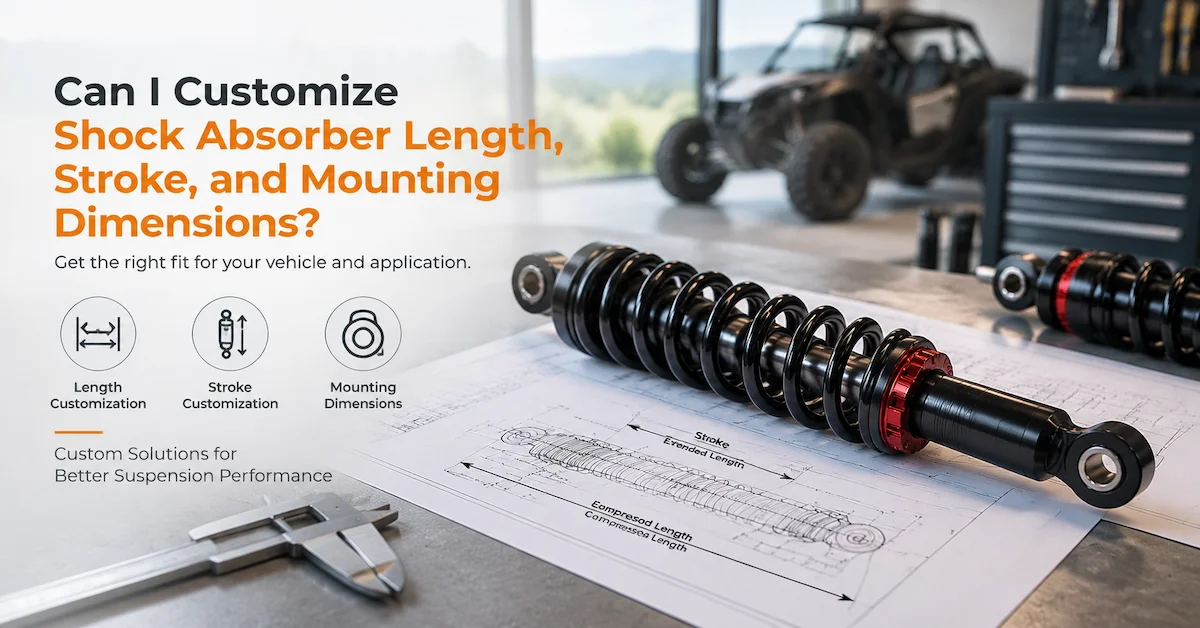
Depending on the project, customization may involve:
- Extended length
- Compressed length
- Stroke
- Body dimensions
- Rod dimensions
- Mounting interfaces
- Reservoir configuration
- Adjustment features
The supplier should be able to explain which parameters can be changed and what other suspension characteristics may be affected.
Suspension Spring Development
Spring development may need to consider:
- Vehicle mass
- Passenger weight
- Cargo
- Ride height
- Suspension geometry
- Shock position
- Available travel
Possible spring parameters include:
- Spring rate
- Free length
- Wire diameter
- Outside diameter
- Preload
A professional development discussion should go beyond simply offering “soft,” “medium,” and “hard.”
Damping Development
Where the project requires damping changes, the supplier should understand the separate roles of:
- Compression damping
- Rebound damping
The goal should not simply be “more damping.”
The goal is to achieve suitable suspension control for the vehicle, spring, load, and intended operating environment.
Why Prototype Revision Capability Matters
A custom suspension project rarely needs only the sequence:
Drawing → Mass Production
A safer development path is:
Requirement → Engineering Review → Prototype V1 → Testing → Revision → Prototype V2 → Approval
The exact number of prototype rounds depends on project complexity.
What matters is whether the supplier can convert test feedback into controlled engineering revisions.
For example, prototype testing may identify:
- Excessive rear sag
- Insufficient travel
- Mounting interference
- Incorrect ride height
- Too much compression resistance
- Insufficient rebound control
The engineering partner should then be able to determine what should change.
That may involve:
- Spring specification
- Shock dimensions
- Damping
- Mounting details
- Component configuration
How Should a Suspension Engineering Partner Support Testing?
A supplier should be transparent about its actual testing scope.
Not every validation step necessarily needs to be performed by the shock absorber manufacturer itself. Some projects require vehicle-level testing by the OEM or other testing resources.
What matters is whether the supplier can connect test results back to engineering decisions.
Dimensional Verification
Critical measurements may include:
- Extended length
- Compressed length
- Stroke
- Mounting-hole diameter
- Mount width
- Spring dimensions
Fitment Validation
The buyer should confirm:
- Installation alignment
- Full suspension movement
- Chassis clearance
- Tire clearance
- Reservoir clearance
- Adjacent component interference
Functional Checks
Depending on product design,checks may include:
- Leakage
- Smooth operation
- Assembly condition
- Product consistency
Vehicle-Level Feedback
Actual vehicle testing may reveal issues involving:
- Sag
- Ride height
- Bottoming
- Cargo support
- Rough-terrain response
- Compression behavior
- Rebound recovery
A good engineering partner should be able to discuss how this feedback affects the next product revision.
Can an Engineering Partner Support Prototype-to-Production Transfer?
This is one of the most important capabilities in an OEM project.
A good prototype does not automatically guarantee good production.
The engineering partner should ensure that mass production follows the approved specification.
Important controls may include:
| Production Control | Purpose |
|---|---|
| Final approved drawing | Controls dimensions and structure |
| Revision number | Prevents outdated designs |
| Spring specification | Controls load behavior |
| Damping specification | Maintains approved response |
| Material requirements | Controls product consistency |
| Approved prototype | Provides physical reference |
| Inspection criteria | Defines acceptance |
| Packaging specification | Controls commercial delivery |
The key principle is:
A suspension engineering partner should not only create a successful prototype; it should be able to reproduce the approved specification consistently in production.
Why Small-Batch Production Is Valuable
For new suspension programs, moving directly from one prototype to a large production order can create unnecessary risk.
A pilot or small production batch can help verify:
- Dimensional consistency
- Assembly repeatability
- Spring consistency
- Product finish
- Branding
- Packaging
- Inspection procedures
The development sequence may therefore become:
Prototype → Testing → Revision → Pilot Batch → Production Approval → Mass Production
This is particularly useful for:
- New ATV models
- New UTV projects
- Private-label suspension products
- Low-volume specialty vehicles
- New aftermarket product launches
How to Evaluate a Suspension Engineering Partner Before Cooperation
Rather than asking only for a quotation, use a capability-based evaluation.
| Area | Question to Ask |
|---|---|
| Engineering | Can you review our drawings and CAD files? |
| Application knowledge | What vehicle information do you need? |
| Customization | Which shock and spring parameters can you change? |
| Prototype | Can samples be revised after testing? |
| Testing | What can you test and what requires vehicle validation? |
| Revision control | How are engineering changes documented? |
| Small batch | Can you support pilot production? |
| Production | How do you reproduce approved specifications? |
| Quality | Which parameters are inspected in production? |
| Communication | Who handles technical feedback during development? |
A strong supplier should be able to answer these questions specifically rather than relying on generic marketing statements.
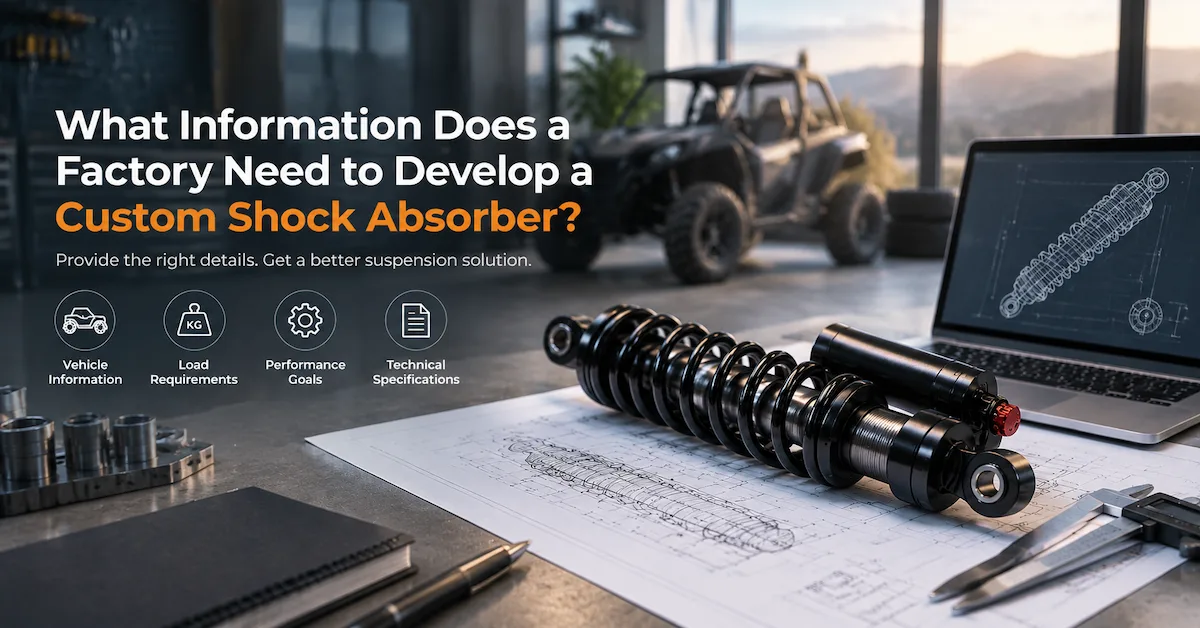
What Information Should You Send to a Suspension Engineering Partner?
A complete technical RFQ can significantly improve the quality of the supplier's response.
Prepare as much of the following information as possible:
- Vehicle type
- Vehicle model or platform
- Front or rear suspension position
- Vehicle weight
- Typical payload
- Maximum operating load
- Existing shock absorber
- 2D technical drawings
- 3D CAD files
- Extended length
- Compressed length
- Stroke
- Mounting dimensions
- Existing spring information
- Current suspension problem
- Desired improvement
- Intended terrain
- Prototype quantity
- Pilot-batch requirement
- Future production volume
If some data is unavailable, identify it clearly instead of guessing.
Engineering cooperation works better when both sides know which specifications are confirmed and which still need development.
Common Signs That a Supplier Is Mainly a Parts Seller
A supplier may be better suited to standard sourcing than engineering development if it:
- Only recommends existing catalog products
- Cannot explain spring or damping requirements
- Does not request vehicle information
- Cannot review drawings or CAD files
- Cannot revise prototypes
- Provides no clear development process
- Cannot explain how prototype specifications transfer to production
This does not mean the supplier is unreliable.
It simply means its business model may not match a custom engineering project.
Why Bedo Auto Can Support Engineering-Led Suspension Projects
Bedo Auto supports customized suspension development for ATV, UTV, off-road, and specialty vehicle applications.
Depending on the project requirements, the development process can include:
- Technical requirement review
- Existing sample analysis
- Drawing review
- CAD evaluation
- Custom shock absorber development
- Suspension spring development
- Prototype manufacturing
- Engineering revisions
- Testing support
- Small-batch validation
- Production preparation
This development approach is suitable for customers who need more than an existing catalog product.
Useful project resources include:
- Shock Absorber Products
- CAD Based Suspension Development
- Suspension Sample Development
- Contact Bedo Auto
OEM buyers can provide drawings, CAD files, physical samples, vehicle specifications, current suspension problems, and expected production volumes for project evaluation.
FAQ
What is a suspension engineering partner?
A suspension engineering partner supports product development rather than only supplying existing components. Its role may include vehicle requirement analysis, drawing and CAD review, shock and spring development, prototypes, revisions, testing support, and production preparation.
What is the difference between a suspension engineering partner and a parts supplier?
A parts supplier primarily provides existing products. An engineering partner can help define or modify suspension specifications based on vehicle requirements and test feedback.
How do I know if a supplier has real suspension engineering capability?
Evaluate whether the supplier can discuss vehicle weight, payload, mounting geometry, stroke, spring rate, compression and rebound damping, prototype revisions, and production control.
Can a suspension engineering partner work from CAD files?
Yes. CAD files can support packaging, mounting, geometry, clearance, and manufacturability review.
Can suspension products be developed from existing samples?
Yes. Existing samples can provide structural and dimensional references, but vehicle requirements should also be evaluated if the new application differs from the original.
Can shock absorber dimensions be customized?
Depending on project feasibility, customization may include extended length, compressed length, stroke, mounting dimensions, body configuration, and other structural parameters.
Can spring rate and damping be adjusted?
They can be adjusted on suitable projects. Final specifications should consider the vehicle, suspension geometry, load, spring characteristics, and target application.
Why are prototypes important in suspension development?
Prototypes help verify fitment, suspension behavior, manufacturing feasibility, and engineering assumptions before larger production quantities are approved.
Can a suspension engineering partner support small-batch production?
A flexible OEM manufacturer may support prototype and pilot quantities before mass production, depending on materials, tooling, manufacturing processes, and project requirements.
How do I make sure production matches the approved prototype?
Control the final drawing, revision number, spring specification, damping configuration, materials, inspection criteria, and approved reference sample.
Conclusion
Finding a suspension engineering partner instead of only a parts supplier requires changing the way you evaluate manufacturers.
Do not focus only on:
- Product catalog
- Unit price
- MOQ
Instead, evaluate whether the supplier can:
Understand the Vehicle → Review Engineering Data → Develop Prototypes → Interpret Test Feedback → Revise the Product → Control Production
For a standard replacement order, a reliable parts supplier may be exactly what you need.
For a new ATV, UTV, off-road, or specialty vehicle project, however, an engineering-led manufacturing partner can provide greater value by connecting vehicle requirements with product development and controlled production.
Bedo Auto supports suspension development through drawing and CAD review, custom shock absorber and spring development, prototype manufacturing, testing support, engineering revision, small-batch validation, and production preparation.
For an engineering-led project, prepare your vehicle information, current suspension problem, drawings, CAD files, samples, and expected quantities before requesting a technical evaluation.