
Can One Shock Absorber Factory Handle Engineering, Prototypes, Testing and Production?
Yes—but OEM buyers should verify that the shock absorber factory has real capabilities at every development stage rather than assuming that “one-stop service” means all technical work is actually controlled by the same manufacturing team.
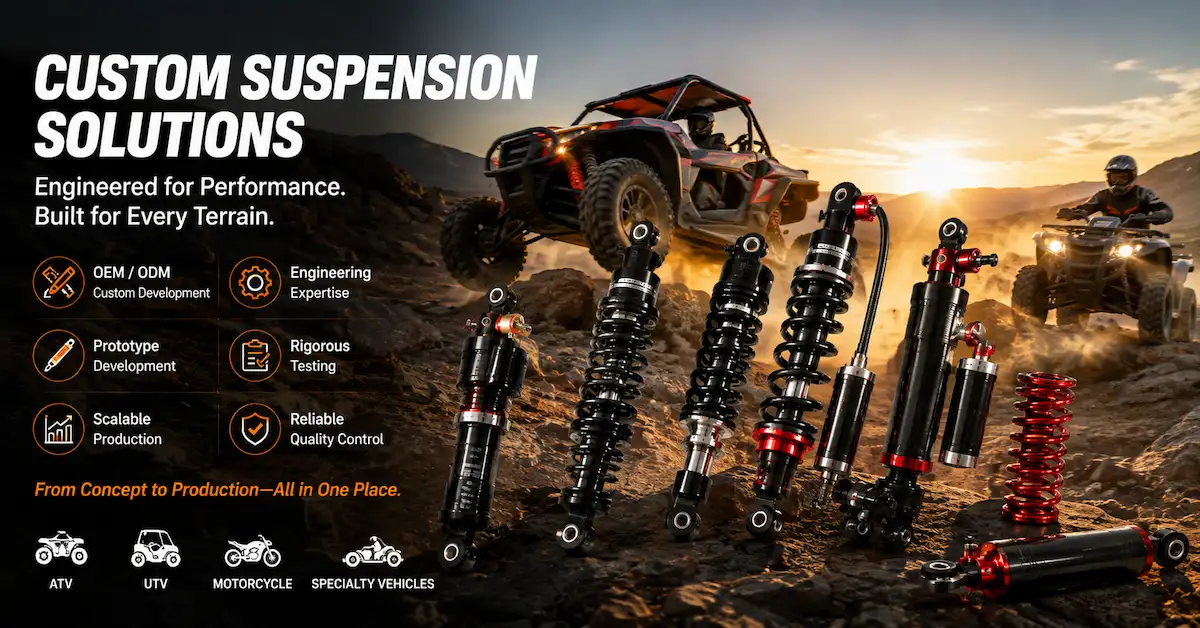
For a new ATV, UTV, off-road vehicle, or specialty vehicle project, an integrated suspension partner should be able to support the project from the first technical discussion through production preparation.
The typical development chain is:
Vehicle Requirements → Engineering Review → Prototype → Testing → Engineering Revision → Pilot Production → Mass Production
Keeping these stages closely connected can reduce specification errors, communication gaps, and problems when an approved prototype is transferred into production.
This is especially important for custom shock absorbers because the final product can depend on interacting parameters such as:
- Extended and compressed length
- Stroke
- Mounting geometry
- Spring rate
- Vehicle weight
- Payload
- Compression damping
- Rebound damping
- Reservoir configuration
- Intended terrain
Buyers can review Bedo Auto's Shock Absorber Products before deciding whether an existing configuration can be adapted or a new OEM development project is required.
Why OEM Buyers Benefit From an Integrated Shock Absorber Development Partner
Managing suspension engineering through several unrelated suppliers can create additional handoffs.
For example, one company may prepare a drawing, another may manufacture the prototype, a third may perform testing, and a fourth may handle final production.
That model can work, but it increases the number of places where information can be lost.
For technically customized shock absorbers, an integrated development partner can offer several advantages.
Fewer Technical Handoffs
When engineering and manufacturing teams communicate directly, changes to:
- Dimensions
- Springs
- Damping
- Mounting interfaces
- Materials
can be reflected more quickly in the next prototype or production revision.
Better Specification Control
The production team should work from the same approved:
- Drawing
- Revision number
- Spring specification
- Damping configuration
- Component list
- Quality requirements
used during validation.
Faster Prototype Revisions
A new suspension project may require more than one prototype.
If testing identifies excessive sag, incorrect fitment, or unsuitable suspension behavior, engineers may need to revise the specification before another sample is produced.
Easier Transition to Production
The biggest challenge is not always creating one successful prototype.
It is reproducing the approved prototype consistently during future production.
What Engineering Capability Should a Shock Absorber Factory Have?
Engineering capability is the first area OEM buyers should evaluate.
A factory that only manufactures existing catalog products may not be suitable for a new custom suspension project.
Drawing and CAD Review
A capable manufacturer should be able to review:
- 2D technical drawings
- 3D CAD files
- Physical samples
- Vehicle installation information
The engineering team should evaluate whether the proposed design is suitable for manufacturing and installation.
For drawing- or CAD-led projects, see Bedo Auto's CAD Based Suspension Development.
Vehicle Application Review
Shock absorber development should not happen independently of the vehicle.
Important inputs can include:
| Project Input | Why It Matters |
|---|---|
| Vehicle type | Defines application |
| Front/rear position | Defines suspension role |
| Vehicle weight | Supports spring development |
| Payload | Defines working load |
| Suspension geometry | Influences shock movement |
| Existing shock | Provides baseline |
| Terrain | Influences performance target |
| Target improvement | Defines engineering direction |
An ATV used for recreational trail riding may need a different suspension target from a UTV carrying tools and cargo.
Spring Development
The factory should understand the relationship between the shock absorber and spring.
Spring-related parameters may include:
- Spring rate
- Free length
- Wire diameter
- Outside diameter
- Preload range
A heavier spring is not automatically better. The correct spring must support the vehicle's actual load and suspension geometry.
Damping Development
Where the project requires performance changes, the supplier should understand:
- Compression damping
- Rebound damping
- Internal valve configuration
- Interaction between spring and damper
OEM buyers should be cautious if a supplier simply describes a product as “harder,” “sportier,” or “heavy duty” without being able to explain the technical target.
Can the Same Factory Develop Shock Absorber Prototypes?
For a new OEM project, prototype development is one of the clearest indicators that the supplier can support more than standard product sales.
A prototype allows buyers to verify whether engineering assumptions work on the actual vehicle.
A professional prototype process should include more than producing one sample.
Initial Engineering Sample
The first prototype can confirm:
- Basic dimensions
- Manufacturing feasibility
- Mounting configuration
- Product structure
Vehicle Fitment Review
The sample should then be checked for:
- Installation
- Mount alignment
- Chassis clearance
- Suspension movement
- Spring clearance
- Reservoir positioning where applicable
Performance Feedback
After installation,the buyer may identify changes related to:
- Ride height
- Load support
- Bottoming
- Spring behavior
- Compression response
- Rebound response
Engineering Revision
Feedback should be converted into controlled technical changes.
A useful process is:
Prototype V1 → Test Feedback → Revision → Prototype V2 → Approval
For related development workflows, buyers can review Suspension Sample Development.
What Should Be Tested Before Shock Absorber Production?
Testing scope should match the product and project requirements.
There is no responsible single testing checklist that applies identically to every shock absorber.
However, OEM buyers should understand what the supplier can verify.
Dimensional Verification
Critical dimensions may include:
- Extended length
- Compressed length
- Stroke
- Upper mount
- Lower mount
- Hole diameter
- Bushing width
- Spring dimensions
Incorrect dimensions can make a technically sound shock unusable on the vehicle.
Fitment Validation
Vehicle-level checks may include:
- Installation alignment
- Full extension clearance
- Compression clearance
- Suspension travel
- Reservoir clearance
- Adjacent component interference
Leakage and Functional Checks
Depending on shock construction,functional verification may examine:
- Sealing
- Assembly function
- Smooth shock movement
- Product condition
Suspension Performance Evaluation
Performance testing may need to assess:
- Spring support
- Compression behavior
- Rebound behavior
- Vehicle response under expected load
The factory should clearly explain what it tests, how it evaluates the result, and what acceptance criteria apply to the project.
Generic claims such as “100% tested” are less useful than a project-specific testing plan.
Why Prototype-to-Production Transfer Is a Critical OEM Step
An approved prototype does not automatically guarantee successful mass production.
This is one of the most important issues for OEM suspension sourcing.
Imagine that Prototype Revision C performs correctly.
If production later uses:
- Revision B drawing
- Different spring specification
- Different damping configuration
- Unapproved component substitutions
the production shock may no longer match the validated sample.
A professional shock absorber factory should therefore control the transition using approved production documentation.
Key items can include:
| Control Item | Purpose |
|---|---|
| Final drawing | Controls geometry |
| Revision number | Prevents outdated production |
| Spring specification | Controls load support |
| Damping configuration | Controls shock behavior |
| Materials/components | Controls product consistency |
| Inspection criteria | Defines acceptance |
| Approved sample | Provides production reference |
For OEM buyers, this stage is often more important than the appearance of the first prototype.
How Does a Complete OEM Shock Absorber Project Work?
A practical integrated workflow can be divided into six stages.
Step 1: Requirement Analysis
The buyer and factory define:
- Vehicle application
- Product objective
- Load conditions
- Terrain
- Production expectations
Step 2: Engineering Review
The manufacturer evaluates:
- Drawings
- CAD data
- Samples
- Dimensions
- Spring requirements
- Damping targets
Step 3: Prototype Manufacturing
The factory produces development samples for initial verification.
Step 4: Testing and Engineering Revision
The prototype is tested and feedback is converted into updated specifications.
Step 5: Pilot or Small-Batch Production
Before full-scale production, a limited batch can help verify:
- Manufacturing consistency
- Assembly repeatability
- Product finish
- Branding
- Packaging
- Quality inspection
Step 6: Mass Production
Once the design and production process are approved, the factory moves into controlled repeat production.
This approach is especially useful for new OEM suspension projects where both technical performance and long-term supply consistency matter.
One Integrated Factory vs Multiple Suppliers
Neither model is universally correct.
The better choice depends on project complexity.
| Factor | Integrated Development Partner | Multiple Suppliers |
|---|---|---|
| Technical communication | More centralized | More interfaces |
| Prototype revisions | Usually simpler | More coordination |
| Specification control | Easier to centralize | Can become fragmented |
| Quality responsibility | Clearer | Shared across suppliers |
| Production transfer | More direct | Additional handoffs |
| Multi-category sourcing | More limited | Can be advantageous |
If a buyer needs dozens of unrelated vehicle systems, multiple specialized suppliers may be the better sourcing strategy.
But for a technically evolving shock absorber project, keeping engineering, prototyping, validation, and production closely connected can reduce development friction.
How Do You Verify That a Factory Really Has All Four Capabilities?
Do not rely only on website claims.
Evaluate each capability separately.
Engineering
Ask whether the technical team can discuss:
- Shock stroke
- Mounting geometry
- Spring rate
- Compression damping
- Rebound damping
- Vehicle load
Request engineering feedback on your actual project rather than generic sales answers.
Prototype Development
Ask:
- Can you manufacture a prototype from our drawings?
- Can you develop from a physical sample?
- Can you revise the sample after vehicle testing?
- Can you support multiple development rounds if required?
Testing
Ask:
- What can you test internally or coordinate?
- Which parameters are measured?
- How are results documented?
- What is the project acceptance standard?
Production
Ask how the factory ensures that production units match the approved development sample.
This should involve controlled:
- Drawings
- Specifications
- Materials
- Manufacturing processes
- Inspection requirements
A factory that can explain these four areas clearly is more useful to an OEM buyer than one offering only a low unit price.
What Information Should You Send Before Requesting an OEM Quotation?
A generic request such as:
“Please quote your best ATV shock.”
does not give the factory enough information for a technical OEM proposal.
A stronger RFQ should include:
- Vehicle type and platform
- Front or rear application
- Current shock absorber sample
- 2D drawings if available
- 3D CAD if available
- Extended and compressed lengths
- Stroke
- Mounting dimensions
- Vehicle weight
- Typical and maximum payload
- Existing spring information
- Performance problem or target
- Operating terrain
- Prototype quantity
- Initial production quantity
- Estimated repeat volume
- Branding requirements
- Packaging requirements
If a parameter is not known, identify it as an engineering question rather than inventing a value.
Which Vehicle Projects Benefit Most From Integrated Shock Absorber Development?
ATV Projects
Potential needs include:
- Replacement suspension
- Performance upgrades
- Utility applications
- New OEM models
UTV Projects
Development often needs greater attention to:
- Passenger load
- Cargo
- Vehicle mass
- Longer travel
- Utility operation
Modified Off-Road Vehicles
Changes such as:
- Larger tires
- Added equipment
- Battery systems
- Cargo racks
can alter suspension requirements.
Specialty Vehicle Projects
Low-volume platforms may particularly benefit from a manufacturer that supports prototypes and pilot production before scaling.
How Bedo Auto Supports OEM Shock Absorber Development
Bedo Auto focuses on shock absorbers, suspension springs, and related suspension development for off-road and specialty vehicle applications.
Depending on the project, support can include:
- Technical requirement review
- Drawing and CAD review
- Existing sample analysis
- Custom shock absorber development
- Suspension spring development
- Prototype manufacturing
- Testing support
- Engineering revisions
- Small-batch validation
- Production preparation
This makes the development relationship more useful for buyers who need more than an existing catalog shock absorber.
Relevant resources include:
- Shock Absorber Products
- Suspension Sample Development
- CAD Based Suspension Development
- Contact Bedo Auto
OEM buyers can submit drawings, CAD files, existing shock samples, vehicle data, and production requirements for project-specific evaluation.
FAQ
Which shock absorber factory can provide engineering, prototypes, testing, and production?
Look for a factory that can review vehicle requirements and drawings, develop and revise prototypes, support project-specific testing, and transfer the approved specification into controlled production.
Can one shock absorber manufacturer handle a complete OEM project?
Yes, if the manufacturer has engineering, prototype, testing support, quality control, and production capabilities appropriate to the project.
Can shock absorbers be developed from CAD files?
Yes. CAD data can help engineers evaluate dimensions, mounting relationships, packaging space, and manufacturing feasibility.
Can a factory develop a shock absorber from an existing sample?
Yes. A physical sample can provide dimensions and construction references, but vehicle data should also be supplied if performance or application requirements will change.
Why should prototypes be tested before mass production?
Prototype testing helps identify fitment, spring, damping, structural, or manufacturing issues before they affect a large production batch.
What shock absorber tests should OEM buyers ask about?
Ask about dimensional inspection, fitment verification, leakage or functional checks, damping evaluation where required, durability expectations, and the acceptance criteria relevant to the specific product.
Can spring rate and damping be customized?
They can be customized on suitable projects when the manufacturer has the necessary engineering and development capability. Final values should match the vehicle, load, suspension geometry, and intended use.
Can a factory support small batches before mass production?
A flexible OEM manufacturer may support prototype and pilot quantities before larger production, depending on product design, materials, processes, and tooling requirements.
How do I make sure mass production matches the approved prototype?
Use controlled drawings, revision numbers, component and spring specifications, damping configuration, inspection standards, and an approved sample as the production reference.
How do I start an OEM shock absorber project with Bedo Auto?
Prepare your vehicle application, drawings or CAD files, physical samples, load data, performance target, prototype quantity, and future production expectations, then submit them through the Bedo Auto Contact Page.
Conclusion
The best shock absorber factory for an OEM project is not simply the supplier with the largest catalog or the lowest quotation.
For technically customized projects, OEM buyers should look for a partner that can connect:
Engineering → Prototype Development → Testing → Engineering Revision → Production
The strongest value comes from maintaining one controlled technical specification throughout the development and manufacturing process.
For ATV, UTV, off-road, and specialty vehicle projects, buyers should specifically verify engineering capability, prototype revision support, testing scope, quality control, and the ability to reproduce an approved design consistently.
Bedo Auto supports suspension projects through drawing and CAD review, shock absorber and spring development, prototypes, testing support, small-batch validation, and production preparation.
If your project requires a custom suspension solution rather than a standard catalog shock, submit the available vehicle information, drawings, CAD files, samples, and expected quantities for technical evaluation.