
What Does Off-Road Parts Customization in China Actually Mean?
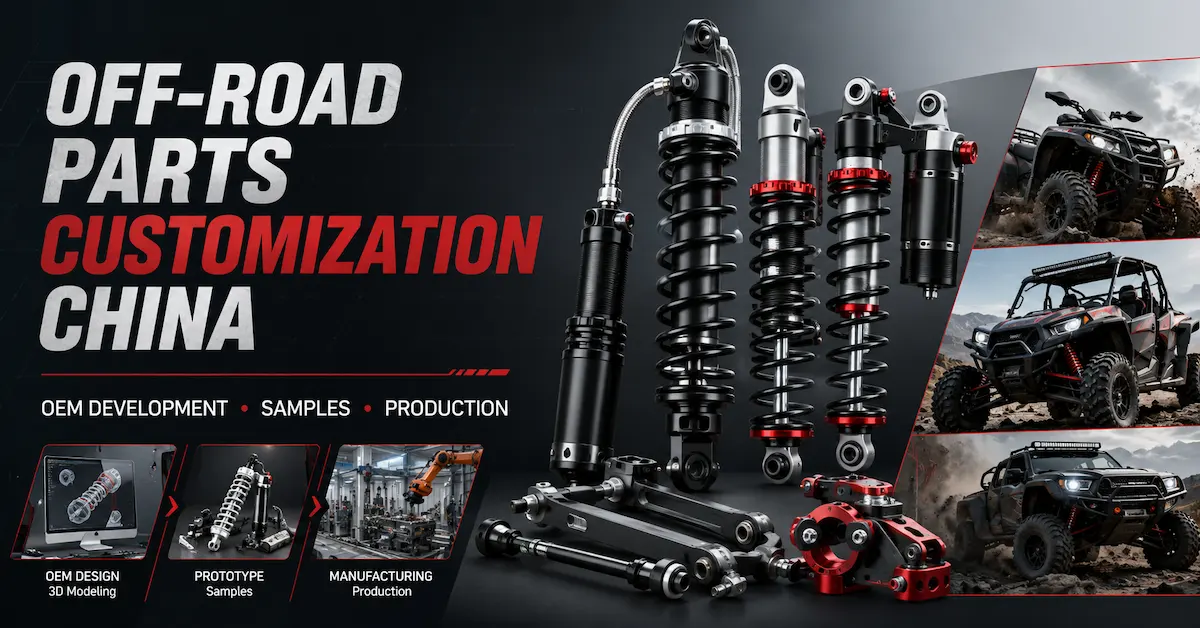
Off-road parts customization China sourcing usually refers to working with a Chinese manufacturer to develop vehicle components according to customer-specific drawings, reference samples, dimensions, vehicle requirements, branding, or performance targets.
However, “custom off-road parts” is a very broad term.
Depending on the supplier, customization might mean only:
- Logo marking
- Color changes
- Packaging
- Labels
Or it may involve real engineering work such as:
- Custom shock absorber dimensions
- Suspension spring development
- Mounting-eye customization
- Bushings and sleeves
- Stroke changes
- Spring-rate changes
- Compression and rebound adjustment
- Reservoir configuration
- Drawing-based components
- Prototype development
- Small-batch validation
For B2B buyers, the first sourcing question should therefore be:
What can this factory actually customize?
Bedo Auto focuses primarily on shock absorbers, suspension springs, and related off-road suspension components rather than claiming to manufacture every part of an ATV or UTV. Its current off-road suspension content describes customization support for shock absorbers, springs, bushings, mounting parts, reservoirs, adjusters, and related suspension components for ATV, UTV, motorcycle, electric motorcycle, snowmobile, and specialty-vehicle projects.
Buyers looking specifically for suspension components can review Bedo's Off-Road Suspension Component Factory Guide.
Who Usually Sources Customized Off-Road Parts From China?
Custom sourcing is most relevant when a standard catalog component cannot meet the project requirement.
Typical B2B buyers include:
- ATV manufacturers
- UTV manufacturers
- Motorcycle brands
- Electric motorcycle developers
- Snowmobile manufacturers
- Utility vehicle companies
- Off-road modification factories
- Specialty vehicle manufacturers
- Aftermarket wholesalers
- Private-label brands
- Importers and distributors
- OEM and ODM purchasing teams
Their objectives can be very different.
An OEM vehicle manufacturer may need a shock absorber developed around a new suspension geometry.
A modification company may need stronger springs and revised damping after installing larger tires, batteries, toolboxes, cargo racks, or other accessories.
An aftermarket distributor may already have a validated shock absorber and mainly require branding, color, packaging, and a repeatable supply specification.
Bedo's current modification-factory guidance specifically identifies vehicle changes such as larger tires, cargo equipment, battery packs, lift-related changes, and reinforced structures as reasons suspension specifications may need to be reconsidered.
Which Off-Road Suspension Parts Can Be Customized?
For suspension-focused projects, buyers can divide customization into several groups.
Complete Shock Absorbers
Possible customization may include:
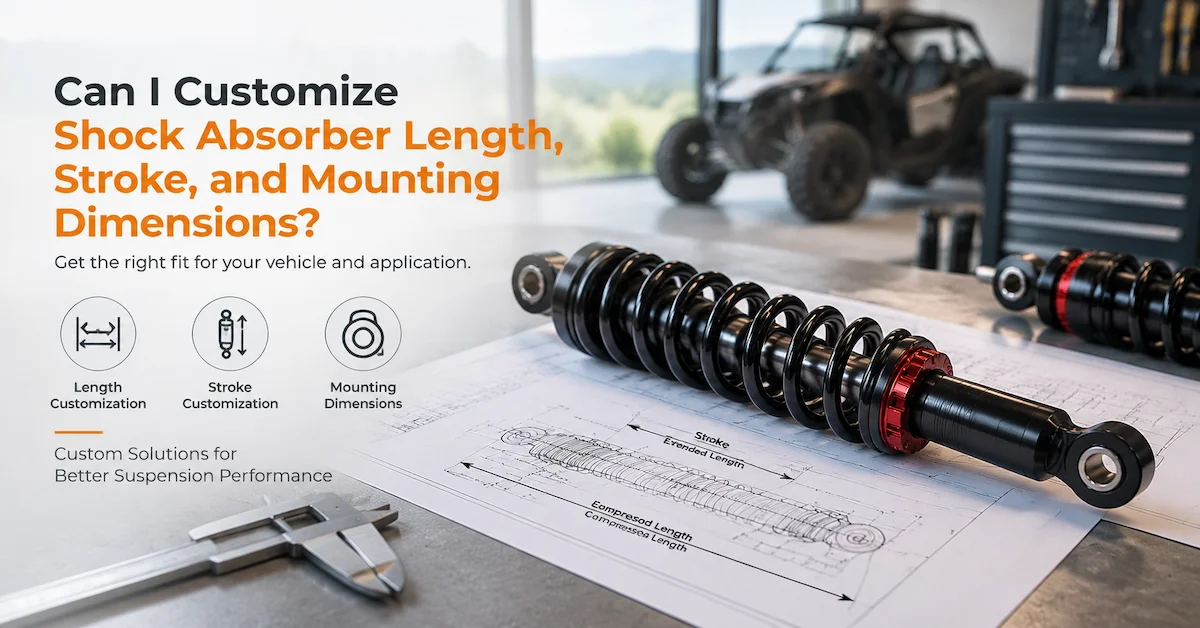
- Extended length
- Compressed length
- Stroke
- Mounting-eye dimensions
- Fork or clevis dimensions
- Spring rate
- Preload range
- Compression damping
- Rebound damping
- Reservoir configuration
- Adjusters
- Surface treatment
- Logo and packaging
Bedo's current OEM ATV shock absorber page also lists customizable valving, spring rates, finishes, and branding as available project options.
Suspension Springs
Spring customization can involve:
- Spring rate
- Wire diameter
- Free length
- Outside diameter
- Load-support target
- Coating
- Color
Spring specifications should be developed around the vehicle and suspension system rather than selected only from appearance.
Bushings and Mounting Components
Custom interfaces may include:
- Mounting eyes
- Bushings
- Sleeves
- Spring seats
- Mounting hardware
- Brackets
These parts may appear simple, but dimensional mistakes can cause installation problems even when the shock absorber itself is correct.
Reservoir and Adjustment Components
Some projects may require:
- External reservoir
- Remote reservoir
- Reservoir bracket
- Hose routing
- Preload adjuster
- Compression adjuster
- Rebound adjuster
Not every vehicle needs these features.
A professional supplier should determine whether they are justified by the application rather than automatically adding complexity.
Standard Parts vs Customized Off-Road Parts
| Evaluation Point | Standard Part | Customized Part |
|---|---|---|
| Geometry | Fixed | Based on project data |
| Mounting | Existing specification | Can be modified |
| Spring rate | Predefined | Can be developed |
| Damping | Standard calibration | Application-specific |
| Appearance | Limited | Color/logo options |
| Packaging | Standard | Private label possible |
| Prototype stage | Often unnecessary | Usually useful for new designs |
| Engineering input | Low | Medium to high |
| Best for | Established replacement demand | OEM, ODM, modified or specialty vehicles |
Customization therefore makes most sense when there is a real technical or commercial reason for changing the existing specification.
What Information Should You Send to a Chinese Customization Factory?
A buyer should not send only a photograph and ask:
“Can you make this?”
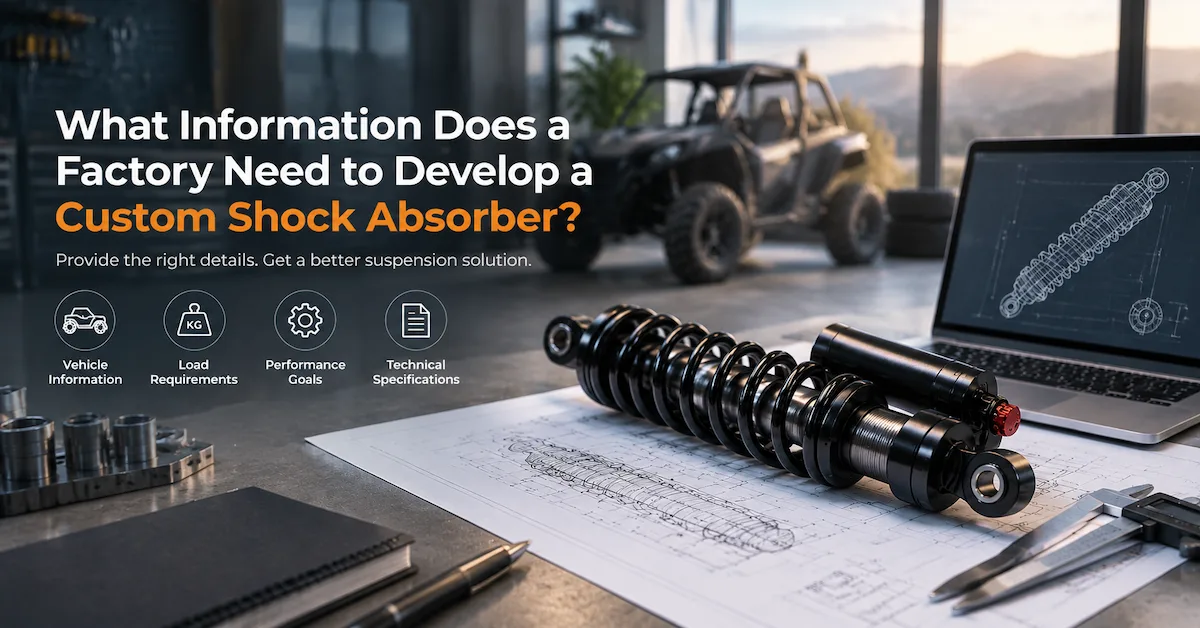
For meaningful engineering review, prepare as much verified information as possible.
| Project Input | Useful Information | Why It Matters |
| Vehicle type | ATV, UTV, motorcycle, snowmobile, etc. | Defines application |
| Position | Front or rear | Defines suspension role |
| Vehicle weight | Empty and loaded | Supports spring development |
| Payload | Riders, cargo, tools, batteries | Defines operating load |
| Extended length | Mount-center dimension | Controls fitment |
| Compressed length | Minimum length | Controls compression |
| Shock stroke | Damper travel | Supports suspension movement |
| Mount dimensions | Hole, bush, fork, width | Ensures installation |
| Spring data | Rate, free length, OD | Provides baseline |
| Damping data | Existing curve or target if available | Supports tuning |
| Drawings | 2D engineering data | Controls dimensions |
| CAD | 3D component/vehicle data | Supports packaging |
| Physical sample | Existing product | Supports analysis |
| Terrain | Sand, trail, rock, mud, snow, utility | Defines duty |
| Main problem | Sag, harshness, bottoming, fitment | Defines objective |
| Prototype quantity | Development volume | Supports planning |
| Production quantity | Expected repeat demand | Supports quotation |
Bedo's current off-road customization guidance likewise recommends confirming vehicle type, installation position, shock lengths, stroke, mounting dimensions, spring rate, damping, load condition, terrain, and surface-treatment requirements before final OEM or ODM production.
Should You Develop Parts From Drawings or Physical Samples?
Both methods can work.
The right method depends on what information already exists.
Drawing-Based Development
Drawings are especially useful when the buyer already controls the design.
They can define:
- Critical dimensions
- Tolerances
- Materials
- Surface finish
- Interface dimensions
- Revision status
- Inspection requirements
Bedo currently supports drawing-based customization of shock absorbers, springs, and related off-road suspension components for OEM/ODM projects.
You can review the related Drawing Customized Off-Road Suspension Components guide.
CAD-Based Development
3D CAD becomes particularly useful when the factory needs to evaluate:
- Packaging
- Vehicle geometry
- Mounting relationships
- Clearance
- Assembly
- Component interference
ISO 16792:2021 specifies requirements for preparing, revising, and presenting digital product-definition data and supports both 3D-model-only and combined 3D-model-plus-2D-drawing workflows.
Sample-Based Development
A physical sample can help identify:
- Structure
- Dimensions
- Spring configuration
- Mounting interfaces
- Reservoir layout
- Appearance
However, buyers should not assume that copying a sample will automatically make it suitable for a different vehicle.
If vehicle weight, geometry, payload, tire size, or terrain changes, the suspension specification may also need to change.
Why Drawings and Revision Control Matter in China OEM Projects
International sourcing often involves several teams:
Engineering → Purchasing → Chinese Supplier → Prototype Team → QC → Production
Without controlled drawings, important changes can be lost between teams.
Consider this sequence:
Revision A
Initial mounting width
Revision B
Width updated after prototype installation
Revision C
Final production-approved design
If purchasing places a bulk order but production uses Revision A, the factory may produce a perfectly consistent batch of the wrong design.
A professional sourcing process should therefore identify:
- Drawing number
- Revision number
- CAD revision
- Approval date
- Prototype version
- Production-release version
Digital-product-definition practices such as ISO 16792 emphasize controlled preparation and revision of digital product data, which is directly relevant to drawing-based OEM collaboration.
How Should Prototype Development Work?
For a genuinely new custom suspension project, buyers should avoid moving directly from an RFQ into mass production.
A more controlled route is:
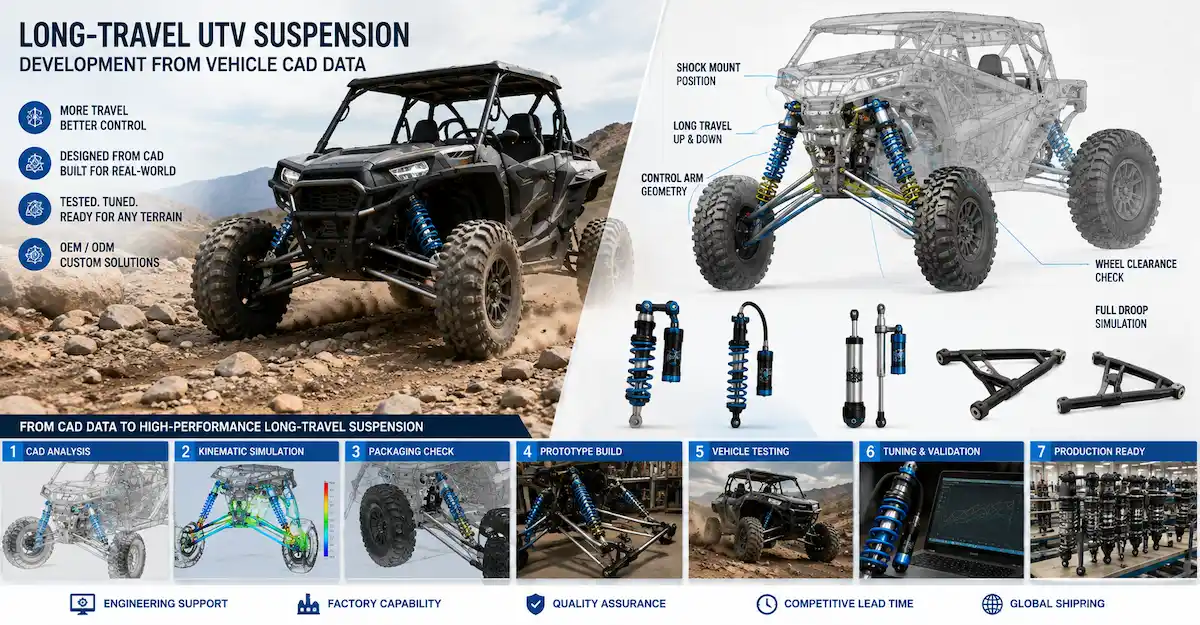
Technical Review → Drawing/Sample Confirmation → Prototype → Testing → Revision → Pilot Batch → Production
Step 1: Confirm Technical Scope
Define whether the project requires:
- Appearance customization
- Dimensional customization
- Spring development
- Damping development
- New mounting structures
- Complete vehicle-specific engineering
Step 2: Manufacture Samples
Prototype parts provide physical evidence of:
- Fitment
- Dimensions
- Assembly
- Appearance
- Manufacturing feasibility
Step 3: Install on the Vehicle
Check:
- Mount alignment
- Chassis clearance
- Tire clearance
- Suspension travel
- Spring clearance
- Reservoir placement
Step 4: Evaluate Performance
For shock absorber projects, this can involve:
- Spring behavior
- Compression response
- Rebound response
- Load support
- Bottoming tendency
- Leakage
- General vehicle response
Step 5: Revise the Specification
Changes should be reflected in drawings and production documents.
Step 6: Validate a Small Batch
Bedo's current off-road customization guidance recommends sample or small-batch testing as a way to verify mounting, spring rate, damping, surface treatment, packaging, and production suitability before larger orders.
Why Small-Batch Production Can Reduce Sourcing Risk
A buyer may be tempted to increase quantity immediately to obtain a lower unit price.
That can be risky when the product is new.
A pilot batch can help verify:
- Repeatable dimensions
- Assembly consistency
- Spring configuration
- Damping consistency
- Finish quality
- Branding
- Packaging
- Vehicle fitment
This stage is particularly useful for:
- New vehicle platforms
- Private-label launches
- Modification products
- Specialty vehicles
- New aftermarket SKUs
The objective is to identify production variation before large inventory is created.
How Should You Evaluate a China Off-Road Parts Customization Supplier?
The lowest quotation is not necessarily the lowest sourcing cost.
Evaluate suppliers across several dimensions.
1. Product Scope
Confirm exactly what the factory manufactures.
If you need suspension components, ask whether it actually supports:
- Shock absorbers
- Springs
- Bushings
- Mounts
- Reservoir components
Do not assume a supplier advertising “off-road parts” manufactures every product category internally.
2. Engineering Capability
Ask whether the supplier can review:
- Physical samples
- Technical drawings
- CAD files
- Vehicle specifications
- Mounting geometry
- Spring requirements
- Damping requirements
3. Prototype Capability
Confirm whether it can manufacture development samples before bulk production.
4. Testing Capability
Ask specific questions:
- What is tested?
- Which parameters are measured?
- What acceptance criteria are used?
- What documentation can be supplied?
Avoid generic statements such as:
“All parts are fully tested.”
without knowing what “tested” actually means.
5. Quality Management
Quality should be managed throughout the process rather than only through final visual inspection.
ISO describes ISO 9001 as an international quality-management-system standard applicable across manufacturing and supplier approval processes.
For B2B buyers, useful supplier questions include:
- How are incoming materials controlled?
- How are drawings and revisions managed?
- How are nonconforming parts handled?
- How are critical dimensions inspected?
- How is production consistency monitored?
Certification can support supplier evaluation, but it does not replace project-specific product validation.
6. OEM/ODM Support
Commercial customization can include:
- Logo
- Labels
- Spring/body colors
- Private-label packaging
- Product identification
Confirm these requirements separately from technical customization.
7. Repeat Production Capability
The supplier should be able to reproduce the approved prototype in later batches.
That requires controlled:
- Drawings
- Materials
- Spring specification
- Damping configuration
- Assembly process
- Inspection criteria
What Should Buyers Compare Beyond Unit Price?
When sourcing off-road parts customization China, compare the total project structure.
A quotation should make it clear what is included.
Important cost areas can include:
- Engineering
- Prototype production
- Tooling where required
- Custom materials
- Custom springs
- Damping development
- Surface treatment
- Testing
- Branding
- Packaging
- Pilot production
- Bulk production
Two suppliers may quote very different prices because they are quoting different scopes.
For example:
Supplier A: copies the sample dimensions.
Supplier B: reviews the application, modifies the spring, develops damping, manufactures prototypes, tests, and updates drawings.
Those quotations should not be compared as if they represent the same service.
What Determines MOQ for Customized Off-Road Parts?
There is no responsible universal MOQ for all custom off-road parts.
MOQ can depend on:
- Component type
- Existing tooling
- New tooling
- Material sourcing
- Custom spring requirements
- Surface treatment
- Machining
- Packaging
- Assembly process
Bedo's current off-road customization content states that many buyers begin with samples or small batches before larger production, especially when fitment or performance still needs verification.
For an OEM buyer, the better question is often:
What is the smallest economically reasonable quantity for this specific design stage?
rather than:
What is your lowest MOQ for everything?
What About Branding and Private Label Customization?
Many B2B buyers sourcing from China are building their own product lines.
Possible commercial customization can include:
- Brand logo
- Laser marking
- Product labels
- Spring color
- Shock body color
- Packaging
- Model numbers
Branding should be approved through a separate artwork process.
Do not mix brand artwork approval with technical drawing approval.
A useful document structure is:
Engineering Drawing
Controls the product.
Brand Artwork
Controls logo and visual identity.
Packaging Specification
Controls labels, cartons, manuals, and packing method.
This separation reduces misunderstandings during repeat production.
Common Risks in Off-Road Parts Customization From China
Risk 1: Choosing a Trader When You Need Engineering
A trading company may be useful for sourcing coordination, but technical development requires access to the actual engineering and production process.
Better approach: understand who designs, prototypes, manufactures, and tests the product.
Risk 2: Sending Only Photos
Photos cannot reliably define critical dimensions or performance requirements.
Better approach: add drawings, samples, CAD, or confirmed measurements.
Risk 3: Choosing by Price Before Defining Scope
Different factories may interpret “custom” differently.
Better approach: issue the same technical RFQ to every supplier.
Risk 4: Skipping Prototypes
Fitment or damping issues discovered after bulk production become expensive.
Better approach: prototype new engineering configurations.
Risk 5: Weak Revision Control
Old drawings may be reused during repeat orders.
Better approach: identify production-approved revisions clearly.
Risk 6: Assuming a Factory Makes Every Off-Road Part
An off-road vehicle contains suspension, steering, drivetrain, braking, frame, electrical, and body systems.
Better approach: qualify the supplier for the specific component family you need.
Why a Suspension-Focused Supplier Can Be Better for Suspension Projects
A broad off-road-parts sourcing company may offer many product categories.
That can be useful for general procurement.
However, a suspension-specific project benefits from deeper knowledge of:
- Shock absorber geometry
- Spring rate
- Preload
- Compression damping
- Rebound damping
- Reservoir systems
- Mounting interfaces
- Vehicle load
- Suspension travel
Bedo Auto's current off-road suspension factory content positions its scope around customized shock absorbers, springs, and related suspension components, with support for samples, drawings, mounting confirmation, spring-rate development, damping adjustment, prototypes, small batches, branding, and repeat manufacturing.
For buyers evaluating this specialized route, see Off-Road Vehicle Suspension Solutions for Modification Factories.
How Bedo Auto Supports Off-Road Customization Projects
Bedo Auto's published capabilities focus on suspension products rather than every possible off-road vehicle component.
Current project support includes:
- Sample analysis
- Technical drawing review
- Vehicle application evaluation
- Mounting-dimension confirmation
- Spring-rate development
- Compression and rebound adjustment
- Reservoir configuration
- Bushing and mounting customization
- Surface-treatment options
- Prototype production
- Small-batch validation
- OEM/ODM branding
- Repeat production support
This makes the company more relevant when the buyer's off-road parts customization China project is specifically centered on suspension.
Buyers can review Bedo's shock absorber products before deciding whether an existing configuration can be adapted or whether a fully customized development project is necessary.
What Should You Include in an Off-Road Parts RFQ?
Prepare a structured sourcing package.
Include:
- Vehicle type
- Vehicle model/application
- Required component
- Front or rear position
- Existing drawing
- 3D CAD if available
- Physical reference sample
- Critical dimensions
- Vehicle weight
- Maximum load
- Spring information
- Damping information
- Terrain
- Main performance issue
- Material requirement
- Surface treatment
- Branding requirement
- Prototype quantity
- Pilot-batch quantity
- Estimated annual or repeat volume
- Inspection requirements
- Packaging requirements
If a parameter is not known, mark it as an open engineering question.
Do not invent technical data simply to make an RFQ appear complete.
For suspension-focused projects, buyers can submit samples, drawings, CAD data, and purchasing requirements through the Bedo Auto Contact Page.
FAQ
What does off-road parts customization China mean?
It generally refers to developing off-road vehicle components with Chinese manufacturers according to customer drawings, samples, dimensions, performance requirements, branding, or OEM/ODM specifications.
What off-road parts can Bedo Auto customize?
Bedo Auto's published scope focuses on suspension products such as shock absorbers, suspension springs, bushings, mounting components, reservoirs, and related suspension components rather than every vehicle system.
Can off-road suspension parts be developed from drawings?
Yes. Bedo currently supports drawing-based custom shock absorbers, suspension springs, and related components for OEM/ODM projects.
Can a Chinese factory customize parts from a physical sample?
Yes, when the supplier has sample-analysis and development capability. The buyer should also provide new vehicle or performance information if the customized part will be used differently from the original sample.
Should I make a prototype before placing a bulk order?
For new dimensions, new spring specifications, new damping, or a new vehicle application, prototype validation can reduce the risk of discovering fitment or performance problems after bulk production.
Can spring rate and damping be customized?
Bedo's published customization capabilities include spring-rate development and compression/rebound adjustment for relevant suspension projects.
Can I order private-label suspension products from China?
Depending on supplier capability, OEM/ODM projects may include logo, color, labels, and packaging. Bedo currently lists OEM/ODM branding and packaging among its project-support options.
How should I evaluate quality when sourcing customized parts?
Review drawing control, materials, incoming inspection, dimensional inspection, functional testing, nonconformance handling, prototype validation, and repeat-production consistency rather than relying only on a final visual check.
Is low MOQ always available for custom parts?
No. MOQ depends on the component, materials, processing, tooling, surface treatment, and customization requirements. Prototype or pilot quantities should be discussed based on the actual project.
How do I start an off-road suspension customization project with Bedo Auto?
Prepare your vehicle application, drawings or CAD, reference samples, mounting dimensions, spring and damping information, target improvements, prototype quantity, and production plan, then submit them through the Bedo Auto Contact Page.
Conclusion
Off-road parts customization China sourcing can be highly effective when the buyer treats it as an engineering and supply-chain project rather than a simple price-comparison exercise.
The most reliable process is:
Requirement → Supplier Qualification → Drawing/Sample Review → Prototype → Vehicle Validation → Engineering Revision → Pilot Batch → Controlled OEM Production
For suspension projects, buyers should pay particular attention to dimensions, mounting geometry, vehicle load, spring rate, damping, revision control, testing, and production consistency.
ISO's digital-product-definition guidance reinforces the value of controlled engineering data, while quality-management frameworks such as ISO 9001 emphasize consistency, process control, and continuous improvement.
Most importantly, buyers should choose a supplier whose technical scope matches the actual product being developed.
Bedo Auto's current specialization is shock absorbers, suspension springs, and related off-road suspension components, with support extending from sample and drawing review through customization, prototypes, small-batch validation, OEM/ODM branding, and repeat production.
If your ATV, UTV, motorcycle, electric motorcycle, snowmobile, utility vehicle, or specialty vehicle project requires customized suspension components from China, prepare your technical package and submit it through the Bedo Auto Contact Page for project-specific review.