
What Are Custom Suspension Solutions?
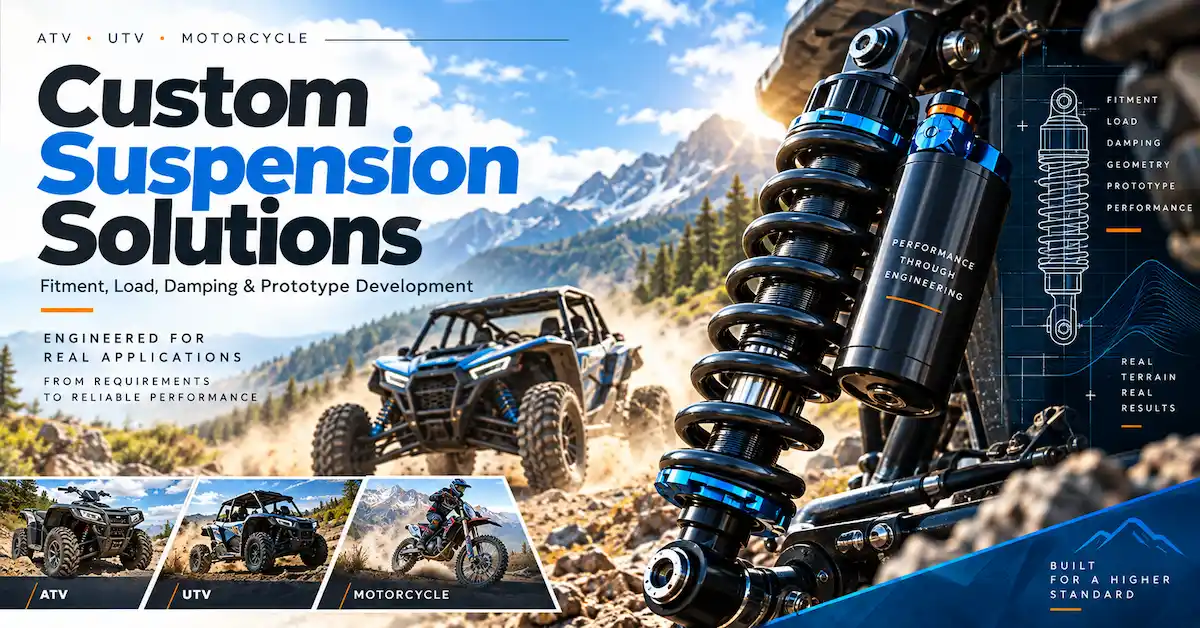
Custom Suspension Solutions are suspension components and engineering services developed around the requirements of a specific vehicle, load condition, terrain, or target performance rather than selected only from a standard catalog.
For ATV, UTV, motorcycle, electric motorcycle, and specialty-vehicle projects, customization may involve much more than changing the spring color or adding a logo.
A complete solution can involve:
-
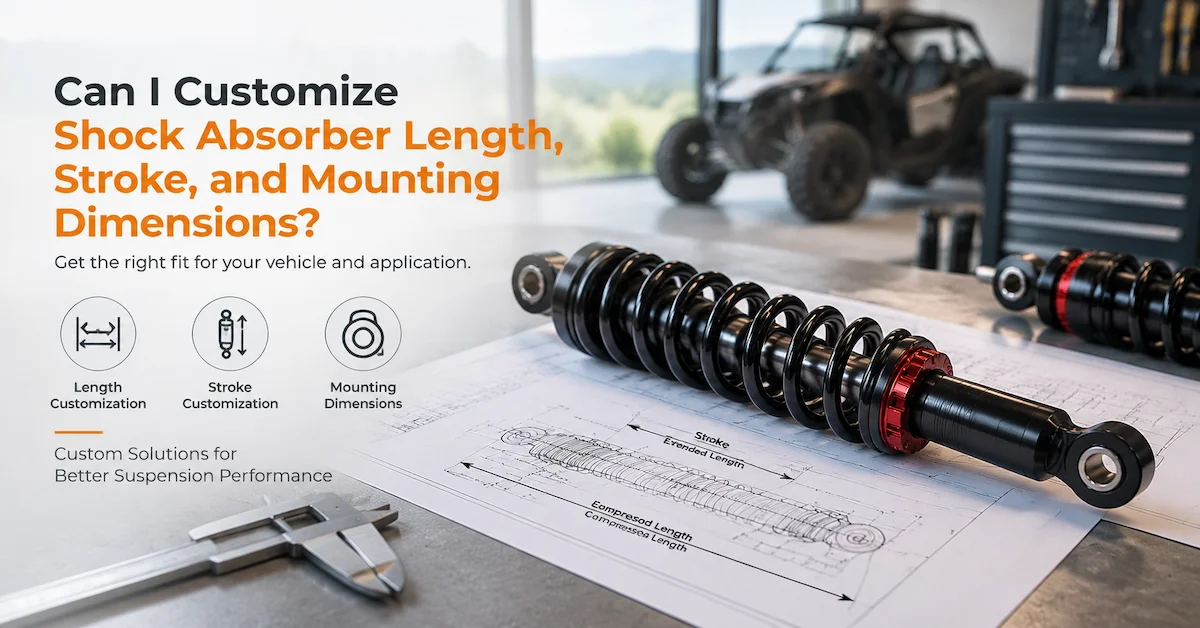
shock absorber length and stroke;
-
upper and lower mounting dimensions;
-
spring rate;
-
preload;
-
compression damping;
-
rebound damping;
-
reservoir configuration;
-
suspension springs;
-
ball joints or related components;
-
corrosion-resistant finishes;
-
prototype development;
-
private-label appearance;
-
packaging;
-
pilot production;
-
production quality control.
The purpose is not simply to create a different-looking suspension product.
The purpose is to make the suspension fit the vehicle, support the expected load, control suspension movement, survive the intended environment, and remain repeatable in production.
BEDO focuses on shock absorbers, suspension springs, and related off-road suspension applications. Buyers can first review the available suspension product range before deciding whether an existing platform can be adapted or a deeper custom program is required.
When Do Standard Suspension Parts Stop Being Enough?
A standard shock absorber may be completely appropriate when:
-
the vehicle configuration is unchanged;
-
the intended load falls within the original design range;
-
mounting dimensions are already compatible;
-
terrain and duty cycle are conventional;
-
existing spring and damping characteristics meet the buyer's target.
Custom development becomes more relevant when one or more of those assumptions change.
The Vehicle Carries More Weight
A utility UTV may carry:
-
two or more passengers;
-
cargo;
-
agricultural tools;
-
accessories;
-
winches;
-
storage systems;
-
additional batteries or equipment.
Extra load can change ride height, available suspension travel, spring deflection, and vehicle behavior.
Simply installing a shock that physically fits does not guarantee sufficient load support.
Tire or Wheel Size Changes
Larger tires may affect:
-
unsprung mass;
-
tire clearance;
-
steering behavior;
-
suspension geometry;
-
full-bump clearance;
-
required damping control.
The shock absorber should therefore be evaluated together with the modified vehicle rather than selected only by model name.
The Vehicle Uses a Different Terrain
A farm UTV working at low speed with cargo has a different suspension requirement from a recreational vehicle operating over rocks and repeated bumps.
Likewise, a beach ATV may need strong resistance to water and corrosion in addition to appropriate spring and damping characteristics.
The Original Suspension Has a Specific Problem
Typical buyer complaints include:
-
excessive sag;
-
frequent bottoming;
-
harsh ride;
-
repeated bouncing;
-
slow suspension recovery;
-
insufficient load support;
-
unstable handling;
-
oil leakage;
-
poor fitment;
-
inconsistent replacement products.
A useful custom project begins by identifying the actual problem instead of asking for a generically “harder” or “better” shock.
Standard, Adapted, or Fully Custom Suspension?
Not every project needs a completely new design.
Choosing the right development route can reduce unnecessary tooling, sample revisions, and cost.
| Development Route | Typical Situation | Engineering Scope | Best For |
|---|---|---|---|
| Standard product | Existing specification already fits | Minimal | Straightforward replacement demand |
| Existing-platform adaptation | Standard platform is close but needs changes | Dimensions, spring, damping, finish | Private label, vehicle variants |
| Sample-based customization | Buyer has an original or reference shock | Measurement, fitment, performance review | Replacement and aftermarket development |
| Drawing/CAD-based development | Buyer controls geometry or new vehicle layout | Engineering review and prototype | OEM vehicle development |
| Full custom suspension solution | Vehicle/load/performance targets are unique | System-level engineering and validation | New platforms, heavy-duty, long-travel, specialty vehicles |
A professional supplier should not automatically push every buyer toward the most complex option.
The correct question is:
What is the minimum level of customization required to solve the vehicle problem reliably?
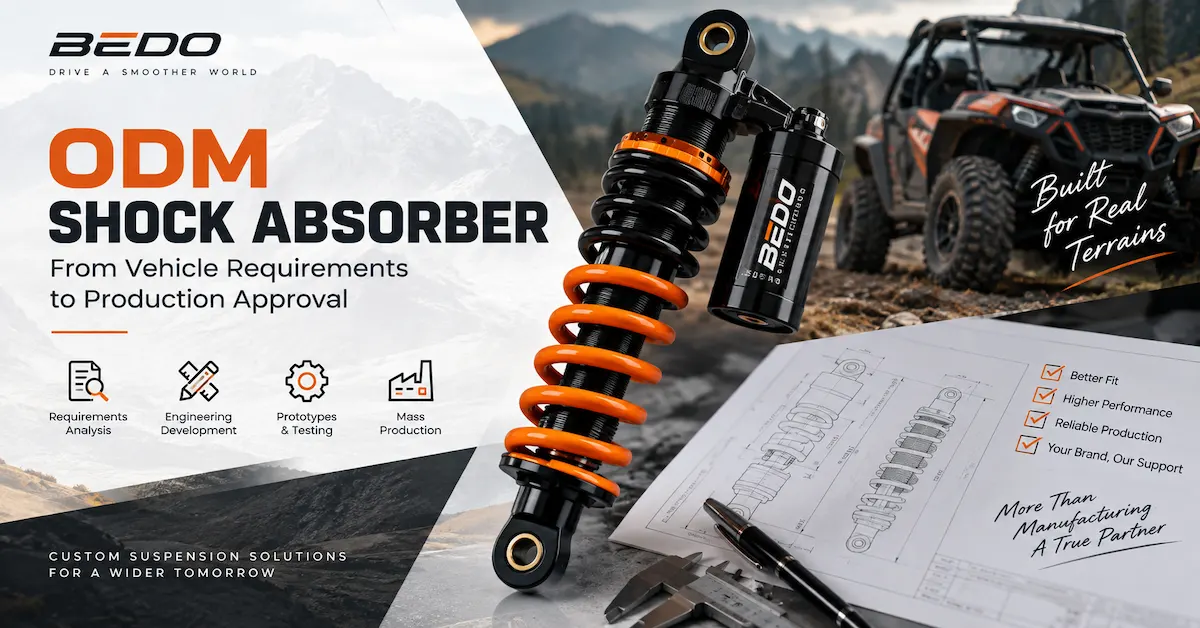
BEDO's existing ATV and UTV suspension solution approach covers shock absorbers, springs, technical parameter confirmation, samples, small-batch validation, OEM/ODM work, and repeat production.
Start With the Vehicle Requirement, Not the Catalog
One of the biggest mistakes in custom suspension sourcing is starting with a catalog shock and attempting to force it into the application.
A stronger process begins with the vehicle.
Define the Vehicle
At minimum, prepare:
-
vehicle type;
-
vehicle model or project code;
-
front or rear suspension position;
-
curb weight;
-
operating weight;
-
maximum expected load;
-
passenger capacity;
-
cargo requirements;
-
accessory weight;
-
tire size;
-
wheel configuration.
For electric motorcycles and electric utility vehicles, battery weight and packaging can also change load distribution.
Define the Operating Environment
Examples include:
-
farm roads;
-
forest trails;
-
rock;
-
gravel;
-
mud;
-
sand;
-
snow;
-
mountain terrain;
-
utility worksites;
-
recreational riding;
-
racing or high-performance use.
A shock developed for repeated rough-terrain use may need a different performance window from one optimized primarily for low-speed utility work.
Define the Problem or Target
Avoid descriptions such as:
We need a better suspension.
Instead, describe an observable condition:
The rear suspension has excessive sag with two passengers and 120 kg of cargo.
Or:
After a large bump, the rear suspension rebounds too quickly and requires better control.
Specific problems lead to more useful engineering decisions.
The Technical Parameters Behind Custom Suspension Solutions
A custom suspension system cannot be defined by overall shock length alone.
Several variables work together.
| Technical Parameter | Why It Matters |
|---|---|
| Extended length | Defines maximum shock extension |
| Compressed length | Helps avoid interference at full bump |
| Effective stroke | Defines usable damper movement |
| Upper mount | Must match the vehicle interface |
| Lower mount | Controls installation accuracy |
| Mounting-hole diameter | Must match bolt/bushing arrangement |
| Mounting width | Prevents looseness or installation conflict |
| Spring rate | Supports vehicle and operating load |
| Preload | Influences initial spring condition and ride height |
| Compression damping | Controls movement as suspension compresses |
| Rebound damping | Controls return movement after compression |
| Reservoir configuration | Affects packaging and shock architecture |
| Surface treatment | Supports durability in water, mud, and corrosive environments |
| Vehicle load | Influences spring and damping requirements |
| Suspension geometry | Determines how shock movement relates to wheel movement |
The important point is interaction.
A higher spring rate may increase load support, but if rebound damping is not reassessed, suspension recovery may no longer be well controlled.
Likewise, increasing shock stroke does not automatically increase usable wheel travel safely.
Suspension geometry, tire clearance, ball-joint movement, CV angles, and physical packaging may also become limiting factors.
Spring Rate and Damping Solve Different Problems
This distinction is central to professional custom suspension development.
Spring Rate
The spring primarily supports the vehicle and load.
It influences:
-
ride height;
-
sag;
-
load capacity;
-
available travel;
-
how quickly the suspension reaches its compression range.
If a vehicle sits too low under cargo, spring selection should be reviewed.
Compression Damping
Compression damping controls the rate at which the shock compresses.
It can affect how the vehicle responds to:
-
bumps;
-
landings;
-
rapid load transfer;
-
repeated impacts.
However, strong compression damping should not be used as a substitute for a spring that cannot support the required static load.
Rebound Damping
Rebound damping controls how the suspension extends after compression.
Too little control can produce repeated bouncing.
Too much rebound resistance may prevent the suspension from recovering quickly enough between consecutive obstacles.
BEDO's guide to compression and rebound damping testing explains why damping should be evaluated using defined configurations and test conditions rather than one isolated force number.
What Should Buyers Send Before Custom Development Starts?
Good engineering depends heavily on good input.
Sending a handful of photos and the message “make this stronger” creates unnecessary uncertainty.
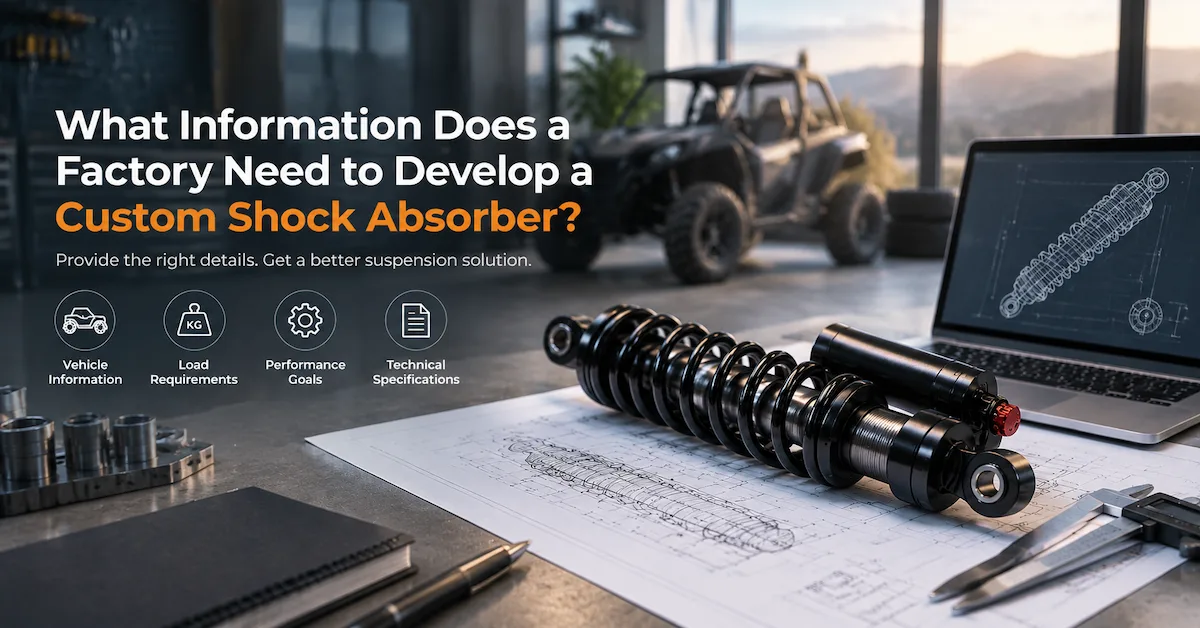
For a custom suspension project, prepare a controlled information package.
Recommended Project Information
-
project name or code;
-
vehicle/application;
-
model year or variant where relevant;
-
front/rear position;
-
project purpose;
-
current suspension problem;
-
target improvement;
-
expected prototype quantity;
-
expected production volume.
Drawings and CAD
Useful technical documents may include:
-
2D dimensioned drawings;
-
3D CAD;
-
suspension hard-point data;
-
installation envelope;
-
mounting dimensions;
-
reservoir clearance;
-
spring envelope;
-
critical tolerances.
BEDO's 2D drawing and 3D CAD suspension guide explains how geometry files can be used to define controlled dimensions and interfaces.
Existing Samples
If original drawings are unavailable, a reference shock can be a practical starting point.
The supplier can review:
-
extended length;
-
compressed length;
-
stroke;
-
upper/lower mounting dimensions;
-
spring dimensions;
-
structural layout.
However, a sample shows what the existing product is. It does not automatically explain what the buyer wants to improve.
That is why vehicle data and performance objectives should accompany the sample.
Buyers without complete engineering documentation can review BEDO's sample-based shock absorber customization process.
Vehicle and Load Data
Include:
-
curb weight;
-
axle or corner weights if available;
-
passenger load;
-
cargo load;
-
accessories;
-
battery weight;
-
normal and maximum operating conditions.
Performance Information
If available, provide:
-
spring specification;
-
preload;
-
sag measurements;
-
damping test data;
-
force-velocity curves;
-
current prototype test results.
If the data does not exist, report the observed vehicle behavior instead of inventing a target number.
A useful development package is explained in more detail in BEDO's custom suspension development files guide.
A Practical Custom Suspension Development Process
A custom project should pass through controlled engineering and approval stages.
1. Requirement Review
The supplier reviews:
-
vehicle;
-
load;
-
terrain;
-
fitment;
-
problem;
-
target performance;
-
project volume.
The goal is to decide whether an existing product can be adapted or whether deeper engineering is needed.
2. Engineering Data Review
Available inputs may include:
-
samples;
-
drawings;
-
CAD;
-
measurements;
-
vehicle data;
-
performance data.
Missing information should be identified before prototype manufacturing.
3. Initial Specification
Engineering defines or proposes:
-
shock dimensions;
-
stroke;
-
mounting interfaces;
-
spring requirements;
-
damping direction;
-
reservoir structure;
-
finish;
-
other functional requirements.
A critical distinction should be made between:
Fixed buyer requirements
and
parameters still open to engineering development.
This prevents a preliminary number from accidentally becoming a production requirement.
4. Prototype Manufacturing
The first prototype is an engineering verification unit.
It should not be treated as proof that mass production has already been approved.
5. Fitment Validation
Before performance testing, verify:
-
mounting interfaces;
-
body clearance;
-
spring clearance;
-
reservoir clearance;
-
compressed position;
-
extended position;
-
full suspension cycle.
BEDO's ATV shock absorber fitment guide recommends validating more than nominal overall length before bulk ordering.
6. Vehicle and Performance Testing
Depending on project scope, review:
-
ride height;
-
sag;
-
load support;
-
compression behavior;
-
rebound behavior;
-
bottoming;
-
wheel control;
-
heat-related performance changes;
-
leakage;
-
durability.
7. Engineering Revision
Testing feedback should be specific.
Instead of:
The shock is not good.
Use:
Rear rebound is too fast after large compression events at the defined passenger and cargo load.
Specific feedback gives the engineering team something actionable.
8. Approved Sample
Once the product is accepted, freeze the relevant:
-
dimensions;
-
spring version;
-
damping version;
-
hardware;
-
finish;
-
labels;
-
packaging;
-
drawing revision.
9. Pilot or Small-Batch Production
A pilot batch can help verify:
-
manufacturing consistency;
-
real-world fitment;
-
packaging;
-
market response;
-
supply-chain repeatability.
BEDO's small-batch OEM/ODM suspension process describes this lower-risk path before larger production commitments.
10. Production Release
The goal is no longer to continue changing the design.
The goal is to reproduce the approved specification consistently.
Custom Suspension Solutions for Different Applications
The same customization strategy should not be applied to every vehicle.
Heavy-Duty Utility UTV
Common priorities:
-
stronger static load support;
-
controlled ride height;
-
enough usable stroke;
-
damping matched to cargo;
-
long-term durability.
The right answer is not automatically the stiffest spring.
The system must still work when the UTV is partly loaded or traveling over repeated uneven surfaces.
Recreational ATV
Typical priorities:
-
impact control;
-
predictable rebound;
-
maneuverability;
-
reasonable rider comfort;
-
terrain adaptability.
Modified ATV or UTV
Modification may involve:
-
larger tires;
-
increased vehicle weight;
-
accessories;
-
lifted suspension;
-
revised mounting position.
These changes may justify fitment and geometry review rather than simply replacing the original shock with a higher-rate spring.
Electric Motorcycle
Electric motorcycles may have different:
-
battery mass;
-
weight distribution;
-
frame packaging;
-
urban operating conditions;
-
rider/cargo requirements.
Suspension should therefore be developed around the actual vehicle rather than assuming the same requirements as a conventional motorcycle.
Private-Label Aftermarket Product
Aftermarket brands may care about:
-
model fitment;
-
performance differentiation;
-
color;
-
logo;
-
packaging;
-
small-batch testing;
-
repeat ordering.
Technical performance should be confirmed before appearance customization becomes the main focus.
What Can Be Customized?
A useful way to discuss custom suspension is to divide it into three layers.
Fitment Customization
Includes:
-
total dimensions;
-
stroke;
-
mounting-hole size;
-
mounting width;
-
mounting structure;
-
body envelope;
-
spring envelope;
-
reservoir position.
Performance Customization
Includes:
-
spring rate;
-
preload;
-
compression damping;
-
rebound damping;
-
adjustable damping options;
-
reservoir architecture.
Commercial Customization
Includes:
-
spring color;
-
body finish;
-
branding;
-
labels;
-
private-label packaging.
The first two determine whether the suspension performs its job.
The third determines how the product is presented to the market.
A buyer evaluating genuine Custom Suspension Solutions should therefore ask about engineering capability before discussing only logo placement and color.
How to Evaluate a Custom Suspension Manufacturer
A supplier should be evaluated on more than whether it can produce a sample.
| Supplier Capability | Buyer Question |
|---|---|
| Application understanding | Do they ask about load, terrain, and vehicle behavior? |
| Engineering review | Can they identify missing or conflicting requirements? |
| Drawing/CAD capability | Can they work from controlled engineering files? |
| Sample development | Can they measure and review an existing unit? |
| Spring development | Can spring requirements be related to actual vehicle load? |
| Damping development | Can compression and rebound be discussed separately? |
| Prototype process | Is there a defined validation and revision stage? |
| Fitment control | Are mounting and compressed/extended conditions reviewed? |
| Quality control | Can the approved specification be reproduced? |
| Revision control | Can engineering and purchasing identify the current version? |
| Small-batch support | Can buyers validate before scaling? |
| Long-term supply | Is repeat production treated as part of the project? |
This is the difference between a parts supplier and a real suspension development partner.
BEDO discusses this distinction in its guide on choosing a suspension engineering partner.
Common Custom Suspension Development Risks
Risk 1: Selecting by Vehicle Model Name Only
Two vehicles with the same general name may differ by year, version, load, or suspension configuration.
Better approach: confirm dimensions and exact vehicle conditions.
Risk 2: Checking Only Extended Length
A shock may have the correct open length and still have the wrong:
-
compressed length;
-
stroke;
-
mounting width;
-
hole diameter;
-
spring envelope;
-
reservoir clearance.
Better approach: validate the complete installation geometry.
Risk 3: Choosing a Spring Without Real Load Data
A spring selected for an empty vehicle may perform poorly under real passenger and cargo conditions.
Better approach: provide actual operating loads.
Risk 4: Using Damping to Compensate for Incorrect Spring Support
Excessive compression damping does not solve an inadequate spring-rate problem.
Better approach: treat spring and damping development as connected but separate engineering decisions.
Risk 5: Skipping Prototype Testing
A dimensionally correct component may still create poor vehicle behavior.
Better approach: test fitment and performance before production release.
Risk 6: Allowing Uncontrolled Revisions
If the buyer approves one sample while production uses a different spring or damping configuration, the project loses traceability.
Better approach: define a final approved revision.
Risk 7: Comparing Suppliers Only by Unit Price
One supplier may quote only manufacturing while another includes:
-
engineering review;
-
prototype work;
-
revisions;
-
testing support;
-
QC;
-
private label;
-
packaging.
These are not equivalent offers.
Compare project scope before comparing price.
What Affects the Cost of Custom Suspension Solutions?
There is no single responsible price for a custom suspension project.
Cost depends on factors such as:
-
existing product vs new design;
-
completeness of drawings;
-
CAD review requirements;
-
sample analysis;
-
structural modifications;
-
spring development;
-
damping development;
-
number of prototypes;
-
testing requirements;
-
revision cycles;
-
surface treatment;
-
branding;
-
packaging;
-
production volume.
A simple color and logo change is commercially different from developing a new UTV rear shock around vehicle load, geometry, and damping targets.
The same logic applies to MOQ and lead time.
They should be evaluated from the actual project rather than treated as universal fixed values.
What Should Be in a Custom Suspension RFQ?
A stronger RFQ allows the supplier to assess engineering scope before quoting.
Include:
-
Vehicle type
-
Model/project code
-
Installation position
-
Curb weight
-
Maximum operating weight
-
Passenger and cargo conditions
-
Tire/wheel configuration
-
Extended and compressed shock dimensions
-
Required or existing stroke
-
Mounting-hole dimensions
-
Mounting widths
-
Spring data, if known
-
Damping data, if known
-
Typical terrain
-
Current suspension problem
-
Target performance
-
Existing sample availability
-
2D drawing/CAD availability
-
Prototype quantity
-
Estimated production quantity
-
Color/logo/packaging requirements
A buyer should avoid submitting only:
Please quote custom UTV suspension.
A much stronger request is:
We are developing a rear suspension solution for a utility UTV carrying two passengers plus cargo. The existing rear suspension has excessive sag and fast rebound after larger bumps. We can provide the current shock sample, vehicle/load data, mounting dimensions, and expected production volume.
That tells the supplier what problem must actually be solved.
How BEDO Supports Custom Suspension Projects
BEDO develops suspension products for ATV, UTV, motorcycle, electric motorcycle, and other off-road or specialty-vehicle applications.
Depending on project maturity, buyers can begin with:
-
a physical sample;
-
dimensional data;
-
2D drawings;
-
3D CAD;
-
vehicle/load information;
-
an existing suspension problem;
-
target performance requirements.
The development path may include engineering review, prototype development, fitment validation, parameter adjustment, small-batch production, OEM/ODM customization, and repeat manufacturing.
You can learn more about BEDO's background and technical positioning on the About Us page.
FAQ
What are Custom Suspension Solutions?
Custom Suspension Solutions are suspension products and engineering processes developed around a specific vehicle's fitment, load, terrain, and performance requirements rather than selected only from standard catalog specifications.
When should I choose custom suspension instead of a standard shock?
Choose custom development when standard products cannot meet important requirements such as mounting geometry, vehicle load, stroke, spring characteristics, damping behavior, packaging, or target performance.
Can a custom suspension project start from an existing sample?
Yes. An existing shock absorber can be measured and reviewed as a reference. Vehicle information and target improvements should also be provided because the sample alone does not define the desired performance.
Do I need 3D CAD to start development?
Not always. Projects can begin from drawings, samples, measurements, and vehicle requirements. CAD becomes especially useful when packaging, suspension geometry, long travel, or reservoir clearance must be reviewed.
Can spring rate be customized?
Yes. Spring requirements can be developed around the vehicle and target load. Buyers should provide realistic operating-weight information rather than selecting a spring only by physical dimensions.
Can compression and rebound damping be customized separately?
Yes. Compression and rebound control different directions of shock movement and may require different engineering adjustments depending on the vehicle problem.
Why is prototype testing important?
Prototype testing verifies fitment, clearance, ride height, load support, stroke usage, damping behavior, leakage, and other project-specific requirements before larger production.
Can I start with a small batch?
Small-batch production can be useful for new products, OEM/ODM programs, specialty vehicles, private-label launches, and market validation before committing to larger quantities.
Can branding and packaging be customized?
Private-label projects may include body finish, spring color, logo, labels, and packaging after the core technical specification has been confirmed.
What information should I send BEDO first?
Send the vehicle application, installation position, load information, current suspension problem, key measurements, available drawings or sample information, target performance, prototype quantity, and expected production plan.
Conclusion
Effective Custom Suspension Solutions begin with the vehicle problem—not with a catalog part number.
For ATV, UTV, motorcycle, electric motorcycle, and specialty-vehicle projects, the most reliable development process connects:
Vehicle & Load Requirements → Fitment & Geometry → Spring Selection → Damping Development → Prototype → Testing → Revision → Approval → Pilot Production → Repeat Manufacturing
The biggest sourcing mistake is assuming that physical fitment alone means a suspension product is suitable.
A shock absorber can bolt onto the vehicle and still have the wrong stroke, spring support, damping behavior, reservoir clearance, or loaded performance.
B2B buyers should therefore evaluate a suspension manufacturer on its ability to understand the application, work with samples and engineering files, support prototype validation, manage revisions, and reproduce the approved specification consistently.
If you are developing an ATV, UTV, motorcycle, electric motorcycle, or specialty-vehicle suspension project, prepare your vehicle data, drawings or sample, load conditions, current problem, target performance, and expected production plan. You can then submit the project through the BEDO Contact Us page for technical review and custom suspension development discussion.