
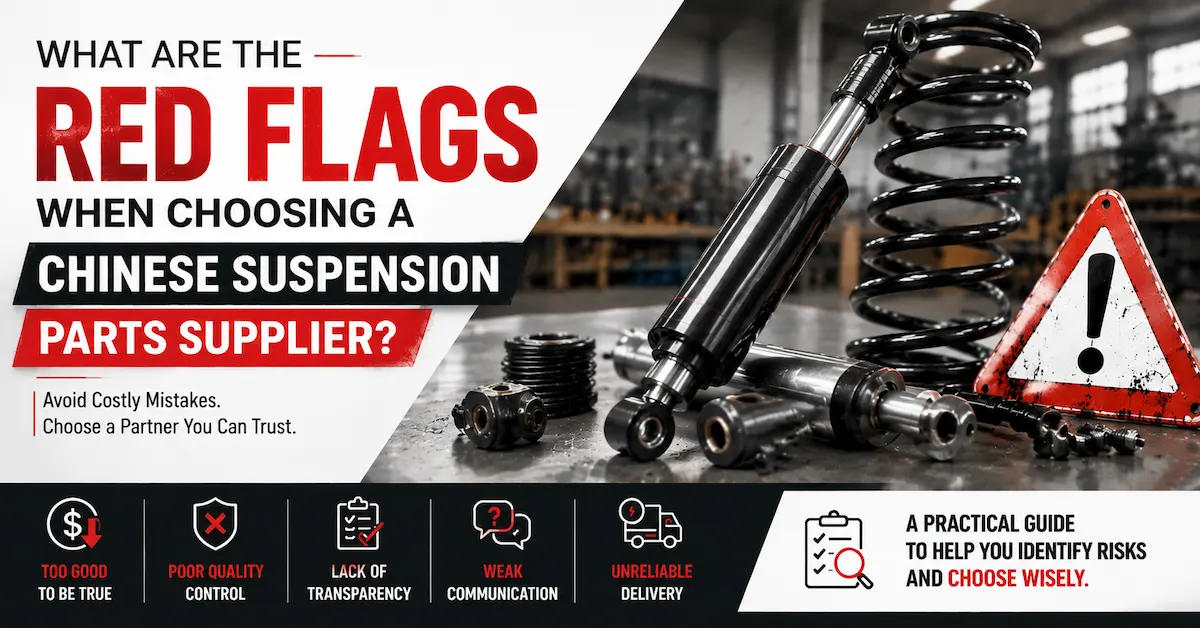
What Are the Red Flags When Choosing a Chinese Suspension Parts Supplier?
Choosing a suspension supplier in China can create significant advantages for aftermarket brands, distributors, and OEM buyers.
However, not every supplier that appears professional online has the capability to support a long-term project.
A supplier may have:
- Attractive product photos
- Competitive pricing
- Fast quotation responses
- A large catalog
But these factors alone do not prove manufacturing capability.
For suspension products, the real risks usually appear later:
- The second production batch does not match the sample.
- Components change without notice.
- Quality problems increase after volume orders.
- Engineering communication becomes difficult.
- The supplier cannot support product improvements.
A careful buyer should evaluate not only:
“Can this supplier make suspension parts?”
but also:
“Can this supplier consistently deliver the same product after our business grows?”
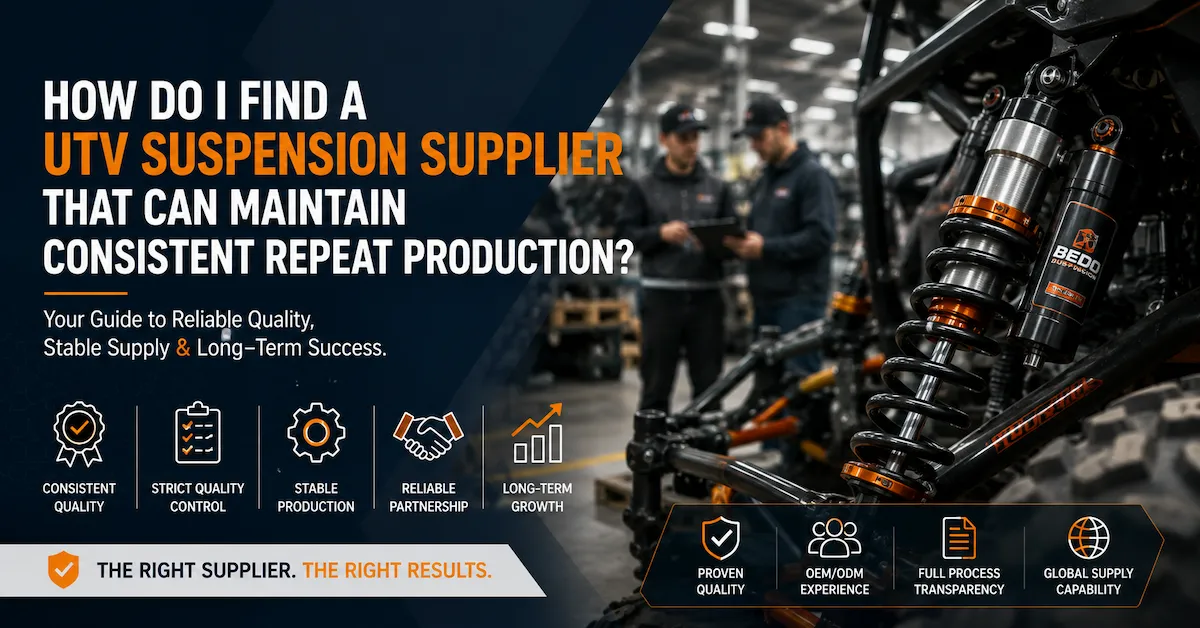
This is the key difference between a short-term supplier and a reliable manufacturing partner.
Why Is Supplier Evaluation Important Before Ordering?
Suspension components directly affect vehicle performance and customer safety.
Unlike simple hardware products, suspension parts involve multiple technical factors:
- Load capacity
- Spring characteristics
- Damping behavior
- Material strength
- Manufacturing accuracy
- Vehicle compatibility
- Long-term durability
A supplier mistake may create problems beyond the product itself.
Possible consequences include:
- Customer complaints
- Warranty claims
- Dealer dissatisfaction
- Replacement costs
- Brand reputation damage
- Lost market opportunities
The supplier selection stage is therefore a risk-control process, not only a purchasing decision.
Red Flag 1: The Supplier Focuses Only on Low Price
Price matters in international sourcing.
However, extremely low quotations should be carefully evaluated.
A suspension supplier offering a much lower price than competitors may be reducing costs through:
- Lower-grade materials
- Simplified manufacturing processes
- Limited inspection
- Reduced engineering support
- Unstable component sourcing
A professional supplier should be able to explain:
- What materials are used
- What processes are controlled
- What testing is performed
- What quality standards are followed
A lower purchase price can become expensive if it creates quality problems later.
Red Flag 2: They Cannot Explain Their Manufacturing Process
A reliable suspension manufacturer should understand its own production process.
Be cautious if the supplier cannot clearly explain:
- How components are produced
- Which processes are controlled internally
- How assembly consistency is maintained
- How finished products are inspected
A supplier should not only show a finished product.
They should explain how that product is repeatedly manufactured.
For OEM and aftermarket buyers, production capability matters more than a single successful sample.
Red Flag 3: They Cannot Discuss Engineering Requirements
Suspension development requires technical communication.
A weak supplier may immediately ask:
“What quantity do you need?”
before understanding:
- Vehicle model
- Application
- Load conditions
- Performance targets
- Current suspension setup
- Expected usage environment
A capable supplier should ask engineering questions first.
For example:
- Is this for recreational riding or heavy-duty work?
- Is the goal more comfort or more payload support?
- Is the product for OEM installation or aftermarket upgrade?
- What terrain will the vehicle operate on?
Good engineering questions usually indicate a supplier is thinking beyond simple production.
Red Flag 4: No Clear Prototype Approval Process
Prototype development should have defined stages.
A professional supplier normally follows a process such as:
Requirement Review → Engineering Design → Prototype → Testing → Revision → Approval → Production
Be cautious if the supplier:
- Sends samples without documentation
- Cannot explain prototype revisions
- Does not record changes
- Starts production before approval
Without a controlled approval process, repeat orders may become inconsistent.
Red Flag 5: The Supplier Cannot Control Product Revisions
One of the biggest risks in long-term cooperation is uncontrolled change.
A supplier may change:
- Materials
- Components
- Suppliers
- Manufacturing methods
- Packaging
without informing the buyer.
Small changes may affect:
- Performance
- Installation
- Durability
- Customer experience
Ask:
“How do you control engineering changes after approval?”
A professional answer should include:
- Revision records
- Approval procedures
- Production communication
- Sample confirmation when necessary
Red Flag 6: Quality Control Is Only Final Inspection
Checking the finished product is important.
But quality cannot depend only on finding problems at the end.
A stronger quality system controls multiple stages.
For example:
| Production Stage | Quality Focus |
|---|---|
| Incoming materials | Component consistency |
| Machining | Critical dimensions |
| Assembly | Process accuracy |
| Filling/charging | Performance consistency |
| Final inspection | Product verification |
| Packaging | Shipping protection |
If a supplier only says:
“We inspect before shipping.”
ask further questions.
The important issue is:
How are defects prevented before final inspection?
Red Flag 7: They Cannot Provide Consistent Repeat Production Evidence
A first sample does not prove production capability.
Ask:
- How many units can you produce monthly?
- How do you maintain consistency?
- How are production batches recorded?
- How do you compare repeat orders with approved samples?
This is especially important for:
- Aftermarket brands
- Distributors
- Private-label projects
- OEM programs
A supplier should be able to support the product after launch, not only during development.
Red Flag 8: They Avoid Technical Documentation
Professional suspension projects require documentation.
Be cautious if a supplier avoids providing:
- Product specifications
- Drawings
- Revision information
- Testing records
- Inspection information
Documentation becomes increasingly important when:
- More SKUs are added
- Multiple teams are involved
- Annual orders increase
- Products enter new markets
A supplier without documentation creates unnecessary dependence on individual communication.
Red Flag 9: Communication Is Fast but Not Detailed
Fast replies are good.
But speed does not equal capability.
A supplier may respond quickly:
“Can do.”
“Good quality.”
“Best price.”
However, these answers do not solve engineering questions.
Look for detailed communication about:
- Requirements
- Risks
- Possible solutions
- Production limitations
- Testing methods
A supplier that explains challenges honestly is often more valuable than one that promises everything.
Red Flag 10: They Cannot Explain Testing Methods
Suspension products should be validated.
Ask:
- How are prototypes tested?
- What performance factors are checked?
- How are production units verified?
- What happens when problems appear?
Testing discussions show whether the supplier understands the product as a system.
A supplier should know that suspension performance involves interaction between:
- Shock absorber
- Spring
- Vehicle weight
- Suspension geometry
- Operating conditions
Red Flag 11: The Supplier Has No Experience With Your Market
Different markets have different expectations.
For example:
OEM Customers
Usually require:
- Engineering cooperation
- Documentation
- Long-term stability
- Production control
Aftermarket Brands
Often require:
- Multiple fitments
- Packaging
- Product positioning
- Dealer support
A supplier should understand your business model.
A factory experienced only with one type of customer may struggle with another.
Red Flag 12: They Cannot Support Small Validation Orders
Some buyers need to reduce risk before scaling.
A supplier that refuses any smaller validation process may not be suitable for new projects.
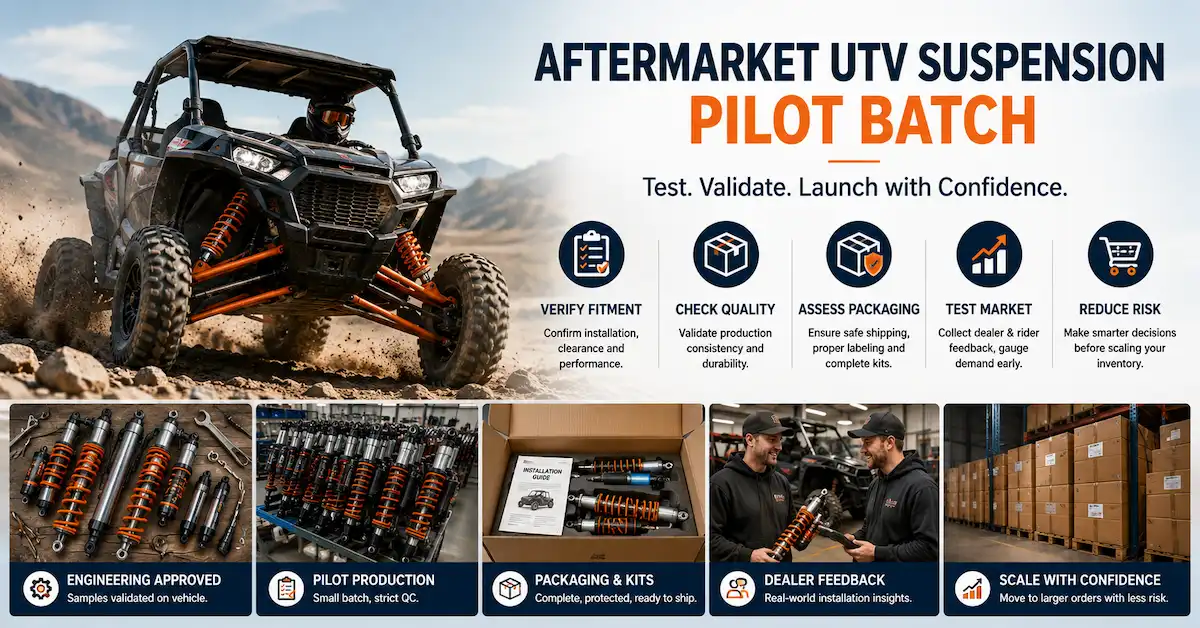
A practical supplier should understand stages such as:
- Prototype
- Confirmation sample
- Pilot batch
- Larger production
Small validation orders can protect both sides.
How Should I Verify a Chinese Suspension Parts Supplier?
A structured evaluation is more reliable than judging from appearance.
Review:
Company Capability
Check:
- Manufacturing experience
- Product range
- Engineering team
- Production equipment
- Customer types
Technical Capability
Review:
- Custom development ability
- Testing knowledge
- Drawing communication
- Problem-solving approach
Production Capability
Understand:
- Capacity
- Process control
- Supplier management
- Quality inspection
Commercial Capability
Evaluate:
- Communication
- Lead times
- Documentation
- After-sales support
What Questions Should I Ask Before Choosing a Supplier?
Before placing an order,ask:
- Do you support OEM and aftermarket projects?
- Can you develop customized suspension products?
- How do you control production revisions?
- What inspections are performed during production?
- How do you ensure repeat orders match approved samples?
- Can you provide prototype testing support?
- What documents can you provide?
- How do you handle quality problems?
- Can you support pilot batches?
- What information do you need before development?
The answers will reveal whether the supplier has a real process.
How Can I Compare Multiple Chinese Suspension Suppliers?
Avoid comparing only quotation sheets.
Use a broader evaluation table.
| Evaluation Area | Key Question |
|---|---|
| Engineering | Can they solve technical problems? |
| Quality | Can they maintain consistency? |
| Production | Can they scale? |
| Communication | Can they manage changes? |
| Experience | Have they supported similar customers? |
| Support | Can they help after launch? |
The lowest price supplier is not always the lowest-risk supplier.
How Does a Supplier Audit Reduce Risk?
A supplier audit helps buyers understand what happens behind the quotation.
Depending on the project, review:
- Factory capability
- Production process
- Quality system
- Sample management
- Testing process
- Packaging
- Documentation
The goal is not to find a perfect factory.
The goal is to understand whether the supplier can support your business requirements.
What Should I Do Before Placing a Large Order?
Before scaling,consider:
Step 1: Confirm Technical Requirements
Finalize:
- Vehicle application
- Specifications
- Performance goals
- Approved samples
Step 2: Validate Production
Check:
- Pilot batch
- Quality consistency
- Packaging
- Documentation
Step 3: Establish Communication Rules
Define:
- Revision approval
- Quality feedback
- Production updates
- Problem-solving process
A good supplier relationship starts before the first large purchase order.
How Can Bedo Auto Support Buyers Evaluating Suspension Suppliers?
For buyers looking for a reliable Chinese suspension partner, Bedo Auto supports discussions around custom suspension development, OEM projects, aftermarket products, production requirements, and long-term supply.
Before supplier evaluation, buyers can review:
Which China Suspension Supplier Can Support Both Aftermarket and OEM Projects?
to understand how engineering capability, production systems, and commercial support should be evaluated.
For projects requiring customization, review:
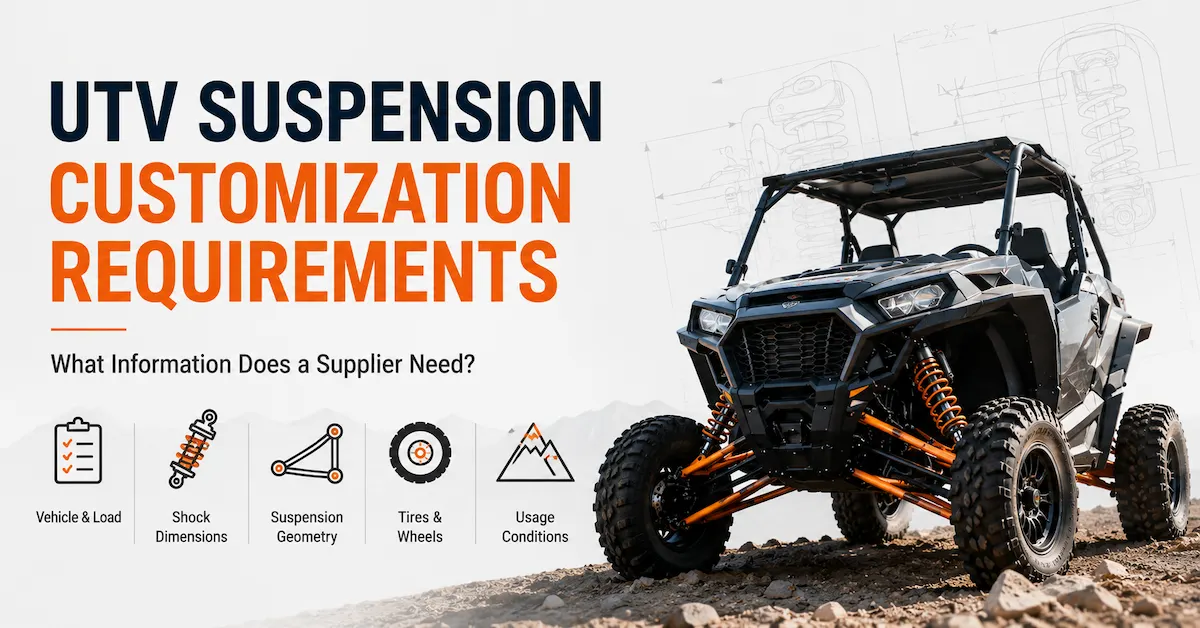
UTV Suspension Customization Requirements
to prepare vehicle information and technical requirements.
For prototype validation before production:
How Do I Test a UTV Suspension Prototype Before Production?
explains the key testing stages.
For OEM, aftermarket, and distributor cooperation, contact:
Provide:
- Vehicle application
- Product requirements
- Target market
- Expected quantity
- Customization needs
- Long-term cooperation goals
This helps create a more efficient supplier evaluation process.
FAQ
What are the biggest red flags when choosing a Chinese suspension supplier?
The biggest warning signs include unclear production processes, poor engineering communication, no revision control, weak quality systems, inconsistent samples, and inability to explain repeat production methods.
Should I choose the cheapest suspension supplier?
Not always. Price should be evaluated together with quality control, engineering capability, production stability, and long-term supply risk.
How can I verify if a suspension supplier is a real manufacturer?
Review their production process, engineering capability, quality control system, documentation, factory information, and experience with similar projects.
Why is prototype approval important?
Prototype approval creates a production reference. Without it, future batches may not match the original expectation.
What quality documents should a suspension supplier provide?
Depending on the project, useful documents include specifications, drawings, revision records, inspection information, and production-related records.
How do I know if a supplier can handle OEM projects?
Ask about engineering support, prototype development, testing methods, documentation, production control, and previous OEM experience.
Can aftermarket suspension suppliers support private-label brands?
Yes, if they have capabilities in customization, packaging, branding, documentation, and stable production.
What causes suspension supplier problems after ordering?
Common causes include unclear specifications, uncontrolled changes, weak communication, insufficient inspection, and lack of production consistency.
Should I order a pilot batch before a large purchase?
For new suppliers or new products, a pilot batch can help verify quality, packaging, production consistency, and market feedback.
How often should supplier performance be reviewed?
Long-term buyers should regularly review quality, delivery performance, communication, and any repeated issues.
Conclusion
Choosing a Chinese suspension parts supplier is not only about finding a factory that can produce components.
The real challenge is finding a supplier that can support your business after the first order.
Avoid suppliers that:
- Only compete on price
- Cannot explain engineering
- Lack quality processes
- Ignore documentation
- Cannot control revisions
- Cannot support repeat production
A reliable supplier should provide:
- Engineering cooperation
- Stable manufacturing
- Clear communication
- Quality control
- Long-term support
For aftermarket brands, distributors, and OEM customers, supplier selection is a long-term business decision.
The right partner does not simply deliver suspension parts.
They help protect your product quality, customer experience, and future growth.