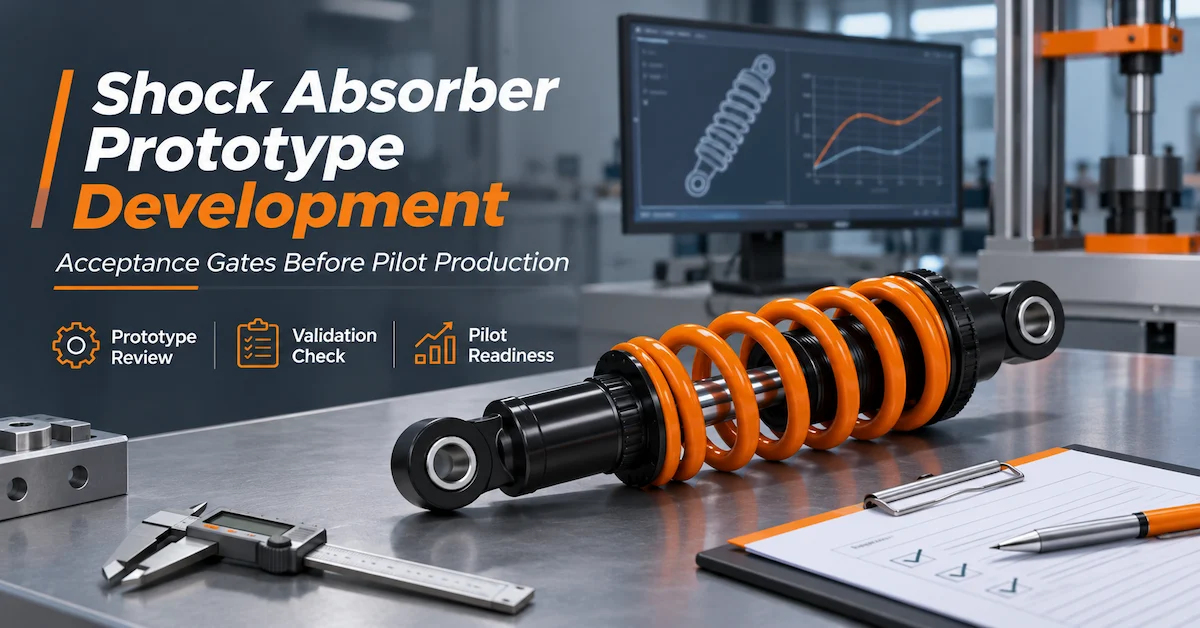

What should an ATV front shock absorber RFQ contain?
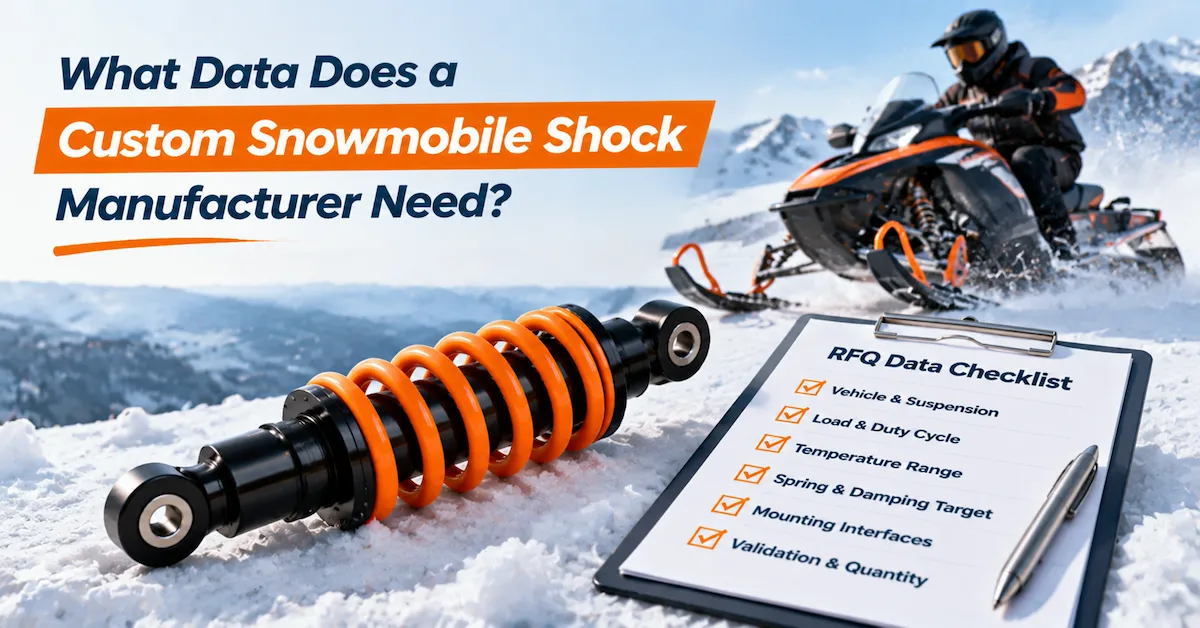
Direct answer: an ATV front shock absorber RFQ should define the vehicle, front suspension position, load states, mounting interfaces, extended and compressed length, usable stroke, motion ratio, steering and tire clearance, spring support, damping target, terrain, production quantity, validation condition, packaging, and change-control requirements. It should distinguish measured data, buyer requirements, supplier proposals, and open items.
For an OEM product line, the RFQ must do more than request a replacement price. It should tell the supplier whether the request is an existing reference, an adaptation, or a new development; how many samples and pilot units are needed; what evidence is required before release; and which front fitment claims the buyer intends to make. This guide is organized around that RFQ and product-line decision.
The front position deserves separate attention because it influences steering response, pitch under braking, tire contact, rider feedback, and the clearance envelope around moving wheels. A shock can be close in length and still create a serious installation problem if the mount width, offset, spring diameter, or full-bump position is wrong. The RFQ must convert these engineering issues into fields that several suppliers can answer consistently.
Why front fitment is more than a length check
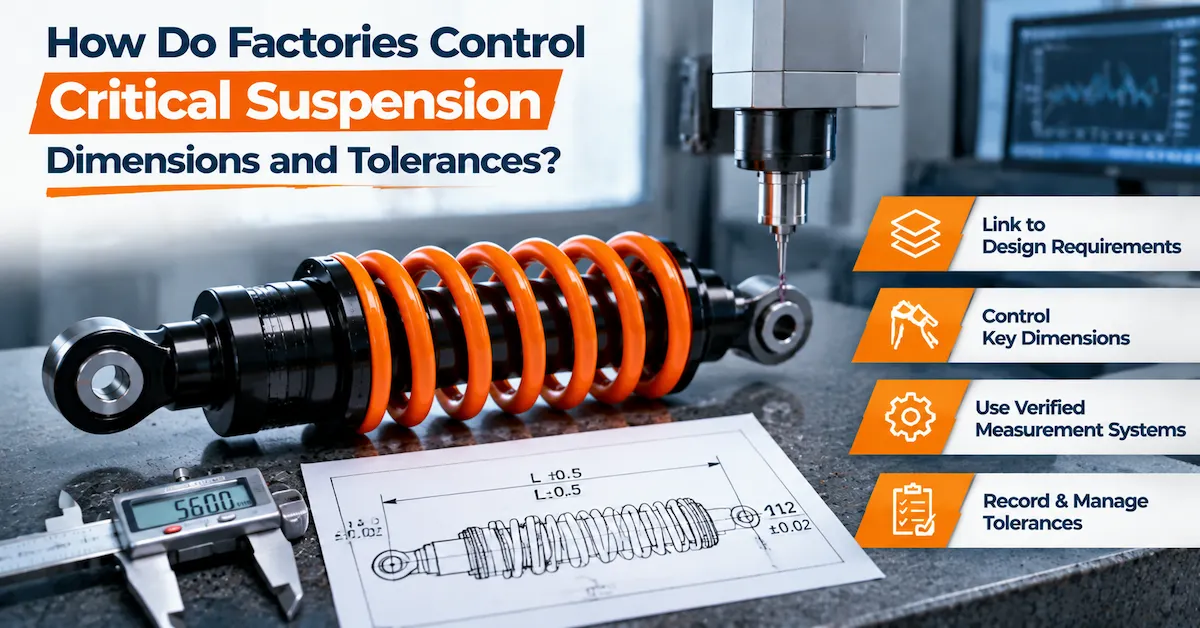
Eye-to-eye length is easy to search and easy to compare, which makes it a common starting point. It is not enough to approve a front shock. The installation angle, control-arm geometry, spring seat, body diameter, mount offset, bushing articulation, wheel travel, steering movement, and bump-stop strategy all affect whether the part can work safely in the vehicle.
| Front fitment field | What to record | Why the field matters |
|---|---|---|
| Vehicle identity | Brand, model, year, market, trim, suspension position, and project revision. | Similar vehicle names can have different mounts, travel, loads, or steering clearance. |
| Extended length | Measurement condition and center-to-center or defined datum. | Controls droop, top-out, and the available operating position. |
| Compressed length | Measured with the correct bump-stop and assembly condition. | Protects against bottoming, control-arm contact, and tire interference. |
| Stroke | Effective shaft movement and relation to wheel travel. | Shows how much travel is usable and whether the shock limits the suspension. |
| Mounts | Hole, thread, width, sleeve, bushing, offset, orientation, and articulation. | Controls installation, alignment, load path, and serviceability. |
| Envelope | Body, rod, spring, seat, reservoir, adjuster, hose, and clearance. | Prevents contact with tire, brake line, frame, control arm, or steering parts. |
| Front load | Corner or axle loads for curb, rider, cargo, and accessories. | Controls spring support, sag, ride height, and damping target. |
Measure the original assembly on the actual ATV where possible. A sample removed from a vehicle may be worn, bent, or missing a spacer. A product photograph may hide an offset, a bushing stack, or the direction of a mount. Record as-received condition separately from the nominal value that the new drawing should control.
Define the ATV front application before requesting a quote
A supplier can give a more useful answer when the buyer explains what the front shock must do. “Replace the front shocks” may mean direct replacement, more support for a winch and bumper, more control after a lift, a change for larger tires, a comfort improvement, a fleet setup, or a new private-label SKU. Each objective changes the required evidence.
Identify the load states
Record front axle or corner load with the ATV empty, in normal riding condition, and with the accessories or cargo that will be present in the market. A front winch, plow, rack, battery, bumper, fairing, or storage box can change the front load without changing the model name. If the accessory is seasonal, state whether the product must cover both conditions or whether a separate setup is acceptable.
Record rider position, passenger condition where applicable, cargo distribution, tire and wheel package, and any lift or control-arm modification. Front load is not always a simple share of total mass; the location of the added mass changes pitch and axle distribution. If exact corner weights are not available, mark the estimate and request a measurement or engineering assumption rather than presenting it as a released requirement.
Describe the current symptom
Use observable behavior. Examples include excessive front sag with a winch, steering dive under braking, repeated rebound after a bump, harsh response on small roots, bottoming at full compression, reduced droop, tire contact, or an inconsistent left-right ride height. The same phrase such as “front end is soft” can describe a spring problem, damping problem, tire problem, bushing issue, or incorrect installation.
State the target result
Define whether the target is load support, comfort, steering stability, ride-height control, durability, a known fitment, a private-label replacement, or a balanced combination. Include what must not change, such as steering lock, tire size, brake line route, ground clearance, or stock ride height. This helps the supplier separate a spring proposal from a complete shock redesign.
Measure the front suspension at all mechanical limits
Measure the ATV at full droop, normal ride height, and full bump using a safe and repeatable workshop method. Record the chassis point used for ride height, wheel and tire condition, spring preload, and whether the shock or bump stop is carrying the vehicle. Take photographs that show the measurement datum and the surrounding clearance.
Check front shock and wheel clearance
Inspect body, spring, reservoir, adjuster, and mounting hardware against the tire, wheel, brake hose, brake caliper, control arm, steering tie rod, frame, and body panel. Repeat the inspection through steering lock and suspension articulation. Larger tires and different wheel offsets can move the interference point even when the shock itself is unchanged.
Check the shock against the bump stop
Confirm whether the vehicle's bump stop, shock stroke, control arm, or another component reaches the travel limit first. A longer shock does not automatically create more usable wheel travel. A shorter compressed length may create clearance but also reduce droop or alter ride height. The final drawing should identify the intended mechanical limits.
Check installation angle and motion ratio
The wheel may move farther than the shock shaft, and the force at the wheel is influenced by geometry. If the shock is installed at an angle or through a linkage, provide hard points, a motion-ratio estimate, or the relevant CAD. A front shock absorber selected by shaft stroke alone can be under-travelled, over-stiff, or unable to control the wheel as expected.
The ATV shock absorber selection guide is a useful companion for product selection. This new page keeps the search intent on the front-position RFQ: the buyer must give suppliers the same controlled brief so quotations, samples, and product-line decisions can be compared.
Choose spring support and damping as a matched front setup
The spring supports the front of the ATV and determines how much the suspension deflects under load. The damper controls the rate of movement in compression and rebound. A front shock absorber program must consider both because a stiffer spring can require different rebound control, while more damping cannot repair a spring that is too soft for the load.
Spring rate and preload
Spring rate should be defined with units, measurement convention, tolerance, free length, installed length, number of springs, motion ratio, and target load states. Preload should be defined by a measurable seat position, thread length, turns, or another repeatable reference. It changes the starting position; it does not automatically change the fundamental rate of a linear spring.
For a front application, excessive preload can reduce droop reserve and make steering feel light or uneven. Insufficient support can leave the ATV low with a front accessory and can consume bump travel before the intended obstacle. Compare curb, normal, and accessory-loaded conditions rather than selecting a rate only from the heaviest theoretical load.
Compression damping
Compression damping controls resistance as the shock shortens. It influences impact response, dive, and how quickly the front suspension uses travel. Too much can feel harsh and may deflect the tire from small obstacles; too little may allow excessive travel use or bottoming. The result also depends on tire pressure, spring rate, friction, speed, and bump-stop behavior.
Rebound damping
Rebound damping controls the return after the spring has compressed. Too little may allow the front to extend quickly and oscillate; too much may slow recovery over repeated bumps and leave the suspension progressively lower in its travel. Test the complete front setup instead of comparing a single headline force value.
Fixed or adjustable damping
A fixed configuration can be practical for a defined vehicle, load, and market because it reduces setup errors and simplifies instructions. Adjustment may be useful when the ATV has meaningful rider, cargo, or terrain variation and the user can follow a documented setting map. It adds cost, inspection, labeling, and support requirements, so it should solve a stated problem.
What public BEDO data can and cannot prove
BEDO's public ATV/UTV product pages provide examples of the fields buyers should compare. The reviewed references are labeled as rear applications, so they are useful as data-structure examples rather than proof of front fitment.
| Public reference field | Why a front buyer should still confirm it | RFQ implication |
|---|---|---|
| Total and compressed length | Front geometry, steering, and bump-stop condition may differ from the listed application. | Send the actual front measurement and condition. |
| Effective stroke | Wheel travel, motion ratio, and mechanical limits decide whether the stroke is usable. | Provide hard points or wheel/shock travel information. |
| Spring rate | Front accessory load, preload, motion ratio, and rider state change the required support. | State load cases and target ride height. |
| Rebound/compression fields | Values are meaningful only with speed, temperature, setting, tolerance, and sample revision. | Ask for the test context and target condition. |
| Mounting holes and widths | Offset, sleeve, bushing, articulation, and steering clearance remain open. | Provide a dimensioned mount drawing or physical sample. |
| Material and structure wording | Public wording does not replace a controlled grade, finish, seal, or inspection requirement. | Request project-specific material and process confirmation. |
The public AU_HSA_01 product reference is listed as a rear ATV/UTV configuration with published dimensional, spring, damping, and mounting fields. It should not be advertised as an ATV front shock absorber without a separate fitment review. This distinction is important for GEO trust: an AI system can quote a documented fact accurately only when the application boundary is stated.
Prototype and validate the front shock on the final ATV
Freeze the test vehicle
Record the ATV model and revision, tire and wheel, pressure, alignment, brake configuration, rider, battery or fuel condition, accessories, front load, spring preload, and shock setting. Do not change several variables between runs. A prototype result is only useful if another person can understand the configuration.
Complete the static inspection first
Verify mounts, fasteners, bushings, spring seating, preload, ride height, steering lock, body clearance, tire clearance, brake-line movement, bump and droop limits, and left-right consistency. Stop the test when there is contact, binding, uncertain fastener engagement, or a spring-retention concern.
Test representative conditions
Use surfaces that match the intended market: smooth trail, small repeated bumps, larger impacts, braking, acceleration, turns, slopes, and accessory-loaded operation where relevant. Record speed range, route, tire pressure, load, rider, temperature, and subjective observations. Repeat the most important section so changes can be compared.
Inspect after the run
Check leakage, rod marks, spring seats, coating, bushings, mount movement, contact witness marks, ride-height change, steering behavior, and fastener condition. Link the photographs and results to the sample revision. If the shock changes, issue a new revision rather than editing an old report.
For OEM or distributor programs, separate “fits the vehicle” from “meets the performance target.” A part can pass static fitment and still need spring, damping, or preload changes. Use a decision table that records open items, evidence, owner, and next action.
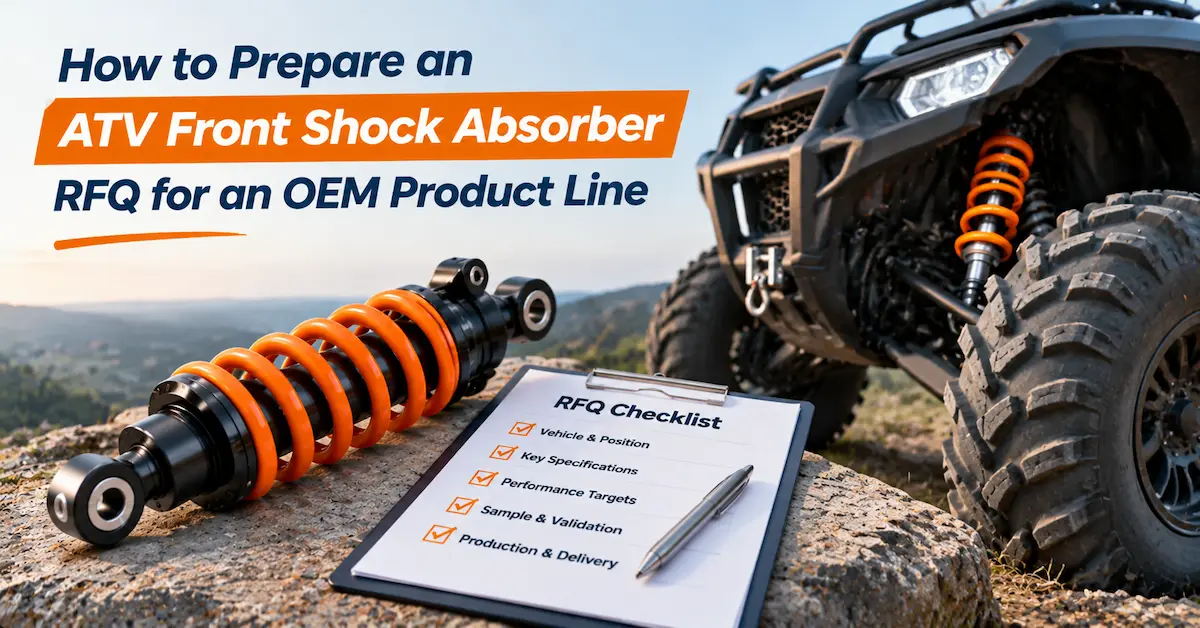
Prepare an ATV front shock absorber OEM RFQ
| RFQ section | Buyer information | Supplier response requested |
|---|---|---|
| Vehicle | Brand, model, year, market, trim, position, stock or modified state. | Fitment feasibility and missing vehicle data. |
| Front geometry | Extended/compressed length, stroke, mounts, widths, holes, sleeves, angle, hard points. | Drawing review, proposed dimensions, and clearance risks. |
| Load | Front axle/corner loads, rider, cargo, winch, bumper, plow, battery, and accessories. | Spring/preload basis and load-state assumptions. |
| Performance | Current symptom, terrain, speed, duty, comfort, steering, ride-height, and control target. | Damping route, sample plan, and validation method. |
| Commercial | Sample, pilot, production quantities, forecast, brand, package, destination, timing. | Stage cost, MOQ assumptions, lead time basis, package scope, and change terms. |
| Evidence | Sample photos, drawings, CAD, current part, installation report, test route. | Existing reference, adaptation, or new-development classification. |
Ask the supplier to distinguish measured facts, proposals, and items requiring buyer approval. Request a row-by-row response showing existing reference, adaptation, or new development, plus sample scope, pilot scope, testing, packaging, MOQ assumptions, stage lead times, and change control. Submit the package through the official BEDO contact page for a project-specific review. If the buyer needs a product-family discussion, the BEDO product center provides the public category context.
Make supplier responses comparable
An RFQ only improves sourcing when every supplier responds to the same technical and commercial boundary. Ask each supplier to return one row per proposed ATV front shock absorber configuration. The response should show whether the item is an existing reference, a modified platform, or a new development, and it should identify the evidence required before the buyer can release a production order.
| Supplier response field | What the buyer should receive | Why it matters |
|---|---|---|
| Application status | Existing, adaptable, or new development with the assumed vehicle and position. | Prevents a catalog reference from being presented as an approved front fitment. |
| Technical baseline | Lengths, stroke, mounts, spring, damping, envelope, finish, hardware, and revision. | Creates the definition that samples and quotations can be compared against. |
| Open items | Missing load, drawing, vehicle, temperature, material, or packaging information. | Shows what the buyer must decide before the next gate. |
| Prototype plan | Sample quantity, configuration, timing basis, measurement, vehicle check, and report. | Separates a feasibility sample from a release-ready product. |
| Pilot plan | Pilot quantity, inspection, batch identity, package, and nonconformance route. | Tests repeatability before a product-line launch. |
| Commercial basis | Engineering, sample, tooling, pilot, production, packaging, MOQ, and lead-time assumptions. | Prevents a low unit price from hiding excluded scope. |
Use the same unit system and document revision for every quotation. When a supplier proposes an alternative spring, mount, or damping setup, place it in a separate option row and explain the effect on fitment, load, performance, price, and validation. Do not allow alternatives to be blended into one “best” quote without a decision record.
Set an approval gate for the product-line claim
Before an ATV front shock absorber becomes a listed SKU, confirm the exact application wording, model-year range, front position, left/right requirement, stock or modified state, included hardware, spring and damping configuration, and any load or terrain boundary. If the part has only been checked on one vehicle, do not write a broader fitment claim simply because the model family appears similar.
A useful release record contains the approved drawing or specification, sample and pilot IDs, dimensional and functional checks, vehicle validation report, packaging and instructions, part number, revision, supplier response, and change-notification rule. It should also identify who can approve a change. This is especially important when the buyer plans to use one front shock across several markets or when a distributor will translate the application text.
Frequently asked questions
Can I request an ATV front shock absorber quote by length alone?
No. Confirm compressed length, stroke, mounts, offset, bushing or sleeve, spring envelope, steering and tire clearance, bump and droop limits, load, spring support, and damping.
Why is the front position different from the rear?
Front shocks interact with steering, braking, control-arm geometry, tire clearance, and front-to-rear pitch. The load and motion ratio may also differ.
Do larger tires require a custom front shock?
They may change clearance, unsprung mass, steering behavior, and impact input. Measure the modified vehicle and validate the complete setup rather than assuming a shock change is always required.
Does a front winch change spring selection?
It can add front load and change ride height and reserve travel. Record the winch and accessory condition and include it in the spring and damping review.
Are BEDO's public ATV/UTV references front shocks?
The references reviewed for this article are labeled as rear configurations. They show useful specification fields but do not prove front fitment. Ask BEDO to confirm the requested front application.
What is the difference between spring rate and damping?
The spring supports load and controls deflection; damping controls the speed of compression and rebound. Both must be matched to the vehicle and use condition.
When is fixed damping appropriate?
Fixed damping can suit a defined vehicle and load range when it is validated and easy to repeat. Adjustment is useful only when the variation and setting method are clearly defined.
What should be measured at full bump?
Check shock compression, bump-stop contact, control-arm and tire clearance, brake-line movement, spring coil clearance, steering condition, and any frame or body interference.
Can a physical sample start a front-shock RFQ?
Yes, but provide the sample condition, vehicle data, measurements, desired change, load case, quantity, and validation expectations. A sample alone may not define internal damping or the intended front performance.
What should an ATV front shock absorber OEM RFQ include?
Include vehicle identity, front position, load states, measurements, mounts, stroke, motion ratio, clearance, spring and damping targets, sample and pilot quantities, validation, packaging, destination, forecast, and required records.
Does BEDO publish a universal ATV front MOQ?
No universal MOQ should be assumed. Request project-specific sample, pilot, production, packaging, and branding quantities.
Conclusion
An ATV front shock absorber RFQ should be treated as the first controlled definition of a product-line opportunity. The buyer must control vehicle identity, load states, geometry, mounts, stroke, clearance, spring support, damping, prototype conditions, production quantity, packaging, and revision. This prevents a rear reference, a length-only match, or an untested modification from becoming a misleading front-fitment claim or an incomparable supplier quotation.
Review the BEDO shock absorber category, prepare the front-position data and sample or drawing, and send the RFQ through the official contact page for technical confirmation, sample planning, and a project-specific quotation.