
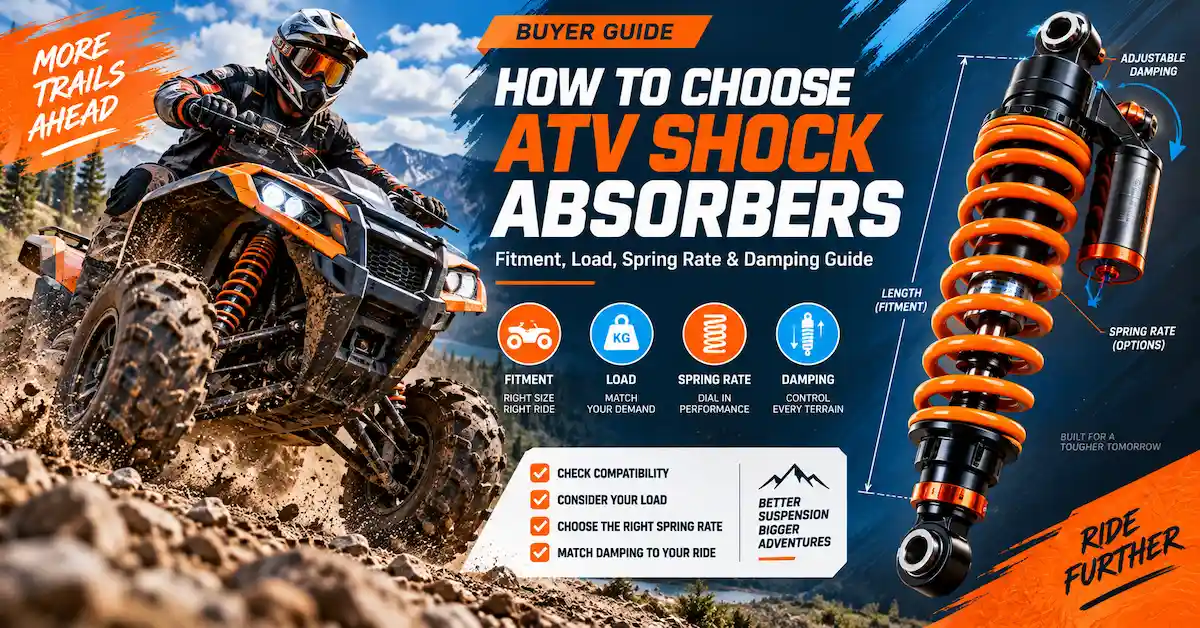
How to Choose ATV Shock Absorbers: Start With the Vehicle
If you are trying to understand how to choose ATV shock absorbers, do not begin with color, appearance, or even shock length.
Begin with the ATV itself.
The correct shock absorber depends on a combination of:
-
vehicle weight;
-
front or rear installation;
-
passenger and cargo load;
-
suspension geometry;
-
mounting dimensions;
-
spring rate;
-
shock stroke;
-
compression damping;
-
rebound damping;
-
tire size;
-
terrain;
-
intended use.
Two ATV shocks may look almost identical and have similar overall lengths, yet behave very differently once installed.
For B2B buyers, this matters even more because a poor selection can result in repeated fitment complaints, excessive returns, unstable vehicle behavior, or inconsistent aftermarket performance.
Buyers can review BEDO's current ATV and UTV shock absorber products to understand the range of suspension configurations available before defining a sourcing or customization project.
Quick ATV Shock Absorber Selection Checklist
Before comparing suppliers or models, collect these basic specifications:
| Selection Item | What to Confirm |
|---|---|
| Vehicle application | ATV model, year, version |
| Installation | Front or rear |
| Extended length | Eye-to-eye or specified mounting reference |
| Compressed length | Minimum shock length |
| Stroke | Available damper movement |
| Upper mount | Hole diameter and mounting width |
| Lower mount | Hole diameter and mounting width |
| Vehicle weight | Curb and operating weight |
| Load | Rider, passenger, cargo, accessories |
| Spring rate | Existing or target value |
| Damping | Compression and rebound requirements |
| Tire size | Standard or modified |
| Terrain | Trail, farm, sand, rock, mud, snow |
| Usage | Utility, recreational, performance |
| Customization | Color, logo, damping, spring, packaging |
If several of these values are unknown, selecting a shock only by product appearance or nominal length creates unnecessary risk.
1. Confirm ATV Shock Fitment Before Comparing Performance
Fitment is the first filter.
A shock absorber that does not move correctly through the ATV's suspension range cannot be fixed by better damping or a stronger spring.
Check Extended Length
Extended length defines how far the shock can extend.
If it is too long, the suspension may:
-
overextend;
-
place extra stress on ball joints;
-
change CV joint angles;
-
create suspension geometry problems.
If it is too short, available droop may be reduced.
Check Compressed Length
Compressed length is equally important.
At full compression, the suspension must reach its intended position without the shock becoming the mechanical stop unless the suspension was designed that way.
An incorrect compressed length can lead to:
-
premature bottoming;
-
tire-to-body interference;
-
suspension component contact;
-
excessive load on shock mounts.
Check Mounting Dimensions
Do not assume that the correct overall length means the shock will install correctly.
Measure:
-
upper mounting-hole diameter;
-
lower mounting-hole diameter;
-
mounting width;
-
bushing dimensions;
-
eye or clevis structure;
-
mounting orientation.
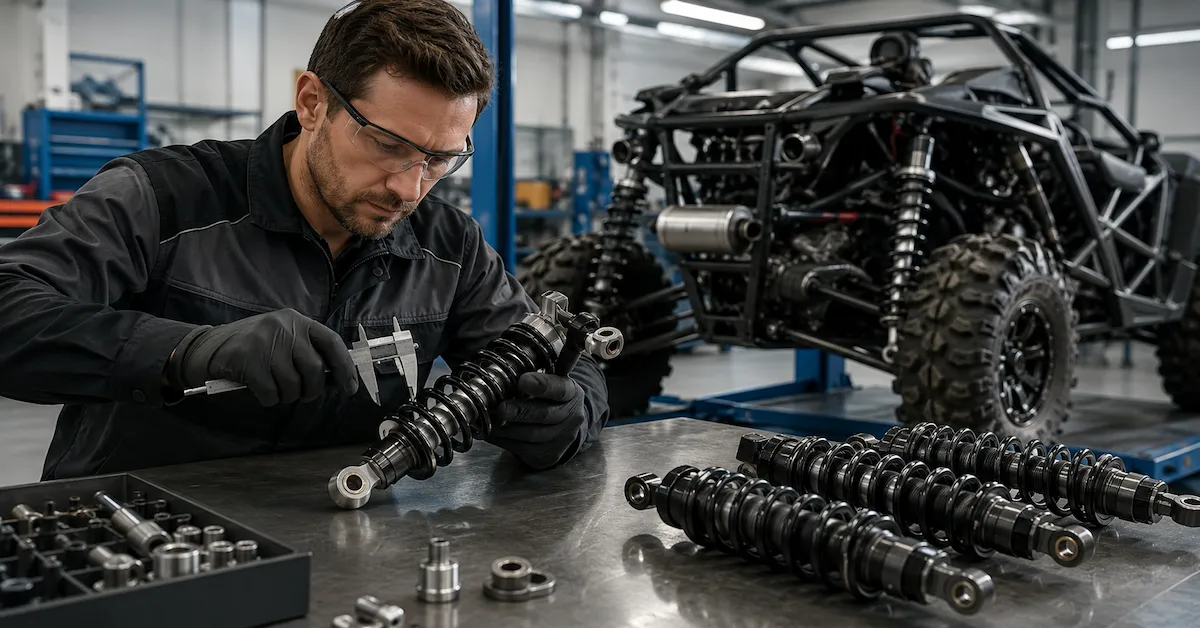
BEDO's ATV shock absorber fitment guide provides a more detailed explanation of why shock length, mounting dimensions, and suspension position should all be confirmed before ordering.
2. Match the Shock to Real Vehicle Load
ATV suspension should be selected for the vehicle in its actual operating condition.
The relevant load may include:
-
rider;
-
passenger;
-
cargo;
-
tools;
-
front or rear racks;
-
winch;
-
storage boxes;
-
larger tires;
-
aftermarket bumpers;
-
other accessories.
A shock that performs correctly on an unloaded ATV may sag excessively once the vehicle is prepared for real work.
Why Load Matters
Additional vehicle weight can affect:
-
ride height;
-
suspension sag;
-
remaining compression travel;
-
spring deflection;
-
bottoming resistance;
-
damping demand.
For utility ATV buyers, this is particularly important because actual working weight may be substantially higher than showroom weight.
When requesting custom shocks, provide both:
Curb weight
and
Typical / maximum operating load
This allows the suspension supplier to evaluate the application more accurately.
3. Choose the Right Spring Rate
Spring rate is one of the most important parameters when learning how to choose ATV shock absorbers.
The spring primarily supports the ATV and its load.
If spring rate is too low, buyers may experience:
-
excessive sag;
-
reduced ride height;
-
frequent bottoming;
-
poor load support;
-
insufficient usable travel under load.
If spring rate is too high, the vehicle may feel:
-
harsh;
-
difficult to compress;
-
less compliant over small bumps;
-
poorly matched when lightly loaded.
Higher Spring Rate Is Not Always Better
A common mistake is assuming that heavy-duty use always requires the stiffest possible spring.
The correct rate depends on:
-
vehicle weight;
-
front/rear weight distribution;
-
leverage ratio;
-
passenger load;
-
cargo;
-
desired ride height;
-
terrain.
For B2B ATV projects, spring selection should therefore be based on the real application rather than a simple “standard” or “heavy-duty” label.
4. Understand Shock Stroke vs Wheel Travel
Shock stroke and wheel travel are related, but they are not the same measurement.
Shock stroke is the distance the damper shaft moves.
Wheel travel is the vertical or suspension-path movement of the wheel.
The relationship depends on suspension geometry and the location of the shock mount.
This is important because buyers sometimes assume:
Longer shock stroke = the same increase in wheel travel.
That is not necessarily true.
Changing stroke or shock length may also affect:
-
suspension arms;
-
CV angles;
-
ball-joint articulation;
-
tire clearance;
-
chassis clearance;
-
mounting loads.
For modified or long-travel ATVs, shock selection should therefore be reviewed together with suspension geometry.
5. Compare Compression and Rebound Damping
Spring rate and damping are not interchangeable.
The spring supports load.
The damper controls suspension movement.
Compression Damping
Compression damping controls how quickly the shock compresses when the wheel moves upward relative to the chassis.
It becomes important during:
-
bumps;
-
rocks;
-
landings;
-
braking load transfer;
-
repeated terrain impacts.
Too little compression control can allow the suspension to move too quickly through its available travel.
Too much can make the ATV feel harsh and reduce compliance.
Rebound Damping
Rebound damping controls how quickly the suspension extends again after compression.
Too little rebound control may lead to:
-
bouncing;
-
unstable chassis movement;
-
poor wheel control.
Too much rebound can make the suspension recover too slowly between repeated bumps.
BEDO's article on compression and rebound damping testing explains why both directions should be evaluated separately.
6. Fixed or Adjustable ATV Shocks?
The right choice depends on the end user and application.
| Shock Type | Advantages | Considerations | Best Fit |
|---|---|---|---|
| Fixed damping | Simple, repeatable, cost-efficient | Limited tuning | Stable vehicle configurations |
| Adjustable damping | Greater tuning flexibility | More complexity and cost | Performance or changing conditions |
| Custom-valved shock | Developed around target application | Requires engineering and validation | OEM/custom ATV programs |
Fixed Damping
Fixed damping can be suitable when:
-
the vehicle configuration is stable;
-
payload varies little;
-
performance requirements are well defined;
-
buyers want production simplicity.
Adjustable Damping
Adjustability can be valuable when:
-
terrain changes frequently;
-
performance tuning is important;
-
end users want setup flexibility;
-
vehicle load changes significantly.
However, more adjustment is not automatically better.
An adjustable shock with the wrong spring, stroke, or basic damping range is still the wrong shock.
7. Choose Shocks According to ATV Terrain
Terrain should influence suspension selection because different environments create different loads and movement patterns.
Farm and Utility Use
Typical priorities:
-
load support;
-
durability;
-
predictable ride height;
-
repeated low-speed bump control.
Forest and Trail Riding
Important factors include:
-
repeated compression/rebound;
-
roots and rocks;
-
wheel control;
-
suspension compliance.
Rocky Terrain
Buyers should pay attention to:
-
impact control;
-
usable suspension travel;
-
rebound recovery;
-
component durability.
Sand and Beach Conditions
Important requirements may include:
-
corrosion resistance;
-
water resistance;
-
stable damping;
-
heat management;
-
consistent performance over repeated terrain inputs.
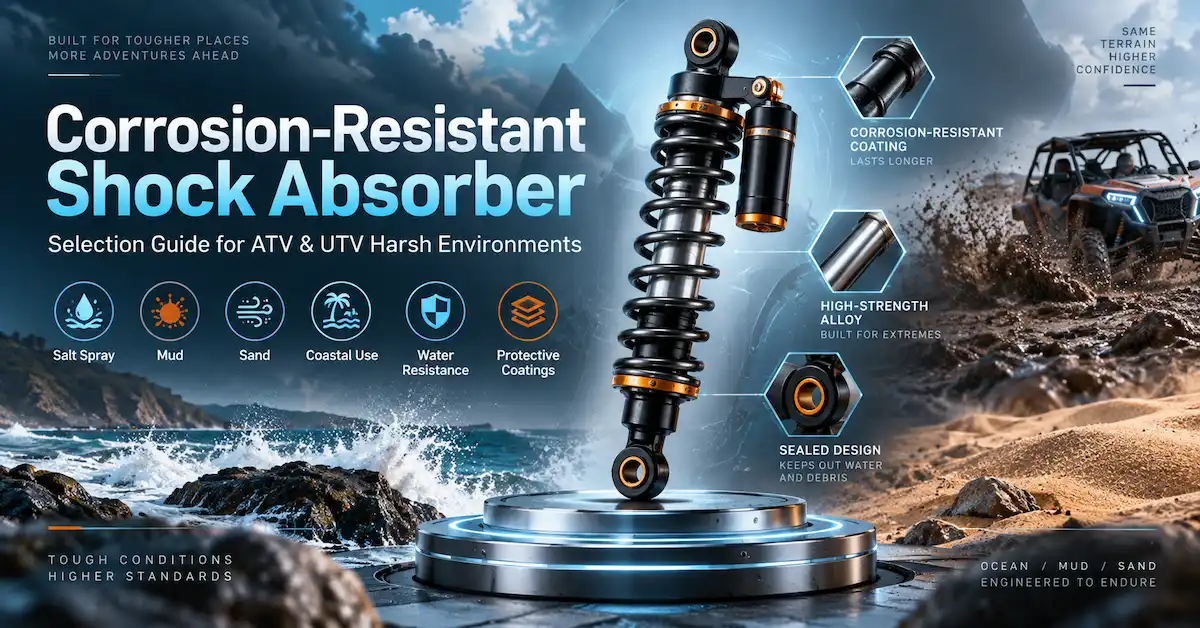
BEDO offers ATV/UTV shock configurations developed for different dimensions and applications, including products intended for rough and sand-related operating environments. Buyers can review the ATV/UTV shock absorber range before discussing vehicle-specific requirements.
8. Do Larger Tires Change ATV Shock Selection?
They can.
Larger tires may increase:
-
unsprung mass;
-
rotational mass;
-
vehicle height;
-
clearance requirements;
-
loads on suspension components.
They may also influence suspension behavior under repeated impacts.
If an ATV has been modified with larger tires, buyers should not automatically use the original suspension specification without reviewing:
-
vehicle weight;
-
suspension travel;
-
ball-joint angles;
-
CV joint angles;
-
tire clearance;
-
spring requirements;
-
damping control.
This is particularly important for modification companies and aftermarket suspension brands.
9. Do Not Select ATV Shocks by Length Alone
This is one of the most common sourcing mistakes.
Consider several existing BEDO ATV/UTV configurations:
| Model | Length | Cylinder OD | Stroke | Spring Rate | Damping |
|---|---|---|---|---|---|
| AU_HSA_01 | 465 mm | 38 mm | 130 mm | 75 LBS | Fixed |
| AU_HSA_02 | 395 mm | 38 mm | 80 mm | 250 LBS | Fixed |
| AU_HSA_03 | 445 mm | 42 mm | 130 mm | 135 LBS | Fixed |
| AU_HSA_04 | 345 mm | 42 mm | 80 mm | 225 LBS | Fixed |
These examples show why overall length alone cannot define the correct shock.
Two products can have:
-
different spring rates;
-
different strokes;
-
different cylinder sizes;
-
different damping targets;
even when they serve the broader ATV/UTV market.
For example, buyers can compare individual product information for AU_HSA_01, AU_HSA_03, and AU_HSA_04.
The purpose of this comparison is not to suggest that one model is universally better.
It shows that shock selection must be application-specific.
10. Standard Replacement or Custom ATV Shock?
Standard shocks are often appropriate for direct replacement applications.
Custom development becomes more valuable when:
-
the ATV has a non-standard load;
-
tires have changed;
-
suspension geometry has changed;
-
a new vehicle is being developed;
-
the existing shock bottoms out;
-
the buyer wants different damping;
-
private-label differentiation is required;
-
standard dimensions do not fit.
Standard ATV Shock
Best when:
-
fitment is already confirmed;
-
vehicle configuration is unchanged;
-
performance target is conventional.
Customized ATV Shock
Best when:
-
fitment needs modification;
-
spring rate must change;
-
damping needs adjustment;
-
vehicle application is unique;
-
performance differentiation is required.
BEDO supports custom suspension development from samples, drawings, CAD information, and vehicle requirements. The custom suspension development files guide explains what technical information buyers should prepare.
11. Validate a Prototype Before Bulk Ordering
For customized ATV shocks, prototype validation is one of the most important risk-control steps.
A prototype should be checked for:
Fitment
-
upper mount;
-
lower mount;
-
clearance;
-
extended position;
-
compressed position.
Static Setup
-
ride height;
-
sag;
-
spring preload;
-
load support.
Dynamic Behavior
-
compression control;
-
rebound recovery;
-
bottoming;
-
terrain response.
Product Condition
-
leakage;
-
abnormal noise;
-
rod movement;
-
adjustment function;
-
finish.
The purpose is to identify problems while they are still inexpensive to correct.
For new OEM, ODM, or private-label programs, buyers can also use small-batch suspension production to validate consistency before scaling.
12. What Quality Checks Matter for ATV Shock Absorbers?
A good sample is not enough.
B2B buyers also need to know whether the approved specification can be repeated.
Important production checks may include:
-
shock length;
-
stroke;
-
mounting dimensions;
-
spring dimensions;
-
spring coating;
-
assembly;
-
rod movement;
-
leakage;
-
pressure retention;
-
damping consistency;
-
surface finish;
-
packaging.
For OEM and distributor programs, batch consistency can be more important than achieving an unusually impressive first prototype.
The production objective should be:
Make every approved unit behave within the controlled specification.
13. Common ATV Shock Selection Mistakes
Mistake 1: Choosing by Appearance
Two shocks may look similar while having completely different internal and spring specifications.
Better approach: compare technical data.
Mistake 2: Using Only Extended Length
This ignores compressed length, stroke, and mounting geometry.
Better approach: verify the complete fitment envelope.
Mistake 3: Ignoring Vehicle Load
A shock selected for an empty ATV may perform poorly under cargo or accessories.
Better approach: provide realistic operating load.
Mistake 4: Choosing the Stiffest Spring
A higher spring rate is not automatically better.
Better approach: match spring rate to the vehicle and usage.
Mistake 5: Treating Compression and Rebound as the Same
They control different phases of suspension movement.
Better approach: evaluate both separately.
Mistake 6: Skipping Prototype Testing
Physical fitment does not guarantee correct suspension performance.
Better approach: validate the vehicle before bulk production.
Mistake 7: Buying Only on Unit Price
Low unit price cannot compensate for:
-
incorrect fitment;
-
high return rates;
-
inconsistent damping;
-
poor batch repeatability.
Better approach: compare total sourcing risk.
14. What Should an ATV Shock Absorber RFQ Include?
A detailed RFQ helps a manufacturer recommend or develop the right solution.
Include:
-
ATV make/model or project code
-
Model year, if applicable
-
Front or rear installation
-
Vehicle curb weight
-
Rider/passenger load
-
Cargo and accessory load
-
Tire size
-
Extended shock length
-
Compressed shock length
-
Stroke
-
Upper mounting dimensions
-
Lower mounting dimensions
-
Current spring specification
-
Current damping information, if available
-
Typical terrain
-
Current suspension problem
-
Target performance
-
Existing sample availability
-
Drawing or CAD availability
-
Prototype quantity
-
Estimated production volume
-
Logo, color, and packaging requirements
Instead of asking:
Please quote ATV shocks.
A stronger sourcing inquiry is:
We need rear shocks for a utility ATV used on farm and rough trail conditions. The vehicle carries additional cargo and currently has excessive rear sag. We can provide the existing shock sample, mounting dimensions, vehicle load data, and target annual quantity.
That information gives the manufacturer a much better starting point.
15. How to Evaluate an ATV Shock Absorber Manufacturer
For OEM, private-label, distributor, or customized programs, evaluate the supplier across several areas.
| Supplier Capability | What Buyers Should Check |
|---|---|
| Fitment understanding | Can dimensions and mounting be verified? |
| Application review | Does the supplier ask about load and terrain? |
| Spring capability | Can spring rate be discussed according to vehicle requirements? |
| Damping capability | Can compression and rebound be evaluated separately? |
| Sample development | Can an existing shock be used as a development reference? |
| Drawing/CAD support | Can technical files be reviewed? |
| Prototype support | Is there a test-and-revision process? |
| Small batch | Can the project be validated before scaling? |
| QC | Are critical dimensions and function checked? |
| Revision control | Can the approved version be frozen? |
| Production consistency | Can repeat orders match the approved sample? |
A capable supplier should be able to explain why a particular shock configuration is appropriate, not simply say that it “fits most ATVs.”
How BEDO Supports ATV Shock Absorber Projects
BEDO focuses on shock absorbers, suspension springs, and related suspension products for ATV, UTV, motorcycle, electric motorcycle, and other off-road vehicle applications.
Depending on the project, development can begin from:
-
an existing shock sample;
-
2D drawings;
-
3D CAD;
-
vehicle data;
-
load requirements;
-
target spring rate;
-
damping requirements;
-
fitment dimensions.
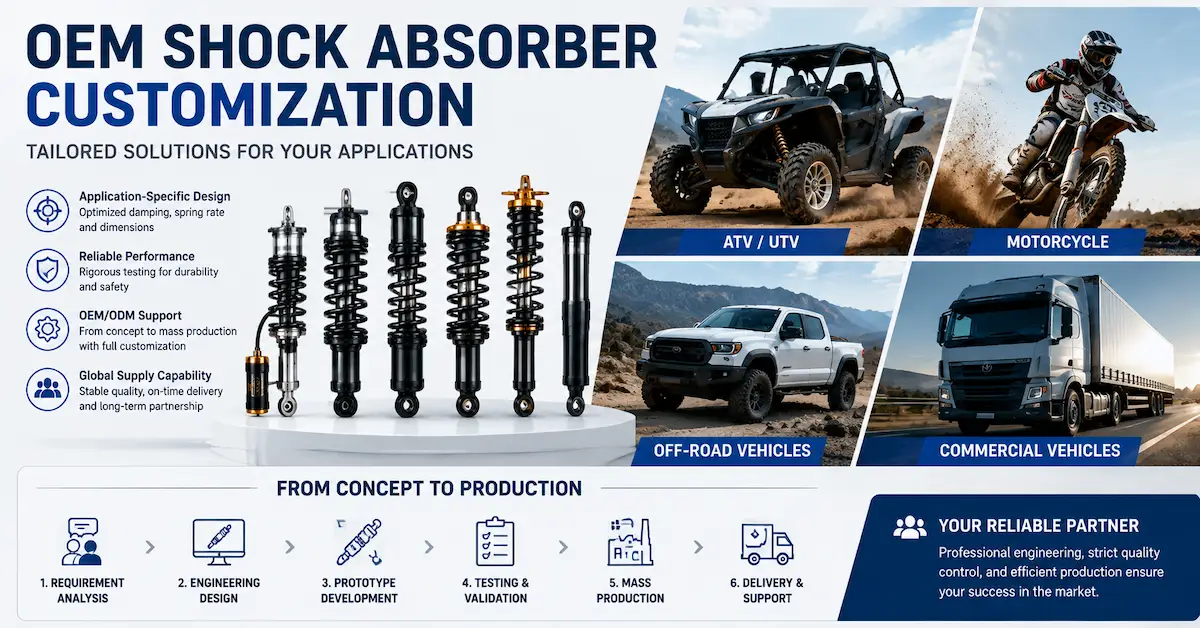
Projects requiring more than a standard product can move through:
Requirement Review → Engineering Review → Prototype → Vehicle Validation → Revision → Approval → Small Batch → Production
You can learn more about BEDO's suspension manufacturing and development capabilities on the About Us page.
FAQ
How do I know what ATV shock absorber I need?
Start with the ATV model, installation position, extended and compressed lengths, stroke, mounting dimensions, vehicle weight, expected load, terrain, and desired performance.
Can I choose ATV shocks based only on overall length?
No. Overall length is only one parameter. Stroke, compressed length, mounting dimensions, spring rate, damping, and vehicle geometry also matter.
How does ATV weight affect shock selection?
Higher operating weight increases spring and damping demands and can reduce available suspension travel if the spring is not matched correctly.
What spring rate should an ATV use?
There is no universal spring rate. It depends on vehicle weight, suspension geometry, load, ride-height target, and intended use.
Are adjustable ATV shocks always better?
Not necessarily. Adjustable shocks provide tuning flexibility, while fixed damping can be appropriate for a stable and well-defined application.
What is the difference between compression and rebound damping?
Compression damping controls the shock as it compresses. Rebound damping controls how quickly it extends after compression.
Does a longer shock give an ATV more wheel travel?
Not automatically. Wheel travel also depends on suspension geometry, shock mounting position, and component limits.
Should ATV shocks be changed after fitting larger tires?
Larger tires may affect suspension load and geometry. The existing shocks should be reviewed rather than automatically replaced based on tire size alone.
Do I need a prototype for custom ATV shocks?
For customized dimensions, spring rates, damping, or vehicle applications, prototype validation is recommended before mass production.
What information should I send for a custom ATV shock quotation?
Provide the vehicle model, load, terrain, shock dimensions, mounting details, spring information, current problem, target performance, samples or drawings, and expected order quantity.
Conclusion
Choosing the right ATV shock absorbers starts with fitment, vehicle load, spring rate, stroke, and damping—not appearance or overall length alone. Buyers should also consider terrain, modifications, and real operating conditions before selecting a standard or custom solution.
For OEM, aftermarket, or private-label projects, validate critical dimensions and performance before bulk production. If you have vehicle data, drawings, or an existing sample, submit them through the BEDO Contact Us page for project review.