The correct treatment depends on the component material and operating environment.
Final surface inspection should check:
Coating coverage
Adhesion
Scratches
Exposed metal
Color consistency
Thread protection
Logo position
Surface defects
Sealing and Contamination Control
Mud, sand, dust, and water can damage seals and internal shock components.
A suitable sealing system may include:
Oil seals
Dust seals
Wipers
Guide components
Protective boots
Rod coatings
Poor sealing may cause:
Oil leakage
Increased friction
Damaged piston rods
Inconsistent damping
Reduced service life
Assembly cleanliness is also important.
Contamination inside the shock absorber may affect oil flow, valves, seals, and damping consistency.
Quality Control in Suspension Component Production
Quality control should cover materials, machining, dimensions, assembly, performance, appearance, and packaging.
Incoming Material Inspection
The factory should inspect:
Tubes
Piston rods
Springs
Seals
Bushings
Machined parts
Mounting components
Reservoir components
Hoses and fittings
Dimensional Inspection
Critical dimensions may include:
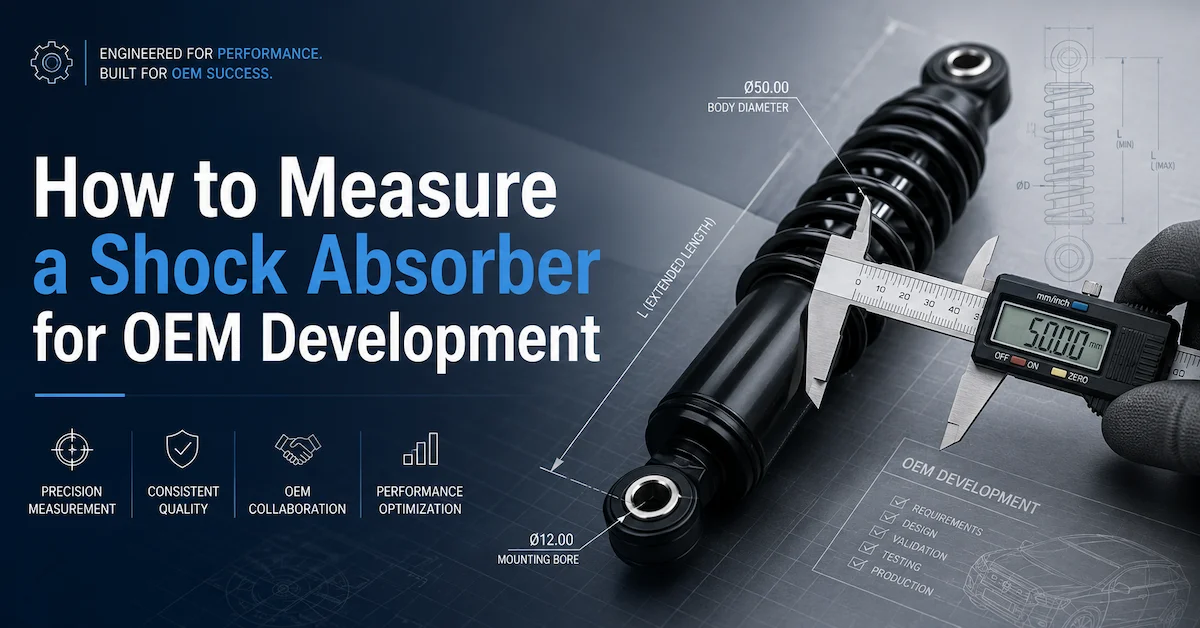
Extended length
Compressed length
Effective stroke
Mounting width
Hole diameter
Spring length
Spring diameter
Rod diameter
Body diameter
Reservoir position
Assembly Control
The production process should control:
Component cleanliness
Seal installation
Valve assembly
Oil filling
Gas charging
Tightening torque
Spring preload
Adjustment functions
Mounting alignment
Leakage Testing
Finished shock absorbers should be checked for:
Oil leakage
Pressure loss
Hose leakage
Seal damage
Surface contamination
Functional Testing
The shock absorber should move smoothly without:
Sticking
Abnormal noise
Excessive friction
Uneven resistance
Adjustment failure
Damping Verification
Compression and rebound forces should be compared with approved specifications when performance testing is required.
Final Inspection
Final checks should include:
Surface finish
Critical dimensions
Product color
Logo position
Labels
Packaging
Quantity
Carton condition
Why Prototype Testing Is Important
A prototype allows buyers to evaluate:
Installation compatibility
Mounting clearance
Suspension travel
Spring support
Compression response
Rebound recovery
Reservoir position
Adjustment access
Product appearance
Testing should reflect realistic operating conditions.
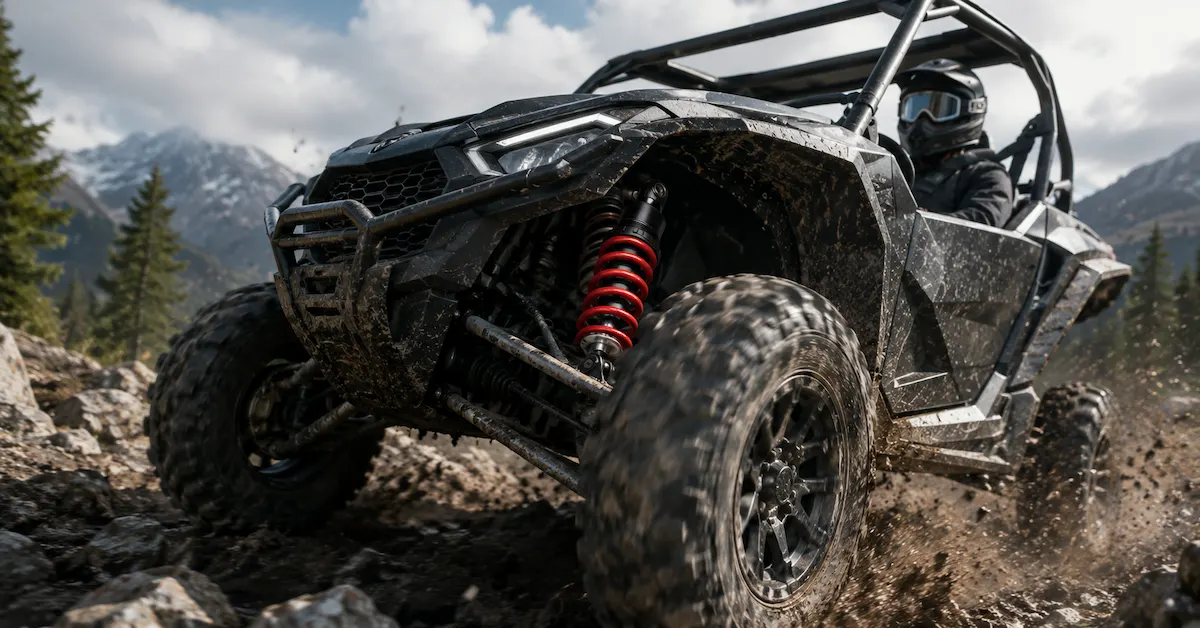
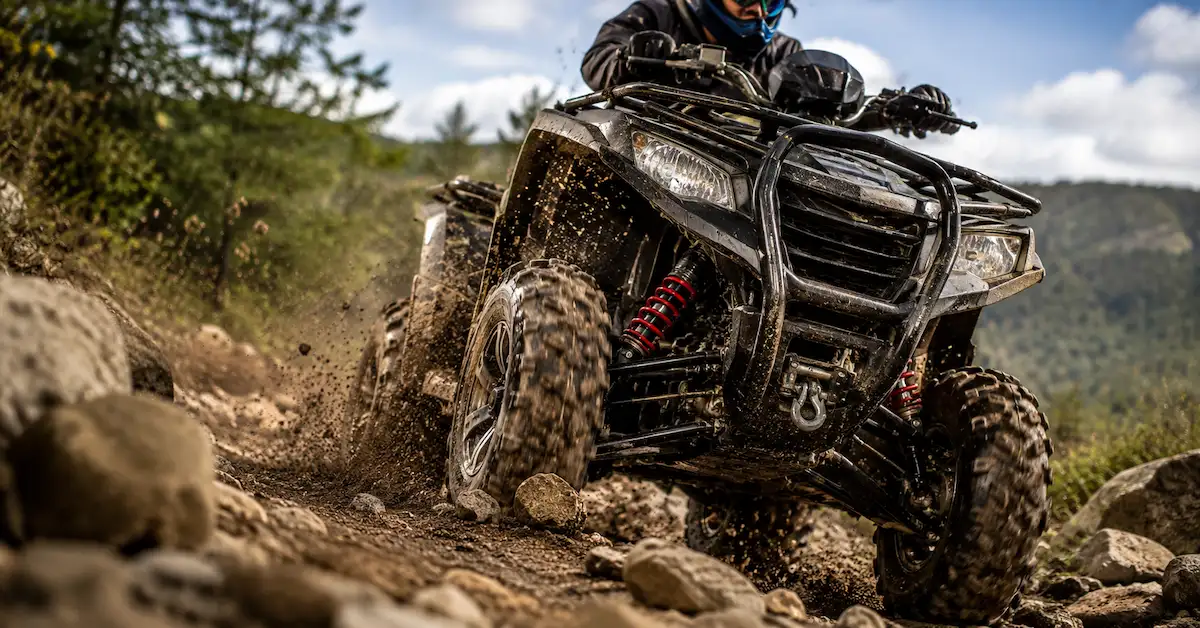
A component intended for a loaded UTV should not be approved only through an unloaded workshop test. Similarly, a racing ATV component should be evaluated under suitable terrain and impact conditions.
Why Small-Batch Validation Reduces Risk
One prototype confirms the design concept, but a pilot batch helps confirm production consistency.
Small-batch validation may reveal:
Dimensional variation
Spring-rate inconsistency
Damping differences
Leakage risks
Adjustment problems
Surface defects
Mounting issues
Packaging errors
Installer feedback
This stage helps B2B buyers reduce the risk of placing a large order before the product and production process are fully verified.
Complete Assembly vs Individual Component Sourcing
Evaluation point
Complete suspension assembly
Individual components
Purchasing complexity
Lower
Higher
Assembly responsibility
Factory
Buyer
Performance matching
Managed as a system
Buyer must coordinate components
Customization
Complete solution
Component-specific
Quality control
Factory-level final inspection
Buyer requires incoming and assembly control
Best suited for
Brands and distributors
Vehicle factories and suspension assemblers
The correct sourcing model depends on the buyer’s manufacturing capabilities.
Brands and wholesalers often prefer complete assemblies. Vehicle manufacturers with internal assembly lines may source individual shock bodies, springs, bushings, and mounting components.
Standard Supplier vs Off-Road Suspension Component Factory
Evaluation point
Standard parts supplier
Custom suspension factory
Product range
Existing components
Custom assemblies and individual parts
Dimensions
Fixed
Developed from samples or drawings
Materials
Standard
Selected for application requirements
Spring rate
Fixed
Customized
Damping
General setting
Application-specific
Branding
Limited
Logo, color, label, and packaging
Prototype support
Limited
Available
Small-batch validation
Not always available
Suitable for new projects
Best application
General replacement
OEM, ODM, private-label, and special vehicles
A standard supplier may be suitable for common replacement demand. A custom factory provides greater value when technical differentiation, fitment accuracy, or long-term product development is required.
How to Evaluate an Off-Road Suspension Component Factory
Before choosing a supplier, buyers should evaluate its engineering, manufacturing, testing, and communication capabilities.
Engineering Capability
Confirm whether the factory can:
Review samples
Review technical drawings
Analyze vehicle applications
Confirm mounting geometry
Develop spring specifications
Adjust damping
Evaluate materials
Produce prototypes
Document approved standards
Manufacturing Capability
Evaluate:
Machining accuracy
Spring-production control
Assembly procedures
Material management
Surface-treatment control
Small-batch flexibility
Mass-production capacity
Batch traceability
Repeat-order consistency
Testing Capability
Ask whether the supplier can support:
Dimensional inspection
Spring inspection
Leakage testing
Functional testing
Damping verification
Adjustment testing
Surface inspection
Final packaging inspection
Communication Capability
A professional supplier should ask about:
Vehicle category
Vehicle weight
Payload
Installation position
Terrain
Suspension travel
Mounting dimensions
Target performance
Order quantity
A supplier that provides a quotation from a photograph alone may overlook critical technical risks.
How Bedo Auto Supports Off-Road Suspension Projects
As an off-road suspension component factory, Bedo Auto supports customized shock absorbers, suspension springs, and related components for ATV, UTV, motorcycle, electric motorcycle, snowmobile, beach buggy, and specialty vehicle applications.
Project support can include:
Sample analysis
Technical drawing review
Application evaluation
Mounting-dimension confirmation
Spring-rate development
Compression and rebound adjustment
Reservoir configuration
Bushing and mounting customization
Material selection
Surface-treatment customization
Prototype production
Small-batch validation
OEM and ODM branding
Customized labels and packaging
Repeat production support
Buyers can learn more about Bedo Auto through the About Us page.
For custom suspension components, samples, drawings, technical specifications, and purchasing requirements can be submitted through the Contact Usページ。
FAQ
What products can an off-road suspension component factory manufacture?
The factory may manufacture shock absorbers, coil springs, piston rods, shock bodies, bushings, mounting eyes, spring seats, reservoirs, adjusters, and related connection parts.
Can suspension components be developed from samples?
Yes. Samples can provide structural and dimensional references. Vehicle information and performance requirements should also be supplied.
Can individual suspension components be customized?
Yes. Dimensions, materials, spring rates, damping, surface treatments, mounting structures, logos, labels, and packaging can be customized.
Can a factory provide complete suspension assemblies?
Yes. Depending on its capabilities, the factory may supply complete shock absorbers, suspension kits, semi-finished assemblies, or individual parts.
Why should spring rate and damping be developed together?
The spring supports the load, while damping controls suspension movement. Incorrect matching may cause bouncing, harshness, bottoming, or poor traction.
Is small-batch production useful?
Yes. A pilot batch allows buyers to verify dimensions, fitment, performance, surface quality, packaging, and production consistency before mass production.
Can Bedo Auto support OEM and ODM projects?
Yes. Bedo Auto supports sample-based and drawing-based development, technical customization, prototype production, small-batch validation, branding, packaging, and repeat manufacturing.
Conclusion
Choosing a reliable off-road suspension component factory helps vehicle brands, manufacturers, importers, and aftermarket companies control suspension fitment, performance, durability, branding, and supply consistency.
The suspension system should be developed as a complete combination of shock absorbers, springs, bushings, mounts, sealing components, reservoirs, and adjustment mechanisms. Changing one component without evaluating the others may create new handling or reliability problems.
Through sample analysis, drawing review, material selection, spring and damping development, prototype testing, small-batch validation, and controlled OEM/ODM production, Bedo Auto supports off-road suspension component projects for global B2B buyers.