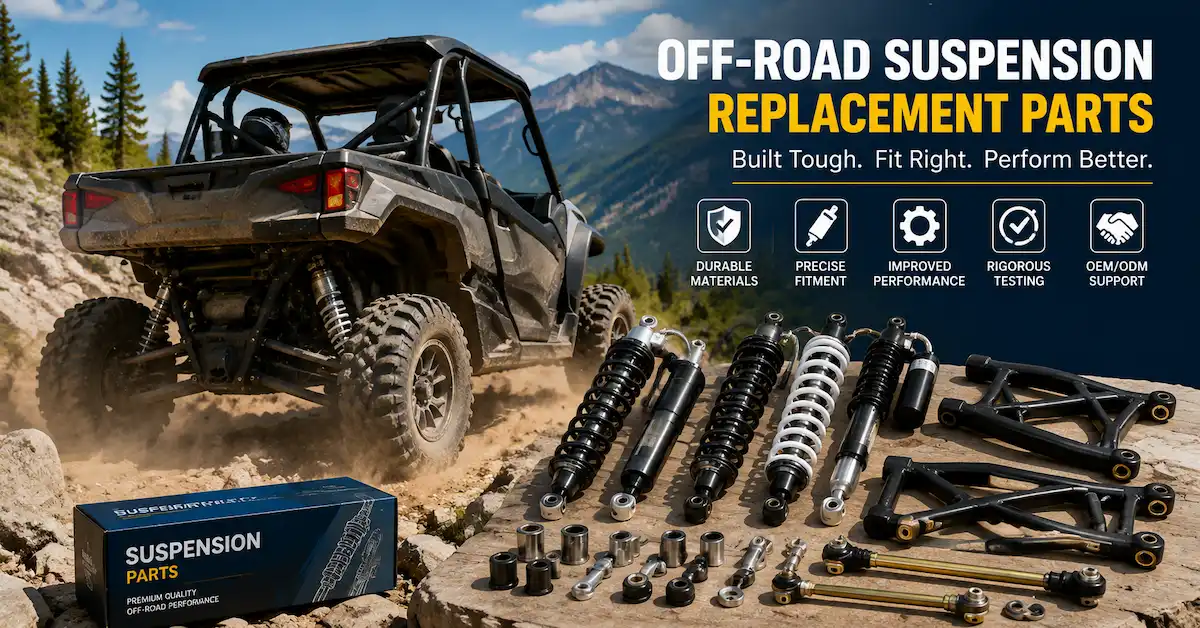
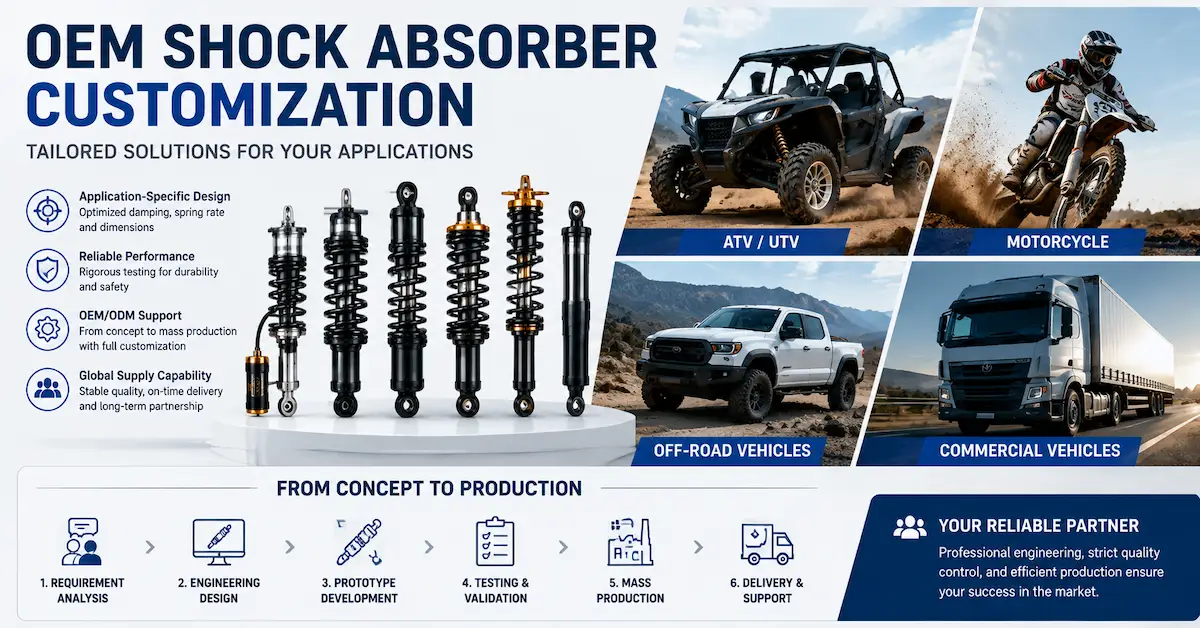
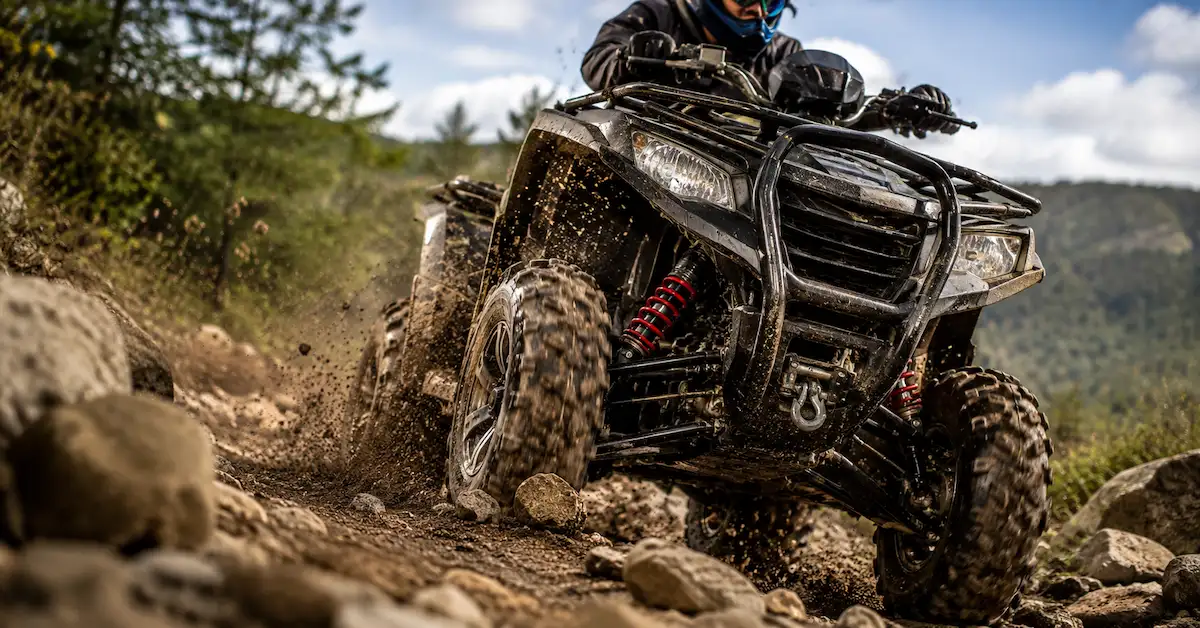
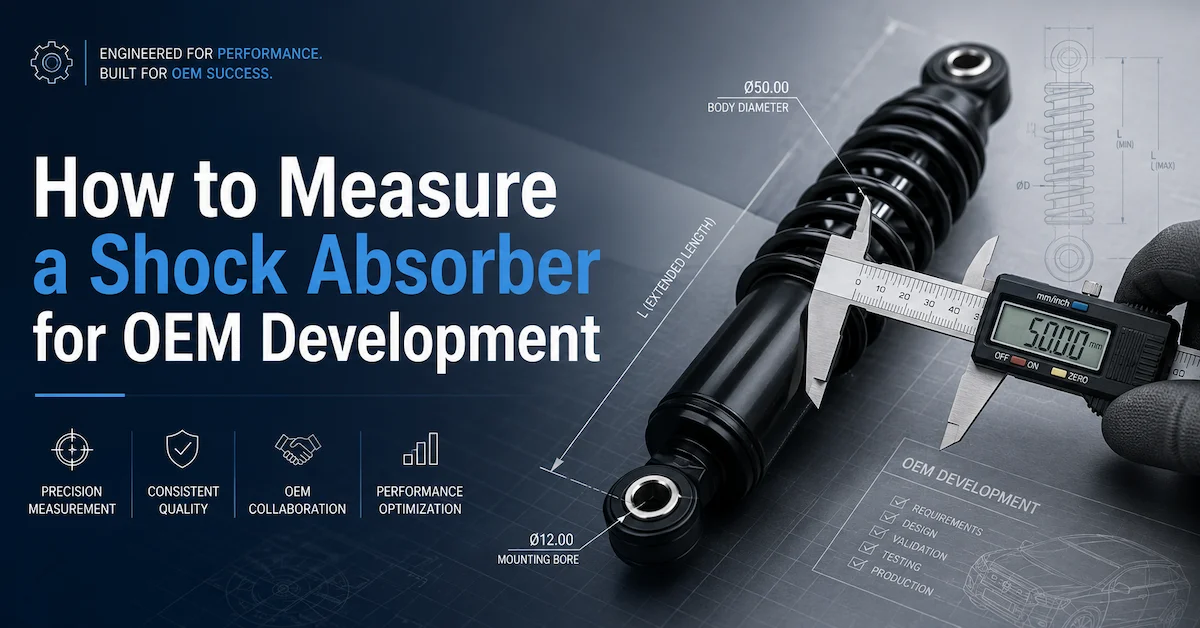
Bedo Auto は、ATV、UTV、オートバイ、電動バイク、スノーモービル、ビーチバギー、特殊車両用のカスタマイズされたショックアブソーバー、サスペンション スプリング、ブッシュ、マウント、および関連サスペンション コンポーネントをサポートしています。購入者は、Bedo Auto 製品ページで利用可能なソリューションを確認できます。
The selected treatment should match the operating environment.
Snow, coastal, agricultural, and commercial applications may require stronger corrosion protection than occasional recreational use.
Sample-Based Replacement Development
A physical sample helps the supplier inspect:
Dimensions
Mounting structure
Spring size
Shock-body size
Piston-rod diameter
Reservoir design
Surface finish
Adjustment mechanisms
However, external measurements do not fully identify:
Spring rate
Compression force
Rebound force
Valve design
Oil specification
Gas pressure
Material grade
Internal tolerances
The buyer should explain whether the new product should match the original or improve its load support, durability, sealing, corrosion resistance, or damping.
Drawing-Based OEM Development
Technical drawings create a clearer production standard.
A drawing may define:
Extended and compressed lengths
Stroke
Mounting-hole diameter
Mounting width
Body and rod diameters
Spring dimensions
Reservoir location
Materials
Surface treatment
Tolerance ranges
Branding position
Before prototyping, the supplier should review:
Full-compression clearance
Full-extension movement
Mounting alignment
Structural strength
Reservoir clearance
Hose routing
Manufacturing feasibility
Tolerance requirements
Early technical review helps reduce tooling changes and repeated samples.
Quality Control for Replacement Suspension Parts
A reliable supplier should control materials, dimensions, assembly, performance, appearance, and packaging.
Incoming Material Inspection
Typical items include:
Tubes
Piston rods
Springs
Seals
Bushings
Machined parts
Reservoir components
Hoses and fittings
Mounting hardware
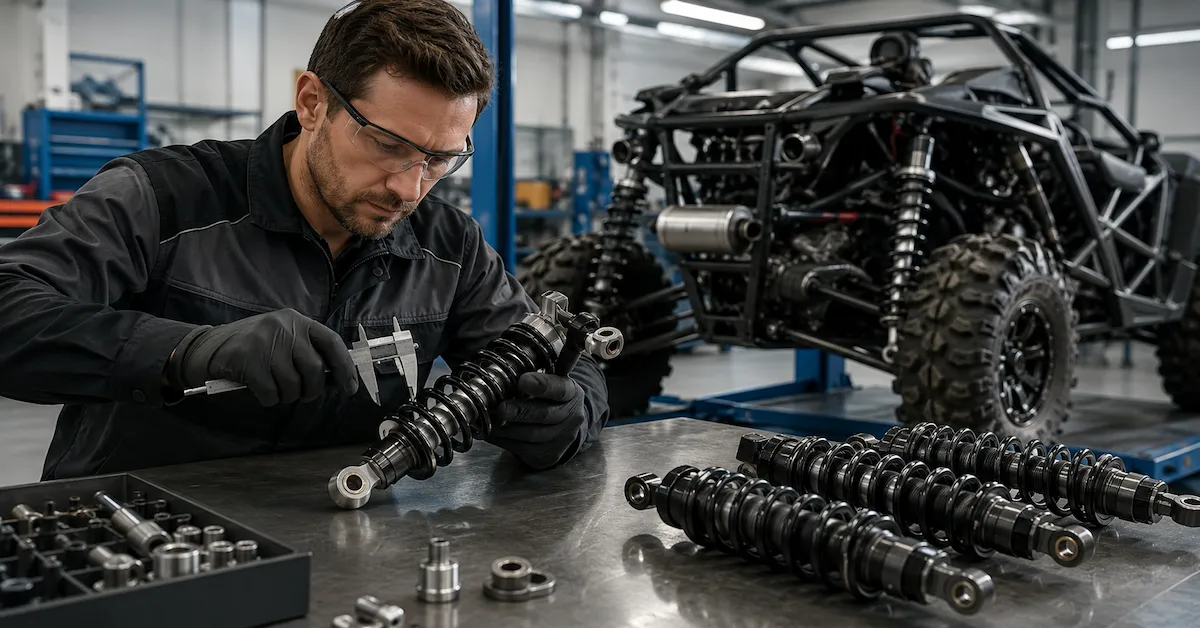
Dimensional Inspection
Critical measurements include:
Extended length
Compressed length
Stroke
Mounting width
Hole diameter
Rod diameter
Body diameter
Spring dimensions
Reservoir position
Assembly Control
The process should control:
Component cleanliness
Seal installation
Valve assembly
Oil filling
Gas charging
Tightening torque
Spring preload
Adjustment functions
Mounting alignment
Leakage and Functional Testing
Finished shocks should be checked for:
Oil leakage
Pressure loss
Hose leakage
Sticking
Abnormal noise
Excessive friction
Uneven resistance
Adjustment failure
Final Inspection
Final checks may include:
Product dimensions
Surface finish
Spring color
Logo position
Product labels
Packaging
Quantity
Carton condition
Why Prototype and Pilot-Batch Testing Matter
A prototype allows buyers to confirm:
Vehicle fitment
Mounting alignment
Suspension travel
Ride height
Spring support
Compression response
Rebound recovery
Reservoir clearance
Product appearance
Testing should reflect realistic vehicle loads and terrain.
A pilot batch then helps verify:
Dimensional consistency
Spring-rate consistency
Damping variation
Leakage control
Coating quality
Packaging accuracy
Repeatable production
This reduces inventory and warranty risks before mass production.
OEM Branding and Packaging Options
B2B replacement programs may include:
Custom spring colors
Shock-body finishes
Logo marking
Model labels
Barcodes
Installation instructions
Product cartons
Private-label packaging
Complete repair kits
Technical specifications should be approved before producing final packaging materials.
How to Evaluate a Suspension Replacement Parts Supplier
Before selecting a supplier, buyers should evaluate four areas.
Engineering Capability
Confirm whether the supplier can:
Review samples and drawings
Confirm vehicle compatibility
Evaluate payload
Develop spring specifications
Adjust damping
Produce prototypes
Record approved standards
Manufacturing Capability
Evaluate:
Material management
Machining accuracy
Assembly procedures
Small-batch flexibility
Production capacity
Batch traceability
Repeat-order consistency
Testing Capability
Ask whether the supplier can support:
Dimensional inspection
Spring inspection
Leakage testing
Functional testing
Damping verification
Final inspection
Communication Capability
A professional supplier should ask about vehicle type, model, installation position, weight, payload, terrain, dimensions, current suspension problems, and target performance.
How Bedo Auto Supports Replacement Suspension Projects
Bedo Auto supports customized shock absorbers, springs, bushings, mounts, and related off-road suspension replacement parts for ATV, UTV, motorcycles, electric motorcycles, snowmobiles, beach buggies, and specialty vehicles.
What are the most common off-road suspension replacement parts?
Common parts include front and rear shock absorbers, coil springs, bushings, sleeves, mounting eyes, reservoirs, spring seats, adjusters, and connection hardware.
Can suspension replacement parts be developed from samples?
Yes. Samples provide structural and dimensional references. Vehicle data, operating load, terrain, and target performance should also be supplied.
Can replacement parts be upgraded for heavy-duty use?
Yes. Spring rate, damping, structure, sealing, materials, and surface protection can be developed according to the actual application.
Are front and rear suspension parts interchangeable?
Usually not. Front and rear components operate under different loads and normally use different lengths, mounting structures, spring rates, and damping settings.
Should bushings be replaced with the shock absorber?
Bushings should be inspected. Worn bushings may cause noise, looseness, misalignment, and premature wear of the replacement component.
Can replacement parts use custom branding?
Yes. OEM projects may include custom colors, logos, model labels, barcodes, instructions, cartons, and private-label packaging.
Why is pilot-batch testing recommended?
A pilot batch helps verify dimensions, fitment, spring consistency, damping, sealing, appearance, packaging, and repeatable production before a larger order.
Conclusion
Reliable off-road suspension replacement parts must restore more than physical fitment. Shock length, stroke, mounting dimensions, spring rate, damping, bushings, sealing, materials, corrosion protection, and operating load must all match the vehicle.
For B2B buyers, the right supplier should be able to evaluate samples, review drawings, confirm application requirements, develop prototypes, test critical functions, and reproduce approved specifications consistently.
Through sample analysis, spring and damping development, prototype validation, pilot production, and controlled OEM/ODM manufacturing, Bedo Auto supports replacement suspension programs for global brands, importers, wholesalers, distributors, repair-parts companies, and aftermarket buyers.