Contamination can damage the piston-rod surface and sealing system.
Possible consequences include:
Oil leakage
Increased friction
Damaged seals
Scratched piston rods
Inconsistent damping
Reduced service life
A suitable protection system may include:
Oil seals
Dust seals
Wipers
Rod coatings
Protective guides
Corrosion-resistant finishes
Assembly cleanliness is also critical because internal contamination may affect valves and oil flow.
Piston Rod and Mounting Strength
The piston rod and mounting eyes experience repeated impact loads.
Important control points include:
Rod material
Rod diameter
Straightness
Surface hardness
Surface finish
Corrosion protection
Mounting-eye dimensions
Bushing quality
Weld quality where applicable
Mounting alignment
A bent rod or misaligned mounting eye may create side loading and accelerate seal wear.
Mounting components should be evaluated together with the motorcycle frame and linkage.
Fixed vs Adjustable Dirt Bike Shocks
Feature
Fixed shock
Adjustable shock
Damping
Factory preset
Rider or technician adjustable
Complexity
Lower
Higher
Cost
Usually lower
Usually higher
Setup
Simple
Requires correct adjustment
Rider flexibility
Limited
Supports different riders
Terrain flexibility
One general setting
Can adapt to different terrain
Best application
Youth or standard replacement
Performance and racing markets
Adjustable options may include:
Spring preload
Rebound damping
Compression damping
High-speed compression
Low-speed compression
Shock-length adjustment
More adjustment clicks do not automatically indicate better performance. The useful range and repeatability are more important.
Development from an Existing Sample
A physical sample can help the supplier evaluate:
Shock length
Stroke
Mounting dimensions
Spring dimensions
Reservoir structure
Body diameter
Rod diameter
Adjustment mechanisms
Surface treatment
However, external measurements do not fully reveal:
Spring rate
Damping curves
Internal valve design
Oil specification
Gas pressure
Friction characteristics
Material grade
The buyer should clearly state whether the new shock must:
Match the original product
Improve bottoming resistance
Support a heavier rider
Improve traction
Reduce harshness
Add adjustment functions
Improve sealing
Reduce production cost
Create a premium aftermarket version
Drawing-Based OEM Development
Drawings are particularly useful for new motorcycle models and original equipment projects.
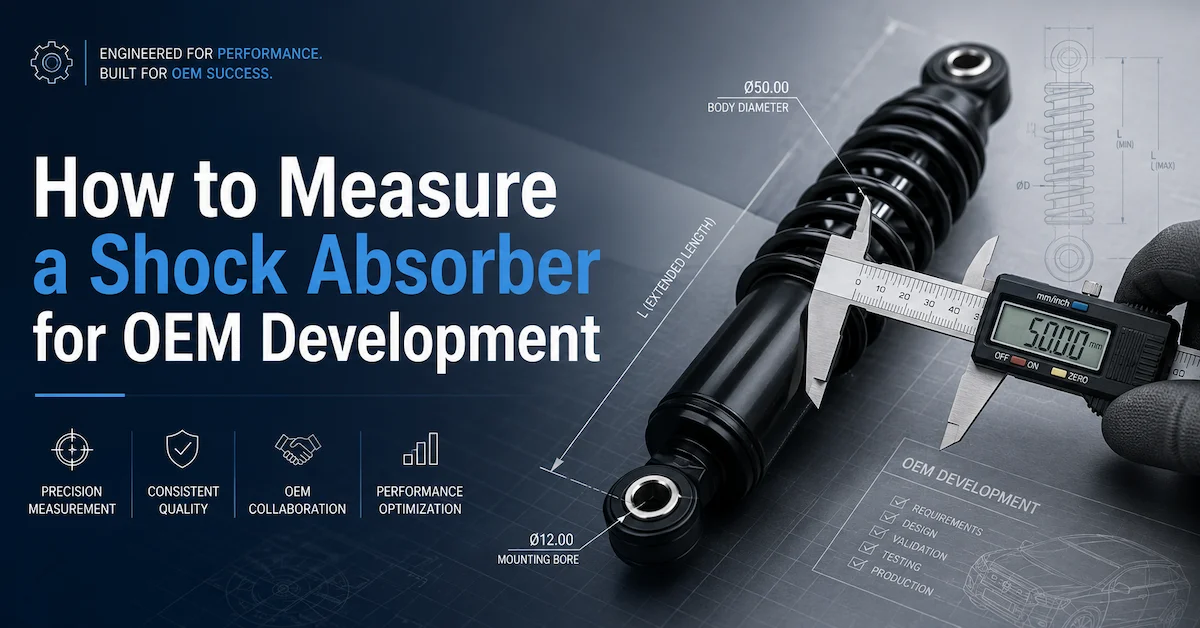
A complete drawing may specify:
Extended length
Compressed length
Effective stroke
Mounting-hole diameter
Mounting width
Body diameter
Rod diameter
Reservoir location
Hose length
Spring dimensions
Material requirements
Surface finish
Tolerance range
Before prototyping, the supplier should review:
Linkage clearance
Swingarm movement
Frame clearance
Reservoir position
Exhaust proximity
Adjustment access
Full-compression interference
Manufacturing feasibility
Early technical review helps reduce repeated samples and tooling changes.
Quality Control in Dirt Bike Shock Production
A reliable dirt bike shock absorber OEM process should include material, dimensional, assembly, functional, and performance controls.
Incoming Material Inspection
The supplier should inspect:
Tubes
Piston rods
Springs
Seals
Bushings
Machined parts
Valve components
Reservoir parts
Hoses and fittings
Dimensional Inspection
Critical dimensions include:
Extended length
Compressed length
Stroke
Mounting width
Mounting-hole diameter
Spring free length
Spring outside diameter
Rod diameter
Body diameter
Reservoir position
Assembly Control
Production procedures should control:
Component cleanliness
Seal installation
Piston and valve assembly
Oil filling
Gas charging
Tightening torque
Spring preload
Adjuster installation
Mounting alignment
Leakage and Functional Testing
Finished shocks should be checked for:
Oil leakage
Pressure loss
Abnormal noise
Sticking
Excessive friction
Uneven movement
Adjustment failure
Damping Verification
Compression and rebound forces should be compared with the approved target.
For adjustable products, different settings should create repeatable and measurable damping changes.
Final Inspection
Final inspection may include:
Product dimensions
Surface finish
Spring color
Logo position
Adjustment markings
Product label
Packaging
Quantity
Prototype Testing Under Real Riding Conditions
A prototype should be evaluated on the motorcycle rather than only on a workbench.
Testing should confirm:
Installation compatibility
Mounting alignment
Spring support
Rider sag
Full-extension clearance
Full-compression clearance
Bottoming resistance
Rebound recovery
Rear-wheel traction
Heat behavior
Seal performance
Adjustment range
Testing should reflect the target rider weight and terrain.
A shock intended for motocross should be tested differently from one developed for trail riding or youth motorcycles.
Why Pilot-Batch Validation Is Important
A single prototype confirms the basic design, but it does not prove production consistency.
A small pilot batch allows buyers to evaluate:
Dimensional variation
Spring consistency
Damping variation
Gas-pressure consistency
Leakage control
Adjustment consistency
Coating quality
Packaging
Installation feedback
Pilot production reduces the risk of approving a large order before the manufacturing process is stable.
Customization Options for OEM Buyers
Custom option
Purpose
Shock length
Matches motorcycle geometry
Stroke
Supports target wheel travel
Spring rate
Matches motorcycle and rider weight
Preload range
Adjusts sag
Compression damping
Controls impacts
Rebound damping
Controls recovery
Reservoir design
Supports oil capacity and heat control
Rod diameter
Matches structural requirements
Body material
Balances weight and strength
Surface treatment
Improves protection
Spring color
Supports brand differentiation
Logo marking
Supports private labeling
Product label
Identifies model and settings
Packaging
Supports wholesale and retail channels
Technical requirements should be prioritized before appearance customization.
How to Evaluate an OEM Supplier
Before starting a dirt bike suspension project, buyers should evaluate four main areas.
Engineering Capability
Confirm whether the supplier can:
Review samples and drawings
Analyze linkage geometry
Develop spring specifications
Adjust compression and rebound
Evaluate reservoir requirements
Produce prototypes
Document approved settings
Production Capability
Evaluate:
Material management
Machining accuracy
Spring-production control
Assembly cleanliness
Small-batch flexibility
Mass-production capacity
Batch traceability
Repeat-order consistency
Testing Capability
Ask whether the supplier can support:
Dimensional inspection
Leakage testing
Functional testing
Spring inspection
Damping verification
Adjustment testing
Pilot-batch inspection
Communication Capability
A professional supplier should ask about the motorcycle model, rider weight, linkage, shock stroke, wheel travel, terrain, riding level, mounting dimensions, and performance target.
A quotation based only on a photograph may overlook major fitment and damping risks.
How Bedo Auto Supports Dirt Bike Shock Projects
Bedo Auto supports customized shock absorbers and suspension springs for motorcycles, electric motorcycles, ATV, UTV, snowmobiles, beach buggies, and specialty vehicles.
A dirt bike shock absorber OEM project can include:
What information is needed for a dirt bike shock absorber OEM project?
The supplier normally needs motorcycle weight, rider weight, shock dimensions, stroke, mounting details, linkage geometry, wheel travel, terrain, riding level, spring information, and performance targets.
Can a dirt bike shock be developed from an existing sample?
Yes. A sample provides structural and dimensional references. Vehicle data and target suspension performance should also be provided.
Can spring rate be customized for different rider weights?
Yes. Spring rate and preload can be developed according to motorcycle weight, rider range, suspension geometry, and intended use.
Is a reservoir necessary for every dirt bike shock?
No. A reservoir can support oil capacity, pressure stability, and heat management, but the requirement depends on the motorcycle and operating conditions.
Can compression and rebound damping be adjusted?
Yes. Fixed or adjustable damping can be developed according to terrain, riding style, spring rate, and performance targets.
Why is linkage information important?
The linkage determines how shock movement relates to wheel movement and how suspension force changes throughout the travel.
Can Bedo Auto provide private-label dirt bike shocks?
Bedo Auto supports OEM and ODM customization, including spring colors, body finishes, logos, labels, packaging, prototypes, and repeat production.
Conclusion
A successful dirt bike shock absorber OEM project depends on more than reproducing the shape of an existing shock.
Shock length, stroke, spring rate, linkage geometry, compression damping, rebound damping, reservoir design, sealing, materials, heat management, and mounting strength must all match the motorcycle and its operating environment.
Through sample analysis, drawing review, spring and damping development, prototype testing, pilot-batch validation, and controlled production, Bedo Auto helps dirt bike brands, manufacturers, importers, distributors, and aftermarket companies develop suspension products with reliable fitment and repeatable performance.