
How Should Shock Absorber Leakage Be Tested Before Shipment?
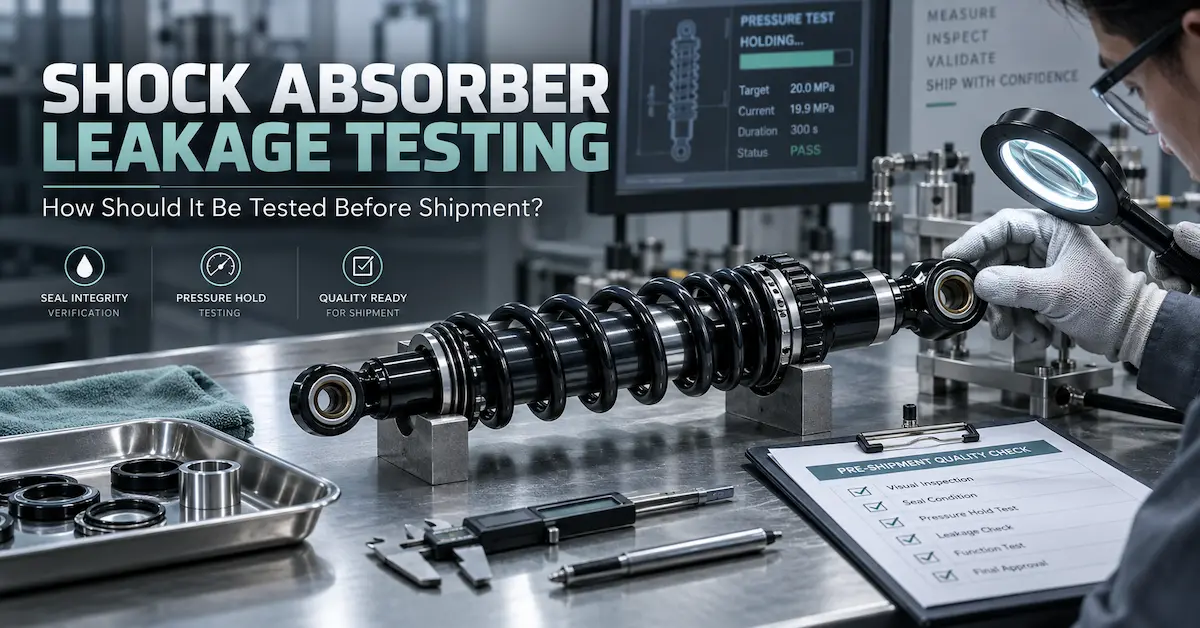
A reliable shock absorber leakage testing process should verify the complete assembled sealing system before shipment, not simply look for obvious oil on the outside of the product. Depending on the shock architecture, the factory should check the piston-rod sealing area, assembled joints, reservoir interfaces, hose and fitting connections, pressure retention where applicable, and the finished shock after functional movement. BEDO’s Shock Absorber Testing Service Guide identifies oil sealing, gas pressure retention, connection reliability, and seal performance as core leakage-validation areas, and specifically notes that leakage problems should be identified before shipment.
For OEM buyers, the important purchasing question is not simply, “Did you perform a leak test?” It is: Which interfaces were inspected, under what product condition, against which acceptance criteria, and how is the result linked to the production batch? A visually dry shock at one moment is not a complete quality system; leakage control begins with seals and assembly processes and ends with a documented shipment-release decision.
Why Leakage Testing Must Start Before Final Inspection
Leakage is often treated as an end-of-line problem, but many of its causes begin much earlier. Seal damage, component contamination, incorrect assembly, unsuitable surface condition, incorrect filling, loose fittings, or alignment problems can all create later leakage risk. BEDO’s Shock Absorber Manufacturer Safety Guide connects sealing reliability with standardized assembly, oil filling, torque control, component installation, and final leakage/function testing rather than treating a visible-oil inspection as the whole process.
A useful factory control sequence is therefore:
Incoming Seal & Component Inspection → Clean Assembly → Filling/Charging Control → Initial Functional Check → Leakage Inspection → Damping/Movement Verification → Final Leakage Recheck → Packaging Release
This sequence is more useful to a buyer than asking for an undefined statement such as “100% leak tested” without knowing what the factory actually controls.
Define What Counts as Leakage Before Production Begins
Buyer and supplier should agree on the acceptance definition before the first production batch. The quality plan should state which external areas must remain free from unacceptable oil or pressure loss and how the product will be evaluated.
A practical leakage-control document may distinguish:
| Inspection area | What should be reviewed |
|---|---|
| Rod/seal interface | Evidence of unacceptable oil escape or damaged seal |
| Body joints | Sealing around assembled interfaces |
| Reservoir interfaces | Leakage around reservoir body or connections |
| Hose connections | Leakage at hose/fitting interfaces where applicable |
| Adjuster interfaces | Sealing around applicable adjustment components |
| Pressure retention | Project-defined retention requirement where applicable |
| Surface condition | Oil contamination that could indicate assembly or sealing problems |
| Packaging condition | Evidence of oil appearing after finished-product handling |
The exact limits and test procedure should be defined for the selected shock architecture. Do not import a pressure, duration, or leakage threshold from another model unless engineering has confirmed that it applies.
Inspect Seals Before They Enter the Shock Assembly
Finished-product inspection cannot compensate for unsuitable or damaged sealing components. BEDO’s Off-Road Suspension Component Factory Guide lists seals alongside tubes, rods, springs, bushings, machined parts, reservoir parts, hoses, and fittings as incoming items requiring quality control.
For a customized shock program, incoming inspection should confirm the approved seal type or part reference and check condition before assembly. The buyer does not necessarily need every seal dimension printed on a customer-facing drawing, but the production specification should prevent an unapproved seal version from being substituted without review.
If the product uses several technical variants, component identification becomes particularly important because two externally identical shocks may use different internal configurations.
Piston-Rod Condition Is Part of Leakage Control
The rod passes through the sealing system repeatedly, so its dimensional and surface condition can influence sealing performance. A quality-control plan should therefore connect the rod specification and inspection with the seal system rather than treating them as unrelated components.
BEDO’s prototype-supplier guidance identifies piston-rod wear resistance, surface characteristics, seals, and assembly inspection as relevant elements in shock development and quality control. Review BEDO’s prototype development guidance.
For OEM buyers, the useful questions are:
- Is the production rod the same approved technical version used during prototype validation?
- Which rod characteristics are controlled before assembly?
- Are damaged or contaminated components prevented from entering assembly?
- Does an approved surface-treatment change trigger sealing review?
The purpose is not to prescribe one universal rod specification; it is to ensure that sealing performance is linked to controlled component requirements.
Control Cleanliness During Assembly
Contamination can interfere with seals and moving interfaces, so assembly cleanliness is a quality-control issue. BEDO’s prototype and performance-shock guidance both identify cleanliness and correct seal installation among assembly-control items.
For the buyer, this means leakage prevention should be built into the manufacturing process instead of being treated only as a final sorting activity.
A useful factory review can ask:
- How are sealing components stored before assembly?
- How are rods and sealing surfaces protected from contamination?
- At what stage is seal installation checked?
- How does the factory prevent damaged components from continuing through production?
- How are abnormal units isolated and investigated?
These questions provide more purchasing value than merely seeing a finished shock placed under a test machine.
Oil Filling and Gas Charging Should Be Controlled Before Leakage Testing
Depending on shock design, oil volume, filling condition, and gas charging are part of the assembled hydraulic system. BEDO’s performance-shock manufacturing guidance lists oil filling and gas charging among the production controls that can affect the final product.
Leakage testing should therefore be performed on the correctly assembled and filled production configuration. A product tested before its hydraulic system is complete does not necessarily provide the same evidence as the finished saleable unit.
For an OEM project, request a controlled process rather than an assumed number. If gas pressure or oil quantity is a critical internal specification, the production documents should define the approved requirement and how the factory controls it. Those internal values should not be invented merely to make the buyer specification appear more detailed.
Cycle the Shock Before the Final Leakage Inspection
A finished shock should be functionally moved so sealing interfaces experience actual rod movement before final inspection. BEDO’s safety and prototype guidance links smooth movement, compression/rebound behavior, seal performance, and leakage checks within finished-shock inspection.
The purpose is to avoid approving a product based only on its stationary condition immediately after assembly.
A practical process can be structured as:
Initial Visual Check → Controlled Shock Movement → Functional Assessment → Leakage Inspection → Additional Project-Specific Check → Release
The movement method and number of cycles should come from the factory’s approved process or project test plan. There is no basis in the BEDO material for declaring one universal cycle count for every ATV, motorcycle, or UTV shock.
Check Smooth Movement Together With Leakage
A shock that does not visibly leak can still have an internal assembly problem. BEDO’s Performance Shock Absorber Supplier Guide states that functional testing should look for sticking, abnormal noise, excessive friction, uneven resistance, and adjustment failure in addition to leakage inspection.
This matters because an incorrectly installed or damaged internal component may eventually create both performance and sealing problems.
For shipment release, treat the following as connected but distinct checks:
| Check | Main question |
|---|---|
| Leakage | Does the assembled product remain properly sealed? |
| Smooth movement | Does the shock move without sticking or abnormal friction? |
| Compression/rebound | Does the product show the approved damping behavior? |
| Adjustment | Do relevant controls operate correctly? |
| Dimensions | Does the finished unit match approved fitment requirements? |
| Appearance | Is there contamination or damage suggesting an assembly problem? |
Damping Verification Can Reveal Problems That Visual Inspection Misses
If oil or gas loss affects the hydraulic system, damping behavior may change before a dramatic external leak is obvious. For OEM and performance projects, damping verification can therefore complement shock absorber leakage testing.
BEDO’s testing guidance treats leakage and damping as separate validation categories, while its safety article states that compression and rebound should meet the approved target.
The correct approach is not to use damping testing as a substitute for leakage inspection. Instead:
Leakage inspection asks whether the system remains sealed.
Damping testing asks whether the shock produces the required hydraulic response.
When both results change, engineering has stronger evidence that the product requires investigation.
Remote-Reservoir Shocks Need More Leakage Checkpoints
A conventional integrated shock and a remote-reservoir shock do not have the same number of external interfaces. A remote-reservoir system may introduce hoses, fittings, reservoir connections, and additional sealing points.
BEDO’s performance-shock guidance specifically includes oil leakage, pressure loss, hose leakage, seal damage, and surface contamination among finished-product checks.
For a remote-reservoir product, the pre-shipment checklist may therefore include:
- shock-body sealing area;
- piston-rod seal;
- reservoir body/interface;
- hose connections;
- fitting interfaces;
- applicable adjustment components;
- complete hose condition after assembly;
- evidence of contamination around connection points.
Each version should be identified clearly. A remote-reservoir test record should not automatically be used as evidence for another configuration with different fittings or hose architecture.
Piggyback Reservoirs Also Need Interface Inspection
A piggyback reservoir eliminates the external hose but still adds reservoir-related components and interfaces to the shock assembly. Inspect the relevant joints and sealing areas according to the approved design.
For buyers, the key lesson is that “reservoir shock” should not be a single generic inspection category. The exact architecture determines where the leakage risks are located.
That same principle applies to adjustable shocks: additional adjusters can introduce more interfaces requiring inspection, depending on the internal design.
Adjustable Shocks Need Leakage and Function Checks Together
An adjustable compression or rebound shock should be inspected not only for sealing but also for correct adjuster operation. BEDO’s testing guide states that adjustable products may require rebound, compression, preload, and repeatability validation.
For production QC, the buyer should define which checks apply to the final product. A useful release record may include:
- correct adjuster version;
- correct baseline position;
- smooth control operation;
- no visible leakage around applicable interfaces;
- expected damping response where required;
- correct adjustment labels or markings.
This prevents an adjustable product from being approved solely because the main rod seal looks dry.
Do Not Treat Prototype Leakage Testing as Production QC
Prototype leakage validation and pre-shipment production inspection serve different purposes.
Prototype testing determines whether the selected seal system and product design are suitable. Production QC determines whether the factory repeatedly assembles that approved design correctly.
| Stage | Main leakage objective |
|---|---|
| Prototype | Validate sealing concept and assembly |
| Engineering revision | Correct identified seal/interface problems |
| Pilot batch | Check consistency across several production units |
| Mass production | Maintain approved sealing performance |
| Pre-shipment release | Identify unacceptable units before dispatch |
| Field investigation | Trace a reported issue to batch/configuration |
BEDO’s prototype guidance recommends moving through prototype validation and then small-batch manufacturing before high-volume production for new projects.
Use a Pilot Batch to Validate Leakage Consistency
One leak-free prototype does not prove that dozens or hundreds of production shocks will be assembled consistently. A pilot batch gives buyers a chance to evaluate whether seals, fittings, oil filling, gas charging, torque, cleanliness, and final inspection remain repeatable across multiple units.
BEDO describes small-batch production as a bridge between prototype approval and mass manufacturing because it can expose production consistency issues.
For a new OEM or private-label project, this is especially valuable when the product includes:
- new seals;
- new body dimensions;
- new reservoir architecture;
- revised fittings;
- new hose routing;
- custom adjusters;
- changed oil or pressure specification;
- a new assembly process.
Define Pre-Shipment Leakage Release Criteria
Before a purchase order enters production, buyer and supplier should agree what allows the finished batch to be released.
A project-specific pre-shipment plan can include:
| Release item | Buyer should verify |
|---|---|
| Product identity | Correct model, version, and drawing revision |
| Visual leakage inspection | No unacceptable external leakage |
| Pressure/sealing check | Project-defined requirement where applicable |
| Hose/fitting inspection | Applicable to reservoir designs |
| Functional movement | Smooth operation after assembly |
| Damping check | Required production verification where specified |
| Adjuster operation | Applicable to adjustable models |
| Surface cleanliness | No contamination suggesting an unresolved issue |
| Batch record | Product traceable to production lot |
| Packaging | No evidence of leakage before carton release |
The exact acceptance criteria should be written before shipment, not negotiated only after a questionable unit is found.
Inspect Again After Relevant Functional Testing
A leakage check should not necessarily occur only once. A unit that is dry immediately after assembly may need to be inspected again after relevant functional or damping testing.
The appropriate sequence can vary, but the quality plan should explain when leakage is reviewed. This is especially important when the buyer requires dyno testing, cycling, adjustment checks, or other operations after initial assembly.
The principle is simple:
The shipment release should reflect the condition of the completed tested product, not merely its condition before testing.
Packaging Can Reveal Leakage Problems Before Shipment
The final quality stage should include packaging inspection. BEDO’s testing guidance lists appearance and packaging alongside dimensions, performance, and leakage under final testing.
For buyers, this matters because oil appearing on protective material or inside finished packaging may indicate a problem that was not obvious during an earlier workshop inspection.
Packaging inspection can also identify surface contamination from assembly processes that should not be confused with verified seal leakage. The supplier’s acceptance criteria should distinguish these conditions rather than leaving warehouse staff to decide individually.
Require Batch Traceability for Leakage Complaints
If a dealer or end customer later reports a leak, the supplier should be able to identify the relevant production configuration and batch.
A useful record may connect:
Buyer SKU → Supplier Part Number → Drawing Revision → Production Batch → Spring/Damping Version → Reservoir/Hose Version → Inspection Record
BEDO’s prototype and production content repeatedly connects validated designs with controlled production preparation and batch consistency.
Traceability turns a field complaint from “one shock leaked” into a technical investigation that can determine whether the issue is isolated or related to a broader batch or process.
What Should a Leakage Test Report Include?
A useful OEM leakage record does not need unnecessary complexity, but it should establish what was inspected.
Suggested fields include:
| Record field | Why it matters |
|---|---|
| Product code | Identifies the exact product |
| Drawing/revision | Links inspection to engineering definition |
| Batch number | Supports traceability |
| Shock architecture | Conventional, piggyback, remote reservoir |
| Inspection points | Identifies which interfaces were checked |
| Test stage | Prototype, pilot, production, pre-shipment |
| Applicable conditions | Records project-defined test basis |
| Result | Pass/fail or engineering disposition |
| Inspector/date | Supports quality history |
| Rework/retest record | Shows how failures were handled |
Do not ask the supplier to add fictitious laboratory precision merely to make the report appear technical.
Failed Leakage Units Should Trigger Root-Cause Review
A failed unit should not simply be wiped clean and retested until it looks acceptable.
A disciplined response is:
Leak Detected → Unit Isolated → Leak Location Identified → Assembly/Component Cause Reviewed → Corrective Action → Reinspection/Retest → Process Review if Necessary
Potential causes may involve sealing components, installation condition, surface damage, hose or fitting interfaces, assembly alignment, or another product-specific factor. The actual root cause should be demonstrated by the investigation rather than guessed from appearance.
Where a corrective action changes a controlled component or assembly process, determine whether the change requires engineering approval or additional validation.
Do Not Use One Leakage Test for Every Shock Design
A conventional rear ATV shock, a separately adjustable performance shock, and a remote-reservoir product do not have identical sealing architectures.
The inspection plan should therefore follow the product.
A useful comparison is:
| Product type | Additional leakage considerations |
|---|---|
| Standard integrated shock | Main rod/seal and body interfaces |
| Piggyback reservoir | Reservoir-related interfaces |
| Remote reservoir | Hose, fittings, reservoir connections |
| Adjustable shock | Applicable adjuster interfaces |
| Custom prototype | Newly developed joints/components |
| Heavy-duty product | Duty-specific validation where defined |
This approach aligns with BEDO’s testing guidance that different projects require different validation methods rather than one universal testing program.
How Does Leakage Testing Affect Supplier Selection?
A supplier should be able to explain how sealing quality is connected to component inspection, assembly, testing, and mass production—not merely state that every shock is “leak-proof.”
BEDO’s Shock Absorber Prototype Supplier Guide recommends evaluating a supplier’s dimensional, functional, leakage, and performance-testing capabilities together with its ability to move from prototypes into manufacturing.
Useful supplier questions include:
- Which leakage points do you inspect for this architecture?
- At which production stages is leakage checked?
- How are seal and rod conditions controlled before assembly?
- How do you check reservoir hoses and fittings?
- Which leakage tests are routine and which are development-only?
- How is a failed unit isolated?
- How are leakage results linked to the batch?
- What changes require renewed prototype validation?
What Should You Send BEDO Before Defining Leakage Tests?
BEDO supports dimensional verification, leakage inspection, performance evaluation, prototype validation, and production quality checks through its shock-testing program.
For a custom shock absorber leakage testing plan, prepare:
- vehicle/application;
- shock drawing and revision;
- product architecture;
- reference sample if available;
- reservoir and hose configuration;
- sealing requirements already defined by the project;
- operating load and terrain;
- development stage;
- prototype quantity;
- pilot quantity;
- expected production order;
- required inspection/reporting documentation.
For customized suspension projects, you can also use BEDO’s custom development files guide to organize drawings, sample records, technical requirements, and validation items before testing begins.
Frequently Asked Questions
1. What Is Shock Absorber Leakage Testing?
It is the process of checking whether the assembled shock maintains its sealing integrity and whether oil, gas pressure, or applicable connection interfaces remain within the approved product requirements before release. BEDO identifies oil sealing, pressure retention, connection reliability, and seal performance as relevant leakage areas.
2. Should Leakage Be Checked on Every Finished Shock?
The production inspection frequency should follow the approved quality plan and product risk. BEDO states that finished shocks should undergo leakage-related inspection before packaging, but the exact method and sampling strategy should be confirmed for the particular production program.
3. Is Visual Inspection Enough?
Visual inspection is useful but may not be the entire project requirement. Depending on shock architecture and OEM specifications, buyers may also require functional movement, pressure/sealing checks, hose/fitting checks, damping verification, or additional validation.
4. Should the Shock Be Cycled Before Checking for Leaks?
Functional movement can help expose sealing or assembly problems before shipment.The factory should define the approved movement and inspection sequence for the product rather than using an arbitrary universal cycle count.
5. What Additional Checks Are Needed for Remote-Reservoir Shocks?
Inspect applicable hoses, fittings, reservoir connections, sealing interfaces, and final routing in addition to the primary shock sealing areas. BEDO includes hose leakage and pressure loss among relevant performance-shock checks.
6. Can Damping Testing Replace a Leakage Test?
No. Damping verification evaluates hydraulic performance; leakage testing evaluates sealing reliability. Changes in damping may support an investigation, but the two controls have different purposes.
7. Should Pilot Batches Be Checked for Leakage Again?
Yes, where the project uses a pilot batch to verify manufacturing repeatability. Pilot production can reveal sealing, assembly, fitting, or process variation that one development prototype may not show.
8. What Should Happen When a Shock Fails Leakage Inspection?
Isolate the unit, identify the leakage location, investigate the relevant components and assembly process, implement an approved correction, and repeat the required inspection. Repeated failures should trigger a broader process review.
9. Should Packaging Be Inspected for Oil Before Shipment?
Yes. Final inspection can include product appearance and packaging because leakage or contamination may become visible after earlier assembly and functional checks. BEDO includes packaging within final production inspection.
10. What Information Should I Send BEDO for a Leakage-Test Review?
Provide the shock drawing, product version, reservoir/hose arrangement where applicable, sample or prototype information, vehicle application, sealing concerns, expected order quantity, and any project-defined acceptance requirements.
Conclusion
Effective shock absorber leakage testing is not a single visual check performed seconds before a carton is closed. It should connect incoming seal and component inspection, clean assembly, oil and gas process control where applicable, rod and sealing-surface quality, functional cycling, finished-product leakage inspection, reservoir and hose checks, damping or functional verification, traceability, and final packaging release. The specific method must follow the shock architecture and project requirements rather than relying on one universal pressure, cycle count, or hold time. BEDO’s testing and manufacturing guidance treats leakage as part of a broader suspension quality-control process that includes prototype validation and production inspection. To define the appropriate pre-shipment process for a standard, adjustable, piggyback, or remote-reservoir shock, contact BEDO with your product drawing, configuration, prototype status, sealing requirements, and expected production quantity so the shock absorber leakage testing scope and shipment-release criteria can be reviewed before volume delivery.