
Where Can I Source Premium ATV Suspension Parts?
For B2B buyers, the best place to source premium ATV suspension parts is usually a specialized suspension manufacturer or supplier that can verify fitment, explain technical specifications, provide samples, control batch quality, and support repeat orders.
However, the right sourcing channel depends on your business model.
An importer buying mixed replacement parts has different needs from an ATV brand developing a new suspension setup.
A private-label buyer may prioritize:
-
branding;
-
packaging;
-
model coverage;
-
small-batch validation.
An OEM vehicle manufacturer may prioritize:
-
drawings;
-
CAD;
-
shock geometry;
-
spring rate;
-
damping;
-
prototype testing;
-
engineering revisions.
Before choosing where to buy, first determine what level of suspension product and technical support you actually need.
BEDO's current suspension product range includes shock absorbers, suspension springs, and related suspension products for ATV, UTV, motorcycle, and other off-road applications.
What Does “Premium ATV Suspension Parts” Actually Mean?
“Premium” should not simply mean a higher price, polished finish, or colorful spring.
For B2B sourcing, premium suspension parts should deliver measurable value in areas such as:
-
accurate fitment;
-
controlled dimensions;
-
appropriate spring rate;
-
stable damping;
-
durable sealing;
-
corrosion resistance;
-
consistent surface finish;
-
repeatable batch quality;
-
application-specific performance;
-
reliable supply.
A visually attractive shock absorber may still be a poor product if:
-
the mounting width is wrong;
-
stroke is insufficient;
-
spring rate is mismatched;
-
damping varies from batch to batch;
-
seals leak;
-
replacement orders do not match the approved sample.
Premium sourcing should therefore focus on engineering consistency and application suitability, not only appearance.
Which ATV Suspension Parts Are Commonly Sourced?
ATV suspension sourcing often involves more than one component category.
Shock Absorbers
ATV shock absorbers control suspension movement and work together with the spring.
Important specifications may include:
-
extended length;
-
compressed length;
-
stroke;
-
cylinder diameter;
-
mounting-hole diameter;
-
mounting width;
-
spring rate;
-
compression damping;
-
rebound damping;
-
fixed or adjustable damping;
-
reservoir configuration.
You can review BEDO's available ATV and UTV shock absorber products as a starting point for specification comparison.
Suspension Springs
Springs influence:
-
vehicle ride height;
-
sag;
-
load support;
-
available suspension travel.
Important sourcing data includes:
-
spring rate;
-
free length;
-
wire diameter;
-
spring dimensions;
-
coating;
-
color;
-
intended load.
Ball Joints and Related Suspension Components
Depending on the vehicle and project, buyers may also need:
-
ball joints;
-
bushings;
-
mounting parts;
-
hardware;
-
related suspension components.
For these parts, fitment and durability can be as important as price.
BEDO discusses broader off-road suspension procurement in its ATV and UTV aftermarket component sourcing guide.
The Four Main Ways to Source ATV Suspension Parts
Not every purchasing channel offers the same advantages.
| Sourcing Channel | Best For | Main Advantage | Main Limitation |
|---|---|---|---|
| Specialized manufacturer | OEM, private label, custom projects | Engineering and customization | Usually requires clearer project information |
| Suspension specialist supplier | Standard and semi-custom programs | Product knowledge | Capability varies by supplier |
| Wholesaler/distributor | Small mixed orders | Convenience and inventory | Less control over original manufacturing |
| General marketplace | Initial market search | Large supplier pool | Supplier verification can be difficult |
1. Source Directly From a Specialized Suspension Manufacturer
For repeat B2B orders, OEM development, private label, or technical customization, sourcing directly from a specialized manufacturer is often the strongest option.
A manufacturer may be able to support:
-
existing samples;
-
2D drawings;
-
3D CAD;
-
custom dimensions;
-
spring-rate changes;
-
damping development;
-
surface treatment;
-
branding;
-
packaging;
-
prototypes;
-
pilot batches;
-
mass production.
This sourcing model is especially suitable when a standard catalog shock cannot fully meet the ATV's requirements.
BEDO's suspension engineering partner guide explains why buyers developing vehicle-specific suspension should evaluate engineering involvement as well as manufacturing capability.
Best For
-
ATV manufacturers;
-
suspension brands;
-
aftermarket brands;
-
importers with private labels;
-
modification companies;
-
new vehicle projects;
-
repeat wholesale programs.
2. Source From a Specialist Wholesaler or Distributor
A distributor may be more suitable when you need:
-
lower initial quantity;
-
mixed models;
-
faster access to existing stock;
-
standard replacement components;
-
local fulfillment.
This can be useful for repair networks or smaller aftermarket sellers.
However, buyers should understand who controls the original product specification.
Ask:
-
Who manufactured the product?
-
Is the specification stable?
-
Will future batches come from the same source?
-
Can dimensions and damping be confirmed?
-
Is customization possible?
For long-term branded programs, direct manufacturer relationships usually provide more control.
3. Use General B2B Marketplaces for Supplier Discovery
General sourcing platforms can be useful for building an initial supplier list.
They allow buyers to compare:
-
product categories;
-
supplier profiles;
-
indicative pricing;
-
basic MOQ information.
But a marketplace listing alone does not prove:
-
engineering capability;
-
real production control;
-
quality consistency;
-
shock testing capability;
-
long-term supply stability.
For premium ATV suspension parts, supplier discovery should only be the first step.
The next step is technical verification.
4. Develop a Custom Supply Program
If your project involves:
-
unusual vehicle weight;
-
larger tires;
-
non-standard suspension geometry;
-
cargo use;
-
performance upgrades;
-
new ATV platforms;
-
private-label differentiation;
a custom development program may provide better results than searching indefinitely for a catalog product.
BEDO supports customized suspension development from drawings, samples, vehicle information, and technical requirements. Its drawing-based off-road suspension customization guide explains how product geometry and application requirements can be converted into a manufacturing project.
How Do You Identify a Premium ATV Suspension Manufacturer?
Do not begin with price.
Begin with capability.
Ask About Application Understanding
A capable supplier should ask:
-
Which ATV is this for?
-
Front or rear?
-
What is the vehicle weight?
-
What load does it carry?
-
What terrain does it use?
-
What problem are you trying to solve?
If the supplier recommends a shock without understanding the vehicle, the recommendation may be based only on dimensions.
Ask About Fitment Control
Confirm whether the supplier reviews:
-
extended length;
-
compressed length;
-
stroke;
-
upper mount;
-
lower mount;
-
hole diameter;
-
mounting width;
-
reservoir clearance.
BEDO's ATV shock absorber fitment guide explains why physical compatibility requires more than matching overall length.
Ask About Spring Capability
A supplier should be able to discuss spring requirements in relation to:
-
vehicle weight;
-
cargo;
-
passenger load;
-
sag;
-
ride height;
-
terrain.
Ask About Damping
Compression and rebound damping solve different suspension-control problems.
A premium supplier should not reduce damping selection to “soft” or “hard.”
For higher-level projects, buyers should understand whether the supplier can discuss:
-
compression behavior;
-
rebound behavior;
-
damping adjustment;
-
prototype revision.
Premium ATV Shock Absorber: What Should You Compare?
When comparing shock absorbers, build a technical comparison rather than comparing photographs.
| Item | Why It Matters |
|---|---|
| Extended length | Controls maximum extension |
| Compressed length | Affects full-compression fitment |
| Stroke | Defines damper movement |
| Spring rate | Determines load support |
| Compression damping | Controls compression movement |
| Rebound damping | Controls extension movement |
| Reservoir type | Affects packaging and architecture |
| Mount dimensions | Determines installation compatibility |
| Surface treatment | Supports environmental durability |
| Sealing | Helps resist contamination and leakage |
| Adjustability | Provides tuning flexibility where required |
If a supplier cannot provide enough information to compare these areas, it becomes difficult to determine whether two quotations represent equivalent products.
Standard Replacement vs Premium Performance Parts
Buyers should define whether they need replacement quality or performance differentiation.
Standard Replacement
Suitable when:
-
vehicle remains stock;
-
original geometry is unchanged;
-
standard operating load applies;
-
cost competitiveness is important.
Heavy-Duty Suspension
Suitable when:
-
vehicle carries higher loads;
-
utility work is common;
-
accessories increase weight;
-
suspension sags or bottoms frequently.
Performance Suspension
Suitable when buyers need:
-
improved damping control;
-
adjustability;
-
terrain-specific setup;
-
higher performance positioning.
Custom Suspension
Suitable when:
-
existing products do not fit;
-
vehicle geometry changes;
-
spring rate needs development;
-
damping targets are unique;
-
OEM/private-label differentiation is required.
The most expensive solution is not always the best.
The correct product is the one whose specification matches the ATV's real application.
How Can You Verify ATV Suspension Quality Before Ordering?
Never rely only on a supplier's marketing claims.
Use samples and controlled verification.
Step 1: Confirm Specifications
Create an approved technical sheet covering:
-
dimensions;
-
mounting;
-
spring;
-
damping;
-
finish;
-
branding;
-
packaging.
Step 2: Evaluate Samples
Check:
-
fitment;
-
dimensions;
-
surface condition;
-
assembly;
-
rod movement;
-
spring finish;
-
leakage.
Step 3: Install on the Vehicle
Review:
-
ride height;
-
sag;
-
clearance;
-
full suspension movement.
Step 4: Test Under Real Load
Test with realistic:
-
rider weight;
-
passenger load;
-
cargo;
-
accessories.
Step 5: Test in Real Terrain
Evaluate performance in the intended environment.
A utility ATV and recreational trail ATV should not necessarily use the same validation conditions.
Why Small-Batch Orders Can Be Better Than Immediate Mass Production
For new sourcing programs, buyers often want the lowest price at the highest volume immediately.
That can create unnecessary risk.
A more controlled approach is:
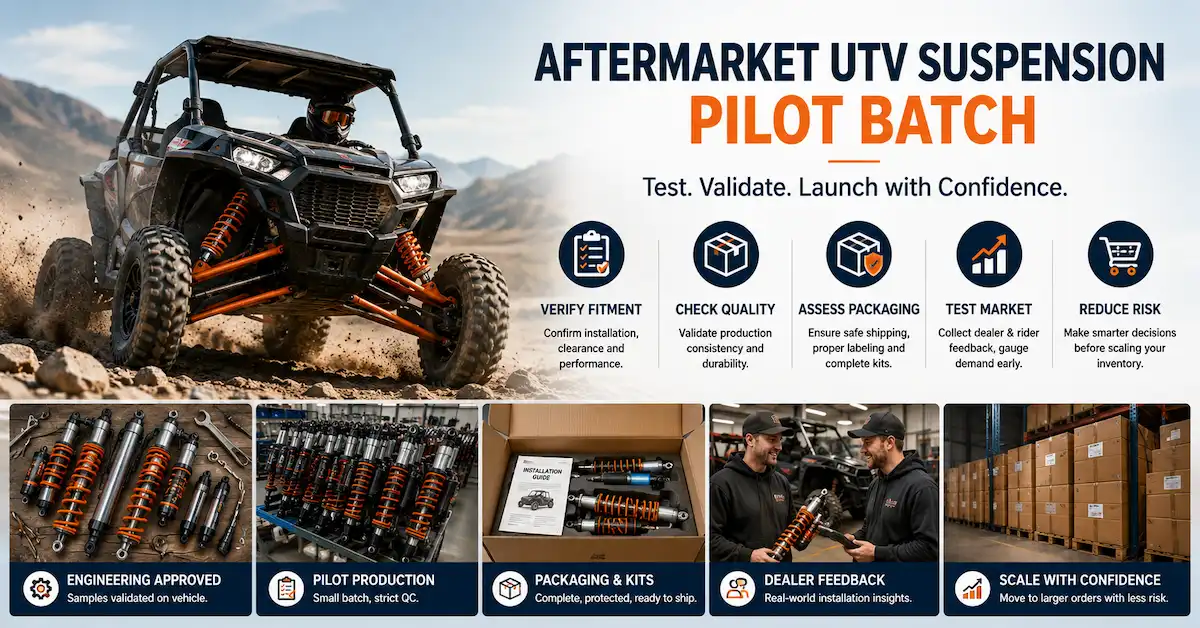
Sample → Testing → Revision → Approved Sample → Small Batch → Mass Production
A pilot batch can help identify:
-
dimensional variation;
-
coating inconsistencies;
-
damping variation;
-
packaging issues;
-
fitment complaints.
BEDO's small-batch OEM/ODM suspension guide explains how smaller initial production can be used to validate custom suspension projects before scaling.
How to Compare ATV Suspension Suppliers
A supplier evaluation matrix can prevent purchasing teams from focusing only on unit price.
| Supplier Evaluation Area | What to Check |
|---|---|
| Product specialization | ATV/UTV suspension experience |
| Fitment support | Dimensions and vehicle matching |
| Engineering | Drawing/CAD/sample support |
| Spring development | Load-based spring matching |
| Damping development | Compression/rebound capability |
| Prototype support | Test and revision process |
| QC | Dimensional and functional control |
| Customization | Color, logo, packaging, technical parameters |
| Small batch | Pilot-order support |
| Repeat production | Batch consistency |
| Communication | Clear technical responses |
| Long-term supply | Stable sourcing relationship |
For a broader sourcing checklist, BEDO's China suspension parts manufacturer guide covers factory capability, product scope, OEM support, and sourcing verification.
What Are the Biggest Risks When Sourcing ATV Suspension Parts?
Risk 1: Buying by Price Only
The cheapest quotation may use a different:
-
spring;
-
coating;
-
seal;
-
internal structure;
-
damping setup.
Better approach: compare equivalent specifications.
Risk 2: Buying by Vehicle Name Only
Vehicle variants can differ.
Better approach: confirm model, year, position, and dimensions.
Risk 3: Assuming “Heavy Duty” Is a Specification
“Heavy duty” is a marketing description unless linked to real technical data.
Better approach: define load, spring rate, damping, and application.
Risk 4: Approving Appearance Instead of Performance
A visually premium shock can still have poor damping consistency.
Better approach: validate function.
Risk 5: No Approved Reference Sample
Without an approved specification, repeat batches may drift.
Better approach: freeze the final sample/drawing.
Risk 6: No Supplier Backup or Long-Term Plan
A one-time supplier may not be suitable for a growing product line.
Better approach: evaluate repeat supply capability early.
What Should You Include in an ATV Suspension RFQ?
A professional RFQ should allow suppliers to quote the same project.
Include:
-
ATV make/model or project code
-
Model year
-
Front or rear position
-
Vehicle weight
-
Passenger load
-
Cargo load
-
Tire size
-
Extended shock length
-
Compressed length
-
Stroke
-
Mounting dimensions
-
Existing spring rate
-
Damping data, if available
-
Typical terrain
-
Current suspension problem
-
Target performance
-
Product categories required
-
Existing samples
-
Drawings/CAD
-
Private-label requirements
-
Packaging
-
Prototype quantity
-
Estimated annual volume
BEDO's OEM suspension RFQ guide provides additional guidance on preparing vehicle, technical, customization, and commercial information before requesting quotations.
When Should You Choose an OEM or ODM Suspension Program?
An OEM or ODM program makes sense when existing parts do not fully match your market.
OEM
Best when the buyer already controls:
-
drawing;
-
sample;
-
dimensions;
-
specification.
The manufacturer focuses on producing the approved product.
ODM
Best when the buyer has:
-
vehicle application;
-
target performance;
-
partial dimensions;
-
an existing problem;
but requires more engineering input to develop the final solution.
For private-label or new ATV suspension products, buyers may also combine technical development with:
-
spring color;
-
shock finish;
-
logo;
-
labels;
-
retail packaging.
How BEDO Supports Premium ATV Suspension Sourcing
BEDO focuses on suspension products for ATV, UTV, motorcycle, electric motorcycle, and other off-road applications.
Its current product scope includes:
-
shock absorbers;
-
suspension springs;
-
ball joints;
-
custom suspension development.
For suitable projects, buyers can discuss:
-
existing samples;
-
drawings;
-
CAD;
-
dimensions;
-
spring rate;
-
damping;
-
surface finish;
-
OEM/ODM;
-
branding;
-
packaging;
-
prototype development;
-
small-batch production.
You can review more background and technical capabilities on the BEDO About Us page.
FAQ
Where can I source premium ATV suspension parts?
For B2B projects, specialized ATV suspension manufacturers are usually the best option when you need stable quality, technical support, customization, or repeat orders. Wholesalers may be more practical for small mixed-stock purchases.
What ATV suspension parts can I source from a manufacturer?
Common products include shock absorbers, suspension springs, ball joints, and related customized suspension components.
How do I know whether an ATV shock absorber is premium quality?
Check fitment accuracy, spring specification, damping consistency, sealing, finish, production QC, and repeatability rather than judging only by appearance or price.
Should I source directly from a manufacturer or distributor?
Direct manufacturers are generally better for OEM, private label, engineering customization, and long-term programs. Distributors can be useful for smaller standard replacement orders.
What information should I provide to an ATV suspension supplier?
Provide vehicle model, year, position, weight, load, shock dimensions, mounting dimensions, terrain, current problem, target performance, and order quantity.
Can ATV suspension parts be private labeled?
Yes, depending on the product and project. Private-label programs may include logo, spring color, body finish, labels, and packaging.
Can a supplier customize spring rate?
For custom projects, spring requirements can be discussed based on vehicle load, suspension geometry, ride-height requirements, and intended use.
Can compression and rebound damping be customized?
Depending on the shock architecture and development scope, compression and rebound characteristics can be discussed separately during custom development.
Should I order samples before bulk purchasing?
Yes. Samples allow buyers to confirm dimensions, fitment, spring behavior, damping, finish, and overall product suitability before scaling.
What is the safest way to start a new supplier relationship?
Begin with clear specifications, verify samples, test them on the target vehicle, freeze the approved version, and use a pilot batch before large-volume production.
Conclusion
If you are asking where to source premium ATV suspension parts, prioritize suppliers that can prove fitment, technical understanding, quality control, and repeat production—not simply offer the lowest price.
For OEM, private-label, or long-term sourcing programs, prepare your vehicle specifications, samples or drawings, load conditions, product requirements, and expected volume. Submit them through the BEDO Contact Us page for sourcing and project review.