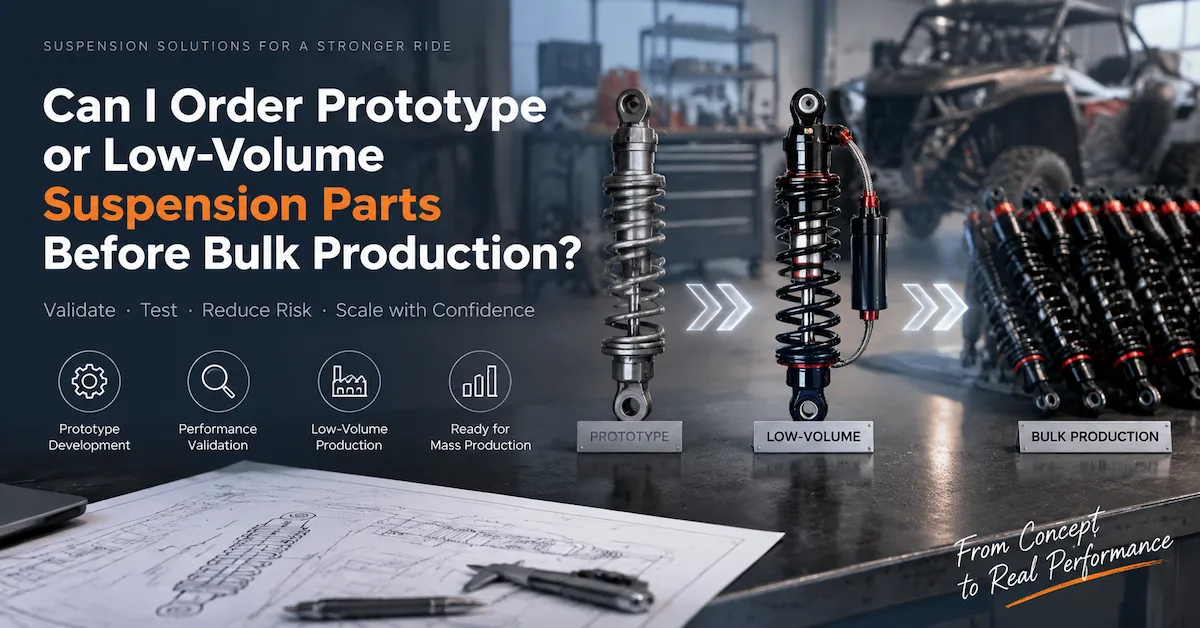

Can I Order Prototype or Low-Volume Suspension Parts Before Bulk Production?
Yes. Buyers can use prototype and low-volume suspension parts to validate a suspension project before committing to a large commercial order. For a custom ATV shock absorber, the first samples can verify dimensions, mounting interfaces, spring selection, damping direction, reservoir packaging, and vehicle fitment. A later pilot or small batch can then answer a different question: whether the factory can reproduce the approved configuration consistently under normal manufacturing conditions.
BEDO supports prototype and small-batch suspension development for custom off-road projects. Its low-volume shock absorber OEM guide describes a staged route from requirement review and prototype development through testing, controlled low-volume production, and later scaling. For OEM buyers, this staged approach can reduce two major risks at the same time: ordering a technically unsuitable product and carrying too much inventory before the design or market demand is proven.
Why Start With Prototypes Instead of a Bulk Order?
A bulk order multiplies whatever is already present in the approved design. If the shock is 2 mm too wide at the lower mount, has an unsuitable spring rate, interferes with a larger tire, or uses damping that does not suit the application, producing hundreds of units does not solve the problem—it turns an engineering issue into an inventory problem.
Prototype development allows the buyer to verify those issues while quantities are still controlled. BEDO’s prototype shock absorber development guide treats prototypes as an engineering-validation stage covering dimensional review, fitment, spring and damping development, testing, revision, and preparation for production.
Prototype ordering is particularly useful when the project includes new:
- mounting dimensions;
- shock length or stroke;
- spring specifications;
- compression or rebound damping;
- reservoir architecture;
- larger tires or added accessories;
- long-travel geometry;
- private-label performance positioning.
The objective is not to make the first sample perfect. It is to make each sample answer specific engineering questions.
Prototype, Pilot Batch, and Low-Volume Production Are Different Stages
Buyers should not use the terms prototype, pilot batch, and low-volume production interchangeably. Each stage has a different purpose.
| Development stage | Main question | Typical buyer decision |
|---|---|---|
| Engineering prototype | Does the proposed design work? | Continue, revise, or stop |
| Revised prototype | Did the engineering change solve the issue? | Approve technical configuration |
| Pilot batch | Can normal production reproduce the approved design? | Release initial commercial order |
| Low-volume production | Can the product be supplied commercially at controlled volume? | Validate market and supply model |
| Bulk production | Is the project technically and commercially ready to scale? | Increase purchasing volume |
BEDO’s small-batch OEM/ODM suspension process follows this same principle: low-volume manufacturing is most useful when it connects product development with later repeatable production rather than functioning as an isolated sample order.
Who Benefits Most From Low-Volume Suspension Development?
Low-volume development is particularly useful when technical or commercial uncertainty is still high.
Typical buyers include ATV manufacturers launching a new platform, private-label brands entering suspension for the first time, distributors testing demand for a new fitment, custom vehicle builders, utility vehicle companies, performance suspension brands, and engineering teams working on modified vehicles.
It is also valuable for a mature brand entering a narrow application. A distributor may already buy thousands of suspension parts annually but need only a small initial quantity for one specific ATV year, spring version, or premium-performance SKU.
A buyer that already has a completely validated specification, stable high-volume demand, established tooling, and repeat production may have less need for a prolonged prototype stage. The correct development model depends on how much technical and commercial risk remains unresolved.
What Information Should You Send Before Ordering the Prototype?
Small quantities do not compensate for incomplete requirements. Before requesting low-volume suspension parts, give the manufacturer enough information to understand what the sample is supposed to prove.
A useful starting package includes:
| Requirement area | Buyer information |
|---|---|
| Vehicle | Make, model, year, variant or new project code |
| Position | Front/rear and relevant installation location |
| Existing shock | Sample, drawing or measurements where available |
| Dimensions | Extended/compressed lengths, stroke and mounting interfaces |
| Vehicle loads | Vehicle, rider, cargo and permanent accessories |
| Tire configuration | Standard or modified wheel/tire package |
| Terrain | Utility, trail, rocky, sand, mud or other duty |
| Current problem | Fitment, sag, bottoming, harshness, bouncing, etc. |
| Target result | Replacement behavior or intended performance change |
| Prototype objective | What the sample must validate |
| Commercial plan | Prototype, pilot and projected production quantities |
BEDO’s ATV suspension RFQ data guide provides a useful structure for organizing these inputs before engineering and quotation begin.
Use Drawings, CAD, or Physical Samples According to the Project
A new suspension project does not always need the same development files. A straightforward replacement may begin from a physical sample and controlled measurements. A new long-travel or reservoir project may need suspension CAD because packaging and movement are more important.
BEDO’s custom suspension development files guide separates drawings, CAD, sample records, load data, spring/damping information, and validation requirements so buyers can provide the data relevant to the engineering problem.
For prototype manufacturing, clearly distinguish:
Confirmed requirements – must be maintained.
Reference data – describes the current product but may change.
Supplier proposal required – engineering recommendation needed.
Pending validation – final value depends on prototype testing.
This prevents an old shock dimension or spring specification from accidentally becoming a mandatory requirement simply because it appeared in the first RFQ.
What Should the First Prototype Validate?
Define the prototype’s purpose before the factory starts manufacturing it.
A first prototype may need to verify:
- extended and compressed dimensions;
- upper and lower mounting fit;
- shock stroke;
- body and spring clearance;
- reservoir location;
- hose routing;
- spring seating;
- ride height;
- sag;
- basic compression behavior;
- rebound recovery;
- adjuster operation;
- leakage;
- physical installation.
A dimensional prototype and a performance prototype may not require the same evaluation. If the first sample is primarily for installation checking, do not pretend that one workshop fitment check also validates durability and damping.
BEDO’s suspension sample development process similarly connects sample analysis, drawing review, engineering adjustment, prototype manufacturing, testing, and production preparation.
Test the Prototype on the Intended Vehicle
A shock can meet the drawing and still be unsuitable in the vehicle. Install the sample on the intended platform and evaluate the actual application.
For fitment, check:
- mounting alignment;
- bracket width;
- bolt/sleeve fit;
- full bump;
- full droop;
- tire clearance;
- chassis clearance;
- spring clearance;
- reservoir clearance;
- adjuster access.
For performance, evaluate the conditions relevant to the project. A cargo shock should be tested with representative load. A trail shock should encounter representative terrain. A rider-weight-specific product should be checked across its intended range.
This distinction matters because prototype and low-volume suspension parts should validate a real commercial application, not merely prove that a factory can manufacture a visually correct shock.
Spring Development Should Happen Before Volume Purchasing
For coilover shocks, spring selection is one of the most important reasons to avoid jumping directly into bulk production.
A spring may physically fit but still produce excessive sag, inadequate load support, limited usable travel, or unnecessarily harsh behavior. If the project changes rider range, cargo, accessories, or suspension geometry, review the spring instead of automatically copying the reference sample.
The prototype stage can evaluate:
- spring rate;
- free length;
- preload;
- available adjustment;
- loaded ride height;
- sag;
- working range;
- clearance.
If multiple spring versions will be sold, identify them with separate controlled part references before pilot production so warehouse and assembly teams cannot mix them later.
Damping Development May Require More Than One Prototype
Compression and rebound behavior often require iterative testing. The first sample may establish the baseline, while a revised sample adjusts valving or another damping characteristic based on vehicle feedback.
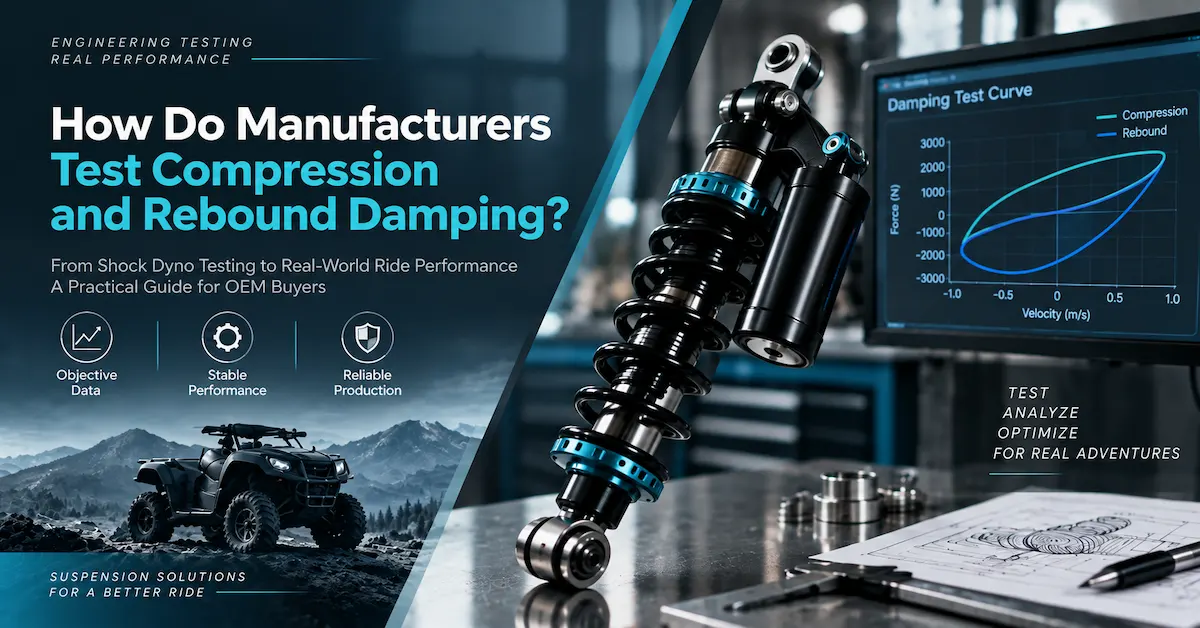
For performance-oriented products, BEDO’s compression and rebound damping testing guide explains why damping data should identify the shock configuration, test condition, and adjustment position rather than rely on broad descriptions such as “soft” or “hard.”
A controlled sequence might be:
Baseline Sample → Dyno/Functional Review → Vehicle Test → Engineering Feedback → Revised Damping → Confirmation Sample
This is a stronger development process than ordering a high-volume “performance shock” from an unverified catalog setting.
Use Pilot Production to Test Manufacturing Repeatability
Once the engineering prototype is approved, the next risk is production consistency.
A pilot batch should answer:
Can the factory manufacture several units using the normal intended process and still match the approved sample?
Review:
| Pilot-batch area | What to verify |
|---|---|
| Dimensions | Critical measurements remain consistent |
| Mounting | Bushings, sleeves and hardware match approval |
| Spring | Correct specification and identification |
| Damping | Production units match approved requirement |
| Leakage | Finished products remain sealed |
| Adjusters | Correct function and baseline setup |
| Reservoir/hose | Correct configuration and assembly |
| Finish | Appearance remains consistent |
| Labeling | Correct SKU/version identification |
| Packaging | Saleable configuration is complete |
| Traceability | Batch links to the approved revision |
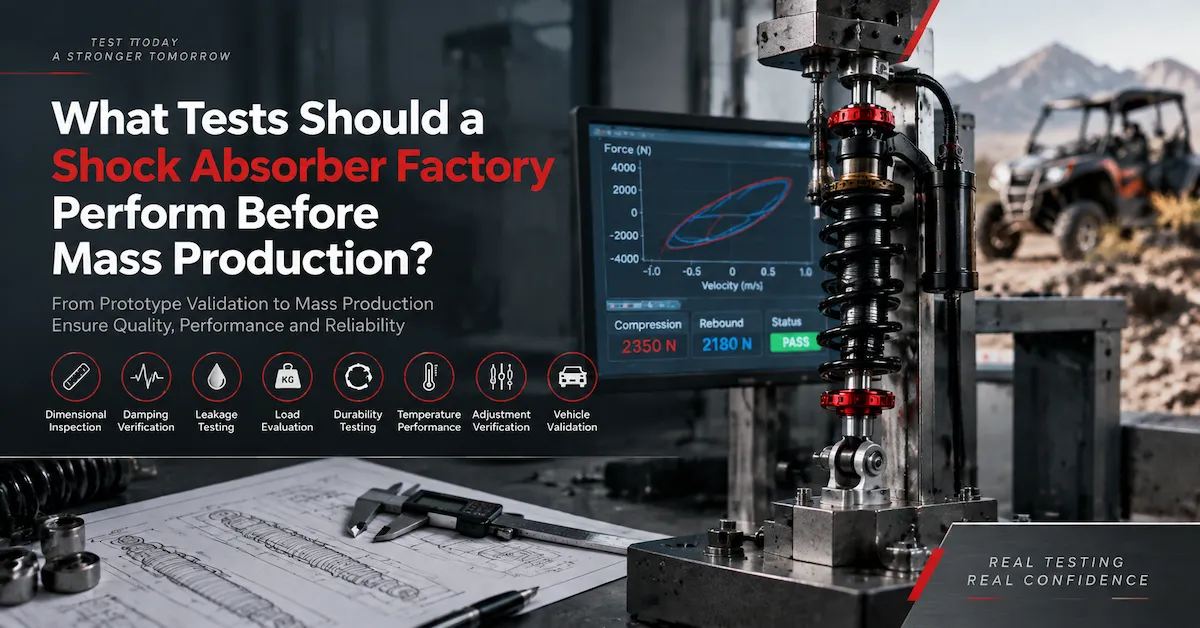
BEDO’s shock absorber testing before mass production guide separates prototype validation, pilot checks, and routine production QC for this reason.
Low-Volume Production Can Also Validate Market Demand
Engineering is only one reason to start small. A new aftermarket brand may not yet know how many customers will purchase a specific suspension SKU.
A controlled commercial batch lets the buyer evaluate:
- dealer interest;
- actual sell-through;
- application questions;
- installation complaints;
- return reasons;
- preferred spring versions;
- packaging;
- technical-support workload.
This information can be used before committing to a larger inventory position.
For a distributor with many vehicle applications, low-volume supply can also be more practical than buying a high MOQ for every individual SKU.
MOQ Should Be Quoted by Development Stage
Do not ask only:
“What is your MOQ?”
Ask:
“What are the prototype quantity, pilot-batch quantity, initial-production MOQ, and repeat-order MOQ for this configuration?”
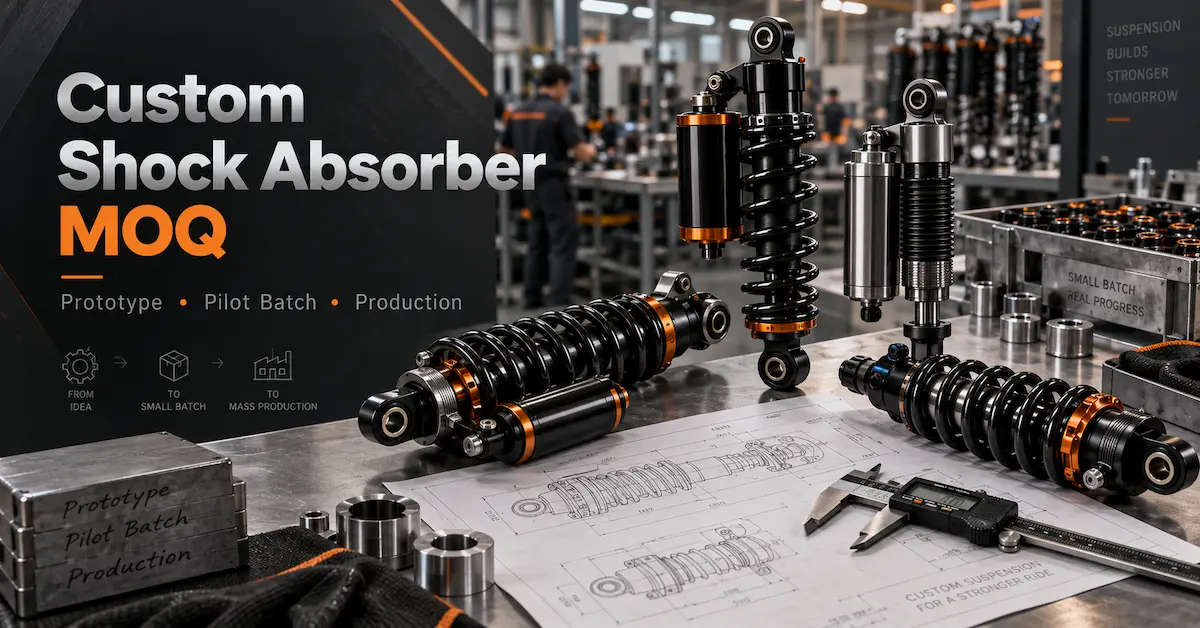
BEDO’s custom shock absorber MOQ guide explains why custom spring specifications, damping, mounting components, finishes, materials, packaging, tooling, and sourcing can influence project quantities.
BEDO does not publish one universal MOQ that should be applied to every custom suspension project. Exact quantities should therefore be confirmed after technical review.
Low Volume Does Not Mean Low Quality Requirements
A buyer ordering a small batch should not accept weaker engineering control simply because the quantity is limited.
A small custom order still needs appropriate:
- controlled drawings;
- component identification;
- assembly procedures;
- dimensional inspection;
- leakage checks;
- damping checks where required;
- spring verification;
- product labeling;
- traceability.
BEDO’s custom suspension low MOQ guide connects low-quantity projects with technical evaluation, prototype development, quality checks, and controlled production rather than treating them as informal workshop orders.
A prototype product can be flexible in development. A sellable low-volume product still needs a defined specification.
Materials and Custom Components Can Limit Low-Volume Flexibility
The final factory may support small assembly quantities while an upstream component supplier requires a larger manufacturing batch.
Possible quantity drivers include:
- custom springs;
- non-standard tubing;
- unique seals;
- special bushings;
- machined mounting parts;
- reservoir components;
- custom hoses;
- surface treatments.
Ask which component is actually driving the minimum quantity.
If a new custom eye mount creates a much higher MOQ, engineering may be able to use an existing proven interface without affecting vehicle requirements. This is a more useful discussion than simply asking the supplier to “reduce MOQ.”
Finish and Branding Should Not Delay Technical Validation
Private-label brands often want unique spring colors, anodized components, logos, cartons, and labels from the first sample.
That may be useful for sales presentations, but early prototypes should primarily answer technical questions. If special finishes or packaging increase cost or require larger batches, consider separating technical validation from final brand presentation.
A practical sequence is:
Engineering Prototype → Technical Approval → Branded Pre-Production Sample → Pilot Batch
This prevents the buyer from spending heavily on custom packaging for a product whose spring or damping still needs revision.
How Should Low-Volume Parts Be Tested?
The validation plan should follow product risk rather than order quantity.
Potential checks include:
- dimensional inspection;
- fitment;
- full movement;
- damping;
- leakage;
- spring behavior;
- load evaluation;
- adjustment;
- vehicle test;
- durability where required.
Not every project needs every test. A straightforward replacement may require a narrower validation program than a newly developed adjustable performance shock.
The key is to define what each prototype or pilot batch must prove before manufacturing begins.
How Does Small-Batch Development Affect Cost?
Small quantities often have a higher unit cost because engineering, machine setup, component sourcing, inspection, testing, and production preparation are spread across fewer parts.
Separate one-time and recurring expenses.
| Cost type | Typical purchasing question |
|---|---|
| Engineering | Is development billed separately? |
| Prototype | What does the sample price include? |
| Tooling/fixture | Is special equipment needed? |
| Testing | Which validation is included? |
| Custom component | Does it carry its own MOQ? |
| Unit price | Price after design approval |
| Branding | Logo/finish charges |
| Packaging | Standard or customized |
| Repeat order | How do price and MOQ change after approval? |
A higher prototype price can still create a lower overall project risk if it prevents a large incorrect inventory order.
Ask for Stage-Based Lead Times
Custom suspension development does not have one meaningful lead time until the project stage is defined.
Ask the supplier to separate:
Engineering Review → Drawing Confirmation → Prototype → Buyer Test → Revision → Pilot Batch → Production → Shipment
A drawing-based existing-platform project and a new long-travel adjustable reservoir shock should not be expected to follow identical schedules.
BEDO supports staged prototype and low-volume development, but specific sample and production timing must be confirmed for the individual configuration rather than inferred from a generic website promise.
Protect Drawings and Custom Development Data
A prototype project may involve vehicle CAD, proprietary dimensions, performance targets, branding, or confidential product plans.
Before transferring sensitive files, clarify:
- confidentiality;
- permitted data use;
- design ownership;
- access to files;
- newly generated drawing ownership;
- tooling ownership;
- exclusivity where applicable.
Do not assume “OEM” or “ODM” automatically establishes these rights.
For a long-term private-label suspension range, these commercial details can be as important as the first sample price.
What Should You Send BEDO to Start a Prototype or Low-Volume Project?
For an efficient initial review, provide:
Vehicle/application + suspension position + existing sample or drawing + critical dimensions + mounting details + rider/cargo loads + terrain + current problem + intended change + prototype objective + pilot quantity + future production forecast.
If CAD is available for a geometry-sensitive design, include the relevant suspension interfaces. If spring or damping targets are already approved, include those specifications. If they are not approved, identify them as areas for engineering development.
You can review BEDO’s low-volume shock absorber OEM process before preparing the project package, then use BEDO Contact Us to submit the available technical data.
Frequently Asked Questions
1. Can I Order Only a Few Prototype Shock Absorbers?
BEDO supports prototype and low-volume development, but the exact sample quantity depends on the design and validation requirements. A project needing several spring or damping comparisons may require more samples than a dimensional-fitment project.
2. Is Prototype Quantity the Same as MOQ?
No. Prototype quantity is associated with engineering validation. Production MOQ relates to manufacturing the approved commercial configuration. A pilot batch may sit between them.
3. Can I Order Low-Volume Suspension Parts Without Custom Tooling?
Sometimes, particularly when an existing manufacturing platform can be adapted. A new mounting structure or special component may require tooling or fixtures. This needs project review.
4. Can Existing Shock Absorbers Be Modified for a Small Batch?
BEDO supports customization based on existing products, drawings, samples, and application requirements. Feasibility depends on which dimensions, spring, damping, mounting, or appearance features need to change.
5. Should I Test the Prototype Before Ordering a Pilot Batch?
Yes. The prototype should first answer the agreed engineering questions. A pilot batch is intended to verify production repeatability after the technical design is sufficiently stable.
6. Do Low-Volume Orders Receive Quality Inspection?
A commercially supplied small batch still requires appropriate quality control. The actual dimensional, leakage, damping, functional, and other checks should be defined by the product and quality plan.
7. Can I Add Private-Label Branding to a Prototype Order?
Potentially, but technical development and branding should remain separate approval tracks. For early engineering samples, standard appearance may sometimes reduce cost and complexity.
8. Will Low-Volume Suspension Parts Cost More Per Unit?
They can because development, setup, component sourcing, testing, and inspection costs are distributed across fewer units. Compare total development risk as well as unit price.
9. Can MOQ Be Lower on Repeat Orders?
It may change after components, tooling, specifications, and processes are established, but this is project-specific.Ask the supplier separately about launch and replenishment quantities.
10. What Should I Send Before Asking BEDO for a Low-Volume Quote?
Send the application, drawing or sample, dimensions, mounting interfaces, loads, terrain, current problem, required customization, sample purpose, pilot quantity, and future purchasing estimate. This allows BEDO to evaluate the technical scope before confirming quantity and commercial terms.
Conclusion
Yes, you can use prototype and low-volume suspension parts before bulk production, and for custom or application-specific suspension this can be a practical way to reduce engineering and inventory risk. The strongest process separates Prototype → Technical Validation → Revision → Pilot Batch → Production Validation → Bulk Production, because each stage answers a different buyer question. A prototype proves whether the suspension concept works; a pilot batch checks whether the factory can reproduce it; low-volume commercial production can validate supply consistency and real market demand before inventory is scaled. BEDO supports custom shock absorber and suspension development from drawings, samples, CAD, and vehicle requirements together with small-batch project support. To evaluate your project, contact BEDO with your application data, drawings or reference samples, technical requirements, prototype objectives, and expected future volume so the appropriate low-volume suspension parts development route can be confirmed before bulk production.