
Can an ATV Suspension Factory Develop Long-Travel Shock Absorbers?
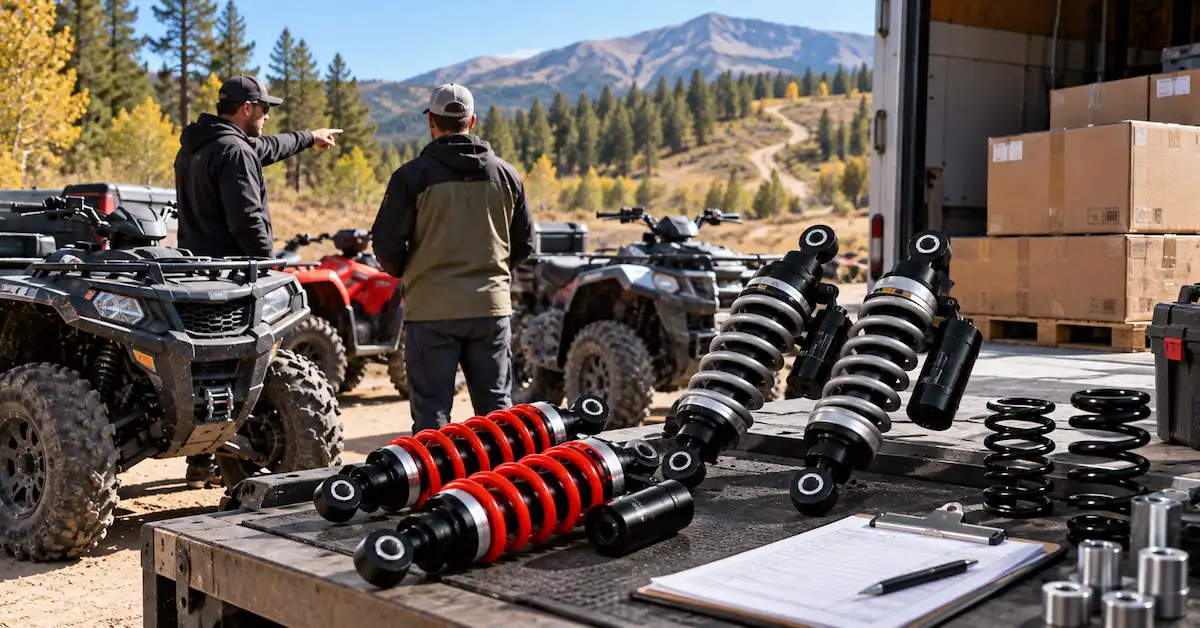
Yes. An ATV suspension factory can develop long-travel shock absorbers when the buyer provides enough information about the vehicle geometry, existing suspension, target wheel movement, vehicle loads, tire clearance, and intended terrain. BEDO supports custom shock absorber development from drawings, CAD data, reference samples, and vehicle requirements, including changes to shock length, stroke, mounting dimensions, spring specifications, and damping. However, a critical engineering boundary must be established at the beginning: developing a longer custom shock for an already validated long-travel chassis is different from redesigning an entire ATV suspension system. BEDO’s long-travel suspension development guide makes this distinction clear. If control arms, steering links, joints, axles, chassis mounts, or other vehicle components must also change, the project extends beyond shock absorber development alone.
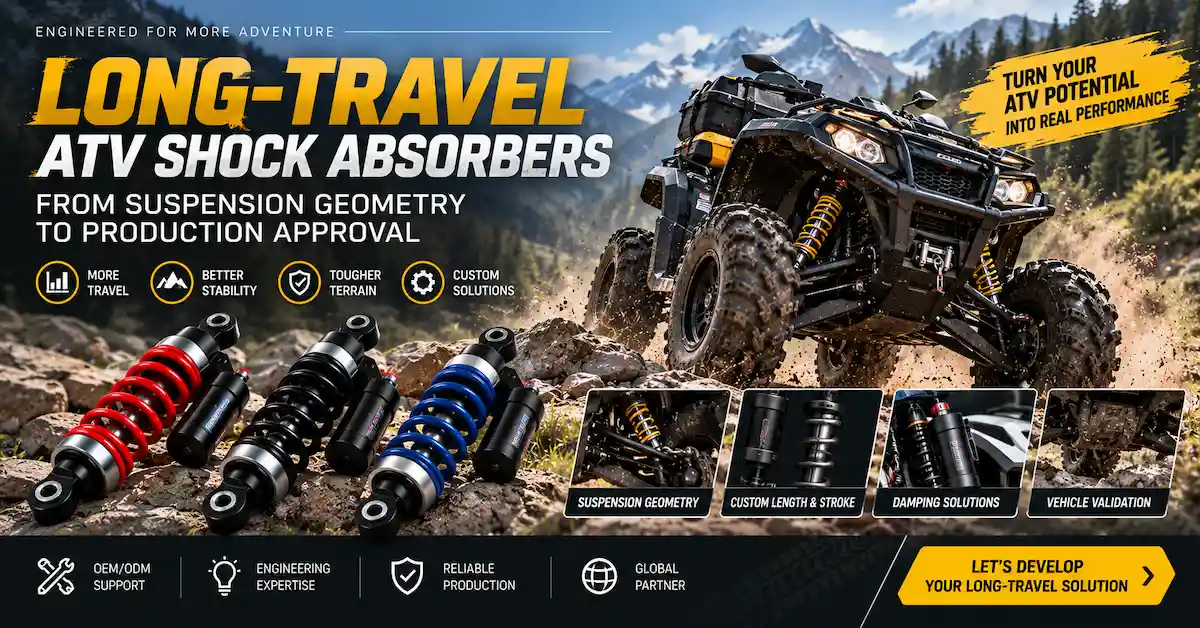
Long Travel Means More Usable Wheel Movement, Not Simply a Longer Shock
A common RFQ begins with a sentence such as “Our existing shock is 400 mm; please make it 480 mm so we can get more travel.” That request is incomplete because shock length, shock stroke, and wheel travel describe different things. Shock stroke is the movement of the damper shaft, while wheel travel is the movement of the wheel through the suspension geometry. Control-arm length, shock mounting position, shock angle, and motion ratio determine the relationship between them. BEDO’s wheel travel and shock stroke guide explains that identical shock strokes can produce different wheel travel on different suspension layouts. For an ATV program, the engineering sequence should therefore be Target Wheel Movement → Suspension Geometry → Required Shock Movement → Stroke → Spring → Damping → Clearance → Prototype Validation rather than “longer shock = long travel.”
Who Actually Needs Long-Travel ATV Shock Development?
Long-travel development is most relevant to ATV manufacturers creating a new off-road platform, aftermarket brands building vehicle-specific performance suspension, specialty vehicle companies changing suspension geometry, racing or recreational product developers, and distributors launching technically differentiated upgrade kits. It is less suitable for a buyer who simply wants a visually larger replacement shock but has no verified suspension geometry or performance target. If the existing chassis already provides the required safe movement and the current shock is the limiting component, a shock-and-spring project may be sufficient. If the target travel forces joints, steering, axles, or control arms beyond their permitted movement, a new damper by itself cannot solve the problem. This distinction should be resolved before tooling, prototypes, packaging, or private-label artwork are commissioned.
Start With Suspension Geometry Before Specifying Shock Length
The factory needs to understand where the shock sits and how the suspension moves through bump and droop. Relevant inputs can include the upper and lower shock mounts, control-arm pivots, knuckle or upright interfaces, steering linkage, wheel and tire envelope, chassis clearance, and driveline components where applicable. CAD is especially valuable because it allows engineers to study shock angle and component clearances at several suspension positions rather than only at static ride height. BEDO’s CAD-based long-travel development guidance identifies full droop, ride height, partial compression, full bump, and steering-plus-suspension combinations as useful review positions. Although that BEDO guide uses a UTV project as its example, the core geometry principle also applies when an ATV buyer asks a shock factory to develop a longer-travel damper: the component must remain compatible with the movement envelope of the target vehicle.
| Geometry input | What should be reviewed | Why it matters |
|---|---|---|
| Upper/lower shock mounts | Location, orientation, width, bolt size | Defines installation geometry |
| Control arms | Pivot positions and movement path | Influences motion relationship |
| Shock angle | Angle through the usable travel | Affects relationship between wheel and shock movement |
| Wheel/tire envelope | Full compression, droop and steering positions | Identifies interference risk |
| Steering components | Tie-rod and joint movement | Prevents steering bind or contact |
| Driveline where applicable | Joint angle, axle movement and clearance | May limit safe droop or bump |
| Chassis/bodywork | Clearance around shock, spring and tire | Defines packaging limits |
| Existing bump-stop system | Engagement position and available movement | Prevents mechanical bottoming elsewhere |
Define Extended Length, Compressed Length, and Stroke Separately
A long-travel RFQ should not contain one ambiguous “shock length” value. Define the fully extended dimension, fully compressed dimension, effective stroke, mounting references, upper and lower mounting type, mounting-hole diameters, bushing or sleeve widths, and any packaging restrictions. BEDO’s shock length and stroke customization guide confirms that length, stroke, and mounting dimensions can be customized, but also warns that increasing stroke requires review of control-arm movement, vehicle geometry, clearance, and shock mechanical limits. Obtain a controlled drawing before sample production so purchasing, engineering, and the factory are all using the same measurement references.
Do Not Confuse Shock Stroke With Wheel Travel
Suppose a buyer wants substantially more wheel travel. It would be incorrect to copy that target number directly into the shock-stroke field. The suspension’s motion relationship determines how much damper movement corresponds to a given wheel movement. That relationship may also change through the suspension’s arc rather than remaining perfectly constant. A shock mounted farther inboard or at a greater angle can move less than the wheel. For this reason, long-travel shock absorbers must be developed from suspension geometry rather than from target wheel travel alone. Where accurate CAD is unavailable, the buyer may need physical cycling, hard-point measurements, or other engineering data to establish the relationship before finalizing the damper stroke. BEDO’s UTV customization data guide likewise separates verified wheel travel from shock stroke and recommends geometry or physical movement data for custom projects.
Use Existing BEDO Models as Dimensional References, Not Long-Travel Ratings
BEDO’s AU_HSA_01 and AU_HSA_03 are useful examples because both product pages publish a 130 mm effective stroke, but the products differ in total length, cylinder outer diameter, and mounting widths. Neither product page identifies the model as a universal long-travel ATV solution. The comparison demonstrates why a catalog stroke number cannot replace vehicle-specific engineering. (bedoauto.com)
| Published specification | AU_HSA_01 | AU_HSA_03 |
|---|---|---|
| Installation position | Rear | Rear |
| Total length | 465 mm | 445 mm |
| Effective stroke | 130 mm | 130 mm |
| Cylinder outer diameter | 38 mm | 42 mm |
| Upper/lower mounting-hole diameter | 10 / 10 mm | 10 / 10 mm |
| Upper/lower mounting width | 32 / 32 mm | 30 / 35 mm |
| Adjustable damping levels | None | None |
The shared 130 mm stroke does not make these shocks interchangeable, and it does not establish their wheel travel on an unspecified ATV. The product-page term “total length” should also remain exactly that until a dimensional drawing confirms the reference points; it should not automatically be rewritten as eye-to-eye length.
Spring Development Must Follow the New Suspension Geometry
Once geometry and the required shock movement are understood, the factory needs load information to develop the spring. Important inputs include curb weight, rider load, front/rear distribution, permanent accessories, cargo where relevant, target ride height, desired sag, suspension motion relationship, and intended terrain. A spring that physically fits a longer shock may still be unsuitable for the vehicle. If the motion relationship changes because the shock mount changes, the effective relationship between wheel load and spring movement can also change. A serious long-travel project should therefore treat the spring as part of the new configuration rather than automatically reusing the original rate. BEDO’s custom shock absorber development service connects spring development, damping, drawings, samples, and prototype validation instead of treating dimensional customization as an isolated manufacturing operation.
Damping Must Be Developed for the New Movement Range
Longer usable travel does not provide good control by itself. Compression damping must manage the suspension as it moves into the stroke, while rebound damping controls extension afterward. The required behavior depends on vehicle mass, selected spring, suspension geometry, tire behavior, terrain, operating speed, and expected duty cycle. A long-travel recreational ATV repeatedly crossing rocks, whoops, or rough trails may place different demands on the damper from a lower-speed utility vehicle even if both use similar physical shock dimensions. The initial damping specification can be established from engineering data, but final tuning should be refined through prototype testing. Do not assume that a higher published damping force is automatically better; damping values only become meaningful when their test conditions and application are understood.
Check Full Bump and Full Droop Before Dynamic Testing
Before driving a prototype aggressively, cycle the suspension through its intended range and inspect all limiting components. At full droop, check shock extension, joint articulation, steering linkage, brake hose or cable routing, and driveline angles where applicable. At full bump, check shock compression, spring condition, bump-stop engagement, tire clearance, chassis interference, and whether another vehicle component reaches its mechanical limit first. Steering should also be checked through relevant bump and droop conditions. This static or controlled movement review can identify geometry problems before they become expensive prototype failures. BEDO’s long-travel engineering guidance specifically stresses that control arms, joints, axles, steering, tires, hoses, and chassis interfaces may reach limits before the longer shock reaches its intended travel.
Decide Whether a Reservoir Is Actually Required
Some long-travel projects use piggyback or remote-reservoir shocks, but a reservoir is not what creates additional suspension travel. It provides additional hydraulic-system packaging and may be useful where oil/gas volume, sustained suspension activity, heat management, compression-control architecture, or installation packaging justifies it. BEDO’s remote-reservoir shock guide emphasizes that a reservoir does not increase stroke automatically and cannot compensate for an incorrect spring, damping specification, mounting arrangement, or suspension geometry. For an ATV project, let the expected duty cycle and packaging requirements determine whether a reservoir belongs in the design instead of adding it simply to make the product appear more performance-oriented.
Long-Travel Development Requires a Prototype, Not Just a Drawing Approval
CAD can establish geometry and packaging, but it cannot fully define dynamic behavior. After the first design review, produce a prototype that represents a controlled specification. Record the drawing revision, spring, damping configuration, mounting hardware, reservoir configuration if applicable, and relevant setup values. BEDO’s suspension sample development process describes prototypes as an engineering verification stage for installation compatibility, suspension travel, spring characteristics, damping performance, structural reliability, and manufacturing feasibility. Prototype testing should therefore answer specific open questions rather than simply confirm that a physical part was produced.
Build the Validation Plan Around the Intended ATV Use
An ATV intended for rocky recreational trails, sand, competitive use, farm work, or mixed terrain should not automatically share one validation program. Define target ride height, sag, bump/droop movement, tire clearance, load conditions, damping behavior, and representative terrain before testing starts. Where sustained rough-terrain operation is important, evaluate whether damping remains consistent through repeated suspension cycles. Where the vehicle carries accessories or cargo, include representative loading. Where larger tires are part of the long-travel conversion, validate their three-dimensional clearance through suspension and steering movement. The acceptance criteria should be documented before sample approval so a successful-looking test drive does not become the only release standard.
Separate Shock Development From Complete Suspension-System Responsibility
This is one of the most important commercial boundaries for an OEM buyer. If your engineering team has already validated new control arms, steering geometry, axles, hard points, and wheel path, an ATV suspension factory may focus on developing the corresponding long-travel shock absorbers, springs, mounting interfaces, and damping. If the desired travel cannot be achieved without changing those vehicle components, the scope becomes a broader suspension-system engineering program. A shock supplier should not imply that extending a damper alone proves the entire modified ATV is safe or production-ready. BEDO’s CAD-development article makes exactly this distinction for off-road vehicle projects.
Control Materials and Manufacturing After the Prototype Is Approved
The production configuration should identify the materials and components that matter to the approved design rather than rely on phrases such as “racing quality” or “heavy duty.” Depending on the product, controlled items may include the shock body, piston rod, mounting eyes, bushings, spring, seats, seals, hydraulic components, reservoir hardware, hose routing, and surface treatment. BEDO’s ATV shock absorber production guide describes a manufacturing sequence involving engineering review, material selection, component manufacturing, assembly, testing, inspection, and delivery. For repeat orders, connect these controls to a drawing revision and approved sample so dimensional or component changes do not enter production without review.
Use a Pilot Batch Before Scaling a New Long-Travel Product Line
A new long-travel product usually carries more development uncertainty than a standard replacement shock. For an aftermarket launch or limited-production ATV, a prototype and pilot batch can reduce the risk of ordering a large volume before fitment, setup instructions, real-terrain performance, packaging, and production consistency have been confirmed. BEDO supports low-volume shock absorber OEM development for prototypes, limited production models, aftermarket upgrades, and custom vehicle applications. Exact prototype quantity, MOQ, capacity allocation, and lead time still need project-specific confirmation rather than being assumed from a general small-batch capability statement.
Compare Development Cost by Scope, Not Only by Shock Price
The commercial scope depends heavily on whether the project is a shock-only modification or part of a new suspension geometry. A project that keeps the existing mounts but changes stroke, spring, and damping is different from one requiring new mounting structures, reservoir packaging, multiple prototypes, custom tooling or fixtures, and repeated vehicle testing. Request quotations that separate engineering, prototype parts, testing, tooling where applicable, pilot production, recurring unit price, branding, packaging, and other project-specific costs. Also identify which activities are the buyer’s responsibility. A low quoted unit price is not meaningful if one supplier is quoting only a physical damper while another is pricing engineering review and validation support.
What Data Should You Send BEDO for a Long-Travel ATV Project?
For an efficient review, send the relevant suspension CAD or drawings, chassis hard points, existing shock information, wheel and tire dimensions, target wheel movement, curb weight, front and rear axle loads where available, rider and cargo conditions, suspension position, intended ride height, terrain, expected operating speed, current suspension limitations, and purchasing forecast. If the project contains sensitive CAD, ask which assemblies and hard-point information are actually required rather than automatically transferring the full vehicle model. BEDO’s custom shock absorber length and stroke service specifically requests vehicle application, existing shock specifications or drawings, CAD where available, required length/stroke/mounting dimensions, load requirements, performance goals, and order quantity.
Frequently Asked Questions
1. Can BEDO manufacture long-travel ATV shock absorbers?
BEDO supports customized shock length, stroke, mounting dimensions, springs, damping, prototypes, and off-road suspension development. Project feasibility still depends on the target ATV geometry, load data, required travel, and validation scope. Review BEDO’s custom ATV shock development capabilities.
2. Does a longer ATV shock automatically create more wheel travel?
No. Wheel travel depends on control-arm geometry, shock mounting position, installation angle, and other suspension components. A longer shock can also move joints, axles, steering, or tires outside their intended operating range.
3. Is shock stroke the same as wheel travel?
No. Shock stroke describes damper movement, while wheel travel describes wheel movement. Their relationship is determined by suspension geometry. Two ATVs can use the same shock stroke and achieve different wheel travel.
4. Can an existing ATV shock sample be used to start development?
Yes. A reference sample can establish baseline dimensions and construction, but it should be accompanied by the target geometry, load, travel, terrain, and performance requirements. BEDO also supports sample-based shock absorber development.
5. Do I need full vehicle CAD?
Not necessarily. Depending on scope, the factory may only need relevant chassis sections, suspension components, hard points, wheel/tire envelopes, shock locations, and critical interfaces. Confirm the minimum useful dataset and file format before transferring proprietary information.
6. Can I keep the original spring when increasing travel?
Do not assume so. If shock geometry, motion relationship, vehicle load, or intended performance changes, the spring should be reviewed. The correct decision depends on the vehicle and development target.
7. Do long-travel shocks need remote reservoirs?
Not automatically. Reservoirs may help with hydraulic volume, heat management, packaging, or tuning in suitable applications, but they do not create wheel travel. Select the architecture around the actual duty cycle and packaging requirements.
8. What should be checked before driving the first prototype?
Check ride height, sag, full bump, full droop, shock limits, tire clearance, steering movement, joint articulation, hoses or cables, driveline clearance where applicable, spring condition, bump stops, and reservoir routing before demanding dynamic testing.
9. Should I order production immediately after one prototype works?
A pilot or small batch is often more appropriate for a new custom configuration. It gives the buyer an opportunity to confirm production consistency, assembly, fitment, packaging, and real-use performance before scaling the program.
10. What should an RFQ for long-travel shock absorbers include?
Include the ATV platform, suspension drawings or CAD, hard points, existing extended/compressed dimensions and stroke, target wheel movement, wheel/tire specification, vehicle and axle loads, rider/cargo requirements, terrain, current problem, prototype quantity, and expected production demand.
Conclusion
An ATV suspension factory can develop long-travel shock absorbers, but the project should begin with the vehicle’s suspension movement rather than a request to simply extend the shock body. Define the hard points and wheel path, establish target wheel travel, calculate the required damper movement, confirm full-bump and full-droop limits, then develop the spring and damping around the vehicle load and intended terrain. Prototype testing must verify that joints, steering, tires, axles, hoses, chassis interfaces, and the shock itself remain within the intended operating range before the design is released for production. BEDO supports custom shock dimensions, spring and damping development, drawing/CAD review, prototypes, and low-volume OEM projects for off-road vehicles. To evaluate a long-travel ATV project, contact BEDO with your vehicle geometry, existing shock information, target travel, loads, wheel and tire data, terrain, and expected order quantity so the appropriate development scope can be reviewed before prototype and production.