
Upgrade the suspension around the new axle and corner loads, not around a single “heavy-duty” part. Start by measuring the vehicle empty and loaded, then set a ride-height and sag target, select a spring that supports the load without making the empty vehicle uncontrollable, match compression and rebound damping to the changed motion, preserve usable bump and droop travel, and validate the complete vehicle across the real operating states.
Adding cargo, passengers, a battery, a winch, a tool attachment, or a trailer can shift both total mass and its distribution. A stronger spring may reduce sag but cannot correct an overloaded tire, brake, wheel, axle, frame, or mount. A stiffer damper may slow motion but cannot provide missing spring support. A credible payload upgrade therefore begins with load-path limits and ends with vehicle evidence.
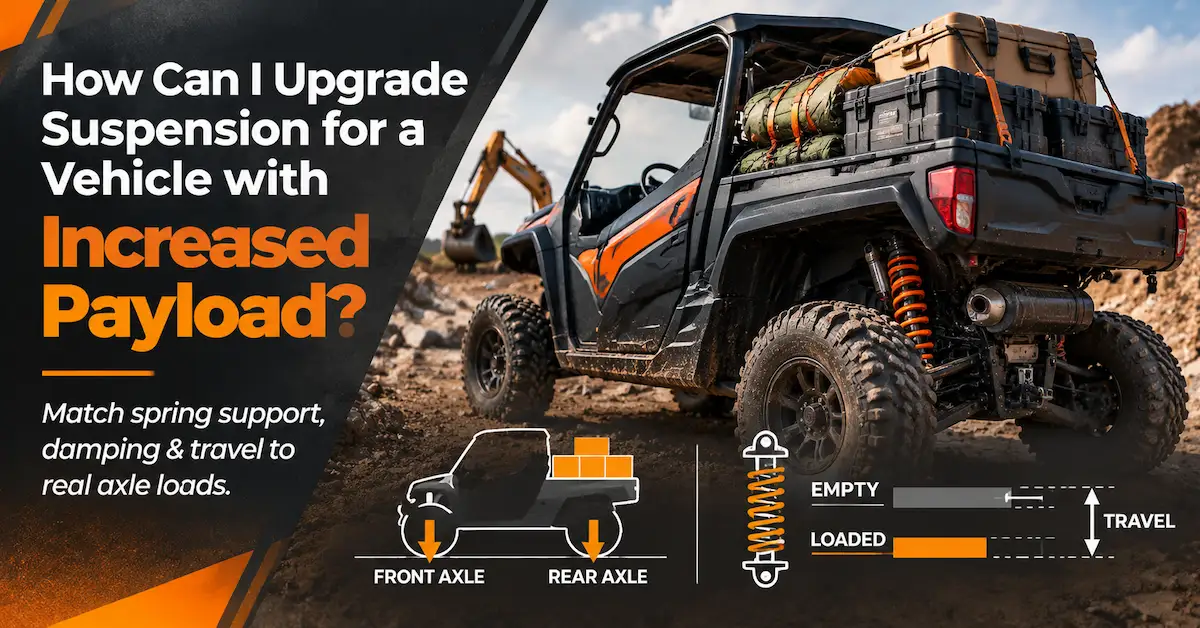
Why increased payload changes more than ride height
Payload changes the static load carried by the springs and the dynamic forces generated when the vehicle accelerates, brakes, corners, crosses an obstacle, or lands after a wheel event. The extra mass may sit near the center, at the front, behind the rear axle, above the cargo bed, or on one side. Those positions produce different axle and corner loads even when the scale shows the same total payload.
The suspension must continue to support the vehicle at the intended ride height, keep usable travel, maintain tire contact, control body motion, and avoid transferring unacceptable forces into mounts and structure. The tires, wheels, brakes, steering, driveline, axles, and frame also need to be included in the load review. A spring upgrade is not permission to exceed the vehicle's certified or engineered limit.
| Change caused by payload | Suspension effect | What the buyer should check |
|---|---|---|
| Higher static axle load | More spring compression and lower ride height. | Loaded sag, bump travel reserve, spring rate, installed length, and mount load. |
| Rear-biased cargo | Rear squat, changed front/rear balance, and possible steering or brake behavior change. | Front and rear ride height, axle loads, tire loading, and load position. |
| High or off-center cargo | More roll moment and corner-load variation. | Left/right height, roll control, stability, tie-downs, and asymmetric conditions. |
| Battery or attachment mass | New mass may be permanent, concentrated, or unsprung. | Battery or tool location, unsprung mass, clearance, and operating states. |
| More dynamic energy | Greater impact and recovery demand during rough use. | Compression and rebound behavior, temperature, bottoming, and repeated events. |
Separate payload capacity from suspension tuning
The suspension can be tuned for a defined load, but the vehicle's maximum allowable load remains a system-level limit. Ask whether the vehicle-side structure, wheel and tire, brake, axle, steering, and fasteners have been assessed. A supplier should not describe a spring or shock as increasing legal or structural payload unless that responsibility and evidence are explicitly defined.
Define the load location
“An extra 200 kg” is incomplete without its position. Record the distance from the axle, the height above the ground, the left/right offset, and whether the mass is fixed or moves. A passenger who shifts position and a low central battery do not create the same suspension condition.
Measure the vehicle before selecting a heavier spring or shock
The first stage of a payload suspension upgrade is a measurement plan. Weigh the vehicle in the conditions that the customer will actually use, and record the suspension state at each weighing. If possible, use axle scales or corner scales rather than relying only on total mass. The goal is to understand how the payload changes the load path.
| Vehicle state | Record | Why it matters |
|---|---|---|
| Ready to operate | Total mass, front/rear or corner loads, tire pressure, ride height, and spring or shock setting. | Establishes the baseline for comparison. |
| Normal work load | Typical cargo, operator or passengers, attachment, load position, and measured axle loads. | Represents the condition the suspension should support most often. |
| Maximum planned payload | Maximum intended cargo, distribution, tie-down condition, and axle/corner loads. | Shows the limit condition for ride height, travel, and control. |
| Asymmetric load | Left/right placement, corner heights, and any one-sided attachment. | Reveals roll, uneven sag, and local mount or tire effects. |
| Dynamic or severe-use state | Terrain, speed, obstacle, duty cycle, towing, and repeated-event description. | Sets damping, heat, durability, and validation priorities. |
Measure ride height from stable datums
Use repeatable body, frame, axle, or suspension reference points. Record the surface condition, tire pressure, fuel or battery state, and whether the operator is seated. A visual estimate of squat can hide a side-to-side difference or a vehicle that has lost bump travel before it appears dramatically low.
Measure available travel and bump-stop engagement
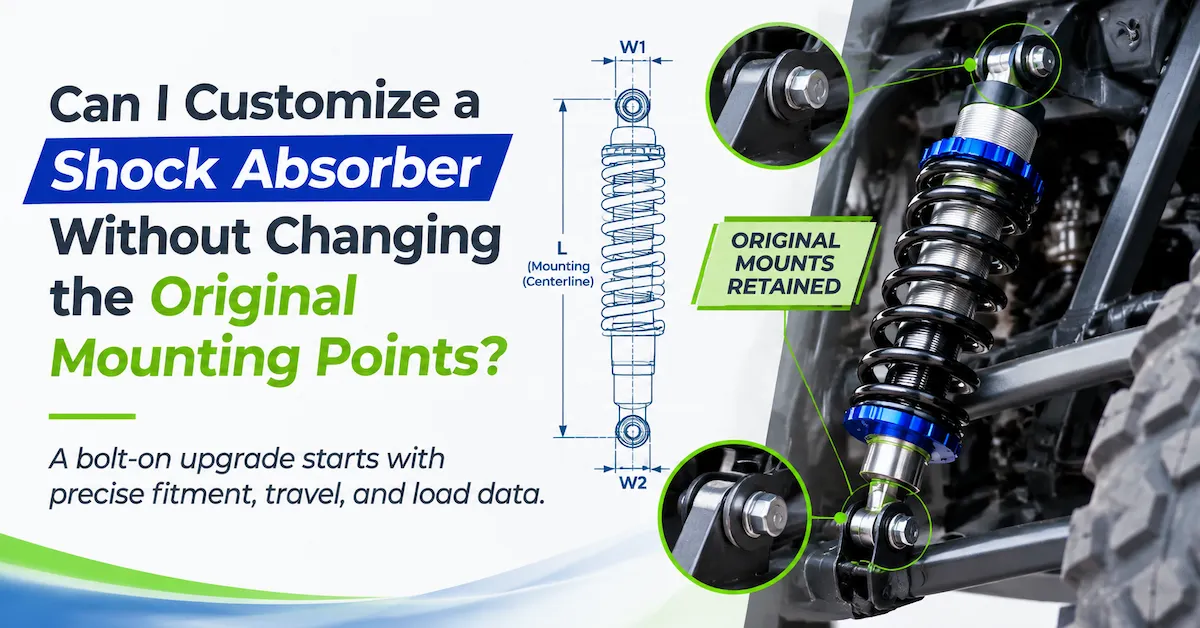
Record shock length, usable stroke, wheel travel, bump-stop position, and any contact at full compression and extension. A heavier load can place the vehicle closer to the bump stop before it encounters a road event. If the shock is already near full compression at rest, changing only damping will not restore the missing travel.
Check what the current shock is actually doing
Inspect the spring rate or identification, preload, damping adjustment, leakage, mount condition, bushing, and unusual wear. A payload problem can expose a worn part, but a worn part and an underspecified part are different problems. Record whether the existing shock is original, modified, or already fitted with a different spring.
For a first technical review, the buyer should provide the vehicle state table, photos of the suspension and load, stock shock dimensions, and a description of the intended work cycle. This is more useful to a suspension spring supplier than a request for “the strongest spring available.”
How do you choose the spring for increased payload?
The spring must support the new load while preserving a useful operating window. The correct choice depends on wheel or shock motion ratio, installed spring length, free length, preload, available travel, the load states, and the desired ride height. A higher rate is not automatically better because the vehicle also needs enough compliance when empty or lightly loaded.
| Spring decision | What it changes | Risk if selected without vehicle data |
|---|---|---|
| Higher spring rate | Reduces compression for a given load and may preserve ride height. | Harsh empty ride, reduced tire compliance, higher mount force, or mismatch with damping. |
| More preload | Raises initial force and may change static ride height without changing the nominal rate. | Reduced available droop, spring unloading, or confusing preload with rate. |
| Longer free length | Can change seat position, preload range, and retention. | Coil bind, packaging conflict, or spring loss at full droop. |
| Progressive spring | Can offer a softer initial response and increased resistance later in the stroke. | Different behavior across load states and harder comparison with one rate number. |
| Separate load-rated option | Matches different customer or fleet conditions with distinct configurations. | Wrong option installed or unclear labeling and service identification. |
Calculate the target from load change and deflection target
At a simplified level, the additional spring force divided by the allowable additional compression gives a starting rate contribution. The actual vehicle calculation must include motion ratio, existing spring support, preload, unsprung mass, and the desired static position. Treat the result as a design starting point, not a guaranteed final spring specification.
Match the spring to the installed condition
Spring rate is a property of the spring's force-deflection behavior, while installed force depends on position and preload. A payload upgrade should specify both. The buyer may need a target for loaded ride height, normal operating sag, maximum compression reserve, and full-droop retention. A catalog spring rate alone cannot answer all four.
Do not hide an empty-load problem
If a vehicle carries a wide range of loads, one high-rate spring may solve maximum squat while creating a poor empty ride. Consider an approved spring option, adjustable preload within a defined range, a progressive spring, or a separate application. The decision should be based on how often each load state occurs and which tradeoff the operator accepts.
How should damping change when payload increases?
The damper controls the speed of suspension movement; it does not carry the static load like the spring. Increasing payload changes the mass and the force needed to control its motion. If the spring is changed, the damper usually needs to be reviewed with it. If the payload is placed high or rearward, the body may also require a different balance of compression and rebound control.
| Observed behavior under payload | Possible direction for review | Evidence needed before approval |
|---|---|---|
| Vehicle stays compressed and bottoms | Review spring support, travel, bump stop, and compression control. | Loaded ride height, travel reserve, impact test, and mount inspection. |
| Vehicle rebounds slowly or remains low after a bump | Review rebound damping and spring recovery together. | Repeated-bump response, tire contact, recovery behavior, and temperature. |
| Vehicle oscillates after a load change | Review rebound and compression balance, not only spring rate. | Controlled response test at normal and maximum load. |
| Ride becomes harsh when lightly loaded | Review rate, preload, compression damping, and load-specific option. | Empty and loaded comfort/control comparison. |
| Performance fades during repeated rough use | Review damper architecture, fluid volume, heat, and duty cycle. | Time-based bench or vehicle evidence under the agreed use condition. |
Use compression and rebound as separate questions
Compression damping influences how quickly the suspension moves into the stroke; rebound damping influences how quickly it returns. A single “damping level” may change both, but the buyer should still describe the symptom and the operating event. The target is controlled wheel and body motion, not maximum resistance in every direction.
Review heat and repeated load cycles
Payload and rough terrain can increase energy input into the damper. A shock that feels correct for one obstacle may behave differently after repeated events or a temperature change. The supplier should define the test condition and explain which part of the vehicle validation it represents. Avoid turning one bench curve into a universal durability promise.
When should you upgrade the spring, the shock, or the complete assembly?
The right scope depends on the failure mode and the condition of the current components. Replacing one part without checking the other can move the problem rather than solve it.
| Situation | Likely review scope | Why |
|---|---|---|
| Ride height drops but motion remains controlled | Spring rate, free length, preload, and installed geometry first. | The primary issue may be support rather than damping. |
| Ride height is acceptable but the vehicle bounces | Damper condition and rebound response, then spring-damper match. | Motion control may be the limiting function. |
| Vehicle bottoms under repeated impacts | Spring, usable travel, bump stop, compression damping, and load limit. | Bottoming is a system condition, not a single-part label. |
| Vehicle has worn mounts or bushings | Mount, bushing, sleeve, hardware, and shock together. | A new shock cannot correct a damaged load path. |
| Load range is large | Complete assembly and application strategy. | One setting may not work for empty, normal, and maximum load. |
| Current shock is too short or has poor clearance | Geometry, mount, travel, and vehicle-side integration. | A higher-rate spring cannot solve a hard packaging limit. |
Do not use preload to carry an unlimited payload
Preload can adjust the starting force and ride height, but it does not create unlimited travel or change the vehicle-side structural limit. Excessive preload can reduce droop, make the spring difficult to service, and give the impression that a maximum load is supported when the tire, axle, or frame is still overloaded.
Inspect the complete load path
Check spring seats, shock eyes, bushings, sleeves, bolts, brackets, control arms, welds, bump stops, tires, wheels, brakes, and the frame. Look for contact marks, deformation, cracking, uneven wear, and loose hardware. The inspection should be repeated after the payload validation, not only before it.
How should an increased-payload suspension be validated?
Validation should reproduce the way the vehicle will be used. The buyer should agree the load states, route or obstacle type, speed range, tire condition, tire pressure, temperature, adjustment setting, and pass criteria before the final test. A supplier can support the component test, but the vehicle owner or OEM must define the complete application acceptance.
| Validation gate | Question answered | Record to retain |
|---|---|---|
| Load and geometry review | Are the payload states, axle loads, travel, mounts, and structural limits understood? | Weighing records, dimensions, photos, and assumptions. |
| Static ride-height check | Does the selected spring place the vehicle in the intended empty, normal, and loaded window? | Datums, heights, sag, preload, tire condition, and load position. |
| Full-stroke clearance check | Does the vehicle avoid interference and retain spring and tire control? | Bump, droop, steering, articulation, and contact evidence. |
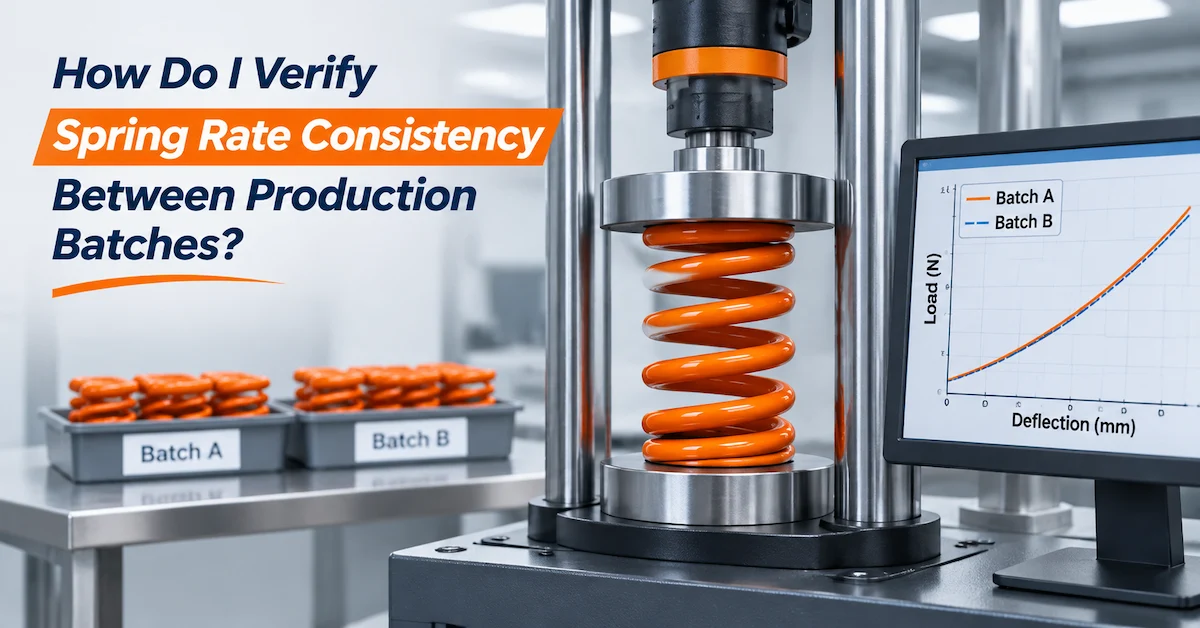
| Bench spring test | Does the spring's load-deflection behavior match the defined target? | Fixture, load points, raw data, rate calculation, sample, and batch. |
| Bench damper test | Does the damper response match the approved setting and condition? | Speed, temperature, curve, setting, machine, and calibration. |
| Vehicle control test | Does the loaded vehicle remain predictable over the planned route and events? | Load, speed, route, driver or operator notes, measurements, and approval. |
| Repeat-production check | Can later units reproduce the approved spring, damper, mounting, and package? | BOM, drawing revision, inspection plan, pilot lot, and change route. |
Test the maximum planned load, not an invented extreme
A validation load should be realistic, documented, and within the vehicle's approved or engineered boundary. Testing an arbitrary extreme may damage the vehicle and still fail to represent the customer's actual use. Define the maximum planned state with location and restraint, and treat any overload test as a separate engineering decision.
Compare the upgrade with the original configuration
A useful comparison records the original and upgraded ride height, sag, travel, response, temperature or fade signal, clearance, tire contact, and operator feedback under the same conditions. The comparison does not need to claim a universal performance percentage. It needs to show what changed, for which load state, and whether the result meets the project objective.
What should the factory provide for a payload-upgrade quotation?
A serious quotation should translate the vehicle information into a proposed configuration and a test scope. The buyer should not have to guess whether the price includes spring selection, damping tuning, samples, fixtures, vehicle testing, pilot inspection, or only a catalog part.
| Quotation item | What to request | Why it protects the buyer |
|---|---|---|
| Application definition | Vehicle, suspension position, load states, terrain, speed, and modifications. | Prevents the quote from being interpreted as universal payload approval. |
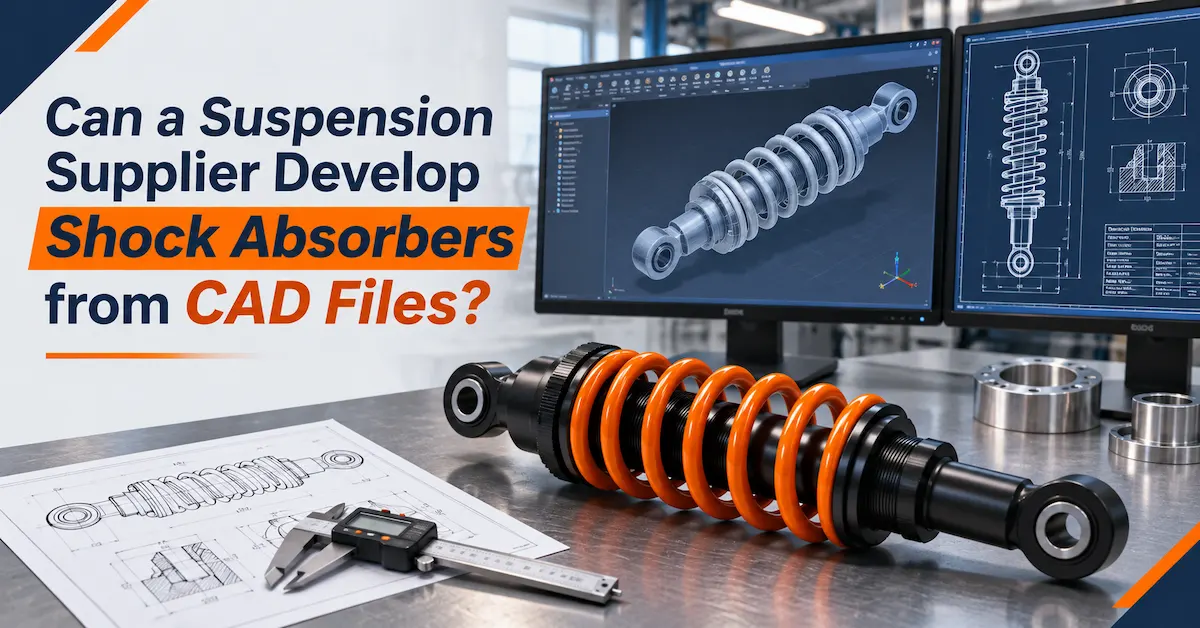
| Proposed spring | Rate or load targets, free and installed length, preload, seat, retention, and option identity. | Connects the part to ride height and load support. |
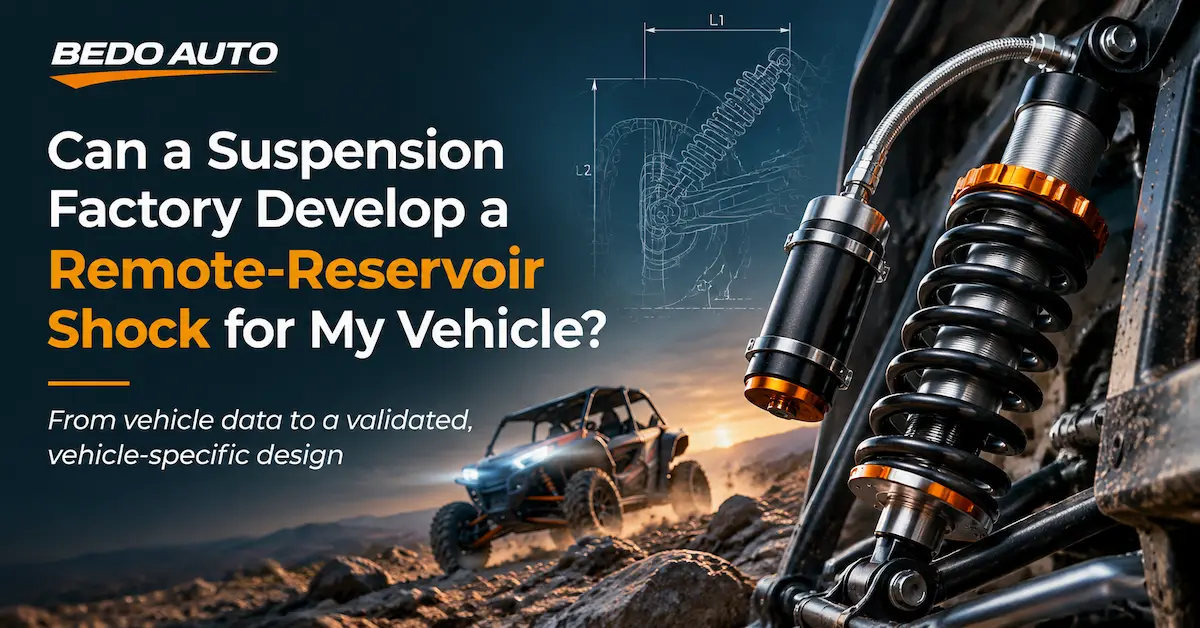
| Proposed damper | Body, stroke, compression and rebound approach, adjustment, and baseline. | Shows how motion control will be matched to the spring and mass. |
| Prototype scope | Quantity, production intent, hardware, testing, and sample documents. | Separates a useful engineering sample from a visual mockup. |
| Validation scope | Bench method, vehicle states, route or event, pass criteria, and responsibility. | Turns “testing included” into a defined deliverable. |
| Production control | Drawing, BOM, inspection, batch identity, packaging, and change notification. | Protects performance after the first approved sample. |
Evidence boundary: a supplier may offer heavy-duty springs, shock absorbers, and custom suspension development, but a product listing alone does not prove a universal payload increase, structural approval, legal rating, certification, durability result, MOQ, or lead time for a particular vehicle. Request project-specific calculations, test records, and vehicle-owner approval before making a payload claim.
Ask for assumptions and exclusions
The factory should identify missing axle loads, assumed tire pressure, provisional geometry, excluded vehicle parts, and any test that the buyer must perform. This makes two quotations comparable and prevents a low price from hiding that the supplier has not assessed the key risk.
Define options for different load states
If the vehicle has a broad operating range, ask whether the program should use one configuration, multiple spring options, a defined preload setting, an adjustable damper, or separate products for different users. The answer should consider installation error, labeling, service, and the operator's ability to use the setting correctly.
How should a fleet or OEM control repeat production?
After validation, freeze the exact product that passed. The released package should identify the vehicle application, spring, damper setting, mount hardware, seat, collar, finish, label, package, inspection method, and production revision. A later unit that has the same body but a different spring or setting is not the same payload solution.
Keep the batch identity for each shipment and define how spring rate and damper response will be checked. Use the same fixture, load points, conditioning, temperature, calculation, and sampling logic for later batches. For a high-risk application, the buyer may need an expanded incoming inspection or a supplier process record. The exact tolerance and sampling plan should be set for the project rather than invented as a universal number.
Control changes that can affect payload behavior
Changes to spring wire, heat treatment, damper internals, oil, gas condition, bushing, mount, coating, supplier, assembly process, or packaging can affect the approved response. The change-control route should define when the buyer receives notice and when a new sample, bench test, or vehicle validation is required.
Link the shipment to the approved application
Product identification should show enough information for purchasing, warehouse, service, and the end customer to distinguish load-rated options. If the same product family serves standard and heavy-load applications, the part number, label, spring marking, or package must prevent an incorrect installation. A generic “heavy duty” name is not a traceability system.
FAQ: suspension upgrades for increased payload
Should I install a higher-rate spring first?
Begin with load measurements and travel targets. A higher-rate spring may be appropriate, but the correct value depends on motion ratio, installed length, preload, load distribution, and empty-load requirements. Install and validate it with the damper and the complete vehicle.
Can a shock absorber increase my vehicle's legal payload?
Not by itself. A shock or spring can be designed for a higher defined load, but legal and structural payload limits involve the vehicle platform, frame, axle, wheel, tire, brake, steering, and applicable regulations. Do not advertise a payload increase without the responsible vehicle authority and evidence.
Is adding preload the same as increasing spring rate?
No. Preload changes the initial force and position of the spring assembly; it does not normally change the nominal rate of a linear spring. It can reduce available droop or create a harsh empty condition if used to compensate for an underspecified spring.
Do I need new shocks when I upgrade springs for payload?
Not always, but the damper must be reviewed. A spring change alters the force and motion the damper must control. If the existing shock is worn, has inadequate travel, poor clearance, or an unsuitable response, a complete shock and spring assembly may be the better development scope.
How do I explain the payload to a suspension factory?
Provide empty, normal, and maximum planned states; front/rear or corner loads; load position; passengers, battery, accessories, and attachments; terrain, speed, and duty cycle; stock suspension dimensions; ride-height and sag targets; and photos of the loaded vehicle. Separate measured values from estimates.
What proves that a heavy-load suspension upgrade is ready?
The evidence should include a defined application, approved spring and damper identity, fitment and full-stroke clearance, static load-state measurements, bench data, vehicle validation, and a production-control package. A single successful installation or a heavy-duty label is not enough.
Conclusion
An increased-payload suspension upgrade should be designed around measured axle and corner loads, load location, ride-height targets, usable travel, spring support, damping, clearance, and the limits of the complete vehicle. The most reliable process separates structural payload responsibility from suspension tuning, tests empty and loaded conditions, compares the upgrade with the original configuration, and freezes the exact spring, damper, hardware, and production records that passed validation.
For an OEM, fleet, utility, or aftermarket program, send the vehicle data before choosing a generic heavy-duty part. Contact BEDO Auto for a payload-focused suspension review with axle loads, load positions, stock shock details, and the intended duty cycle so the spring and damping proposal can be evaluated against the real vehicle.