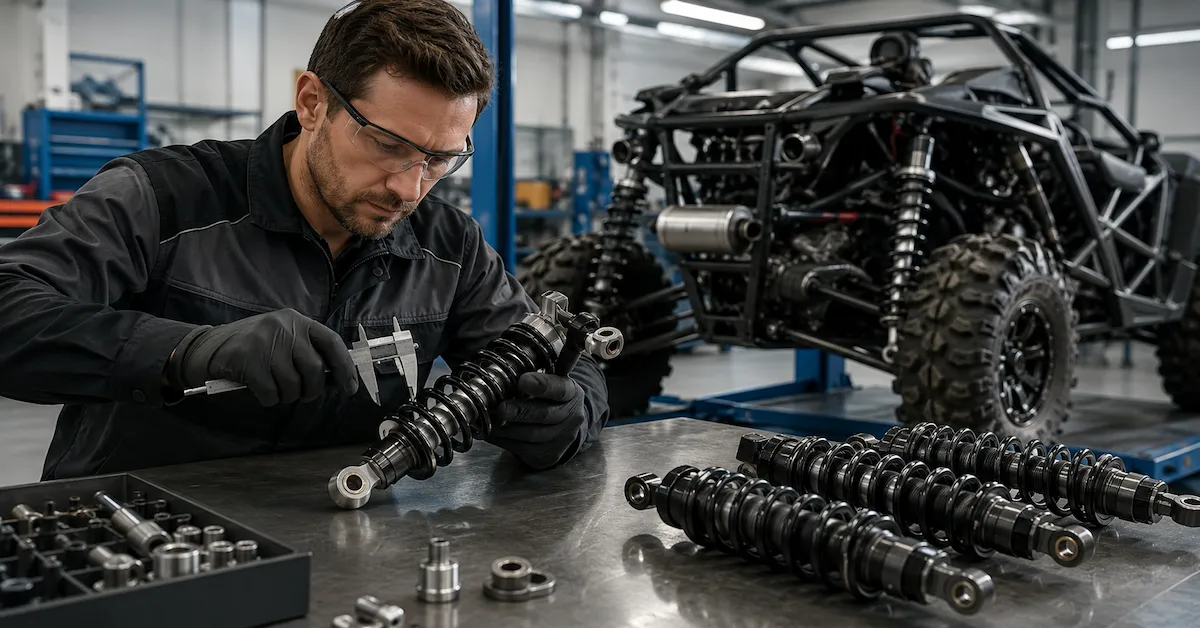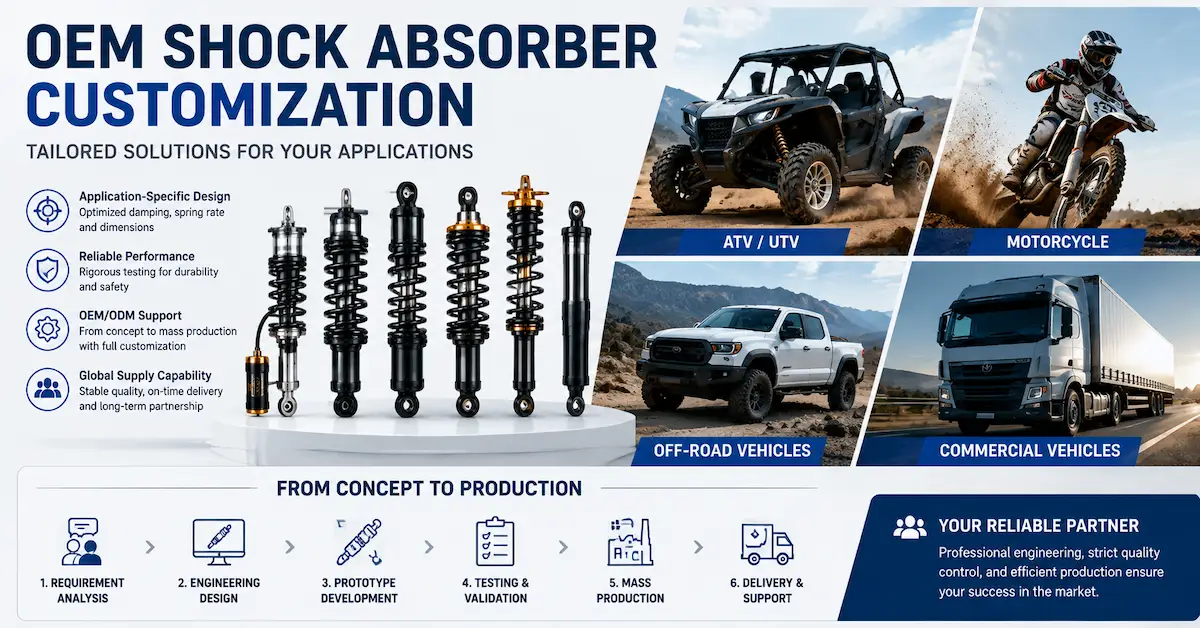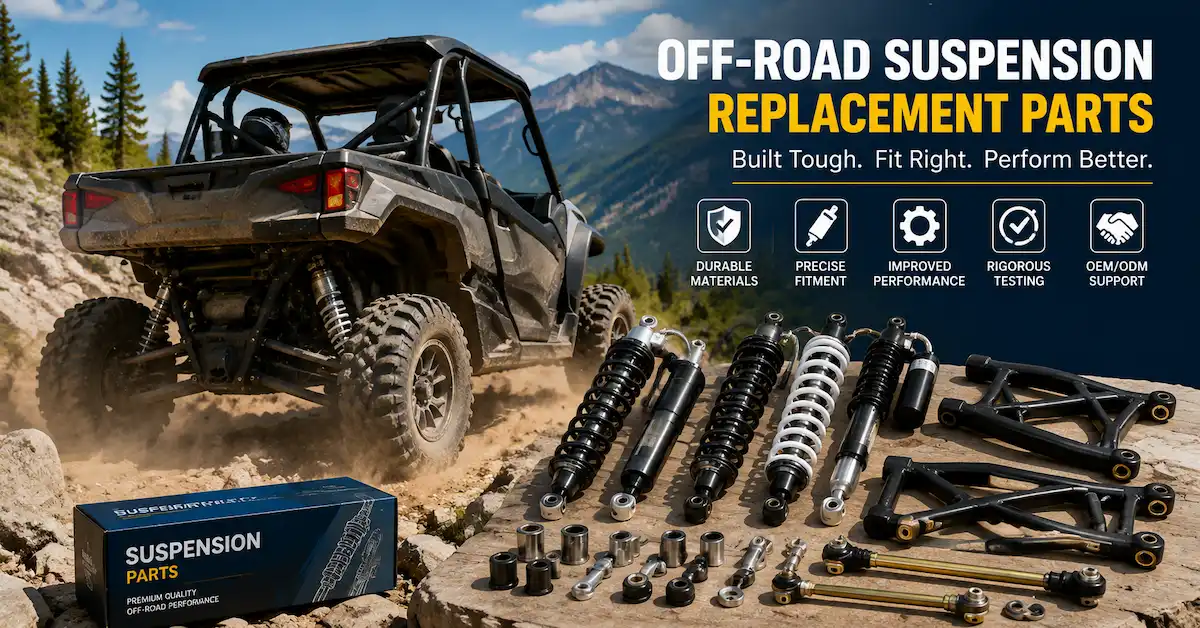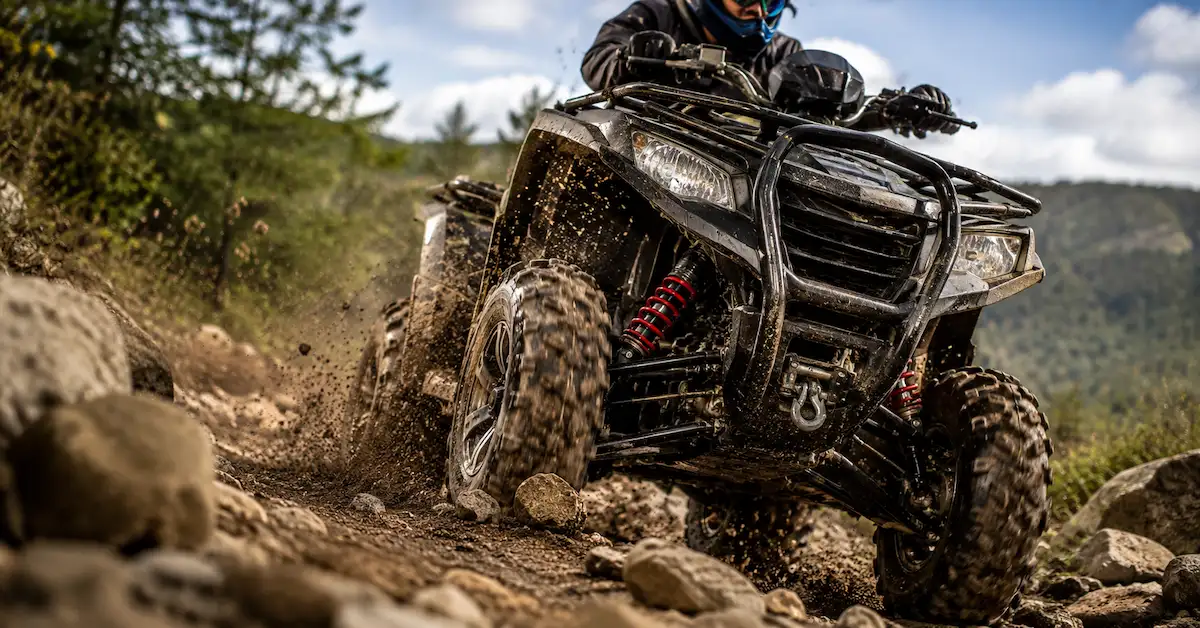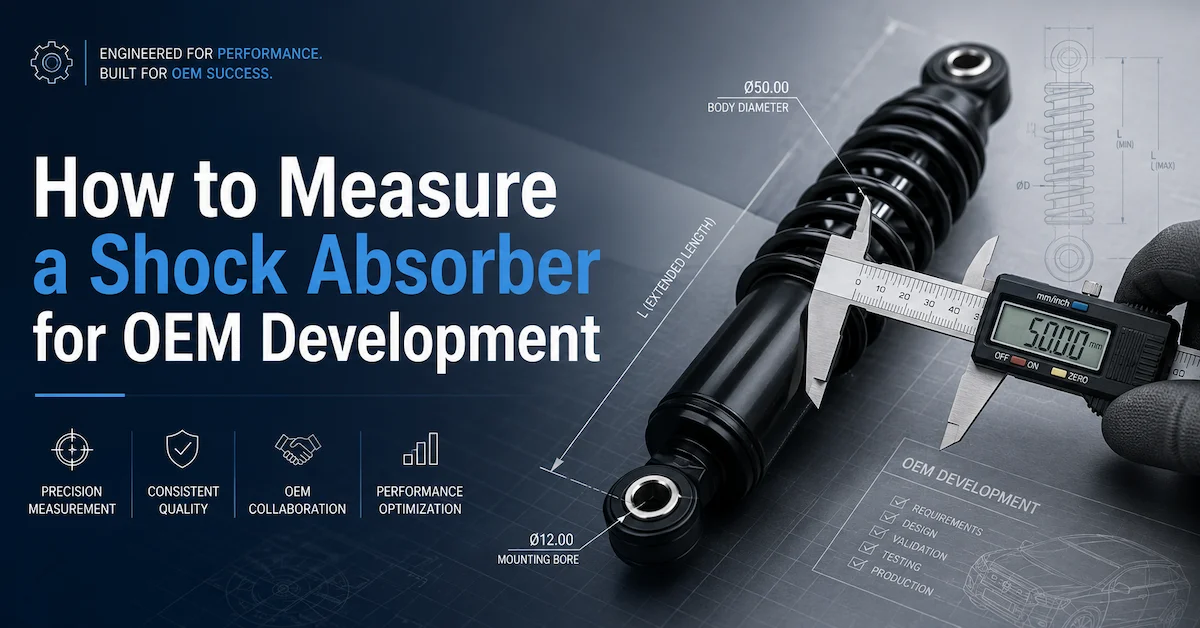

A dirt bike shock absorber OEM project must account for repeated jumps, sharp impacts, mud, dust, high suspension speeds, changing rider loads, and long periods of aggressive off-road use.
A dirt bike rear shock may appear similar to a standard motorcycle shock, but its operating conditions are significantly more demanding. The suspension must absorb large impacts, recover quickly between obstacles, resist overheating, maintain tire contact, and protect the rider and chassis from excessive force.
For dirt bike manufacturers, suspension brands, importers, wholesalers, distributors, and private-label aftermarket companies, selecting the right OEM partner is therefore a technical decision rather than only a price comparison.
The supplier must understand:
- Motorcycle weight
- Rider weight
- Suspension linkage
- Wheel travel
- Shock stroke
- Spring rate
- Compression damping
- Rebound damping
- Terrain
- Riding level
- Expected duty cycle
Bedo Auto supports customized shock absorbers and suspension springs for motorcycles, electric motorcycles, ATV, UTV, snowmobiles, and other off-road vehicles. Buyers can review available suspension products through the Bedo Auto Products page.
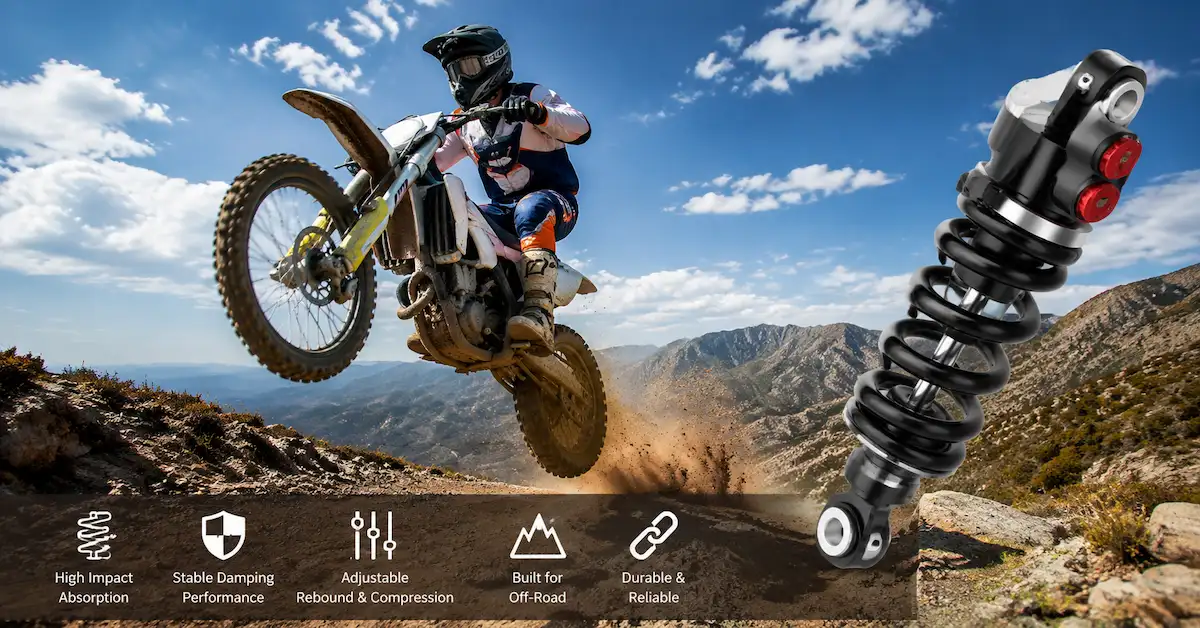
Why Dirt Bike Suspension Requires Application-Specific Development
Dirt bikes regularly operate on:
- Motocross tracks
- Forest trails
- Rocky terrain
- Sand
- Mud
- Enduro routes
- Jump sections
- Steep climbs
- High-speed off-road courses
These environments produce rapid and repeated suspension movement.
A shock absorber designed for ordinary road use may experience:
- Frequent bottoming
- Excessive heat buildup
- Damping fade
- Seal contamination
- Slow suspension recovery
- Poor landing control
- Reduced rear-wheel traction
- Premature component wear
A professional dirt bike shock absorber OEM supplier should design the product around the intended riding environment rather than applying a general motorcycle setting.
A motocross bike may require stronger bottoming resistance and more controlled landings. An enduro bike may need greater comfort and traction across long, irregular trails. A youth dirt bike may require lighter spring and damping settings than a full-size competition motorcycle.
Who Needs OEM Dirt Bike Shock Absorbers?
Customized dirt bike suspension products are suitable for several B2B customer groups.
| Buyer type | Typical requirement |
|---|---|
| Dirt bike manufacturer | Rear shock for a new motorcycle platform |
| Motorcycle brand | Model-specific suspension development |
| Importer | Replacement products for regional markets |
| Distributor | Stable stock and model coverage |
| Performance brand | Adjustable premium suspension |
| Modification workshop | Small-batch custom products |
| Racing supplier | Application-specific damping |
| Private-label company | Logo, colors, labels, and packaging |
| Electric dirt bike brand | Suspension matched to battery weight |
The OEM development process should change according to the buyer’s objective.
A vehicle manufacturer may prioritize fitment, cost, reliability, and mass-production consistency. A performance aftermarket brand may focus on adjustable damping, reservoir design, low weight, and premium appearance.
What Makes a Dirt Bike Shock Absorber Different?
Dirt bike shocks normally require a combination of impact resistance, rapid response, heat management, and contamination protection.
Important design factors include:
| Design factor | Why it matters |
|---|---|
| Shock stroke | Supports required suspension movement |
| Spring rate | Carries motorcycle and rider load |
| Compression damping | Controls impacts and landings |
| Rebound damping | Controls suspension recovery |
| Reservoir capacity | Supports oil volume and heat management |
| Piston rod strength | Resists bending and repeated load |
| Seal system | Protects against mud and dust |
| Mounting structure | Transfers high suspension loads |
| Adjustment range | Supports rider and terrain tuning |
| Oil specification | Influences damping consistency |
| Surface treatment | Protects against corrosion and wear |
A visually larger shock is not automatically better. The internal specification must match the motorcycle and suspension linkage.
Key Information Buyers Should Provide
Before starting a dirt bike shock absorber OEM project, buyers should prepare detailed vehicle and suspension information.
| Required information | Purpose |
|---|---|
| Dirt bike model | Establishes the application |
| Engine or motor type | Helps identify vehicle configuration |
| Motorcycle weight | Influences spring and damping |
| Rider weight range | Determines operating load |
| Installation position | Confirms rear suspension structure |
| Extended length | Defines maximum shock length |
| Compressed length | Confirms minimum installation length |
| Effective stroke | Defines available shock movement |
| Mounting dimensions | Ensures correct fitment |
| Wheel travel | Helps evaluate suspension ratio |
| Linkage geometry | Influences shock speed and force |
| Spring specification | Provides a load-support reference |
| Riding terrain | Defines performance requirements |
| Rider level | Recreational, enduro, motocross, or racing |
| Existing sample | Supports physical analysis |
| Technical drawing | Defines dimensions and tolerances |
| Estimated quantity | Supports prototype and production planning |
Buyers should also describe the existing suspension problem.
Common problems include:
- Rear suspension bottoms too easily
- Shock feels too stiff over small bumps
- Rear wheel loses traction
- Suspension rebounds too quickly
- Shock overheats during long rides
- Seals leak after mud exposure
- Spring is unsuitable for heavier riders
- Reservoir interferes with the frame
- Replacement shock does not match the linkage
Extended Length, Compressed Length, and Stroke
These three measurements are fundamental to fitment.
Extended Length
Extended length is normally measured between the center points of the upper and lower mounting holes when the shock is fully extended.
An incorrect extended length may change:
- Ride height
- Chassis balance
- Swingarm angle
- Rear-wheel position
- Steering behavior
Compressed Length
Compressed length is measured using the same mounting-center reference points at full shock compression.
An incorrect compressed length may cause:
- Mechanical interference
- Shock-body damage
- Tire contact
- Linkage damage
- Mounting-bracket overload
- Reduced wheel travel
Effective Stroke
Nominal stroke can often be calculated by subtracting compressed length from extended length.
However, usable stroke may be affected by:
- Internal bump stops
- External bump stops
- Seal-head clearance
- Spring coil bind
- Linkage limits
- Frame interference
Shock stroke and rear-wheel travel are not necessarily equal because the linkage creates a motion ratio.
Why Suspension Linkage Matters
Many dirt bikes use a linkage system between the swingarm, frame, and rear shock.
The linkage affects:
- Shock movement speed
- Force transmitted to the shock
- Progressive suspension behavior
- Wheel travel
- Spring requirements
- Damping requirements
A shock absorber developed without understanding the linkage may fit physically but perform incorrectly.
For example, a rising-rate linkage may increase shock force as the suspension approaches full compression. This helps resist bottoming, but it also changes the required spring and damping characteristics.
For new dirt bike platforms, buyers should provide:
- Linkage drawings
- Swingarm dimensions
- Shock mounting positions
- Installation angle
- Wheel travel
- Full-compression geometry
- Full-extension geometry
Spring Rate Selection
The spring supports:
- Motorcycle weight
- Rider weight
- Protective equipment
- Fuel
- Battery weight for electric dirt bikes
- Additional accessories
Spring rate affects:
- Static sag
- Rider sag
- Ride height
- Available travel
- Bottoming resistance
- Rear-wheel traction
- Chassis balance
A spring that is too soft may cause:
- Excessive sag
- Frequent bottoming
- Reduced ground clearance
- Unstable landings
- Limited usable travel
A spring that is too stiff may cause:
- Poor traction
- Harsh riding
- Reduced small-bump response
- Increased rider fatigue
- Rear-wheel skipping
A dirt bike suspension manufacturer should evaluate spring rate together with linkage ratio, rider weight, riding style, and terrain.
Compression Damping for Impacts and Landings
Compression damping controls resistance as the shock shortens.
It affects how the rear suspension responds to:
- Jump landings
- Rocks
- Roots
- Deep holes
- Braking loads
- Acceleration
- Sharp terrain edges
Insufficient compression damping may cause:
- Frequent bottoming
- Excessive chassis movement
- Poor landing stability
- Reduced suspension support
Excessive compression damping may cause:
- Harsh impact response
- Reduced traction
- Rider fatigue
- Increased frame and mount stress
- Poor performance over repeated bumps
The objective is not maximum compression resistance. The correct setting should allow the suspension to absorb impacts while maintaining sufficient support.
High-Speed and Low-Speed Compression
Some advanced dirt bike shocks separate compression adjustment into high-speed and low-speed circuits.
These terms refer to shock piston speed rather than motorcycle speed.
Low-Speed Compression
Low-speed compression influences suspension movement caused by:
- Acceleration
- Braking
- Weight transfer
- Smooth terrain changes
- Chassis movement
Increasing low-speed compression can provide stronger support but may reduce comfort if adjusted excessively.
High-Speed Compression
High-speed compression controls rapid shock movement caused by:
- Jump landings
- Rocks
- Sharp holes
- Sudden obstacles
- Hard impacts
A useful high-speed compression circuit should reduce bottoming without making the suspension excessively harsh.
Rebound Damping and Traction
Rebound damping controls how quickly the shock extends after compression.
Too little rebound damping may cause:
- Fast suspension extension
- Repeated bouncing
- Unstable rear movement
- Poor control after jumps
- Reduced traction
Too much rebound damping may cause:
- Slow suspension recovery
- Suspension packing
- Reduced travel over repeated bumps
- Poor rear-wheel contact
- Harsh riding
Dirt bike terrain often includes closely spaced obstacles, so the shock must recover quickly enough for the next impact without rebounding uncontrollably.
Spring rate and rebound damping should always be evaluated together.
Piggyback and Remote Reservoir Options
Reservoir shocks are commonly used in dirt bike applications because they provide additional oil and gas capacity.
Piggyback Reservoir
A piggyback reservoir is attached directly to the shock body.
Advantages may include:
- Compact integrated construction
- No external hose
- Strong mechanical protection
- Simplified installation
Potential limitations include:
- Installation-clearance requirements
- Heat concentration near the shock body
- Limited reservoir positioning
Remote Reservoir
A remote reservoir connects to the shock through a hose.
Advantages may include:
- Flexible positioning
- Increased installation options
- Additional oil capacity
- Alternative heat-management layout
The project must confirm:
- Hose length
- Hose routing
- Abrasion protection
- Reservoir mounting
- Full-suspension clearance
- Exhaust heat exposure
The correct reservoir structure depends on motorcycle packaging and performance requirements.
Heat Management and Damping Fade
Repeated suspension movement creates heat inside the shock absorber.
Heat buildup may increase during:
- Motocross racing
- Long enduro rides
- Repeated jumps
- High-speed trails
- Rocky terrain
- Heavy riders
- Hot weather
Damping consistency may be affected by:
- Oil volume
- Oil specification
- Shock-body size
- Reservoir capacity
- Body material
- Piston design
- Valve structure
- Gas pressure
- Operating duration
A professional OEM supplier should understand the expected duty cycle before selecting the shock structure.
Testing a product only through short manual compression cannot confirm performance under prolonged off-road operation.
Sealing and Mud Protection
Dirt bike shocks are exposed to:
- Mud
- Dust
- Sand
- Water
- Stones
- Cleaning chemicals
- Pressure washing
Contamination can damage the piston-rod surface and sealing system.
Possible consequences include:
- Oil leakage
- Increased friction
- Damaged seals
- Scratched piston rods
- Inconsistent damping
- Reduced service life
A suitable protection system may include:
- Oil seals
- Dust seals
- Wipers
- Rod coatings
- Protective guides
- Corrosion-resistant finishes
Assembly cleanliness is also critical because internal contamination may affect valves and oil flow.
Piston Rod and Mounting Strength
The piston rod and mounting eyes experience repeated impact loads.
Important control points include:
- Rod material
- Rod diameter
- Straightness
- Surface hardness
- Surface finish
- Corrosion protection
- Mounting-eye dimensions
- Bushing quality
- Weld quality where applicable
- Mounting alignment
A bent rod or misaligned mounting eye may create side loading and accelerate seal wear.
Mounting components should be evaluated together with the motorcycle frame and linkage.
Fixed vs Adjustable Dirt Bike Shocks
| Feature | Fixed shock | Adjustable shock |
|---|---|---|
| Damping | Factory preset | Rider or technician adjustable |
| Complexity | Lower | Higher |
| Cost | Usually lower | Usually higher |
| Setup | Simple | Requires correct adjustment |
| Rider flexibility | Limited | Supports different riders |
| Terrain flexibility | One general setting | Can adapt to different terrain |
| Best application | Youth or standard replacement | Performance and racing markets |
Adjustable options may include:
- Spring preload
- Rebound damping
- Compression damping
- High-speed compression
- Low-speed compression
- Shock-length adjustment
More adjustment clicks do not automatically indicate better performance. The useful range and repeatability are more important.
Development from an Existing Sample
A physical sample can help the supplier evaluate:
- Shock length
- Stroke
- Mounting dimensions
- Spring dimensions
- Reservoir structure
- Body diameter
- Rod diameter
- Adjustment mechanisms
- Surface treatment
However, external measurements do not fully reveal:
- Spring rate
- Damping curves
- Internal valve design
- Oil specification
- Gas pressure
- Friction characteristics
- Material grade
The buyer should clearly state whether the new shock must:
- Match the original product
- Improve bottoming resistance
- Support a heavier rider
- Improve traction
- Reduce harshness
- Add adjustment functions
- Improve sealing
- Reduce production cost
- Create a premium aftermarket version
Drawing-Based OEM Development
Drawings are particularly useful for new motorcycle models and original equipment projects.
A complete drawing may specify:
- Extended length
- Compressed length
- Effective stroke
- Mounting-hole diameter
- Mounting width
- Body diameter
- Rod diameter
- Reservoir location
- Hose length
- Spring dimensions
- Material requirements
- Surface finish
- Tolerance range
Before prototyping, the supplier should review:
- Linkage clearance
- Swingarm movement
- Frame clearance
- Reservoir position
- Exhaust proximity
- Adjustment access
- Full-compression interference
- Manufacturing feasibility
Early technical review helps reduce repeated samples and tooling changes.
Quality Control in Dirt Bike Shock Production
A reliable dirt bike shock absorber OEM process should include material, dimensional, assembly, functional, and performance controls.
Incoming Material Inspection
The supplier should inspect:
- Tubes
- Piston rods
- Springs
- Seals
- Bushings
- Machined parts
- Valve components
- Reservoir parts
- Hoses and fittings
Dimensional Inspection
Critical dimensions include:
- Extended length
- Compressed length
- Stroke
- Mounting width
- Mounting-hole diameter
- Spring free length
- Spring outside diameter
- Rod diameter
- Body diameter
- Reservoir position
Assembly Control
Production procedures should control:
- Component cleanliness
- Seal installation
- Piston and valve assembly
- Oil filling
- Gas charging
- Tightening torque
- Spring preload
- Adjuster installation
- Mounting alignment
Leakage and Functional Testing
Finished shocks should be checked for:
- Oil leakage
- Pressure loss
- Abnormal noise
- Sticking
- Excessive friction
- Uneven movement
- Adjustment failure
Damping Verification
Compression and rebound forces should be compared with the approved target.
For adjustable products, different settings should create repeatable and measurable damping changes.
Final Inspection
Final inspection may include:
- Product dimensions
- Surface finish
- Spring color
- Logo position
- Adjustment markings
- Product label
- Packaging
- Quantity
Prototype Testing Under Real Riding Conditions
A prototype should be evaluated on the motorcycle rather than only on a workbench.
Testing should confirm:
- Installation compatibility
- Mounting alignment
- Spring support
- Rider sag
- Full-extension clearance
- Full-compression clearance
- Bottoming resistance
- Rebound recovery
- Rear-wheel traction
- Heat behavior
- Seal performance
- Adjustment range
Testing should reflect the target rider weight and terrain.
A shock intended for motocross should be tested differently from one developed for trail riding or youth motorcycles.
Why Pilot-Batch Validation Is Important
A single prototype confirms the basic design, but it does not prove production consistency.
A small pilot batch allows buyers to evaluate:
- Dimensional variation
- Spring consistency
- Damping variation
- Gas-pressure consistency
- Leakage control
- Adjustment consistency
- Coating quality
- Packaging
- Installation feedback
Pilot production reduces the risk of approving a large order before the manufacturing process is stable.
Customization Options for OEM Buyers
| Custom option | Purpose |
|---|---|
| Shock length | Matches motorcycle geometry |
| Stroke | Supports target wheel travel |
| Spring rate | Matches motorcycle and rider weight |
| Preload range | Adjusts sag |
| Compression damping | Controls impacts |
| Rebound damping | Controls recovery |
| Reservoir design | Supports oil capacity and heat control |
| Rod diameter | Matches structural requirements |
| Body material | Balances weight and strength |
| Surface treatment | Improves protection |
| Spring color | Supports brand differentiation |
| Logo marking | Supports private labeling |
| Product label | Identifies model and settings |
| Packaging | Supports wholesale and retail channels |
Technical requirements should be prioritized before appearance customization.
How to Evaluate an OEM Supplier
Before starting a dirt bike suspension project, buyers should evaluate four main areas.
Engineering Capability
Confirm whether the supplier can:
- Review samples and drawings
- Analyze linkage geometry
- Develop spring specifications
- Adjust compression and rebound
- Evaluate reservoir requirements
- Produce prototypes
- Document approved settings
Production Capability
Evaluate:
- Material management
- Machining accuracy
- Spring-production control
- Assembly cleanliness
- Small-batch flexibility
- Mass-production capacity
- Batch traceability
- Repeat-order consistency
Testing Capability
Ask whether the supplier can support:
- Dimensional inspection
- Leakage testing
- Functional testing
- Spring inspection
- Damping verification
- Adjustment testing
- Pilot-batch inspection
Communication Capability
A professional supplier should ask about the motorcycle model, rider weight, linkage, shock stroke, wheel travel, terrain, riding level, mounting dimensions, and performance target.
A quotation based only on a photograph may overlook major fitment and damping risks.
How Bedo Auto Supports Dirt Bike Shock Projects
Bedo Auto supports customized shock absorbers and suspension springs for motorcycles, electric motorcycles, ATV, UTV, snowmobiles, beach buggies, and specialty vehicles.
A dirt bike shock absorber OEM project can include:
- Existing-sample analysis
- Technical drawing review
- Motorcycle and rider-load evaluation
- Mounting-dimension confirmation
- Spring-rate development
- Compression and rebound adjustment
- Reservoir configuration
- Material selection
- Surface-treatment customization
- Prototype production
- Pilot-batch validation
- OEM and ODM branding
- Customized labels and packaging
- Repeat-production support
Buyers can review the Bedo Auto product range, learn more through the About Bedo Auto page, or submit samples, drawings, and purchasing requirements through the Contact Us page.
FAQ
What information is needed for a dirt bike shock absorber OEM project?
The supplier normally needs motorcycle weight, rider weight, shock dimensions, stroke, mounting details, linkage geometry, wheel travel, terrain, riding level, spring information, and performance targets.
Can a dirt bike shock be developed from an existing sample?
Yes. A sample provides structural and dimensional references. Vehicle data and target suspension performance should also be provided.
Can spring rate be customized for different rider weights?
Yes. Spring rate and preload can be developed according to motorcycle weight, rider range, suspension geometry, and intended use.
Is a reservoir necessary for every dirt bike shock?
No. A reservoir can support oil capacity, pressure stability, and heat management, but the requirement depends on the motorcycle and operating conditions.
Can compression and rebound damping be adjusted?
Yes. Fixed or adjustable damping can be developed according to terrain, riding style, spring rate, and performance targets.
Why is linkage information important?
The linkage determines how shock movement relates to wheel movement and how suspension force changes throughout the travel.
Can Bedo Auto provide private-label dirt bike shocks?
Bedo Auto supports OEM and ODM customization, including spring colors, body finishes, logos, labels, packaging, prototypes, and repeat production.
Conclusion
A successful dirt bike shock absorber OEM project depends on more than reproducing the shape of an existing shock.
Shock length, stroke, spring rate, linkage geometry, compression damping, rebound damping, reservoir design, sealing, materials, heat management, and mounting strength must all match the motorcycle and its operating environment.
Through sample analysis, drawing review, spring and damping development, prototype testing, pilot-batch validation, and controlled production, Bedo Auto helps dirt bike brands, manufacturers, importers, distributors, and aftermarket companies develop suspension products with reliable fitment and repeatable performance.