
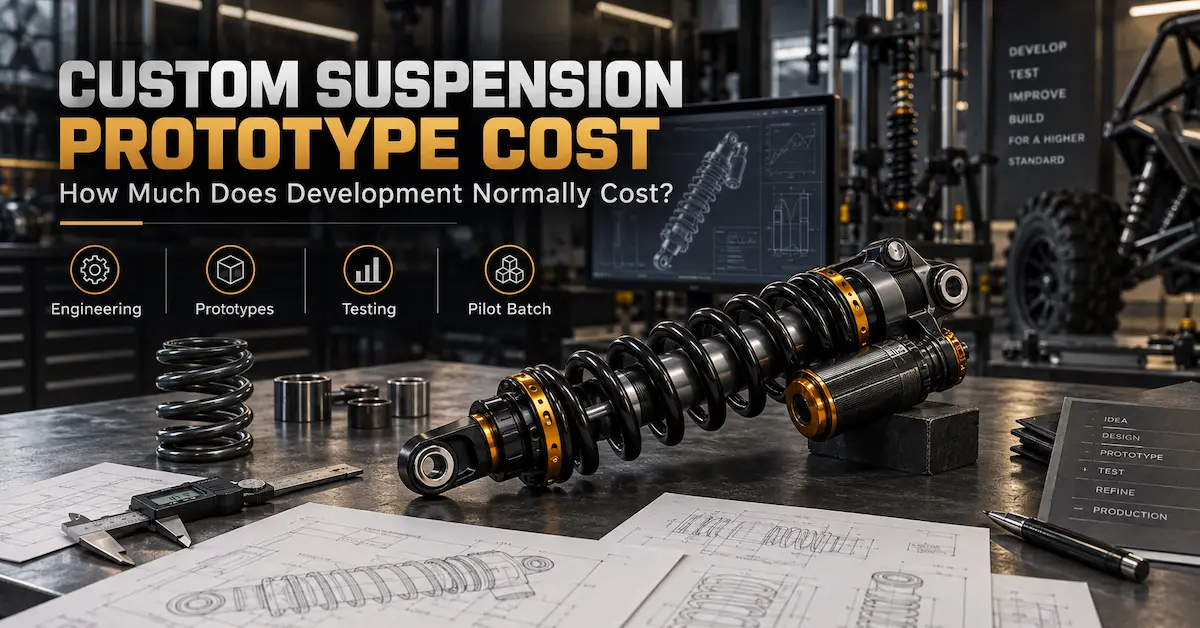
How Much Does Custom Suspension Prototype Development Normally Cost?
There is no single reliable “normal” price for custom suspension prototype development because the scope can range from modifying an existing shock platform to engineering an entirely new vehicle-specific suspension component. A project based on an existing shock with revised mounting dimensions may require relatively limited engineering, while a project involving new CAD geometry, custom springs, new compression and rebound damping, remote reservoirs, multiple prototypes, and vehicle validation can require substantially more development work.
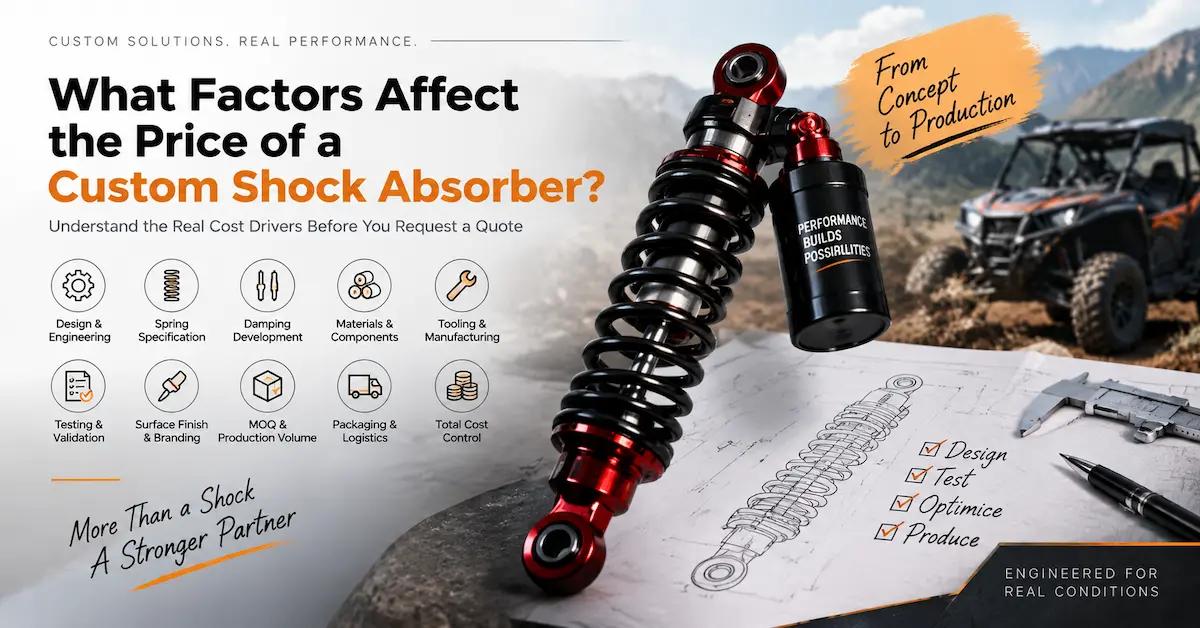
For BEDO projects, the available information does not publish a fixed dollar range that should be presented as a universal prototype-development fee. The more useful purchasing approach is to break the custom suspension prototype development cost into engineering, physical prototypes, testing, revisions, tooling or fixtures where required, and later pilot-production expenses.
Buyers can review BEDO’s shock absorber and suspension product range before deciding whether an existing platform may provide a starting point for the project.
Prototype Cost Is Different From the Final Production Unit Price
One of the most common purchasing mistakes is taking the prototype quotation and assuming the finished production shock will cost the same amount per unit.
Prototype pricing can contain work that will not be repeated on every mass-produced shock, including engineering review, sample measurement, drawing preparation, CAD adjustments, machine setup, low-volume machining, test preparation, and engineering revisions.
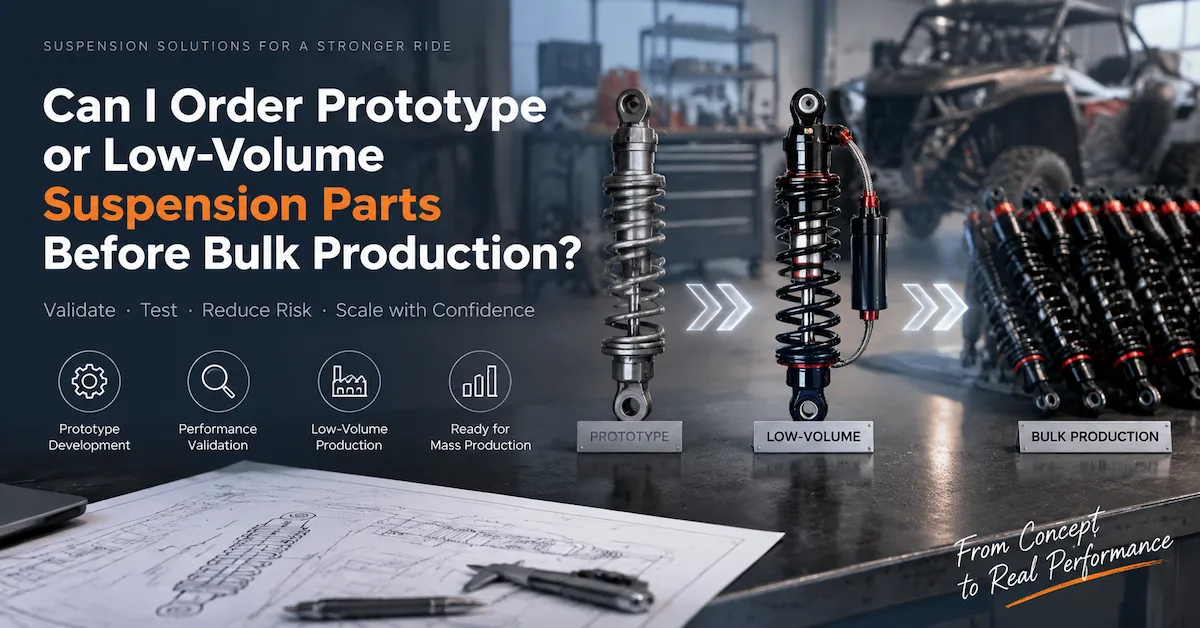
The project should therefore be separated into four commercial stages.
Development Stage
Engineering, requirement review, CAD or drawing work, manufacturability analysis, and technical planning.
Prototype Stage
Physical samples produced for fitment, spring, damping, and performance validation.
Pilot Stage
A small production run used to verify manufacturing repeatability.
Production Stage
Recurring manufacturing cost after the approved product and process are stable.
This distinction is especially important when comparing a prototype supplier with a mass-production supplier. A low prototype price does not necessarily mean low production cost, and an expensive engineering prototype does not automatically mean an expensive volume product.
1. Existing Platform or Clean-Sheet Development
The first cost question is whether BEDO can begin with an existing shock architecture or whether the project requires a substantially new design.
An existing platform may already have established shock bodies, seals, spring seats, bushings, assembly processes, machining programs, and inspection methods. The buyer may only need changes to dimensions, spring, damping, finish, or branding.
A clean-sheet project can require more work involving new:
- extended and compressed dimensions;
- stroke;
- mounting structures;
- spring seats;
- body dimensions;
- reservoir packaging;
- internal configuration;
- manufacturing fixtures;
- technical drawings.
Before commissioning a completely new shock, compare your requirements with BEDO’s existing products. If a current platform already meets most structural requirements, modifying it may reduce both prototype complexity and development risk.
2. Drawing and Engineering Work Can Be a Separate Cost
Some buyers arrive with a complete released drawing. Others arrive with only an old shock absorber, photographs, or handwritten dimensions.
These projects are not equivalent.
If a physical sample must first be measured and turned into a technical drawing, engineering work can include:
Sample inspection → dimensional measurement → preliminary drawing → buyer review → engineering revision → prototype release
The earlier article on custom suspension development files explains why drawings, CAD, samples, vehicle data, and technical requirements should be controlled separately.
Likewise, if your development begins with a physical part rather than an original drawing, use the sample-to-drawing development approach to distinguish measurable geometry from spring, damping, material, or internal specifications that still need engineering confirmation.
More incomplete information usually means more supplier engineering work before a physical prototype can be produced.
3. CAD and Vehicle-Geometry Review Can Increase Engineering Scope
A straightforward replacement shock may not require a complete vehicle CAD study.
A long-travel ATV project, new reservoir layout, modified control arm, larger-tire package, or non-standard mounting position may require more detailed digital review.
CAD work can involve checking:
- upper and lower mounting points;
- shock angle;
- full compression;
- full droop;
- wheel and tire envelope;
- chassis clearance;
- spring clearance;
- reservoir placement;
- hose routing;
- adjuster access.
The purpose is to identify geometric issues before money is spent manufacturing parts.
BEDO-related projects that require this type of analysis can follow a CAD-based suspension development workflow.
Although additional CAD work adds engineering scope at the beginning, resolving an interference issue digitally can be less expensive than manufacturing, shipping, installing, and rejecting an incorrect physical prototype.
4. Custom Mounting Components Can Increase Prototype Cost
An existing shock body with a different spring does not have the same manufacturing scope as a shock requiring a newly machined upper eye, lower clevis, special sleeve, or unique bushing.
New mounting structures can introduce:
- engineering drawings;
- machining programs;
- setup time;
- prototype machining;
- dedicated inspection;
- fixtures or gauges;
- supplier-specific components.
If the vehicle application can use an existing validated mounting component without compromising geometry or fitment, doing so may reduce development complexity.
However, mounting components should never be standardized simply to reduce price when the vehicle requires another interface.
Fitment must remain the priority.
5. Spring Development Changes the Prototype Budget
Custom spring development can become a separate workstream inside the suspension project.
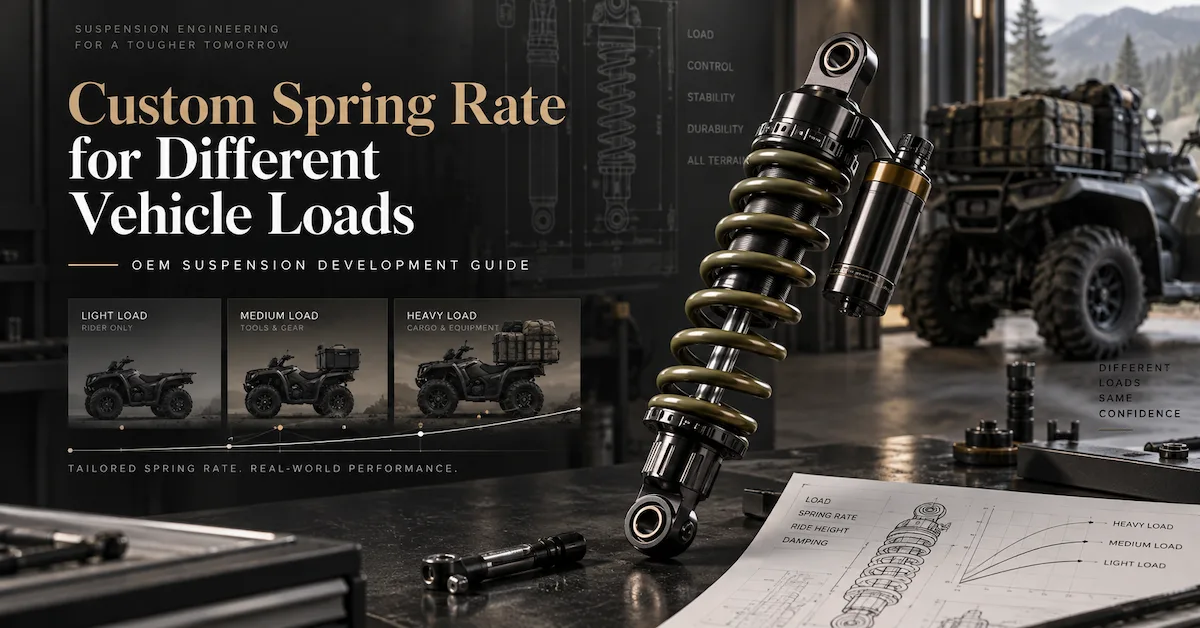
A prototype program may require one or several spring configurations depending on rider weight, cargo, suspension geometry, and intended terrain.
Possible development variables include:
- spring rate;
- free length;
- diameter;
- preload;
- coil configuration;
- finish;
- application load.
Consider two prototype programs.
Project A uses an existing spring already suitable for the target vehicle.
Project B compares three candidate spring specifications before selecting one.
Project B requires more parts, more vehicle evaluation, and potentially more revision work. It should therefore not be expected to carry the same custom suspension prototype development cost.
6. Damping Development Can Require Several Sample Iterations
Compression and rebound damping development is another major variable.
A buyer may simply want the factory’s existing damping configuration, or may need a shock developed around specific terrain, vehicle weight, spring characteristics, and rider behavior.
A performance-development sequence may look like:
Reference Shock → Baseline Test → Prototype Valving → Dyno Test → Vehicle Test → Engineering Feedback → Revised Prototype
Every additional iteration can require parts, assembly, testing, and engineering time.
BEDO projects involving damping development can refer to the compression and rebound damping testing guide to understand why one force value or subjective “hard/soft” description is insufficient.
For budget planning, ask whether the quotation includes one damping specification or a defined number of development iterations.
7. Fixed, Adjustable, and Reservoir Shocks Have Different Complexity
Shock architecture can significantly change prototype development scope.
A conventional fixed-damping design may use fewer components than a separately adjustable compression/rebound shock.
A remote-reservoir design can additionally require:
- reservoir body;
- fittings;
- hose;
- mounting bracket;
- routing analysis;
- additional sealing points;
- packaging review.
A piggyback reservoir can eliminate the hose but create another local clearance issue.
Do not request every available premium feature before determining whether the application actually requires it.
More components mean more items that need to be engineered, manufactured, assembled, inspected, and validated.
8. Materials and Special Components Influence Prototype Pricing
Prototype cost can also change when the project requires components outside the manufacturer’s standard production system.
Examples may include a unique:
- bushing;
- sleeve;
- seal;
- mounting eye;
- reservoir fitting;
- hose;
- spring;
- machined collar;
- surface treatment.
The unit price of one small part may appear insignificant, but custom sourcing can introduce supplier minimums, machining setup, material purchasing, or longer preparation.
Before freezing an unusual component, ask whether an existing proven component can satisfy the same functional requirement.
This is not about choosing cheaper materials. It is about avoiding unnecessary one-off complexity.
9. Tooling, Fixtures, and Gauges May Be One-Time Costs
Some custom designs can be produced using existing factory tooling. Others may require a dedicated fixture or inspection gauge.
Potential one-time items include:
- machining fixtures;
- assembly fixtures;
- dimensional gauges;
- prototype holding tools;
- custom inspection tools.
These should be identified separately from the recurring production price.
When reviewing a quotation, ask:
Is this cost one-time or recurring?
Who owns the tooling?
Will it be reused on repeat orders?
Is replacement tooling included in future pricing?
This provides a much clearer picture of the real project investment.
10. Prototype Quantity Affects Total Development Cost
One prototype unit is not automatically sufficient.
The required quantity depends on what the project needs to validate.
A development program might require different samples for:
Fitment
One configuration verifies dimensions and mounting.
Spring Comparison
Several units or interchangeable setups compare load support.
Damping Comparison
Different internal configurations are evaluated.
Durability Testing
Testing may consume or significantly age the sample.
Vehicle Testing
Additional units may be required for practical validation.
Retained Reference
Buyer or supplier may keep an approved sample for future production comparison.
Therefore, the correct prototype quantity should come from the validation plan rather than from an arbitrary “lowest MOQ.”
11. Testing Scope Can Significantly Change the Budget
Different products require different test programs.
Possible prototype validation can include:
- dimensional inspection;
- installation validation;
- leakage inspection;
- compression testing;
- rebound testing;
- load evaluation;
- adjustment verification;
- durability evaluation;
- temperature-related testing where relevant;
- vehicle testing.
A simple dimensional replacement prototype does not necessarily require the same development program as a premium adjustable ATV shock.
The related shock absorber testing before mass production guide explains why testing should be selected according to project risk rather than using one universal checklist.
Before accepting a prototype quotation, ask which tests are included and which would be additional.
12. Leakage and Sealing Validation Are Part of Development Cost
A custom hydraulic shock should not be approved merely because it fits the vehicle.
Seal interfaces and assembled joints also need appropriate validation.
Products with remote reservoirs can introduce additional fitting, hose, and reservoir interfaces that need inspection.
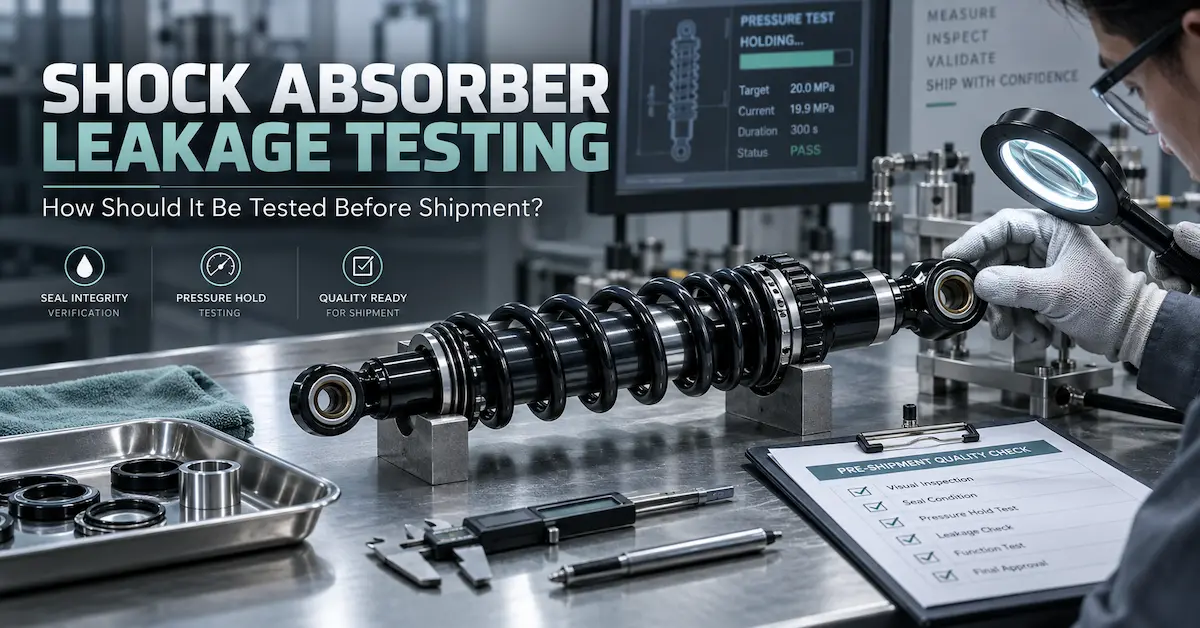
BEDO projects can reference the shock absorber leakage testing guide for a structured approach to seal integrity, functional checks, and pre-shipment control.
If a new architecture requires more sealing interfaces, its validation scope can also be different from that of a simpler shock.
13. Every Engineering Revision Can Add Cost
This is one of the most underestimated cost drivers.
Suppose Prototype 1 identifies an incorrect mounting width.
The drawing is revised.
Prototype 2 solves the mounting issue, but vehicle testing shows the spring is unsuitable.
The spring changes.
Prototype 3 improves load support, but the damping now needs adjustment.
Another revision follows.
None of these changes is necessarily a sign of poor development; prototypes exist to identify issues. But each revision can consume additional engineering, parts, machining, assembly, shipping, and testing.
Buyers can reduce avoidable revisions by sending complete requirements before the first sample is manufactured.
What Does a Prototype Development Budget Actually Include?
Instead of asking for one lump-sum number, separate the commercial scope.
Engineering Cost
Requirement analysis, drawing review, CAD work, DFM review, technical communication.
Sample Manufacturing Cost
Prototype components, machining, assembly, springs, reservoirs, and hardware.
Testing Cost
Applicable damping, leakage, durability, load, or vehicle validation.
Tooling and Fixture Cost
One-time production or inspection aids where required.
Revision Cost
Additional prototypes or parts after engineering changes.
Logistics Cost
Prototype shipment and any return of physical reference samples where applicable.
Pilot-Batch Cost
Separate small production run after prototype approval.
Production Cost
Recurring unit price once the configuration is finalized.
This breakdown makes supplier quotations much easier to compare.
Existing Platform Modification vs New Prototype Development
A simple way to understand cost is to compare three development routes.
Route A: Existing Platform with Limited Modification
The supplier already has a suitable basic shock architecture. The buyer changes limited features such as spring specification, color, branding, or packaging.
This generally creates the lowest engineering uncertainty.
Route B: Existing Platform with Technical Customization
The shock architecture remains broadly suitable, but the project requires new dimensions, mounts, spring, or damping.
This introduces more engineering and validation work.
Route C: New Vehicle-Specific Prototype
The project requires significant new geometry, unique mounting, spring development, custom damping, reservoir packaging, CAD review, testing, and production preparation.
This creates the broadest prototype-development scope.
The three routes should not be compared using the same prototype price expectation.
Can You Estimate Cost Before the Drawings Are Finished?
A supplier may be able to provide a preliminary estimate when enough project information is available, but the buyer should understand which assumptions remain open.
For example, a quotation may assume:
- existing mounting components;
- one spring configuration;
- fixed damping;
- standard finish;
- no new tooling.
If later engineering requires a new clevis, custom spring, adjustable compression, and remote reservoir, the original estimate no longer represents the same product.
Ask the supplier to mark important commercial assumptions clearly.
This is more useful than demanding a fixed final price before the product itself has been defined.
Why Generic Online Price Ranges Can Be Misleading
For this BEDO topic, the available source information does not establish a universal dollar range for custom suspension prototype development.
Using an unsupported figure such as “a prototype normally costs $X–$Y” could mislead buyers because it ignores:
- development depth;
- shock architecture;
- number of samples;
- custom components;
- test scope;
- tooling;
- revisions;
- vehicle requirements.
A realistic project quotation needs technical context.
For B2B purchasing, a transparent scope is more useful than an attractive but unsupported average price.
How Can Buyers Reduce Custom Suspension Prototype Development Cost?
The most effective approach is usually to reduce unnecessary uncertainty and redesign.
Start with accurate application data.
Provide:
- exact vehicle;
- front/rear position;
- existing shock or sample;
- dimensions;
- mounting interfaces;
- vehicle weight;
- rider weight;
- cargo;
- accessories;
- tire configuration;
- terrain;
- current problem;
- target result.
For geometry-sensitive projects, include the relevant CAD.
For performance projects, explain what the suspension is expected to improve.
For commercial planning, provide the expected pilot and production quantities.
The more clearly the project is defined, the easier it is for a supplier to identify which development work is genuinely necessary.
Do Not Cut the Wrong Costs
There is an important difference between avoiding unnecessary engineering and removing necessary validation.
Good cost reduction might mean:
Using an existing validated mount instead of designing a new one without functional reason.
Poor cost reduction might mean:
Skipping prototype vehicle testing even though the new shock uses different geometry and damping.
Likewise, using standard packaging during development can be sensible.
Skipping required leakage or fitment checks to save money can create a much larger field problem later.
The target should be lower development waste, not lower engineering confidence.
When Should You Move from Prototype to Pilot Production?
Move forward when the relevant technical requirements have been approved and documented.
The project should normally have a controlled reference covering:
- drawing revision;
- shock dimensions;
- mounting interfaces;
- spring version;
- damping configuration;
- reservoir arrangement where applicable;
- testing status;
- approved physical sample.
The next step is then low-volume or pilot production.
The prototype and low-volume suspension guide explains why pilot production answers a different question from engineering prototypes: whether the factory can reproduce the approved design using the intended manufacturing process.
Pilot-Batch Cost Should Be Budgeted Separately
A pilot batch is not simply “more prototypes.”
Prototype production can involve individual engineering attention.
Pilot production should increasingly resemble normal manufacturing.
The pilot batch can verify:
- production dimensions;
- spring identification;
- damping consistency;
- assembly repeatability;
- leakage;
- finish;
- labeling;
- packaging;
- traceability.
A successful pilot can then support a more informed decision about bulk purchasing.
How Does MOQ Affect Prototype Development Economics?
Custom component minimums can influence the project even when only a few complete prototypes are required.
A custom spring supplier, surface-treatment provider, machined fitting supplier, or packaging vendor may have its own minimum.
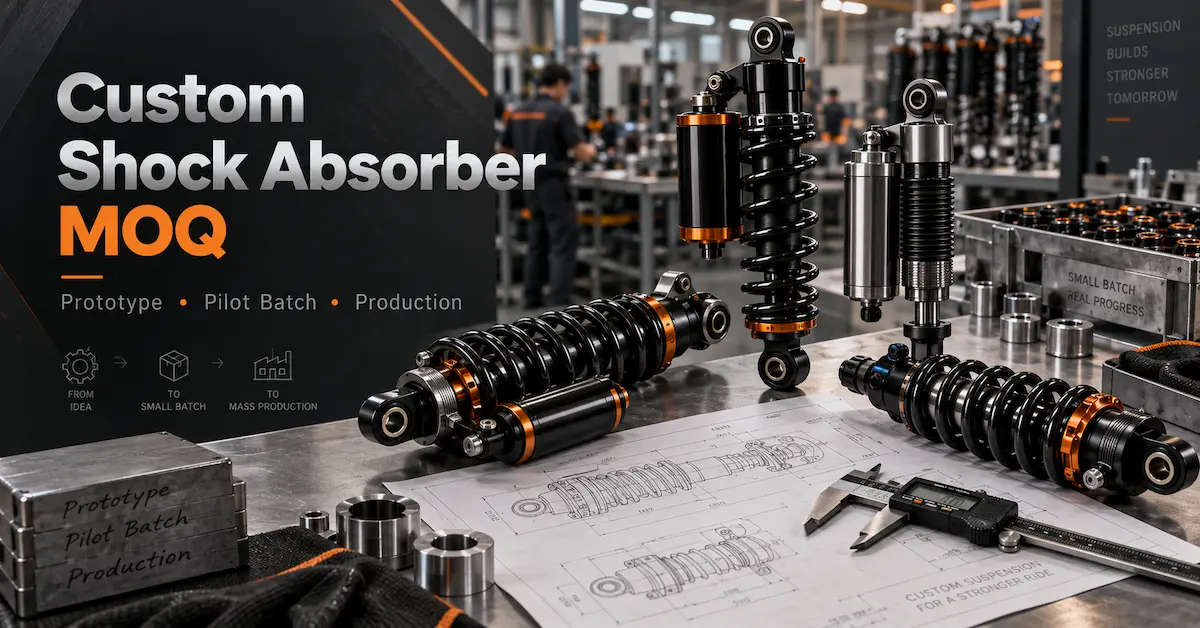
This is why buyers should distinguish:
Prototype Quantity
How many finished samples are needed?
Component Minimum
How many custom parts must be purchased or manufactured?
Pilot MOQ
What quantity is appropriate for production validation?
Production MOQ
What quantity applies after approval?
For additional context, review the custom shock absorber MOQ guide.
How Should You Compare Two Prototype Quotations?
Do not compare the final totals until you normalize the scope.
Quotation A may include only physical samples.
Quotation B may include engineering and testing.
Before comparing, confirm whether each quotation includes:
Drawing/CAD Review
Yes or no?
Sample Quantity
How many and which configurations?
Spring Development
Existing or custom?
Damping Development
Existing setting or new engineering?
Testing
Which tests?
Tooling
Included or separate?
Revision Rounds
Included or charged separately?
Branding
Standard or custom?
Shipping
Included or excluded?
Pilot Production
Included or quoted later?
The lowest number is meaningful only when the development scope is comparable.
What Should You Send BEDO for a Prototype Cost Review?
BEDO supports shock absorbers and suspension springs for custom projects and provides a path from technical development into small-batch and later production. Buyers can first review the company’s suspension product range and company information.
For a project-specific custom suspension prototype development cost, prepare:
- vehicle model/project;
- installation position;
- existing shock or sample;
- drawing or CAD where available;
- extended/compressed dimensions;
- stroke;
- mounting details;
- vehicle/rider/cargo loads;
- spring target;
- damping target;
- reservoir requirement;
- terrain;
- current suspension problem;
- prototype objective;
- required testing;
- prototype quantity;
- expected pilot quantity;
- expected production volume.
Then contact BEDO and request a stage-based quotation separating engineering, prototype, testing, tooling where applicable, revisions, pilot production, and recurring manufacturing cost.
Frequently Asked Questions
1. What Is a Normal Custom Suspension Prototype Development Cost?
There is no universal fixed amount supported by the available BEDO information. The cost depends on engineering depth, design complexity, sample quantity, springs, damping, components, testing, revisions, and production preparation.
2. Is Prototype Cost the Same as Sample Price?
Not always. A simple sample may represent an existing product, while prototype development can include engineering, drawings, new components, spring or damping changes, and testing.
3. Does CAD Work Increase Prototype Cost?
It can add engineering work, but CAD review can also reduce the risk of manufacturing incorrect geometry and needing another physical prototype.
4. Does Custom Spring Development Cost Extra?
It can. New spring specifications may involve engineering, sourcing, prototype components, and testing.
5. Does Custom Damping Increase the Cost?
It can because several compression or rebound configurations may need to be assembled, tested, and revised before approval.
6. Are Remote-Reservoir Prototypes More Complex?
They can require additional reservoir components, fittings, hoses, mounting, packaging analysis, and leakage checks compared with a simpler integrated shock architecture.
7. How Many Prototypes Should I Order?
The quantity should follow the validation plan. Fitment, spring comparison, damping development, durability testing, vehicle evaluation, and retained samples can require different quantities.
8. Is Testing Included in the Prototype Price?
Do not assume so. Ask the supplier to identify exactly which dimensional, damping, leakage, durability, load, or vehicle tests are included in the quotation.
9. Can Prototype Development Cost Be Reduced?
Yes, particularly by providing complete technical information, using existing validated components where suitable, controlling revisions, and avoiding unnecessary cosmetic customization during early engineering.
10. How Can I Get an Accurate BEDO Prototype Quote?
Provide the vehicle application, drawing or sample, dimensions, load conditions, spring and damping requirements, customization scope, validation requirements, prototype quantity, and future purchasing plan through BEDO Contact Us.
Conclusion
The custom suspension prototype development cost cannot be reduced to one meaningful universal price because the prototype is not simply a low-volume production shock. The budget can include engineering review, sample measurement, drawings and CAD, mounting development, spring selection, compression and rebound tuning, custom components, tooling or fixtures, physical prototypes, testing, revision rounds, and pilot-production preparation. A buyer adapting an existing platform will usually face a different development scope from a buyer creating a new long-travel, adjustable, reservoir-equipped vehicle-specific suspension system. The safest purchasing approach is to separate Engineering Cost → Prototype Cost → Validation Cost → Revision Cost → Pilot Cost → Production Cost before comparing suppliers. To obtain a project-specific quotation, contact BEDO with your vehicle data, drawings or physical sample, loads, spring/damping requirements, prototype objectives, testing scope, and expected future volume so the custom suspension prototype development cost can be evaluated against the actual work your project requires.