
What Affects the Lead Time for Custom Shock Absorber Development?
There is no reliable universal custom shock absorber development lead time that applies to every project. A buyer adapting an existing shock platform with a different spring may move through development very differently from an OEM creating new mounting geometry, spring characteristics, compression and rebound damping, remote-reservoir packaging, prototypes, and vehicle tests. BEDO’s shock absorber customization guidance therefore treats development timing as project-specific rather than publishing one fixed schedule for every customized product.
The most important factors are the completeness of buyer data, customization depth, availability of existing components, drawing and CAD readiness, new spring or damping requirements, tooling or fixture needs, prototype quantity, testing scope, engineering revisions, buyer approval speed, pilot-batch requirements, and preparation for repeat production.
For purchasing teams, the right question is not simply “How many days will this shock take?” A more useful question is: How long will requirement review, prototype preparation, testing, revisions, pilot production, and final production each require for this specific configuration?
Separate Development Lead Time Into Different Stages
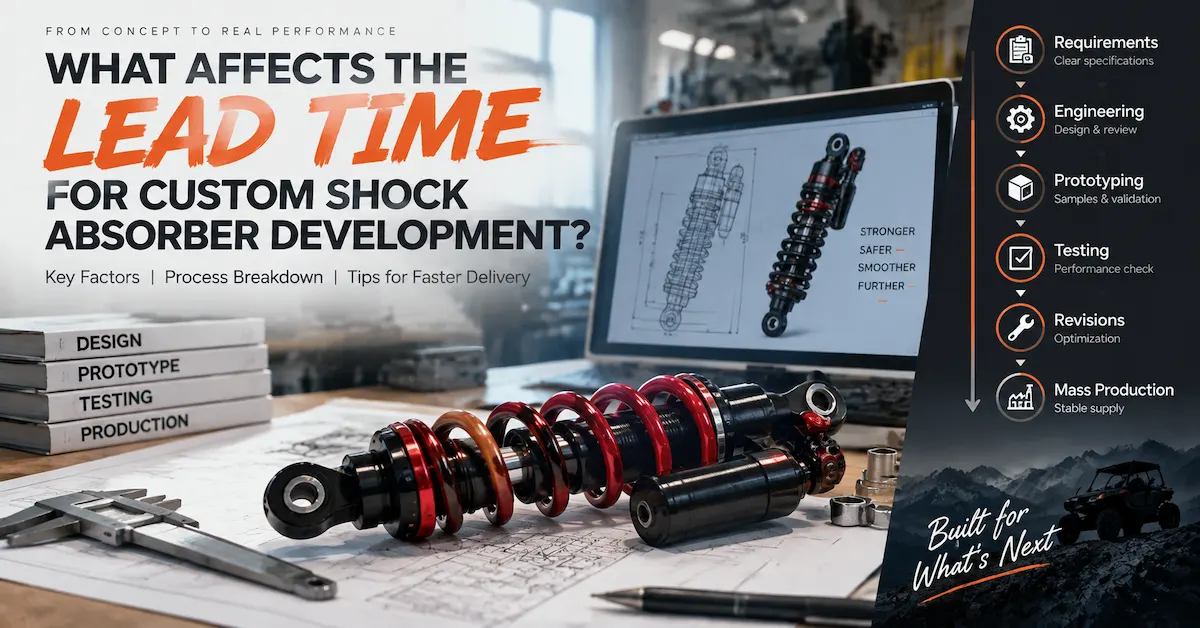
One headline delivery date can hide important schedule assumptions. BEDO’s shock absorber factory RFQ guide recommends separating prototype timing, engineering revision timing, and mass-production timing.
A practical project schedule can be divided as follows:
| Development Stage | Main Activity | Main Cause of Delay |
|---|---|---|
| Requirement review | Vehicle, load, dimensions, target performance | Missing buyer data |
| Engineering review | Drawing, CAD, sample, manufacturability | Unresolved geometry |
| Prototype preparation | Components, machining, spring, assembly | Custom parts or materials |
| Prototype validation | Fitment, damping, leakage, vehicle tests | Test scope and availability |
| Engineering revision | Correct dimensions, spring, damping, mounts | Number of changes |
| Pilot batch | Validate production repeatability | Process/component readiness |
| Production release | Freeze specification and QC plan | Open approval items |
| Mass production | Repeated manufacturing | Capacity and material planning |
A supplier should state which approval starts each stage. “30-day lead time,” for example, is ambiguous unless the buyer knows whether that period begins from the first inquiry, drawing approval, prototype approval, deposit, or final specification release.
1. Incomplete Vehicle and Application Data Creates the First Delay
Many schedule problems start before engineering actually begins. A buyer may send only a product photograph, approximate shock length, and vehicle model, then expect the factory to immediately produce a custom sample.
For a serious OEM development program, the supplier may need:
- vehicle type and platform;
- front or rear position;
- vehicle weight;
- rider/passenger load;
- cargo and accessory loads;
- extended and compressed shock dimensions;
- stroke;
- upper and lower mounting interfaces;
- spring information;
- current damping information;
- terrain;
- current suspension problem;
- desired performance change.
BEDO’s custom shock absorber development requirements guide states that more complete vehicle, geometry, load, operating-environment, performance, testing, and production information helps development move more efficiently from concept to prototype and production.
For buyers, preparing these inputs before requesting the final quotation can reduce repeated clarification cycles later.
2. Existing Platform or New Shock Architecture
Starting from an existing production platform can reduce the amount of work required to define every component from the beginning.
If BEDO already has a shock architecture suitable for the required mounting structure, dimensions, body size, and general application, engineering may only need to review selected changes such as:
- spring;
- damping;
- mounting dimensions;
- finish;
- branding.
A completely new product may require additional engineering for the shock body, rod, mounts, spring seats, reservoir system, internal components, bushings, sleeves, and manufacturing processes.
That difference directly affects custom shock absorber development lead time.
Buyers should therefore review the existing BEDO shock absorber product range before assuming that a clean-sheet design is necessary.
3. Drawing Quality and Revision Readiness
Development can move faster when the technical definition is controlled before sample manufacturing.
A useful drawing should establish important dimensions, mounting interfaces, stroke, product envelope, and revision status. When the drawing contains unclear dimensions or conflicts with the reference sample, engineering must stop and resolve the discrepancy.
BEDO’s custom suspension parts from drawings guide follows the sequence:
Customer Drawing → Engineering Review → Prototype → Testing → Approval → Production
This is preferable to manufacturing first and trying to resolve dimensional questions after the sample arrives.
Before prototype release, check:
- current drawing revision;
- measurement references;
- upper/lower mount dimensions;
- critical tolerances;
- unresolved supplier-proposal items;
- prototype status.
Every unconfirmed dimension has the potential to create another review or prototype cycle.
4. CAD and Suspension Geometry Review
CAD can add engineering work before sample production, but it can also prevent much larger physical delays.
Geometry-sensitive projects may require CAD review for:
- shock angle;
- hard points;
- control-arm movement;
- full bump;
- full droop;
- tire clearance;
- body clearance;
- reservoir placement;
- hose routing;
- adjuster access.
BEDO’s CAD-based suspension development guide explains why digital fitment and geometry review can identify problems before prototype manufacturing.
For long-travel, larger-tire, remote-reservoir, or new-platform projects, skipping CAD review to “save time” can create a longer total schedule if the first physical sample later reveals interference that could have been seen digitally.
5. Physical Sample Analysis Can Either Shorten or Extend the Project
A physical reference shock can accelerate product definition because engineers can measure mounting structures, body dimensions, spring packaging, and external architecture.
BEDO supports sample-based development through its custom shock absorber development process.
However, the sample can also create additional work if it is:
- worn;
- modified;
- leaking;
- missing sleeves or spacers;
- not confirmed for the exact target vehicle;
- different from the desired final performance.
The factory must determine which features should be reproduced and which should be changed.
A clean reference sample combined with vehicle data generally gives engineering more useful information than a sample sent without application context.
6. Custom Components and Material Availability
A project using existing components can move differently from one requiring new parts.
Potential custom items include:
- mounting eyes;
- clevises;
- bushings;
- sleeves;
- piston rods;
- seals;
- spring seats;
- reservoir fittings;
- hoses;
- brackets.
A newly designed component may require drawing review, raw-material preparation, machining setup, supplier coordination, inspection planning, or fixtures before the prototype can be assembled.
This means the complete shock may be waiting on one relatively small custom component.
When evaluating schedule risk, ask the factory:
Which component currently has the longest preparation time?
This often gives a more useful answer than asking only for the final shock lead time.
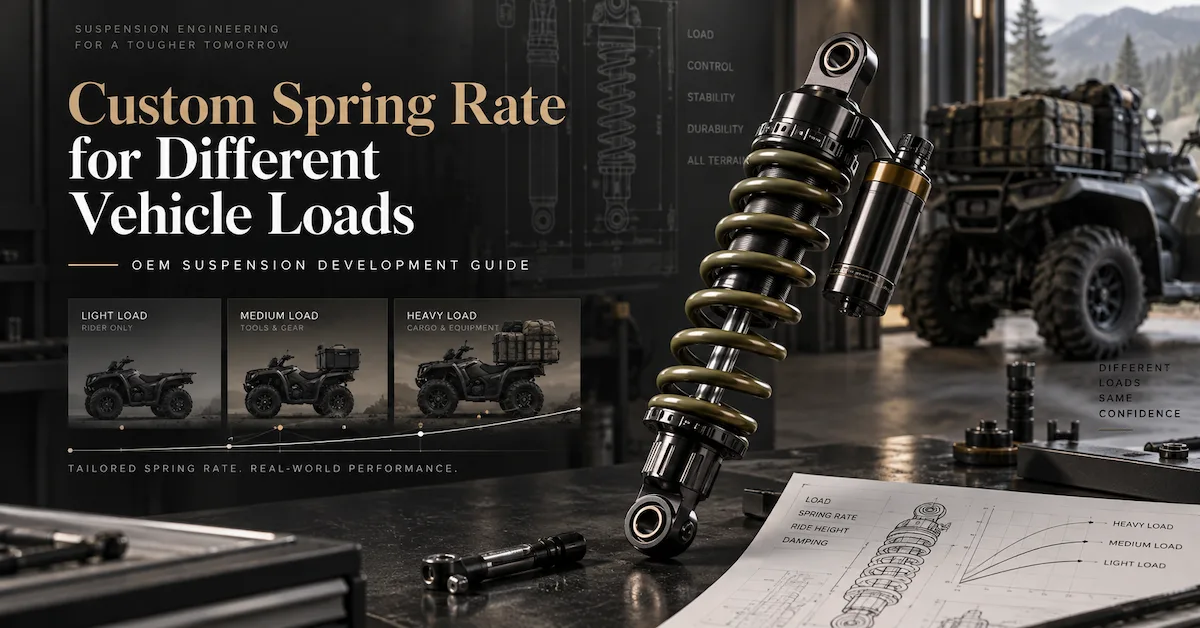
7. Custom Spring Development Can Add Another Engineering Cycle
If the existing spring is suitable, the prototype may use it as the starting configuration.
If the vehicle requires another spring rate, free length, coil geometry, preload range, or load behavior, spring development becomes another part of the schedule.
A custom spring project can involve:
Vehicle Load Data → Spring Proposal → Prototype Spring → Assembly → Sag/Load Evaluation → Revision if Required
BEDO’s custom coil spring OEM guide treats spring dimensions and vehicle requirements as engineering inputs rather than simple catalog choices.
Spring timing can also be affected by material preparation, prototype quantity, finish, and whether several spring versions are being evaluated.
For multi-load products, decide early whether the project needs one spring or several approved configurations.
8. Compression and Rebound Damping Development
Custom damping can add significant development time because its final value may only become clear after testing.
A typical process can involve:
Existing Baseline → Initial Damping Configuration → Prototype → Dyno/Functional Testing → Vehicle Evaluation → Feedback → Revision
If compression and rebound both require development, several prototype configurations may need comparison.
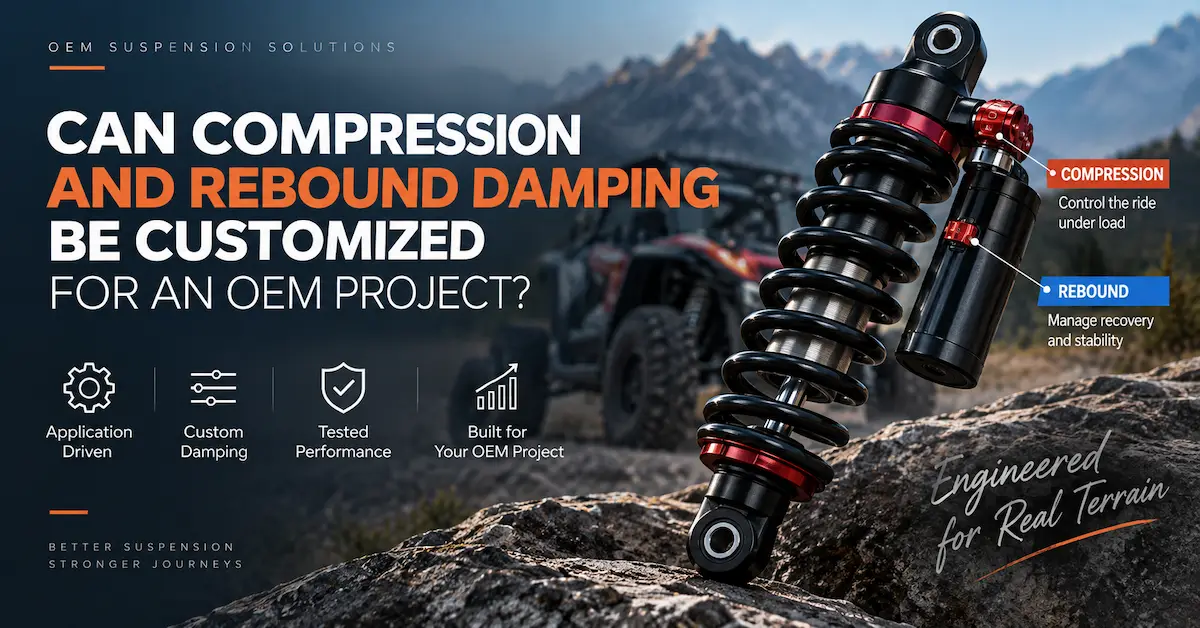
BEDO’s compression and rebound damping customization guide describes damping as an application-specific engineering variable tied to vehicle weight, spring, load, terrain, and performance objectives.
A buyer requesting “stronger damping” without a measurable target can lengthen the project because engineering first needs to define what problem is actually being solved.
9. Prototype Quantity and Prototype Complexity
One prototype does not suit every project.
The sample quantity can depend on whether the buyer needs:
- fitment validation;
- spring comparison;
- damping comparison;
- front/rear development;
- durability samples;
- vehicle-testing samples;
- retained references.
BEDO’s prototype shock absorber factory guide emphasizes that prototype requirements depend on the design, materials, custom components, spring requirements, manufacturing process, and future production plan.
A simple dimensional sample normally creates a different schedule from a program containing three spring versions and multiple damping configurations.
Define the purpose of every prototype before manufacturing starts.
10. Testing Scope Can Become a Major Schedule Driver
Testing should answer project-specific risks, but each additional validation activity can extend the development schedule.
Depending on the project, tests may include:
- dimensional inspection;
- fitment;
- compression and rebound testing;
- leakage;
- load evaluation;
- adjustment verification;
- durability;
- temperature-related evaluation;
- vehicle testing.
BEDO’s shock absorber testing guide separates these validation areas because not every product requires the same test program.
The development schedule should identify which testing occurs internally, which requires the buyer’s vehicle, and which depends on a third party or specific operating conditions.
Vehicle testing often becomes a schedule bottleneck when the physical prototype is ready but the buyer has not prepared the target vehicle or test environment.
11. Engineering Revisions Are Often the Largest Unknown
Prototype development exists because not everything can be predicted perfectly before physical testing.
A first prototype may reveal:
- incorrect mounting width;
- inadequate clearance;
- wrong spring support;
- unsuitable damping;
- reservoir interference;
- hose-routing problems;
- adjuster-access issues.
If the prototype must be revised, the project returns to engineering and manufacturing.
A controlled revision path is:
Issue Found → Engineering Review → Drawing/CAD Update → New Components → Revised Prototype → Retest
Every revision can affect the custom shock absorber development lead time.
For this reason, buyers should ask for both:
First Prototype Lead Time
and
Typical Revision Lead Time for This Project Scope
They are not the same scheduling question.
12. Buyer Feedback and Approval Speed Matter Too
Not every delay occurs inside the factory.
A prototype can be completed quickly and then remain waiting for buyer evaluation for weeks. The buyer may need to coordinate engineering, purchasing, vehicle testing, management approval, or end-customer feedback.
To reduce approval delays, establish before the sample arrives:
- who receives the prototype;
- who performs installation;
- what will be tested;
- what counts as approval;
- who can request changes;
- how feedback will be documented;
- when the final decision is expected.
Avoid feedback such as:
“It feels slightly wrong.”
A more useful response is:
“Rear sag is outside our approved range at the defined cargo condition; please review spring specification.”
Structured feedback makes the next engineering cycle easier.
Prototype, Revision, and Production Lead Time Must Be Quoted Separately
This is one of the most important procurement practices for custom suspension projects.
Ask the supplier for three different schedules:
Prototype Lead Time
The period required after the technical package is confirmed to produce the initial sample.
Engineering Revision Lead Time
The period required if spring, damping, dimensions, mounts, or another component must be modified after testing.
Production Lead Time
The period required after the approved technical configuration is released for manufacturing.
BEDO’s China shock absorber factory RFQ guide explicitly recommends separating these three timing stages.
This prevents a prototype estimate from accidentally being interpreted as the mass-production delivery schedule.
Pilot-Batch Production Adds Time but Reduces Scale-Up Risk
Moving directly from one approved prototype into a large commercial order may shorten the apparent schedule but increase manufacturing risk.
A pilot batch can check whether normal production consistently reproduces:
- dimensions;
- mounting interfaces;
- spring specification;
- damping;
- leakage control;
- finish;
- assembly;
- labeling;
- packaging.
BEDO’s low-volume shock absorber OEM guide positions small-batch production between prototype validation and larger-scale manufacturing.
For a new technical configuration, this stage can prevent a manufacturing problem from being discovered only after a large order has been completed.
Low-Volume Production and Mass Production Have Different Scheduling Logic
Prototype and small-batch manufacturing can involve more individual engineering attention.
Mass production depends more heavily on:
- confirmed components;
- purchased materials;
- production capacity;
- assembly planning;
- inspection planning;
- packaging availability.
A factory may be able to produce a few engineering samples relatively quickly while still needing a different planning window for a large production order.
This is why development and production timing should remain separate in the purchase plan.
Private-Label Packaging Can Delay an Otherwise Approved Shock
The technical shock may be ready while retail packaging is not.
Private-label requirements can include:
- logos;
- printed cartons;
- labels;
- barcodes;
- instructions;
- inserts;
- application information.
These materials may have their own supplier lead times and approval process.
For early engineering samples, consider whether full retail packaging is actually necessary.
A useful sequence can be:
Technical Prototype → Technical Approval → Branding Sample → Pilot Batch → Commercial Production
This prevents carton artwork from delaying a critical suspension test.
Surface Treatment Can Affect the Prototype Schedule
Custom anodizing, coating, plating, spring color, laser marking, or another special finish may require separate processing.
If the first prototype is primarily for geometry and vehicle performance, ask whether standard production finish can be used during early development.
Once the technical specification is stable, final appearance can then be approved on the pre-production version.
This approach is not appropriate when the finish itself affects fit, corrosion requirements, or another functional characteristic. In those cases, it belongs in the technical validation program.
Manufacturability Review Can Save Time Later
A geometrically correct shock is not automatically easy to produce consistently.
Before prototype or production release, review:
- machining access;
- tolerance realism;
- assembly sequence;
- special tooling;
- inspection feasibility;
- component sourcing.
BEDO’s suspension manufacturability review guide explains why DFM-related questions should be resolved before production rather than left to the workshop.
A small design change made early can sometimes avoid longer delays caused by difficult machining or repeated inspection problems later.
Incomplete Revision Control Can Create Hidden Delays
Even a technically correct project can lose time when different teams work from different revisions.
The buyer may approve Drawing Rev C while the prototype workshop still has Rev B.
To avoid this, control:
Project Code → Drawing Revision → CAD Revision → Spring Version → Damping Version → Prototype ID → Test Result
BEDO’s custom suspension development files guide recommends organizing drawings, CAD, samples, load data, test requirements, and commercial documents under clear revision control.
The goal is simple: everyone should know exactly which product is currently being developed.
What Information Helps BEDO Quote Lead Time More Accurately?
Do not ask for the final schedule using only a product photo.
Send the technical information that determines development complexity:
| RFQ Information | Why It Affects Timing |
|---|---|
| Vehicle application | Establishes use case |
| Front/rear position | Defines product role |
| Existing sample | Can provide structural reference |
| Drawings/CAD | Reduces dimensional uncertainty |
| Length/stroke/mounts | Defines fitment |
| Vehicle/load data | Supports spring development |
| Existing spring | Establishes baseline |
| Damping requirement | Defines tuning work |
| Terrain | Supports performance target |
| Reservoir requirement | Changes architecture |
| Testing scope | Determines validation stages |
| Prototype quantity | Determines sample work |
| Pilot requirement | Adds production-validation stage |
| Forecast volume | Supports production planning |
| Branding/packaging | Adds commercial preparation |
BEDO’s shock absorber factory RFQ questions and custom development requirements guide both emphasize detailed buyer inputs before the project schedule and quotation are finalized.
How Can Buyers Reduce Custom Shock Development Lead Time?
The safest way to shorten development is not to skip engineering steps. It is to remove avoidable uncertainty.
Provide Complete Requirements Early
Send the correct vehicle, load, dimensions, drawings, CAD, sample, terrain, and target behavior together.
Freeze Critical Geometry Before Prototype Manufacturing
Do not continue changing mounting dimensions after components are already being machined unless testing requires it.
Separate Technical and Cosmetic Approval
Validate fitment, spring, and damping before allowing packaging or color discussions to control the engineering schedule.
Prepare the Test Vehicle in Advance
Do not wait until the prototype arrives to locate the ATV, rider, load condition, or test environment.
Define Prototype Acceptance Criteria
Know what the prototype must prove before testing begins.
Return Structured Feedback Quickly
Use measurements, photos, load conditions, and test observations rather than subjective statements alone.
Plan a Pilot Batch in Advance
If pilot validation is required, include it in the original project schedule rather than adding it after prototype approval.
This approach can reduce wasted cycles without sacrificing technical validation.
Should You Choose the Supplier With the Shortest Quoted Lead Time?
Not automatically.
A very short quotation may exclude:
- engineering review;
- custom spring development;
- damping optimization;
- vehicle validation;
- revision work;
- pilot production.
Another supplier may quote a longer schedule because it includes these stages.
Before comparing timelines, normalize the project scope.
A useful comparison looks like:
| Timing Scope | Factory A | Factory B |
|---|---|---|
| Engineering review included | Yes/No | Yes/No |
| Drawing/CAD review | Included/Excluded | Included/Excluded |
| Prototype configuration | Same? | Same? |
| Spring development | Included? | Included? |
| Damping development | Included? | Included? |
| Testing | Which tests? | Which tests? |
| Revision allowance | Defined? | Defined? |
| Pilot batch | Included? | Included? |
| Production lead time | Defined? | Defined? |
Only after the scope is equivalent should the headline lead times be compared.
Frequently Asked Questions
1. How Long Does Custom Shock Absorber Development Take?
There is no universal schedule. BEDO states that development time depends on project complexity, available engineering data, new components, prototype requirements, testing, revisions, and manufacturing preparation. Exact timing should be confirmed after technical review.
2. What Usually Causes the Biggest Development Delay?
Common causes include incomplete vehicle data, unresolved drawings, new components, custom spring or damping development, prototype revisions, testing availability, and slow buyer approval.
3. Can a Physical Sample Shorten Development Time?
It can provide a useful dimensional and structural starting point, but the buyer should still provide application and performance requirements. A worn or modified sample may require additional review.
4. Does CAD Make Custom Shock Development Faster?
CAD review adds work before physical sampling but can identify geometry and clearance problems digitally, potentially reducing avoidable prototype revisions.
5. Does Custom Spring Development Increase Lead Time?
It can, particularly when a new spring specification, prototype spring, load validation, or several candidate spring rates are required.
6. Does Custom Damping Increase Lead Time?
It can because compression and rebound configurations may require prototype assembly, testing, vehicle feedback, and revisions before the final setup is approved.
7. Is Prototype Lead Time the Same as Production Lead Time?
No. Prototype preparation, engineering revisions, pilot production, and mass production should be scheduled separately.
8. Can a Pilot Batch Delay Mass Production?
It adds a validation stage, but it can reduce the risk of discovering production-consistency problems after a much larger order has already been manufactured.
9. How Can I Get a More Accurate Lead-Time Quote From BEDO?
Provide the vehicle, drawings or sample, dimensions, spring/damping requirements, load data, terrain, prototype quantity, testing scope, pilot requirement, branding needs, and production forecast.
10. What Is the Best Way to Shorten the Project Without Increasing Risk?
Prepare complete engineering data, freeze critical requirements before sample manufacturing, define the test plan early, make the test vehicle available, respond quickly with measurable feedback, and control drawing revisions throughout the project.
Conclusion
The custom shock absorber development lead time is determined by the complete engineering and validation path rather than a single manufacturing date. Requirement completeness, existing versus new architecture, drawings and CAD, custom components, spring and damping development, prototype quantity, testing, engineering revisions, buyer feedback, pilot production, finishes, packaging, and production preparation can all affect the schedule. The safest planning method is Requirement Review → Engineering Confirmation → Prototype → Testing → Revision → Approval → Pilot Batch → Production Release → Mass Production, with timing quoted separately for each major stage. BEDO supports custom shock absorber development from drawings, CAD files, physical samples, vehicle requirements, prototypes, testing, and low-volume validation. To receive a project-specific schedule, contact BEDO with your vehicle application, drawings or sample, dimensions, load information, spring and damping requirements, prototype quantity, testing scope, pilot-batch needs, and expected production volume so the actual custom shock absorber development lead time can be evaluated before the project starts.