
What Is the MOQ for Custom Shock Absorbers From a China Factory?
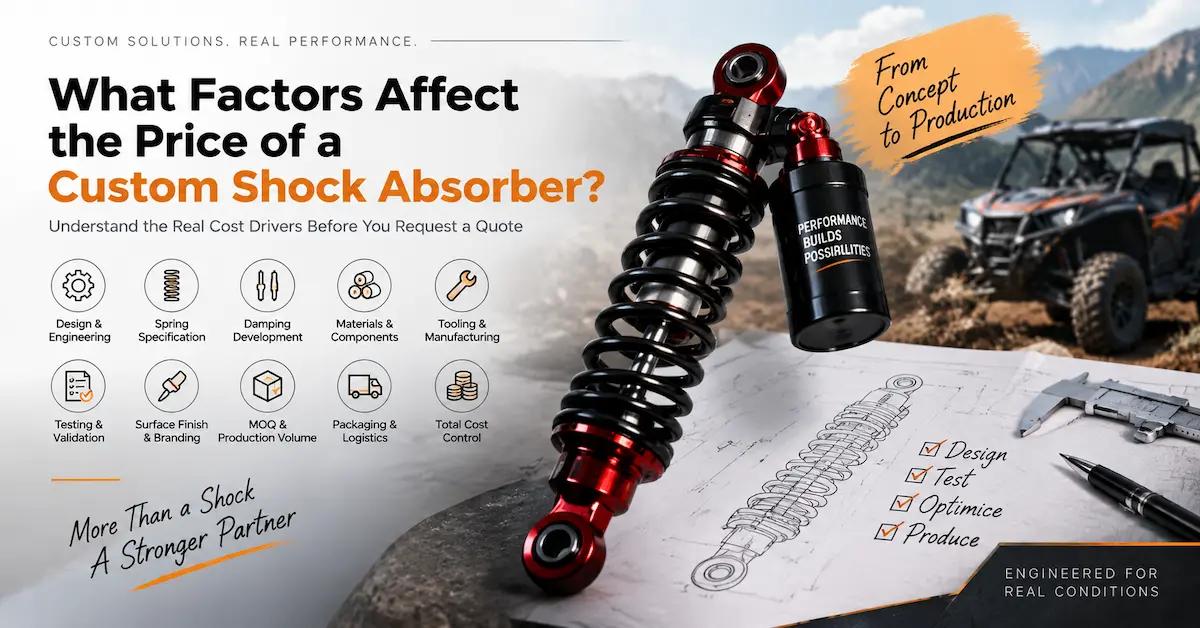
There is no single universal custom shock absorber MOQ that applies to every China factory or every custom project. The quantity can change according to whether the buyer is selecting an existing shock platform, changing only branding, modifying the spring or damping specification, introducing new mounting dimensions, requesting a new reservoir configuration, or developing a completely new vehicle-specific product. BEDO’s current custom-development material explicitly states that custom and low-volume suspension projects can begin with prototypes or small batches, while the applicable MOQ depends on the design, customized components, materials, spring requirements, and manufacturing process rather than one fixed quantity.
For an OEM buyer, the more useful question is therefore not simply, “What is your minimum order?” It is: What is the minimum quantity for this exact technical configuration at the prototype, pilot, and repeat-production stages? Those three quantities can be different, and separating them can significantly reduce purchasing risk.
Why a Factory Cannot Quote One MOQ for Every Custom Shock
A catalog shock using existing components is very different from a new shock requiring a special spring, unique mounting eye, dedicated machining, new valving, surface treatment, reservoir hardware, or branded packaging. BEDO’s custom suspension low MOQ guide identifies custom dimensions, damping, spring matching, appearance, prototypes, and small-batch manufacturing as separate parts of low-volume suspension development. BEDO’s customization content also states that MOQ can depend on new custom components, material sourcing, spring requirements, machining, surface treatment, assembly, and packaging.
A buyer should therefore expect the supplier to review the specification before confirming the final custom shock absorber MOQ. A factory that immediately promises the same low quantity for every design without reviewing drawings, components, spring requirements, or future volume may be giving only a preliminary sales answer rather than a production-ready quotation.
Separate Prototype Quantity, Pilot-Batch Quantity, and Production MOQ
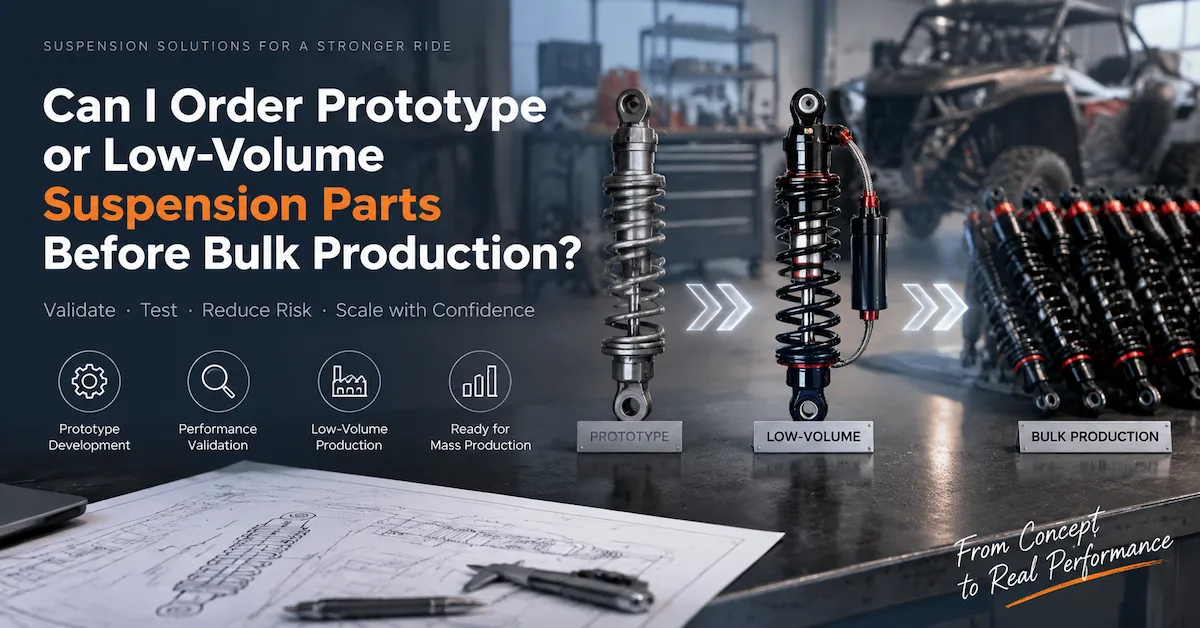
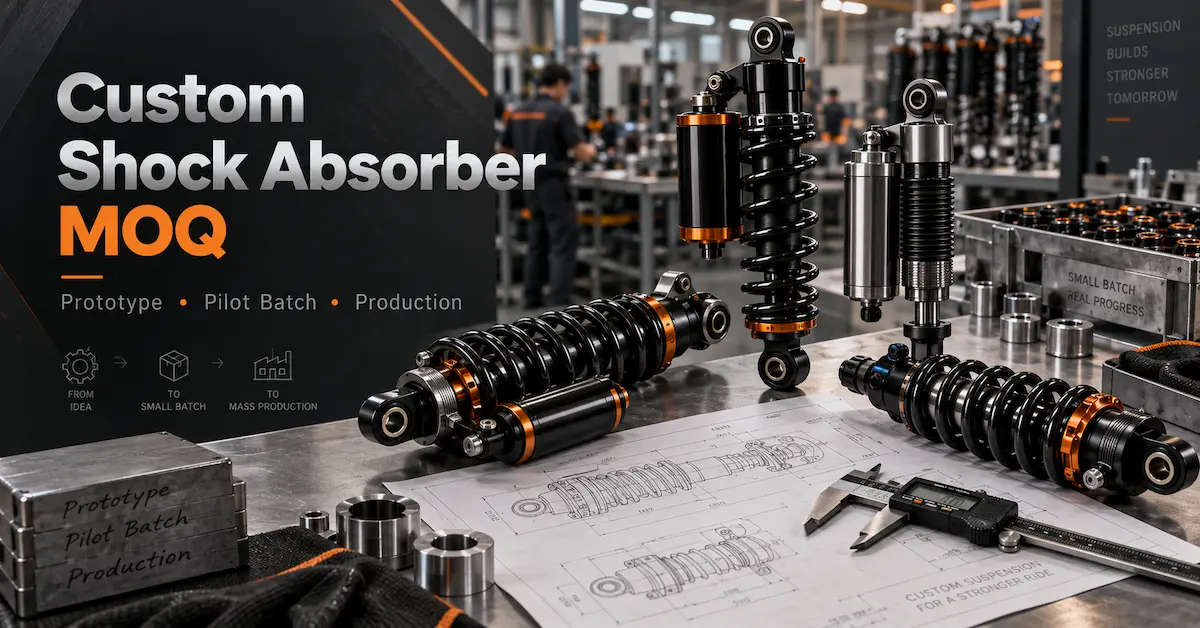
The biggest mistake in MOQ discussions is treating all project stages as one order. BEDO’s RFQ guidance specifically recommends asking separately about prototype quantity, pilot-batch quantity, and production MOQ because each stage solves a different problem.
| Order stage | Main purpose | Buyer decision |
|---|---|---|
| Prototype | Verify design, fitment, spring, damping, and application | Does the engineering solution work? |
| Revised prototype | Confirm changes after first testing | Are the revisions correct? |
| Pilot / small batch | Validate manufacturing repeatability | Can the factory reproduce the approved product? |
| Initial commercial order | Launch a sellable product | Is inventory risk acceptable? |
| Repeat production | Maintain stable supply | Can the supplier reproduce the approved version efficiently? |
BEDO’s low-volume shock absorber OEM guide uses the same progression: prototype development, testing and optimization, controlled small-batch production, and then larger OEM production.
This staged structure is particularly useful for startups, specialty vehicle builders, ATV aftermarket brands, and private-label distributors because it avoids committing to commercial inventory before the technical product has been validated.
Existing Shock Platforms Usually Allow Greater Quantity Flexibility
If the project can start from an existing shock architecture, the factory may already have relevant body components, mounting hardware, seals, machining programs, spring seats, and assembly processes. Customization may then focus on a smaller number of variables such as spring configuration, damping, finish, logo, or packaging.
For buyers, this can reduce development complexity compared with a completely new shock design. BEDO’s shock absorber customization company guide distinguishes between branding-only customization, existing-platform modification, and deeper engineering development, and it recommends technical review before final MOQ confirmation.
However, do not assume that using an existing platform automatically guarantees the lowest MOQ. A special spring, unique color, non-standard mounting component, or dedicated retail carton can still create its own sourcing minimum.
A New Mounting Design Can Change MOQ
Changing the extended length or damping setting is not the same as introducing a completely new upper or lower mounting structure. If the project requires new clevises, mounting eyes, sleeves, bushings, brackets, or other machined components, the factory may need dedicated machining, fixtures, material purchasing, or supplier coordination.
That can affect minimum order quantity even when the total shock volume is relatively small.
Before requesting a quotation, send the mounting dimensions, installation drawings, reference sample, and vehicle application. BEDO’s ATV suspension RFQ guide recommends combining vehicle identification, shock dimensions, mounting interfaces, original sample or drawing, loads, customization requirements, sample quantity, and future production forecast in one RFQ package.
Custom Springs Can Have Their Own MOQ
Spring customization is another reason why one shock-absorber MOQ number can be misleading. A custom shock may use an existing body but require a new spring rate, free length, diameter, coil design, or finish.
The factory therefore needs to consider not only the number of complete shocks but also the sourcing and manufacturing requirements of the spring.
BEDO’s low-volume guidance lists spring rate, wire diameter, coil length/design, and color among customizable spring characteristics.
When discussing MOQ, ask:
- Is the spring an existing specification or a new development?
- Does the spring supplier have a separate minimum?
- Does each spring rate require its own quantity?
- Can several shock variants share one spring?
- Does color or surface treatment create another minimum?
- Can unused spring components be carried into future orders?
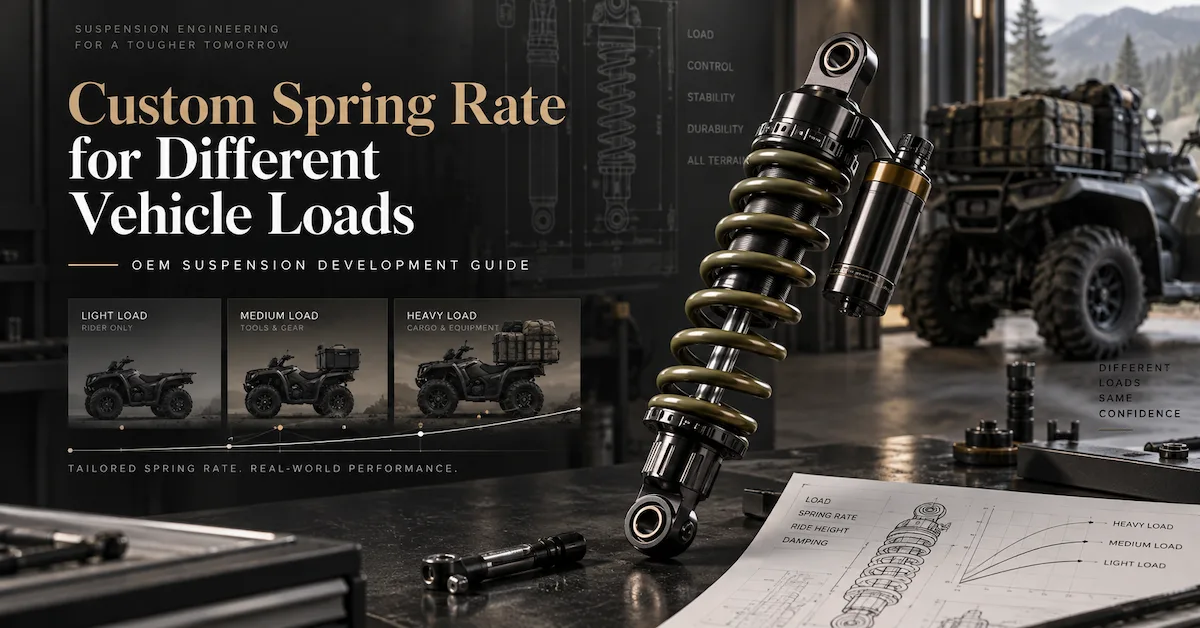
These questions matter when one shock platform will be sold for several rider weights or vehicle loads.
Damping Customization Does Not Necessarily Use the Same MOQ as Branding
Changing a logo and changing the hydraulic specification are fundamentally different projects. A branding-only program may use an already validated product, while new compression or rebound damping can require engineering, prototype assembly, dyno evaluation, vehicle testing, and another approval cycle.
BEDO’s custom shock material states that compression and rebound damping can be modified on suitable shock designs and that the required characteristics should be based on the target vehicle and confirmed through physical testing.
For purchasing, separate:
Branding MOQ – quantity associated with logo, label, packaging, or color.
Technical MOQ – quantity associated with the physical shock configuration.
Development quantity – prototypes needed to establish the technical version.
Production MOQ – quantity required once that version is approved.
This avoids a common situation in which a buyer sees “low MOQ” but later discovers that the technical configuration and custom packaging have separate minimums.
Surface Treatment and Color Can Affect Small-Batch Economics
A custom finish can differentiate a private-label product, but it can also add another batch-dependent process. Anodizing, coating, plating, spring color, laser marking, or another finish may require a minimum processing lot or incur a setup charge when quantities are small.
BEDO’s customization content lists surface treatment, color, and branding among the variables that can affect project scope and cost.
A good RFQ should therefore ask whether the factory can:
- process very small color batches;
- combine components with another production lot;
- charge a setup fee instead of increasing MOQ;
- maintain the same appearance on later repeat orders;
- document the approved finish for future batches.
The cheapest launch strategy may be to validate the technical shock first using a standard finish and finalize custom appearance after the engineering configuration is stable.
Tooling and Fixtures Can Change the Commercial Equation
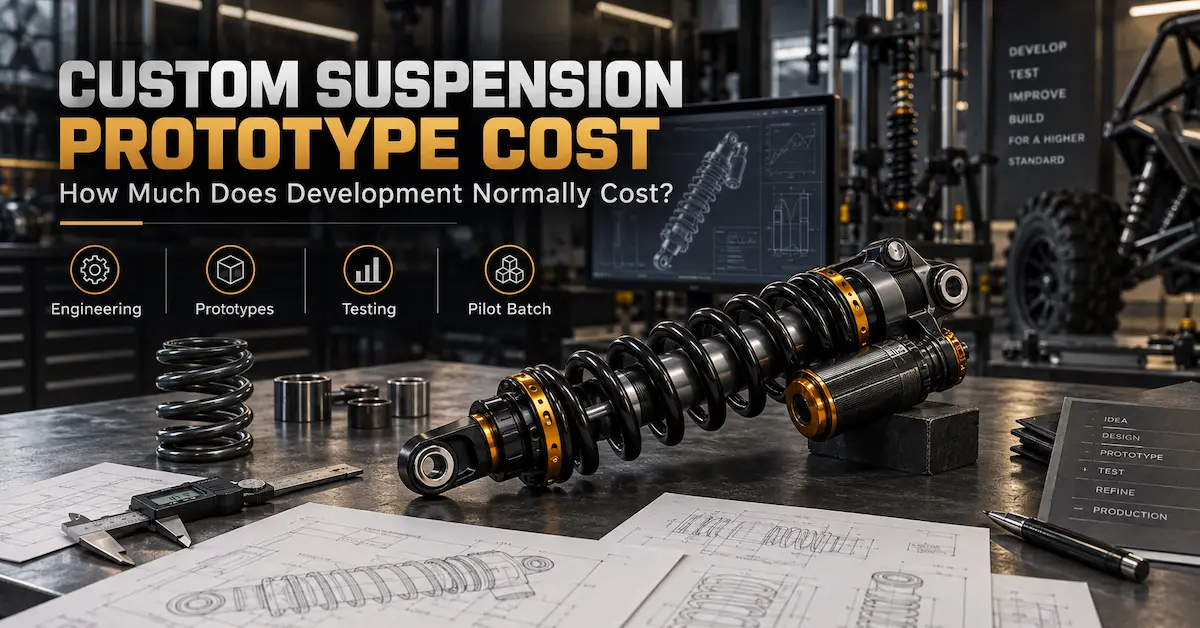
A project that needs new tooling, machining fixtures, gauges, or specialized assembly equipment may still be feasible in low volume, but the buyer needs to know how those one-time costs are handled.
Rather than asking only for unit price and MOQ, request a quotation that separates:
| Cost area | Buyer should clarify |
|---|---|
| Engineering | Is technical development charged separately? |
| Prototype | What is included in sample pricing? |
| Tooling/fixtures | Is there a one-time charge? |
| Testing | Which validation work is included? |
| Custom components | Do they have separate minimum quantities? |
| Production unit | Price after specification approval |
| Branding | Logo, finish and packaging cost |
| Repeat order | Does pricing or MOQ change later? |
BEDO’s RFQ content similarly recommends asking whether quotations include prototypes, engineering, tooling, testing, custom springs, surface finishes, and other project-specific costs instead of comparing unit prices alone.
Material Sourcing Is Another MOQ Driver
Low-volume manufacturing does not eliminate upstream material requirements. A factory may be flexible in final shock assembly but still depend on minimum purchasing quantities for specially sized tubing, unique spring wire, seals, custom bushings, reservoir components, or other non-standard items.
This is one reason BEDO states that MOQ can depend on material sourcing and customized components.
OEM buyers should ask whether a high MOQ is being driven by:
- the final assembly process;
- a specific purchased component;
- raw material;
- surface treatment;
- custom packaging;
- external supplier requirements.
Once the cause is known, engineering may be able to adjust the design to use an existing component without compromising the actual performance target.
Packaging Can Create a Different Minimum From the Shock Itself
Private-label buyers frequently focus on suspension engineering but overlook packaging MOQ. Custom printed boxes, molded inserts, labels, manuals, barcodes, and other retail materials can have minimum quantities independent of the shock absorber.
For a market-validation launch, ask whether the supplier can use:
- neutral cartons plus branded labels;
- standard protective packaging;
- digital labels for pilot quantities;
- custom printed packaging only after larger production begins.
This allows the first small batch to focus on product validation rather than forcing a high packaging investment before sales demand is proven.
BEDO’s private-label ATV suspension content treats technical product approval and branding/packaging approval as related but separate decisions.
How Does MOQ Change Between Existing, Modified, and New Designs?
The following table is a purchasing framework, not a BEDO quotation or fixed industry MOQ.
| Project type | Typical development complexity | Main MOQ drivers |
|---|---|---|
| Existing validated model | Lower | Packaging, finish, inventory planning |
| Existing model + branding | Low to moderate | Color, logo, packaging |
| Existing model + new spring | Moderate | Spring sourcing and validation |
| Existing model + damping change | Moderate | Engineering, prototype, testing |
| New mounting dimensions | Higher | Machining, components, fixtures |
| New reservoir architecture | Higher | Reservoir, fittings, hose, assembly |
| New vehicle-specific shock | Highest | Engineering, components, prototype, testing, manufacturing setup |
The key point is that custom shock absorber MOQ should follow project complexity, not the marketing label “OEM” or “custom.”
Low MOQ Does Not Mean Skipping Engineering Validation
A very small production quantity is useful only if the resulting shock is technically correct. BEDO’s Custom Suspension Low MOQ Guide still includes requirement analysis, technical evaluation, prototype development, controlled low-MOQ production, and scale-up support. It also lists dimensional inspection, performance testing, leakage testing, and final inspection as quality-control areas for low-volume projects.
For buyers, that means a low-MOQ supplier should not be evaluated only on quantity flexibility. It should also be able to explain how a small order will receive appropriate drawing control, assembly, testing, and inspection.
Prototype Quantity Should Be Driven by the Validation Plan
There is no useful universal answer such as “every custom shock project needs two samples.” The appropriate number depends on what the prototype must prove.
A project may need samples for:
- installation checking;
- left/right or front/rear configurations;
- spring comparison;
- damping comparison;
- durability testing;
- vehicle testing;
- retained reference samples;
- customer approval.
BEDO’s Prototype Shock Absorber Factory Guide states that MOQ for custom prototype shocks is project-specific and depends on shock design, materials, custom components, spring requirements, manufacturing processes, and future production plans.
The buyer should define the test plan first, then request the prototype quantity needed to execute it.
Pilot-Batch MOQ Should Validate Manufacturing, Not Just Create Inventory
The pilot batch serves a different purpose from the engineering prototype. Its job is to determine whether production can reproduce the approved specification.
Potential checks include:
- dimensional consistency;
- assembly repeatability;
- spring version control;
- damping consistency;
- leakage;
- finish consistency;
- labels;
- packaging;
- batch traceability.
BEDO’s customization workflow describes small-batch production as a way to confirm assembly, appearance, dimensional consistency, performance consistency, packaging, and customer approval before scaling into larger OEM production.
Therefore, an unusually large “pilot MOQ” deserves a follow-up question: Which manufacturing requirement makes that quantity necessary?
Production MOQ Should Match the Buyer’s Reorder Pattern
A supplier suitable for a first order may not automatically be suitable for long-term replenishment. Distributors selling many ATV models can have high total annual volume while ordering relatively few units of each individual SKU.
BEDO’s ATV shock absorber supplier selection guide recommends quoting the expected product mix and separating prototype, launch, and replenishment quantities rather than evaluating one high-volume SKU alone.
Ask whether MOQ applies:
- per shock model;
- per spring specification;
- per damping configuration;
- per color;
- per packaging version;
- per purchase order;
- or across combined models.
This distinction can have more impact on inventory than the headline MOQ itself.
A Very Low MOQ Can Still Be Expensive Per Unit
Small batches may reduce total inventory investment but increase the unit cost because engineering, setup, sourcing, testing, and production preparation are distributed across fewer products.
The buyer should therefore evaluate both:
Minimum cash commitment
and
cost per approved sellable unit.
A 20-unit batch at a higher unit price may be commercially safer than 200 units at a lower price if the product has not yet been validated in the market. Conversely, continuing indefinitely with prototype-level purchasing can become expensive after demand is established.
The best production plan allows the commercial quantity to grow after the design and market are proven.
Ask Whether MOQ Can Drop on Repeat Orders
The first production order may involve setup or component purchasing that later orders do not. Ask whether repeat-order MOQ can change once the design is stable, components have been standardized, or packaging is already available.
Also ask whether the supplier can retain:
- special components;
- packaging;
- springs;
- tooling;
- fixtures;
- approved setup data.
Do not assume the answer. Storage, ownership, and reuse conditions should be confirmed project by project.
This is especially important for seasonal ATV or specialty-vehicle products where replenishment may be smaller than the initial launch order.
Do Not Negotiate MOQ Before Freezing the Product Scope
A buyer cannot effectively negotiate custom shock absorber MOQ when the supplier still does not know whether the project requires a standard shock with a logo or a completely new hydraulic architecture.
Before the commercial discussion becomes final, define:
- vehicle application;
- shock position;
- dimensions;
- mounting interfaces;
- spring requirement;
- damping requirement;
- reservoir architecture;
- materials/finish;
- validation;
- branding/packaging;
- prototype quantity;
- forecast volume.
BEDO’s ATV Suspension RFQ Data Checklist is useful for organizing these inputs before requesting a final quotation.
What Should a China Shock Absorber Factory Explain in Its MOQ Quote?
A useful response should tell the buyer why the minimum exists.
Ask the supplier to state:
| MOQ question | Useful supplier answer |
|---|---|
| Prototype minimum | Quantity required for defined validation |
| Pilot minimum | Quantity required to verify manufacturing |
| Production minimum | Quantity for stable repeat production |
| Main MOQ driver | Component, material, process, finish, packaging, etc. |
| Mixed-model policy | Whether several SKUs can share an order |
| Repeat-order MOQ | Whether it differs after first production |
| Tooling requirement | Whether setup/tooling creates a one-time cost |
| Component leftovers | Ownership/use of unused custom components |
| Scaling plan | How pricing and capacity change at higher volume |
This turns MOQ from an arbitrary sales number into a supply-chain decision.
How BEDO Approaches Low-Volume Custom Shock Projects
BEDO currently states that it supports custom shock absorber development from prototypes through small-batch manufacturing and larger OEM production. Its low-volume shock absorber OEM guide covers ATV, UTV, motorcycle, golf-cart, utility-vehicle, EV, and specialty applications and includes custom dimensions, damping settings, spring configurations, structural design, and branding.
BEDO does not publish one universal quantity that should be treated as the MOQ for every custom shock absorber project. Its newer customization content explicitly states that the applicable quantity depends on the design, customization, materials, components, spring requirements, and manufacturing process.
For buyers, that is the correct way to approach the question: submit the technical project first, then obtain a stage-specific commercial proposal.
Frequently Asked Questions
1. What Is the Standard MOQ for Custom Shock Absorbers?
There is no universal standard MOQ. The quantity can depend on whether the project uses existing components, custom springs, new damping, machining, special materials, finishes, tooling, or packaging. BEDO confirms MOQ on a project-specific basis.
2. Can Custom Shock Absorbers Be Ordered in Small Quantities?
Yes, when the manufacturer supports low-volume development. BEDO states that custom suspension projects can begin with prototypes and small batches before scaling into OEM production.
3. Is Prototype MOQ the Same as Production MOQ?
No. Prototype quantity supports engineering validation, while production MOQ is associated with repeat manufacturing. A pilot batch can sit between these two stages.
4. Does a Custom Spring Increase MOQ?
It can. A unique spring may have its own material, manufacturing, finishing, or supplier requirements. Confirm the spring quantity separately from the complete shock quantity.
5. Does Custom Damping Increase MOQ?
It may increase development work or require dedicated components and validation. Whether it changes production MOQ depends on the shock architecture and the components needed for that damping specification.
6. Can Different Shock Models Be Combined to Reach MOQ?
Possibly, but this must be confirmed with the supplier. Ask whether MOQ applies per model, technical configuration, spring, finish, packaging variant, or combined purchase order.
7. Does Private-Label Packaging Have a Separate MOQ?
It can. Printed cartons, labels, inserts, and manuals can have independent supplier minimums. For small launches, ask whether standard packaging plus custom labels is available.
8. Is a Very Low MOQ Always Better?
No. Evaluate engineering support, quality control, testing, repeat-order capability, and total project cost. An extremely low minimum has little value if the product cannot be reproduced consistently later.
9. What Information Should I Send Before Asking for MOQ?
Provide vehicle application, shock position, drawings or sample, dimensions, spring and damping requirements, customization, testing needs, prototype quantity, launch quantity, and future production forecast. BEDO’s RFQ data guide provides a related checklist.
10. What Is BEDO’s Custom Shock Absorber MOQ?
BEDO supports prototype and low-volume custom projects but does not state one universal MOQ for every custom shock. The applicable quantity is confirmed after reviewing the design, components, spring requirements, customization, manufacturing process, and future production plan. Buyers can submit the project through BEDO Contact Us.
Conclusion
The correct answer to custom shock absorber MOQ is not one generic quantity. A China factory should evaluate the technical and commercial scope first: whether the project uses an existing platform or new architecture, which components are customized, whether a new spring or damping configuration is required, what finishing and packaging are involved, and whether tooling or special materials are needed. Buyers should then separate prototype quantity → pilot-batch quantity → initial commercial MOQ → repeat-order MOQ, because each stage solves a different development or supply problem. BEDO supports prototypes, low-volume custom shock absorber development, small-batch validation, and later OEM production rather than presenting one fixed minimum for every design. To obtain a project-specific quantity and quotation, contact BEDO with your vehicle application, drawings or reference sample, dimensions, spring/damping requirements, customization needs, prototype plan, and expected future volume so the appropriate custom shock absorber MOQ can be determined before you commit to inventory.