
What should an OEM buyer expect from a suspension parts development company?
Direct answer: a suspension parts development company should turn a vehicle requirement, sample, or drawing into a controlled set of suspension components that work together and can be validated, released, and reproduced. The company should manage the interfaces between shocks, springs, ball joints, bushings, sleeves, brackets, and hardware, while clearly separating buyer requirements, supplier proposals, test evidence, and open decisions.
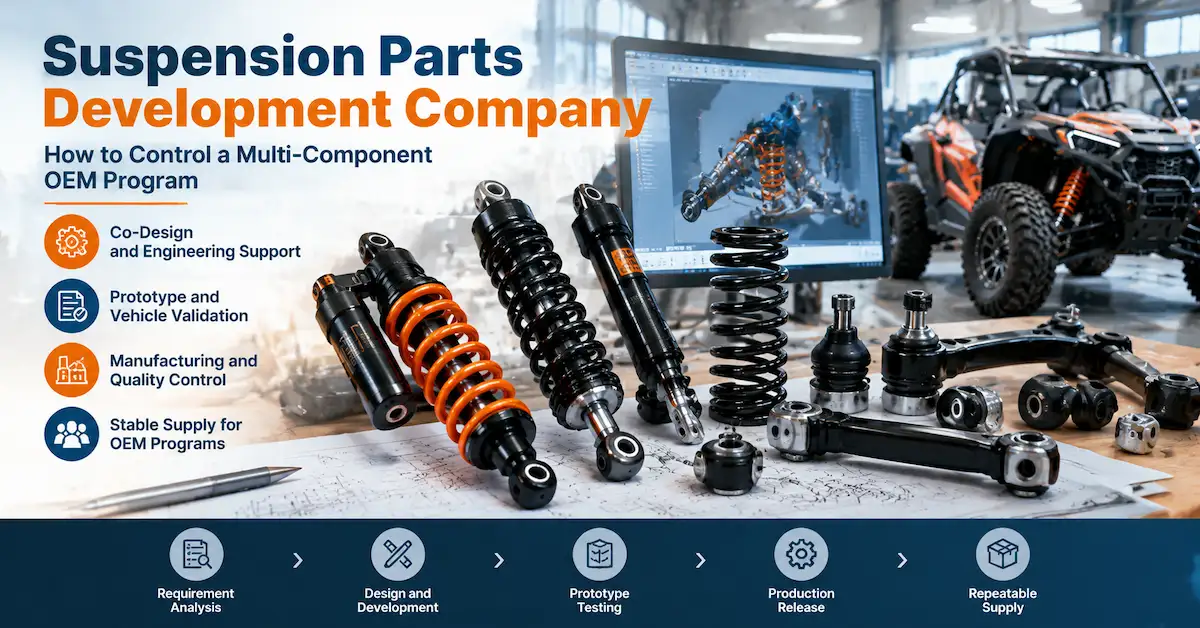
The development partner is valuable when the project is more complex than selecting a standard part. It should help define the engineering inputs, review CAD or samples, propose manufacturable changes, document prototypes, coordinate vehicle validation, prepare a pilot release, and carry the approved revision into production. A good partner reduces ambiguity between engineering, purchasing, quality, and assembly rather than adding another unstructured communication channel.
This article is for vehicle OEMs, ATV and UTV brands, motorcycle companies, aftermarket suspension brands, special-vehicle developers, distributors, and procurement engineers searching for a suspension parts development company. Its unique question is how to evaluate a development partner for a multi-component program from first input to repeat production. It is not a generic guide to choosing one shock by length.
Define the development partner's role before the project starts
Many suspension projects fail because the buyer and supplier assume different responsibilities. The buyer may expect a complete suspension system while the supplier believes it is quoting a shock assembly. The buyer may send a sample and expect reverse engineering while the supplier assumes the sample is an approved drawing. Put the role in writing before comparing companies.
| Development role | Typical responsibility | Decision the buyer must control |
|---|---|---|
| Requirement owner | Vehicle identity, load states, geometry, market, environment, and performance target. | Which requirements are mandatory, estimated, or still open. |
| Component developer | Shock, spring, ball joint, bushing, sleeve, or hardware proposal within the approved envelope. | Which proposed values become released specifications. |
| System interface owner | Compatibility between suspension components, brackets, wheel travel, and vehicle structure. | Who approves the assembled interface and full-travel result. |
| Validation coordinator | Bench checks, vehicle test plan, route, load states, measurements, and issue tracking. | Acceptance criteria and release decision. |
| Manufacturing transfer owner | Drawing, BOM, inspection plan, pilot, packaging, label, and change control. | What evidence is required before production ordering. |
| Commercial owner | Sample, MOQ, lead time, tooling, price, packaging, and after-sales terms. | Which terms are included, excluded, or subject to project confirmation. |
A company may perform several roles, but the project should still name the owner of each decision. If the buyer controls vehicle geometry and the development company proposes the damper, the interface review must be shared. If a separate supplier makes the spring, the spring-to-shock relationship needs an approval route. A single contact person cannot replace a responsibility matrix.
Start with a vehicle-level development brief
Vehicle and application identity
Record platform code, model year, market, front or rear position, left and right requirement, wheel and tire, number of passengers, drive layout, fuel or battery state, and whether the project is OEM, replacement, upgrade, or private label. Include the final modification list for an aftermarket or special-vehicle project. The development company should know which vehicle revision is being designed around.
State the customer's use rather than only the vehicle label. A farm ATV, recreational ATV, utility UTV, electric platform, motorcycle, buggy, and fleet vehicle may share a product family while having different load states, duty cycles, and expectations. The brief should explain the route, surface, speed, temperature, water, mud, dust, salt, wash-down, storage, and service environment.
Load cases and motion targets
Provide curb, normal, and maximum intended routine mass, front and rear axle loads, passengers, cargo, accessories, towing or trailer tongue load, and weight distribution. Add ride-height window, sag target, wheel travel, bottoming reserve, rebound behavior, comfort, handling, and noise expectations. Avoid using "heavy duty" as the only performance description.
Spring support and damping control different parts of the response. The spring establishes load support and ride-height behavior; the damper controls movement. The development brief should not ask for a stronger shock while leaving the spring and axle loads undefined. A supplier can propose a configuration, but the buyer still needs to approve the assumptions and vehicle-level result.
Geometry and interfaces
Measure or draw extended length, compressed length, effective stroke, mounting-hole diameter, installation width, sleeve, bushing, thread, body diameter, spring outer diameter, spring seat, installation angle, motion ratio, bump-stop engagement, droop limit, and clearance. Check full bump and droop against tires, brakes, drive shafts, control arms, body panels, reservoirs, adjusters, and wiring.
For a multi-component program, add the mating bracket, ball-joint taper or thread, control-arm interface, hardware stack, torque responsibility, and articulation requirement. A shock can meet its own drawing while the assembled suspension still binds or reaches the wrong mechanical limit. The suspension parts development company should review the assembly, not only individual dimensions.
Use a staged development process
Stage 1: input and risk review
The first output should be an input register. It lists confirmed data, estimated data, missing data, buyer-owned data, supplier-owned proposals, and risks. Review the sample or drawing for wear, ambiguity, missing tolerances, and possible changes in the final vehicle. This stage prevents a supplier from silently treating an old or damaged sample as the production definition.
Stage 2: concept and interface proposal
The development company should return the proposed shock, spring, mounting, bushing, ball joint, or hardware configuration with the reason for each change. Mark what is directly copied from the sample, what is redesigned, and what depends on a vehicle test. Include a manufacturability review so that the proposed geometry can be made, inspected, assembled, and packaged.
Stage 3: drawing and BOM release for prototype
Before prototype production, freeze a temporary development BOM and drawing set. Give each component a part number and revision. Record material or finish status, spring information, damping target, installation hardware, labels, and deviations. If the design is not yet released, mark the sample as development-only so it cannot be mixed with production inventory.
Stage 4: prototype inspection and assembly review
Measure the parts before vehicle installation. Inspect lengths, stroke, holes, widths, spring free length, spring rate or load points, mounting hardware, bushings, ball joints, finish, leakage, rod movement, and adjustment operation where applicable. Assemble the complete suspension and check torque, alignment, articulation, full-travel clearance, ride height, and sag.
Stage 5: vehicle validation and issue closure
Test the final vehicle under the defined empty, normal, and maximum routine states. Use representative small bumps, larger impacts, repeated obstacles, braking, acceleration, turns, slopes, and cargo operation as relevant. Record route, speed, tire pressure, alignment, temperature, load, driver, settings, ride height, sag, bottoming, rebound, noise, and observations. Every issue should have a condition, owner, suspected cause, action, retest, and status.
Stage 6: pilot and production release
The pilot verifies whether the approved prototype can be repeated and controlled. Compare units for dimensions, spring, damping, leakage, finish, hardware, labels, packaging, and traceability. Freeze the production BOM, drawings, inspection plan, acceptance limits, packaging, change control, MOQ, stage lead time, and service identity only after the pilot evidence is reviewed.
Control the interfaces between suspension parts
The development company creates value where components meet. A spring rate can be correct on a bench but unsuitable at the installed length. A damper can produce the requested force but fail to control the energy stored in a new spring. A ball joint can fit a hole but have the wrong taper or articulation. The interface review should make these risks visible.
| Interface | Typical risk | Development output |
|---|---|---|
| Shock and spring | Wrong seat, preload, coil clearance, rate, or installed length. | Assembly drawing, spring record, preload reference, and clearance result. |
| Shock and bracket | Incorrect hole, sleeve, width, angle, orientation, or articulation. | Interface drawing, fit sample, torque method, and full-travel check. |
| Spring and vehicle mass | Correct empty ride height but poor loaded support or excessive harshness. | Load worksheet, sag target, load-deflection evidence, and vehicle result. |
| Damper and motion ratio | Bench force does not create the expected wheel control. | Motion-ratio review, test condition, and vehicle validation data. |
| Ball joint and control arm | Incorrect taper, thread, boot, articulation, or clearance. | Interface measurement, installation check, and articulation result. |
| Part and packaging | Correct components become mixed by side, position, or revision. | Label, barcode, pack list, carton, and service identification. |
Ask the suspension parts development company to return a single interface-control list. It should show the drawing or sample reference, responsible owner, status, open issue, test required, and approval date. This list is particularly important when shocks, springs, ball joints, and brackets are not made by the same organization.
What public BEDO information can support a development discussion?
BEDO's public company page describes a manufacturer in Ningbo, Zhejiang, China, with shock absorbers, suspension springs, and ball joints in its product scope. The public site also presents custom solutions and design support. This makes BEDO relevant to an initial development-company discussion, but the buyer should ask for a project-specific responsibility matrix and evidence package before treating the scope as approved.
The official AU_HSA_01 page publishes 465 mm total length, 130 mm effective stroke, 75 LBS spring rate, 2000 N rebound, 650 N compression, 10 mm holes, and 32 mm upper and lower mounting widths. It also presents a rear ATV/UTV application, aluminum alloy and steel pipe, internal gas chamber, oil-gas separation, fixed damping, and a 0.1 m/s inspection speed. These fields show how a development brief can be made concrete.
BEDO's public spring category and selected spring pages describe suspension springs as precision wound and load tested. This public statement indicates the type of spring evidence a buyer should request for a vehicle-specific project. It does not supply the rate, material grade, tolerance, coating, or load-deflection record for an unknown application.
| BEDO public source | Useful starting evidence | Project information still needed |
|---|---|---|
| About BEDO Auto | Company identity, Ningbo location, public manufacturer and custom-support positioning. | Named project engineer, design ownership, process responsibility, capacity, and approved case evidence. |
| AU_HSA_01 product page | Published shock dimensions, spring, damping, material, structure, mounting, and image. | Vehicle fitment, current revision, tolerances, test report, MOQ, lead time, and packaging. |
| Suspension springs category | Public spring product direction and a route for spring-development discussion. | Vehicle-specific rate, load-deflection record, material, finish, tolerance, and inspection plan. |
| Ball joint category | Public ball-joint product direction for a broader suspension-parts scope. | Stud, taper, thread, articulation, boot, grease, load, and interface confirmation. |
Require clear engineering outputs at every gate
A development partner should return useful records, not only verbal updates. The document names can vary, but the information should answer what was decided, who approved it, which revision was tested, and what remains open.
| Gate | Minimum output | Buyer decision |
|---|---|---|
| Input review | Vehicle brief, load cases, geometry, environment, targets, missing-input list, and risk register. | Is the scope defined enough to proceed? |
| Concept review | Proposed parts, interfaces, assumptions, design responsibility, and manufacturability comments. | Is the proposed direction acceptable? |
| Prototype release | Temporary BOM, drawings, revisions, material status, spring, damping, hardware, and deviation list. | Can a controlled sample be built? |
| Sample inspection | Dimensions, spring, damping, leakage, finish, mounting, assembly, and configuration photographs. | Does the sample match the intended configuration? |
| Vehicle validation | Test plan, load states, route, measurements, observations, issues, corrective actions, and retest. | Does the assembled vehicle meet the target? |
| Pilot release | Variation, packaging, labels, inspection plan, nonconformance route, and final BOM. | Can repeat production be ordered? |
For a suspension parts development company, communication quality is part of technical quality. A useful report distinguishes facts from assumptions, shows the sample or batch identity, and records the next decision. If the supplier only says that a part is in production or that the ride feels better, the buyer cannot compare versions or close the issue.
Control design ownership, data, and revisions
Agree on drawing ownership, CAD format, part-number rules, inspection data, test data, sample retention, confidentiality, private-label artwork, and the right to approve changes. These commercial and technical points are connected. A buyer cannot manage a future service part if the approved revision, spring, damping setting, or mounting hardware is not identifiable.
Set a revision rule before prototype one. A change to length, spring, bushing, valve, seal, oil, gas, coating, mounting eye, ball-joint taper, or packaging should produce a new revision or a documented deviation. State which changes require a new sample, bench test, vehicle test, or written buyer approval. The rule should apply to sourced parts as well as components made by the development company.
Use a shared issue log with an owner and due date. When a vehicle test shows bottoming, harshness, noise, leakage, poor clearance, or side-to-side variation, keep the complete vehicle configuration and test conditions. Avoid changing spring, damping, tire pressure, and preload together unless the goal is a new concept. Otherwise the team may find an improvement without knowing which change created it.
Make the development quotation comparable
Ask each candidate to separate engineering, prototype, tooling or fixture, testing, pilot, production, packaging, and support costs. A development company may quote a low sample price while excluding drawing review, vehicle test support, private-label packaging, or later revisions. A line-by-line scope makes supplier comparison more useful.
| Commercial field | Request | Risk if unclear |
|---|---|---|
| Development scope | Input review, CAD or sample work, drawings, DFM, sample revisions, and meetings. | Unplanned engineering charges or unfinished design ownership. |
| Prototype | Quantity, configuration, included hardware, inspection, and test support. | A sample cannot be compared with the intended production part. |
| MOQ and volume | Development, pilot, production, repeat, and component-specific quantities. | Inventory or supplier economics are discovered too late. |
| Lead time | Each stage, buyer approval dependency, material preparation, and shipping. | Launch planning uses one unrealistic number. |
| Packaging and service | Carton, label, hardware, instructions, barcode, replacement identity, and warranty basis. | Correct engineering parts reach the market with poor service control. |
| Change control | Notification, approval, revalidation, record retention, and affected stock. | Approved calibration or fitment changes without buyer awareness. |
BEDO's public website states custom solutions, design support, and small-batch ordering, but the site does not publish one universal development fee, MOQ, lead time, packaging standard, or warranty term. Ask the suspension parts development company to confirm the terms of the exact project and quantity rather than copying a number from another program.
Prepare a development-company RFQ
Send a controlled brief that makes the project reviewable by engineering, quality, and purchasing. A suspension parts development company should be able to return a responsibility matrix, open-point list, preliminary BOM, development stages, and commercial assumptions.
| RFQ section | Buyer input | Expected development response |
|---|---|---|
| Vehicle | Platform, model year, position, market, wheel, tire, passengers, and modifications. | Application fit, missing data, and interface risk. |
| Components | Shock, spring, ball joint, bushing, sleeve, bracket, hardware, label, and packaging scope. | Component ownership and interface matrix. |
| Loads and targets | Axle loads, passengers, cargo, terrain, speed, ride height, sag, comfort, and control. | Spring and damping proposal with assumptions. |
| Files and samples | CAD, drawings, photos, worn samples, measurement sheet, and competitor reference. | Sample or drawing review, DFM comments, and prototype plan. |
| Validation | Route, load states, test method, acceptance criteria, and customer observations. | Bench and vehicle test plan with issue closure process. |
| Launch | Sample, pilot, forecast, packaging, destination, target date, and private-label needs. | MOQ, stage lead time, price basis, records, and change control. |
Suspension parts development company FAQ
When should an OEM use a development company instead of a catalog supplier?
Use a development partner when the vehicle, load, geometry, or performance target is not fully covered by a released catalog part, or when several suspension components must work together. A catalog supplier may be enough for a documented direct replacement.
Can a sample be the complete development specification?
No. A sample helps define external geometry and visible construction, but it may be worn and cannot reveal every internal, material, tolerance, or process field. Pair it with vehicle data, drawings, targets, and an acceptance plan.
Who should own the suspension interface?
The project should name one interface owner. It may be the vehicle OEM, the development company, or a jointly approved engineering team. The owner must control full-travel clearance, spring and damper interaction, mounting, articulation, and vehicle validation.
What does a DFM review add?
A DFM review identifies ambiguous tolerances, difficult assembly, inaccessible inspection points, sourcing risks, packaging problems, and changes that could make the prototype hard to repeat. It should return proposed deviations before production.
Does a prototype passing a vehicle test approve production?
No. The prototype proves the configuration under the tested conditions. A pilot is still needed to show that the configuration, inspection, labeling, packaging, and component variation can be controlled in repeat production.
What public BEDO product data can start an RFQ?
Use values published on the relevant official product page, such as AU_HSA_01 dimensions, stroke, spring, damping, materials, and mounting fields. Confirm the current revision and vehicle-specific suitability before ordering.
Does BEDO publish universal development lead times?
No universal lead time should be assumed. Request separate drawing-review, sample, revision, pilot, production, inspection, packaging, and shipping stages for the specific project.
What should not be claimed without internal evidence?
Do not claim a named certification, customer case, capacity, cycle life, durability result, universal fitment, MOQ, lead time, packaging commitment, or warranty term unless BEDO confirms the exact claim and product revision.
Conclusion
A suspension parts development company should manage the complete path from vehicle requirement to repeatable suspension components. The essential capabilities are input discipline, interface ownership, sample and drawing review, manufacturability feedback, controlled prototypes, vehicle validation, pilot transfer, data traceability, and explicit commercial terms.
BEDO Auto's public information provides a factual starting point through its Ningbo manufacturer identity, shock absorber, suspension spring, and ball-joint categories, selected product parameters, factory imagery, and custom-support positioning. The next step is to send a complete development brief and ask BEDO to confirm responsibility, drawings, material and process evidence, test gates, MOQ, lead time, packaging, and change control for the target vehicle.