
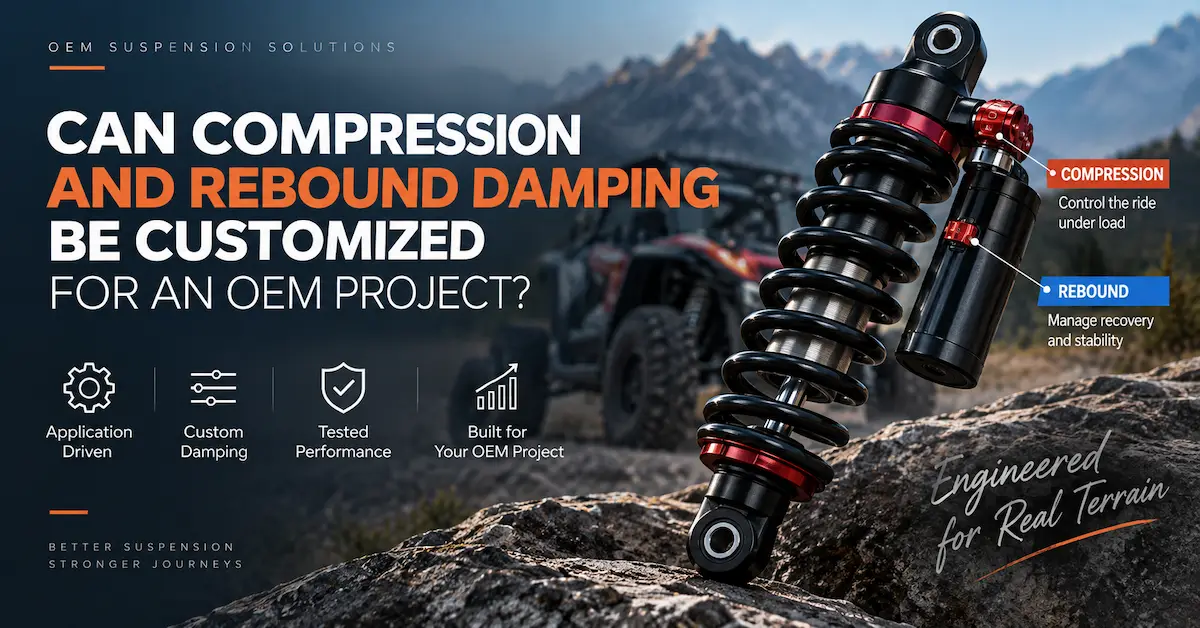
Can Compression and Rebound Damping Be Customized for an OEM Project?
Yes. Compression and rebound damping customization can be developed for an OEM suspension project when the selected shock architecture supports the required changes. The correct damping should be defined around the vehicle application rather than selected as an isolated force number. Vehicle mass, rider or passenger load, cargo, spring rate, preload, suspension geometry, available travel, tire configuration, terrain, operating speed, and target ride behavior can all influence the required result. BEDO’s custom damping shock absorber guide describes customized compression and rebound characteristics as part of application-specific shock development, while its customization guidance states that suitable shock designs can be modified and then physically validated.
For OEM buyers, the goal should not be “more damping.” The goal should be a defined response to a defined vehicle problem. Excessive chassis movement, repeated bouncing, slow suspension recovery, harsh sharp-impact response, changing rider loads, and a new spring specification are different engineering problems and should not automatically receive the same damping solution.
What Does Compression Damping Control?
Compression damping controls resistance while the shock absorber shortens. It influences how quickly suspension movement occurs as the wheel moves upward relative to the vehicle during bumps, load transfer, braking, cornering, holes, rocks, or landings.
If compression control is too low for the application, the vehicle may use excessive suspension travel too quickly or feel poorly controlled during large inputs. If compression resistance is unnecessarily high, the suspension can become harsh and may fail to use available movement effectively over smaller terrain irregularities.
The engineering target should therefore be controlled compression appropriate to the vehicle, rather than the largest possible damping force. A utility ATV carrying tools and an unloaded recreational ATV can need different suspension behavior even when the shock dimensions look similar.
What Does Rebound Damping Control?
Rebound damping controls extension after the spring has been compressed. It determines how quickly the suspension returns toward its normal position.
Too little rebound control can allow the spring to return too quickly and contribute to repeated oscillation. Too much rebound resistance can slow recovery so much that the suspension does not regain sufficient travel before the next bump.
On repeated rough terrain, excessive rebound damping can become particularly noticeable because each successive impact may occur before the suspension has fully recovered.
A useful rebound target therefore depends on the spring as well as the vehicle. When a project introduces a substantially different spring rate, rebound damping should normally be reassessed rather than assumed to remain correct.
Why OEM Damping Should Start With the Vehicle Problem
An OEM RFQ should explain what behavior needs improvement. Asking a supplier for “20% more damping” without a validated baseline tells engineering very little.
A more useful project brief might state:
| Current vehicle behavior | Engineering question |
|---|---|
| Vehicle continues bouncing after a bump | Does rebound control need to increase? |
| Suspension recovers too slowly on repeated terrain | Is rebound resistance too high? |
| Shock uses travel too quickly during large impacts | Does compression damping need review? |
| Ride is harsh over small rocks | Is compression resistance excessive for the application? |
| Cargo causes frequent bottoming | Is the main issue spring rate, travel, compression damping, or a combination? |
| New heavier spring has been installed | Does rebound damping still match the spring? |
| Vehicle behavior changes during sustained rough use | Should damping stability under operating temperature be evaluated? |
This approach converts subjective complaints into a development program the supplier can measure and validate.
What Information Should Buyers Send for Damping Development?
A factory cannot define reliable compression and rebound targets from a photograph alone. BEDO’s custom shock absorber development guide asks buyers to provide vehicle, suspension, load, application, and performance information before development planning.
A useful OEM package should include:
| Development input | What to provide |
|---|---|
| Vehicle application | Type, model, year or new-platform code |
| Suspension position | Front/rear and installation location |
| Existing shock | Sample, drawing or technical specifications |
| Shock dimensions | Extended/compressed length, stroke and mounts |
| Vehicle weight | Relevant operating weight |
| Rider/passenger load | Typical and intended range |
| Cargo/accessories | Weight and location |
| Spring | Rate, dimensions and preload where known |
| Suspension geometry | CAD or relevant hard points where available |
| Tire/wheel | Standard or modified specification |
| Terrain | Utility, trail, rocks, sand, mud or mixed use |
| Current problem | Specific suspension behavior to improve |
| Target result | Comfort, control, load support, recovery, etc. |
| Adjustment requirement | Fixed, compression, rebound or both |
| Quantity | Prototype, pilot and projected production |
The clearer these inputs are, the easier it is to determine whether an existing damping platform can be adapted or a deeper development program is needed.
Spring Rate and Damping Must Be Developed as a System
Spring and damping have different jobs.
The spring primarily supports vehicle load and stores energy as the suspension compresses. The shock absorber controls the rate at which the suspension moves.
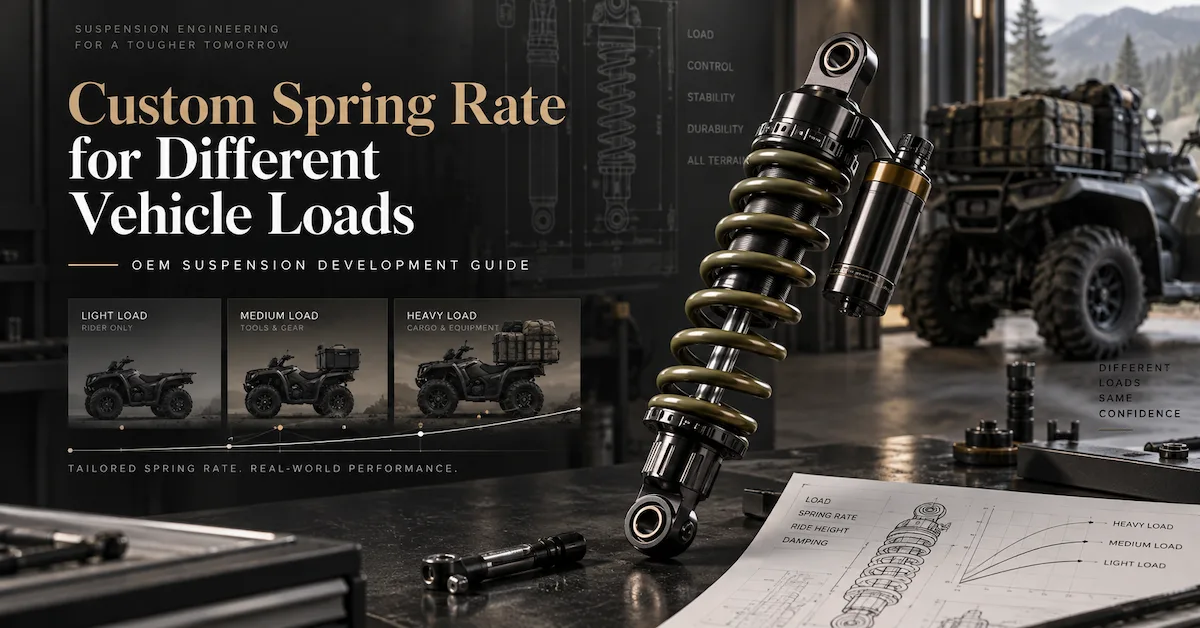
A damper cannot reliably compensate for a spring that is fundamentally unsuitable for the load. If the rear suspension sags excessively under cargo, simply adding large amounts of compression damping does not correct the static spring-support requirement.
Likewise, changing to a substantially higher-rate spring can affect how the suspension returns after compression, which may require rebound damping to be reviewed.
BEDO’s current premium ATV guidance likewise treats spring and damping as one engineering package rather than independent marketing features.
A practical development order is:
Vehicle Load → Spring Specification → Preload and Sag → Compression Target → Rebound Target → Prototype → Test → Vehicle Validation
Do Not Confuse Preload With Damping
Preload changes the installed starting condition of the spring. Compression and rebound damping control suspension movement.
Increasing preload does not increase compression damping.
Adding rebound damping does not increase spring rate.
These functions should remain separate in the technical specification because otherwise the development team may attempt to solve the wrong problem.
For projects involving different rider weights or changing loads, BEDO’s rider-weight suspension guide provides a useful example of how spring rate, preload, rider load, and damping can be reviewed together.
Fixed Damping Can Still Be Customized for OEM Production
Customization does not automatically mean adding external adjustment knobs.
A shock can remain externally fixed while the factory develops a specific internal compression and rebound setting for the target OEM vehicle. This can be appropriate when the application is predictable and the vehicle manufacturer wants consistent behavior without end-user tuning.
A fixed configuration can offer several advantages:
- simpler customer setup;
- fewer external controls;
- easier version management;
- consistent delivered settings;
- potentially lower product complexity.
The technical requirement is still vehicle-specific even though the customer cannot adjust it after delivery.
BEDO’s current ATV content distinguishes fixed damping from rider-adjustable damping and notes that absence of external adjustment does not answer whether a factory-set OEM specification can be developed.
When Does Adjustable Compression Add Value?
Compression adjustment becomes more useful when the same vehicle is expected to operate across meaningfully different conditions.
For example:
- light recreational use versus equipment carrying;
- smooth trails versus rough terrain;
- different rider/load conditions;
- performance-oriented customers who understand suspension setup.
The engineering team should define the useful adjustment range instead of simply asking for the largest number of positions.
An OEM buyer should know:
- what the adjuster changes;
- which direction increases resistance;
- the factory baseline position;
- the usable range;
- which vehicle conditions were validated;
- whether the settings create measurable damping changes.
An adjustment knob that produces little meaningful change has limited technical value regardless of its appearance.
When Does Adjustable Rebound Add Value?
Rebound adjustment is useful when customers need to tune suspension recovery within a validated range.
This can be relevant when the vehicle uses more than one approved spring configuration or when rider/load conditions vary enough to justify recovery adjustment.
The same caution applies: more rebound is not automatically more control.
Too much rebound resistance can slow the suspension and reduce its ability to recover between bumps. OEM instructions should therefore provide a baseline setup and a clear tuning method rather than leaving the user to assume maximum settings are best.
Should an OEM Shock Have Both Compression and Rebound Adjustment?
Not always.
Separate adjustment provides greater tuning flexibility but also introduces more components, manufacturing controls, testing requirements, customer education, and version-management risk.
A practical comparison is:
| Damping strategy | Main value | Main limitation | Typical OEM direction |
|---|---|---|---|
| Fixed damping | Simple, consistent setup | No end-user tuning | Replacement and predictable applications |
| Rebound adjustable | Allows recovery tuning | Compression remains fixed | Selected performance applications |
| Compression adjustable | Allows impact/body-control tuning | Rebound remains fixed | Load or terrain variation |
| Compression + rebound | Greater independent tuning | More complexity | Premium/performance projects |
| Advanced multi-adjustment | Broader tuning options | Highest development and user complexity | Specialist applications |
The best specification is the simplest architecture that solves the target application.
Remote Reservoirs Are Separate From Damping Adjustment
A remote or piggyback reservoir should not be confused with adjustable damping.
A reservoir can be part of fixed-damping or adjustable architectures depending on the design. It can support hydraulic packaging, additional fluid volume, thermal management, or specific control layouts, but it does not automatically create better compression and rebound characteristics.
The reservoir decision should therefore be made separately from the damping-setting decision.
For demanding off-road projects, buyers can first establish spring, damping, travel, and duty-cycle requirements, then determine whether a reservoir architecture adds measurable value.
Which Internal Factors Can Influence Damping Development?
From an engineering perspective, damping behavior can be influenced by multiple internal variables. Depending on shock architecture, these may include piston flow paths, valve or shim configurations, hydraulic fluid characteristics, gas system configuration, internal friction, adjuster components, and reservoir architecture.
OEM buyers generally do not need to prescribe every internal detail unless their engineering specification requires it. Instead, the important commercial and technical output is a controlled damping specification that the supplier can reproduce and verify.
The buyer should focus on:
- required vehicle behavior;
- measurable damping targets;
- approved prototype configuration;
- testing method;
- production consistency.
This reduces the risk of specifying an internal feature without understanding its effect on the complete shock.
How Is Compression and Rebound Damping Tested?
BEDO’s shock absorber testing guide includes compression and rebound evaluation among its development and validation areas. A damping test can use controlled shock movement to measure the resisting force produced during compression and extension.
For OEM development, test records should identify:
- exact shock or prototype version;
- damping configuration;
- spring configuration where relevant;
- adjustment position;
- applicable test condition;
- compression result;
- rebound result;
- acceptance target;
- engineering disposition.
A single unexplained force number should not be treated as a complete damping specification.
Why Force–Velocity Data Matters
A shock does not experience only one shaft speed in actual vehicle use.
Force–velocity data helps engineering examine how damping changes across the tested range of damper movement speeds rather than evaluating one isolated operating point.
The purpose is not to create the largest graph or the highest force. It is to compare:
- the reference shock;
- prototype versions;
- adjustment positions;
- the approved final configuration;
- later production units.
This allows OEM engineers to determine whether a revision changed compression, rebound, or both.
Test Compression and Rebound Separately
The report should clearly distinguish compression results from rebound results.
A development review can then answer:
Did compression change in the intended direction?
Did rebound remain inside the target?
Did an internal modification affect both directions?
Does the final version match the approved spring and vehicle?
Without separate information, the buyer can see that total damping changed but may not understand which part of the suspension behavior was altered.
Adjustable Shocks Need Multiple Test Positions
For an adjustable product, one test position cannot prove the complete adjustment range.
During development, representative settings can be compared, such as:
- lower setting;
- baseline setting;
- upper setting;
- technically relevant intermediate positions.
The exact test plan depends on the shock architecture and buyer requirement.
More important than click count is whether the adjustment creates a controlled and repeatable change.
BEDO’s premium ATV damping guide specifically notes that the useful damping range matters more than the nominal number of adjustment positions.
Vehicle Testing Is Still Required After Dyno Development
A dyno measures the shock. The vehicle determines whether that shock performs correctly in the complete suspension system.
Final evaluation should consider:
- spring;
- suspension geometry;
- tire;
- vehicle load;
- rider;
- cargo;
- terrain;
- steering/handling;
- repeated bumps;
- real suspension travel.
A damping configuration that looks technically consistent on a bench can still feel unsuitable when installed in a vehicle with the wrong spring or motion ratio.
A strong OEM workflow therefore uses both component testing and application testing.
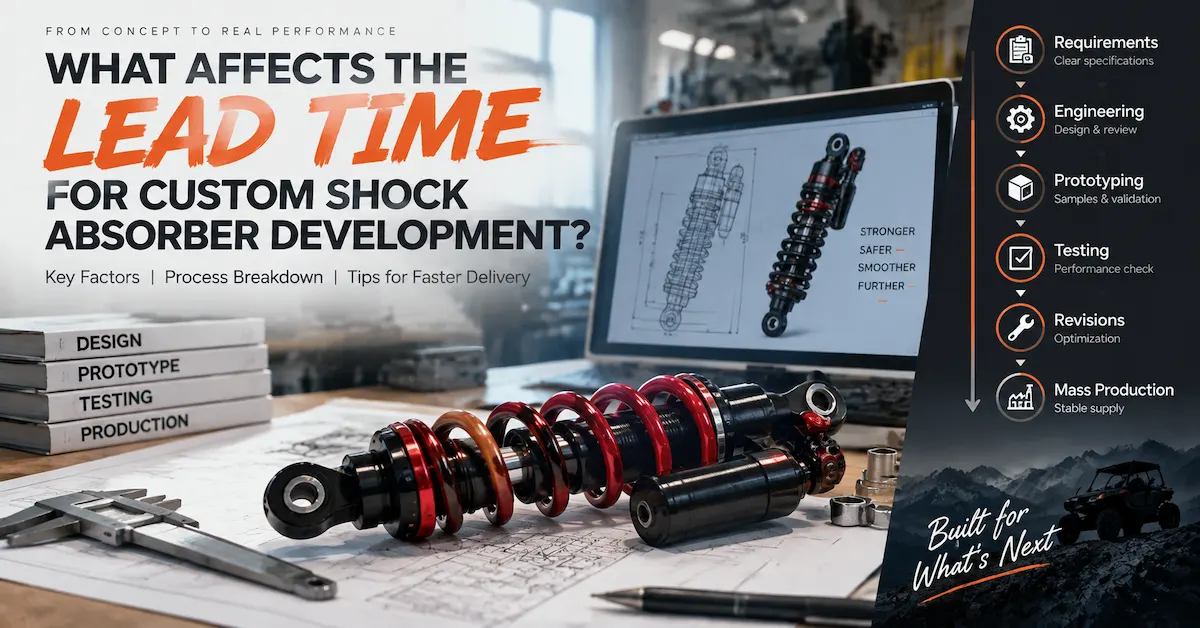
Prototype Development Should Follow a Controlled Sequence
A practical compression and rebound damping customization project can follow this sequence:
Step 1 – Vehicle Requirement Review
Define vehicle, load, spring, terrain, and performance goals.
Step 2 – Baseline Evaluation
Review existing shock, drawings, sample, and available damping data.
Step 3 – Initial Damping Proposal
Define compression and rebound development direction.
Step 4 – Prototype Manufacturing
Build a traceable prototype configuration.
Step 5 – Bench Testing
Measure applicable compression and rebound behavior.
Step 6 – Vehicle Evaluation
Install the prototype and assess the actual target conditions.
Step 7 – Engineering Revision
Adjust the configuration if required.
Step 8 – Final Prototype Approval
Freeze the approved spring and damping combination.
Step 9 – Pilot Production
Verify repeatability before larger production.
This development logic is consistent with BEDO’s broader OEM shock absorber customization process.
Use a Pilot Batch to Confirm Damping Repeatability
One approved prototype proves that one shock can meet the target. It does not prove production repeatability.
A pilot batch should verify whether multiple units reproduce the approved configuration.
Possible checks include:
- correct internal damping version;
- compression consistency;
- rebound consistency;
- adjuster operation;
- spring version;
- oil/gas process where applicable;
- leakage;
- dimensions;
- product identification.
BEDO supports low-volume OEM development as a bridge between prototype validation and larger production.
For OEM customers, this stage can be particularly valuable because visually identical shocks may contain different damping versions.
Production Version Control Is Critical
If an OEM program has more than one damping setup, every configuration should have a controlled identity.
Do not rely only on spring color or external appearance.
A technical version can be linked to:
Buyer SKU → Supplier Model → Drawing Revision → Spring Version → Damping Version → Adjustment Baseline → Production Batch
This reduces the risk of the wrong damping setup being assembled, packaged, or reordered later.
For private-label customers, the technical product code should also remain separate from branding and carton artwork.
What Manufacturing Controls Matter for Custom Damping?
The approved damping specification must eventually be translated into a repeatable production process.
Depending on architecture, production control can involve:
- correct internal components;
- valve configuration;
- hydraulic filling;
- gas process where applicable;
- assembly cleanliness;
- correct spring;
- correct adjuster assembly;
- testing;
- leakage inspection;
- traceability.
The buyer does not necessarily need to define every shop-floor process. However, the supplier should be able to explain how the approved prototype becomes a controlled production configuration.
This is one reason a specialized OEM suspension partner provides more value than a factory that can only copy external dimensions.
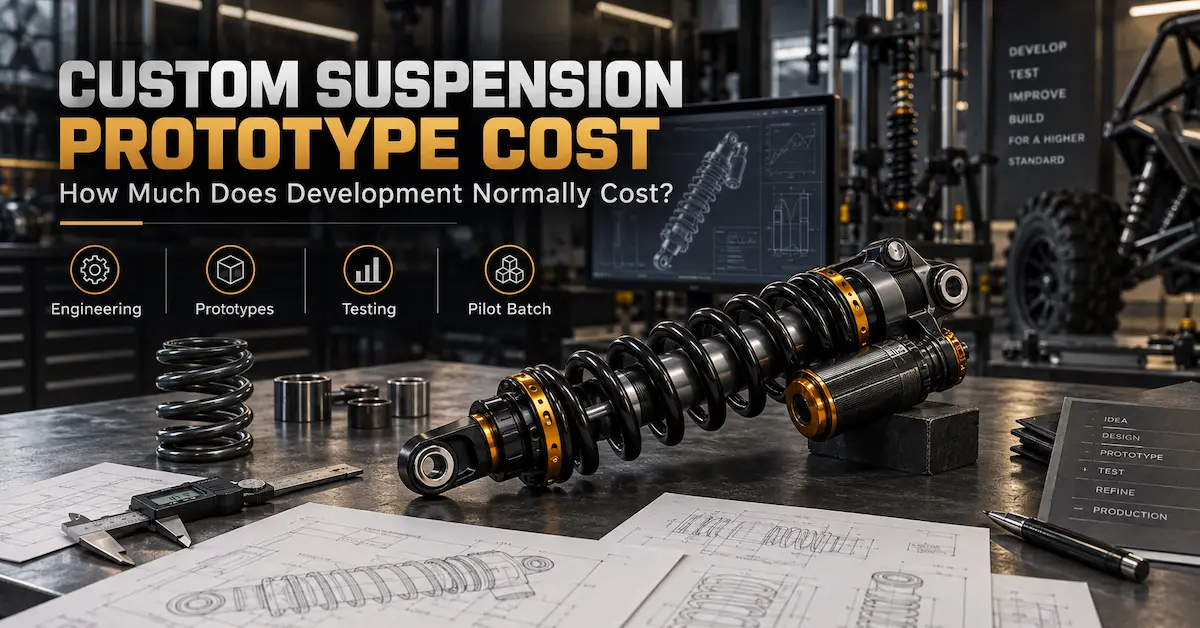
How Does Custom Damping Affect Cost and MOQ?
Technical damping development can have a different commercial scope from standard catalog production.
Cost may be affected by:
- engineering work;
- prototype quantity;
- different internal configurations;
- dyno testing;
- vehicle testing;
- revision rounds;
- adjustment hardware;
- reservoir architecture;
- pilot production.
MOQ may also depend on whether the selected damping configuration uses existing production components or dedicated custom components.
BEDO supports custom and low-volume suspension projects, but its current information does not establish one universal MOQ for every damping program.
Buyers should request separate commercial information for:
prototype quantity
pilot quantity
initial production quantity
repeat-order quantity
How Should OEM Buyers Compare Two Damping Suppliers?
Give both suppliers the same vehicle and technical brief.
Then compare:
| Supplier question | What the buyer should evaluate |
|---|---|
| Can compression be customized? | Technical capability and applicable architecture |
| Can rebound be customized? | Same |
| Can both be developed separately? | Degree of tuning control |
| How is the spring incorporated? | System-level engineering |
| What testing is used? | Objective validation |
| Are vehicle tests supported? | Application validation |
| How are prototypes revised? | Development discipline |
| How is final damping documented? | Repeat-order control |
| Can a pilot batch be supplied? | Manufacturing repeatability |
| What changes require retesting? | Change-control maturity |
Avoid selecting a supplier because it offers the most adjuster clicks or the largest advertised damping-force figure.
When Is Custom Damping Unnecessary?
Not every OEM shock needs a new damping-development program.
If an existing validated shock already meets the required:
- fitment;
- vehicle load;
- spring;
- terrain;
- ride behavior;
- performance target;
then retaining the existing damping can reduce development complexity.
Customization creates value when the existing configuration does not meet the target application or when the buyer needs meaningful technical differentiation.
Changing damping simply so a product can be marketed as “custom” adds development cost without necessarily creating customer value.
What Should You Send BEDO for an OEM Damping Project?
BEDO currently states that it supports custom shock absorber development, compression and rebound damping modification on appropriate shock designs, prototypes, testing, and low-volume OEM projects.
For an efficient engineering review, prepare:
- vehicle application;
- front/rear position;
- existing shock or sample;
- drawing/CAD where available;
- extended/compressed dimensions;
- stroke;
- mounting details;
- vehicle weight;
- rider/passenger load;
- cargo/accessories;
- spring rate and preload;
- tire configuration;
- suspension geometry where relevant;
- intended terrain;
- existing damping data;
- current suspension problem;
- target behavior;
- desired adjustability;
- prototype quantity;
- expected production volume.
Submit the project through BEDO Contact Us and ask the engineering team to distinguish existing-platform options, proposed damping development, prototype requirements, validation scope, and production conditions.
Frequently Asked Questions
1. Can Compression and Rebound Damping Be Customized Separately?
Yes, on suitable shock architectures. Whether separate adjustment or internal factory-set tuning is appropriate depends on the vehicle, spring, load, terrain, and product objective. BEDO’s custom damping guidance supports separate compression and rebound development for applicable projects.
2. Do OEM Shocks Need External Damping Adjusters?
No. A fixed shock can still use a vehicle-specific factory damping configuration. External adjustment is only necessary when the customer or application benefits from user tuning.
3. Should Spring Rate Be Finalized Before Damping?
Spring and damping should be developed together, but establishing the correct load-support direction is important before final damping approval because a major spring change can alter suspension behavior.
4. Can Damping Be Customized From an Existing Shock Sample?
Yes. An existing shock can provide structural and baseline information. The supplier also needs vehicle, spring, load, terrain, and performance requirements when the new product is intended to behave differently.
5. Can Stronger Compression Damping Fix a Soft Spring?
Not reliably. Compression damping controls movement, while the spring supports load. A spring that is fundamentally too soft should be reviewed rather than compensated for only with damping.
6. Does Higher Rebound Damping Mean Better Control?
No. Excessive rebound can slow suspension recovery. The correct setting should match the spring and the frequency of terrain inputs.
7. Do Remote Reservoirs Automatically Improve Damping?
No. Reservoir architecture can support particular hydraulic and thermal requirements, but it does not replace correct spring, geometry, and damping development.
8. How Is Custom Damping Verified?
Development can include controlled compression/rebound measurement, force–velocity evaluation where appropriate, adjustment testing, and vehicle validation under representative load and terrain.
9. Can BEDO Supply Small-Batch Custom Damping Shocks?
BEDO states that it supports prototype and low-volume OEM projects, including custom damping. Exact quantity and commercial terms must be confirmed for the specific design.
10. What Information Should I Send Before Requesting a Damping Quote?
Provide the target vehicle, shock/sample or drawing, dimensions, spring specification, loads, suspension geometry where available, terrain, current problem, desired behavior, adjustment requirements, prototype plan, and expected volume.
Conclusion
Yes, compression and rebound damping customization can be developed for an OEM suspension project when the shock architecture and application justify it. The correct process begins with the vehicle rather than with an arbitrary damping-force target: define vehicle load, spring rate, preload, suspension geometry, travel, rider and cargo conditions, terrain, and the specific behavior that needs improvement. Compression should control suspension movement into the stroke, while rebound should control recovery; neither should be maximized simply to make the shock feel “performance-oriented.” The safest OEM route is Vehicle Requirements → Spring and Load Review → Damping Targets → Prototype → Compression/Rebound Testing → Vehicle Validation → Engineering Revision → Pilot Batch → Controlled Production. BEDO supports custom damping development, prototypes, testing, and OEM suspension production for suitable projects. To discuss a new configuration, contact BEDO with your vehicle data, drawings or reference sample, spring and damping requirements, operating conditions, prototype needs, and expected production quantity so the appropriate compression and rebound development route can be reviewed before production.