
Can an ATV Suspension Supplier Customize Shocks for Different Rider Weights?
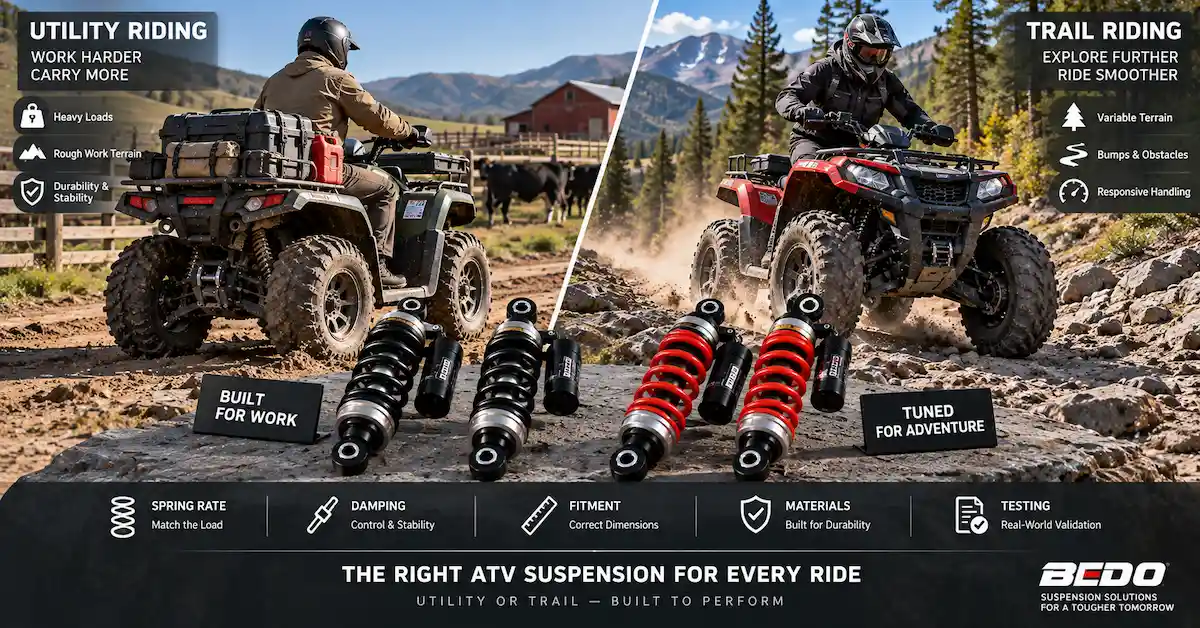
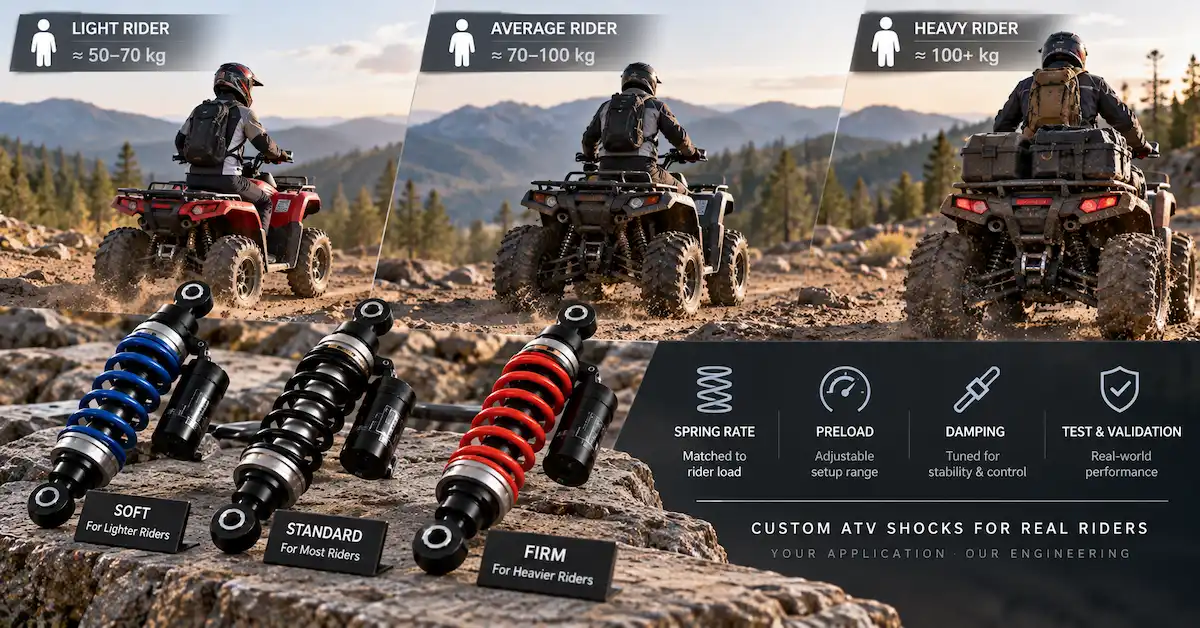
Yes. An ATV suspension supplier with spring and damping development capabilities can customize shocks for defined rider-weight ranges. The work may involve a different spring specification, an appropriate preload range, revised compression and rebound damping, or a combination of these changes. BEDO’s OEM ATV shock absorber program includes customizable spring rates and valving. However, rider weight alone does not establish the correct configuration: vehicle loading, suspension geometry, installation requirements, and intended use must also be reviewed. For OEM manufacturers, distributors, and private-label brands, the objective should be a validated application range—not a universal shock advertised as suitable for every rider.
Start with the Complete Operating Load, Not Body Weight Alone
Ask customers for their ready-to-ride weight, including normal riding equipment, and record cargo and vehicle accessories separately. Their locations matter as well as their mass. Consider an illustrative comparison on the same ATV: an 80 kg rider with equipment plus 20 kg on the rear rack adds the same total mass as a 100 kg rider with equipment and no rack cargo, but it does not necessarily create the same front and rear axle loads. This is a load-distribution example, not a recommended payload. BEDO’s custom shock absorber development requirements identify cargo location, accessories, operating conditions, and performance objectives as relevant inputs. A useful brief also distinguishes recreational riding from loaded utility work rather than assigning both uses the same specification solely because rider weights match.
Give the Supplier a Rider-Weight Development Specification
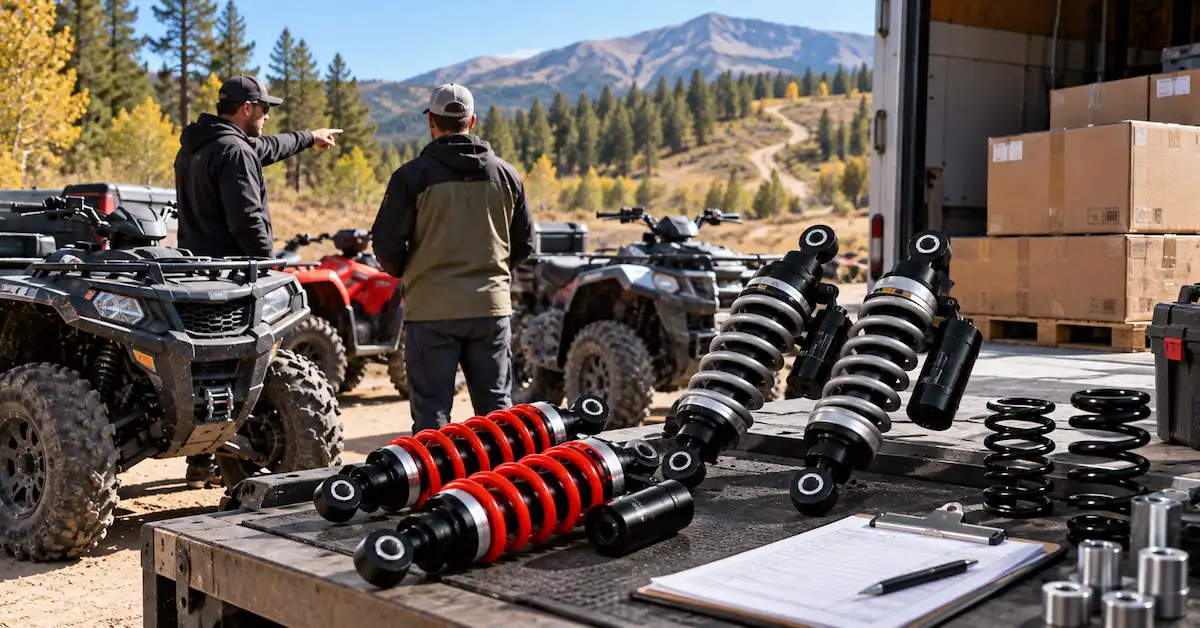
Prepare a requirement sheet that connects each intended rider group to a specific vehicle configuration. The table below is a proposed development checklist, not a set of BEDO-approved weight ratings or spring values. Ask the ATV suspension supplier to mark missing information and explain how it will be established. BEDO’s dimension, spring-rate, and damping customization guide describes these parameters as related parts of vehicle-specific development.
| Specification area | Information to provide or confirm |
|---|---|
| Vehicle application | Model, year, variant, installation position, and relevant modifications |
| Rider range | Minimum, typical, and maximum intended ready-to-ride weight |
| Additional loads | Cargo, accessories, their locations, and representative axle loads where available |
| Existing suspension | Shock dimensions, mounting interfaces, spring information, and adjustment settings |
| Installation geometry | Drawings or CAD, shock angle, available movement, and surrounding clearance |
| Spring target | Rate with complete units, dimensions, load–deflection requirements, and preload limits |
| Damping target | Compression and rebound requirements, adjustment functions, and evaluation conditions |
| Validation plan | Load combinations, terrain, acceptance criteria, sample requirements, and approval responsibilities |
Understand the Difference Between Spring Rate and Preload
Spring Rate Determines Resistance to Additional Compression
Spring rate describes the additional force required to compress a spring by a given distance, commonly expressed in N/mm or lb/in. For a linear spring within its working range, that relationship remains approximately constant. A spring that is unsuitable for the application can produce excessive sag or an unnecessarily harsh response; choosing the highest rate is therefore not a reliable selection method. BEDO’s guide to spring rate in ATV shock performance connects spring selection with ride height, damping, and intended terrain. Ask for the rate and its measurement basis rather than a description such as “medium” or “heavy” alone.
Preload Adjusts the Starting Condition, Not a Linear Spring’s Rate
Preload is the initial compression applied to the installed spring. It can change the suspension’s settled position and help accommodate load variation within the approved setup range, but it does not change the rate of a linear spring. More preload is not the same as a stiffer spring. When the existing rate is fundamentally unsuitable, turning the preload collar farther is not a complete solution. BEDO’s adjustable off-road shock guide explains this limitation. For a modest change within an already validated application, approved setup adjustments may be sufficient; a broader rider range may require another spring or shock configuration.
Use Sag Measurements to Evaluate the Proposed Rider Range
Agree on a consistent measurement method before comparing setups. Record suspension position from a defined full-extension reference, then record the settled positions with the vehicle alone, with the rider and equipment, and with any intended cargo. Keep measurement points, tire settings, fuel condition, and rider posture consistent across comparisons. Ask engineering staff to interpret the results alongside available compression and extension movement; do not prescribe one sag percentage for every ATV or mix a wheel-position measurement with a shock-stroke measurement. BEDO’s shock absorber measurement guide also calls for recording preload settings and checking clearance in loaded, unloaded, extended, and compressed conditions. These records give the supplier a measurable problem to investigate instead of only “the rear feels too low.”
Review Damping After Changing the Spring Specification
Spring support and damping control should be evaluated together. Compression damping influences resistance during compression, while rebound damping controls how the suspension extends afterward. A spring change can alter the combination that needs to be validated; it does not justify automatically increasing every damping setting. Too little rebound control can allow excessive return movement, while too much can slow recovery between repeated bumps. BEDO’s heavy-duty ATV shock absorber guide discusses matching spring support, damping, load, and terrain. For your development program, define the expected riding conditions and compare the lighter and heavier load cases. A setup that feels controlled at the upper end should also be checked for acceptable response at the lower end.
Compare Compatible Shock Designs Before Assigning Rider Weights
An ATV suspension supplier should first establish a suitable physical configuration, then develop its load and performance specification. BEDO’s AU_HSA_01 and AU_HSA_03 illustrate why existing products cannot be assigned to rider groups simply from a catalog photograph. Both are listed as rear ATV/UTV shocks with 130 mm effective stroke and fixed damping, but their lengths and mounting widths differ. The following values are published screening data, not vehicle-specific fitment approvals or rider-weight recommendations.
| Published specification | AU_HSA_01 | AU_HSA_03 |
|---|---|---|
| Installation position | Rear | Rear |
| Total length | 465 mm | 445 mm |
| Effective stroke | 130 mm | 130 mm |
| Cylinder outer diameter | 38 mm | 42 mm |
| Upper/lower mounting-hole diameter | 10 / 10 mm | 10 / 10 mm |
| Upper/lower mounting width | 32 / 32 mm | 30 / 35 mm |
| Adjustable damping levels | None | None |
| Approved rider-weight range | Not specified on the product page | Not specified on the product page |
The product pages also show spring-rate fields using “LBS” without a distance denominator. Obtain confirmation in complete units, such as N/mm or lb/in, before using those figures for engineering comparison. Do not interpret a spring marking as a rider’s body-weight allowance. Likewise, confirm the drawing references behind “total length” before treating it as an installation-center measurement. The absence of external damping adjustment describes the listed configuration; it does not establish whether a different factory-set specification can be developed for an OEM project.
Develop Rider Packages Around Validated Boundaries
For a proposed product line, consider a small number of application-specific packages rather than a separate item for every possible body weight. Your starting plan might distinguish a lower rider-load range, the principal target range, and a higher-load configuration that includes defined accessories or cargo. These are planning categories, not established BEDO weight bands. Ask the ATV suspension supplier whether a common assembly can support the required versions and which components or settings must differ. Set the final boundaries from engineering review and testing, then identify any conditions requiring another package. For rental or shared-use vehicles, also evaluate how staff will select and record the approved setup when riders change.
Check Spring Materials and Manufacturing Consistency
A rider-weight program needs reproducible springs, not just different colors. Request the approved material specification, wire diameter, free length, coil geometry, end configuration, surface treatment, and load–deflection acceptance requirements. Ask how the manufacturing process controls those requirements and whether relevant heat-treatment or finishing records are available for review. BEDO’s custom coil spring development guide discusses these material, dimensional, and performance considerations. For the assembled shock, also confirm spring-seat compatibility and the intended compression range. Treat fatigue and corrosion requirements as specified tests with agreed conditions, not as conclusions drawn from the appearance of the coating. Define which characteristics must be checked when the spring version changes.
Validate the Lower and Upper Ends Before Approving Production
Build the test plan around the proposed application range, not only its average rider. Ask the ATV suspension supplier to evaluate representative lower, typical, and upper operating loads, including the cargo arrangements you intend to publish. The plan should address installation, settled ride height, available movement, spring behavior, damping response, sealing, and the required durability evaluation. BEDO’s shock absorber testing guide describes several of these test areas; agree which apply to your configuration and identify the test conditions and acceptance criteria in advance. Check current quality-system certificates separately, including their scope and validity, but do not substitute them for configuration-specific evidence. Where one test result is proposed to cover multiple variants, request the engineering justification rather than assuming all versions are equivalent.
Keep Approved Weight Ranges Linked to Product Identification
Once testing establishes a usable range, document exactly what it means. For a private-label catalog, state whether the range includes riding equipment, what cargo conditions were evaluated, which vehicle versions are covered, and which setup instructions apply. Link those claims to the spring specification, damping configuration, drawing revision, and product identifier. Do not rely on spring color as the only way to distinguish versions. BEDO’s suspension sample development process connects engineering review, prototypes, testing, and production preparation. Use the transition to production to confirm that the approved reference, assembly records, labels, and packaging all identify the same configuration. Agree how a proposed component change will trigger review before affected products are supplied.
Confirm Costs, Order Quantities, and Timing by Variant
BEDO describes small-batch support in its low-volume shock absorber OEM guide, but exact quantities and schedules need project confirmation. Request separate quotations for development samples, pilot production, and repeat orders, identifying the rider-load variants included in each. Ask whether minimum quantities apply to each spring specification, damping configuration, finish, or packaging version, and confirm available production allocation for the proposed mix. Separate recurring unit costs from engineering, samples, testing, and tooling or fixtures where required. Define milestones for technical review, prototype preparation, revisions, validation, and production after approval. Also agree how customer drawings and brand artwork may be used. This makes the commercial scope of the customization program clear without assuming that every additional weight option has the same cost or lead time.
Frequently Asked Questions
Can the Supplier Recommend a Spring Rate from Rider Weight Alone?
Not reliably. Rider weight is one input, but the supplier also needs the vehicle application, operating loads, suspension geometry, and performance objectives. Request an engineering recommendation based on that information rather than a universal kilograms-to-spring-rate conversion.
Does a Lighter Rider Automatically Need a Softer Spring?
Not automatically. Ask the supplier to review the existing specification and explain the reported problem first. Harshness may involve damping, tire settings, or suspension friction as well as spring selection; replacing the spring without diagnosis may not address the concern.
Can One Adjustable Shock Work for Every Rider?
Adjustment can support a defined operating range, but it cannot correct every spring or application mismatch. Publish only the range validated for the product and provide the associated setup instructions rather than claiming unlimited rider-weight coverage.
Are Progressive Springs Always Better for Changing Rider Weights?
No. Linear and progressive designs have different load–deflection characteristics, and neither is universally better. Request the relevant curve and evaluate the spring with the vehicle, damping configuration, and intended load range before choosing a design.
Can I Change Only the Spring Instead of Developing a Complete Shock?
A spring-only change may be a development option, but confirm dimensions, seating, preload limits, movement, and damping compatibility first. Ask which validation must be repeated before approving the revised assembly for the intended riders.
Does a Reservoir Make a Shock Suitable for Heavier Riders?
A reservoir does not replace correct spring and load matching. Establish the support requirements first, then evaluate whether the damper architecture is appropriate for the operating duty. Do not use reservoir size as a rider-weight rating.
Do Custom Shocks Increase the ATV’s Permitted Payload?
Do not treat suspension customization as permission to exceed the vehicle manufacturer’s published loading or passenger-use limits. Keep the development brief within the approved vehicle operating envelope and distinguish a component’s tuning range from the vehicle’s overall limits.
Can BEDO Start Development from Existing Shocks?
BEDO describes support for existing samples, drawing review, spring development, damping adjustment, and prototypes. Send the sample with the vehicle details, current setup, target rider range, and the behavior you want to improve; the sample alone does not describe every requirement.
What Should Dealers Record When a Customer Reports Poor Ride Quality?
Request the product identifier, vehicle configuration, ready-to-ride weight, cargo and accessories, current settings, and a clear description of when the issue occurs. Record available measurements and photographs before deciding whether the customer needs a setup adjustment or a different approved configuration.
Should Every Rider-Weight Version Have a Separate Product Code?
Use identifiers that let purchasing, assembly, warehousing, and dealers distinguish the actual configurations. Where spring or damping specifications differ, record that difference explicitly and keep the approved application and setup instructions connected to the correct version.
Conclusion
An ATV suspension supplier can customize shocks for different rider weights, but the process should begin with the complete vehicle and operating-load requirements—not a spring selected from body weight alone. Establish compatible dimensions, choose the spring specification and preload range, evaluate damping, and validate the intended lower and upper load conditions before publishing rider-weight claims. For a BEDO project, submit your ATV application and rider-weight customization requirements, including drawings or samples, ready-to-ride weight ranges, cargo arrangements, existing settings, and purchasing plans. Request an engineering review and a defined sample proposal before approving the product for your range.