
A reliable aftermarket UTV suspension supplier for distributors should do more than offer a competitive first quotation.
For a distributor, wholesaler, importer, or private-label brand, the real value of a supplier comes from its ability to repeatedly deliver suspension products with the correct:
- Vehicle fitment
- Product specifications
- Quality level
- Packaging
- Identification
- Order quantity
- Lead time
A supplier may provide an excellent sample but still become a poor long-term partner if later batches change in dimensions, spring configuration, damping, finish, or component quality.
For distributors, supplier reliability therefore means:
Correct Fitment + Consistent Product + Controlled Quality + Commercial Flexibility + Repeat-Order Stability
This is particularly important in the UTV aftermarket because returns, fitment complaints, warranty issues, and unavailable repeat stock can quickly reduce distributor margins.
The best sourcing process is not:
Find Lowest Price → Place Large Order
A safer process is:
Supplier Evaluation → Sample → Fitment Verification → Pilot Order → Market Launch → Repeat Orders
Why Do Distributors Need Different Supplier Criteria Than OEM Vehicle Manufacturers?
OEM vehicle manufacturers and aftermarket distributors often buy from the same suspension industry, but their sourcing priorities are different.
An OEM development team may focus heavily on:
- CAD engineering
- New suspension geometry
- Prototype development
- Vehicle validation
- New component design
A distributor usually has additional commercial concerns:
- Which UTV models can I sell this product for?
- How clearly is fitment documented?
- Can I test the market with a manageable quantity?
- Will repeat orders match the first approved batch?
- Can the products carry my brand?
- Is the packaging suitable for resale?
- Can the supplier support additional models later?
- How quickly can I replenish inventory?
This means a technically capable manufacturer is not automatically the best distributor supplier.
A distributor-oriented suspension partner must understand both:
Suspension Products + Aftermarket Supply Requirements
What Makes an Aftermarket UTV Suspension Supplier Reliable?
Distributors should evaluate suppliers using a practical capability checklist.
| Supplier Capability | Why It Matters to Distributors |
|---|---|
| Clear UTV fitment | Reduces incorrect orders and returns |
| Consistent specifications | Protects repeat-order quality |
| Relevant UTV applications | Expands product opportunities |
| Quality control | Reduces complaints and warranty risk |
| Sample support | Allows product evaluation |
| Flexible ordering | Helps control inventory exposure |
| Private-label capability | Supports brand development |
| Packaging support | Improves resale efficiency |
| Repeat-order supply | Protects long-term availability |
| Technical communication | Helps resolve fitment issues |
Price should be considered only after these basic requirements are understood.
Does the Supplier Understand Aftermarket UTV Applications?
A professional UTV suspension supplier should understand why an aftermarket customer replaces or upgrades the original suspension.
A product should not be selected only because it looks similar or has approximately the same dimensions.
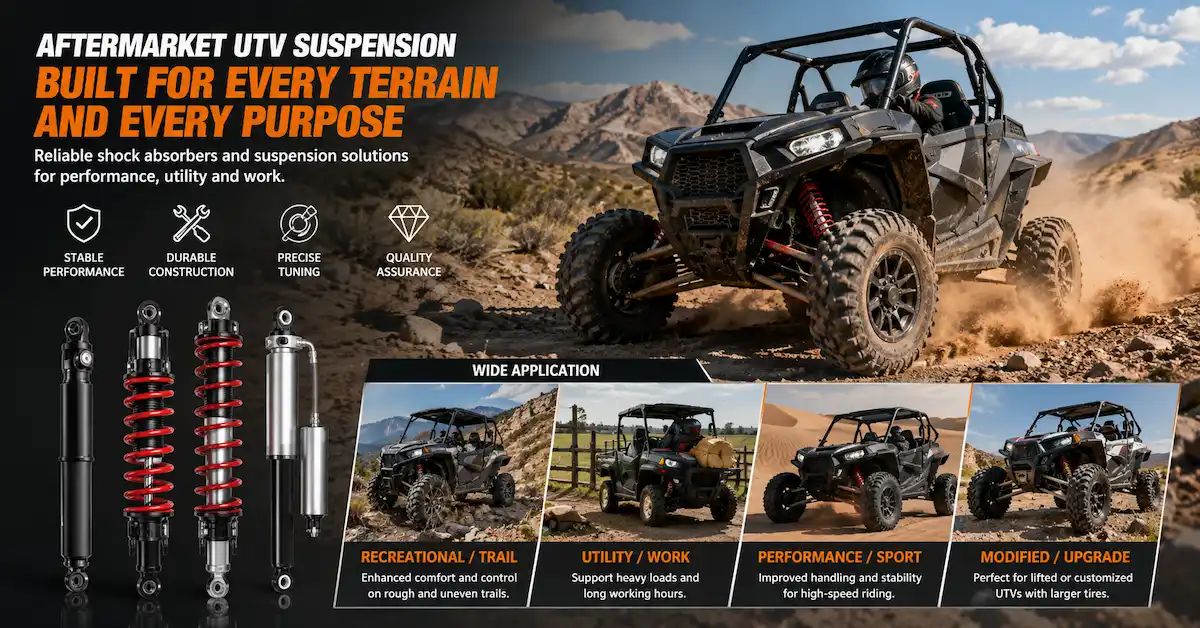
Recreational UTV Applications
Customers may want:
- Improved trail comfort
- Better rough-terrain control
- More consistent suspension response
- Replacement for worn suspension components
Utility UTV Applications
Utility vehicles may experience:
- Tools and cargo
- Passenger loads
- Agricultural use
- Worksite operation
- Long operating periods
The suspension requirements can therefore be different from those of a recreational vehicle.
Modified UTV Applications
Aftermarket customers may modify vehicles with:
- Larger tires
- Lift kits
- Additional equipment
- Cargo systems
- Protection accessories
These changes can increase weight or alter suspension behavior.
A knowledgeable aftermarket UTV suspension supplier should therefore ask about the actual vehicle application instead of simply matching products by appearance.
How Important Is UTV Fitment Information for Distributors?
Fitment accuracy is one of the biggest commercial risks in aftermarket distribution.
Incorrect fitment can create:
Wrong Order → Installation Failure → Return → Customer Complaint → Margin Loss
For this reason, distributors should ask suppliers to provide or confirm as much fitment information as possible.
Useful information may include:
- Vehicle brand
- Vehicle model
- Model year where relevant
- Front or rear application
- Extended length
- Compressed length
- Stroke
- Upper mounting configuration
- Lower mounting configuration
- Mounting-hole dimensions
- Product code
- Application notes
A structured product code is especially useful for warehouses and repeat orders.
| Fitment Data | Distributor Benefit |
|---|---|
| Vehicle model | Simplifies catalog listing |
| Front/rear position | Reduces order errors |
| Product dimensions | Supports technical verification |
| Application notes | Helps sales teams |
| Product/SKU code | Simplifies repeat purchasing |
For a distributor,accurate fitment information is not only a technical benefit. It is a commercial risk-control tool.
What UTV Suspension Products Should Distributors Evaluate?
Product strategy depends on the target market.
An aftermarket distributor may evaluate several suspension categories.
Replacement UTV Shock Absorbers
These may serve:
- Repair markets
- Replacement demand
- Dealers
- General aftermarket customers
The priority is usually:
- Fitment
- Reliability
- Repeatability
Performance Coilover Shocks
These may target:
- Off-road enthusiasts
- Upgrade customers
- Modified vehicles
Buyers may pay more attention to:
- Spring configuration
- Adjustability where applicable
- Suspension behavior
- Product appearance
Reservoir Shock Absorbers
Reservoir configurations may be relevant for certain performance-oriented applications.
Availability should always be confirmed for the specific vehicle platform rather than assuming every configuration can fit every UTV.
Suspension Springs
Spring products may support:
- Replacement demand
- Load-related applications
- Suspension upgrades
The correct specification should be evaluated according to the intended vehicle application.
How Should Distributors Evaluate UTV Suspension Quality?
Avoid relying on broad statements such as:
“Our products are high quality.”
Instead, ask what the supplier actually controls.
Dimensional Consistency
Key dimensions may include:
- Extended length
- Compressed length
- Stroke
- Eye width
- Hole diameter
- Mounting interfaces
Even a relatively small dimensional change can create installation problems.
Assembly Quality
Review:
- Component condition
- Fastening
- Surface finish
- Spring installation
- Reservoir and hose assembly where applicable
Functional Verification
Depending on the product and project,suppliers may check:
- Leakage
- Shock movement
- General functionality
- Dimensional conformity
Product Identification
Distributors should also consider whether the supplier can maintain consistent:
- Product codes
- Labels
- Model identification
This reduces warehouse and fulfillment errors.
Why Is Batch Consistency More Important Than One Perfect Sample?
Samples are important, but they are only the first validation step.
A distributor should ask:
Will my third order match the first approved order?
This question matters because an excellent sample cannot compensate for inconsistent commercial production.
The supplier should be able to control the approved:
- Product specification
- Dimensions
- Spring configuration
- Damping configuration where applicable
- Components
- Finish
- Product identification
- Quality criteria
The key principle is:
For distributors, supplier reliability means receiving the same approved specification repeatedly—not receiving one excellent sample.
This is one of the most important differences between sample sourcing and long-term distribution.
Should Distributors Order Samples Before Wholesale Production?
Yes.
Samples allow distributors to evaluate the supplier before exposing more capital to inventory.
A useful process is:
Supplier Screening → Sample Order → Fitment Check → Product Review → Pilot Order → Commercial Order
What Should You Check on the Sample?
Review:
- Vehicle fitment
- Mounting dimensions
- Product finish
- General assembly
- Product identification
- Packaging
- Functional behavior
If possible, compare the sample against the supplier's stated specification rather than reviewing appearance alone.
What Does a Sample Not Prove?
One sample does not fully prove:
- Batch consistency
- Long-term supply stability
- Repeat-order lead time
- Mass-production quality
That is why a pilot order can be valuable before a large distributor purchase.
What MOQ Should UTV Suspension Distributors Ask About?
Do not ask only:
What is your MOQ?
For aftermarket distribution, MOQ should be discussed by purchasing stage.
Sample MOQ
Used for:
- Fitment verification
- Product evaluation
Trial-Order MOQ
Used for:
- Market testing
- Dealer feedback
- Initial inventory
Wholesale MOQ
Used for:
- Regular distributor orders
- Larger-scale resale
Private-Label MOQ
Branding may involve additional requirements such as:
- Logo
- Product labels
- Spring or body color
- Packaging
- Customized specifications
These requirements can affect minimum quantities.
Therefore, distributors should ask:
What are the MOQ requirements for samples, standard wholesale orders, and private-label products separately?
This provides much more useful commercial information.
Can an Aftermarket UTV Suspension Supplier Support Private Label?
Private-label capability can be valuable for distributors that want to build their own product line instead of competing only as resellers.
Depending on project requirements and manufacturing feasibility, private-label discussions may include:
- Product logo
- Labels
- Product codes
- Color requirements
- Retail packaging
- Outer cartons
- Brand-specific identification
However, distributors should clarify an important distinction:
Private-label packaging customization is not necessarily the same as product engineering customization.
Ask the supplier:
Does your private-label service cover only branding and packaging, or can product specifications also be customized?
This distinction becomes important if your brand needs a differentiated suspension product instead of a standard shock with a new logo.
What Packaging Support Should Distributors Evaluate?
Packaging is often ignored during early supplier comparison, but it directly affects aftermarket distribution.
A distributor may require:
- Protective product packaging
- Individual product boxes
- Product labels
- SKU identification
- Model information
- Private-label packaging
- Shipping cartons
Good packaging helps reduce:
- Transit damage
- Warehouse confusion
- Picking errors
- Dealer handling problems
Before requesting a final quotation,define whether you need:
Factory Bulk Packaging
or
Retail-Ready / Brand-Specific Packaging
because the commercial scope may be different.
How Should Distributors Compare UTV Suspension Prices?
The lowest unit price does not automatically produce the highest distributor profit.
Distributors should evaluate the total supply cost.
| Cost Factor | Business Impact |
|---|---|
| Unit price | Direct purchasing cost |
| MOQ | Inventory exposure |
| Packaging | Resale readiness |
| Quality variation | Warranty/complaint cost |
| Fitment errors | Return cost |
| Lead time | Inventory planning |
| Repeat availability | Lost-sales risk |
| Product consistency | Brand reputation |
| Freight/packing efficiency | Landed cost |
For example, Supplier A may quote slightly less per unit but create higher costs through:
- Wrong fitment
- Unclear product identification
- High MOQ
- Poor repeat availability
- Inconsistent batches
Supplier B may have a higher initial unit cost but deliver stronger commercial value.
Therefore:
Distributor profitability depends on total supply-chain performance, not only the factory price.
What Lead-Time Questions Should Distributors Ask?
Different stages may have different lead times.
Ask separately about:
Sample Lead Time
How long does product evaluation take?
Trial-Order Lead Time
How quickly can a pilot batch be prepared?
Standard Production Lead Time
What should the distributor expect for regular orders?
Private-Label Lead Time
Does:
- Branding
- Packaging
- Color
- Customized specifications
add additional production time?
Repeat-Order Lead Time
This may be the most important question for an established distributor.
Ask:
If I reorder the same specification six months later, how quickly can you reproduce it?
Repeat availability directly influences inventory planning.
How Can Distributors Evaluate Repeat-Order Reliability?
Long-term distributor relationships depend on specification management.
Ask the supplier how it handles:
- Product codes
- Approved specifications
- Drawing revisions where applicable
- Spring configuration
- Component changes
- Packaging versions
- Repeat-order documentation
If a component must change, distributors should know whether the supplier communicates the change before production.
Unexpected changes create risk for:
- Product fitment
- Customer expectations
- Catalog information
- Warranty management
Distributor-Oriented Supplier vs One-Time Parts Seller
| Capability | Distributor-Oriented Supplier | One-Time Parts Seller |
|---|---|---|
| Fitment information | Structured | Basic |
| Sample support | Important | Transaction-based |
| Pilot orders | Useful | Less important |
| Private label | Project-based | Limited |
| Repeat-order management | Core requirement | Less structured |
| Specification consistency | Important | Less visible |
| Technical communication | Supported | Basic |
| Long-term cooperation | Priority | Transaction-focused |
A one-time parts seller can still be useful for certain purchases.
But distributors building a suspension product category usually need a supplier designed for repeat cooperation.
How Can You Verify an Aftermarket UTV Suspension Supplier Before Cooperation?
Before committing to a large order, evaluate the supplier step by step.
1. Review Product Application Knowledge
Ask which UTV applications the supplier understands or supports.
2. Verify Manufacturing and Supply Capability
Understand how products are produced and controlled.
3.Order Samples
Check:
- Fitment
- Product specification
- Finish
- Packaging
4. Understand the Quality Process
Ask what is inspected during:
- Incoming materials
- Production
- Final inspection
5. Review Product Specification Control
Find out how repeat orders are kept consistent.
6.Discuss MOQ
Separate:
- Sample
- Trial
- Wholesale
- Private-label quantities
7. Confirm Packaging Requirements
Do not wait until production to define packaging.
8. Confirm Lead Times
Include repeat-order timing.
9. Evaluate Technical Communication
Send one or two real application questions and assess the quality of the supplier's response.
10. Start With a Pilot Order
When practical, test commercial production before significantly increasing inventory.
What Information Should Distributors Send When Requesting a Quotation?
A distributor RFQ should include more than:
“Send your UTV shock price list.”
A better inquiry provides commercial and product context.
Product Requirements
Provide:
- Target UTV models
- Front/rear application
- Required shock type
- Existing sample or reference
- Product specifications if available
- Desired product positioning
Quantity Information
Provide:
- Sample quantity
- Trial-order quantity
- Initial wholesale quantity
- Estimated future demand
You do not need to promise unrealistic annual volume. A realistic forecast is more useful.
Market Information
Include:
- Country or sales region
- Distributor / wholesaler / brand status
- Target customer type
- Product launch plan
Private-Label Requirements
Specify whether you need:
- Logo
- Labels
- Product colors
- Packaging
- Private-label product codes
Existing Technical Information
If available,provide:
- Product photos
- Dimensions
- Existing samples
- Vehicle information
- Drawings
A high-quality RFQ makes it easier for the supplier to give a relevant commercial proposal.
How Bedo Auto Supports Aftermarket UTV Suspension Projects
Bedo Auto supports suspension projects for ATV, UTV, off-road, and specialty vehicle applications.
Distributors and aftermarket brands can submit:
- Target UTV models
- Existing shock absorber samples
- Product specifications
- Required quantities
- Market requirements
- Private-label requirements
for project evaluation.
Depending on the project, support may include:
- Shock absorber product evaluation
- Customized suspension development
- Engineering communication
- Sample and prototype development
- Small-batch project evaluation
- Production preparation
Buyers can first review Shock Absorber Products to identify relevant product directions.
For technical or distributor sourcing discussions, use the Contact Bedo Auto page.
For a more useful distributor quotation, send your target UTV models, estimated quantities, sales market, branding requirements, packaging requirements, and any existing shock samples or technical specifications.
FAQ
Who is a reliable aftermarket UTV suspension supplier for distributors?
A reliable supplier should provide clear fitment information, consistent product specifications, controlled quality, commercial ordering support, and dependable repeat-order production.
What should distributors check before buying aftermarket UTV suspension?
Check vehicle fitment, product specifications, sample quality, production consistency, MOQ, packaging, lead time, private-label options, and repeat-order reliability.
Can aftermarket UTV shocks be private labeled?
Private-label branding may be available depending on the supplier, product, quantity, and project requirements. Buyers should confirm whether customization includes only branding or also product specifications.
What MOQ should UTV suspension distributors expect?
MOQ varies by product configuration, components, packaging, branding, and manufacturing requirements. Ask separately about sample, trial-order, wholesale, and private-label quantities.
Should distributors test UTV suspension samples before placing a wholesale order?
Yes. Samples can help verify fitment, specifications, finish, packaging, and basic product suitability before a larger commercial order.
Why is fitment data important for UTV distributors?
Accurate fitment information reduces incorrect orders, customer returns, catalog errors, and installation complaints.
How do I compare aftermarket UTV suspension suppliers?
Compare fitment accuracy, product consistency, quality control, MOQ, pricing scope, packaging, private-label support, technical communication, lead times, and repeat-order reliability.
Can a UTV suspension supplier support a trial order before a larger wholesale order?
Some suppliers can support samples or smaller pilot orders depending on product design, materials, components, and manufacturing requirements.
What information should I send for a UTV suspension distributor quotation?
Provide target UTV models, product requirements, expected quantities, target market, packaging needs, branding requirements, and any existing samples or specifications.
How can distributors reduce risk when sourcing UTV shock absorbers?
Use supplier verification, sample evaluation, fitment checks, controlled specifications, pilot orders, and repeat-order quality management before increasing purchase volume.
Conclusion
Choosing a reliable aftermarket UTV suspension supplier for distributors requires much more than finding the lowest quotation.
A strong long-term supplier should help control the factors that directly affect distributor profitability:
Fitment Accuracy + Product Consistency + Quality Control + MOQ Flexibility + Commercial Support + Repeat-Order Reliability
The recommended sourcing path is:
Supplier Evaluation → Sample → Fitment Verification → Pilot Order → Market Launch → Repeat Orders
For UTV distributors, wholesalers, importers, and private-label brands, the most valuable supplier is one that can repeatedly deliver the approved product while supporting the commercial requirements of the aftermarket channel.
Bedo Auto supports aftermarket and customized suspension projects for UTV and other off-road applications. Distributors can submit their target vehicle models, samples, specifications, quantity expectations, and branding requirements for project evaluation.