
Why Custom UTV Suspension Is Often a Balance Problem
Custom UTV Suspension is not always about making every shock absorber larger, stiffer, or more adjustable.
Many customization projects begin because the vehicle itself has changed.
A UTV may leave the original factory configuration and later receive:
- a front winch;
- steel bumpers;
- roof and doors;
- larger tires;
- skid protection;
- rear cargo systems;
- utility equipment;
- additional passenger seats;
- a heavier battery pack;
- permanently mounted tools.
Each change can alter how much weight is supported by the front and rear suspension.
The result may be a UTV that still looks mechanically correct but no longer behaves as a balanced vehicle.
Typical complaints include:
- front suspension feels harsh while the rear sags;
- rear suspension bottoms under cargo;
- steering feels less predictable;
- nose dive increases under braking;
- vehicle pitch becomes excessive over bumps;
- one end rebounds faster than the other;
- unloaded ride becomes too stiff after a heavy-duty upgrade.
The important engineering question is therefore:
Which part of the vehicle changed, where did the load move, and which suspension end actually needs to be revised?
BEDO's UTV suspension customization data guide also emphasizes that total vehicle weight alone is not enough; front and rear axle loads can provide a much clearer picture of the suspension requirement.
Total Vehicle Weight Does Not Tell the Whole Story
Consider two UTVs with the same total operating weight.
One may carry most additional mass in a rear cargo bed.
Another may have:
- a front winch;
- steel bumper;
- front utility attachment.
Even if total weight is identical, their suspension requirements can be very different.
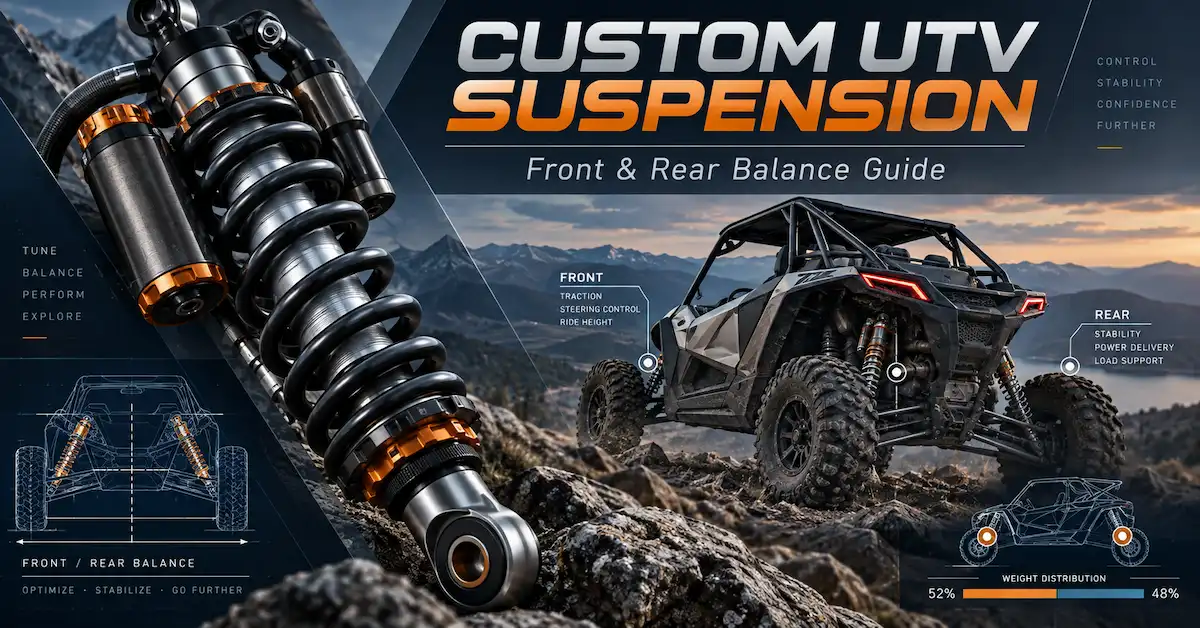
This is why front/rear load distribution should be treated as an important input in a Custom UTV Suspension project.
A useful starting point is:
| Vehicle Condition | Front Load Change | Rear Load Change | Likely Suspension Focus |
|---|---|---|---|
| Front winch + bumper | High | Low | Front spring/damping |
| Rear cargo system | Low | High | Rear spring/damping |
| Four passengers | Medium | High | Both ends / balance |
| Larger tires | Both | Both | Geometry + damping review |
| Heavy battery | Depends on position | Depends on position | Position-specific |
| Full utility build | High | High | Complete suspension review |
This prevents the common assumption that every modified UTV simply needs “heavy-duty rear shocks.”
Start With Front and Rear Axle Loads
For a vehicle-level custom project, axle loads are often more useful than total weight alone.
They help answer:
- How much weight does the front suspension support?
- How much does the rear suspension support?
- Which end changed after modification?
- Is the imbalance permanent or only present when loaded?
Baseline Condition
Measure or estimate the vehicle in its normal production configuration.
Record:
- front axle load;
- rear axle load;
- ride height;
- relevant suspension setup.
Modified Condition
Repeat after installing the planned accessories or vehicle equipment.
The difference tells the engineering team where the load moved.
Operating Condition
Finally, add:
- passengers;
- typical cargo;
- tools;
- equipment.
A utility UTV should be evaluated in the configuration it actually uses—not only as an empty chassis.
Front and Rear UTV Suspension Do Different Jobs
A balanced suspension does not mean identical front and rear shock specifications.
The front suspension may be strongly affected by:
- steering;
- braking;
- front-wheel impacts;
- winches;
- bumpers;
- steering geometry.
The rear suspension may be more influenced by:
- cargo;
- passengers;
- utility equipment;
- towing-related load transfer;
- rear-mounted batteries.
That means Custom UTV Suspension often requires different engineering decisions at each axle.
The goal is coordinated behavior, not identical parts.
Front Accessories Can Create a Hidden Suspension Problem
Many utility builds add equipment to the front first.
Examples include:
- winch;
- brush guard;
- snow equipment;
- heavy bumper;
- front rack;
- work attachments.
This permanent mass can increase front suspension sag.
Possible symptoms include:
- lower front ride height;
- reduced available compression travel;
- increased nose dive;
- more frequent front bottoming;
- steering behavior changes.
A buyer may incorrectly upgrade only the rear because the vehicle also carries cargo.
That can leave the front suspension as the limiting part of the system.
Rear Cargo Requires More Than a Stiffer Rear Spring
Rear load is one of the most common reasons for UTV suspension customization.
BEDO already discusses rear-load development in its custom UTV rear shock guide.
A stronger spring may improve:
- ride height;
- static sag;
- cargo support.
But if the spring is changed substantially, other parameters may also require review.
These can include:
- rebound damping;
- compression damping;
- available shock travel;
- unloaded ride behavior.
A rear spring should therefore not be selected as an isolated component.
Spring Rate Changes Can Alter Vehicle Balance
Imagine the original rear suspension sags badly under cargo.
The buyer installs a much higher spring rate.
Loaded ride height improves—but now the rear may:
- feel harsh when empty;
- return too quickly after compression;
- transfer more motion to the chassis.
The front suspension has not changed.
The overall vehicle may now feel less balanced even though the original sag complaint was reduced.
This is why a Custom UTV Suspension project should consider:
Front Spring + Rear Spring + Front Damping + Rear Damping
as one coordinated system.
Damping Balance Matters During Pitch Motion
UTVs do not move only vertically.
They also pitch forward and backward.
Under Braking
Weight transfers toward the front.
Front compression behavior becomes important.
During Acceleration
Load transfers rearward.
Rear suspension response contributes to chassis control.
Over Large Terrain Changes
The front axle may encounter an obstacle first, followed by the rear.
If the two ends respond very differently, the chassis can feel unsettled.
Front-to-rear damping does not need to be numerically identical.
It should create a coordinated vehicle response for the intended use.
Compression and Rebound Should Be Evaluated at Both Ends
A buyer may identify:
Rear suspension feels too soft.
But the actual vehicle behavior could involve both axles.
For example:
- rear compression may be insufficient;
- front rebound may be too slow;
- spring balance may be mismatched.
BEDO's compression and rebound damping testing guide explains why compression and rebound should be treated separately.
For a balanced UTV setup, they should also be evaluated by axle.
Passenger Layout Changes More Than Total Weight
A four-seat UTV does not simply weigh more than a two-seat UTV.
Passenger position matters.
If rear passengers sit behind the vehicle center, they may increase rear axle loading disproportionately.
BEDO's four-seat UTV suspension guide highlights why passenger number alone is not enough to define the suspension specification.
A useful evaluation should consider:
- number of passengers;
- seating position;
- expected passenger mass;
- cargo carried at the same time.
That information can explain why one suspension end needs a larger revision than the other.
Battery Position Matters in Electric UTVs
Electric UTV development introduces another important variable: permanent battery mass.
A heavier battery may be positioned:
- centrally;
- under seats;
- toward the rear;
- in another chassis location.
Its position can alter axle loading before passengers or cargo are added.
BEDO's electric UTV battery suspension guide explains that battery weight should be evaluated together with its location and the resulting front/rear load distribution.
For electric vehicles, Custom UTV Suspension should therefore start from the completed battery configuration rather than a conventional vehicle weight assumption.
Larger Tires Affect Both Ends of the Suspension
Larger tires are different from cargo because they add mass at the wheels.
Potential effects include:
- increased unsprung mass;
- changed wheel clearance;
- altered effective ride height;
- increased steering loads;
- different response over repeated terrain.
A tire upgrade should therefore trigger a broader review of:
- front suspension;
- rear suspension;
- shock clearance;
- joint angles;
- damping.
Simply increasing spring rate may not address the real change.
Lift Kits and Geometry Changes Require More Caution
A suspension lift can change more than visual ride height.
Depending on vehicle architecture, it can affect:
- shock operating position;
- control-arm angles;
- CV joint angles;
- ball-joint articulation;
- droop;
- available compression travel.
If the modified geometry changes the shock's motion relationship, the original damping behavior may no longer feel the same.
This is one situation where vehicle geometry and CAD information can become important.
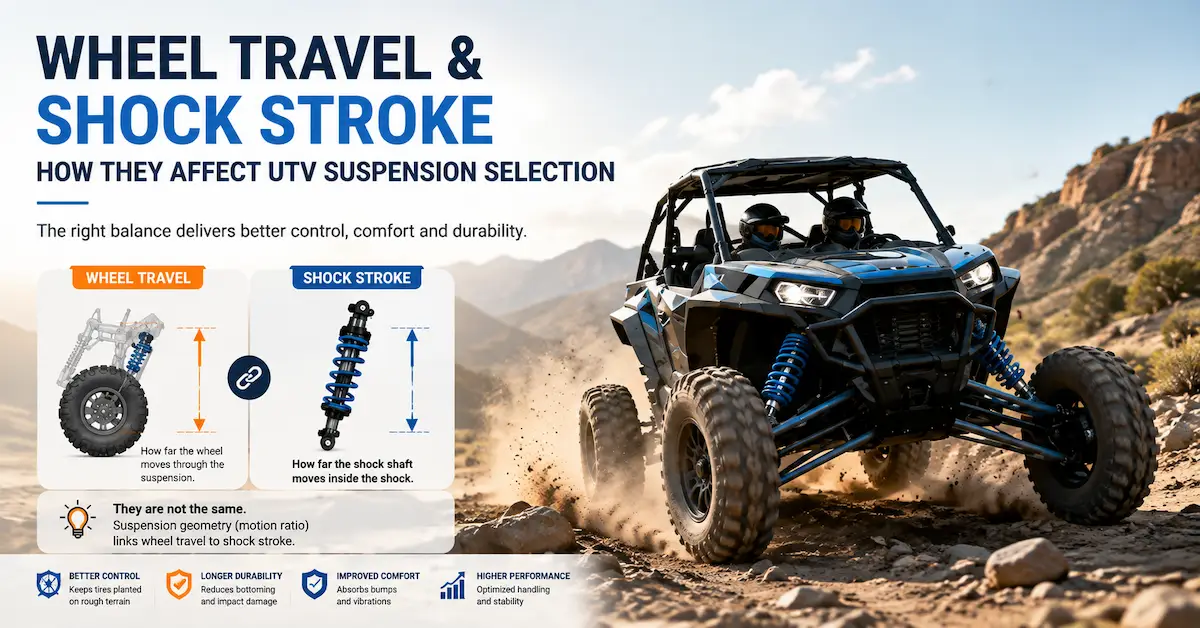
BEDO's UTV suspension design service discusses the connection between shock movement, wheel travel, suspension hard points, and vehicle geometry.
Do You Need to Customize All Four Shocks?
Not always.
A good customization project changes only what the application requires.
Rear-Only Revision May Be Enough When
- permanent change is primarily rear cargo;
- front axle load remains near baseline;
- front ride and handling remain acceptable.
Front-Only Revision May Be Enough When
- a heavy front attachment is installed;
- rear configuration remains standard.
Full-Vehicle Revision Is More Appropriate When
- passenger configuration changes;
- both axles gain significant accessories;
- tire/wheel package changes substantially;
- geometry changes;
- vehicle is being developed from a new platform.
The objective should be minimum necessary engineering change, not maximum parts replacement.
Build Three Validation Conditions
A Custom UTV Suspension setup should rarely be validated at only one load condition.
Use at least three representative conditions where applicable.
Light Condition
Example:
- driver only;
- little cargo.
Check:
- comfort;
- excessive stiffness;
- wheel compliance.
Normal Working Condition
Example:
- common passenger configuration;
- normal tools/cargo.
This is often the most important setup.
Maximum Intended Condition
Example:
- full passenger load;
- expected maximum working cargo.
Check:
- sag;
- remaining travel;
- bottoming;
- vehicle balance.
A custom suspension that only works at maximum payload may disappoint users during normal operation.
Measure Front and Rear Ride Height Together
Ride-height measurements can reveal imbalance before dynamic testing begins.
Record:
- front ride height unloaded;
- rear ride height unloaded;
- front normal-load height;
- rear normal-load height;
- maximum-load condition.
The objective is not to force both ends to have the same numeric sag.
Different vehicle architectures require different setups.
The purpose is to identify unexpected changes or excessive loss of usable travel.
A Practical Front-to-Rear Validation Matrix
| Test Condition | Front Check | Rear Check | Whole-Vehicle Check |
|---|---|---|---|
| Empty/light | Compliance | Compliance | Ride attitude |
| Normal load | Sag/control | Sag/control | Balance |
| Max load | Travel reserve | Travel reserve | Stability |
| Braking | Compression | Chassis support | Pitch |
| Acceleration | Front recovery | Rear support | Pitch |
| Repeated bumps | Rebound recovery | Rebound recovery | Chassis settling |
| Articulation terrain | Wheel control | Wheel control | Traction |
This kind of test matrix is more valuable than asking whether a shock simply feels “better.”
Do Not Tune Around One Extreme Scenario
A utility buyer may say:
The vehicle sometimes carries maximum cargo.
If that condition occurs only occasionally, optimizing the entire suspension solely around maximum load may create poor everyday ride quality.
The design target should consider:
- how often the vehicle is unloaded;
- how often it carries normal cargo;
- how often it reaches maximum load.
This is the vehicle's operating envelope.
Custom suspension should work across that envelope as effectively as practical.
When Adjustable Shocks Become Useful
Adjustable damping can be helpful when one vehicle has genuinely different operating modes.
For example:
Mode A
Light recreational use.
Mode B
Loaded utility operation.
Adjustment may provide additional flexibility between those conditions.
However, adjustability does not eliminate the need for correct:
- spring rate;
- fitment;
- shock stroke;
- geometry.
The base suspension still needs to be appropriate.
Prototype Changes Should Be Isolated Where Possible
If the first prototype has poor front-to-rear balance, avoid changing every variable simultaneously.
For example, if rear sag is excessive:
- confirm rear load;
- review rear spring;
- validate ride height;
- then assess damping balance.
If spring and damping are changed together immediately, it becomes harder to understand which modification caused the improvement.
Controlled iteration produces better engineering data.
Test Changes Using the Same Vehicle Configuration
Prototype comparison becomes unreliable when the vehicle itself changes between tests.
Keep consistent where possible:
- tire size and pressure;
- passenger weight;
- cargo;
- accessory configuration;
- terrain;
- speed;
- preload baseline.
Then compare:
Prototype A vs Prototype B
under the same conditions.
This is especially important for OEM programs.
When Should CAD Be Used?
Not every Custom UTV Suspension project requires complete CAD data.
A simple spring or damping revision may start from:
- samples;
- dimensions;
- vehicle data.
CAD becomes more valuable when the project involves:
- new mounting locations;
- reservoir packaging;
- larger suspension travel;
- lift geometry;
- new chassis;
- limited clearance.
The level of engineering data should match the level of customization.
OEM vs Aftermarket Custom UTV Suspension
The development goal may also differ by customer type.
OEM Vehicle Project
Usually prioritizes:
- complete vehicle balance;
- CAD and geometry;
- production-ready specification;
- long-term repeatability.
Aftermarket Upgrade
May prioritize:
- fitment with known vehicle platforms;
- improved operating range;
- installation simplicity;
- private-label differentiation.
Modification Factory
Often deals with:
- non-standard accessories;
- larger tires;
- lifts;
- additional equipment.
The same phrase—Custom UTV Suspension—can therefore describe different engineering scopes.
How Should Buyers Define the Project Scope?
Before requesting a quotation, classify the project.
| Customization Level | Typical Scope |
|---|---|
| Appearance | Color, logo, finish |
| Dimensional | Length, mounts, packaging |
| Load adaptation | Springs, preload range |
| Performance | Compression/rebound tuning |
| Vehicle rebalance | Front + rear spring/damping |
| Geometry development | CAD, travel, new mounting |
This prevents quotations from different suppliers from representing completely different levels of work.
BEDO's UTV customization data guide similarly distinguishes basic dimensional customization, performance customization, and vehicle-level development.
What Should Be Included in a Front/Rear Balance RFQ?
For this type of Custom UTV Suspension project, provide:
- Vehicle model or project code
- Curb weight
- Front axle weight
- Rear axle weight
- Passenger layout
- Typical passenger load
- Typical cargo
- Maximum cargo
- Front accessories
- Rear accessories
- Battery weight and position
- Tire/wheel setup
- Lift or geometry modifications
- Front shock dimensions
- Rear shock dimensions
- Front spring information
- Rear spring information
- Available travel
- Current suspension symptoms
- Target use
- Typical terrain
- Prototype requirements
- Expected production quantity
Instead of saying:
We need Custom UTV Suspension.
A better inquiry is:
The vehicle has gained 45 kg at the front from a winch and bumper and approximately 110 kg at the rear from permanent equipment. With two passengers, the rear sits low and the front feels harsh over repeated bumps. We can provide axle-load data, front/rear shock samples, and mounting dimensions.
That gives the suspension manufacturer a real engineering problem to evaluate.
How BEDO Supports Custom UTV Suspension Projects
BEDO supports shock absorbers, suspension springs, and customized suspension development for UTV, ATV, motorcycle, electric motorcycle, and other off-road applications.
Depending on project scope, buyers can begin with:
- vehicle and axle-load data;
- existing shock samples;
- drawings;
- CAD;
- front/rear suspension dimensions;
- spring specifications;
- damping requirements;
- target operating conditions.
For projects involving a broader vehicle redesign, buyers can also review BEDO's UTV suspension design service and current suspension products.
FAQ
What is Custom UTV Suspension?
Custom UTV Suspension is a suspension setup developed or modified around a specific UTV's vehicle weight, front/rear load distribution, geometry, accessories, passengers, cargo, terrain, and performance target.
Should front and rear UTV shocks have the same spring rate?
Not generally. Front and rear suspension positions often support different loads and perform different vehicle-control functions.
Do I need to upgrade all four shocks after adding cargo equipment?
Not necessarily. If the load change is primarily at the rear and front suspension behavior remains appropriate, a rear-focused revision may be sufficient.
Can a heavy front winch affect UTV suspension?
Yes. A winch, steel bumper, or front equipment can increase front axle load and change sag, ride height, available travel, and braking behavior.
Why did my UTV become harsh after installing heavy-duty rear springs?
The new spring may be too stiff for light-load operation, or rebound/compression damping may no longer be balanced with the spring.
Can larger tires require suspension retuning?
Yes. Larger tires can change unsprung mass, clearance, suspension loads, and vehicle response.
Does an electric UTV require different suspension?
It can. Battery weight and location may significantly alter permanent axle loads and therefore spring and damping requirements.
Is adjustable damping useful for a utility UTV?
It can be useful when the vehicle regularly operates under very different conditions, but correct spring rate, stroke, geometry, and fitment are still required.
Is CAD necessary for Custom UTV Suspension?
Not always. Simple projects can begin from samples, dimensions, and vehicle data. CAD becomes more useful when mounting, geometry, travel, or packaging changes substantially.
What information should I send for a custom UTV suspension quotation?
Provide vehicle weight, front/rear axle loads, passengers, cargo, accessories, tire setup, geometry changes, shock and spring data, terrain, current problems, and target operating conditions.
Conclusion
Effective Custom UTV Suspension should restore balance across the whole vehicle after passengers, cargo, batteries, accessories, tires, or geometry change—not simply make one end stiffer. Front and rear axle loads, spring support, damping, travel, and real operating conditions should be evaluated together.
For an OEM, aftermarket, or modified UTV project, send your axle-load data, shock samples, drawings, CAD, and vehicle configuration through the BEDO Contact Us page for technical review.