
What Should Distributors Check Before Buying Aftermarket ATV Suspension?
Before placing a bulk order, check vehicle-specific fitment, spring and damping specifications, sample-validation records, complete package contents, pricing units, replenishment conditions, and product traceability. Make the purchasing decision for each stock-keeping unit, or SKU, rather than assuming that approval of a supplier covers its entire catalog. BEDO’s ATV shock absorber supplier selection guide addresses the broader manufacturer evaluation. The checks below focus on the next decision: whether the particular product, packaging, documentation, and commercial arrangement are ready for your distribution business. A supplier can be suitable while an individual product still requires additional approval.
Define Whether You Are Buying Replacement Parts or an Upgrade
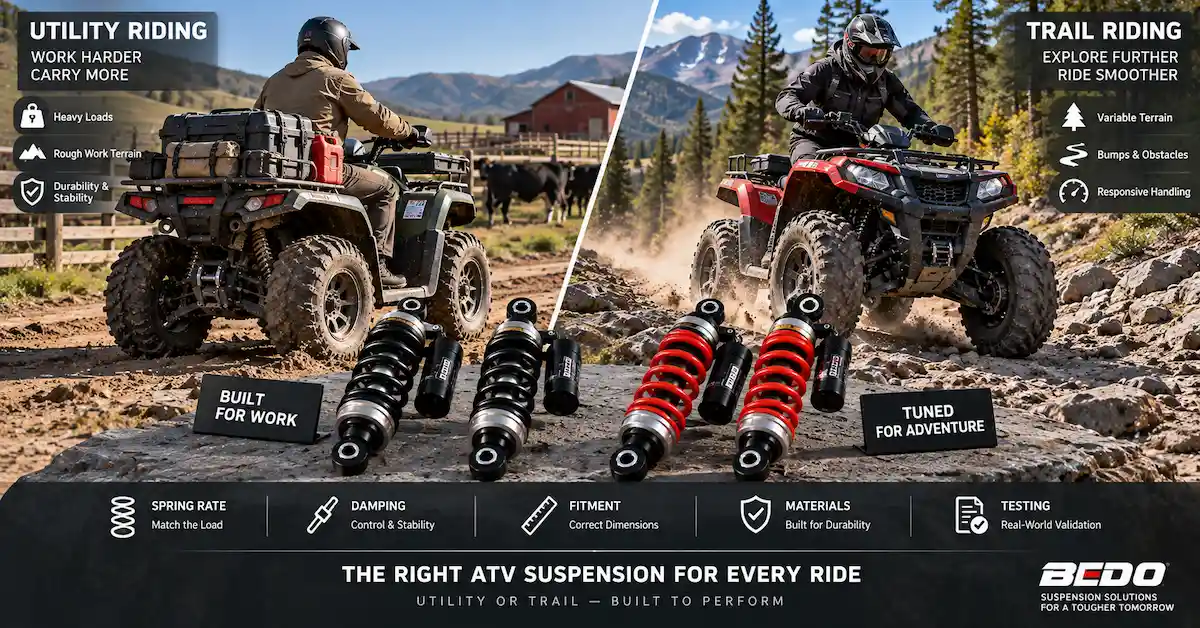
Separate replacement-oriented products from products intended to change vehicle behavior. A replacement program needs a clearly established application and specification; an upgrade program also needs a defined performance objective and validation plan. For a utility ATV, document working loads and accessories. For recreational trail use, describe the expected rider-load range and terrain. A lifted or otherwise modified vehicle should be reviewed separately from the standard configuration. BEDO’s aftermarket ATV suspension guide makes this distinction between replacement, upgrade, and modified-vehicle projects. For distributors, importers, and private-label buyers, the practical starting point is a written scope: identify whether you are ordering complete shock assemblies, separate springs, or a specifically defined kit—not an unspecified “suspension system.”
Verify Fitment Before Creating Dealer Listings
Build the application record around the exact vehicle model, year, variant, installation position, and approved configuration. Keep the supporting drawing and measurement references attached to that record. BEDO’s shock absorber measurement guide explains why length alone cannot establish compatibility: mounting widths, orientation, compressed dimensions, and surrounding clearance also matter. Use the following as a specification-request checklist. It identifies information to confirm, not universal dimensions or acceptance limits.
| Specification area | Information to request before approval |
|---|---|
| Vehicle application | Make, model, year, variant, installation position, and relevant modifications |
| Length references | Extended and compressed dimensions with defined measurement points |
| Travel | Effective stroke and intended movement limits |
| Mounting interfaces | Upper/lower hole diameters, widths, sleeves, bushings, and orientation |
| Installation clearance | Body and spring dimensions, surrounding space, and reservoir clearance where applicable |
| Spring specification | Dimensions, rate with complete units, preload requirements, and intended loading |
| Performance specification | Compression/rebound requirements, adjustment function, and evaluation conditions |
| Controlled documents | Drawing revision, specification revision, sample reference, and approval status |
Use Model Comparisons to Detect False Interchangeability
BEDO’s AU_HSA_03 and AU_HSA_04 show why apparently similar shocks should not be combined into one application listing. Both product pages specify a 42 mm cylinder outer diameter, 10 mm upper and lower mounting holes, rear installation, and fixed damping. Their lengths, strokes, and mounting widths nevertheless differ. The table below reproduces selected published specifications for screening; it does not establish vehicle-specific compatibility.
| Published specification | AU_HSA_03 | AU_HSA_04 |
|---|---|---|
| Installation position | Rear | Rear |
| Total length | 445 mm | 345 mm |
| Effective stroke | 130 mm | 80 mm |
| Cylinder outer diameter | 42 mm | 42 mm |
| Upper/lower mounting-hole diameter | 10 / 10 mm | 10 / 10 mm |
| Upper/lower mounting width | 30 / 35 mm | 32 / 30 mm |
| Adjustable damping levels | None | None |
The shared hole diameter does not override the other differences: published total length differs by 100 mm, effective stroke by 50 mm, and both mounting-width combinations are different. For your catalog, retain separate product records unless a complete engineering review establishes otherwise. Also preserve the page terminology: “total length” is not automatically a confirmed eye-to-eye measurement, and cylinder outer diameter is not piston diameter. Request a dimensioned drawing before transferring these fields into dealer technical sheets.
Match Spring and Damping Requirements to the Intended Customer
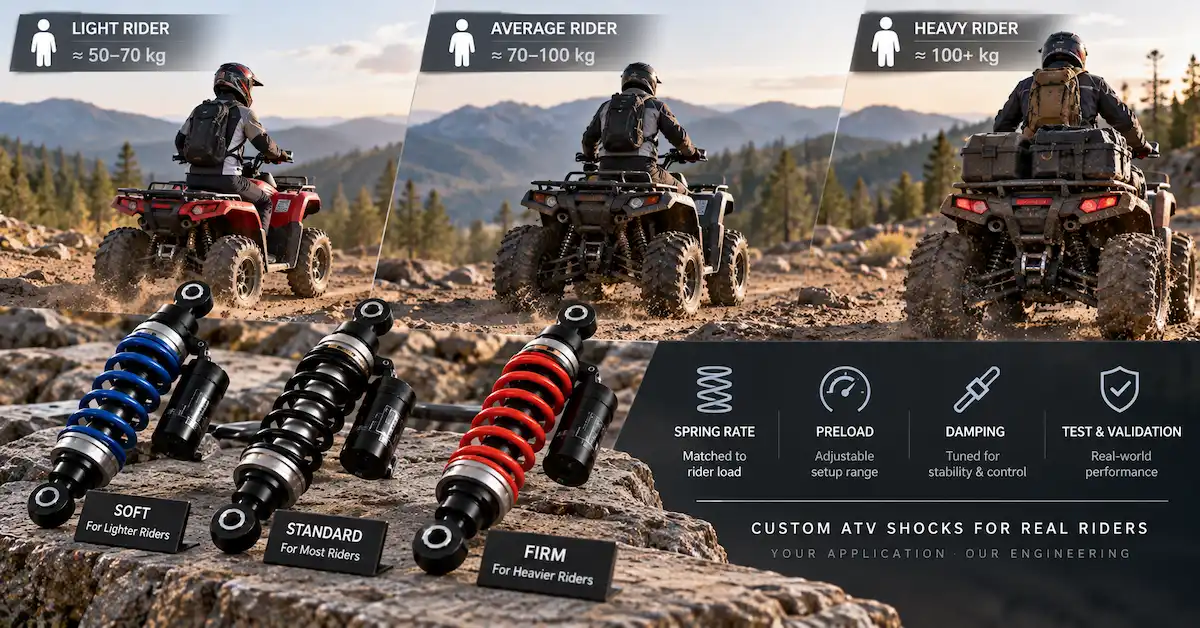
For each aftermarket ATV suspension product, write down the operating conditions against which it will be evaluated. A useful brief identifies the vehicle configuration, rider and cargo loads, terrain, and the behavior the product is intended to maintain or change. Request spring information with complete units and a defined load–deflection relationship, along with compression and rebound requirements under stated test conditions. Avoid translating an unexplained spring marking into a rider-weight recommendation or treating a larger damping-force number as proof of a better product. BEDO’s aftermarket engineering guidance emphasizes matching the spring and damping specification to the vehicle and intended use rather than applying one setting to every customer.
Review Materials, Sealing, and Production Inspection
The two compared product pages identify aluminum alloy and steel pipe, but these descriptions do not specify every material grade or manufacturing requirement. For the ordered configuration, request the applicable material specifications, surface-treatment requirements, critical dimensions, and inspection criteria. Ask the supplier to explain where incoming-component inspection, machining checks, assembly control, leakage checks, and final inspection occur, as applicable to the design. BEDO’s ATV shock absorber production guide outlines these manufacturing and inspection areas. For sandy, muddy, or coastal applications, agree the relevant exposure and validation conditions instead of accepting an undefined “rust-proof” claim as a test result. Confirm which records will accompany the order and which are available for review.
Approve Test Evidence for the Configuration You Will Stock
A test report should be traceable to the product being approved. Request the part number, drawing revision, spring and damping configuration, test conditions, acceptance criteria, and results. BEDO’s shock absorber testing guide discusses dimensional, damping, leakage, load, durability, temperature, and vehicle testing; the appropriate combination depends on the project. Distinguish development testing from routine production inspection and agree who performs each activity. Request current quality-system documents separately, checking their company name, location, scope, and validity. For a new or modified product, establish the sample and pilot-batch approval plan before committing to launch inventory. Do not treat one accepted prototype or a general factory certificate as approval of every configuration in an order.
Define Exactly What One Saleable Unit Contains
For your purchasing file, create a contents list for the unit your dealer will actually receive. Specify whether it contains one shock, a pair, or a larger kit, and identify every supplied spring, sleeve, bushing, spacer, fastener, and instruction sheet. Clearly state which parts are not included and which existing vehicle components must be retained under the approved installation instructions. Check the commercial quantity against this definition: ten individual shocks represent five two-shock packages, not ten pairs. Where your warehouse will assemble retail kits, agree the component references and matching requirements before ordering the separate items. Make the same contents list govern the quotation, purchase order, packing specification, warehouse record, and dealer description.
Approve Packaging and Private-Label Details Separately
BEDO’s OEM ATV shock absorber program lists customization options for valving, spring rates, finishes, and branding. For a private-label order, maintain separate approvals for the technical product, artwork, and packaging. Request a packed sample showing how the assembly and loose hardware are restrained and protected. Check product codes, quantities, installation position, application wording, barcode requirements where applicable, and the approved instruction version. Match dealer photographs to the configuration supplied rather than using a similar-looking development sample. Before providing proprietary artwork or drawings, agree their permitted use and any requested exclusivity. Branding approval should identify the product; it should not replace engineering approval or expand an unverified fitment claim.
Check MOQ, Production Allocation, and Replenishment Timing
An aftermarket ATV suspension launch order and its later replenishment orders may require different quantities. Ask for minimum order quantities by model and relevant variant, including spring specification, finish, and packaging. Confirm whether models can be combined and whether a low-volume reorder uses the same conditions as the initial order. BEDO’s low-volume shock absorber development guide describes small-batch projects and staged development, but exact quantities and delivery arrangements require project confirmation. Request separate timing for samples, revisions, production after approval, inspection, and shipment. Ask what production allocation is available for your actual product mix, and distinguish factory completion from arrival at your warehouse before communicating availability to dealers.
Compare Costs on the Same Product and Packaging Basis
Normalize every quotation before comparing prices. A price per bare shock cannot be compared directly with a price per packaged pair containing mounting hardware. Separate recurring product costs from engineering, samples, tests, tooling or fixtures where required, branding, packaging, and transport. BEDO’s OEM customization process identifies development work, materials, components, finishes, and manufacturing complexity as cost considerations. For an internal comparison, allocate the agreed order costs across the number of complete saleable units, using the same delivery scope for each quotation. Record exclusions and unresolved costs rather than assigning invented allowances. A lower quoted unit price should not win automatically when it represents a different specification, package, or level of validation.
Agree on Batch Identification, Changes, and Returns
Before the first order, decide how a product received from a dealer will be connected to its production batch and approved specification. Request a method for linking product identification, drawing revisions, inspection records, and component changes. BEDO’s repeat-production guide, written for UTV programs, describes these traceability and change-control questions; they are also useful questions to ask for an ATV order without assuming the two applications share specifications. For your return process, record the reported issue separately from its eventual cause: an installation complaint, missing part, shipping damage, and suspected functional defect should not automatically receive the same diagnosis. Agree the reporting evidence, investigation responsibilities, response arrangements, and available remedies. Keep disputed stock identifiable while the issue is assessed.
Use Three Release Points Instead of One General Approval
A practical distributor-side approach is to separate bulk-order approval, shipment release, and release to dealers. The proposed checklist below is an internal purchasing control, not a claim that every supplier already follows this exact procedure. Assign responsibility for each stage and keep unresolved items visible. Warehouse receiving checks should confirm that the agreed shipment arrived; they should not be used as a substitute for the engineering validation required before the product was purchased.
| Release point | Records to have in place | Reasons to hold release |
|---|---|---|
| Before the bulk order | Approved application and specification, required sample evidence, kit contents, quotation scope, and purchasing terms | Unverified fitment, undefined acceptance criteria, or unclear saleable quantity |
| Before shipment | Agreed inspection results, batch identification, approved labels and packaging, and reconciled quantities | Undocumented configuration changes, mismatched labels, or missing inspection evidence |
| Before dealer supply | Receiving checks, complete kit contents, batch-linked inventory, and matching catalog information | Missing hardware, damaged stock, identification differences, or unsupported application wording |
Prepare an Order-Ready Inquiry for BEDO
Ningbo Bedo Auto Parts Co., Ltd. manufactures shock absorbers and springs and describes professional design support, customization, and small-batch ordering in its company profile. Its drawing-based suspension development service also covers customer drawings, CAD files, existing samples, engineering review, prototypes, testing support, and production preparation. For an aftermarket ATV suspension inquiry, provide your intended applications, available technical records, proposed retail configuration, launch quantities, and replenishment expectations. Ask BEDO to distinguish suitable existing products from items requiring modification or further development, then request a quotation that identifies the sample scope, open technical questions, included services, and approval milestones.
Frequently Asked Questions
Is a Vehicle Name Enough to Approve Fitment?
No. Request the specific model, year, variant, installation position, and supporting product information. BEDO’s OEM ATV program asks buyers to provide model and year details when discussing part-number references and project requirements.
Can Standard Fitment Information Be Used for a Modified ATV?
Do not extend the application automatically. Identify the modifications and request a separate review of mounting, clearance, load, and movement requirements before including that configuration in the approved listing.
Can Spring Color Be Used as a Load Rating?
Use the documented spring specification rather than appearance. Record any supplier-defined color code only when it is supported by a controlled specification, and keep cosmetic color options separate from technical load recommendations.
Can I Buy Individual Shocks and Package Them as Pairs?
Confirm the required configuration and matching criteria first. Define the part numbers, technical versions, supplied hardware, and intended application of the packaged pair rather than selecting two components solely because they look alike.
How Many Samples Should a Distributor Request?
Agree the quantity around the configurations and evaluations involved. Identify which samples are needed for installation, functional testing, durability work, and retained references; do not substitute an arbitrary sample count for a validation plan.
Can Different Models Be Combined to Meet an MOQ?
Ask the supplier to confirm this in the quotation. Record whether the minimum applies to the total order, each model, or each technical and packaging variant. Do not assume that a mixed order satisfies every minimum.
Should Factory Lead Time Include Shipping?
Define the milestones separately: approval, manufacturing completion, inspection release, dispatch, and expected arrival. Ask the quotation to state which period it covers so the purchasing team and dealers do not interpret the same date differently.
Can Private-Label Artwork Be Approved While Testing Continues?
Artwork can be reviewed as a separate task, but keep its status distinct from technical approval. Do not treat a finished carton design as permission to release an unvalidated product for sale.
What Evidence Should Dealers Submit with a Product Complaint?
Request the order or batch reference, vehicle details, installation information, photographs, operating conditions, and a clear description of the issue. Use the agreed investigation process before assigning a cause or promising a remedy.
What Should Prevent a Bulk Purchase from Being Released?
Keep the affected item on hold when fitment remains unverified, acceptance requirements are undefined, kit contents are unclear, or the proposed production configuration differs from the approved one without review. Resolve essential technical questions before weighing commercial incentives.
Conclusion
Before buying aftermarket ATV suspension, distributors should establish exactly what they will stock, which applications it covers, what evidence supports approval, and how later deliveries will remain identifiable and consistent. Check the complete saleable product—not only the shock absorber in the sample photograph—and connect technical approval with kit contents, dealer information, purchasing terms, and return procedures. To discuss a BEDO order, submit your aftermarket ATV suspension requirements, including target vehicles, drawings or samples, intended use, packaging configuration, and purchasing forecasts. Request an item-by-item technical review and a defined sample proposal before committing to bulk inventory.