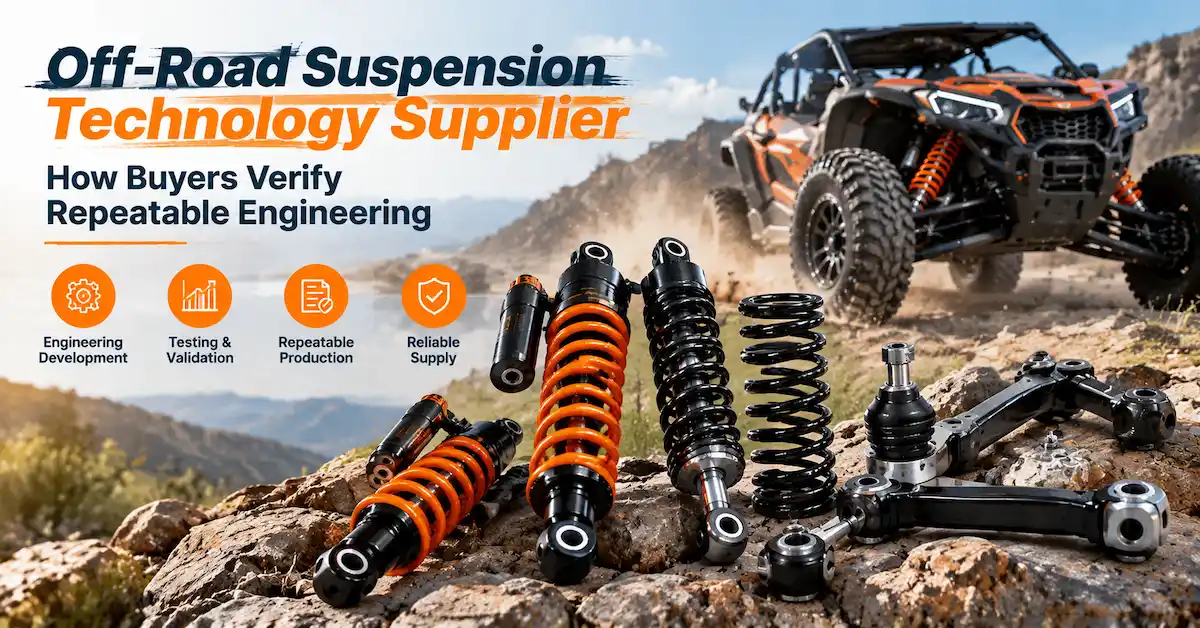

How do buyers evaluate a shock absorber tuning factory?
Direct answer: evaluate a shock absorber tuning factory by asking whether it can define, measure, tune, validate, and reproduce the complete suspension configuration for a named vehicle. The review should cover geometry, loads, spring rate, preload, damping direction and speed, temperature, adjustment range, vehicle test conditions, production tolerances, change control, and service identity.
A factory that only quotes a body length or a catalogue photograph has not yet demonstrated tuning capability. A credible response separates a published reference from a project proposal, states missing information, gives a prototype and test path, and explains how an approved damper setting becomes a repeatable production record.
This guide is for OEM purchasing teams, powersports brands, electric motorcycle companies, ATV and UTV importers, aftermarket suspension brands, vehicle retrofitters, and distributors comparing a shock manufacturer with a true engineering and tuning partner. The single procurement problem is supplier qualification: can this Shock absorber tuning factory own the technical loop from customer brief to production?
Ningbo Bedo Auto Parts Co., Ltd. publicly presents itself as a manufacturer in Ningbo, Zhejiang, China, focused on shock absorbers and suspension springs for motorcycles, ATVs, UTVs, and related off-road applications. Its public company information describes custom solutions, design support, small-batch ordering, a 2009 establishment, ISO9001 certification history, and global export activity. These facts support an initial audit. They do not confirm that every current program uses the same equipment, process boundary, test method, MOQ, lead time, or warranty terms.
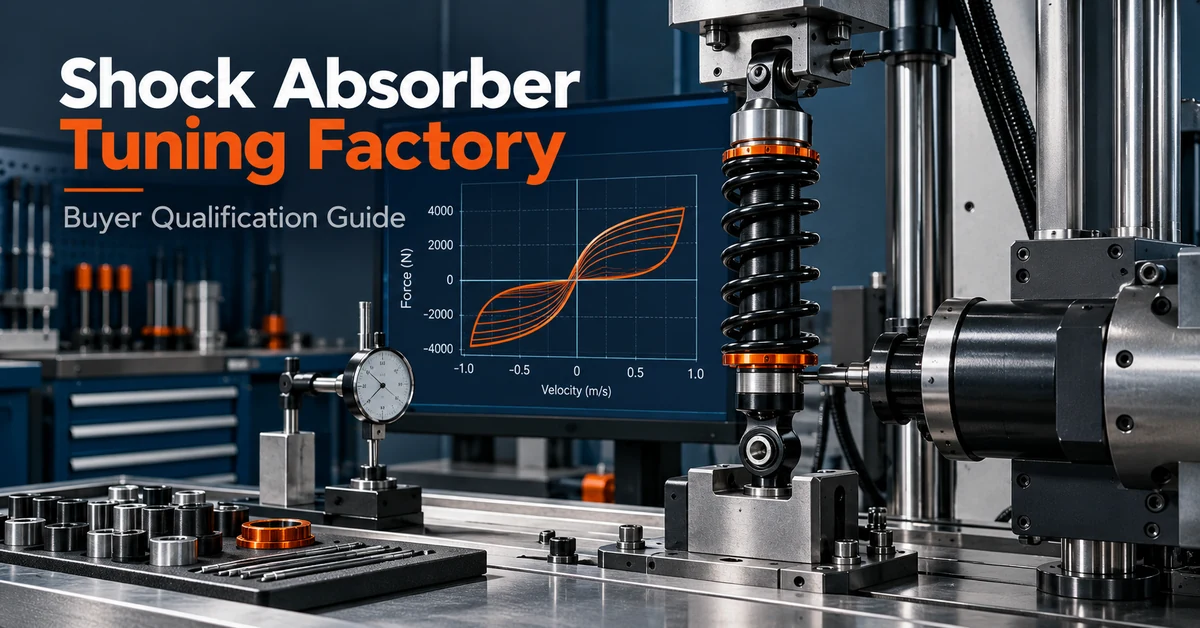
Define tuning scope before comparing factory quotations
"Tuning" can mean different services. It may be a fixed damper setting for one OEM vehicle, a spring and shock package for an aftermarket kit, an adjustable damper with a marked baseline, a replacement part matched to an existing fitment, or a full development program that includes geometry review and vehicle testing. These scopes should not be compared on the same unit-price line.
| Tuning scope | Typical deliverable | Question for the factory |
|---|---|---|
| Catalogue fitment review | Existing part, nominal dimensions, and application confirmation. | Which model, year, position, load state, and revision are included? |
| Fixed damping tune | Spring, damper force target, baseline, and vehicle validation. | Which bench conditions and vehicle states define approval? |
| Adjustable damper tune | Adjustment range, clicks, baseline, setting map, and instructions. | Are settings repeatable and supported by data or only by labels? |
| New platform development | Input review, prototype, test matrix, design revision, and pilot plan. | Who owns geometry, spring, damper, testing, and change approval? |
| Private label supply | Approved configuration, label, carton, hardware, and replenishment control. | How are parts and service replacements traced to the approved revision? |
A clear scope prevents a common commercial failure: a supplier offers a low price for a physical shock while the buyer expects engineering, test support, private-label packaging, and future revisions to be included. Ask the factory to state included and excluded work in the first quotation.
Audit the factory's engineering inputs
A shock absorber tuning factory should ask questions before proposing a setting. At minimum, it needs vehicle identity, installation position, extended and compressed dimensions, available stroke, mount geometry, spring requirement, axle loads, rider or passenger condition, cargo or battery condition, tire and wheel data, environment, intended speed, and the behavior the customer wants to change. If a supplier does not ask for these inputs, the buyer should treat the first setting as a provisional sample rather than a finished tune.
Geometry and interface
Provide the shock length at full droop, ride height, and full bump. Record the physical stroke, wheel travel, motion ratio, mounting angle, hole diameter, mounting width, sleeve or bushing, thread, spring seat, reservoir clearance if applicable, and contact zones at steering lock or articulation. A part can have a correct total length and still lose usable wheel travel or strike a frame, battery, tire, or body panel.
Load and use
Separate curb, rider, passenger, cargo, battery, accessory, and maximum conditions. State whether the vehicle is for recreation, farm work, resort transport, utility, delivery, competition, or mixed use. The same shock may feel acceptable in a single-rider road condition and under-damped when a passenger and cargo are added. The tuning request should name which states must be supported and which are outside the approval boundary.
| Factory audit input | What a complete answer contains | Warning sign |
|---|---|---|
| Vehicle | Platform, year, market, position, side, tire, wheel, accessories, and drive layout. | The supplier treats a model name as the entire specification. |
| Mounting | Length, stroke, holes, widths, sleeves, angles, thread, and clearance. | Only overall length is quoted. |
| Spring | Rate, free length, installed length, preload, sag, and load state. | "Heavy duty" replaces a spring proposal. |
| Damping | Direction, velocity, temperature, setting, curve, and tolerance. | Only maximum force or an adjective is supplied. |
| Validation | Bench method, vehicle route, load, speed, tire, symptom, and acceptance. | "Tested" appears without conditions or records. |
Verify the difference between a feature and a tuning result
Reservoirs, adjustment knobs, threaded bodies, painted springs, billet collars, and multiple click positions are features. They can be valuable, but they do not by themselves prove that a vehicle is tuned. The buyer should ask what problem the feature solves, what installation space it needs, how it is adjusted, how it is inspected, and what evidence supports the chosen range.
For example, an adjustable rebound circuit can help cover rider and cargo variation when its baseline and limits are understood. It can also create confusion if the detents are not consistent or if a customer cannot return to the approved starting point. A reservoir may help oil volume or heat management in a demanding duty cycle, but its value depends on the actual space, hose routing, service access, and thermal requirement. The supplier should map the feature to a use case.
| Feature | Potential value | Evidence to request |
|---|---|---|
| Rebound adjustment | Changes recovery response for defined load or terrain conditions. | Setting map, direction, detent check, baseline, and vehicle result. |
| Compression adjustment | Changes impact support or compliance under a defined circuit. | Low- and high-speed definitions, force data, and vehicle validation. |
| Threaded spring seat | Allows a defined preload or ride-height adjustment. | Range, lock method, spring coil clearance, and installed measurement. |
| Remote reservoir | May support oil volume or packaging for a specific duty cycle. | Mounting space, routing, heat evidence, service, and leak control. |
| Private label | Creates a traceable aftermarket or OEM service identity. | Label proof, part number, carton, barcode, revision, and change rule. |
Public reference boundary: BEDO product pages publish examples of shock absorber fields such as total length, effective stroke, spring rate, rebound and compression values, adjustment levels, mounting holes, widths, materials, and application category. These fields show how a technical RFQ can be structured. They are not a promise that one published configuration is suitable for an unidentified vehicle or that every factory project has the same setting, tolerance, or test result.
Review the factory's bench and vehicle test method
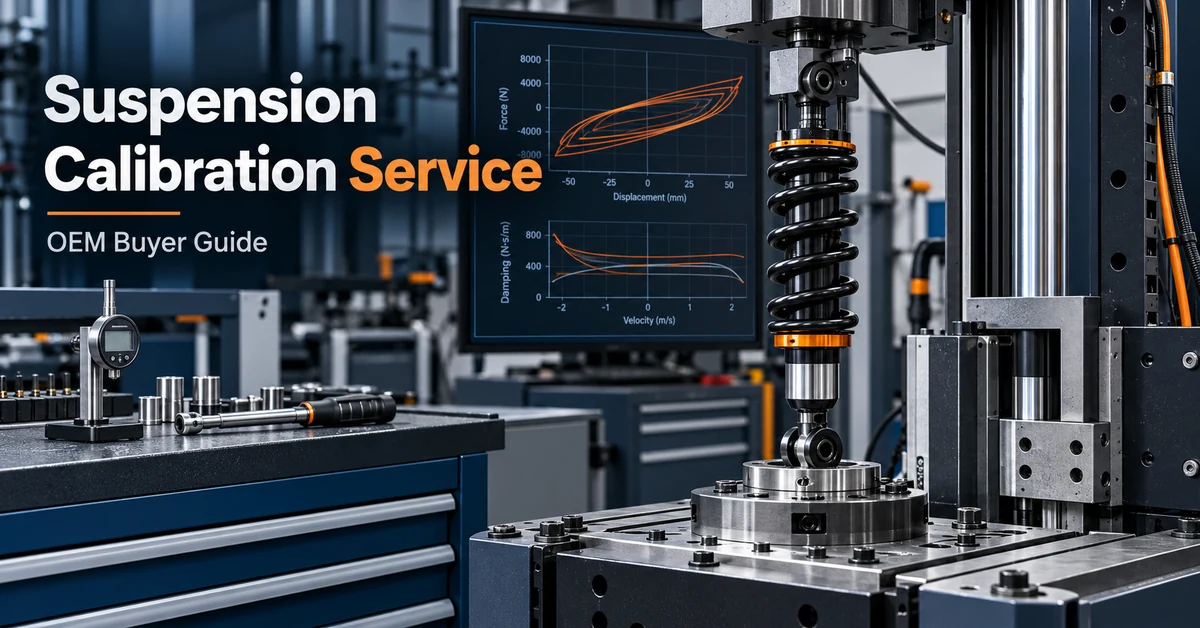
A tuning factory should be able to explain both component and vehicle validation. Bench data helps compare revisions and detect manufacturing drift. Vehicle testing explains whether the selected force response produces the desired ride, control, traction, clearance, and recovery under the intended platform. Neither replaces the other.
Bench data that can be compared
Ask for force in the relevant direction at named velocities, temperature, stroke, cycle, adjustment position, and measurement accuracy. If the damper is adjustable, repeat several settings and record the detent or click position. If the comparison is between samples, test them under the same conditions. A chart without units, temperature, direction, or setting identity is difficult to audit and easy to misinterpret.
Vehicle data that explains customer value
Record vehicle mass state, rider or driver, passenger, cargo, battery, tire pressure, wheel, route, speed, surface, ambient condition, and adjustment. Write the original symptom and the observed result separately. "More comfortable" may mean less high-frequency harshness for one rider and slower body control for another. Use a short rating scale plus measurable observations such as ride height, sag, bottoming events, recovery, tire contact, or steering stability.
| Test layer | Required condition | Evidence for release |
|---|---|---|
| Dimensional | Part number, revision, lengths, stroke, mount, spring, thread, and hardware. | Inspection record and fitment approval. |
| Spring | Rate, load-deflection, installed length, preload, sag, and reserve. | Approved spring identity and setup range. |
| Damper bench | Direction, velocity, temperature, setting, cycle, and instrument status. | Force curve, tolerance, and repeatability decision. |
| Static vehicle | Axle loads, ride height, bump, droop, articulation, and clearance. | No interference and acceptable static position. |
| Dynamic vehicle | Route, speed, tire, load, operator, weather, and target symptom. | Accepted behavior or defined iteration. |
| Pilot repeatability | Multiple parts, final packaging, label, and inspection method. | Production release or corrective action. |
If the buyer needs a certified laboratory method or a specific durability standard, that requirement belongs in the RFQ. The factory should confirm whether it can perform the test internally, arrange a third party, or provide only a development recommendation. This makes the evidence boundary clear.
Check materials, finish, seals, and environment
Off-road and powersports shocks see water, mud, dust, salt, wash-down, vibration, temperature changes, impact, and long storage. A tuning result is not credible if the physical specification cannot survive the intended environment. Ask which material and finish are proposed for the body, rod, spring, mounts, spacers, fasteners, and protective parts. Ask how seals and oil containment are checked, and which corrosion or environmental evidence is actually available.
Do not translate "waterproof," "rust-proof," or "all-weather" into a test rating without a method and acceptance limit. The correct questions are: what exposure, what duration, what temperature, what contamination, what inspection, and what failure limit? If a market needs a certification or a named standard, write it into the project scope before the sample.
| Risk area | Buyer question | Factory record |
|---|---|---|
| Rod and seal | How is contamination, leakage, and surface damage controlled? | Material or finish definition, inspection, leakage check, and service boundary. |
| Body and spring | What protects the part in water, salt, mud, or storage? | Finish, coating, spring treatment, exposure method, and acceptance. |
| Mounting hardware | How are bushing, sleeve, hole, and fastener variations controlled? | Drawing, tolerance, material, torque instruction, and incoming check. |
| Heat and duty | What cycle and temperature represent the intended route? | Test conditions, oil or damper behavior, recovery, and recheck plan. |
Audit quality control and repeat-production discipline
Factory capability is not only a machine list. It is the ability to hold the approved configuration when volume, supplier changes, operator changes, and packaging demands increase. Ask for the control plan from incoming material to final packing. It should identify critical dimensions, spring identity, damping or movement checks, leakage or appearance checks where applicable, label and revision control, nonconforming product handling, and retained records.
Change control is especially important for a tuning program. A different spring supplier, piston, seal, coating, bushing, or adjustment part may change the vehicle result even when the overall appearance remains the same. The buyer should define which changes require notice, approval, remeasurement, bench retest, vehicle retest, or a new part number.
| Audit point | Evidence to request | Release question |
|---|---|---|
| Document control | Drawing, BOM, setting map, inspection sheet, revision, and approval record. | Can production identify the exact approved configuration? |
| Incoming control | Component identity, material or finish evidence, and supplier record. | Can an unapproved change be detected before assembly? |
| Assembly control | Work instructions, torque or process checks, and operator records. | Is the build repeatable between batches? |
| Final inspection | Dimensions, spring, movement or damping check, appearance, and label. | Are critical features checked before packing? |
| Nonconformance | Containment, root cause, correction, and affected stock procedure. | Can a field issue be isolated to revision and lot? |
BEDO's official pages describe a manufacturing company with quality-control and custom-support positioning. They are a good starting point for a supplier conversation. The buyer should still request current project documents and confirm what is factory-made, what is sourced, what is tested, and which records accompany pilot and production shipments.
Compare MOQ, lead time, packaging, and after-sales support
A tuning factory can be technically capable and commercially unsuitable if its development, pilot, or repeat-order terms are unclear. Ask separately for sample quantity, pilot quantity, production MOQ, spring or hardware MOQ, label and carton minimums, engineering fee, sample lead time, pilot lead time, production lead time, inspection time, and shipping assumptions. Do not use a catalogue lead time for a new configuration that has not yet completed drawing review.
| Commercial field | Stage-specific question | Risk when omitted |
|---|---|---|
| MOQ | Does the minimum apply to shock, spring, label, carton, hardware, or service part? | A low sample quantity becomes an impractical production commitment. |
| Lead time | What starts the clock: deposit, drawing approval, sample approval, or material release? | Launch schedules miss hidden approval and sourcing steps. |
| Packaging | How are body, rod, spring, hardware, label, barcode, carton, and pallet protected? | Damage and revision confusion occur in distribution. |
| After-sales | How are fitment questions, leakage, noise, and setup issues documented? | Field complaints cannot be tied to product revision. |
| Change control | What requires notice and revalidation? | Vehicle behavior changes without purchasing approval. |
BEDO's public website describes small-batch ordering and custom solutions, but it does not publish one universal MOQ, lead time, packaging standard, or warranty term for every tuning project. Ask for a written quotation based on the exact platform, quantity, market, label, packaging, and revision.
Write a factory-audit RFQ
The best RFQ asks for an engineering answer and a commercial answer in the same controlled document. Start with the platform and intended use, then attach measurements, vehicle photographs, load cases, target behavior, environment, forecast, market, label, and required evidence. Ask the factory to flag any missing input rather than assuming a generic setting.
| RFQ block | Buyer provides | Factory returns |
|---|---|---|
| Platform | Vehicle type, model, year, market, position, side, tire, wheel, accessories. | Application boundary and fitment questions. |
| Geometry | Length, stroke, mounts, widths, holes, angle, linkage, bump, droop, clearance. | Interface drawing, tolerance, and prototype measurement plan. |
| Load | Rider, passenger, cargo, battery, axle load, sag, ride height, target reserve. | Spring proposal, preload, and load-state assumptions. |
| Damping | Comfort/control target, route, speed, temperature, fixed or adjustable choice. | Bench conditions, force target, setting map, and vehicle test plan. |
| Production | Quantity, forecast, MOQ, launch, label, packaging, service, and documents. | Price, lead time, inspection, change control, and responsibility matrix. |
Ask for a gap list after the first review. A gap list is a positive sign because it makes the engineering work visible. The buyer can then decide which gaps are measured by the vehicle team, proposed by the factory, or closed during the prototype stage.
Use an audit scorecard that rewards evidence
When several factories are under review, score the response against the same questions. Give separate lines to company identity, application questions, geometry review, spring method, damping method, bench conditions, vehicle validation, quality control, change control, packaging, service, MOQ, and lead time. Do not give a high score merely because a supplier has a polished catalog or many adjustment features. A factory that identifies a missing vehicle input can be more useful than one that gives an immediate setting with no stated basis.
Keep the scorecard linked to the program stage. A supplier may be suitable for a replacement part but not for a new platform, or suitable for prototype work but not yet approved for repeat production. Mark each capability as confirmed, proposed, outsourced, or not available. This makes the purchasing decision easier to explain internally and gives the factory a practical list of evidence it must provide before the next gate.
The scorecard should also include communication quality. Are questions answered in a way that preserves units, conditions, revision, and responsibility? Can the factory state what it does not know? Does it return a drawing or table that engineering and quality can review? These behaviors predict how efficiently a future change or field complaint will be handled. They should be recorded alongside technical and commercial scores, not treated as informal impressions.
Shock absorber tuning factory FAQ
What is the difference between a shock manufacturer and a tuning factory?
A manufacturer can produce a shock. A tuning factory demonstrates how a shock and spring are matched to a named vehicle, load, geometry, and target behavior, then carries that approved definition into repeat production. Some suppliers can do both; the buyer should verify the evidence.
Can a tuning factory work from an original sample?
Usually an original sample can start the fitment review, but it may not reveal internal damping, material, tolerance, or the reason the original part was selected. Send the sample with vehicle data and state whether the objective is replacement, improvement, or a new platform.
Are published damping numbers enough to select a part?
No. A force value must have direction, speed, temperature, setting, and measurement context. It also must be linked to spring, geometry, load, and vehicle behavior. Use published values as reference fields, not universal fitment proof.
Should buyers prefer adjustable shocks?
Prefer adjustment only when the program needs it and the factory can define a usable, repeatable range with a baseline. Fixed damping may be better for a controlled vehicle and a simple service path.
What factory evidence should be in a supplier review?
Request company identity, process boundary, engineering drawings, BOM, spring and damping records, test method, inspection plan, revision control, sample and pilot plan, packaging, MOQ, lead time, and after-sales route. Confirm which claims are public and which are project-specific.
Does BEDO publish universal tuning capacity?
No universal capacity or commercial term should be assumed from a general company page. Request project-specific equipment, personnel, test, sample, pilot, production, MOQ, lead-time, and evidence details from BEDO.
How can a buyer reduce a tuning project's risk?
Use one platform-specific RFQ, mark confirmed and missing data, require a prototype revision, define bench and vehicle gates, approve the spring and setting together, and make change control and service identity part of the purchase specification.
Conclusion
The right shock absorber tuning factory is not selected by appearance, a low unit price, or a long feature list. It is selected by evidence: the factory can interpret vehicle data, match spring and damping, measure the result, validate it on the platform, define production controls, and support a traceable repeat order.
BEDO Auto's public information provides a reasonable starting point through its Ningbo manufacturer identity, product categories, custom-solution positioning, and public company history. Send a complete RFQ and ask BEDO to confirm the exact tuning scope, current revision, test method, MOQ, lead time, packaging, and change-control requirements before purchase.