
Why OEM Supplier Qualification Goes Beyond Supplier Selection
Finding a Shock Absorber OEM Supplier is only the beginning of an OEM suspension project.
A supplier may have:
-
attractive product photos;
-
a competitive quotation;
-
a responsive sales team;
-
a successful first sample.
None of these alone proves that the supplier is ready to support repeat OEM production.
For an ATV, UTV, motorcycle, electric motorcycle, off-road vehicle, or specialty-vehicle program, the real sourcing question is:
Can this supplier convert the approved engineering requirements into repeatable production while controlling technical changes, quality risks, and long-term supply?
That question is different from simply asking whether a supplier can manufacture a shock absorber.
BEDO already discusses the first-stage supplier selection process in its Shock Absorber Supplier Selection Guide. Once a buyer identifies a technically relevant candidate, the next step should be supplier qualification.
A practical qualification process connects:
Supplier Screening → Technical Audit → Project Definition → Prototype → Validation → Pilot Batch → Production Approval → Ongoing Supplier Management
This article focuses on that transition.
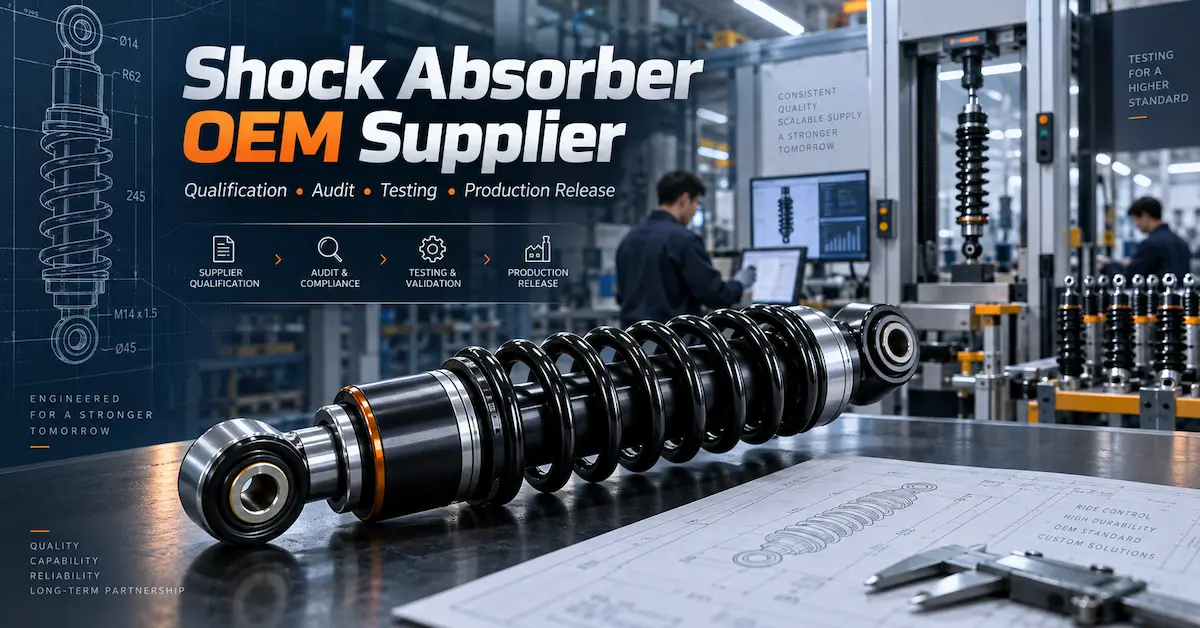
What Is a Shock Absorber OEM Supplier?
A Shock Absorber OEM Supplier manufactures shock absorbers or related suspension products according to an OEM buyer's controlled vehicle, product, engineering, quality, and commercial requirements.
Depending on the project, the buyer may provide:
-
existing shock absorber samples;
-
2D drawings;
-
3D CAD;
-
mounting dimensions;
-
vehicle geometry;
-
vehicle weight;
-
payload;
-
spring requirements;
-
damping targets;
-
performance requirements;
-
branding and packaging specifications.
The supplier's responsibility may extend beyond physical manufacturing.
A capable OEM partner may need to support:
-
technical review;
-
manufacturability discussion;
-
prototype development;
-
engineering revisions;
-
testing;
-
small-batch production;
-
quality control;
-
repeat manufacturing.
Buyers can review BEDO's current shock absorber and suspension products to understand the type of off-road suspension configurations that can form the starting point for an OEM discussion.
Supplier Selection vs Supplier Qualification vs Supplier Approval
These three stages are often treated as the same process, but they solve different problems.
| Stage | Main Question | Typical Output |
|---|---|---|
| Supplier Selection | Is this supplier worth evaluating? | Shortlist |
| Supplier Qualification | Can this supplier support our product and process requirements? | Qualified supplier status |
| Supplier Approval | Is this exact product/process ready for production? | Production release |
A company can therefore be a capable shock absorber manufacturer but still not be approved for one specific OEM program.
For example, a supplier may have strong experience with standard motorcycle rear shocks but limited experience with:
-
heavy utility UTVs;
-
remote reservoirs;
-
unusually high cargo loads;
-
long-travel suspension;
-
specialized environmental requirements.
Qualification must therefore consider both:
Supplier Capability
and
Project Fit
Start With a Supplier Nomination Standard
Before contacting multiple factories, define what would make a supplier eligible for nomination.
Otherwise, purchasing teams tend to compare whatever information each supplier chooses to present.
Create a qualification framework covering areas such as:
-
application experience;
-
engineering capability;
-
manufacturing process;
-
prototype support;
-
testing;
-
quality control;
-
revision management;
-
production scalability;
-
technical communication;
-
commercial terms.
This prevents supplier selection from becoming:
Supplier A has the lowest price, so we will develop with Supplier A.
A better logic is:
Supplier A and Supplier B both meet the required technical and manufacturing capability. Now we can compare commercial value.
Define the Project Before Auditing the Supplier
A supplier cannot be meaningfully qualified for an undefined product.
Before the qualification process, clarify whether the project is:
Direct Replacement
The existing product is already defined.
The supplier mainly needs to reproduce:
-
geometry;
-
fitment;
-
spring;
-
damping;
-
appearance.
Sample-Based Improvement
The buyer has an existing shock but wants to improve:
-
spring rate;
-
damping;
-
durability;
-
finish;
-
cost;
-
packaging.
Drawing-Based OEM Production
The buyer controls the technical specification and expects manufacturing according to drawings.
New Vehicle Development
The project may require:
-
vehicle data;
-
suspension geometry;
-
engineering iterations;
-
prototype testing;
-
validation.
Private-Label Program
The technical product may already exist, but the buyer needs controlled:
-
logo;
-
color;
-
labels;
-
packaging;
-
product identification.
These projects require different supplier capabilities.
BEDO's OEM Suspension RFQ Guide explains why technical, validation, customization, and commercial requirements should be defined before quotations are compared.
Build a Controlled Supplier Qualification Package
An OEM buyer should send controlled project information rather than a loose chain of emails, screenshots, and chat messages.
A useful qualification package may contain:
-
project brief;
-
vehicle data;
-
2D drawings;
-
CAD where relevant;
-
reference sample data;
-
current spring specification;
-
current damping information;
-
performance target;
-
testing requirements;
-
branding requirements;
-
packaging;
-
prototype plan;
-
production forecast.
BEDO's Custom Suspension Development Files Guide recommends organizing engineering and commercial information into a controlled project package.
This helps answer an important qualification question:
Does the supplier have a process for handling controlled technical information, or does project knowledge exist only in individual sales messages?
Audit How the Supplier Handles Engineering Questions
A capable OEM supplier should not simply accept every buyer requirement without review.
Good engineering communication often includes questions such as:
-
Which vehicle is this for?
-
What is the suspension position?
-
What is the vehicle operating weight?
-
What is maximum payload?
-
What is the intended terrain?
-
Is the current spring acceptable?
-
Is damping being copied or changed?
-
What problem should the new product solve?
-
Which dimensions are fixed?
-
Which parameters are open to engineering revision?
This behavior matters.
A supplier that identifies missing information early may reduce development risk later.
In contrast, a supplier that responds to an incomplete drawing with:
No problem, we can make it.
without asking about critical missing parameters may create hidden assumptions.
Verify Direct Engineering Communication
For technically demanding projects, determine whether the buyer can communicate with people who understand:
-
shock absorber structure;
-
spring specifications;
-
damping;
-
mounting;
-
vehicle requirements;
-
production feasibility.
A long communication chain can create information loss.
For example:
Buyer Engineer → Import Agent → Salesperson → Factory Sales → Engineer
creates more opportunities for technical details to change than:
Buyer Engineer → Supplier Technical Team
A trading company is not automatically unsuitable, but the communication structure should be understood before nomination.
BEDO's China Shock Absorber Factory RFQ Questions provides additional questions buyers can use to distinguish production capability, technical support, and commercial representation.
Review What the Supplier Actually Manufactures
Do not stop at:
Are you a shock absorber manufacturer?
Ask which operations are performed or controlled internally.
Depending on the product architecture, these may include:
-
machining;
-
tube processing;
-
piston-rod preparation;
-
spring sourcing or production;
-
valve-component preparation;
-
assembly;
-
oil filling;
-
gas charging;
-
surface finishing;
-
inspection;
-
packaging.
The objective is not to require every operation to be performed under one roof.
The objective is to understand:
-
what the supplier controls;
-
what is outsourced;
-
how outsourced parts are specified;
-
how incoming quality is controlled;
-
how process changes are managed.
This becomes especially important when product performance depends on several suppliers within the manufacturing chain.
Identify Critical-to-Quality Characteristics
Not every product characteristic creates the same risk.
Before pilot production, define which characteristics are especially important to the vehicle and buyer.
For a shock absorber, these may include:
| Critical Area | Example Characteristics |
|---|---|
| Fitment | Extended length, compressed length, mounting hole, mounting width |
| Travel | Stroke |
| Load support | Spring specification |
| Motion control | Compression/rebound configuration |
| Sealing | Leakage resistance |
| Moving surface | Piston-rod condition |
| Environment | Coating / surface protection |
| Assembly | Correct internal configuration |
| Identification | Product code / label |
| Packaging | Correct SKU and protection |
This list should be project-specific.
A direct replacement shock may place greater emphasis on dimensional interchangeability.
A performance-oriented UTV shock may place more emphasis on spring and damping consistency.
A beach application may add environmental protection as a critical requirement.
Qualify the Supplier's Drawing-Control Process
One of the highest-risk OEM situations is when purchasing and production refer to different product versions.
Ask:
-
Who creates the production drawing?
-
Who approves it?
-
How are revisions identified?
-
How are obsolete revisions removed from production?
-
How does the factory know which spring belongs to which drawing?
-
How is the damping version connected to the product code?
A good sample is not enough if the factory cannot explain how that sample becomes a controlled production definition.
The final approved product should normally point back to a defined combination of:
-
drawing;
-
product code;
-
spring;
-
damping setup;
-
hardware;
-
finish;
-
packaging.
Ask How Engineering Changes Are Controlled
OEM development rarely moves directly from first drawing to final production without change.
Typical changes can include:
-
mounting dimension revision;
-
spring-rate change;
-
damping adjustment;
-
coating change;
-
bushing revision;
-
packaging correction.
The supplier should have a clear way to distinguish:
Old Requirement
from
New Approved Requirement
An uncontrolled change process creates several risks:
-
old samples remain in circulation;
-
purchasing quotes the wrong version;
-
production uses an obsolete drawing;
-
packaging identifies the wrong SKU.
For OEM buyers, revision discipline is part of supplier qualification.
Protect Sensitive Technical Data Before Development
OEM shock absorber projects may include confidential information such as:
-
unreleased vehicle drawings;
-
CAD;
-
suspension geometry;
-
target performance;
-
proprietary packaging;
-
product plans.
Before sharing more information than necessary, buyers should clarify:
-
confidentiality expectations;
-
permitted use;
-
supplier access;
-
subcontractor access;
-
drawing ownership;
-
newly developed file ownership;
-
file retention.
Do not assume that the term “OEM” automatically defines intellectual-property ownership.
Share enough information to define the engineering problem, but avoid providing unrelated confidential vehicle data.
Use the Prototype Stage as a Supplier Qualification Gate
A prototype is not only a product-development tool.
It is also an opportunity to evaluate the supplier.
Observe:
-
Does the sample match the approved dimensions?
-
Are deviations documented?
-
Does the supplier identify problems before shipping?
-
Are requested revisions implemented correctly?
-
Is product identification clear?
-
Can the supplier explain what configuration was built?
A prototype can reveal problems in:
-
technical communication;
-
manufacturing interpretation;
-
documentation;
-
internal coordination.
BEDO's OEM development workflow treats prototype validation as a major step before production approval. Its ODM Shock Absorber Development Guide also emphasizes moving from controlled requirements to prototype, testing, revision, and production approval.
Define Prototype Acceptance Criteria Before Testing
Avoid evaluating samples only with:
Looks good.
or:
Ride feels better.
A stronger prototype plan defines what must be confirmed.
Fitment
Confirm:
-
overall dimensions;
-
mounting interfaces;
-
installation clearance;
-
compressed/extended positions.
Spring
Confirm:
-
specification;
-
installed condition;
-
ride height;
-
sag where relevant.
Damping
Confirm:
-
expected compression behavior;
-
expected rebound behavior;
-
adjustment function if applicable.
Product Condition
Confirm:
-
leakage;
-
rod movement;
-
finish;
-
hardware;
-
assembly.
Vehicle Validation
Where required, evaluate:
-
intended load;
-
representative terrain;
-
vehicle behavior.
Acceptance criteria should reflect the application rather than use one universal test.
Ask Exactly What the Supplier Means by “Testing”
Many suppliers say:
We test every product.
That statement is incomplete.
Buyers should ask:
-
What is tested?
-
At what production stage?
-
Which samples are tested?
-
Against what requirement?
-
How are results recorded?
-
Which tests are development-only?
-
Which tests continue during mass production?
BEDO's Shock Absorber Testing Before Mass Production Guide distinguishes areas such as dimensional inspection, damping verification, leakage/sealing checks, durability, temperature-related evaluation where needed, and vehicle-level validation.
The key OEM principle is:
Testing must connect to an approved requirement and acceptance criterion.
Development Testing and Production Inspection Are Not the Same
This distinction should be clear during qualification.
Development Testing
Answers:
Does this design meet the intended application?
It may involve:
-
prototype fitment;
-
vehicle testing;
-
damping evaluation;
-
durability work.
Production Inspection
Answers:
Does normal production continue to match the approved product?
It may focus on:
-
dimensions;
-
configuration;
-
leakage;
-
appearance;
-
identification;
-
selected functional characteristics.
A supplier can have strong development testing but weak production control—or the opposite.
OEM buyers need both.
Separate Buyer Requirements From Supplier Recommendations
During technical discussions, create three categories:
Required by Buyer
Proposed by Supplier
To Be Confirmed Through Testing
This avoids a common OEM problem.
A supplier may recommend a spring or damping configuration during the first discussion.
If that recommendation later becomes unsuitable, purchasing may incorrectly argue that the supplier failed an “approved requirement.”
Clear status improves communication.
Do Not Approve Mass Production Directly From One Prototype
A prototype proves that the supplier can build one development unit.
It does not prove the supplier can produce a batch consistently.
That is why a pilot or small-batch stage can be valuable.
BEDO's Small Batch OEM/ODM Suspension Guide explains how lower-volume production can be used to verify fitment, damping, spring requirements, finish, and production consistency before scaling.
A pilot batch asks a different question:
Can the production process repeatedly reproduce the approved prototype?
What Should a Pilot Batch Verify?
A pilot run can evaluate:
-
production documentation;
-
component availability;
-
assembly consistency;
-
spring identification;
-
damping configuration;
-
dimensions;
-
leakage;
-
surface finish;
-
labels;
-
packaging;
-
batch traceability.
It can also identify whether operators have enough information to build the correct version without relying on the development engineer's memory.
This is important because mass production eventually becomes a process—not a prototype project.
Review Repeatability, Not Just Average Quality
Suppose ten shock absorbers are produced.
Nine are excellent.
One has:
-
different mounting width;
-
incorrect spring;
-
leakage;
-
wrong label.
The “average product” may still look good statistically, but the customer receives one incorrect unit.
OEM buyers should therefore think about both:
Typical performance
and
variation control
Supplier qualification should determine whether critical characteristics remain controlled across the batch.
Establish a Quality Agreement Before Production Release
The exact format can vary, but the buyer and supplier should clearly understand:
-
approved specification;
-
inspection responsibility;
-
critical characteristics;
-
nonconforming-product handling;
-
change-notification expectations;
-
traceability requirements;
-
complaint handling;
-
corrective-action process.
This does not need to become unnecessary bureaucracy.
Its purpose is to prevent assumptions.
A useful quality agreement answers:
Who controls what after the product enters repeat production?
Define What Requires Buyer Approval
Not every small manufacturing adjustment needs formal buyer requalification.
But application-critical changes should be controlled.
Depending on the project, these could include:
-
spring specification;
-
damping configuration;
-
seals;
-
piston rod;
-
mounting parts;
-
major materials;
-
critical machining;
-
surface treatment;
-
key subcontractor changes.
The buyer and supplier should agree on what requires:
-
notification;
-
sample approval;
-
technical review;
-
full revalidation.
Without such rules, a supplier may consider a substitute component “equivalent” while the buyer considers it an unauthorized change.
Build Basic Product Traceability
Traceability helps answer:
Which production lot created this field problem?
Useful identifiers may include:
-
product code;
-
production lot;
-
manufacturing date;
-
revision;
-
packaging label.
Traceability becomes especially valuable for distributors and OEMs managing multiple:
-
models;
-
regions;
-
production batches.
If a warranty complaint appears, the buyer can isolate the relevant batch instead of questioning the entire product history.
Evaluate Complaint Handling Before You Have Complaints
Supplier qualification should include a discussion about what happens when something goes wrong.
Ask:
-
Who receives technical complaints?
-
What evidence should buyers provide?
-
Can returned samples be analyzed?
-
Can production records be reviewed?
-
How are corrective actions communicated?
A supplier's response to problems can matter as much as initial sample quality.
No manufacturing program is strengthened by pretending failures never occur.
The useful capability is structured problem resolution.
Audit Packaging and Product Identification
Packaging may seem commercial rather than technical.
For multi-SKU suspension programs, it can directly affect quality.
Consider a distributor buying similar shocks with different:
-
spring rates;
-
damping;
-
applications.
If packaging does not clearly distinguish them, warehouse errors may create fitment or performance complaints.
Check:
-
product code;
-
vehicle/application identification;
-
front/rear identification where relevant;
-
quantity;
-
hardware;
-
label accuracy;
-
protective packaging.
A correct product in the wrong carton still creates a customer problem.
Evaluate Production-Capacity Fit, Not Just Maximum Capacity
A supplier may advertise high capacity.
That does not automatically mean your project fits its production model.
Ask:
-
Can the supplier support your launch quantity?
-
Can it support pilot quantities?
-
What happens when demand increases?
-
Can repeat orders be scheduled predictably?
-
How are urgent changes handled?
-
Does your product compete with much larger customers for capacity?
A startup ordering 200 units and a major OEM ordering 50,000 units may both need capable factories—but not necessarily the same production structure.
Capacity Should Be Matched to the Product Lifecycle
A useful production plan separates:
Prototype Quantity
Engineering validation.
Pilot Quantity
Process validation.
Initial Production
Market launch.
Repeat Production
Normal supply.
Growth Volume
Forecasted scale.
If buyers communicate only the final annual forecast, a supplier may build the wrong assumptions about the early development stage.
If buyers communicate only the sample quantity, the supplier may underestimate long-term production requirements.
MOQ Should Be Evaluated by Project Stage
A single MOQ number can be misleading.
OEM suspension programs may have different quantities for:
-
sample;
-
prototype;
-
pilot batch;
-
first order;
-
repeat order.
The correct question is not:
What is your MOQ?
It is:
What quantity applies at each development and production stage?
This is especially important for new brands, specialty vehicles, and lower-volume off-road platforms.
Lead Time Should Also Be Separated Into Stages
Similarly, avoid asking for one generic lead time.
Separate:
-
technical review;
-
prototype production;
-
revision;
-
pilot batch;
-
mass production.
A project with two prototype revisions will naturally have a different timeline from a direct-repeat order.
The most useful supplier is one that can explain where time is spent and what information is required to move to the next stage.
Compare Supplier Quotations Only After Normalizing Scope
Two quotations can appear similar while including different work.
Before comparing price, align:
| Quotation Item | Supplier A | Supplier B |
|---|---|---|
| Drawing revision | Same | Same |
| Spring specification | Confirmed | Confirmed |
| Damping configuration | Confirmed | Unclear |
| Prototype | Included | Extra |
| Testing | Defined | Basic |
| Packaging | Included | Included |
| Pilot batch | Supported | Not stated |
| Engineering revision | Included | Limited |
A lower price can simply mean a narrower scope.
BEDO's Shock Absorber Factory RFQ Guide discusses this exact problem: quotations should be compared only after technical and commercial assumptions are aligned.
Calculate Total Supplier Risk, Not Only Unit Price
A low-priced shock absorber can become expensive if it creates:
-
repeated prototypes;
-
delayed vehicle launch;
-
fitment problems;
-
warranty returns;
-
air freight;
-
distributor claims;
-
product recalls;
-
obsolete inventory.
A better commercial comparison is:
Unit Cost + Development Cost + Quality Risk + Logistics Risk + Warranty Risk + Change Risk
This does not mean choosing the most expensive supplier.
It means choosing the supplier with the strongest overall value for the project.
Use a Supplier Qualification Scorecard
A structured scorecard improves internal decision-making.
Example:
| Area | Suggested Evaluation |
|---|---|
| Application experience | Relevant vehicle/project experience |
| Engineering communication | Technical clarity and responsiveness |
| Drawing/CAD control | Revision and configuration management |
| Prototype capability | Sample accuracy and revision response |
| Testing | Defined methods and acceptance criteria |
| Manufacturing | Process control |
| Quality | Inspection and problem management |
| Traceability | Batch/product identification |
| Pilot support | Small-batch repeatability |
| Capacity | Fit with forecast |
| Commercial | Price and terms |
| Supply risk | Stability and communication |
Do not let one score automatically replace engineering judgment.
The scorecard exists to make trade-offs visible.
Know the Red Flags Before Supplier Nomination
Potential warning signs include:
-
quotation issued from insufficient data;
-
no questions about vehicle application;
-
inability to identify drawing revision;
-
unclear sample configuration;
-
vague “we test everything” statements;
-
no distinction between prototype and mass-production requirements;
-
unexplained product substitutions;
-
inconsistent technical answers;
-
no clear batch identification;
-
unwillingness to discuss corrective actions.
One red flag does not automatically disqualify a supplier.
Several related red flags should trigger deeper review.
Different Vehicle Applications Require Different OEM Supplier Strengths
A Shock Absorber OEM Supplier suitable for one product may not be ideal for another.
ATV Projects
May prioritize:
-
compact packaging;
-
terrain response;
-
rider/load variation;
-
aftermarket fitment.
UTV Projects
May add stronger requirements around:
-
passengers;
-
cargo;
-
heavy-duty use;
-
longer duty cycles.
Motorcycle Projects
May prioritize:
-
compact geometry;
-
rider feedback;
-
adjustable performance;
-
installation constraints.
Electric Motorcycle or Utility Vehicle Projects
May require additional attention to:
-
battery mass;
-
weight distribution;
-
new chassis packaging.
Therefore, ask whether the supplier has experience with your type of suspension problem, not simply whether it manufactures shocks.
OEM and ODM Require Different Supplier Responsibilities
The distinction matters during qualification.
OEM-Dominant Project
The buyer already controls:
-
design;
-
drawing;
-
specification;
-
test criteria.
Supplier qualification focuses heavily on:
-
manufacturability;
-
process control;
-
production consistency;
-
change management.
ODM-Dominant Project
The supplier contributes more engineering input.
Qualification should place more weight on:
-
technical analysis;
-
design recommendations;
-
prototype iteration;
-
application knowledge.
BEDO's ODM Shock Absorber Development Guide explains how ODM projects often begin with incomplete product specifications and require more supplier-side technical development.
What Should Be Included in a Shock Absorber OEM Supplier RFQ?
Before asking for production pricing, prepare as much relevant information as possible:
-
Vehicle type
-
Vehicle model/project code
-
Front or rear position
-
Existing shock sample
-
Current drawing
-
3D CAD where applicable
-
Extended length
-
Compressed length
-
Stroke
-
Mounting-hole dimensions
-
Mounting width
-
Vehicle curb weight
-
Operating weight
-
Passenger/cargo load
-
Existing spring specification
-
Target spring requirement
-
Existing damping data
-
Target damping behavior
-
Typical terrain
-
Duty cycle
-
Environmental conditions
-
Current product problem
-
Prototype quantity
-
Test requirements
-
Pilot quantity
-
Forecast production volume
-
Branding requirements
-
Packaging requirements
-
Required documentation
-
Target development schedule
A complete RFQ allows the supplier to explain its scope clearly and reduces hidden assumptions.
A Practical Shock Absorber OEM Supplier Qualification Workflow
For many projects, the following sequence works better than choosing a supplier from a quotation alone:
Step 1 — Project Definition
Define the application and technical/commercial scope.
Step 2 — Supplier Pre-Screening
Identify relevant manufacturers.
Step 3 — Technical Review
Evaluate application understanding and engineering capability.
Step 4 — Process Review
Understand manufacturing and QC control.
Step 5 — RFQ Alignment
Ensure suppliers quote equivalent scope.
Step 6 — Prototype
Build controlled engineering samples.
Step 7 — Validation
Confirm fitment, spring, damping, function, and application requirements.
Step 8 — Revision
Close technical gaps.
Step 9 — Approved Sample/Specification
Freeze the production baseline.
Step 10 — Pilot Batch
Evaluate repeatability.
Step 11 — Quality/Change Agreement
Define production controls.
Step 12 — Production Release
Approve normal manufacturing.
Step 13 — Supplier Scorecard
Monitor quality, delivery, responsiveness, and technical performance.
This process turns sourcing from a quotation exercise into a controlled OEM supply program.
How to Manage a Shock Absorber OEM Supplier After Launch
Supplier qualification should not end after the first production order.
Track useful performance indicators such as:
-
delivery performance;
-
rejection rate;
-
field complaints;
-
response time;
-
revision accuracy;
-
packaging accuracy;
-
batch consistency;
-
corrective-action quality.
The purpose is not to create unnecessary administrative work.
It is to detect a deteriorating supplier relationship before it creates a major supply problem.
When Should a Supplier Be Requalified?
Requalification may be worth considering when there is a significant change in:
-
product design;
-
damping configuration;
-
spring specification;
-
material;
-
manufacturing process;
-
production location;
-
important subcontractor;
-
capacity arrangement.
The required level of requalification depends on risk.
A packaging change may need only document approval.
A critical piston-rod or damping-system change may require new technical validation.
How BEDO Supports OEM Shock Absorber Projects
BEDO focuses on shock absorbers, suspension springs, and related off-road suspension solutions for ATV, UTV, motorcycle, electric motorcycle, and specialty-vehicle applications.
Depending on project maturity, buyers can begin with:
-
existing samples;
-
2D drawings;
-
3D CAD;
-
vehicle/load information;
-
spring requirements;
-
damping targets;
-
current performance problems.
The development path can include engineering review, prototype development, testing, revision, small-batch validation, and production preparation.
You can review BEDO's current Products, learn more about company capabilities through About Us, or submit a controlled project package through the Contact Us page.
FAQ
What is a Shock Absorber OEM Supplier?
A Shock Absorber OEM Supplier manufactures shock absorbers according to a buyer's vehicle, drawing, performance, quality, branding, and production requirements. Depending on the project, the supplier may also support engineering review, prototypes, testing, and production validation.
How is OEM supplier qualification different from supplier selection?
Supplier selection creates a shortlist. Qualification verifies whether a supplier has the engineering, manufacturing, quality, communication, and production systems needed for the specific OEM project.
Should I approve a shock absorber supplier after one successful sample?
Usually not for a serious OEM program. One prototype proves that one sample can be produced. A pilot batch provides better evidence of production repeatability.
What should I audit in a shock absorber factory?
Review application knowledge, engineering communication, drawing control, manufacturing processes, component control, assembly, inspection, testing, revision management, traceability, and production planning.
What tests should an OEM shock absorber supplier perform?
Testing depends on the application. Possible areas include dimensions, fitment, leakage, spring verification, damping, durability, temperature-related behavior where required, and vehicle-level validation.
Why is drawing revision control important?
Revision control ensures that the supplier manufactures the currently approved product rather than an older prototype or obsolete specification.
Should a supplier be allowed to change components after approval?
Critical product changes should follow an agreed notification and approval process. Buyers and suppliers should define which substitutions require technical review or revalidation.
Why is pilot production important?
Pilot production evaluates whether the factory can repeatedly manufacture the approved product under normal production conditions before larger orders begin.
How should I compare OEM shock absorber quotations?
First confirm that suppliers are quoting the same drawing, spring, damping configuration, testing scope, packaging, prototype support, and production requirements. Then compare commercial terms.
What information should I send BEDO for an OEM project review?
Provide the vehicle application, suspension position, existing sample or drawing, dimensions, vehicle/load data, spring and damping information, target improvement, prototype quantity, test requirements, and expected production volume.
Conclusion
Choosing a Shock Absorber OEM Supplier should end with a controlled production release—not simply a low quotation or one successful prototype. Engineering communication, specification control, testing, pilot production, traceability, change management, and repeatability determine whether a supplier can support a long-term OEM program.
For a new ATV, UTV, motorcycle, or specialty-vehicle suspension project, submit your drawings, samples, vehicle data, validation requirements, and production forecast through the BEDO Contact Us page for project review.