
Why Ask Questions Before Requesting a Shock Absorber Quotation?
A useful quotation from a China shock absorber factory should be based on a clearly defined product and project scope.
One of the most common sourcing mistakes is sending only a photo and a message such as:
“Please quote your best price for this shock absorber.”
Two factories may respond with similar-looking products but base their quotations on completely different assumptions regarding:
- Materials
- Shock construction
- Spring specification
- Damping configuration
- Mounting dimensions
- Testing scope
- Branding
- Packaging
- Prototype requirements
- Order quantity
The quotations may therefore appear comparable even though the products are not.
For an OEM ATV, UTV, off-road, or specialty vehicle project, a better sequence is:
Supplier Capability → Technical Specification → Prototype Scope → Testing Requirements → Commercial Terms → Quotation
Before asking for the lowest price, determine whether the supplier can actually support the project.
Bedo Auto's Shock Absorber Products can provide a starting reference for buyers evaluating standard and customized suspension configurations.
1. Are You a Manufacturer or a Trading Company?
This is one of the first questions to ask.
A trading company is not automatically unsuitable, but the sourcing model matters when your project requires engineering revisions or custom manufacturing.
Ask:
- Do you manufacture shock absorbers directly?
- Which production processes are controlled by your company?
- Where is the manufacturing facility?
- Can our engineers communicate directly with your technical team?
- Can you support a factory visit or video audit?
For a simple replacement product, an experienced distributor may be sufficient.
For an OEM development project involving custom springs, damping, prototypes, or technical revisions, direct factory communication can reduce additional information handoffs.
2. What Types of Shock Absorbers Do You Manufacture?
Do not assume every shock absorber factory has experience with your application.
Ask which products and vehicle categories it regularly supports.
Examples may include:
- ATV shock absorbers
- UTV shock absorbers
- Motorcycle shocks
- Coilover shock absorbers
- Reservoir shocks
- Utility vehicle suspension
- Specialty vehicle shocks
The most relevant question is not:
How many products are in your catalog?
It is:
Have you developed products for an application similar to ours?
A supplier familiar with UTV cargo applications, for example, may approach spring and load requirements differently from one primarily manufacturing standard motorcycle replacement shocks.
3. Do You Support OEM and Custom Shock Absorber Development?
A supplier offering a logo change is not necessarily offering engineering customization.
Ask exactly which specifications can be developed.
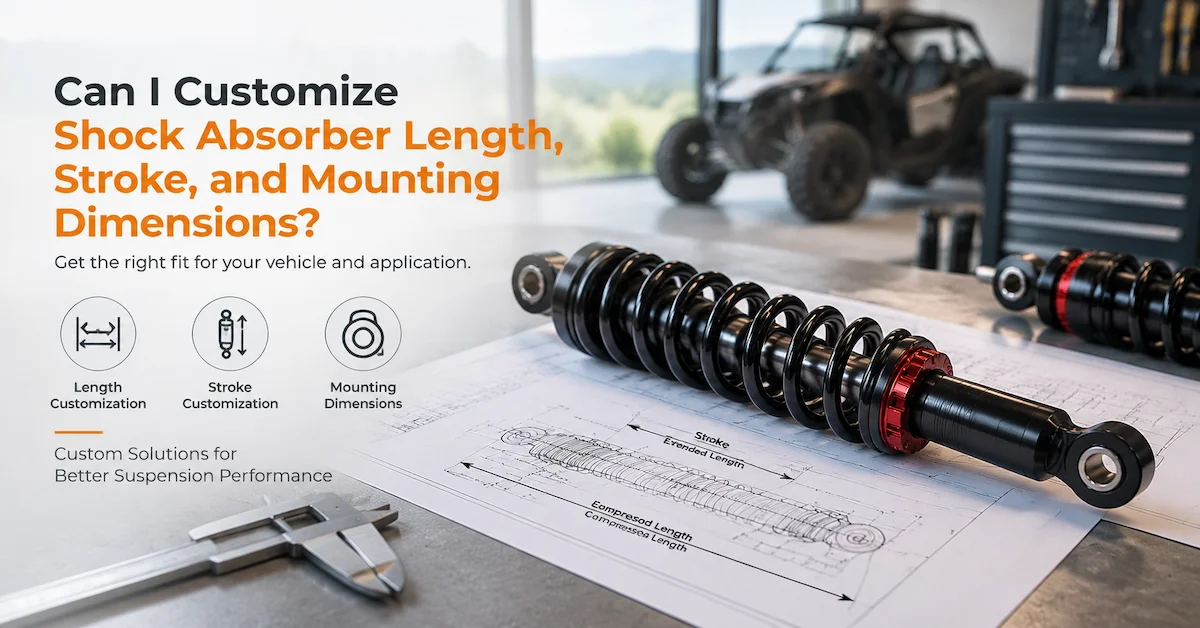
Dimensional Customization
Confirm whether the factory can modify:
- Extended length
- Compressed length
- Stroke
- Shock body dimensions
- Mounting-hole diameter
- Mounting width
- Eye, fork, or clevis interfaces
Spring Customization
Ask whether it can develop:
- Spring rate
- Free length
- Wire diameter
- Outside diameter
- Preload specification
Damping Customization
Where relevant,ask about:
- Compression damping
- Rebound damping
- Internal valving
- Adjustment options
Commercial Customization
This may include:
- Spring color
- Shock finish
- Logo
- Labels
- Private-label packaging
A good RFQ separates technical customization from appearance customization so suppliers quote the same project scope.
4. Can You Work From Drawings, CAD Files, or Physical Samples?
Different OEM projects begin with different technical inputs.
Ask whether the China shock absorber factory can work from:
- 2D drawings
- 3D CAD files
- Existing shock absorber samples
- Vehicle specifications
- Early concepts
More importantly, ask whether the supplier only accepts these files or actually reviews them.
Useful follow-up questions include:
- Can your engineering team identify manufacturability issues?
- Can you review mounting interfaces and tolerances?
- Can you provide technical feedback before prototyping?
- How are drawing revisions controlled?
For CAD-led projects, see Bedo Auto's CAD Based Suspension Development.
5. What Vehicle Information Do You Need Before Quoting?
This question can reveal a lot about the supplier's engineering depth.
A supplier quoting a customized suspension product without asking about the vehicle may be working from assumptions.
A professional engineering discussion may require:
| Vehicle Information | Why It Matters |
|---|---|
| Vehicle type | Defines application |
| Front/rear position | Defines suspension role |
| Vehicle weight | Supports spring selection |
| Typical payload | Defines normal load |
| Maximum payload | Defines operating limits |
| Suspension layout | Affects shock movement |
| Existing shock | Establishes baseline |
| Terrain | Influences development target |
| Performance issue | Defines what needs improvement |
For example, “UTV rear shock” is not enough information if one vehicle carries only passengers and another regularly carries heavy tools or cargo.
A stronger supplier will often ask:
What problem are you trying to solve?
That question is more valuable than immediately asking only for order quantity.
6. Can You Develop Prototypes Before Mass Production?
Prototype support is particularly important for custom shock absorber projects.
Ask:
- Can you manufacture engineering samples?
- What is the prototype MOQ?
- What is the prototype cost?
- What information must be approved before prototyping?
- Can prototypes be revised after vehicle testing?
- How many development rounds are normally planned?
A typical development route is:
Drawing/CAD → Engineering Review → Prototype → Vehicle Testing → Revision → Approval
For sample-led projects, buyers can also review Suspension Sample Development.
Prototype capability matters because a technically plausible drawing may still reveal issues during installation or vehicle testing.
7.What Exactly Can You Test?
Avoid asking only:
“Do you test your shock absorbers?”
Almost every supplier can answer “yes.”
Instead, ask:
- What is tested on every unit?
- What is tested by batch?
- Which parameters are measured?
- What requires customer vehicle testing?
- Can results be documented?
- What acceptance criteria are used?
Depending on the project,verification may include:
Dimensional Checks
- Overall length
- Stroke
- Mount dimensions
- Spring dimensions
Functional Checks
- Leakage
- Smooth movement
- Assembly condition
Performance-Related Testing
Depending on equipment and project scope:
- Damping behavior
- Spring characteristics
- Load-related performance
Vehicle-Level Validation
Some requirements can only be properly evaluated on the vehicle,such as:
- Ride height
- Sag
- Bottoming behavior
- Terrain response
- Cargo support
A credible supplier should distinguish between factory-level testing and vehicle-level validation instead of making broad claims that every aspect is “fully tested.”
8. How Do You Control Prototype-to-Production Consistency?
This is one of the most important questions in an OEM shock absorber RFQ.
A successful prototype is useful only if the factory can reproduce it.
Ask how the supplier controls:
- Final approved drawing
- Revision number
- Spring specification
- Damping specification
- Material requirements
- Component configuration
- Approved reference sample
- Inspection criteria
The quotation should ultimately refer to a controlled specification, not simply a photo or model name.
For example:
Prototype Revision C approved
should not later become:
Production based on Revision B
because an outdated drawing remained in the production system.
9.What Is the MOQ for My Specific Project?
Do not ask only:
“What is your MOQ?”
For custom development, there may be different quantities at different stages.
Ask separately about:
Prototype Quantity
The number required for initial development and validation.
Pilot-Batch Quantity
A limited production quantity used to check consistency before commercial scale.
Production MOQ
The quantity required for stable repeat manufacturing.
MOQ may depend on:
- Custom components
- Special springs
- Finishes
- Packaging
- Materials
- Tooling
- Production process
A factory advertising a very low generic MOQ may still have a different requirement for your specific design.
10. What Is Included in the Shock Absorber Quotation?
Two quotations can have the same unit price but cover different costs.
Ask suppliers to identify whether the quotation includes:
- Unit price
- Prototype cost
- Engineering charges, if applicable
- Tooling
- Testing
- Custom springs
- Surface finishes
- Logo
- Labels
- Packaging
- Export cartons
- Spare parts
- Freight terms
This makes supplier comparison much more meaningful.
For OEM sourcing, the lowest unit price is not useful if important development or quality costs appear later.
11.What Are the Prototype, Revision, and Production Lead Times?
Avoid treating all project timing as one “delivery time.”
Ask about three different periods.
Prototype Lead Time
How long does it take after technical confirmation to produce the first sample?
Engineering Revision Lead Time
If testing requires a different:
- Spring
- Damping setup
- Dimension
- Mount
how long will the next revision take?
Mass Production Lead Time
After final approval, how long does production require?
A supplier that clearly separates these stages usually provides a more realistic project schedule.
12. How Do You Control Product Quality?
Ask the factory to explain its quality process rather than simply saying it has “strict QC.”
Incoming Inspection
Ask how critical:
- Materials
- Springs
- Seals
- Purchased components
are checked.
In-Process Control
Ask how the factory controls:
- Machining dimensions
- Assembly
- Component matching
- Process consistency
Final Inspection
Ask which final checks are performed, such as:
- Dimensions
- Appearance
- Leakage
- Functional verification
Also ask:
What happens when a product does not meet the acceptance criteria?
The answer helps reveal whether the company has a structured quality process or only informal final inspection.
13.Can You Support a Pilot or Small-Batch Order?
This is especially important for new products.
A pilot batch can help validate more than one engineering sample.
It may reveal production variation in:
- Dimensions
- Spring specifications
- Assembly
- Product finish
- Branding
- Packaging
For new OEM projects, the development path may therefore be:
Prototype → Testing → Revision → Pilot Batch → Production Approval → Mass Production
This is generally safer than moving directly from one sample to a large order.
14. How Do You Manage Repeat Orders and Engineering Revisions?
OEM relationships often continue for years.
Ask:
- How are revision numbers managed?
- How are superseded drawings controlled?
- How is the approved specification stored?
- How do you prevent an old version from entering production?
- How are component substitutions approved?
Long-term sourcing depends on repeatability.
A factory that produces an excellent first batch but cannot maintain the same specification in repeat production creates procurement risk.
15. What Information Do You Need From Me for an Accurate Quotation?
A professional supplier should clearly explain what it needs before quoting.
A strong OEM shock absorber RFQ may contain:
| Buyer Information | Purpose |
|---|---|
| Vehicle application | Defines use case |
| Vehicle model/platform | Identifies target |
| Front/rear position | Defines function |
| Existing sample | Provides reference |
| Drawings | Controls dimensions |
| CAD files | Supports engineering |
| Extended/compressed length | Confirms fitment |
| Stroke | Defines shock travel |
| Mounting dimensions | Controls installation |
| Vehicle weight | Supports spring development |
| Payload | Defines operating load |
| Existing spring | Provides baseline |
| Performance target | Defines engineering goal |
| Terrain | Adds application context |
| Prototype quantity | Development planning |
| Forecast quantity | Production planning |
| Branding | Defines OEM scope |
| Packaging | Defines commercial scope |
A more complete RFQ generally results in more comparable quotations.
How Should You Compare Quotations From Different Shock Absorber Factories?
Do not compare only the final dollar figure.
Normalize the quotation first.
For example:
| Comparison Area | Factory A | Factory B |
|---|---|---|
| Same drawing revision | Yes | Yes |
| Same spring specification | Yes | Yes |
| Same damping target | Yes | Yes |
| Prototype included | Yes | No |
| Testing scope | Defined | Unclear |
| Packaging included | Yes | Yes |
| Pilot batch supported | Yes | No |
| Production lead time | Defined | Defined |
Only after confirming equivalent scope should unit prices be compared directly.
This prevents a lower quotation from appearing more attractive simply because important requirements were excluded.
Red Flags Before Requesting a Formal Quotation
Some supplier behaviors deserve additional investigation.
Quoting Immediately Without Technical Questions
For a standard catalog product, this may be normal.
For a custom OEM product, it can indicate that the supplier is assuming specifications rather than evaluating them.
Cannot Explain Spring or Damping Requirements
If performance customization is required, technical communication matters.
No Defined Prototype Process
A supplier that jumps directly from drawing to mass production may not be appropriate for a new suspension design.
Vague Testing Claims
“100% tested” has limited value unless the supplier can explain what is tested and according to which criteria.
No Revision-Control Process
This creates risk when prototypes change during development.
Unclear Quotation Scope
A price without clear information about tooling, samples, packaging, testing, or customization can create later cost changes.
How Bedo Auto Supports OEM Shock Absorber RFQ Evaluation
Bedo Auto supports suspension projects that begin from:
- Technical drawings
- CAD files
- Physical shock absorber samples
- Vehicle requirements
- Existing suspension problems
Depending on project requirements,support can include:
- Drawing and CAD review
- Custom shock absorber development
- Suspension spring development
- Prototype manufacturing
- Engineering revisions
- Testing support
- Small-batch validation
- Production preparation
Useful resources include:
- Shock Absorber Products
- CAD Based Suspension Development
- Suspension Sample Development
- Contact Bedo Auto
When requesting a quotation, sending the vehicle application, drawings, sample data, load requirements, desired performance change, prototype quantity, and production forecast can help make the technical review more productive.
FAQ
What should I ask a China shock absorber factory before requesting a quotation?
Ask about factory status, engineering capability, product range, customization, drawings and CAD support, prototype development, testing, MOQ, lead time, quality control, and production consistency.
What information is needed for an accurate shock absorber quotation?
Provide the vehicle application, shock dimensions, mounting details, drawings or samples, vehicle weight, payload, spring information, performance target, quantity, branding, and packaging requirements.
Should I send drawings before asking for price?
For custom products, yes.Drawings help suppliers understand dimensions, tolerances, mounting interfaces, and manufacturing requirements, making quotations more comparable.
Can a shock absorber factory quote from a physical sample?
Often yes. A sample can provide dimensions and structural references, but vehicle application information is still important if the new shock must perform differently.
Should prototype cost be quoted separately?
For custom development, separating prototype, tooling, testing, and production costs makes the commercial scope easier to understand.
What affects custom shock absorber MOQ?
MOQ can be affected by product construction, custom components, spring specifications, finishes, tooling, materials, packaging, and manufacturing processes.
What affects shock absorber development lead time?
Project complexity, drawing readiness, prototype manufacturing, component availability, testing, and engineering revisions can all affect development time.
How do I compare quotations from different shock absorber factories?
First confirm that each supplier is quoting the same specification, spring, damping target, testing scope, packaging, MOQ, and commercial terms.
What testing should be included in an OEM shock absorber project?
Testing depends on the application but may include dimensional inspection, functional and leakage checks, damping-related verification, spring evaluation, and vehicle-level validation.
How can I make sure repeat production matches the approved sample?
Use controlled drawings, revision numbers, approved spring and damping specifications, material requirements, QC criteria, and a validated reference sample.
Conclusion
Before requesting a quotation from a China shock absorber factory, OEM buyers should establish whether the supplier can meet both the technical and commercial requirements of the project.
The most important questions should clarify four areas:
Engineering Capability + Development Process + Quality Control + Commercial Scope
A useful quotation should therefore be based on:
Defined Vehicle Application → Controlled Technical Specification → Prototype & Testing Scope → Quantity → Production Terms
For simple replacement products, the process may be straightforward.
For custom ATV, UTV, off-road, or specialty vehicle suspension projects, spending more time defining the RFQ before comparing prices can reduce misunderstandings, engineering revisions, and unexpected costs later.
Bedo Auto supports OEM shock absorber projects through drawing and CAD review, custom shock and spring development, prototypes, testing support, small-batch validation, and production preparation.