
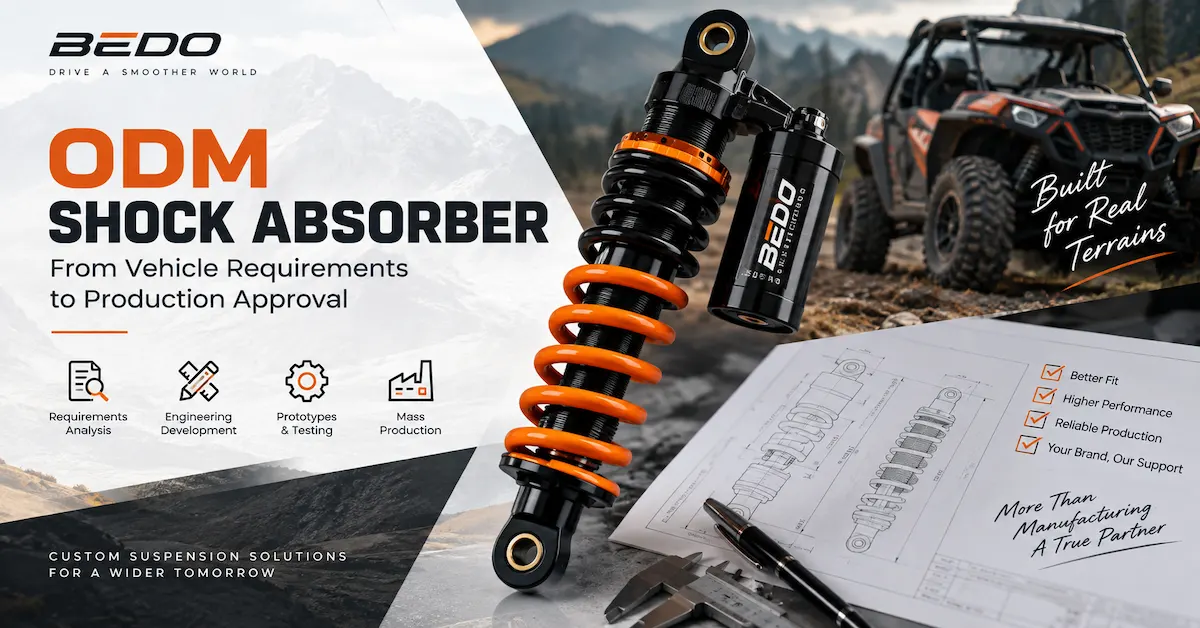
What Is an ODM Shock Absorber?
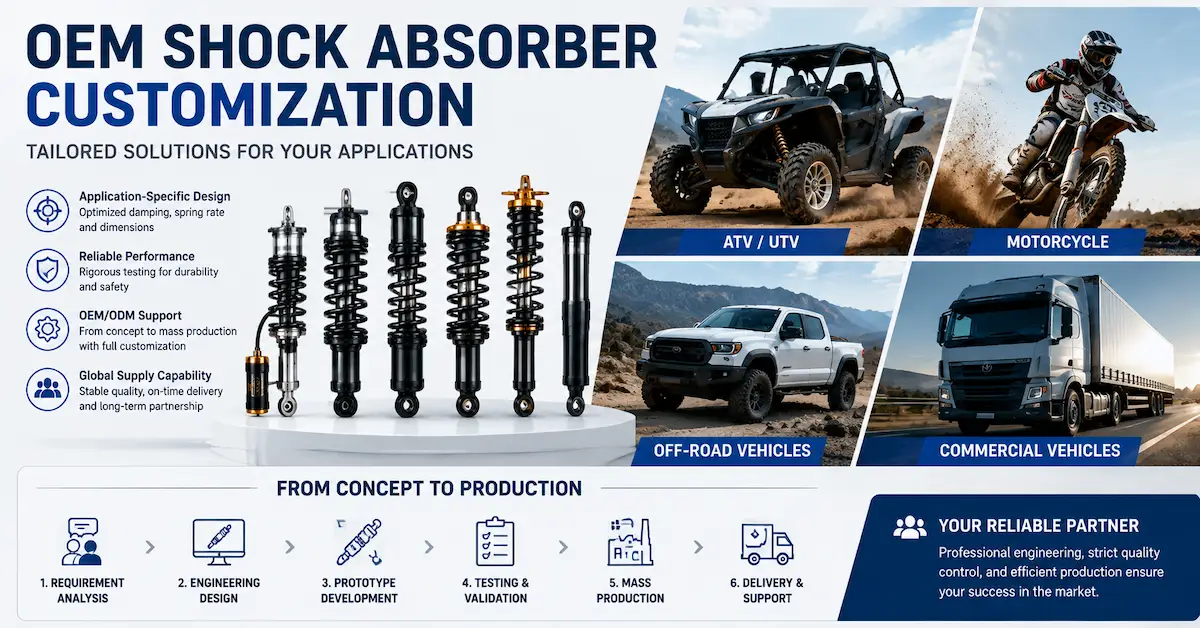
An ODM Shock Absorber is developed with meaningful engineering input from the manufacturer rather than being produced only from a finished buyer-owned specification.
In a typical OEM project, the buyer may already have a confirmed drawing, sample, dimensions, damping target, spring specification, and product structure. The supplier's main responsibility is to manufacture the product according to those controlled requirements.
ODM is different.
The buyer may begin with:
-
a vehicle application;
-
a suspension problem;
-
an existing shock that needs improvement;
-
partial dimensions;
-
an early CAD model;
-
a target load condition;
-
a new ATV or UTV platform;
-
or a product concept for an aftermarket brand.
The suspension manufacturer then helps translate those requirements into a practical shock absorber specification.
For buyers developing ATV, UTV, motorcycle, electric motorcycle, or other off-road suspension products, this engineering involvement can be more important than appearance customization.
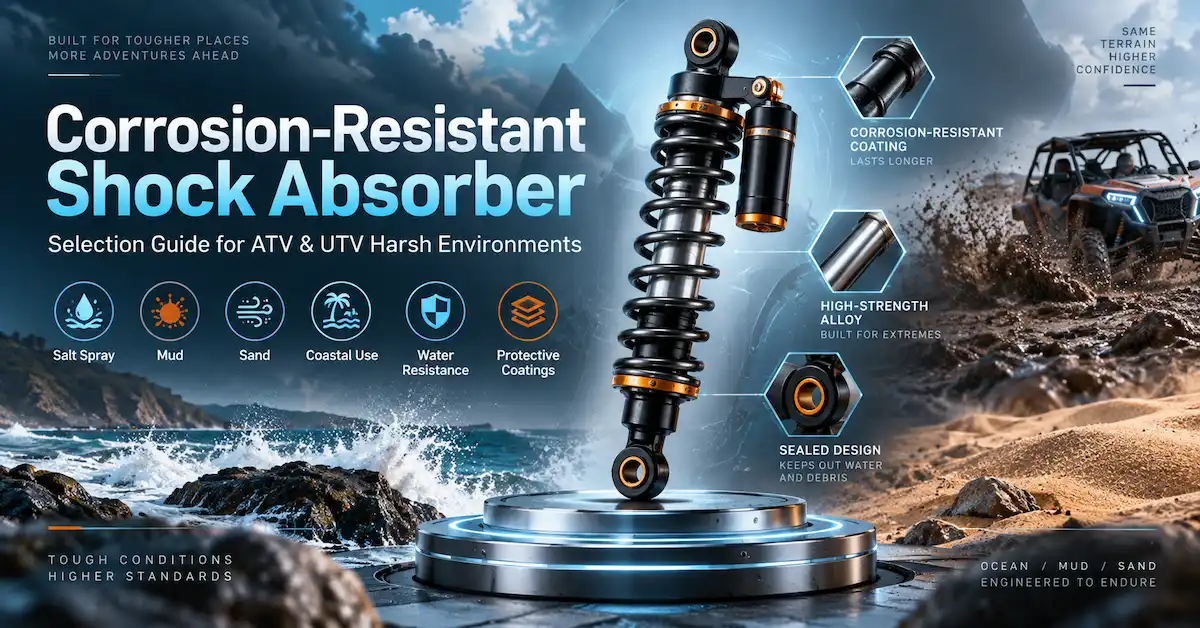
BEDO currently supports shock absorbers, suspension springs, and related suspension development for off-road and specialty-vehicle applications. Buyers can first review the available shock absorber and suspension product categories before deciding whether a catalog product, OEM modification, or ODM project is more appropriate.
ODM vs OEM vs Standard Shock Absorbers
Buyers often use OEM and ODM interchangeably, but the development responsibilities are different.
| Development Model | Buyer Provides | Manufacturer Role | Best For |
|---|---|---|---|
| Standard product | Basic model/application requirement | Supplies an existing specification | Straightforward replacement requirements |
| OEM shock absorber | Confirmed sample, drawing or detailed specification | Manufactures and makes controlled changes | Existing products, private label, replacement programs |
| ODM shock absorber | Vehicle data, application goals, partial specifications or concept | Supports engineering, specification development, prototype and revision | New vehicles, performance improvement, specialty applications |
An ODM project is particularly valuable when the buyer knows what the vehicle needs to achieve, but the final shock specification has not yet been defined.
For example, a UTV brand may know that its current rear suspension sags with two passengers and cargo. It may know the mounting position and current shock size but not know whether the correct solution is:
-
a higher spring rate;
-
revised preload;
-
different compression damping;
-
different rebound damping;
-
more usable stroke;
-
a different reservoir configuration;
-
or a combination of changes.
That is an engineering development problem rather than a simple sourcing problem.
BEDO's own small-batch OEM/ODM framework similarly distinguishes buyer-defined OEM projects from ODM projects where the supplier contributes more design and technical development.
Who Actually Needs ODM Shock Absorber Development?
ODM is not automatically the best solution for every buyer.
A buyer with a fully validated drawing and production specification may need a capable OEM manufacturer rather than a new development program.
ODM is more suitable when important technical decisions are still open.
ATV and UTV Vehicle Manufacturers
A new vehicle platform may require suspension development around:
-
vehicle curb weight;
-
maximum loaded weight;
-
front/rear weight distribution;
-
passenger capacity;
-
cargo;
-
wheel travel;
-
suspension geometry;
-
tire size;
-
expected terrain.
A standard catalog shock may physically fit while still delivering the wrong ride height or damping behavior.
Specialty Vehicle Developers
Agricultural utility vehicles, limited-production vehicles, electric utility platforms, recreational vehicles, and modified off-road vehicles frequently use non-standard packaging.
They may need dimensions or performance characteristics that do not correspond to an existing catalog model.
Aftermarket Suspension Brands
Aftermarket buyers often want more than a replacement product.
They may need:
-
improved load support;
-
adjustable damping;
-
distinctive spring settings;
-
revised reservoir packaging;
-
private-label appearance;
-
model-specific fitment;
-
a clear performance difference from standard replacement shocks.
Importers and Distributors Building a Private Label
Some distributors already understand their target market but do not have an internal suspension engineering department.
An ODM partner can help convert market requirements into a product specification before branding, packaging, and repeat production are finalized.
Buyers Replacing an Existing Shock Without Original Drawings
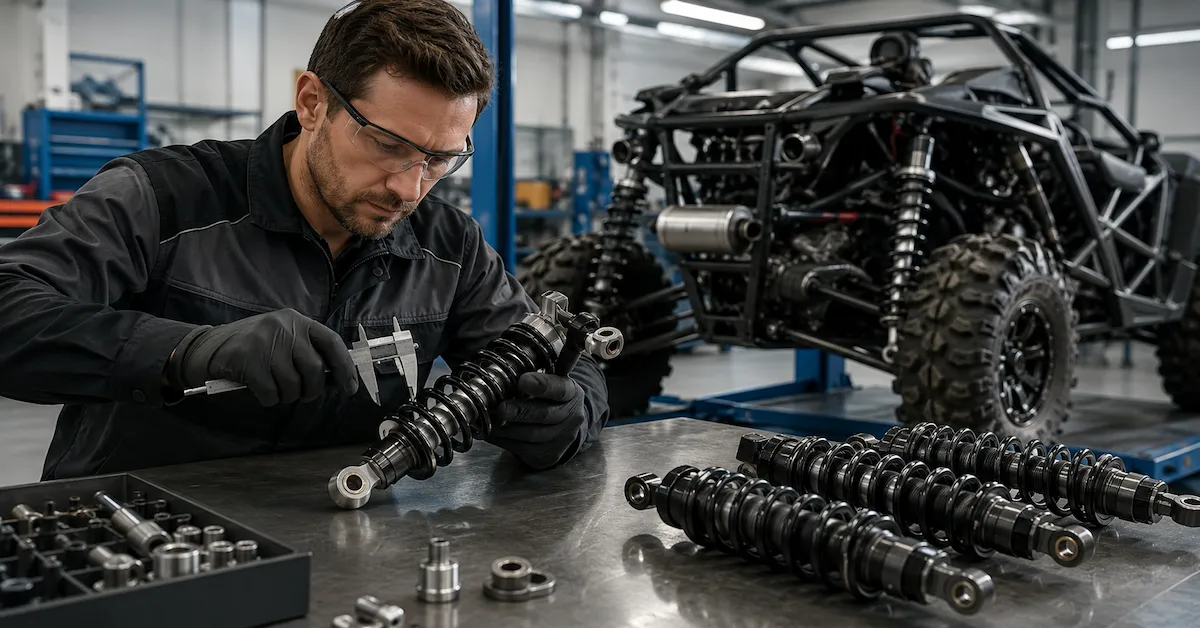
A physical shock absorber can provide a useful starting point.
BEDO's sample-based shock absorber customization process explains how an existing unit can be measured and reviewed when complete original engineering documentation is unavailable.
Start an ODM Project With the Vehicle, Not the Shock Absorber
One of the most common sourcing mistakes is asking a manufacturer:
“Can you make a shock with this length?”
Length matters, but shock length alone does not define suspension performance.
A useful ODM Shock Absorber specification should start with the vehicle and its operating conditions.
Vehicle Information
Prepare:
-
vehicle type;
-
model or development code;
-
front or rear installation;
-
curb weight;
-
maximum loaded weight;
-
passenger capacity;
-
cargo or tool load;
-
battery weight for electric vehicles;
-
tire and wheel configuration.
Suspension Geometry
Important dimensional inputs may include:
-
extended shock length;
-
compressed shock length;
-
effective stroke;
-
upper mounting dimensions;
-
lower mounting dimensions;
-
mounting-hole diameter;
-
mounting width;
-
available shock-body clearance;
-
spring clearance;
-
reservoir clearance.
For new platforms, wheel travel and shock stroke should not be treated as the same measurement. Shock movement depends on suspension geometry and the relationship between wheel movement and the damper mounting position.
Operating Environment
An ATV used recreationally on relatively moderate trails does not have the same requirements as a UTV carrying tools over farm roads every day.
Define conditions such as:
-
farm roads;
-
forest trails;
-
mud;
-
rocks;
-
gravel;
-
sand;
-
snow;
-
mountain terrain;
-
repeated utility use;
-
higher-speed recreational use.
The target application should guide engineering decisions rather than being added after the shock has already been designed.
The Technical Parameters That Matter Most
ODM development becomes much easier when purchasing and engineering teams use the same technical language.
| Parameter | Why Buyers Should Care |
|---|---|
| Extended length | Defines maximum installed shock extension |
| Compressed length | Helps prevent mechanical interference at full compression |
| Stroke | Defines available damper movement |
| Mounting dimensions | Determines whether the product can actually install correctly |
| Spring rate | Controls load support, sag and ride-height behavior |
| Preload | Changes the initial spring condition and vehicle setup |
| Compression damping | Controls suspension movement as the shock compresses |
| Rebound damping | Controls how quickly the suspension extends again |
| Reservoir configuration | Influences packaging and shock architecture |
| Surface treatment | Matters for water, mud and corrosion exposure |
| Target load | Helps define spring and damping requirements |
| Terrain | Helps establish the intended performance window |
These variables interact.
For example, increasing spring rate may improve load support, but that does not automatically mean the damping is correct.
Likewise, increasing shock stroke without reviewing suspension geometry can create interference elsewhere in the vehicle.
ODM engineering should therefore evaluate the suspension as a system rather than treating every specification as an independent number.
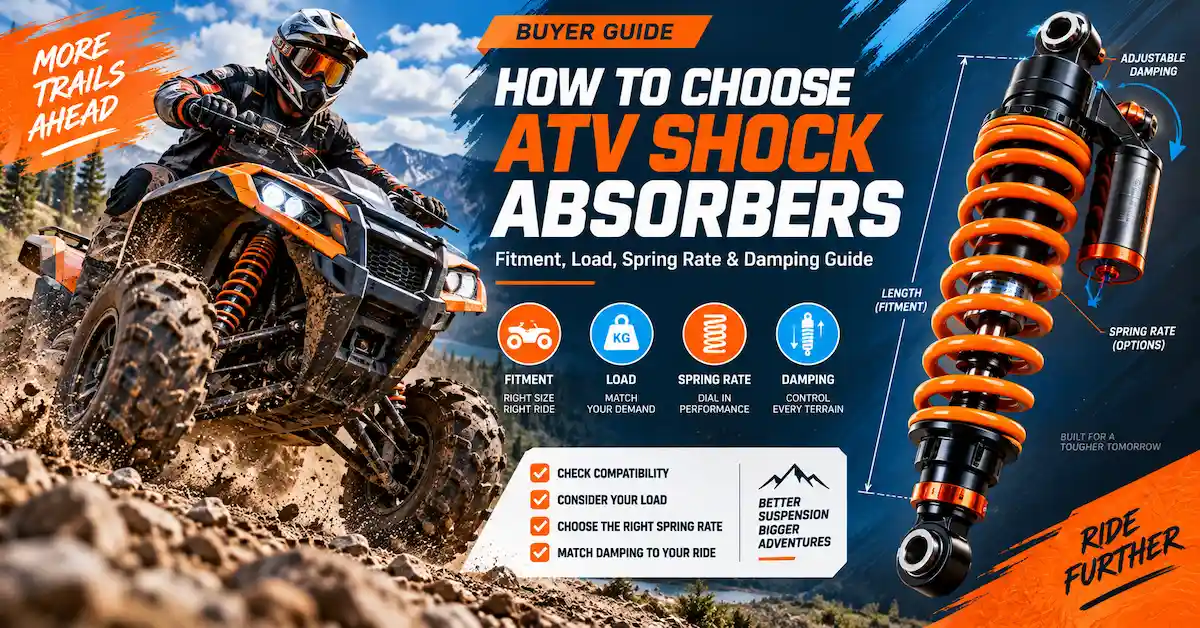
Spring Rate Is Not the Same as Damping
This distinction is especially important for buyers discussing custom suspension for the first time.
The spring primarily supports vehicle load and influences ride height, while the damper controls the speed of suspension movement.
If a heavily loaded UTV sits too low, the problem may involve spring rate or spring setup.
If the wheel returns too quickly after compression and the vehicle feels uncontrolled, rebound damping may require attention.
If the suspension moves through its travel too easily during an impact, compression damping may be part of the problem.
Simply requesting a “harder shock” is therefore too vague for a serious ODM program.
A better requirement is:
The vehicle carries two passengers plus approximately the target cargo load, the rear suspension sags excessively, and the current shock also rebounds too quickly after larger compression events.
That gives the manufacturer an engineering problem to evaluate.
What Files Should You Send to an ODM Shock Absorber Manufacturer?
A controlled project package reduces misunderstandings.
Useful inputs include:
-
2D drawings;
-
3D CAD files;
-
existing shock absorber drawings;
-
physical reference samples;
-
installation photographs;
-
vehicle dimensions;
-
suspension geometry information;
-
vehicle/load information;
-
known spring specifications;
-
known damping data;
-
performance complaints;
-
target market information;
-
prototype quantity;
-
expected future production volume.
BEDO's custom suspension development file guide specifically recommends organizing drawings, CAD, vehicle data, photos, approval criteria, product identification, and commercial information into a controlled development package.
A supplier cannot reliably reconstruct suspension geometry from several screenshots and an approximate overall length.
Better input normally produces a better prototype.
A Practical ODM Shock Absorber Development Process
A professional project should move through controlled stages.
Step 1: Application and Requirement Review
The manufacturer first needs to understand:
-
what vehicle the shock is for;
-
how it is used;
-
what is wrong with the current setup;
-
what the buyer wants to improve;
-
which dimensions are already fixed;
-
which parameters remain open for development.
This stage should happen before quoting a final production solution.
Step 2: Drawing, Sample or CAD Review
The manufacturer reviews the information available.
This may involve:
-
measuring an existing sample;
-
checking controlled dimensions;
-
reviewing mounting interfaces;
-
identifying packaging constraints;
-
identifying missing information.
A buyer with incomplete drawings can use a sample and vehicle data as a development starting point, while a new vehicle program may rely more heavily on CAD and engineering drawings.
Step 3: Initial Specification Development
The project can then define an initial combination of:
-
shock dimensions;
-
stroke;
-
mounting interfaces;
-
spring specification;
-
damping direction;
-
structural configuration;
-
surface treatment;
-
appearance requirements.
At this point, specifications should be separated into two categories:
Controlled requirements — dimensions or functions that must not change.
Development variables — specifications that may be adjusted after prototype testing.
This prevents engineering revisions from being mistaken for manufacturing errors.
Step 4: Prototype Manufacturing
The first prototype is not simply a small mass-production order.
Its purpose is validation.
The buyer should expect to evaluate:
-
installation;
-
clearance;
-
ride height;
-
sag;
-
usable stroke;
-
load support;
-
compression behavior;
-
rebound behavior;
-
leakage;
-
surface finish;
-
overall vehicle response.
Step 5: Test, Feedback and Revision
A technically useful test report does not say only:
“The shock feels too soft.”
Better feedback identifies:
-
vehicle load;
-
terrain;
-
speed range;
-
whether the problem occurs during compression or rebound;
-
whether travel is being fully used;
-
whether the vehicle bottoms;
-
whether wheels lose contact;
-
whether ride height changes excessively.
This gives the manufacturer information that can support the next revision.
Step 6: Final Sample Approval
The final approved specification should become the controlled reference for production.
Purchasing should make sure the approved version includes the relevant:
-
dimensions;
-
spring specification;
-
damping configuration;
-
mounting details;
-
finish;
-
labels;
-
packaging;
-
revision number.
Step 7: Pilot or Small-Batch Production
Moving directly from one prototype to large-volume production can increase risk.
A controlled small batch gives the buyer a chance to evaluate repeatability and real-market use before scaling.
BEDO provides small-batch support for customized suspension development, and its small-batch OEM/ODM suspension guide describes this approach as a way to validate fitment, spring rate, damping and production requirements before higher-volume manufacturing.
Step 8: Production and Quality Control
After approval, manufacturing should reproduce the confirmed design rather than continue changing specifications informally.
Important checks can include:
-
critical dimensions;
-
mounting holes and widths;
-
stroke;
-
assembly condition;
-
rod movement;
-
leakage;
-
surface finish;
-
spring coating;
-
packaging;
-
batch consistency.
For B2B buyers, repeatability is as important as the performance of the first approved sample.
What Can Be Customized in an ODM Shock Absorber Project?
ODM customization can be divided into three levels.
1. Fitment Customization
This includes:
-
extended length;
-
compressed length;
-
stroke;
-
mounting hole;
-
mounting width;
-
upper/lower mount structure;
-
body and spring envelope.
If fitment is wrong, further performance testing may not even be possible.
2. Performance Customization
This may include:
-
spring rate;
-
preload direction;
-
compression damping;
-
rebound damping;
-
adjustable damping configuration;
-
reservoir architecture.
These variables should be connected to real vehicle requirements.
3. Commercial and Brand Customization
Once technical performance is controlled, buyers may also discuss:
-
shock body color;
-
spring color;
-
logo;
-
labels;
-
surface finish;
-
private-label packaging.
Technical customization should come before cosmetic differentiation.
Changing a spring color is simple customization. Developing a new shock for a loaded utility UTV is an engineering project.
BEDO's suspension customization factory guide makes the same distinction between appearance customization and engineering customization involving dimensions, spring rate, damping, fitment, and prototype validation.
How to Evaluate an ODM Shock Absorber Manufacturer
The lowest unit price is rarely enough information to select a development partner.
Buyers should evaluate the entire path from engineering to repeat production.
| Evaluation Area | Key Buyer Question |
|---|---|
| Application understanding | Does the supplier ask about vehicle weight, load and terrain? |
| Engineering input | Can the supplier work with samples, drawings and CAD? |
| Fitment development | Can mounting dimensions and stroke be reviewed? |
| Spring development | Can spring requirements be discussed around actual vehicle load? |
| Damping development | Can compression and rebound requirements be reviewed separately? |
| Prototype support | Is there a clear validation and revision process? |
| Small-batch capability | Can the project be validated before full production? |
| Quality control | Are critical production characteristics checked consistently? |
| Revision management | Can both parties identify which specification is approved? |
| Long-term production | Can approved products be repeated without uncontrolled changes? |
BEDO's broader shock absorber supplier selection guide also recommends separating engineering review, prototype, testing, revision and production instead of comparing suppliers on price alone.
Common ODM Development Risks
Risk 1: Starting With Incomplete Dimensions
Approximate length and photographs are not enough for production approval.
Better approach: confirm controlled mounting dimensions and stroke before finalizing a prototype.
Risk 2: Choosing Spring Rate Without Real Load Data
A spring selected for an empty vehicle may behave differently when passengers, cargo, tools, or batteries are added.
Better approach: provide realistic operating loads.
Risk 3: Treating Damping as One Number
Compression and rebound solve different suspension-control problems.
Better approach: define the behavior the buyer wants to improve.
Risk 4: Skipping Prototype Validation
A shock can look correct on paper and still create clearance or vehicle-dynamics problems.
Better approach: validate installation and performance before mass production.
Risk 5: Approving a Sample Without Revision Control
If purchasing, engineering, and production refer to different drawings or samples, repeat orders can drift.
Better approach: assign a final approved specification or revision.
Risk 6: Comparing Quotations With Different Engineering Scope
One quotation may include development, prototypes and revision support while another covers only manufacturing.
Better approach: compare equivalent project scope, not only unit price.
What Affects ODM Shock Absorber Cost?
There is no responsible universal price for an ODM project.
Development cost depends on variables such as:
-
whether the buyer has a complete drawing;
-
whether a sample must be analyzed;
-
how much structural development is required;
-
spring development complexity;
-
damping development requirements;
-
prototype quantity;
-
number of revision cycles;
-
testing scope;
-
surface-treatment requirements;
-
branding and packaging;
-
expected production quantity.
A project based on a confirmed sample with minor performance adjustments is fundamentally different from a new suspension concept requiring geometry review and multiple prototypes.
The same applies to MOQ and lead time.
They should be discussed according to the actual project rather than presented as fixed values without technical context.
What Should Be Included in an ODM Shock Absorber RFQ?
A stronger RFQ helps the manufacturer respond with a more useful development proposal.
Include as much as possible:
-
Vehicle type and application
-
Front or rear installation
-
Vehicle curb weight
-
Maximum operating weight
-
Passenger and cargo load
-
Extended length
-
Compressed length
-
Required or existing stroke
-
Upper and lower mounting dimensions
-
Existing spring information
-
Known damping information
-
Typical terrain
-
Current suspension problem
-
Target performance improvement
-
Drawings, CAD or physical sample availability
-
Surface and branding requirements
-
Prototype quantity
-
Expected production plan
Instead of sending:
Please quote ODM shocks for UTV.
Send:
We are developing a rear shock for a utility UTV. The vehicle carries passengers and cargo, and the current suspension has excessive rear sag and fast rebound after large compression events. We can provide the current shock sample, mounting dimensions, vehicle weight data and target production plan.
That immediately gives engineering and purchasing teams a much clearer starting point.
How BEDO Supports ODM Shock Absorber Development
Ningbo Bedo Auto Parts Co., Ltd. focuses on shock absorbers and suspension springs for off-road and related vehicle applications and states that it supports customized solutions, design support, technical development, and small-batch ordering.
Depending on the project stage, buyers may begin with:
-
an existing shock absorber;
-
a technical drawing;
-
CAD data;
-
vehicle information;
-
load requirements;
-
performance targets.
The objective is to move from incomplete application requirements toward a controlled product specification that can be prototyped, validated, revised, and prepared for repeat production.
Buyers can review BEDO's company and technical capabilities or submit project information through the BEDO contact page.
FAQ
What is an ODM Shock Absorber?
An ODM Shock Absorber is a shock absorber developed with engineering and design input from the manufacturer based on the buyer's vehicle, application, performance target, sample, drawing, or partial specification.
What is the difference between OEM and ODM shock absorbers?
OEM normally starts from a buyer-controlled design, drawing, sample, or detailed specification. ODM usually requires greater manufacturer involvement in engineering, design recommendations, parameter development, prototypes, and revision.
Can an ODM manufacturer develop a shock absorber from an existing sample?
Yes, a physical sample can be used as a development reference when original drawings are unavailable. Critical dimensions, structure, mounting interfaces, and performance requirements still need to be reviewed and confirmed before production.
What vehicle information is needed?
Useful information includes vehicle type, curb weight, loaded weight, installation position, mounting dimensions, suspension geometry, tire configuration, passenger/cargo load, terrain, and target performance.
Can spring rate be customized?
Spring requirements can be developed according to the application and load target. Buyers should provide realistic vehicle and operating-load information rather than choosing spring rate only from a catalog value.
Can compression and rebound damping be developed separately?
Yes. Compression and rebound control different directions of damper movement and should be evaluated according to the vehicle's behavior and target performance.
Should buyers order prototypes before mass production?
For new or modified shock absorber specifications, prototype validation helps identify fitment, load-support, damping, clearance, and production issues before larger orders.
Is ODM suitable for small production quantities?
It can be. Small-batch development can be useful for prototypes, new vehicle programs, specialty vehicles, aftermarket launches, and market validation. Actual quantities depend on the project's manufacturing requirements.
How long does an ODM shock absorber project take?
There is no single fixed timeline. Development time depends on the completeness of the buyer's information, engineering complexity, prototype requirements, testing, revisions, and production preparation.
What is the best way to request an ODM quotation?
Provide the vehicle application, dimensions, load condition, drawings or samples, performance goals, prototype requirements, expected production volume, and any branding requirements. A detailed RFQ allows the supplier to evaluate both engineering and manufacturing scope.
Conclusion
Choosing an ODM Shock Absorber partner is not simply a matter of finding a factory that can manufacture a shock absorber with a requested length.
A successful ODM project connects:
Vehicle Requirements → Engineering Review → Controlled Specification → Prototype → Vehicle Testing → Revision → Approval → Small Batch → Repeat Production
For ATV, UTV, motorcycle, electric motorcycle, aftermarket, and specialty-vehicle buyers, the most important supplier capability is the ability to convert real application requirements into a product that fits correctly, performs as intended, and can be reproduced consistently.
Before requesting a quotation, prepare as much vehicle, load, geometry, sample, drawing, and performance information as possible. Then evaluate whether the supplier can explain not only what it can manufacture, but also how the product will be developed, validated, approved, and controlled in production.
For buyers developing a new off-road suspension product, BEDO can review available project information and discuss the appropriate path from sample, drawing, or vehicle requirement to prototype and production. Use the BEDO Contact Us page to submit the available technical and purchasing information for project review.