
Where Can You Source Premium ATV Suspension Parts for Your Brand?
You can source premium ATV suspension parts through a specialist OEM/ODM manufacturer that supports both product development and branded supply. BEDO Auto in Ningbo, China, is one option to evaluate: its manufacturing and customization capabilities include shock absorbers, springs, design support, and small-batch ordering, while its OEM ATV shock absorber program lists customization options for valving, spring rates, finishes, and branding. For your supplier shortlist, treat these capabilities as the starting point—not the final quality approval. Before placing your brand on a product, establish what will be supplied, which vehicle applications will be validated, and how later orders will remain consistent with the approved specification.
Choose a Sourcing Route That Matches Your Private-Label Strategy
Structure your inquiry around one of three routes: branding an existing product, modifying an existing design, or developing a component from your own requirements. For an existing-product launch, focus on verified fitment, documentation, packaging, and replenishment. For a modified product, identify the dimensions, spring characteristics, damping targets, or appearance requirements that need to change. For drawing-based development, establish responsibility for engineering review, prototype revisions, and approval. A distributor or sourcing partner may be suitable when it can provide clear access to the people controlling those decisions; a factory label alone is not sufficient qualification. This development-led approach is intended for aftermarket brands, importers, and powersports distributors building repeatable product lines, rather than buyers seeking an unidentified one-off replacement.
Define Premium ATV Suspension Parts Around a Specific Application
For your sourcing brief, define premium ATV suspension parts as products that meet documented application requirements and can be supplied repeatedly to that specification—not simply products with a distinctive finish. Choose the first vehicle platform and customer use case before expanding the catalog. For a recreational trail range, ask engineers to evaluate rider-load conditions, intended terrain, and ride-control objectives. For a utility ATV range, include cargo and accessory loads in the development brief. For sand, mud, or coastal use, specify the exposure conditions you want considered in sealing and surface-protection validation. Replace vague instructions such as “make it stronger” with agreed evaluation criteria. A focused launch specification gives your engineering, purchasing, and marketing teams the same product requirements to work toward.
Build the Technical Specification Before Comparing Prices
Use the following table as a proposed specification checklist, not as a claim that every listed requirement is already available on every BEDO model. Ask the supplier to identify confirmed values, open questions, and items requiring development. BEDO’s shock absorber measurement guide provides a related starting point for gathering dimensional and vehicle information.
| Specification area | Information to confirm before sample approval |
|---|---|
| Vehicle application | ATV make, model, year, variant, and installation position |
| Length definitions | Extended and compressed dimensions, measurement reference points, and tolerances |
| Mounting interfaces | Upper and lower hole diameters, widths, sleeve details, and orientation |
| Travel and clearance | Required usable stroke and vehicle clearance through the intended movement range |
| Spring specification | Dimensions, rate with complete units, and agreed load–deflection requirements |
| Damping specification | Compression and rebound targets, test conditions, and adjustment function where applicable |
| Materials and environment | Material specifications, finish requirements, exposure conditions, and validation plan |
| Approval records | Drawing revision, sample identification, test requirements, and acceptance criteria |
Compare Actual BEDO Models Before Selecting a Starting Design
The three products below are listed as rear ATV/UTV shock absorbers with fixed damping, an internal gas chamber, and oil–gas separation. Their published dimensions provide useful screening information, but they are not a vehicle-specific fitment approval.
AU_HSA_01 and AU_HSA_03 illustrate why a shared stroke and bolt-hole diameter are insufficient grounds for interchangeability: their published lengths and mounting widths differ. Use that comparison to ask better engineering questions, not to rank one model as universally superior. The pages label the length field “total length,” so obtain a dimensioned drawing before treating that number as an eye-to-eye measurement. For private-label selection, request confirmation of the complete assembly, final application, and approved product revision.
Check Materials and Workmanship Behind the Finish
The listed models identify aluminum alloy and steel tubing, but those broad material descriptions do not specify a complete private-label manufacturing standard. For your project, request confirmation of the relevant grades, critical dimensions, surface treatments, and component specifications. Ask how the manufacturer controls machining, assembly, spring selection, sealing, and filling or charging operations where applicable. Clarify which processes are performed internally and which involve outside suppliers, then request the inspection records appropriate to the agreed design. For cosmetic approval, define acceptable finish variation, marking placement, and packaging protection separately from functional acceptance. BEDO’s supplier evaluation guide provides further questions for distinguishing detailed manufacturing explanations from general quality claims.
Approve Samples Against a Written Quality Plan
Before approving premium ATV suspension parts for production, agree what the sample must demonstrate: dimensional conformity, installation compatibility, intended movement, functional performance, and any required durability or environmental evaluation. State the test conditions, acceptance limits, responsible party, and revision procedure in the approval record. Request current quality-system certificates and confirm their scope, but assess them separately from evidence for the particular product being purchased. BEDO describes sample analysis, drawing review, prototype manufacturing, spring development, damping adjustment, and testing support in its suspension sample development process. Use that discussion to agree a project-specific validation plan. After the engineering sample is accepted, arrange a pilot batch where appropriate and compare production units with the approved reference. Keep a retained sample and its documentation together so future questions have a defined starting point.
Specify Branding, Packaging, and Product Identity Together
BEDO’s OEM ATV program includes branding and finish options, while its distributor guidance also addresses labels, packaging, product documentation, and stock-keeping units, or SKUs. When branding premium ATV suspension parts, create a separate brand-approval sheet covering artwork, colors, logo position, product identifiers, carton information, and the exact contents of each saleable unit. State whether a listing represents one shock, a pair, or a kit, and identify any included mounting hardware. Match the approved retail description to the validated vehicle application rather than enlarging the fitment claim for marketing convenience. Also clarify how customer drawings and artwork may be used and whether any requested design exclusivity is actually offered. Do not assume that a branded finish makes a catalog design exclusive to your business.
Confirm MOQ, Available Capacity, and Lead-Time Milestones
BEDO states that it supports small-batch ordering, but your minimum order quantity and delivery schedule still need a project-specific quotation. Request quantities by model, spring specification, finish, and packaging variant rather than discussing only an overall order total. Ask for separate timing estimates for technical review, sample preparation, any revisions, pilot production, and repeat orders. Confirm what starts each timing commitment: receipt of complete requirements, sample approval, artwork approval, or another agreed milestone. For capacity planning, ask what production allocation is available for your particular product mix and launch window. This provides a more useful purchasing basis than assuming a general factory capacity figure guarantees delivery of your selected models on a particular date.
Compare Total Project Cost and Repeat-Order Controls
When comparing quotations for premium ATV suspension parts, separate recurring unit costs from development, samples, tooling or fixtures where required, testing, branding, packaging, and transport. Request comparable quotations against the same specification and state which services are included or excluded. Discuss replacement-part availability and the process for investigating reported defects before launch, rather than assuming a generic warranty statement answers those questions. For repeat orders, require a reference to the approved drawing, component requirements, product identification, and packaging revision. Agree how proposed changes will be communicated and when reapproval is necessary. A useful supplier-review question is: “What records will you use to show that this order matches the product we approved?” BEDO’s guidance on production consistency emphasizes controlled specifications, traceability, and production records as areas for buyer evaluation.
Prepare a Sourcing Brief for BEDO
A useful opening inquiry identifies your brand’s target market, selected ATV platforms, installation position, intended use, available drawings or samples, performance objectives, trial-order plan, and expected repeat demand. Add the proposed retail configuration and branding requirements, then distinguish essential specifications from preferences that remain open to engineering discussion. BEDO’s drawing-based suspension development covers customer drawings, CAD files, existing samples, and vehicle requirements, with engineering review, prototype production, and small-batch validation among the described support activities. Ask the team to respond with a proposed starting design, unresolved technical questions, sample scope, quotation assumptions, and the next approval step. That response becomes a practical basis for evaluating the project.
Frequently Asked Questions
Can BEDO supply ATV suspension products under my own brand?
BEDO lists private-label support and branding options for relevant suspension projects. Confirm the selected product, artwork, packaging, specification, and order conditions before treating the program as approved.
Should I begin with an existing model or a new design?
Start by comparing an existing model with your application requirements. Request modifications or new development only where the confirmed specification or planned product offering requires them; establish the associated sample and approval work first.
Do I need complete CAD files to begin a discussion?
Not necessarily. BEDO describes development based on drawings, CAD files, existing samples, and vehicle requirements. Explain what information you have and ask which additional measurements or documents are needed for the next stage.
Are the three listed rear shocks adjustable?
Their product pages list no adjustable damping levels. Treat them as fixed-damping starting points. For a project requiring rider adjustment, ask BEDO to evaluate an appropriate configuration rather than assuming these models include it.
Can I select a shock using only its length?
Do not make that selection without confirming the mounting interfaces, compressed dimension, stroke, installation space, and application requirements. Ask for a drawing with defined measurement references and arrange the appropriate fitment validation.
Does a listed ATV model family prove fitment for every year?
Use the specific year, variant, and installation position when requesting confirmation. BEDO’s OEM ATV page asks buyers to provide model and year information for part-number references and project discussions.
Can suspension springs or ball joints be included in the product line?
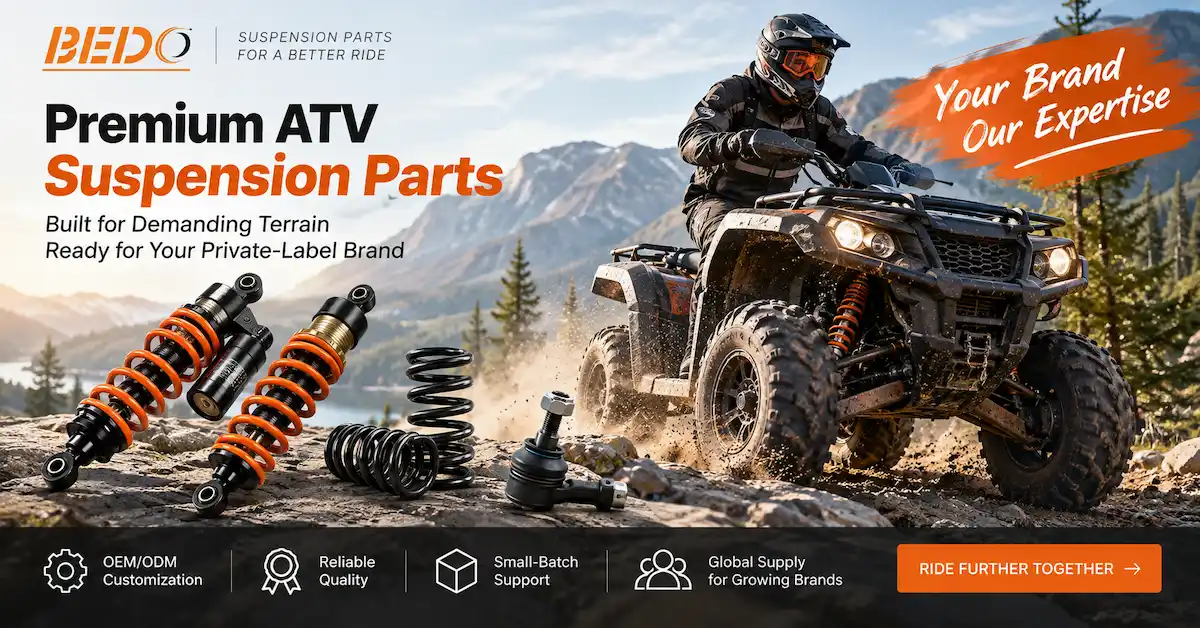
BEDO’s product navigation includes suspension springs and ball joints alongside shock absorbers. Request item-level specifications, availability, and private-label options for each proposed component; category presence alone does not establish a complete matching kit.
Can a new brand begin with a small order?
Ask for a sample and trial-order proposal. BEDO advertises small-batch support, but confirm the applicable quantity for each model, configuration, and packaging option rather than assuming a single minimum applies to everything.
What should happen when a sample needs changes?
Record the issue, affected requirement, proposed correction, and sample revision. Agree what needs to be retested and who must approve it. Do not release the earlier version for production while the change remains unresolved.
What should be agreed about after-sales support?
Request the defect-reporting process, required photographs or measurements, batch-identification method, evaluation responsibilities, and available remedies. Include spare-component availability and response arrangements in the commercial discussion; do not assume unconfirmed coverage.
Conclusion
The right source for premium ATV suspension parts should be able to discuss the product behind your label: its application, specification, validation, manufacturing requirements, and repeat-order controls. Begin your BEDO evaluation with a manageable set of target applications, approve both the technical product and its branded presentation, and document the basis for future supply. To take the next step, contact BEDO with your private-label ATV suspension project, including your target models, drawings or samples, intended use, and purchasing plan. Ask for a technical review and a clearly scoped sample proposal before committing to production.