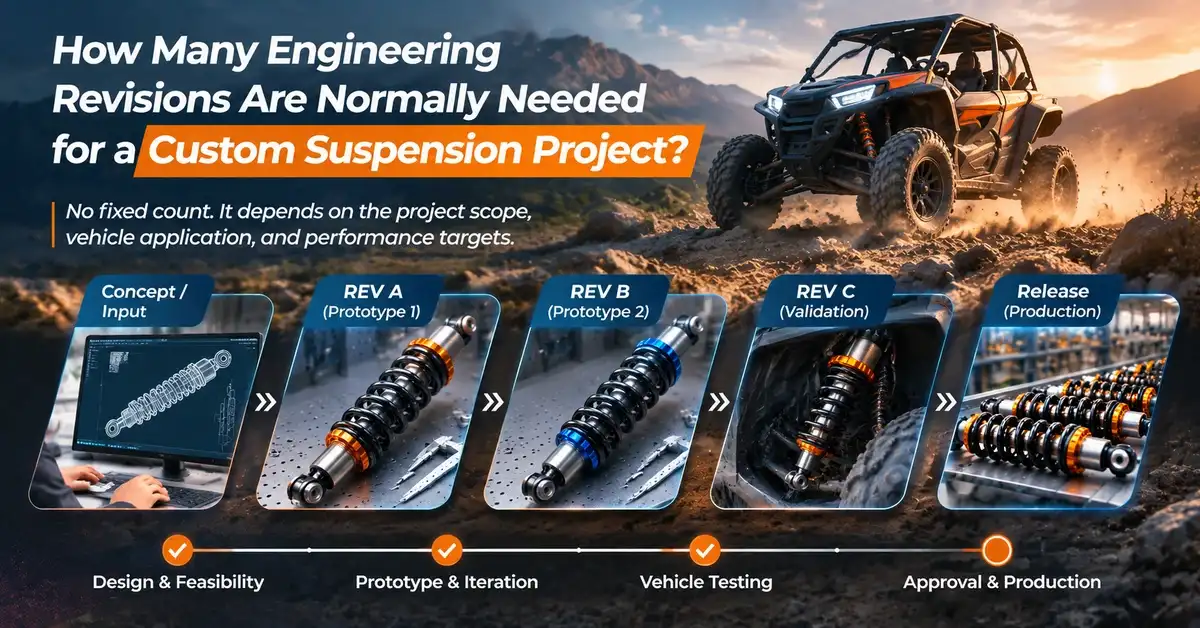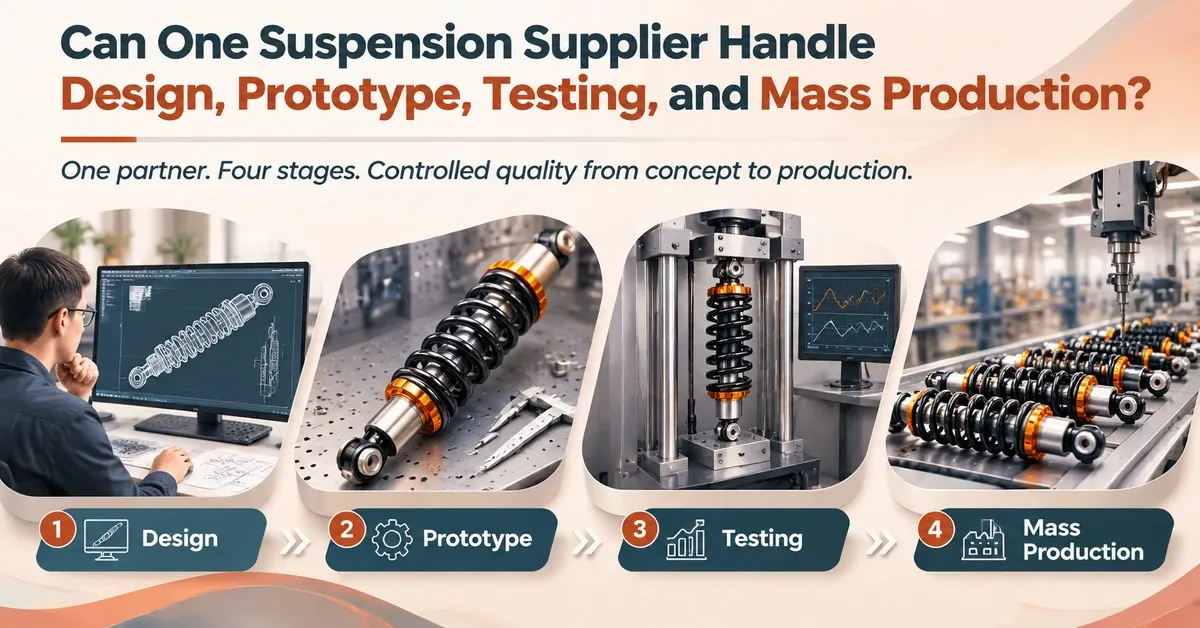

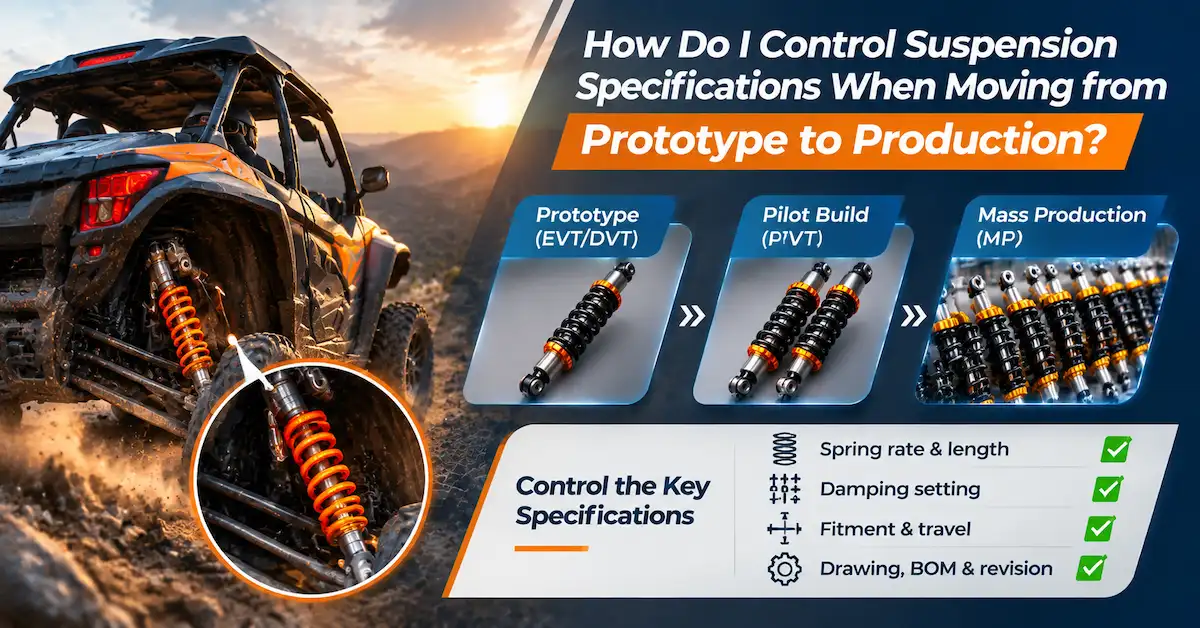
Control the transition by freezing one approved product definition and linking every production unit to its drawing, BOM, spring or damper setting, inspection method, packaging, and revision history. A prototype can work on a vehicle while still containing undocumented tuning, hand-selected parts, temporary hardware, or a supplier process that is not ready for repeat orders. Production control begins when the buyer converts the successful prototype into a controlled specification and then verifies that the pilot build follows it.
The key rule is simple: production should reproduce the approved configuration, not the appearance of the last sample.
Why a successful prototype is not yet a production specification
A prototype often contains engineering flexibility that is useful during development but unsuitable for repeat purchasing. The spring may have been selected from available stock, the damping may have been adjusted by hand, a bushing may be temporary, or a bracket may have been modified during vehicle installation. These details can be invisible in a product photograph but decisive in production behavior.
| Prototype condition | Why it is acceptable during development | What production must control |
|---|---|---|
| Hand-tuned damping | Allows engineers to explore response quickly. | Internal configuration, setting, test condition, and approved response. |
| Selected-from-stock spring | Provides a fast way to reach ride height or sag for a vehicle test. | Spring identity, rate or load-deflection target, free length, seat, and batch traceability. |
| Temporary hardware | Helps confirm installation and movement before final hardware is sourced. | Approved bolt, sleeve, bushing, washer, torque, and installation stack. |
| Modified bracket or spacer | May solve a prototype packaging issue while the design is being evaluated. | Released geometry, responsibility for the vehicle-side part, and inspection method. |
| Informal test setting | Lets the operator compare alternatives during early tuning. | Baseline, adjustment direction, setting identification, and acceptance condition. |
Freeze the approved sample's identity
Assign a sample number and revision to the physical unit that passed the agreed test. Record its spring, damping setting, hardware, finish, and any vehicle-side components. If the approved sample cannot be reconstructed from the records, the production transfer is incomplete.
Separate vehicle approval from supplier production approval
Vehicle testing answers whether the complete application performs under the defined condition. Supplier production approval answers whether the factory can reproduce the approved part. Both approvals are necessary and should not be replaced by one another.
What documents should be frozen before pilot production?
The exact document set depends on the product, but the core principle is that every functional feature has one controlled reference. The buyer should not ask quality to inspect from an old drawing while purchasing orders from a newer spreadsheet.
| Controlled document | Minimum content | Owner or approval question |
|---|---|---|
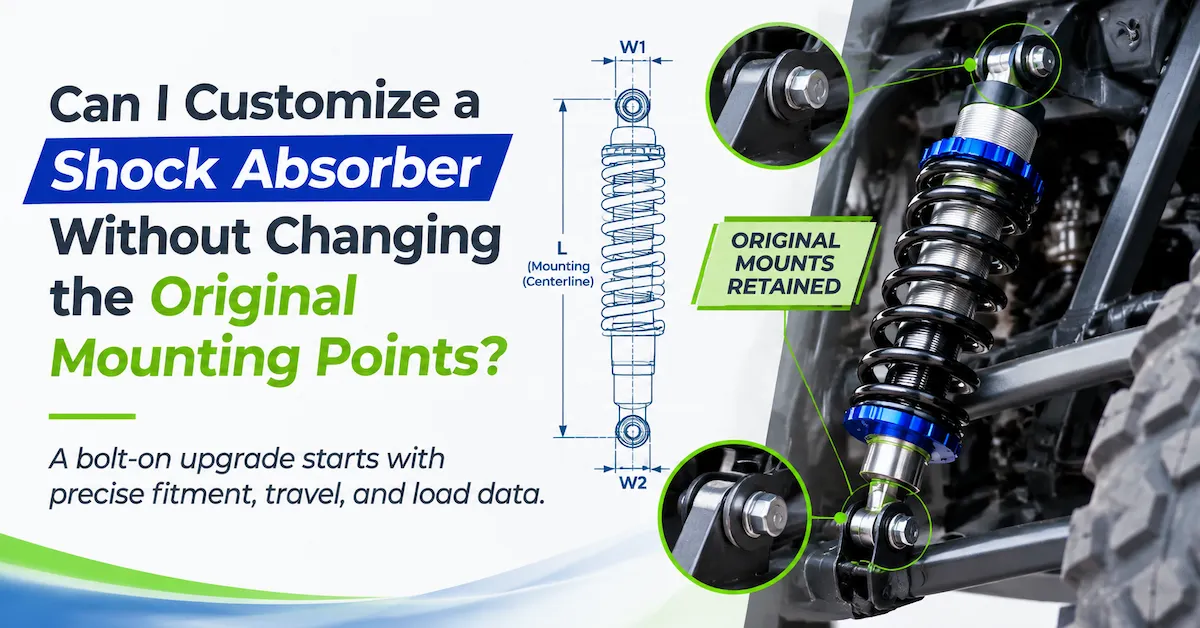
| Application drawing or CAD | Mounts, centers, widths, lengths, stroke, clearance datums, and revision. | Does it define the vehicle interface and movement envelope? |
| BOM | Body, spring, damper parts, bushings, hardware, finish, labels, and quantities. | Does it identify the complete production configuration? |
| Performance specification | Spring load-deflection, damping setting, adjustment baseline, temperature, and test method. | Can quality and engineering measure the same response? |
| Inspection plan | Critical dimensions, sampling, fixtures, reaction to failure, and records. | Can production variation be detected before shipment? |
| Work instruction | Assembly sequence, torque, setting, marking, and special handling. | Can operators build the same configuration repeatedly? |
| Packaging and label specification | Part number, application, protection, installation information, and traceability. | Can the correct configuration be identified in storage and service? |
| Change-control record | Approval roles, notification threshold, retest rules, and deviation process. | What happens when a part or process changes later? |
Use one revision number across the package
The drawing, BOM, test record, inspection plan, and purchase specification should be cross-referenced. They do not need identical file names, but a buyer should be able to prove which versions were active when the pilot was approved. This prevents a spring rate or damping setting from changing through an unrelated document update.
Mark provisional and production-intent parts
Prototype hardware that is not approved for production should be marked as provisional. Production-intent parts should be traceable to the supplier, lot, and revision. Mixing both types in one sample area is a simple way to lose control of the transfer.
For buyers building a controlled part definition, BEDO's shock absorber BOM guide and dimension and tolerance control resource provide useful checkpoints before the pilot purchase order is released.
How should the pilot prove production readiness?
The pilot should be built with production-intent parts, equipment, work instructions, inspection, and packaging wherever practical. Its purpose is to expose the difference between a design that works and a process that can repeat the design.
| Pilot check | Question answered | Record to retain |
|---|---|---|
| Part and BOM verification | Were the approved components used in the intended quantities and revisions? | Lot identity, incoming records, BOM check, and deviations. |
| Dimensional inspection | Does the built assembly match the released interface and travel definition? | Datums, measurements, fixture, sample identity, and reaction. |
| Spring verification | Does the spring match the approved load-deflection or rate condition? | Load points, conditioning, calculation, and batch traceability. |
| Damper verification | Does the response match the approved setting at the defined condition? | Speed, temperature, setting, curve, calibration, and revision. |
| Assembly audit | Were torque, preload, orientation, marking, and adjustment settings controlled? | Work instruction, audit result, operator or station, and nonconformance. |
| Packaging inspection | Can the correct application be protected, labeled, and traced? | Package sample, label, installation material, and shipment check. |
| Vehicle confirmation | Does the pilot configuration remain suitable on the defined vehicle? | Load state, fitment, travel, route or event, observations, and approval. |
Define what counts as a pilot deviation
A deviation can be a substituted component, an out-of-tolerance dimension, a temporary assembly method, a missing record, or a test condition that differs from the approved plan. Each deviation should be classified as accepted, corrected and retested, or rejected. Do not close a pilot because the finished product “looks right.”
Use the pilot to test the inspection method
An inspection plan is not complete until the factory can use it. Check whether the fixture locates the part repeatably, whether the load points are clear, whether the calculation is understood, and whether a failed result has a defined reaction. If quality cannot reproduce the measurement, the specification is not yet production-ready.
How do you control spring and damper specifications?
Spring and damper behavior should be identified by more than a marketing description. A part number, test setting, and approved condition should connect the physical component to the vehicle application.
| Specification | What to identify | Common control gap |
|---|---|---|
| Spring | Rate or load-deflection points, free length, installed length, wire or part identity where approved, seat, and preload. | “Heavy duty” label with no application-specific measurement. |
| Damper | Body, stroke, compression/rebound approach, adjuster baseline, temperature, and test speed. | Same body name used for different internal settings. |
| Mount and bushing | Width, sleeve, hole or thread, offset, hardness or approved part identity, and hardware stack. | Nominal hole size is controlled while side load or width is not. |
| Finish and protection | Approved finish, exposed surfaces, seals, caps, and environmental requirement. | Appearance change made without checking sealing or corrosion exposure. |
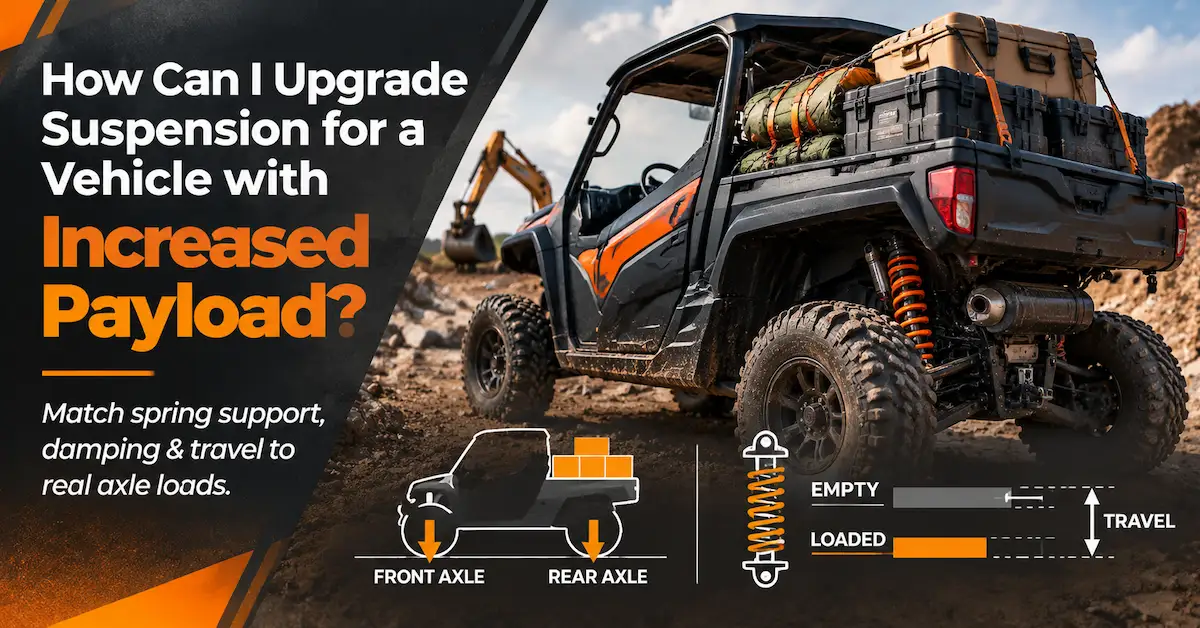
| Application | Vehicle, position, load state, modifications, and installation limits. | Product family is sold without separating vehicle-specific variants. |
Control settings at the point of assembly
If the production shock uses an adjustable feature, record the assembly baseline and how it is marked or verified. If it is fixed, identify the internal configuration or acceptance response that defines it. The buyer should be able to distinguish a production setting from a technician's temporary tuning adjustment.
Do not over-specify unapproved details
Specification control does not mean inventing tolerances for every material, coating, or internal component. Define the features that affect fitment, function, safety, traceability, and service. Other supplier-controlled details can remain confidential if the quality agreement defines how changes are notified and validated.
What is the correct change-control process after release?
Changes after production release are normal. The risk comes from making them without assessing their effect on the approved application. A controlled process starts with a change request and ends with an updated document set and approval record.
| Change step | Required question | Possible output |
|---|---|---|
| Describe the change | What component, process, supplier, setting, or document will change? | Change request with reason and proposed date. |
| Assess impact | Could it affect fitment, load, damping, durability, packaging, service, or identification? | Risk assessment and affected-document list. |
| Define verification | What dimensional, bench, vehicle, or production check is needed? | Focused retest plan or justified no-retest decision. |
| Approve implementation | Who accepts the change and which revision becomes active? | Signed or recorded approval and effective revision. |
| Verify first changed lot | Did the implemented change match the approved request? | First-lot inspection, test record, and traceability. |
| Update purchasing and service | Can future orders, warehouse teams, and users identify the new configuration? | Updated PO specification, label, package, and service information. |
Set change triggers in the quality agreement
Changes to spring, damper internals, oil, gas condition, bushing, mount, seal, supplier, heat treatment, assembly process, inspection method, or package may require notification. The agreement should state when a sample, bench test, vehicle check, or pilot is required. The exact threshold must be project-specific.
Keep obsolete specifications out of purchasing
Archive obsolete files and make the active revision obvious. A supplier acknowledgement should reference the same revision as the buyer's purchase order. If an older drawing remains in an email folder or shared drive without status, it can re-enter the production process later.
How can buyers control repeat orders?
Repeat-order control begins with the purchase order. Include the application, part number, revision, spring and damper identity, required records, packaging, quantity assumptions, and deviation approval route. Do not rely on a product family name if several settings or load options share the same body.
Evidence boundary: a successful prototype or a supplier's standard quality certificate does not prove that every later unit matches the approved suspension specification. Repeat supply needs application-specific records, traceability, inspection, and change control. Fixed MOQ, lead time, certification, warranty, and durability claims should be confirmed separately for the project.
Use incoming inspection proportionate to risk
The buyer can verify critical dimensions, spring behavior, damper response, markings, and packaging according to the application's risk and the supplier's agreed sampling plan. The plan should define what happens when a sample fails, including containment, investigation, and release authority.
Compare batch data over time
Trend review can show drift before the product becomes a field problem. Compare results using the same fixture, load points, temperature, calculation, and sample identification. A trend is not automatically a failure, but it should trigger a review when it approaches the project limit or changes the distribution of results.
FAQ: suspension specification control
What is the most important document when moving from prototype to production?
No single document is enough. The released drawing, BOM, performance specification, inspection plan, work instruction, packaging, and change-control record must agree. The BOM identifies what is built; the tests and inspections verify how it performs.
Can a golden sample replace a drawing and BOM?
No. A golden sample can support visual and functional comparison, but it cannot fully define hidden spring, damping, material, setting, or process requirements. Use it as a reference alongside controlled documents and test records.
When should a production pilot be rejected?
Reject or contain it when a critical requirement fails, a deviation is not approved, the sample cannot be traced, the test method was not followed, or the built configuration differs from the released specification. A corrective action should identify the cause and the required retest.
Do all supplier changes require a full vehicle retest?
No. The verification should match the risk. A label-only change may need a document and packaging check. A spring, damper, mount, stroke, or process change may require focused bench and vehicle validation. The decision must be recorded.
How should a buyer handle a supplier substitution?
Require advance notification, identify the affected component and function, assess fitment and performance risk, approve samples or tests as needed, and update the BOM and purchase specification before the changed part enters repeat supply.
Conclusion
Controlling suspension specifications from prototype to production requires more than saving the final CAD file. Freeze the approved configuration, connect drawing, BOM, spring, damper setting, inspection, packaging, and revision history, then use a production-intent pilot to prove that the factory can reproduce it. After release, apply risk-based change control and trend review to protect repeat orders.
For an OEM or aftermarket program, prepare the approved prototype record, drawings, BOM, test results, application limits, and required inspection evidence before requesting repeat production. BEDO buyers can review the prototype-to-mass-production consistency guide, the manufacturing and quality-control resources, and the official contact channel for a project-specific production-transfer discussion.