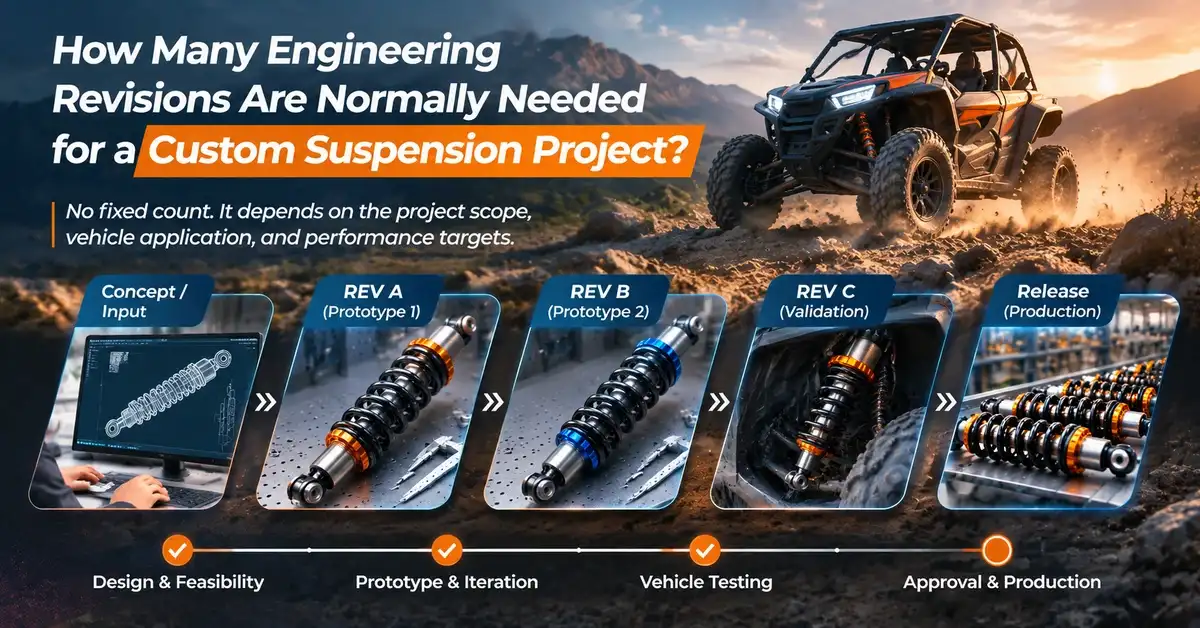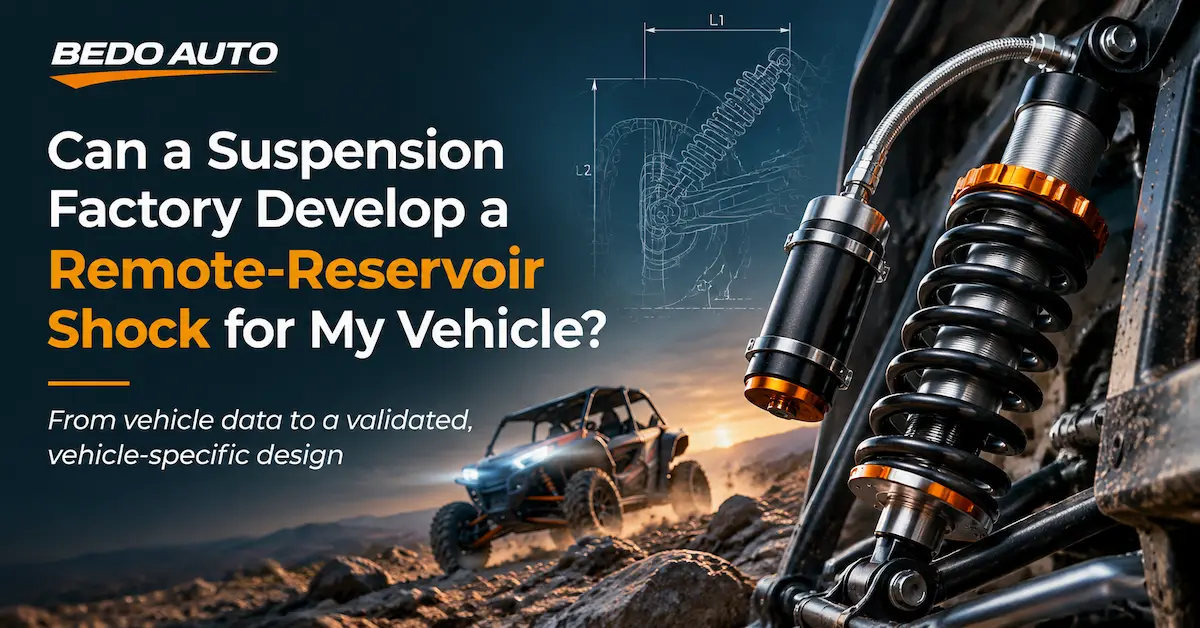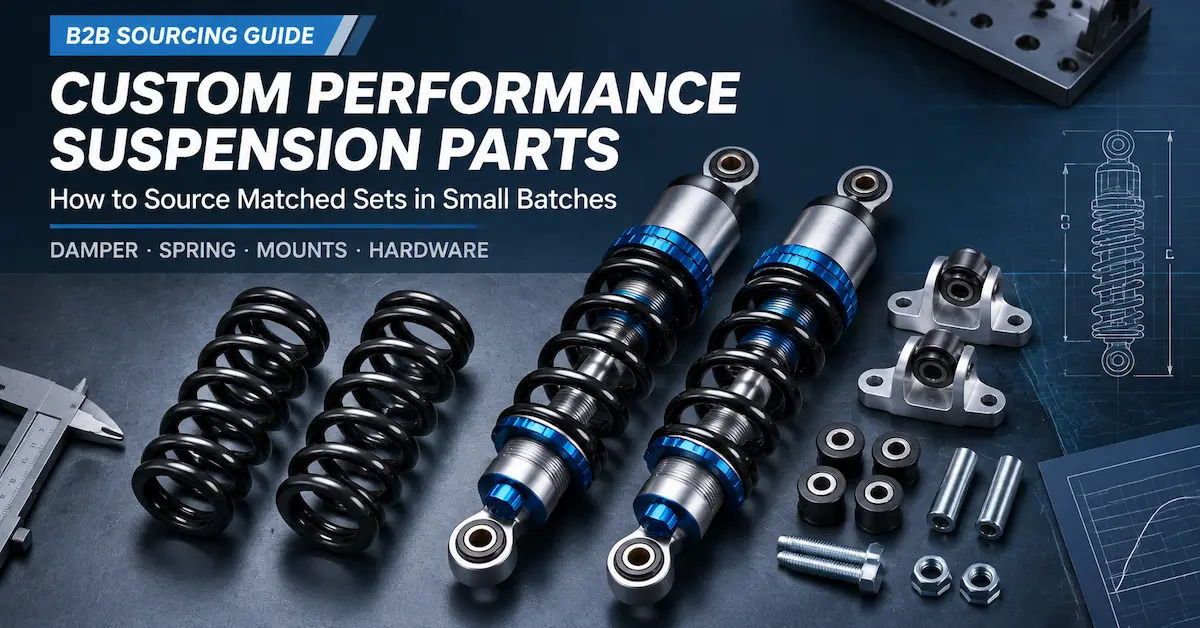

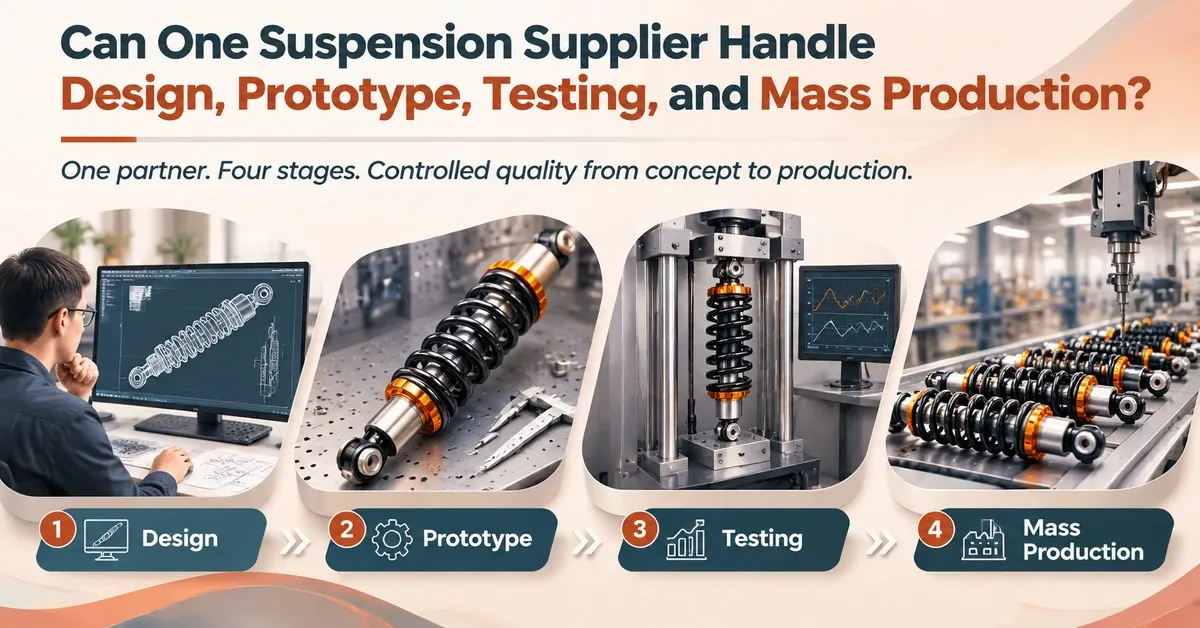
One suspension supplier can handle the full path from design to mass production, but only when its engineering, testing, quality, and production responsibilities are defined as one controlled program. A supplier may be able to design a shock absorber or spring, build prototypes, support vehicle testing, and manufacture repeat orders. That capability is not proved by a catalog or by a successful first sample. The buyer needs evidence that the same product definition, revision history, test method, and change-control process can continue from concept through production.
The practical question is therefore not “can the supplier do everything?” It is “which deliverables does the supplier own at each gate, and what evidence must the buyer approve before the next gate opens?”
This guide is for OEM engineers, aftermarket suspension brands, fleet buyers, specialty-vehicle developers, and distributors comparing a one-stop suspension supplier with several specialist vendors. It focuses on design responsibility, prototype learning, testing ownership, production readiness, and the purchasing risks that appear when a project changes hands.
What does “one supplier” actually include?
“One supplier” can describe very different commercial arrangements. A factory may manufacture the final shock while an outside engineering company owns the design. Another supplier may provide CAD and samples but subcontract testing. A trading company may coordinate several factories and issue one quotation. These arrangements can all work, but the buyer should not treat them as equivalent to an integrated supplier with clear ownership.
| Supplier model | What the buyer receives | Main control question |
|---|---|---|
| Integrated design-to-production supplier | Engineering input, prototypes, test support, production, quality records, and repeat supply under one program. | Are the internal handoffs and approval gates documented? |
| Manufacturing supplier with external design | Production of a customer or third-party design, sometimes with build feedback. | Who owns design changes, validation, and technical responsibility? |
| Project coordinator or trading company | One commercial contact for multiple external vendors. | Can the buyer trace the actual manufacturer, test source, BOM, and change route? |
| Specialist consortium | Separate design, test, spring, damper, and production specialists. | Who integrates the complete suspension and resolves conflicting data? |
Define ownership before discussing price
A quotation should identify who owns the technical input review, CAD interpretation, spring selection, damping proposal, prototype build, fixture design, bench testing, vehicle test coordination, drawing release, pilot inspection, packaging, and production change notification. If these fields are missing, a low unit price may simply exclude the work required to make the product repeatable.
Separate supplier capability from buyer approval
An integrated supplier can prepare a design and evidence package, but the vehicle OEM or brand still needs to approve the application, load states, performance targets, and release decision. Supplier ownership does not remove the buyer's responsibility to define the vehicle and accept the product for its intended use.
When is a one-stop suspension supplier the better choice?
Using one supplier is most useful when the project has strong interaction between geometry, spring support, damping, packaging, and production method. A change in shock stroke can alter fitment. A change in spring rate can change damping demand. A bracket change can affect the assembly fixture. A single technical owner can reduce the time spent translating these changes between companies.
| Project condition | Why one supplier may help | What still needs confirmation |
|---|---|---|
| Vehicle-specific shock or spring | Geometry, load, spring, damping, and fitment decisions stay connected. | Hard points, load states, motion envelope, and final vehicle validation. |
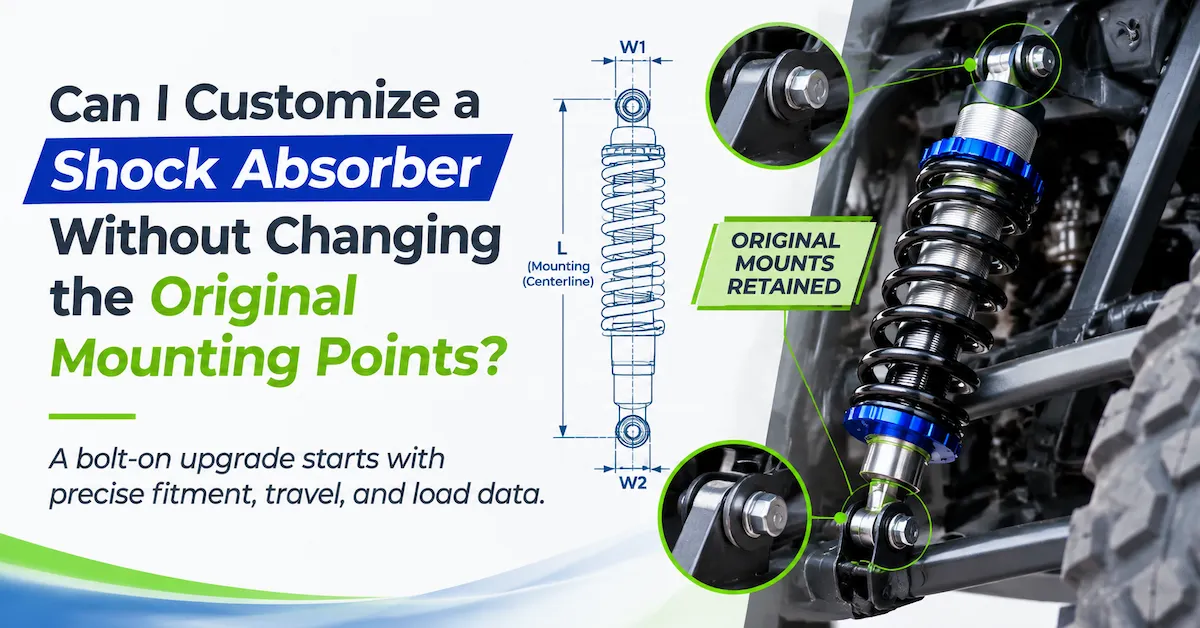
| Aftermarket application with original mounts | The supplier can link interface measurements to a repeatable custom configuration. | Mount dimensions, installation hardware, clearance, and application limits. |
| New platform or low-volume vehicle | Prototype feedback can be incorporated before production tooling and inspection are fixed. | Prototype purpose, sample quantity, forecast, and release criteria. |
| Multiple related products | Shared components, springs, labels, and quality methods may be coordinated more easily. | Part-number separation, BOM control, and configuration traceability. |
| Frequent engineering changes | One revision system can connect drawings, samples, test results, and purchase records. | Formal change approval and the point at which a new validation is required. |
One supplier is not automatically better for every project. If the buyer already has a validated damper design, a specialist production source may be more efficient. If the design requires an independent test laboratory or a regulated certification process, the supplier may need to coordinate an outside party. The important issue is transparent responsibility, not the number of companies shown on the purchase order.
What should the design stage deliver?
Design work should convert a vehicle requirement into a controlled product definition. A useful design package does more than show a 3D shape. It identifies the fixed vehicle interface, available travel, spring and damper targets, environmental assumptions, service conditions, and the information that remains provisional.
| Design deliverable | Buyer should review | Why it matters later |
|---|---|---|
| Input and assumption register | Vehicle position, load states, modifications, missing data, and provisional dimensions. | Prevents an assumption from becoming an undisclosed production requirement. |
| Interface drawing or CAD review | Mount centers, width, hole or thread, offset, length, stroke, and clearance envelope. | Creates a shared fitment reference for prototype inspection. |
| Spring definition | Rate or load-deflection target, free length, installed length, preload, seat, and retention. | Connects ride height and support to a traceable part. |
| Damper definition | Body, stroke, damping approach, adjustment, baseline, and test condition. | Allows bench results and later orders to refer to the same configuration. |
| BOM and revision plan | Components, hardware, finish, labels, packaging, revision identifiers, and change rules. | Provides the bridge from engineering sample to production purchasing. |
Ask whether the design is application-specific
A general shock body can be used across several vehicles, but the complete application may still require a different spring, mount, damping setting, or bracket. The quotation should identify the product family and the vehicle-specific configuration. This avoids a common mistake in which a buyer approves a prototype visually and later receives a nominally similar part with a different functional setup.
Link design choices to measurable behavior
“Improved comfort” or “heavy duty” is not enough to release a design. State the intended loaded ride height, sag range, bottoming concern, rebound recovery, temperature condition, adjustment need, or installation limitation. The exact target can be project-specific; it must be written so the supplier and buyer can test the same question.
For a first review, buyers can compare the supplier's proposed configuration with the available shock absorber product range and then send the vehicle drawings, dimensions, load states, and intended use through BEDO's technical contact channel.
What should the prototype stage prove?
A prototype is a decision tool, not simply an early production unit. The buyer and supplier should define what each sample is intended to prove. A dimensional sample may answer whether the part installs and clears. A tuned sample may answer whether the spring and damping direction is correct. A production-intent sample may answer whether the final BOM and assembly method can be repeated.
| Prototype type | Primary question | Do not assume it proves |
|---|---|---|
| Geometry sample | Can the part be installed and moved through the defined envelope? | Final spring rate, damping, durability, or production consistency. |
| Functional tuning sample | Does the proposed spring and damping direction address the vehicle symptom? | Final production settings or long-term repeatability. |
| Production-intent sample | Can the approved parts, fixtures, settings, and assembly method reproduce the design? | Every vehicle condition unless the agreed validation covers it. |
| Packaging sample | Can the part be labeled, protected, serviced, and shipped as planned? | Complete vehicle performance or structural approval. |
Record every successful change
Prototype work often changes preload, spring, shims, oil, gas condition, bushings, brackets, or adjustment settings. Each successful change should be linked to a sample identity and revision. Otherwise, the supplier may know that “the latest one worked” while purchasing cannot identify which configuration to order.
Use a decision matrix for prototype approval
The matrix should list fitment, travel, clearance, spring support, damping response, leakage or retention, service access, and appearance or packaging requirements. Mark each item as pass, fail, open, or not applicable. A verbal approval at the end of a test day is not a reliable production instruction.
Who should own testing?
Testing can be divided between supplier bench testing, supplier-supported vehicle testing, buyer vehicle validation, and independent laboratory work. A one-stop supplier may coordinate all of these, but the test plan should distinguish what the supplier measured from what the vehicle owner accepted.
| Test layer | Typical question | Required traceability |
|---|---|---|
| Dimensional inspection | Does the sample match the released interface and packaging definition? | Drawing revision, datums, measured values, hardware, and sample number. |
| Spring load-deflection | Does the spring support the defined installed and loaded conditions? | Fixture, load points, conditioning, calculation, and spring identity. |
| Damper bench test | Does the compression and rebound response match the defined setting? | Speed, temperature, setting, curve, machine, calibration, and revision. |
| Vehicle validation | Does the complete vehicle remain usable and controlled in the planned duty cycle? | Vehicle state, load, route, settings, observations, measurements, and approval. |
| Pilot inspection | Can production-intent parts reproduce the approved configuration? | Lot identity, inspection plan, nonconformances, reaction, and release. |
The supplier should state which test results are engineering evidence and which are acceptance evidence. A bench curve may confirm a damper setting, but it cannot replace a vehicle check for tire contact, steering clearance, body motion, or operator control. Likewise, a successful vehicle test does not replace the need for production inspection.
How does the project move from testing to mass production?
The transition begins when the approved configuration is frozen and the production process is defined. The supplier should issue or update the drawing, BOM, work instructions, inspection plan, test method, packaging specification, label, and change-control record. The pilot then checks whether those documents describe what the factory actually builds.
| Release gate | Evidence to review | Decision |
|---|---|---|
| Design freeze | Approved drawing, CAD, BOM, spring, damping setting, hardware, and revision history. | Is the product definition complete enough to build? |
| Process readiness | Assembly sequence, fixtures, work instructions, inspection points, and trained responsibilities. | Can the factory build the defined part consistently? |
| Pilot build | Production-intent parts, lot identity, inspection results, deviations, and corrective actions. | Does the process reproduce the approved sample? |
| Packaging release | Label, protection, installation information, traceability, and shipping check. | Can the correct application reach the buyer without confusion? |
| Repeat-order release | Purchase specification, sampling plan, change notification, and approved records. | Can purchasing reorder the same controlled configuration? |
Do not call a pilot a mass-production approval automatically
A pilot can expose process variation, operator errors, packaging problems, or a component that was available for the prototype but not controlled for later orders. The buyer should decide what the pilot must prove and what deviations are acceptable. A production quantity by itself is not evidence of production readiness.
Control the handoff to purchasing
Purchasing needs an application-specific part number, revision, approved quantity assumptions, required inspection records, packaging, and change contact. If the same shock body serves several vehicles, the spring, damping setting, hardware, and label must prevent the configurations from being mixed.
What are the risks of using one supplier?
A single supplier reduces coordination, but it can also concentrate technical and commercial risk. The buyer should keep access to the approved drawings, test records, change history, and sample identity. This does not mean forcing the supplier to disclose confidential process details; it means preserving enough information to verify what was approved.
Evidence boundary: a supplier's ability to offer design, samples, testing, and production does not prove that every project can be completed without outside support, that every vehicle fitment is universal, or that a fixed MOQ, lead time, certification, or durability result applies to all configurations. Those items must be confirmed for the specific program.
Ask what happens when the first design fails
A credible supplier should describe a controlled retune or redesign path: what data is reviewed, which revision changes, whether the prototype is rebuilt, and which tests are repeated. The buyer should avoid contracts that define success only as delivery of a sample and leave failure responsibility unclear.
Protect continuity without hiding the supplier's know-how
Agree which records are buyer-owned application documents and which are supplier confidential process documents. At minimum, the buyer should retain the approved interface, BOM, performance definition, acceptance record, sample identity, and change history needed for future purchasing and field support.
FAQ: one-stop suspension supplier capability
Can one suspension supplier design and manufacture a complete shock absorber?
Yes, when the supplier has the required engineering, prototype, testing, quality, and production resources or has clearly disclosed its qualified partners. The buyer should verify deliverables and ownership at each gate rather than relying on the phrase “one-stop.”
Is one supplier always faster?
It can reduce translation time between design, testing, and production, but speed depends on input quality, revision discipline, sample availability, and approval response. A single supplier with unclear ownership can still create delays.
Should the supplier or buyer run vehicle testing?
The supplier can support or coordinate testing, while the vehicle owner usually defines the application and final acceptance conditions. The responsibility should be written into the project plan, including load states, route, settings, records, and approval authority.
What documents should be available before mass production?
At minimum, the approved drawing or CAD, BOM, spring and damping identity, inspection and test methods, prototype approval record, pilot results, packaging and label definition, and change-control route should be identified. The exact package depends on the project.
Can a one-stop supplier handle low-volume and repeat orders?
Possibly, but prototype, pilot, and repeat-production assumptions are different. Confirm whether the quoted process, parts, records, packaging, and inspection method are suitable for the expected order stage and application.
Conclusion
One suspension supplier can handle design, prototype, testing, and mass production when the program is managed through explicit ownership, staged evidence, controlled revisions, and a frozen production definition. The strongest supplier relationship is not the one with the broadest marketing claim; it is the one that connects vehicle data, engineering decisions, test records, pilot results, purchasing documents, and change control.
Before requesting a full-program quotation, prepare the vehicle drawings, load states, intended use, prototype purpose, validation responsibility, forecast, and required records. Buyers evaluating an integrated suspension partner can review BEDO's custom suspension design scope, compare the relevant suspension product categories, and contact BEDO with the technical package for a project-specific assessment.