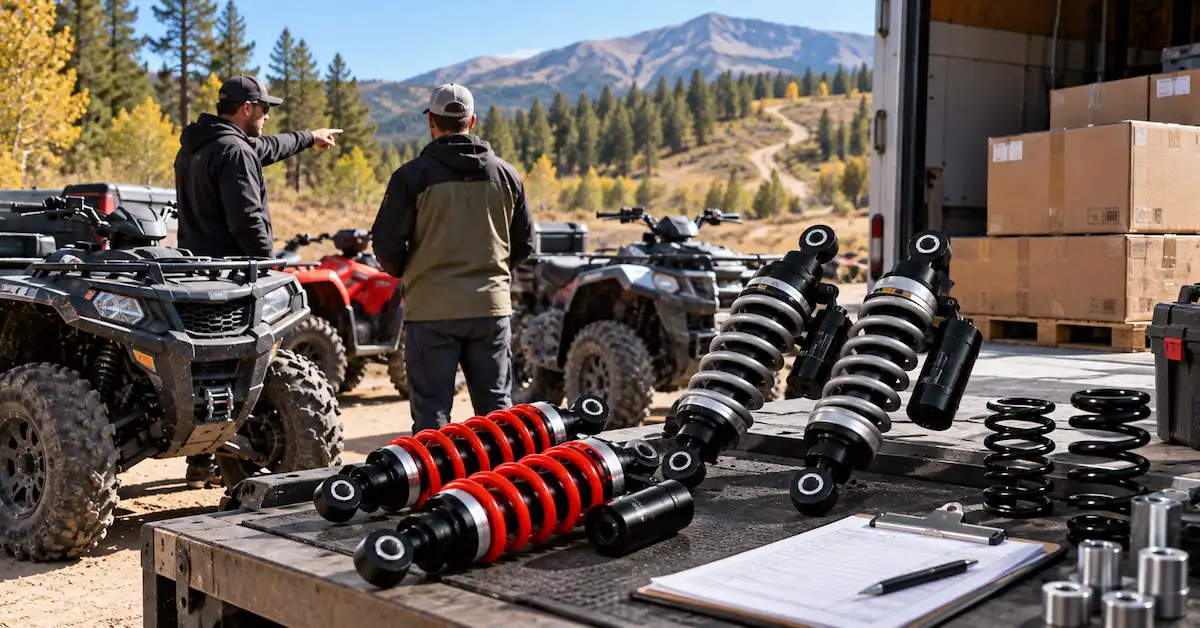

Can ATV Shocks Be Customized for Larger Tires and Added Accessories?
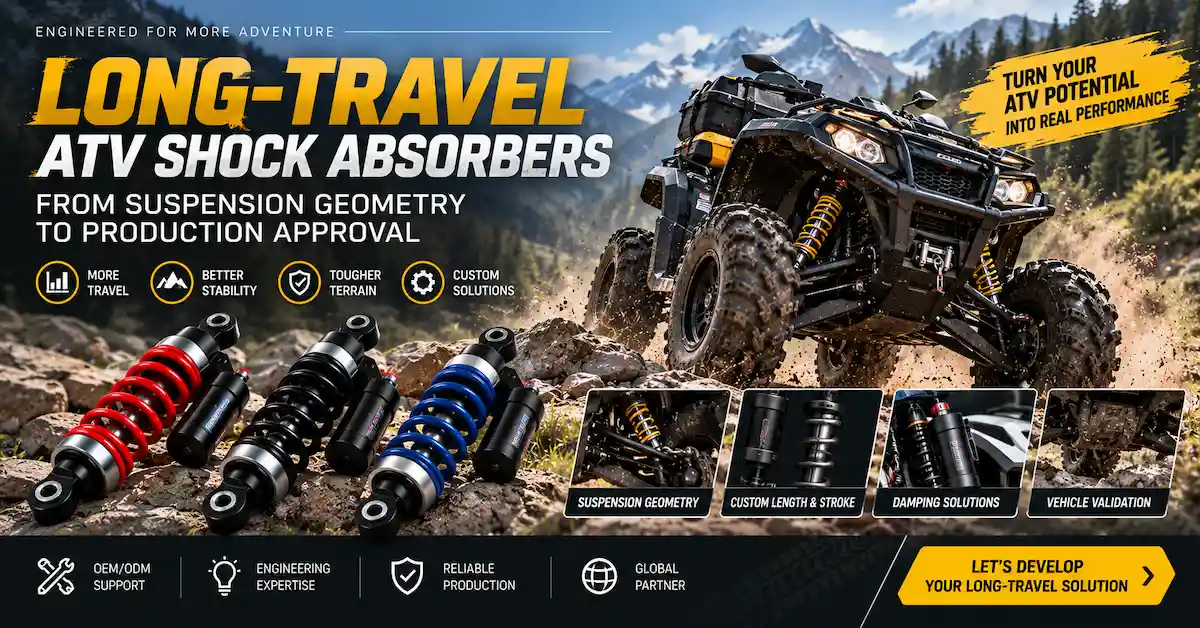
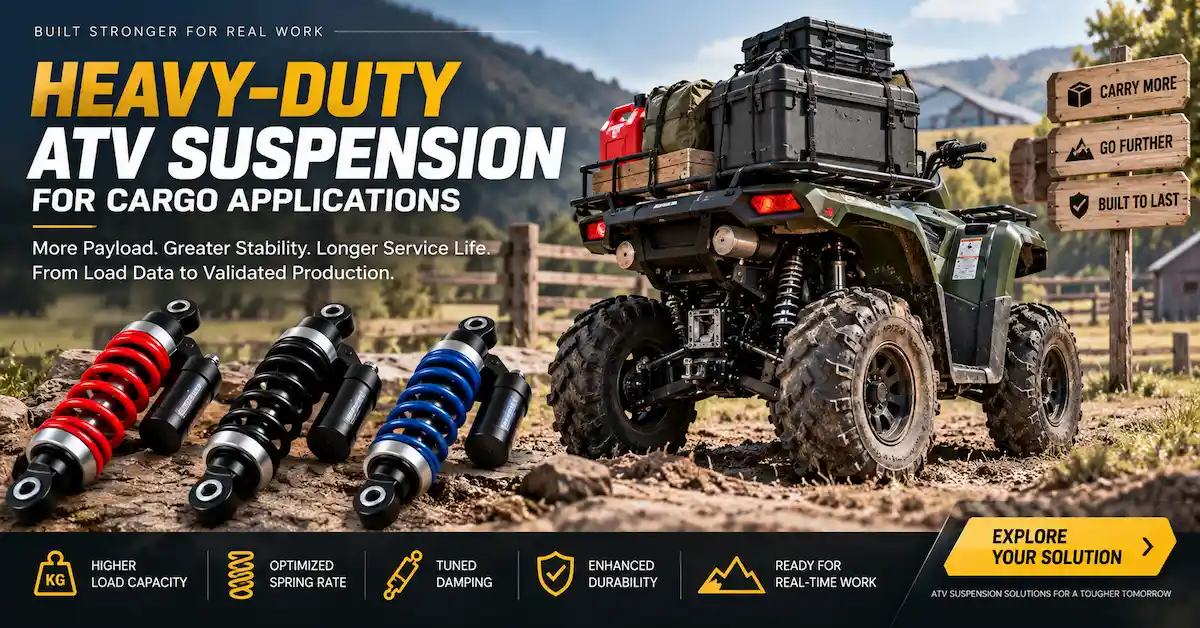
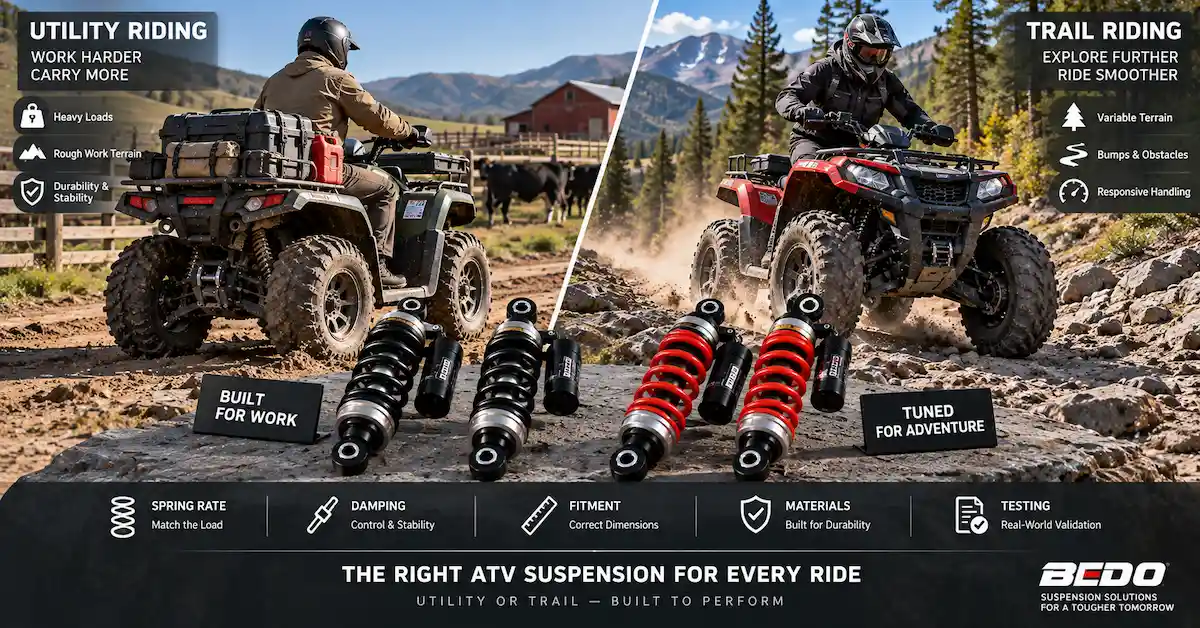
Yes. ATV shocks can be customized when larger tires, winches, bumpers, cargo racks, toolboxes, snow-plow equipment, protective armor, fuel systems, or other accessories change the vehicle’s operating condition. Depending on the modification, the engineering response may involve spring rate, preload range, compression damping, rebound damping, mounting dimensions, or another shock configuration. BEDO’s heavy-duty ATV shock absorber guide specifically identifies larger tires and accessories among the factors that can alter suspension requirements. The key point for OEM and aftermarket buyers is that “modified ATV” is not one suspension specification: tire mass, accessory weight, mounting location, terrain, and existing geometry must be evaluated before deciding what actually needs to change.
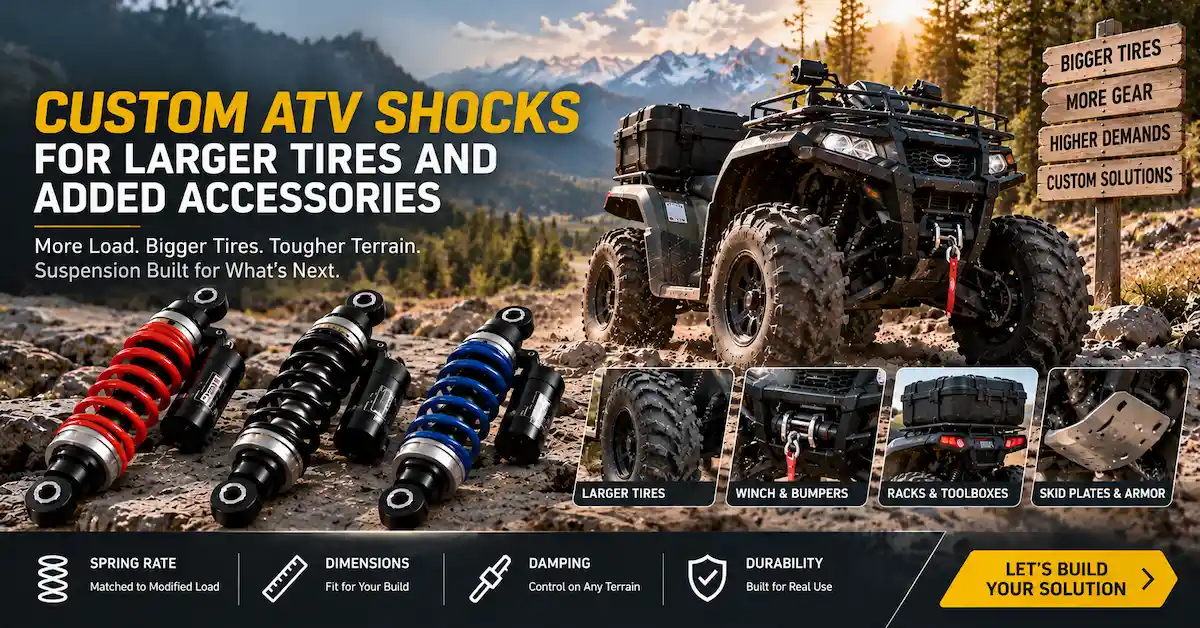
Larger Tires and Added Accessories Affect the Suspension in Different Ways
Larger tires primarily affect the wheel side of the suspension. If the new tire-and-wheel assembly is heavier, unsprung mass increases and the shock may need to control a different wheel mass over bumps and repeated terrain. A larger tire diameter can also create clearance issues at compression or steering extremes, even though the shock itself has not changed length. Chassis-mounted accessories create a different problem: a front winch or steel bumper adds load mainly toward the front of the vehicle, while a rear toolbox or cargo system can increase rear axle load and suspension sag. BEDO’s off-road modification content notes that larger tires, heavier accessories, cargo racks, reinforced structures, batteries, and lift-related changes can make an original suspension specification less suitable for the modified vehicle.
| Vehicle modification | Main suspension question to investigate | What should not be assumed |
|---|---|---|
| Larger tire and wheel assembly | Has unsprung mass, clearance,or wheel response changed? | Larger tire automatically requires a longer shock |
| Front winch | How much permanent front axle load is added? | A rear spring change will correct a front-load problem |
| Heavy front bumper | How has front ride height and sag changed? | Maximum preload is automatically the correct solution |
| Rear rack or toolbox | What constant rear load does the accessory add? | One “heavy-duty” spring suits every cargo arrangement |
| Snow plow | What happens to front sag and remaining travel when installed? | The unloaded setup and plow setup can use identical validation |
| Armor or skid protection | Where is the permanent added mass located? | Total added weight alone describes axle distribution |
| Additional fuel or battery system | Is the mass permanent and where is it mounted? | Only rider weight matters |
| Lift or geometry modification | Have shock length, stroke, mounting, or clearance requirements changed? | Tire diameter alone defines the required shock dimensions |
Start With the Modified Vehicle Weight, Not the Original Specification
Before asking a supplier for heavy-duty or custom ATV shocks, document the vehicle as it will actually be used. Record the base vehicle configuration, rider with normal equipment, new tire and wheel specifications, each permanently installed accessory, typical cargo, and the location of those loads. When possible, obtain front and rear axle weights instead of using only total vehicle weight.A 25 kg accessory mounted ahead of the front axle can affect suspension loading differently from 25 kg positioned over the rear rack, even though both add the same amount to total mass. BEDO’s custom shock absorber development guidance emphasizes vehicle load, cargo location, accessories, terrain, and performance targets as inputs for suspension development. The better the input data, the less the supplier must rely on assumptions.
Prepare a Modification Specification Before Requesting Custom Shocks
A useful development request should allow the supplier to distinguish the original vehicle, the modification, the resulting problem, and the desired outcome. Use the following as a buyer-side specification checklist rather than as a universal BEDO acceptance standard.
| Information area | What the buyer should provide | Why it matters |
|---|---|---|
| ATV identification | Model, year, variant, front/rear position | Defines the base application |
| Original wheel/tire | Diameter, width, wheel information,assembly weight if known | Provides a comparison point |
| Modified wheel/tire | New dimensions and assembly weight if available | Helps evaluate unsprung-mass and clearance changes |
| Permanent accessories | Type, individual weight, and mounting location | Changes baseline sprung load |
| Variable loads | Rider, cargo, tools, hunting gear, or work equipment | Defines operating range |
| Axle loads | Original and modified front/rear values where available | Improves spring-selection input |
| Suspension measurements | Extended/compressed dimensions, stroke,mounting interfaces,sag | Defines fitment and operating position |
| Current problem | Excessive sag, bottoming, harshness, bouncing, slow recovery, clearance issue | Gives engineering a measurable target |
| Terrain | Farm road, mud, rocks, sand, trail, commercial work | Establishes validation conditions |
| Purchasing plan | Samples, trial batch, projected repeat order | Defines development scope |
BEDO also supports customization starting from an existing shock sample combined with vehicle and technical information. Its sample-and-specification development approach is particularly relevant when an aftermarket buyer has a physical reference part but the modified ATV no longer behaves as intended with the original specification.
Larger Tires Do Not Automatically Mean You Need a Stiffer Spring
A common sourcing mistake is assuming that larger tires automatically require a much stiffer spring. Tire changes can increase unsprung mass, but spring selection is mainly tied to the supported vehicle load, suspension geometry, desired ride position, and operating conditions. If the larger wheels are accompanied by a heavy winch, bumper, rack, protection system, or other chassis-mounted equipment, then the spring requirement may change because the sprung load has changed as well. BEDO’s heavy-duty ATV content makes the same distinction: a suitable solution may involve an application-specific spring rate and damping configuration, but simply making every component stiffer can reduce compliance and vehicle control. The supplier should therefore separate tire-related wheel-mass changes from accessory-related chassis loading before recommending a new spring.
Choosing custom ATV shocks should therefore begin with the modified vehicle’s actual load distribution rather than tire size alone.
Use Sag and Remaining Travel to See What the Added Load Is Doing
Sag gives the development team a practical way to see how far the suspension settles under the modified vehicle’s load. Record a consistent reference with the suspension extended, then measure the vehicle with its normal ready-to-ride configuration and again with representative accessories or cargo. The important question is not merely whether the vehicle sits lower, but how much useful compression and extension movement remains. If a permanent front winch and bumper consume significantly more of the original operating travel, the supplier can evaluate whether spring support, preload, or another specification needs revision. BEDO’s shock measurement guidance reinforces the need to define measurement references, dimensions, preload, and loaded conditions rather than relying on photographs or nominal product length alone.
Preload Can Compensate for Some Load Change, but It Has Limits
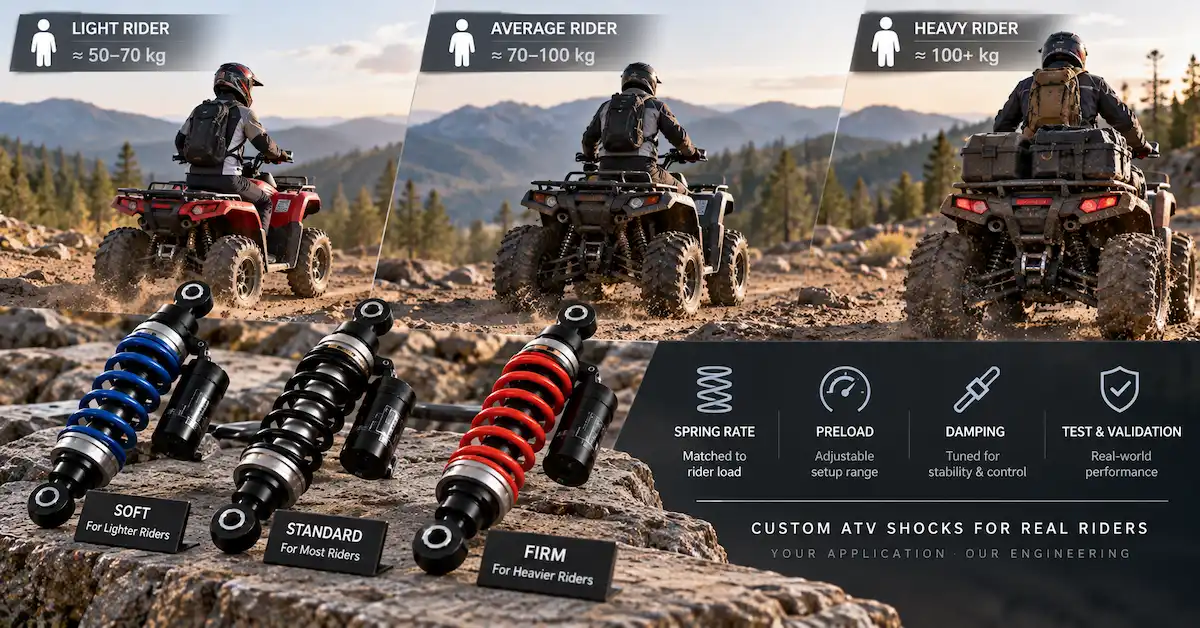
Preload changes the spring’s installed starting condition and can help establish an appropriate operating position within a validated adjustment range. It does not turn an unsuitable linear spring into a different spring rate. If the ATV carries a small permanent accessory increase, an approved preload adjustment may be enough; if the vehicle gains a front plow system, heavy bumper, large toolbox, and other constant equipment, the original spring may no longer provide an acceptable operating range. In that case, the supplier should evaluate a different spring specification instead of simply tightening the preload until the ride height appears correct. The correct decision should also consider how the vehicle behaves when variable cargo is removed.
Damping Should Be Re-Evaluated After Tire or Spring Changes
The shock absorber controls how the suspension moves, while the spring primarily provides load support. Larger and heavier wheel assemblies can change the wheel mass the damper must control, while a meaningful spring-rate change alters the energy stored and released by the spring. Compression damping therefore needs evaluation during impacts, and rebound damping needs evaluation as the wheel and spring return after compression.BEDO’s heavy-duty suspension guidance states that compression and rebound can be developed around vehicle load, spring rate, terrain, and performance targets. A stronger spring should not automatically be paired with maximum damping; too much damping can produce harshness or slow recovery, while too little can leave the vehicle unsettled over repeated terrain.
Do Not Order a Longer Shock Just Because the Tires Are Larger
Increasing tire diameter changes the tire’s outer radius and may affect ground clearance and body-to-tire clearance, but it does not by itself establish that the ATV needs a longer shock. Shock length and stroke must remain compatible with suspension geometry, mounting points, control arms, steering components, drivetrain limits, and available compression and extension movement. If a lift kit or other geometry change is installed together with the larger tires, then extended length, compressed length, effective stroke, and mounting interfaces may need a full engineering review. BEDO’s customization capability includes dimension, stroke, and mounting evaluation, but those variables should be reviewed as a system rather than changed individually. Its custom ATV shock absorber development guide provides a useful starting point for this type of project.
Existing BEDO Models Show Why a “Heavy-Duty Swap” Is Not Enough
Two BEDO rear ATV/UTV shocks help demonstrate the fitment issue. AU_HSA_02 and AU_HSA_04 are both published with an 80 mm effective stroke, yet their total lengths, body diameters, mounting-hole diameters, and mounting widths differ. These values can be used for preliminary comparison, but they do not make either model a universal solution for larger tires or additional equipment.
| Published specification | AU_HSA_02 | AU_HSA_04 |
|---|---|---|
| Installation position | Rear | Rear |
| Total length | 395 mm | 345 mm |
| Effective stroke | 80 mm | 80 mm |
| Cylinder outer diameter | 38 mm | 42 mm |
| Upper/lower mounting-hole diameter | 12 / 12 mm | 10 / 10 mm |
| Upper/lower mounting width | 40 / 32 mm | 32 / 30 mm |
| Adjustable damping levels | None | None |
| Listed materials | Aluminum alloy and steel pipe | Aluminum alloy and steel pipe |
The 50 mm difference in published total length and the different mounting interfaces show why a buyer cannot select an “upgrade shock” from stroke alone. The same principle applies after fitting larger tires: physical appearance or a heavier-looking body does not prove compatibility. BEDO’s product information and recent custom-shock development guidance both emphasize matching mounting, stroke, spring, damping, and the vehicle application together.
Accessory Location Determines Whether the Front, Rear, or Both Need Changes
A modified ATV should not automatically receive identical front and rear suspension upgrades.A front winch, plow mount, and heavy bumper may create a front-focused load change, while a rear utility box or hunting equipment can primarily affect the rear. Accessories mounted centrally may influence both ends differently depending on the vehicle’s existing weight distribution. Measure or estimate axle-specific changes wherever possible and ask the supplier to evaluate the affected position separately. This can prevent an unnecessary four-shock redesign when only one axle requires a significant spring or damping revision, or reveal that both ends need different specifications rather than one common “heavy-duty” configuration.
Permanent Accessories and Occasional Cargo Should Be Treated Separately
A permanent accessory changes the vehicle every time it operates; variable cargo changes from trip to trip. This distinction matters when defining the spring and adjustment range. A fixed front winch or permanently installed toolbox can be included in the baseline vehicle specification, while occasional cargo should be represented as an additional operating case. If the difference between empty and loaded conditions is wide, the development team may investigate a spring and preload combination capable of covering the approved range, or consider separate configurations when one compromise cannot meet both targets.The goal is not to make the vehicle feel identical at every load, but to define acceptable operating behavior under the conditions the product will actually be sold for.
Larger Tires Also Require a Clearance Review at Full Suspension Movement
Before approving custom ATV shocks, check the tire throughout the vehicle’s relevant steering and suspension movement. A larger tire can approach the fender, suspension components, bodywork, or other surrounding parts at compression even when static ground clearance looks improved. If wheel width, offset, control arms, or lift components have also changed, the clearance review becomes more important. Shock customization should not create a travel range that allows another part of the vehicle to contact before the intended suspension limit is reached. For OEM and aftermarket development, record the tire specification and vehicle modifications on the same drawing or project file used for shock approval so later revisions do not separate suspension data from the actual modified vehicle.
Materials and Components Should Match the New Duty Cycle
If a modification changes load or off-road severity significantly, ask what material, sealing, mounting, bushing, surface-treatment, and shock-body requirements apply to the proposed configuration.BEDO lists aluminum alloy and steel pipe on several existing ATV shock pages, but these descriptions alone do not define every material grade or prove that a particular catalog product is suitable for a heavier modified vehicle. For an OEM project, request model-specific requirements and identify which components are critical to the approved configuration. BEDO’s shock absorber manufacturing guidance discusses production and quality-control considerations for ATV shocks. The buyer’s objective should be repeatable manufacturing to an approved specification, not simply a visibly larger spring or reservoir.
Validate the Modified ATV, Not Just the Shock on a Bench
Bench testing can provide useful damping, dimensional, sealing, or other product data, but a modified ATV should also be evaluated in the configuration for which the suspension will be sold. Test the relevant tire and wheel package, permanent accessories, representative rider load, and intended cargo. Establish acceptance criteria before testing: fitment, sag, remaining movement, interference, compression response, rebound recovery, leakage, temperature behavior where relevant, and the intended terrain should all be considered according to the project.BEDO’s development approach supports prototype and small-batch validation before larger production. That is particularly useful when several modifications interact and the buyer needs evidence that the final combination—not merely the individual shock—works as intended.
Before approving custom ATV shocks for production, validate the complete modified vehicle with its intended tires, accessories, rider load, and representative cargo.
Use Small-Batch Development Before Launching a Modified-ATV Product Line
For a distributor or private-label brand, committing immediately to a large order can create inventory risk when the product targets a modified vehicle rather than a standard replacement application. BEDO describes small-batch OEM/ODM suspension development as a way to confirm fitment, spring rate, damping, and real-use performance before scaling production. A practical development route is technical brief → prototype → vehicle validation → revision if required → pilot batch → production approval.Exact minimum order quantity and lead time should still be confirmed for the specific spring, damping, finish, and packaging configuration rather than inferred from a general small-batch capability statement.
Separate Technical Customization from Private-Label Customization
A red spring, branded reservoir, custom logo, or retail carton can differentiate a product visually, but none of those items establishes compatibility with larger tires or heavier accessories. Keep technical approval and brand approval as separate but linked records. Technical approval should define mounting, spring, damping, load range, tire configuration, accessory configuration, and validation results. Private-label approval can then define color, logo, labels, product codes, packaging, and retail contents. BEDO supports OEM development and brand-oriented customization, making it possible to combine both scopes, but the technical version should be frozen before a marketing claim such as “for oversized tires” or “for winch-equipped ATVs” is published.
Compare Cost by Modification Scope, Not by Shock Size
Customization cost depends on what actually changes.A project that retains the existing dimensions but requires a revised spring and damping specification has a different development scope from one involving new mounting geometry, stroke, reservoir layout, prototype fixtures, multiple spring versions, testing, branding, and retail packaging. Request quotations that separate recurring product cost from engineering, samples, testing, tooling or fixtures where applicable, packaging, and other one-time work. Also identify whether each tire or accessory configuration needs a separate validated version. A cheaper shock that requires repeated rework, creates unresolved fitment issues, or generates incorrect application listings can be more expensive to a distributor than a properly defined development project.
What Should You Send BEDO for a Modified ATV Shock Project?
Ningbo Bedo Auto Parts Co., Ltd. manufactures shock absorbers and springs and describes customization, professional design support, and small-batch ordering in its company profile. For a project involving larger tires or added accessories, provide the original and modified vehicle information together rather than sending only the old shock.Include tire and wheel specifications, accessory type and location, vehicle or axle weights where available, shock dimensions, sag measurements, terrain, current symptoms, and your target improvement. If you already have a reference shock, BEDO also supports sample-based shock absorber customization, allowing the physical part to be evaluated alongside the new application requirements.
Frequently Asked Questions
1. Do Larger ATV Tires Always Require New Shocks?
No. A larger tire does not automatically mean the original shock must be replaced. Check tire-and-wheel mass, suspension response, clearance, geometry, and any accompanying vehicle modifications first. Custom shocks become relevant when the original configuration no longer meets the defined application requirements.
2. Do Larger Tires Require a Higher Spring Rate?
Not automatically. Spring rate should primarily match supported load, geometry, and the intended operating position.A heavier tire changes unsprung mass, while a heavy bumper or winch changes chassis-supported load. The engineering response to these two changes may therefore be different.
3. Can a Winch or Heavy Bumper Require Front Shock Changes?
Yes, if the added front weight changes sag, available travel, or vehicle behavior enough to fall outside the intended suspension setup. Measure the modified front axle condition and ask the supplier to evaluate spring and damping requirements instead of selecting a stronger front spring by appearance alone.
4. Can Rear Shocks Be Customized for a Permanent Toolbox or Cargo Rack?
Yes. Provide the accessory weight, mounting location, normal cargo range, vehicle information, and existing suspension data. The supplier can then evaluate whether the rear spring, preload, damping, or another part of the configuration requires modification.
5. Does Adding Preload Solve Every Accessory-Weight Problem?
No. Preload can adjust the installed operating position within an appropriate setup range, but it does not change a linear spring’s inherent rate.A significant permanent load increase may require a different spring or a broader suspension review.
6. Should I Install Longer Shocks with Larger Tires?
Not solely because the tire diameter increased. Shock length should be based on suspension geometry, mounting points, compressed and extended limits, and available clearance. If a lift or geometry modification is also installed, request a full dimensional review.
7. Can Compression and Rebound Damping Be Customized?
BEDO’s heavy-duty and OEM suspension content describes damping development around load, spring rate, terrain, and target performance. The exact configuration and validation requirements must be determined for the individual vehicle project.
8. Does a Reservoir Automatically Make a Shock Better for a Modified ATV?
No. A reservoir can be useful in certain designs or operating duties, but it does not replace correct spring, damping, fitment, or load matching. Determine whether the application actually needs that architecture before adding it as a specification.
9. Can BEDO Develop a Shock from My Existing Modified ATV Sample?
BEDO describes support for existing samples combined with vehicle and technical parameters. Send the reference shock together with details of the larger tires, accessories, loads, terrain, and problems you want to address; the physical sample by itself does not define the modified vehicle requirement.
10. Should Each Tire or Accessory Package Have a Different Product Code?
Use separate product identification whenever the approved spring, damping, dimensions, or validated application differs enough that warehouse staff, dealers, or customers could otherwise confuse the versions. If one configuration is validated for several modification packages, document the exact approved boundaries instead of relying on a general “fits modified ATVs” statement.
Conclusion
ATV shocks can be customized for larger tires and added accessories, but the correct development path starts with the complete modified vehicle rather than simply requesting a stronger or longer shock.Larger wheel-and-tire assemblies can change unsprung mass and clearance requirements, while winches, bumpers, racks, toolboxes, plows, and other accessories can change sprung load, axle distribution, sag, and the available suspension operating range. The engineering sequence should therefore be modified vehicle data → front/rear load → tire and clearance review → sag and available travel → spring specification → damping evaluation → prototype validation → controlled production. BEDO supports shock absorber and spring customization, samples, engineering development, and small-batch projects for off-road applications. To evaluate your project, contact BEDO with the original and modified tire specifications, accessory weights and locations, vehicle or axle loads where available, drawings or reference samples, terrain, and purchasing plan so the appropriate custom ATV shock configuration can be reviewed before production.