
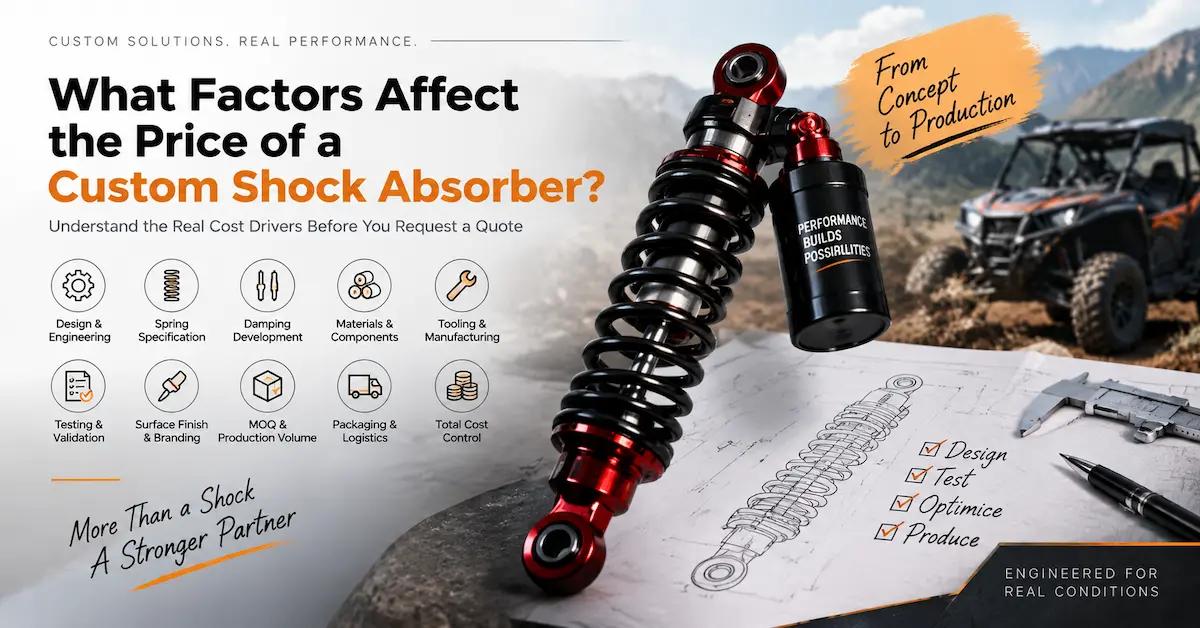
What Factors Affect the Price of a Custom Shock Absorber?
The custom shock absorber price depends on much more than the physical size of the finished product. A buyer requesting an existing shock with a different logo has a very different project from an OEM customer asking for new mounting dimensions, a custom spring rate, revised compression and rebound damping, a reservoir system, prototype development, and vehicle testing.
For this reason, a supplier normally needs to review the complete technical scope before providing a meaningful final quotation. BEDO’s custom suspension development services cover different levels of customization, from existing-platform modifications to deeper suspension engineering projects.
For OEM buyers, distributors, and private-label suspension brands, the most useful purchasing principle is simple: compare quotations only after confirming that each supplier is quoting the same technical configuration, development work, validation scope, and commercial package.
1. Existing Shock Platform or Completely New Development
One of the biggest factors affecting custom shock absorber cost is whether the project can start from an existing production platform.
An existing shock platform may already have established body components, seals, spring seats, machining programs, mounting structures, assembly procedures, and inspection processes. If the customer only needs limited modifications, development work can be significantly different from designing a vehicle-specific shock from the beginning.
For example, an existing platform may only require:
- a different spring specification;
- revised damping;
- another finish;
- buyer branding;
- different packaging.
A completely new project may additionally require new dimensions, mounting interfaces, components, drawings, CAD review, prototype manufacturing, and testing.
BEDO’s shock absorber customization process distinguishes between simpler product customization and deeper engineering work involving dimensions, stroke, mounting, spring and damping development.
Before requesting a price, tell the supplier whether the goal is to adapt an existing product or develop a substantially new suspension configuration.
2. Shock Length, Stroke, and Mounting Dimensions
Custom dimensions can directly change engineering and manufacturing complexity.
Important parameters may include:
- extended length;
- compressed length;
- effective stroke;
- upper mounting structure;
- lower mounting structure;
- mounting-hole diameter;
- mounting width;
- sleeve or bushing dimensions;
- shock-body diameter;
- spring envelope.
A small change to an existing mounting dimension may be relatively straightforward if existing components can still be used. A completely new clevis, eye mount, sleeve, or bracket can require new machining, fixtures, components, and dimensional inspection.
BEDO’s custom shock absorber length and stroke guide explains why length and stroke should also be reviewed against the vehicle’s suspension geometry rather than changed independently.
Providing an accurate technical drawing or physical reference sample before quotation helps the supplier determine whether existing manufacturing resources can be used.
3. Custom Spring Development
The spring is another important contributor to the custom shock absorber price.
A custom project may require changes to:
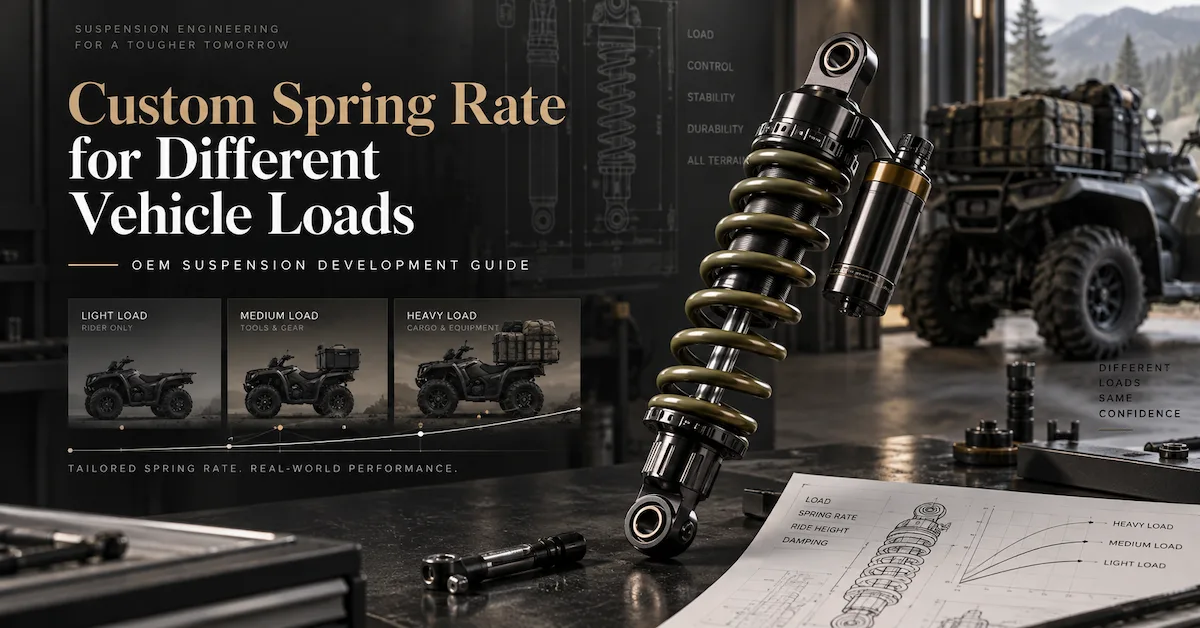
- spring rate;
- free length;
- inner or outer diameter;
- preload range;
- coil geometry;
- surface treatment;
- spring color.
If an existing spring already meets the vehicle’s load and suspension requirements, development can be simpler. When rider weight, cargo, accessories, suspension geometry, or vehicle use changes, the supplier may need to evaluate a new spring specification.
A new spring can also introduce separate sourcing or production requirements. The spring manufacturer may have its own minimum processing quantity, material requirements, or setup costs.
When comparing quotations, ask whether the quoted shock uses an existing spring or includes new spring development and validation.
4. Compression and Rebound Damping Development
Custom damping is another major cost factor because it involves engineering work rather than only mechanical dimensions.
Compression damping controls suspension movement as the shock compresses. Rebound damping controls how the shock extends again after an impact.
If a buyer requests a new vehicle-specific damping configuration, development may include:
- evaluation of the existing shock;
- new damping targets;
- internal configuration changes;
- prototype assembly;
- damping testing;
- vehicle testing;
- engineering revisions.
BEDO’s custom damping development guide discusses compression and rebound requirements in relation to vehicle weight, spring characteristics, load, terrain, and performance objectives.
An existing fixed-damping specification is therefore not commercially equivalent to a newly developed performance configuration. Make sure suppliers are quoting the same damping-development scope before comparing prices.
5. Fixed, Piggyback, or Remote-Reservoir Design
Shock architecture also changes cost.
A conventional integrated shock generally has a different component structure from a piggyback-reservoir or remote-reservoir system.
A reservoir configuration may add:
- reservoir body;
- additional internal components;
- fittings;
- hose components for remote designs;
- reservoir mounting hardware;
- additional machining;
- assembly steps;
- packaging requirements;
- additional inspection points.
If compression or rebound adjustment is also included, the number of components and production-control requirements can increase again.
Buyers should choose reservoir architecture because the vehicle duty cycle, packaging, or damping system requires it—not simply because reservoir shocks look more premium.
6. Materials and Component Specifications
Materials influence both product cost and manufacturability.
The final quotation can change according to the specified:
- shock body material;
- piston rod requirements;
- mounting components;
- bushings;
- sleeves;
- seals;
- spring material;
- reservoir components;
- fittings;
- surface treatments.
A standard component already used by the factory can have a different commercial structure from a newly developed component requiring special machining or separate sourcing.
When possible, distinguish between requirements that are technically essential and those that are preferences.
If a material specification has not yet been confirmed, ask the supplier for an engineering proposal rather than inventing a material grade simply to complete the RFQ.
7. Machining Complexity, Tooling, and Fixtures
A custom shock may contain geometry that is technically possible but expensive to manufacture.
Possible cost drivers include:
- additional machining setups;
- difficult tool access;
- special threads;
- new drilling operations;
- non-standard mounting eyes;
- specialized gauges;
- assembly fixtures;
- prototype fixtures;
- dedicated inspection tools.
BEDO’s suspension manufacturability review guide explains why manufacturing feasibility should be evaluated before a design reaches volume production.
If a supplier recommends modifying a non-critical feature to reduce machining complexity, ask what impact the change has on fitment and performance before approving it.
Manufacturing simplification can reduce cost, but it should never silently change a critical engineering requirement.
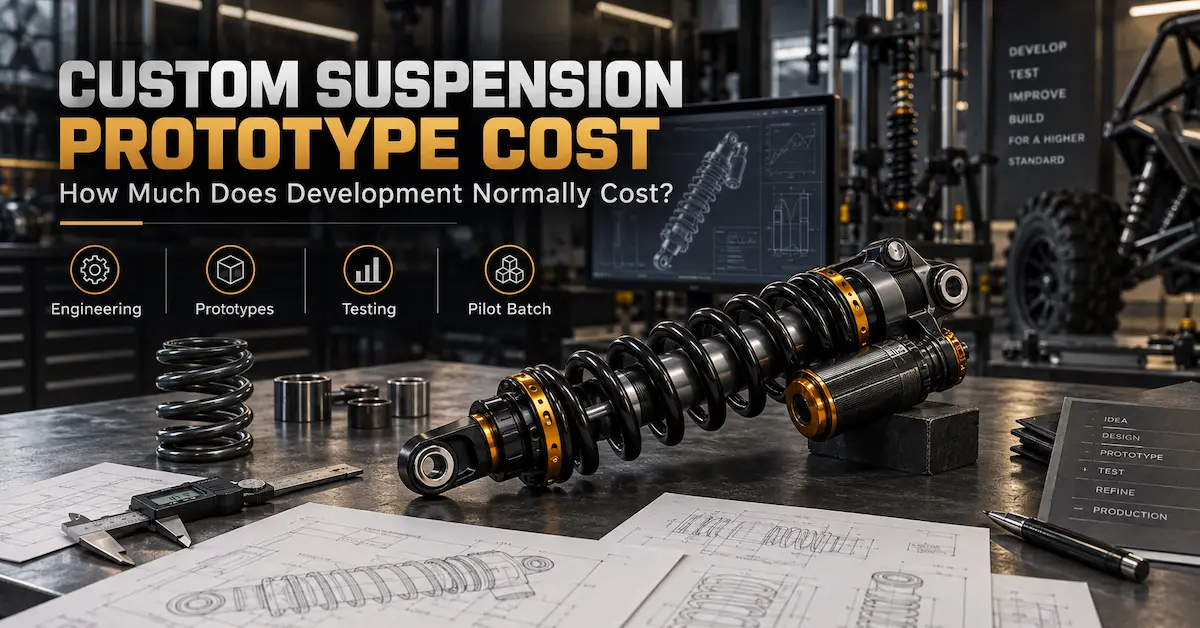
8. Prototype Quantity
Prototype pricing should not be confused with mass-production pricing.
A prototype project may include much more than one physical shock. Engineering teams may need samples for:
- dimensional verification;
- vehicle installation;
- different spring rates;
- alternative damping specifications;
- left/right configurations;
- durability tests;
- retained reference samples;
- customer approval.
The number of required prototypes should therefore come from the validation plan.
BEDO’s prototype shock absorber development guide treats prototypes as an engineering stage that may include sample analysis, drawing review, spring development, damping development, testing, revisions, and production preparation.
A higher prototype unit price does not automatically mean that the eventual production shock will have the same unit price.
9. Engineering Revision Rounds
Repeated changes can increase total project cost even when each individual modification appears small.
For example, a project may follow this sequence:
Prototype 1 identifies a mounting problem.
Prototype 2 corrects the mounting but changes the spring.
Prototype 3 adjusts damping after vehicle testing.
Prototype 4 revises reservoir packaging.
Each revision can require additional engineering, parts, machining, assembly, shipping, testing, and drawing updates.
Buyers can reduce unnecessary revision cost by clearly separating:
- fixed requirements;
- existing reference data;
- supplier-proposed items;
- specifications pending validation.
The more complete the RFQ is before the first prototype, the less likely the project is to repeat work because of missing information.
10. Testing and Validation Requirements
Testing scope can significantly affect the total custom shock absorber price.
Depending on the application, buyers may require:
- dimensional inspection;
- leakage testing;
- compression and rebound damping tests;
- adjustment verification;
- load evaluation;
- durability testing;
- temperature-related validation;
- vehicle testing;
- pilot-batch inspection.
Not every project requires every possible test.
A standard replacement shock and a newly developed adjustable performance shock should not automatically use identical validation programs.
BEDO’s shock absorber testing guide covers several testing categories that can be selected according to the application.
The important purchasing question is:
Which tests are included in the quoted development price, and which would be charged separately?
11. Surface Finish and Appearance Requirements
Visual customization can influence cost even when the suspension specification remains unchanged.
Examples include:
- custom spring colors;
- anodized components;
- coating;
- plating;
- laser marking;
- logo application;
- custom labels;
- special product identification.
A standard production finish may be easier to supply in a small quantity than a custom color requiring a dedicated processing batch.
If the first samples are mainly intended for technical validation, buyers can consider using a standard finish first and approving final branding after the spring and damping configuration has been confirmed.
This helps keep cosmetic revisions from interfering with engineering development.
12. Private-Label Packaging
Packaging should be treated separately from the physical suspension product.
A private-label order may require:
- custom cartons;
- labels;
- barcodes;
- instruction sheets;
- molded inserts;
- protective materials;
- product cards.
Packaging suppliers may have minimum quantities that differ from the shock factory’s production minimum.
For a small market-validation batch, ask whether standard packaging combined with custom labels is available before committing to a large custom-carton order.
BEDO’s private-label ATV suspension guide separates technical approval from branding and packaging approval, which is useful for reducing early project complexity.
13. MOQ and Production Quantity
The quantity being ordered affects both total investment and unit pricing.
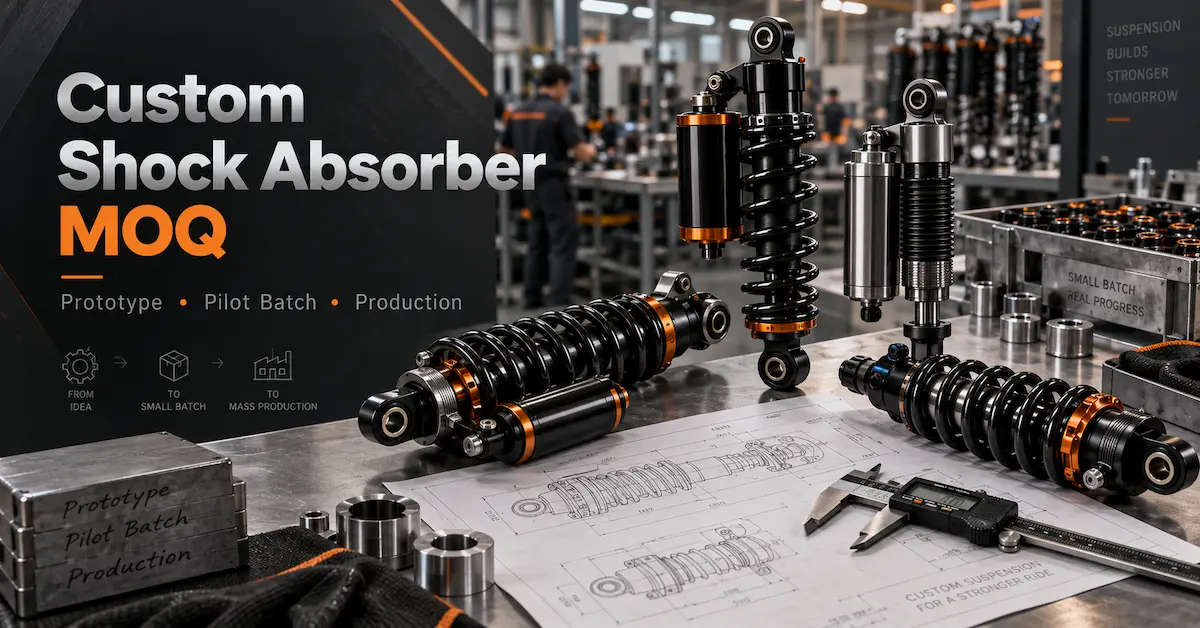
Custom projects should normally distinguish between:
- prototype quantity;
- pilot-batch quantity;
- first commercial order;
- repeat-order quantity;
- annual forecast.
BEDO’s custom shock absorber MOQ guide explains why minimum quantities may depend on the specific spring, custom components, machining, surface treatment, packaging, and manufacturing process.
Higher volume can improve cost efficiency because some development and setup expenses are spread across more products. However, ordering a large quantity before the design or market is validated can increase inventory risk.
For a new product, the lowest unit price is not necessarily the lowest-risk purchasing strategy.
14. Low-Volume Versus Mass Production
Low-volume production often has a higher unit cost because manufacturing setup, engineering, inspection, and component sourcing are distributed across fewer units.
However, it can reduce total project exposure.
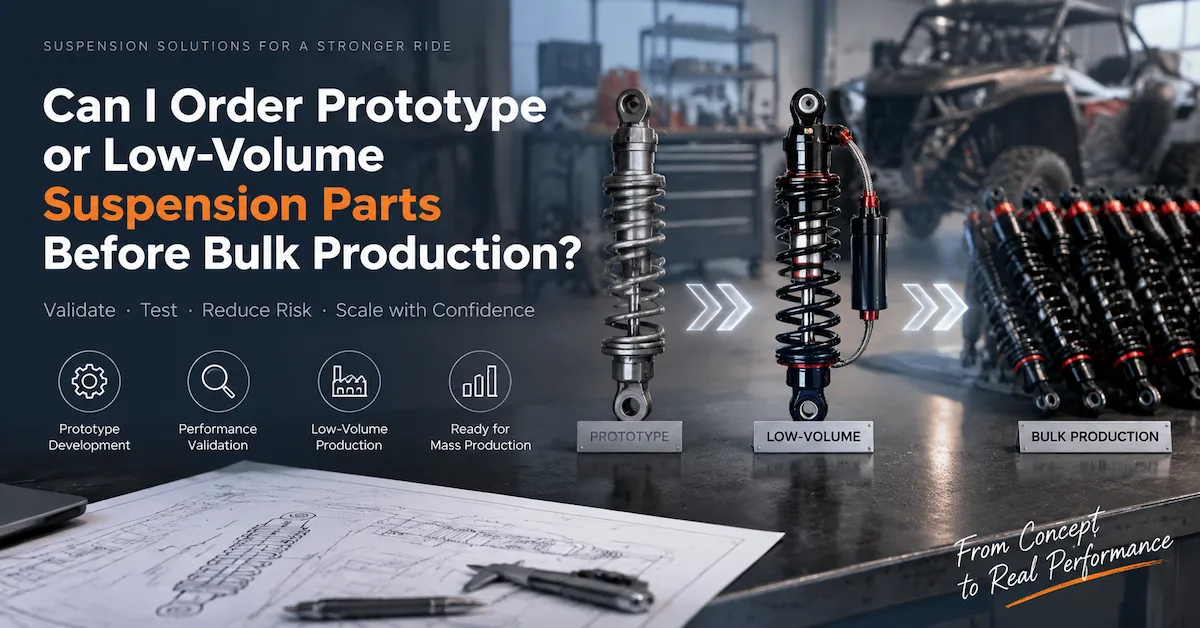
BEDO supports prototype and low-volume suspension development, allowing buyers to validate the product before scaling.
A practical purchasing route is:
Prototype → Technical Validation → Pilot Batch → Small Commercial Order → Bulk Production
This gives engineering and purchasing teams several points at which they can stop, revise, or scale the program.
15. Production Quality-Control Requirements
A custom shock developed successfully in the prototype stage still needs a repeatable production-control plan.
Quality requirements can include:
- incoming component inspection;
- critical dimensional checks;
- spring identification;
- assembly controls;
- damping verification;
- leakage inspection;
- adjuster checks;
- final appearance;
- batch traceability;
- packaging inspection.
More extensive QC can influence production cost, but it also reduces the risk of inconsistent commercial batches.
The correct question is not simply how much inspection costs. Buyers should ask which inspections are necessary to preserve the approved product.
16. Order Complexity and Number of Variants
A purchase order containing one shock model in one specification is simpler than a mixed order containing:
- several spring rates;
- several damping versions;
- multiple colors;
- different packaging;
- different vehicle fitments.
Every additional configuration creates more production planning and identification requirements.
If your product line needs multiple versions, ask the factory whether some components can be standardized across them.
Common shock bodies, mounts, reservoirs, or packaging structures may help reduce production complexity while allowing performance-specific springs or damping configurations to remain separate.
Why Two Custom Shock Absorber Quotes Can Be Very Different
Two factories may appear to quote the same product while actually pricing completely different scopes.
Before comparing prices, confirm the following items for each quotation:
Technical specification
Are the dimensions and mounting requirements identical?
Spring
Is the spring standard or newly developed?
Damping
Is the supplier using an existing specification or developing a new one?
Prototype
How many samples are included and what are they intended to validate?
Testing
Which tests are included?
Tooling and fixtures
Are they included, separate, or unnecessary?
Surface finish and branding
Are both suppliers quoting the same appearance?
Packaging
Does the price include the same saleable configuration?
MOQ
Does it apply per shock model, spring version, damping version, or total order?
Production unit price
Is the quoted figure a prototype price, pilot-batch price, or volume-production price?
The correct comparison method is:
Same Specification → Same Engineering Scope → Same Testing Scope → Same Packaging → Same Quantity Basis → Compare Price
Do Not Compare Prototype Price Directly With Production Price
Prototype parts are often expensive per unit because they may carry:
- engineering work;
- low-volume machining;
- setup;
- custom component sourcing;
- inspection;
- testing;
- revision work.
Volume production can use an established configuration and more efficient manufacturing flow.
For purchasing purposes, divide the quotation into five groups:
Development Cost
Engineering, CAD/drawing work, revisions.
Prototype Cost
Development samples.
Validation Cost
Testing and vehicle evaluation.
Production Cost
Recurring approved product price.
Commercial Cost
Branding, packaging, logistics.
This gives a much clearer view of what the project actually costs.
How Can Buyers Reduce Custom Shock Cost Without Reducing Quality?
Reducing uncertainty is often more effective than removing necessary components or tests.
Provide the factory with accurate:
- vehicle information;
- load data;
- shock dimensions;
- mounting interfaces;
- drawings or CAD;
- reference sample;
- spring requirements;
- target damping behavior;
- terrain;
- quantities.
Ask whether the project can reuse existing validated components where doing so does not compromise the vehicle requirement.
Also freeze major technical decisions before paying for expensive finishes, packaging, or bulk materials.
Avoid changing dimensions, spring rate, damping, and appearance simultaneously after the first prototype unless testing demonstrates that those changes are genuinely necessary.
What Should You Send Before Requesting a Factory Quote?
The quality of the quotation depends heavily on the quality of the RFQ.
Before asking BEDO for a final custom shock absorber price, prepare:
- vehicle model or project platform;
- front/rear installation position;
- current shock or reference sample;
- extended/compressed dimensions;
- effective stroke;
- mounting dimensions;
- vehicle and rider loads;
- cargo and accessories;
- tire modifications;
- spring requirements;
- damping requirements;
- reservoir requirement;
- required adjustability;
- drawings/CAD;
- terrain;
- prototype quantity;
- required testing;
- private-label requirements;
- first-order quantity;
- repeat-order forecast.
BEDO’s ATV suspension RFQ data guide provides a related checklist for preparing this information.
Frequently Asked Questions
1. Is There a Standard Custom Shock Absorber Price?
No. Custom shock pricing depends on the technical and commercial scope. An existing-platform branding project and a completely new suspension-development program cannot reasonably use the same pricing structure.
2. Why Are Custom Shock Samples Expensive?
Prototype pricing can include engineering, setup, special parts, low-volume machining, testing, and inspection spread across a small number of units.
3. Does a Custom Spring Increase the Price?
It can. A new spring may require specification development, sourcing, manufacturing setup, finishing, and validation.
4. Does Custom Damping Increase Development Cost?
It can because the supplier may need to create and test new compression and rebound characteristics instead of using an already validated configuration.
5. Do Remote-Reservoir Shocks Cost More to Develop?
They can involve more components, fittings, hoses, reservoir parts, assembly work, packaging, and testing. The exact difference depends on the architecture.
6. Does Higher MOQ Always Mean a Lower Unit Price?
Not automatically, but larger quantities can improve cost efficiency by distributing setup and development expenses. Technical complexity and component sourcing still influence the final price.
7. Does Private Labeling Affect Custom Shock Price?
It can. Custom finishes, logos, labels, cartons, and packaging can add setup or supplier minimum quantities.
8. Why Are Two Factory Quotations So Different?
The suppliers may be quoting different technical specifications, springs, damping work, testing, tooling, packaging, or order stages. Normalize the scope before comparing price.
9. How Can I Get a More Accurate Quotation?
Provide a complete RFQ with vehicle details, dimensions, loads, drawings or sample, spring and damping requirements, customization, testing, and volume expectations.
10. Can BEDO Quote Both Prototype and Production Prices?
For a project-specific discussion, request separate quotations or clearly separated cost sections for engineering, prototypes, testing, pilot production, and expected volume production. Contact BEDO with the technical project information required for evaluation.
Conclusion
The custom shock absorber price is determined by the complete project scope rather than by shock size or appearance alone. Existing versus new architecture, dimensions, mounting interfaces, spring development, compression and rebound damping, reservoir design, materials, machining, tooling, prototype rounds, testing, surface finish, branding, packaging, MOQ, order volume, and production QC can all affect the quotation. For B2B buyers, the safest comparison method is Same Technical Specification → Same Development Scope → Same Validation Scope → Same Packaging → Same Quantity Basis → Compare Price. BEDO supports custom suspension development from drawings, CAD, physical samples, prototypes, and low-volume projects through later OEM production. To obtain a project-specific quotation, contact BEDO with your vehicle application, dimensions, load information, spring and damping requirements, customization needs, prototype plan, and expected production volume so the final custom shock absorber price reflects the product and development support your project actually requires.