
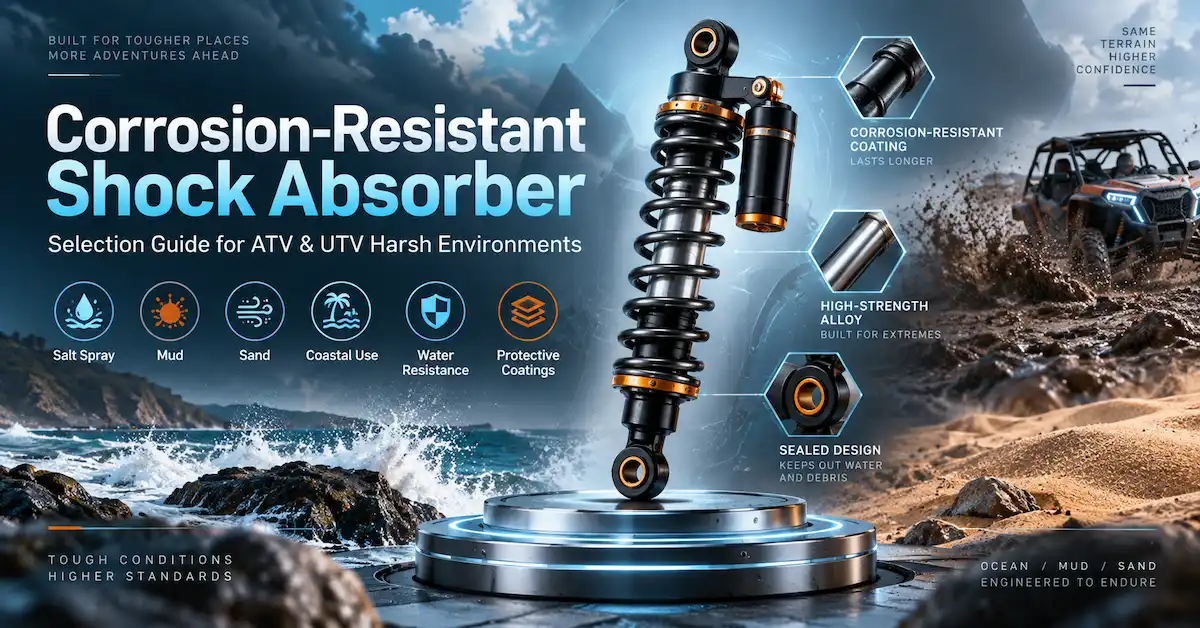
What Is a Corrosion Resistant Shock Absorber?
A Corrosion resistant shock absorber is designed to reduce deterioration caused by moisture, mud, salt, dirt, chemicals, outdoor storage, and repeated environmental exposure.
For ATV, UTV, motorcycle, snow, beach, and specialty-vehicle applications, corrosion protection should not be treated as a cosmetic requirement.
Corrosion can affect:
-
shock bodies;
-
piston rods;
-
springs;
-
mounting eyes;
-
threads;
-
adjustment components;
-
brackets;
-
fasteners;
-
reservoirs;
-
surface coatings.
Visible rust is only one possible symptom.
Environmental damage can also lead to rough rod surfaces, damaged seals, difficult adjustment, seized threads, weakened coatings, poor appearance, and shortened component life.
For B2B buyers, the right question is therefore not:
“Is this shock rust-proof?”
A better question is:
Which parts are protected, how are they protected, and under what operating environment was the protection specified?
BEDO supplies shock absorbers and suspension products for off-road applications, and buyers can review the current shock absorber and suspension product range before discussing environmental requirements for a custom or OEM project.
Corrosion Resistant Does Not Mean Corrosion-Proof
This distinction matters when writing a specification or comparing suppliers.
No general statement such as:
-
anti-rust;
-
waterproof;
-
corrosion-resistant;
-
outdoor grade;
tells a buyer exactly how the product will perform in every environment.
Actual corrosion behavior depends on:
-
base material;
-
surface preparation;
-
coating system;
-
coating thickness and consistency;
-
scratches and exposed edges;
-
water retention;
-
salt exposure;
-
temperature;
-
cleaning chemicals;
-
mud and sand abrasion;
-
storage conditions;
-
maintenance.
A finish that performs acceptably on a recreational ATV in a dry inland region may not be appropriate for a beach vehicle, coastal distributor market, snow application, or utility UTV that remains wet and muddy for long periods.
For procurement, corrosion resistance should be an application requirement, not a marketing adjective.
Where Do Shock Absorbers Face the Highest Corrosion Risk?
Environmental exposure varies significantly by application.
Beach and Sand Applications
Beach ATVs and UTVs may encounter:
-
moisture;
-
airborne salt;
-
wet sand;
-
abrasive particles;
-
frequent washing.
Sand can also damage protective surfaces mechanically, exposing underlying material.
One BEDO ATV/UTV product, AU_HSA_04, is positioned for beach and rough-terrain applications, making environmental resistance an important discussion point during product selection.
Farm and Utility Vehicles
Agricultural and utility vehicles commonly encounter:
-
mud;
-
water;
-
fertilizers or agricultural contaminants;
-
repeated washing;
-
outdoor storage;
-
long wet/dry cycles.
The corrosion requirement should therefore reflect the real duty cycle rather than only initial appearance.
Mud and Trail Riding
Mud creates two problems:
-
moisture remains on the component;
-
abrasive contamination may accumulate around seals and moving areas.
Repeated mud exposure makes cleaning, sealing, rod protection, and surface durability especially important.
Snow and Winter Conditions
Snow vehicles can face:
-
moisture;
-
low temperature;
-
salt;
-
road-treatment chemicals;
-
repeated freeze/thaw cycles.
A winter suspension product therefore needs both environmental protection and stable mechanical performance under its intended temperature range.
Coastal Markets
Even when a vehicle does not operate directly on a beach, coastal storage can expose metal parts to saline air.
Importers selling into coastal regions should communicate this requirement early rather than assuming a standard finish will be adequate.
Which Shock Absorber Components Need Corrosion Protection?
A useful corrosion specification breaks the product into components.
| Component | Main Exposure Risk | Buyer Should Check |
|---|---|---|
| Shock body | Water, mud, scratches | Base material and finish |
| Piston rod | Water, dirt, seal contact | Surface quality and protection |
| Coil spring | Water, stones, coating damage | Spring coating and exposed areas |
| Reservoir | Water, mud, salt | Material and surface finish |
| Mounting eyes | Dirt, water, impact | Coating and exposed metal |
| Threads | Water, contamination | Protection and serviceability |
| Adjusters | Mud and corrosion | Operation after exposure |
| Fasteners | Moisture and salt | Material/finish specification |
| Bushings | Dirt and water | Material and sealing condition |
| Seals/wipers | Sand, mud, water | Contamination protection |
This is why buyers should avoid evaluating anti-corrosion capability only by looking at the painted shock body.
The most visible component is not necessarily the most sensitive one.
Materials Matter Before Coating Begins
A protective finish cannot completely compensate for poor material selection or inappropriate product design.
Shock absorber structures commonly combine different materials because different components have different functions.
For example, BEDO's M_HSA_02 motorcycle shock absorber lists aluminum alloy and steel pipe materials and describes corrosion-resistant, waterproof, and rust-resistant appearance characteristics.
For B2B projects, however, buyers should go beyond the product-page description and confirm the required material and surface-treatment specification for their own environment.
Steel Components
Steel provides useful structural characteristics but normally requires appropriate surface protection in exposed environments.
Depending on product design, protection may involve processes such as:
-
painting;
-
powder coating;
-
plating;
-
other protective finishes.
Aluminum Components
Aluminum components naturally behave differently from steel, but their surface still requires appropriate specification for appearance, wear, and environmental durability.
Anodized or other protective finishes may be used depending on the component and project.
Mixed-Material Assemblies
Many suspension products combine:
-
steel;
-
aluminum;
-
coatings;
-
bushings;
-
seals;
-
fasteners.
Buyers should therefore evaluate the complete assembly, not just one material.
Surface Treatment Is a System, Not a Color
A black, blue, red, or silver shock body tells you almost nothing about corrosion performance.
Color is appearance.
Surface protection is engineering.
A useful surface-treatment discussion should include:
-
substrate material;
-
surface preparation;
-
treatment type;
-
coverage;
-
critical masking areas;
-
thread protection;
-
edge protection;
-
scratch acceptance;
-
adhesion;
-
finish consistency.
BEDO's article on shock absorber manufacturing safety and reliability identifies painting, powder coating, anodizing, plating, protective finishing, and corrosion-resistant materials as possible surface-protection approaches.
The appropriate process depends on the component and application.
Do Not Ignore the Piston Rod
The piston rod is especially important because it repeatedly moves through the sealing system.
A damaged or corroded rod surface can contribute to:
-
seal wear;
-
increased friction;
-
contamination;
-
oil leakage;
-
inconsistent shock movement.
For harsh off-road applications, buyers should ask how the rod surface is protected against:
-
corrosion;
-
abrasion;
-
mud;
-
sand;
-
water;
-
stone impact.
This is a different engineering question from the finish used on the outer shock body.
Sealing Is Part of Corrosion Resistance
Coating protects surfaces.
Sealing protects internal areas and moving interfaces.
For off-road shocks, contamination may include:
-
dust;
-
mud;
-
water;
-
sand;
-
grit.
A suitable sealing arrangement may incorporate:
-
oil seals;
-
dust seals;
-
wipers;
-
guides;
-
protected interfaces.
The exact structure depends on the shock design.
BEDO's heavy-duty ATV shock absorber guide discusses sealing and contamination protection as part of durability for off-road shock absorbers.
A strong exterior coating does not solve a poor sealing problem.
Likewise, excellent seals cannot protect external steel if its coating is damaged or inadequate.
Both need to be considered.
Spring Corrosion Can Be Easy to Overlook
The coil spring is exposed continuously to the environment.
Typical risks include:
-
stones;
-
mud;
-
water;
-
abrasion;
-
scratches;
-
coating chips.
Once the protective layer is damaged, exposed areas may begin to deteriorate.
Buyers sourcing ATV or UTV shocks should therefore ask:
-
What coating is used on the spring?
-
How is coating consistency inspected?
-
Are spring ends adequately protected?
-
What happens if the coating is scratched?
-
Is the same finish used across repeat production?
For private-label projects, spring color can be customized, but appearance customization should not replace durability requirements.
Waterproof and Corrosion Resistant Are Not the Same Requirement
These two terms are often used together but describe different concerns.
Water resistance relates to preventing unwanted water exposure or ingress into sensitive areas.
Corrosion resistance relates to how materials and surfaces withstand environmental deterioration.
A shock may resist water ingress but still develop rust on unprotected external steel.
Likewise, a corrosion-resistant outer body does not automatically guarantee sealing performance.
B2B buyers should treat them as separate requirements.
How Should Buyers Specify Corrosion Resistance?
Avoid sending a supplier only:
“We need an anti-rust ATV shock.”
That does not define an engineering target.
Instead, communicate the environment.
Describe the Application
Include:
-
ATV, UTV, motorcycle, or other vehicle;
-
front/rear position;
-
utility or recreational use;
-
typical terrain;
-
expected vehicle life;
-
maintenance conditions.
Describe Environmental Exposure
Specify whether the vehicle regularly encounters:
-
water;
-
mud;
-
sand;
-
salt;
-
snow;
-
high humidity;
-
coastal storage;
-
repeated washing;
-
chemical contaminants.
Identify Critical Components
State which parts require special attention:
-
spring;
-
body;
-
piston rod;
-
reservoir;
-
mounts;
-
hardware;
-
adjusters.
Define Validation Requirements
If your company or market requires a particular environmental test, inspection standard, or acceptance criterion, include it in the RFQ.
Do not assume every supplier uses the same corrosion test.
BEDO's public product information describes corrosion-resistant features on several shocks, but public pages do not establish one universal corrosion-test duration for every suspension product. B2B buyers should therefore agree on project-specific validation requirements before production.
Standard Finish vs Enhanced Corrosion Protection
The right protection level depends on the environment.
| Application | Environmental Risk | Procurement Focus |
|---|---|---|
| Dry recreational use | Lower | Basic surface durability |
| General trail riding | Medium | Mud/water protection |
| Farm/utility | Medium–high | Wet cycles, contamination, washing |
| Beach/sand | High | Salt, sand, abrasion |
| Coastal storage | High | Humidity and airborne salt |
| Snow/winter | High | Moisture, salt, temperature |
| Heavy-duty fleet use | Application dependent | Durability and repeatability |
The important procurement principle is:
Do not pay for an undefined “premium coating.” Specify the environment and required performance first.
How Corrosion Affects Shock Absorber Performance
Corrosion is often discussed as an appearance problem.
For suspension products, it can become functional.
Potential consequences may include:
-
rough piston-rod surface;
-
seal damage;
-
oil leakage;
-
difficult adjuster operation;
-
seized threads;
-
damaged mounting areas;
-
weakened spring coating;
-
poor customer perception;
-
warranty claims;
-
premature replacement.
A distributor may be able to sell a product that looks excellent when new, but long-term customer satisfaction depends on what happens after months of mud, water, storage, and cleaning.
Why Surface Preparation and Workmanship Matter
Even a suitable coating system can perform poorly if application is inconsistent.
Manufacturing control should address:
-
cleanliness before coating;
-
surface preparation;
-
coating coverage;
-
curing/process control where applicable;
-
masking;
-
thread protection;
-
handling after finishing;
-
scratch prevention;
-
assembly damage.
For B2B sourcing, this means corrosion resistance is partly a process-control problem.
The buyer should not only ask:
Which coating do you use?
Also ask:
How do you control coating consistency between batches?
What Should Quality Control Check?
For environmentally resistant shock absorbers, QC can include several levels.
Visual Surface Inspection
Check for:
-
scratches;
-
exposed metal;
-
inconsistent finish;
-
missed areas;
-
damaged edges;
-
coating defects.
Dimensional Inspection
Surface processes should not create problems at:
-
mounting interfaces;
-
threads;
-
adjustment features;
-
close-tolerance components.
Functional Inspection
Inspect:
-
rod movement;
-
adjusters;
-
mounting interfaces;
-
leakage;
-
assembly condition.
Environmental Validation
When required by the buyer, agree on:
-
test method;
-
test duration;
-
sample condition;
-
acceptance criteria;
-
inspected components.
Do not compare test-hour numbers from different suppliers unless the test method and acceptance criteria are also equivalent.
Corrosion Resistance Should Be Approved Before Mass Production
An approved prototype should represent more than:
-
correct fitment;
-
correct spring rate;
-
correct damping.
For harsh-environment products, the approved specification should also document relevant finish and material requirements.
That may include:
-
material;
-
surface treatment;
-
spring coating;
-
rod treatment;
-
hardware finish;
-
color;
-
inspection requirements.
After approval, these become production-control items.
A visually similar coating should not be substituted casually if environmental performance was part of the product specification.
Sample and Small-Batch Validation Reduce Risk
For custom or private-label projects, buyers should avoid jumping directly from a drawing to a large production order.
A better sequence is:
Application Review → Material/Finish Selection → Prototype → Environmental & Functional Review → Revision → Approval → Small Batch → Production
For an existing sample, BEDO's sample-based UTV shock absorber development guide specifically notes that mud, water, sand, dust, and outdoor storage should be considered during material and surface-treatment selection.
For new programs, small-batch validation can also help confirm appearance and manufacturing consistency before larger orders.
How to Evaluate a Corrosion Resistant Shock Absorber Supplier
A Corrosion resistant shock absorber supplier should be able to explain more than the appearance of its coating.
Do not evaluate suppliers by product photography alone.
Use a structured comparison.
| Supplier Question | Why It Matters |
|---|---|
| What is the intended operating environment? | Shows application awareness |
| Which materials are used? | Establishes the base specification |
| Which components receive surface treatment? | Prevents protection gaps |
| How is the spring protected? | Springs face direct exposure |
| How is the piston rod protected? | Rod condition affects sealing |
| What sealing arrangement is used? | Helps control contamination |
| How is coating quality inspected? | Supports batch consistency |
| Can custom finishes be specified? | Important for OEM/ODM |
| Can prototypes be validated first? | Reduces sourcing risk |
| Can requirements be frozen after approval? | Supports repeat production |
A supplier that only says “our shocks are rust-proof” has provided less useful information than one that can explain the materials, treatment, sealing, inspection, and validation plan.
What Affects the Cost of Corrosion Resistant Shock Absorbers?
Corrosion protection can affect product cost, but the cheapest finish is not always the lowest-cost solution over the product lifecycle.
Cost variables may include:
-
material selection;
-
coating type;
-
surface preparation;
-
component complexity;
-
piston-rod treatment;
-
spring finish;
-
fastener protection;
-
sealing structure;
-
inspection requirements;
-
environmental testing;
-
custom colors;
-
production quantity.
Buyers should balance:
unit cost + environmental durability + warranty risk + brand positioning
rather than comparing unit price alone.
When Is a Custom Corrosion Resistant Shock Absorber Worth Considering?
Custom development may be appropriate when:
-
the vehicle operates near salt water;
-
standard shocks rust too quickly;
-
the target market has high humidity;
-
the vehicle is used continuously in mud;
-
winter road salt is common;
-
standard spring coatings are insufficient;
-
private-label durability must exceed basic replacement products;
-
a special finish or branding system is required.
BEDO supports customized suspension projects for ATV, UTV, motorcycle, and other off-road applications. Its ATV/UTV suspension solution approach includes discussion of surface treatment and corrosion resistance alongside shock dimensions, spring rate, damping, samples, OEM/ODM requirements, and small-batch planning.
What Should Be Included in a Corrosion-Resistance RFQ?
For a serious B2B quotation, include:
-
Vehicle type
-
Vehicle application
-
Front/rear position
-
Target market
-
Typical terrain
-
Water exposure
-
Mud exposure
-
Sand exposure
-
Salt/coastal exposure
-
Snow/winter exposure
-
Cleaning method
-
Outdoor-storage conditions
-
Required material information
-
Required surface treatment
-
Spring finish
-
Piston-rod requirement
-
Hardware requirement
-
Environmental test requirement, if applicable
-
Acceptance criteria
-
Product color
-
Logo/branding
-
Prototype quantity
-
Expected production volume
A stronger inquiry sounds like this:
We need rear UTV shocks for a utility vehicle sold in coastal markets. Vehicles operate in wet, muddy conditions and may be stored outdoors. Please recommend suitable materials and surface treatments and confirm how spring, rod, body, reservoir, and mounting components are protected. We can provide current samples and vehicle specifications.
That gives the supplier enough context to discuss a real solution.
How BEDO Supports Harsh-Environment Shock Absorber Projects
BEDO manufactures shock absorbers and suspension springs for off-road and related vehicle applications and supports customized development and small-batch projects.
Depending on the application, buyers can discuss:
-
shock dimensions;
-
vehicle load;
-
spring rate;
-
compression and rebound damping;
-
materials;
-
surface treatment;
-
corrosion resistance;
-
color;
-
existing samples;
-
drawings;
-
OEM/ODM requirements.
More information about the company's manufacturing and technical capabilities is available on the BEDO About Us page.
For a harsh-environment project, environmental exposure should be defined at the beginning of development—not after the prototype has already been approved.
FAQ
What is a Corrosion resistant shock absorber?
A Corrosion resistant shock absorber uses suitable materials, protective surfaces, sealing, and component finishes to reduce deterioration caused by water, mud, salt, humidity, sand, and other environmental conditions.
Is a corrosion-resistant shock absorber completely rust-proof?
Not necessarily. Corrosion resistance depends on materials, finish, exposure, damage, maintenance, and testing conditions. Buyers should define measurable project requirements rather than rely only on “rust-proof” terminology.
Which shock absorber parts can corrode?
Potentially exposed parts include the shock body, spring, piston rod, reservoir, mounting eyes, threads, adjusters, brackets, and fasteners.
Which applications need stronger corrosion resistance?
Beach ATVs, coastal vehicles, farm UTVs, muddy trail vehicles, snow applications, outdoor fleets, and vehicles exposed to frequent washing may need stronger protection.
Is waterproof the same as corrosion-resistant?
No. Water resistance concerns unwanted water exposure or ingress, while corrosion resistance concerns material and surface deterioration. A project may require both.
Does spring coating matter?
Yes. Springs are directly exposed to stones, mud, water, and scratches. Damaged coating can expose the underlying material.
Why is piston-rod corrosion important?
The piston rod passes through the seal system. Surface damage or corrosion can increase seal wear, friction, contamination, and leakage risk.
Should I request a corrosion test?
If environmental resistance is critical to your market, specify the required test method and acceptance criteria in the RFQ. Do not assume every supplier uses the same standard.
Can corrosion-resistant finishes be customized for OEM projects?
Surface treatments, appearance, color, spring finish, and other requirements can be discussed during OEM/ODM development, subject to the product design and project requirements.
What information should I send for a quotation?
Provide vehicle type, environment, water/mud/salt exposure, target market, samples or drawings, required finish, test requirements, prototype quantity, and expected production volume.
Conclusion
A Corrosion resistant shock absorber should be selected around the real operating environment, not a generic anti-rust claim. Materials, coatings, piston-rod protection, sealing, spring finish, and production consistency all influence long-term durability.
For harsh-environment ATV, UTV, motorcycle, or specialty-vehicle projects, define the exposure and validation requirements before production. Submit your application, sample, or drawings through the BEDO Contact Us page for project review.