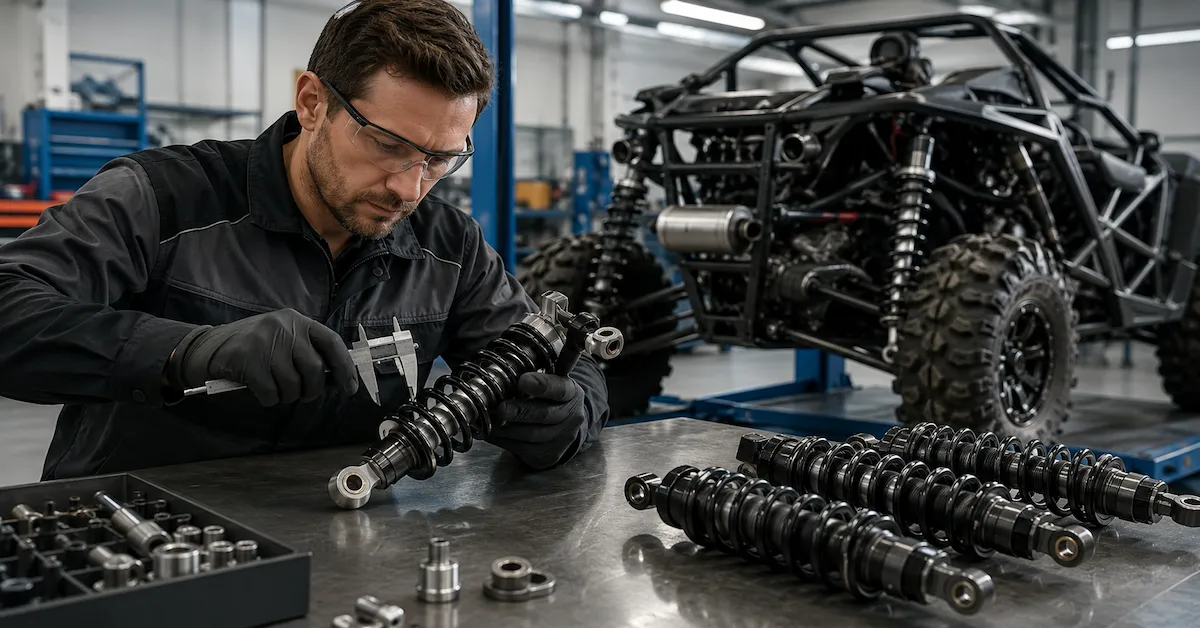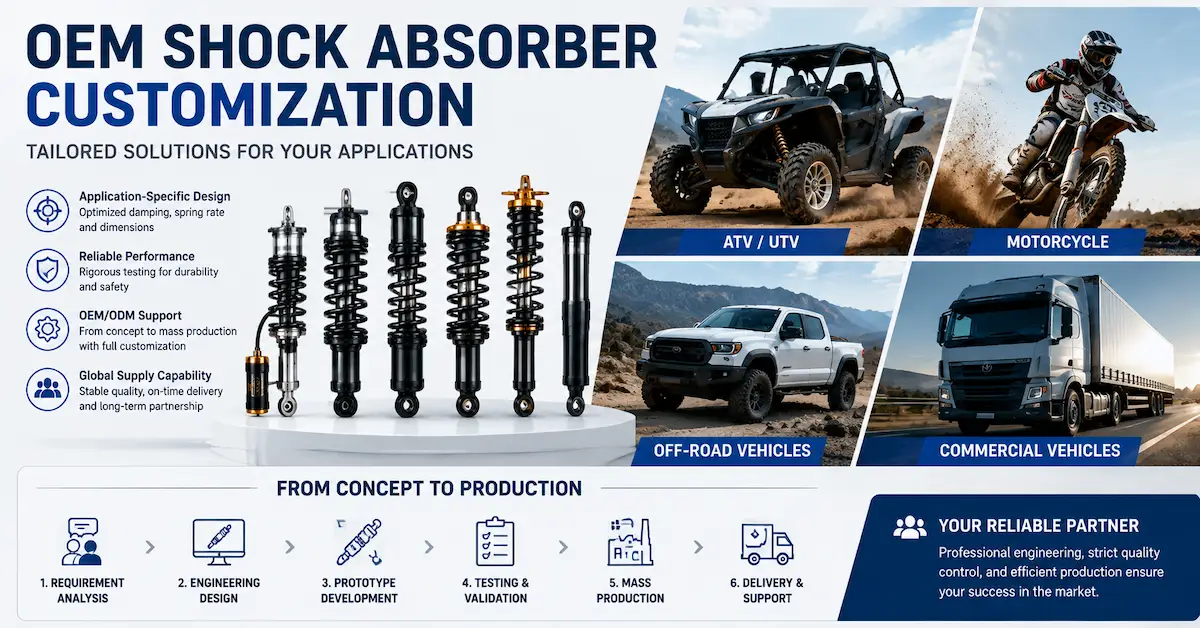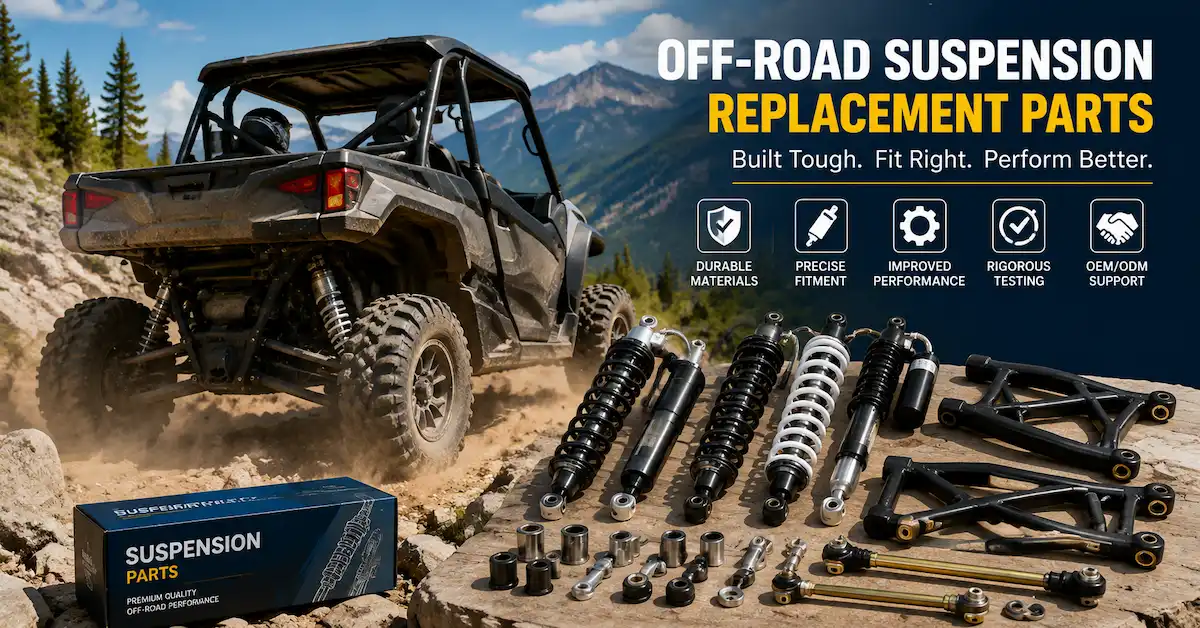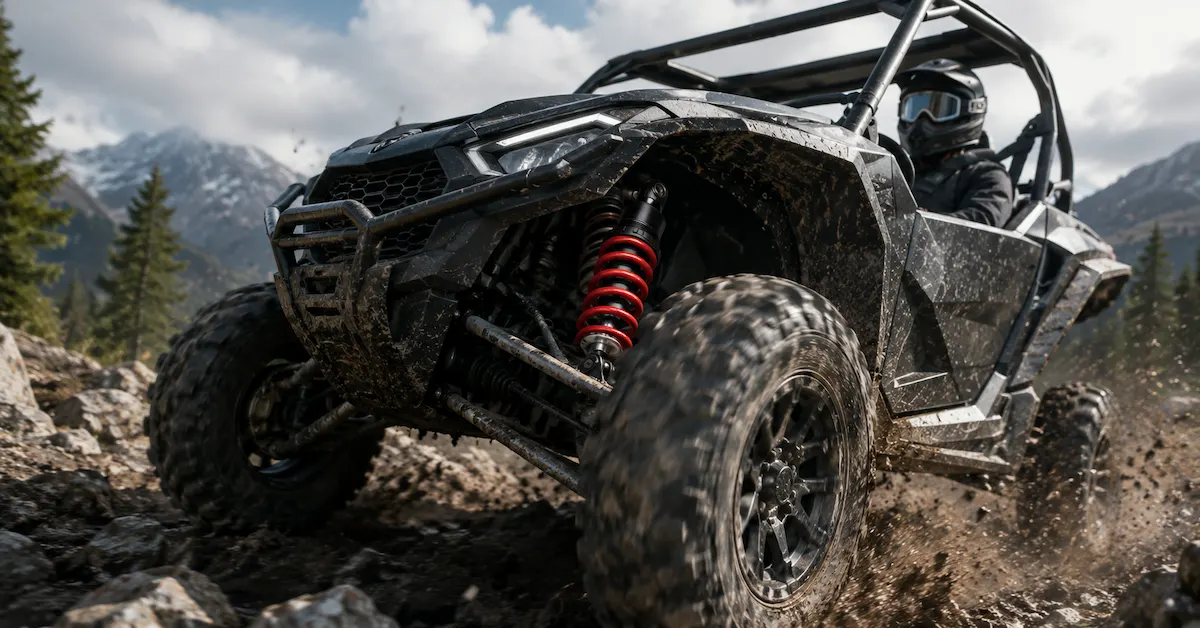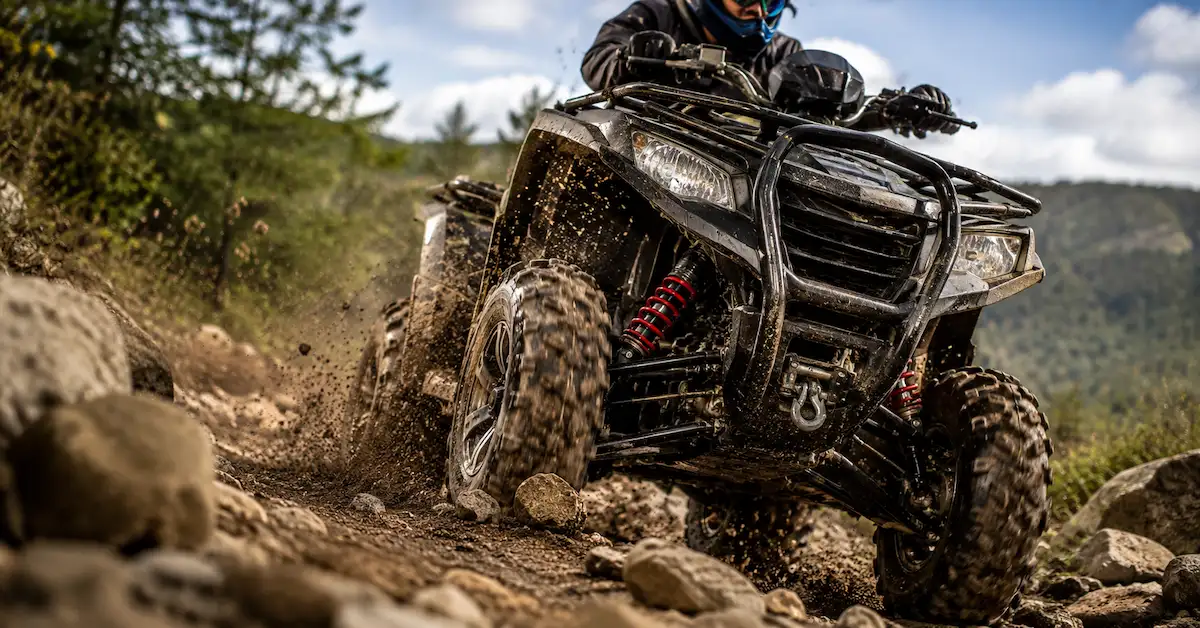

For ATV, UTV, motorcycle, electric motorcycle, snowmobile, and specialty vehicle brands, choosing a shock absorber manufacturer is not simply a purchasing decision based on dimensions and unit price.
Shock absorbers influence suspension movement, tire contact, ride stability, vibration control, impact absorption, and the service life of surrounding components. A product may fit the mounting points but still perform poorly if the spring rate, damping force, stroke, sealing structure, or operating load is incorrect.
This creates significant risks for B2B buyers. Incorrectly matched shock absorbers may lead to unstable handling, excessive bouncing, oil leakage, premature wear, customer complaints, warranty costs, and inconsistent repeat orders.
A reliable manufacturing partner should therefore understand the complete application, convert vehicle data into controlled technical specifications, verify performance through testing, and reproduce the approved product consistently.
Bedo Auto provides shock absorbers, suspension springs, and customized suspension components for off-road and specialty vehicle applications. Buyers can explore the available product range through the Bedo Auto Products page.
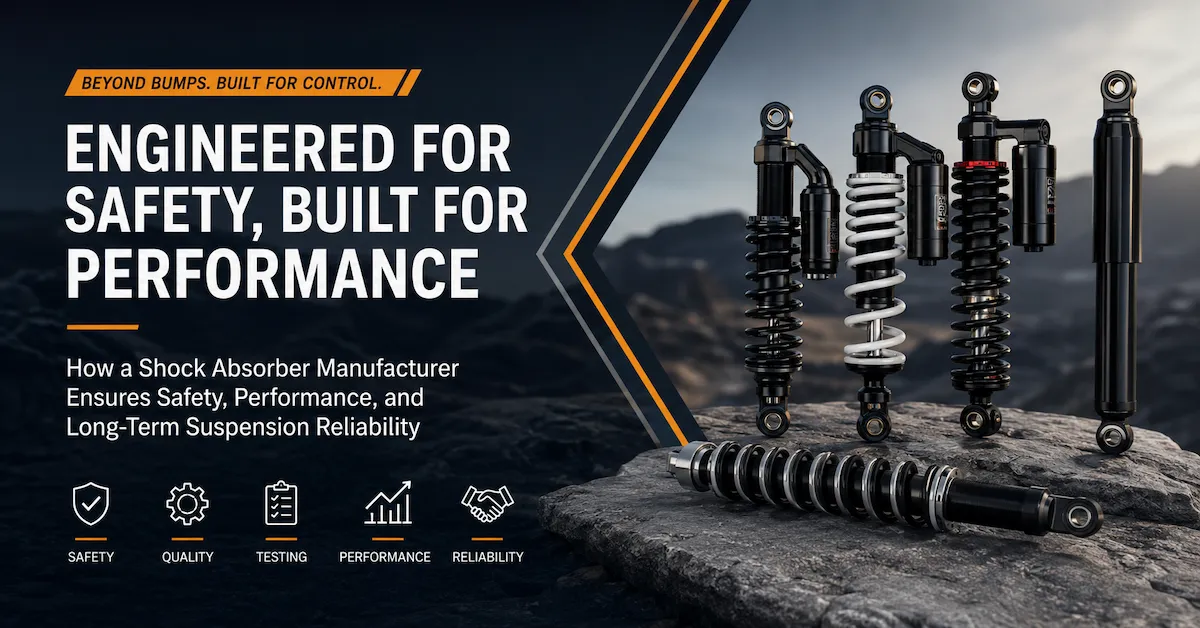
Why Shock Absorbers Are Critical to Suspension Safety
A suspension system must allow the wheels to move over uneven surfaces while keeping the vehicle stable and controllable.
The spring supports the vehicle and absorbs part of the impact. The shock absorber controls how quickly the suspension compresses and rebounds. Without sufficient damping, the spring may continue oscillating after the vehicle passes over a bump.
This uncontrolled movement may cause:
- Excessive vehicle bouncing
- Reduced tire contact
- Poor cornering stability
- Harsh or uncontrolled rebound
- Longer settling time after impacts
- Increased wear on springs and bushings
- Reduced rider confidence
- Unstable behavior under changing loads
For off-road vehicles, these risks are increased by mud, rocks, jumps, cargo loads, repeated compression cycles, water exposure, and large temperature changes.
A professional shock absorber manufacturer should design the product around these operating conditions rather than applying one standard damping setting to every vehicle.
How a Shock Absorber Manufacturer Defines the Application
Reliable shock absorber development starts with application analysis.
Before recommending a product, the manufacturer should understand the vehicle, installation position, operating environment, total load, and performance target.
| Information required | Why it matters |
|---|---|
| Vehicle category | ATV, UTV, motorcycle, electric motorcycle, and snowmobile applications require different structures |
| Installation position | Front and rear shocks experience different loads and motion ratios |
| Vehicle weight | Influences spring support and damping requirements |
| Rider and passenger load | Changes suspension sag and operating weight |
| Cargo or equipment load | Important for utility UTVs and commercial vehicles |
| Battery weight | Critical for electric motorcycle suspension matching |
| Terrain | Mud, rocks, sand, snow, trails, and paved roads create different impact conditions |
| Riding purpose | Recreational, racing, utility, touring, or commercial use |
| Target performance | Comfort, load support, control, durability, or upgrade positioning |
| Sample or drawing | Helps confirm dimensions, fitment, and structural requirements |
| Order plan | Determines prototype, small-batch, and production planning |
Selecting a shock absorber only by overall length is not enough. Stroke, mounting width, spring rate, damping curve, seal structure, body diameter, operating temperature, and maximum load must also be considered.
Spring Rate and Damping Must Work Together
Spring rate and damping perform different functions, but they must be developed as one suspension system.
Spring Rate Controls Vehicle Support
The spring supports the vehicle, rider, passengers, cargo, and additional equipment.
Spring rate affects:
- Static ride height
- Suspension sag
- Load capacity
- Bottoming resistance
- Initial ride comfort
- Available suspension travel
- Vehicle balance
If the spring is too soft, the vehicle may sag, bottom out, or become unstable under load.
If the spring is too stiff, the ride may become harsh and the suspension may not follow uneven terrain effectively.
Spring selection should consider vehicle weight, payload, terrain, suspension geometry, and intended performance.
Damping Controls Suspension Movement
Damping controls the speed of suspension compression and rebound.
Compression damping influences how the suspension reacts when a wheel meets an obstacle. Rebound damping controls how quickly the suspension returns after compression.
Insufficient damping may produce repeated bouncing and poor control. Excessive damping may prevent the suspension from responding freely to closely spaced bumps.
The correct solution is not simply “soft” or “hard.” A professional manufacturer should develop damping according to the spring, suspension travel, vehicle weight, speed, and terrain.
Design Factors That Affect Long-Term Reliability
Suspension reliability depends on the complete shock absorber design rather than one individual component.
| Design factor | Effect on performance and reliability |
|---|---|
| Piston rod quality | Influences movement, seal life, strength, and resistance to surface damage |
| Seal system | Helps retain oil and prevent contamination |
| Shock body material | Affects strength, heat control, corrosion resistance, and weight |
| Piston and valve structure | Determines compression and rebound characteristics |
| Oil specification | Influences damping consistency at different temperatures |
| Gas chamber design | Helps manage pressure and reduce cavitation where applicable |
| Bushings | Affect vibration isolation, fitment, and load transfer |
| Mounting eyes | Influence installation accuracy and structural strength |
| Spring material | Determines fatigue resistance and long-term load support |
| Surface treatment | Protects components from water, mud, salt, and corrosion |
| Adjustment system | Supports controlled tuning where adjustable damping is required |
For off-road applications, the manufacturer must balance strength, weight, sealing, heat control, and corrosion protection.
A stronger component is not automatically better if it creates excessive weight, poor suspension response, or incorrect movement.
Common Shock Absorber Problems and Their Causes
A capable manufacturer should understand how shock absorbers fail during real use and apply this knowledge during design and production.
Oil Leakage
Oil leakage may result from:
- Worn seals
- Damaged piston rod surfaces
- Contamination around the seal
- Incorrect assembly
- Excessive side loading
- Mechanical impact
- Incorrect installation angle
- Operation beyond the designed stroke
Leakage reduces the oil available for damping and can create inconsistent suspension behavior.
When leakage occurs, the surrounding spring, mount, bushing, and installation structure should also be inspected. A damaged mounting system may continue stressing the replacement shock absorber.
Piston Rod or Body Damage
Bent rods, dented bodies, damaged threads, and deformed mounting eyes may result from:
- Severe impacts
- Incorrect installation
- Misaligned mounting points
- Improper assembly tools
- Incorrect tightening torque
- Operation outside the designed travel
- Collision with surrounding components
These failures highlight the importance of accurate dimensions, correct installation clearance, and controlled production tolerances.
Worn Bushings and Mounting Parts
Bushings may deteriorate through aging, contamination, overloading, excessive movement, or poor installation.
Possible results include:
- Noise
- Mounting movement
- Poor alignment
- Unstable suspension response
- Increased wear on adjacent parts
- Reduced shock absorber service life
The shock absorber should therefore be evaluated as part of the complete suspension mounting system.
Incorrect Spring and Damping Match
A shock absorber may show no visible damage but still perform badly if its spring and damping settings do not match the application.
Common examples include:
- Using a standard motorcycle shock on a heavier electric model
- Installing recreational UTV shocks on a heavy utility vehicle
- Increasing vehicle weight without changing the spring
- Adding larger tires or cargo equipment
- Changing suspension geometry during modification
- Applying road-vehicle damping to rough off-road terrain
Application-specific development helps prevent these mismatches.
How a Shock Absorber Manufacturer Controls Materials
Product reliability begins before assembly.
A professional factory should inspect incoming materials and purchased components before they enter production.
Typical incoming checks include:
- Material specification
- Tube dimensions
- Piston rod diameter
- Piston rod surface quality
- Spring wire specification
- Seal condition
- Bushing condition
- Mounting-part dimensions
- Surface defects
- Supplier batch information
Using the correct material is only the first step. Consistency between batches is equally important for long-term OEM and ODM cooperation.
Dimensional Inspection and Fitment Control
Fitment problems are among the most common causes of returns in suspension sourcing.
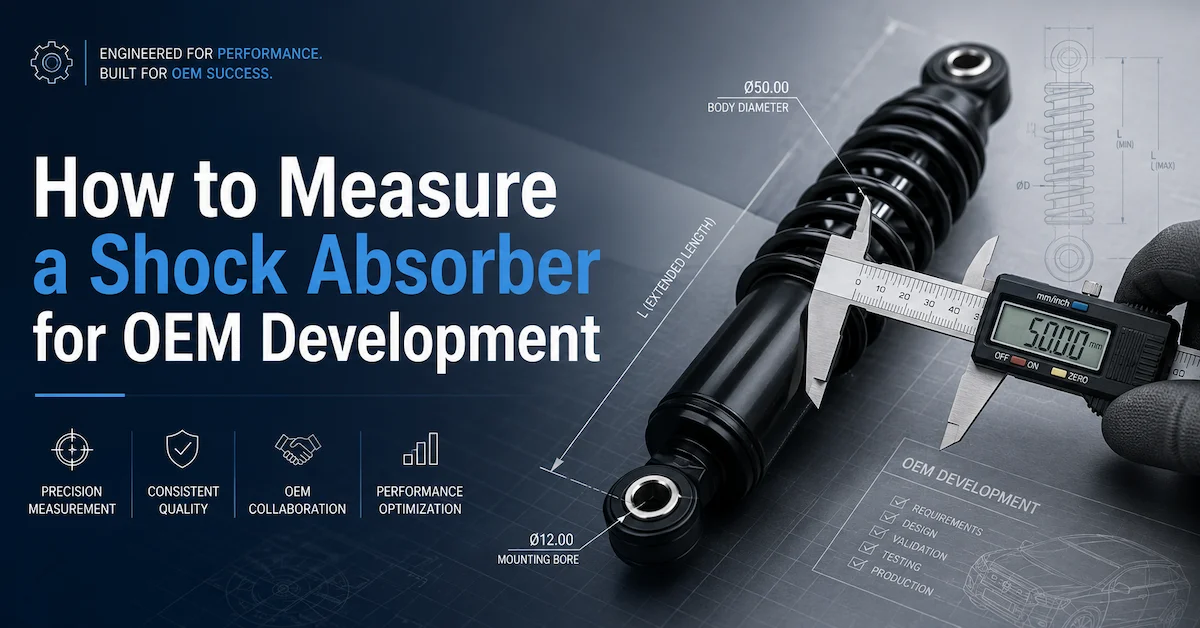
Important dimensions should be inspected against the approved drawing or reference sample.
| Inspection item | Why it matters |
|---|---|
| Extended length | Defines full shock absorber length |
| Compressed length | Prevents mechanical interference |
| Effective stroke | Controls suspension travel |
| Mounting hole diameter | Ensures bolt compatibility |
| Mounting width | Prevents looseness or installation failure |
| Body diameter | Affects structure and installation clearance |
| Rod diameter | Influences strength and sealing |
| Spring free length | Affects preload and ride height |
| Spring outside diameter | Ensures installation clearance |
| Mounting orientation | Prevents incorrect assembly |
A product that looks visually similar may still fail if one critical dimension is outside the permitted tolerance.
Assembly Control and Clean Production
Assembly quality directly affects internal friction, sealing performance, damping consistency, and service life.
A controlled assembly process should address:
- Component cleanliness
- Seal installation
- Piston and valve assembly
- Oil filling
- Gas charging where required
- Fastening torque
- Spring preload
- Adjustment mechanism operation
- Mounting alignment
- Final functional movement
Contamination inside the shock absorber can damage seals and internal surfaces. Incorrect oil volume or assembly torque may also change damping performance.
For this reason, assembly procedures should be standardized and documented.
Leakage, Function, and Damping Testing
Finished shock absorbers should be tested before packaging.
Leakage Testing
Leakage inspection helps verify sealing performance after assembly.
The product should be checked for:
- Visible oil leakage
- Seal damage
- Abnormal pressure loss
- Surface contamination
- Incorrect component installation
Functional Testing
The shock absorber should move smoothly without sticking, unusual noise, or inconsistent resistance.
Functional testing can identify:
- Excessive internal friction
- Incorrect assembly
- Misaligned components
- Abnormal valve behavior
- Adjustment-system problems
Damping Verification
Damping tests help confirm whether compression and rebound forces meet the approved target.
This is especially important for OEM projects because two shocks with identical external dimensions can deliver very different suspension performance.
A professional shock absorber manufacturer should treat damping targets as controlled technical specifications rather than subjective descriptions.
Surface Treatment and Corrosion Protection
Off-road shock absorbers are regularly exposed to water, mud, dust, chemicals, and changing weather.
Surface protection may include:
- Painting
- Powder coating
- Anodizing
- Plating
- Protective finishing
- Corrosion-resistant materials
The selected treatment should match the application environment.
For example, a snowmobile shock absorber may require stronger moisture and corrosion protection than a component used mainly in dry indoor equipment.
Surface inspection should check:
- Coating consistency
- Adhesion
- Scratches
- Exposed metal
- Color consistency
- Logo position
- Thread protection
Why Approved Samples Must Become Production Standards
A successful prototype does not automatically guarantee reliable mass production.
After sample approval, the manufacturer should document the complete specification.
This may include:
- Final drawing revision
- Material requirements
- Spring dimensions
- Spring rate
- Damping target
- Surface finish
- Mounting dimensions
- Color requirements
- Logo position
- Packaging standard
- Inspection requirements
- Accepted tolerance range
These specifications should become the reference for future production.
For B2B buyers, repeatability is as important as initial sample performance. A supplier that cannot reproduce the approved product may create warranty claims, installation problems, and inconsistent customer reviews.
Why Small-Batch Validation Reduces Purchasing Risk
Small-batch production creates a controlled step between prototype development and mass manufacturing.
It allows buyers to evaluate:
- Installation compatibility
- Ride quality
- Spring support
- Compression response
- Rebound control
- Endurance performance
- Coating durability
- Packaging quality
- Installer feedback
- Customer response
Small-batch validation is particularly useful for:
- New vehicle models
- Private-label products
- Modified vehicles
- New target markets
- Sample-based development
- Replacement parts without complete drawings
- Performance upgrade products
Bedo Auto supports customized development and flexible small-batch cooperation for suspension projects.
Standard Replacement Products vs Custom Manufacturer Development
| Evaluation point | Standard replacement product | Custom manufacturer solution |
|---|---|---|
| Fitment | Based on common dimensions | Based on sample, drawing, or vehicle data |
| Spring rate | Fixed specification | Matched to vehicle and payload |
| Damping | General setting | Developed for the target application |
| Mounting structure | Standard | Customizable |
| Surface treatment | Fixed option | Selected for the operating environment |
| Branding | Limited | Color, logo, label, and packaging support |
| Validation | General inspection | Prototype and small-batch validation |
| Best suited for | Basic replacement demand | OEM, ODM, private label, and special projects |
Standard products may be suitable for established replacement applications. Custom development becomes more valuable when vehicle weight, suspension geometry, terrain, branding, or performance requirements differ from common specifications.
How B2B Buyers Should Evaluate a Shock Absorber Manufacturer
Buyers should evaluate both technical and commercial capabilities before selecting a manufacturing partner.
Technical Capability
Confirm whether the supplier can:
- Review drawings
- Measure samples
- Analyze vehicle applications
- Confirm critical dimensions
- Recommend spring specifications
- Develop damping targets
- Produce prototypes
- Test leakage and function
- Document approved specifications
- Investigate product failures
Manufacturing Capability
Evaluate:
- Production equipment
- Assembly control
- Material management
- Quality inspection
- Batch traceability
- Small-batch flexibility
- Mass-production capacity
- Packaging control
- Repeat-order consistency
- Lead-time planning
Communication Capability
A capable supplier should ask technical questions before giving a final quotation.
Questions about vehicle weight, payload, terrain, stroke, mounting size, installation position, spring rate, and performance targets indicate that the manufacturer understands suspension development.
A supplier that quotes only from a photograph may overlook important technical risks.
How Bedo Auto Supports Suspension Safety and Reliability
As a specialized shock absorber manufacturer, Bedo Auto supports shock absorbers, suspension springs, and related components for ATV, UTV, motorcycle, electric motorcycle, snowmobile, beach buggy, and specialty vehicle applications.
Bedo Auto can support:
- Sample evaluation
- Customer drawing review
- Application analysis
- Dimension confirmation
- Spring-rate development
- Damping adjustment
- Surface-treatment selection
- Prototype production
- Small-batch validation
- OEM and ODM branding
- Packaging customization
- Repeat production support
Buyers can review available suspension products through the Bedo Auto Products page, learn about manufacturing support through the About Bedo Auto page, or submit project information through the Contact Us page.
FAQ
What does a shock absorber manufacturer control?
A shock absorber manufacturer controls product dimensions, materials, seals, spring specifications, damping performance, surface treatment, assembly, testing, branding, packaging, and batch consistency.
Why do shock absorbers affect suspension safety?
Shock absorbers control unwanted suspension movement and help the tires maintain more stable contact with the driving surface. Correct damping improves vehicle stability, impact control, and rider confidence.
What are common signs of shock absorber damage?
Common signs include oil leakage, damaged piston rods, unusual noise, unstable movement, worn bushings, damaged mounts, excessive bouncing, and reduced damping performance.
Can shock absorbers be developed from customer samples?
Yes. A physical sample provides structural and dimensional references. Development accuracy improves when the sample is combined with drawings, vehicle data, load information, and performance requirements.
Why should spring rate and damping be developed together?
The spring supports the vehicle load, while damping controls suspension movement. Changing one without considering the other may cause harsh riding, bottoming, instability, or insufficient suspension response.
Is small-batch production useful before mass production?
Yes. A small batch allows buyers to test fitment, damping, spring support, durability, appearance, packaging, and market response before placing a larger order.
Can Bedo Auto support OEM and ODM projects?
Yes. Bedo Auto supports sample-based and drawing-based development, technical parameter confirmation, shock absorber customization, suspension spring development, small-batch production, branding, and long-term supply cooperation.
Conclusion
A reliable shock absorber manufacturer ensures safety, performance, and long-term suspension reliability through more than basic assembly.
The process begins with understanding the vehicle and continues through spring-rate selection, damping development, material inspection, sealing design, dimensional control, assembly management, functional testing, small-batch validation, and repeatable production.
For B2B buyers, the best manufacturing partner is not simply the factory offering the lowest unit price. It is the supplier that can identify application risks, convert samples and drawings into controlled specifications, verify product performance, and reproduce approved quality across future orders.
Bedo Auto supports customized shock absorbers, suspension springs, OEM/ODM development, and small-batch cooperation for off-road and specialty vehicle projects, helping brands build suspension products designed for stable performance and long-term reliability.