
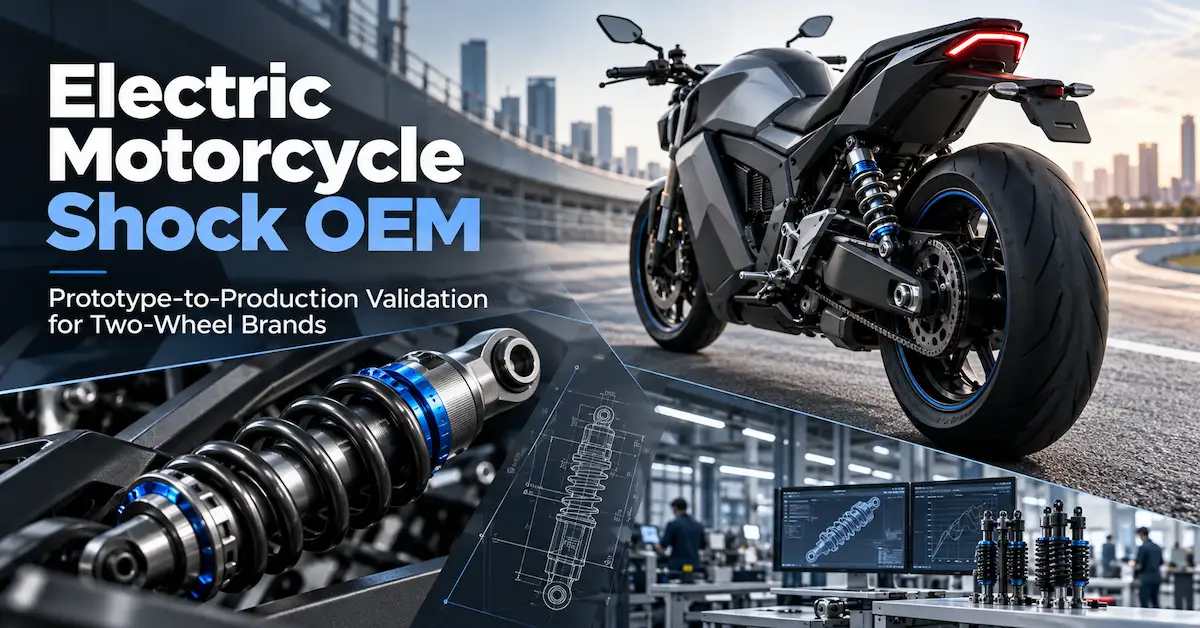
What should an electric motorcycle shock OEM prove before mass production?
Short answer: an electric motorcycle shock OEM should prove four things before mass production: the shock fits the vehicle drawing, the spring supports the real electric platform load, the compression and rebound behavior is measurable and repeatable, and the approved sample can be reproduced with controlled inspection and packaging. A supplier that only offers a catalog shock or a visual customization is not enough for an OEM release.
For a two-wheel electric brand, the most useful OEM process is a controlled loop: define the vehicle and load states, audit the interface, select or revise the spring and damping, build a sample, test it on the vehicle, record the changes, freeze the specification, and then control repeat production.
This article targets electric motorcycle brands, EV startups, importers developing a private-label model, fleet and delivery vehicle companies, distributors with a new rear shock line, and engineering teams that need an electric motorcycle shock OEM partner. Its single search intent is RFQ and supplier evaluation for prototype-to-production development. It is deliberately different from a generic "what is an electric motorcycle shock absorber" article because it focuses on release gates, evidence, and production risk.
BEDO Auto publicly presents shock absorbers, suspension springs, ball joints, custom solutions, design support, and small-batch orders. Its public catalog includes an electric motorcycle rear hydraulic shock absorber reference. The figures below are useful project evidence, but they are not a universal specification for every electric motorcycle. The OEM buyer must still confirm platform fit, duty cycle, target damping, test method, MOQ, lead time, packaging, and revision control.
Define the OEM project before asking for a quote
An electric motorcycle shock OEM project fails early when the buyer sends only a product photograph or a vehicle name. The supplier needs enough information to understand the physical interface and the intended behavior. Electric motorcycle platforms vary widely: a light urban commuter, a delivery scooter, a high-load cargo model, a moped-style motorcycle, and a dual-sport platform can all use a rear shock but require different spring and damping decisions.
Identify the platform and market
State whether the part is for a new vehicle, replacement, upgrade, or private-label product. Include wheelbase, curb mass, gross vehicle mass, front and rear axle loads, rider range, passenger condition, cargo condition, top speed, road type, and target market. A market description is not only a marketing field. It can reveal climate, road quality, service expectations, package labeling, and the required validation conditions.
Define the rear suspension interface
Provide extended length, compressed length, effective stroke, upper and lower mounting hole diameter, mounting width, sleeve dimensions, mounting orientation, spring outside diameter, free length, and the available clearance. Include the upper and lower mount photographs and a drawing of the surrounding frame. If a linkage is present, include its motion ratio or the pivot geometry. Also identify whether the shock is installed at an angle and whether a passenger, battery cover, motor, or chain guard limits access to the preload adjuster.
Describe electric-specific mass and use
Record battery mass and position, motor location, controller and enclosure mass, rider and passenger states, cargo, and any variation between a removable and installed battery. Note whether the rear shock carries the majority of the battery-related load or whether the pack sits low and central. Add acceleration, hill, braking, regenerative braking if used, and road impact conditions. The supplier needs a real load and work cycle, not just the phrase "electric motorcycle."
| Input category | Minimum OEM data | Why the shock supplier needs it |
|---|---|---|
| Vehicle mass | Curb mass, gross vehicle mass, front and rear axle loads. | Sets the installed spring load and target support. |
| Rider and cargo | Solo, passenger, delivery, and maximum cargo conditions. | Defines the load range and sag window. |
| Battery and motor | Mass, position, enclosure, motor location, torque and drive modes. | Explains rear load, pitch, traction, and repeated compression events. |
| Geometry | Lengths, stroke, mounts, sleeves, angle, linkage, and clearances. | Prevents an installation error or a shock that binds at full travel. |
| Performance | Ride height, sag, comfort, stability, bottoming limit, noise target. | Turns subjective expectations into a testable target. |
| Commercial plan | Sample quantity, annual volume, launch date, labels, packaging, service need. | Connects prototype work to production and after-sales supply. |
Use a published product reference without treating it as a universal OEM spec
The current BEDO Auto product record for a high-performance electric motorcycle rear hydraulic shock absorber provides a strong starting point for a technical discussion. It lists a rear position, external gas chamber, oil-gas separation, aluminum alloy and steel pipe materials, a 290 mm total length, 43 mm cylinder outer diameter, 70 mm effective stroke, 65 LBS spring rate, 1.9 kg weight, 10 mm upper and lower mounting hole diameters, 20 mm upper and lower mounting widths, and 25 adjustable damping levels. It also lists maximum rebound damping of 300 to 3,000 N and compression damping of 250 to 2,500 N, with inspection speed listed as 0.1 m/s.
These values are public product data, not a promise that the same configuration is suitable for every electric motorcycle. A buyer should confirm whether the force ranges are nominal, maximum, or adjustment-related; how the force is measured; what tolerances apply; which spring and preload are supplied; and what vehicle load was used for the published configuration. This distinction is essential for OEM work because a number without a test condition cannot serve as a complete acceptance criterion.
| BEDO public reference | Published value | OEM confirmation required |
|---|---|---|
| Product type | Electric motorcycle rear hydraulic shock absorber | Rear position, vehicle platform, and installation orientation. |
| Architecture | External gas chamber; oil-gas separation | Gas specification, operating temperature, service expectation, and packaging protection. |
| Material description | Aluminum alloy and steel pipe | Material grade, treatment, finish, corrosion requirement, and controlled supplier source. |
| Geometry | 290 mm total length; 43 mm cylinder outer diameter; 70 mm effective stroke | Vehicle drawing, compressed clearance, bump stop, motion ratio, and tolerance. |
| Spring | 65 LBS spring rate | Rate definition, tolerance, preload, installed length, rider and cargo load. |
| Damping | Rebound 300-3,000 N; compression 250-2,500 N; 25 adjustment levels | Force-velocity method, setting map, repeatability, and target vehicle behavior. |
| Mounting | 10 mm upper and lower holes; 20 mm upper and lower widths | Sleeve, bolt, frame tolerance, side load, bushing, and clearance. |
| Mass and finish | 1.9 kg; steel anti-corrosion, waterproof, rust-proof, customizable appearance | Measured mass tolerance, finish specification, test evidence, and color or label approval. |
The six release gates for an electric motorcycle shock OEM
A practical OEM program can be managed through release gates. The names may differ between companies, but the logic is the same: each gate should close a different risk before the buyer pays for the next level of commitment.
Gate 1: application and interface review
The supplier reviews the vehicle drawing, sample, or measurements. The buyer receives a written list of confirmed dimensions, assumptions, missing data, and potential interference. The goal is to avoid spending on a prototype that cannot physically install or that reaches full compression before the vehicle bump stop.
Gate 2: preliminary spring and damping definition
The supplier recommends a spring rate, preload range, damping arrangement, and any adjustment requirement against the stated load states. The buyer should ask for the target ride height, sag, and test conditions. If the supplier only says "heavy duty" or "comfortable," request a measurable explanation.
Gate 3: dimensional sample
The first sample proves that the geometry, mounting, clearances, and basic assembly work. It may not yet be the final damping calibration. Mark the sample revision and record the supplied spring, preload setting, finish, labels, and hardware. Photograph the installed condition and measure before road testing.
Gate 4: bench and static testing
Check dimensions, spring rate, adjustment action, compression and rebound force at agreed speeds, leakage, surface condition, and installed sag. The buyer should receive a test record that connects the result to the sample revision. If the product uses an external gas chamber, also document clearance, mounting orientation, and any service or pressure requirement that the supplier expects the buyer to manage.
Gate 5: vehicle validation
Test the shock on the actual motorcycle using the rider, passenger, cargo, battery, tire, and drive conditions defined in the RFQ. Record ride height, sag, bottoming, rebound, braking, launch, cornering, noise, leakage, and temperature change as relevant. The same route should be repeatable so a change in spring or damping can be evaluated rather than described only by memory.
Gate 6: production release
Freeze the drawing, part number, spring specification, damping target, adjustment map, material and finish, inspection plan, packaging, labels, and change-notification process. Define the critical-to-function dimensions and their tolerances. Require approval before any change in material, process, supplier, spring, oil, gas, seal, finish, or packaging that could change performance or service life.
How to evaluate spring and damping data
Spring data
For a spring, ask how the rate is defined, the tolerance, the free length, wire or coil geometry if relevant, installed length, preload, and expected sag at each load state. A product can list "65 LBS" while different suppliers use different measurement conventions or tolerances. The buyer should request the actual load-deflection method and the accepted range.
Compression and rebound data
Force depends on velocity, direction, temperature, stroke position, adjustment setting, and sometimes the mounting condition. Ask for a clear force-versus-velocity record with the test speed and direction. If there are 25 adjustment levels, request a setting map that identifies the baseline and demonstrates that each level creates a consistent and useful change. A high count of clicks is not automatically a high-value feature.
Vehicle-level acceptance
Bench data and vehicle feel should agree, but they answer different questions. Bench data verifies the component. Vehicle testing verifies the system: spring, shock, linkage, frame, tires, rider, battery, and cargo. An OEM supplier should be open about which results are measured on the shock and which results depend on the motorcycle. This transparency helps the buyer avoid assigning a vehicle-level problem to the wrong component.
Materials, finish, sealing, and durability evidence
The public BEDO electric motorcycle reference lists aluminum alloy and steel pipe and describes the steel as anti-corrosion, waterproof, and rust-proof. For an OEM program, ask for the actual material and surface specification, the treatment or coating, the protected areas, and the inspection method. If the motorcycle is used in rain, coastal air, winter salt, delivery wash-down, or dusty roads, define the environment before the supplier selects a finish.
Ask how the seal and sliding surfaces are protected, what cleaning methods are acceptable, and how leakage is detected. If the shock is exposed to road spray or pressure washing, include that condition in validation. If the motorcycle operates for long periods with a heavy battery and cargo, request a durability plan that reflects repeated cycles rather than a single static inspection. The public product page should be treated as a starting point; project-specific evidence must be supplied by the OEM partner.
Do not publish or sell a certification claim unless the certificate, scope, holder, product identity, and validity are available. The same rule applies to claims such as "tested for millions of cycles," "waterproof to a specific rating," or "approved by a major brand." These may be valid for a specific project, but they cannot be inferred from a general description.
OEM, ODM, and sample-based development
OEM usually means the buyer defines the product or vehicle requirement and the supplier manufactures to an agreed specification. ODM may involve more supplier-led design and product definition. Many electric motorcycle projects combine both: the brand has the frame and vehicle target, while the shock supplier contributes geometry review, spring and damping proposals, sample changes, and manufacturing feedback.
When a sample is available
Send the existing sample with a controlled description of what must stay unchanged and what may be improved. Identify symptoms such as sag, harshness, leakage, noise, or premature wear. A supplier should measure the sample, compare it to the vehicle condition, and document the proposed change. "Copy this sample" is not a complete engineering brief if the sample itself is poorly matched to the electric platform.
When only a drawing or target exists
Send the interface drawing, vehicle loads, battery and motor layout, target ride height, desired comfort and stability, and the production forecast. Ask the supplier to return a preliminary configuration, assumptions, and the data needed for a prototype. This is where a design-support capability can reduce later rework, but the buyer should still retain approval of the released specification.
When the product is a private-label replacement
Confirm brand marking, color, adjustment labels, packaging, instruction sheet, spare hardware, barcode, and after-sales identification. Ensure the private-label appearance does not hide the technical revision. The buyer should be able to trace a replacement shock back to the approved drawing and production batch even if the visible branding is different.
Commercial questions for an electric motorcycle shock OEM
Ask for a quote that separates development cost, sample cost, tooling or fixture cost, unit price, packaging, labels, and freight assumptions. State the sample quantity, target annual volume, launch timing, and expected replacement demand. A one-piece prototype request and a 10,000-piece annual program should not be quoted under the same hidden assumptions.
| Commercial item | What to request in writing | Why it protects the OEM program |
|---|---|---|
| MOQ | Sample minimum, pilot minimum, production minimum, and price breaks. | Shows whether the development plan fits the buyer's launch volume. |
| Lead time | Drawing review, sample, revision, pilot, repeat production, and shipping timing. | Prevents a single vague delivery promise from hiding the real schedule. |
| Packaging | Individual protection, carton quantity, labels, corrosion protection, hardware, and manuals. | Reduces damage, mixed revisions, and after-sales confusion. |
| Change control | Notice period, approval requirement, and affected materials or processes. | Protects the approved vehicle calibration from uncontrolled changes. |
| Quality records | Inspection format, traceability, sampling plan, and nonconformance response. | Creates evidence for receiving inspection and field investigation. |
| Service support | Spare parts, replacement identification, warranty route, and technical contact. | Limits downtime when the model reaches the market. |
The public BEDO pages reviewed for this article do not establish a universal MOQ, lead time, packaging standard, certification, or warranty term for every electric motorcycle shock. The buyer should request those fields for the exact configuration and quantity. This is a normal part of OEM due diligence, not a weakness in the article or the product.
How to evaluate BEDO Auto as an electric motorcycle shock OEM
BEDO Auto is a Ningbo, Zhejiang, China manufacturer with public suspension product categories and an electric motorcycle rear shock absorber reference. The website presents custom solutions, design support, and small-batch order support. It also provides an About Us page, a shock absorber category, the electric motorcycle product reference, and a contact page.
For an OEM buyer, the qualification call should ask BEDO to confirm the technical owner, sample process, drawing or sample review, spring and damping changes, test records, revision control, production inspection, packaging, MOQ, lead time, and after-sales process. Also request authorized factory photographs, applicable material or test evidence, and a publishable project case if the company wants the article to claim original evidence. The website product data gives the conversation a concrete starting point; the RFQ and approval records close the remaining evidence gaps.
Electric motorcycle shock OEM FAQ
What is the difference between an OEM shock supplier and a catalog shock seller?
An OEM supplier works from a controlled vehicle requirement and supports sample development, test evidence, revision control, and repeat production. A catalog seller may only provide an existing part and a price. The right choice depends on whether the buyer needs validated integration or a known replacement part.
Can the BEDO electric motorcycle reference fit any electric motorcycle?
No. The published dimensions and performance values are a reference configuration. The buyer must confirm mounting, motion ratio, load, spring rate, damping target, clearance, battery and cargo condition, and vehicle validation.
What should be measured first?
Measure extended and compressed length, stroke, upper and lower hole diameter, mounting width, sleeves, spring dimensions, installation angle, linkage geometry, and clearances. Then document axle loads and target ride height for the electric platform.
Are 25 damping levels automatically better for OEM use?
No. The useful question is whether the adjustment range is repeatable and whether each setting solves a real load, terrain, or rider condition. The buyer should request a setting map and validate the baseline on the target motorcycle.
What force data should the supplier provide?
Request compression and rebound force with test speed, direction, stroke position, temperature, adjustment setting, tolerance, and sample revision. Without the test conditions, a force number is difficult to compare or reproduce.
Do I need a vehicle test if the shock matches the drawing?
Yes for a new OEM platform. Drawing fit proves installation, not ride height, sag, braking, launch, cornering, rebound, noise, heat, or durability. The component and vehicle should be validated together.
Can the supplier support a small pilot order?
BEDO's public site presents small-batch order support, but the actual minimum, cost, lead time, and production conditions must be confirmed for the specific shock and quantity.
What evidence is still needed before this article can score 90 or more?
The article has public product facts, images, supplier identity, and a clear RFQ path. To close the publication gate, BEDO should add an identified author and technical reviewer, current factory or production photographs, confirmed MOQ and lead time, packaging evidence, test or inspection records, material documentation, an authorized case study, and a publishable FAQ approved by engineering.
Conclusion
An electric motorcycle shock OEM should be selected by the evidence it can provide from prototype to production. The buyer needs a controlled interface review, a spring and damping definition tied to battery and payload states, a dimensional sample, measurable bench data, vehicle validation, a frozen specification, and repeat-production controls. Commercial items such as MOQ, lead time, packaging, labeling, change control, and after-sales identification belong in the same project file.
BEDO Auto's public electric motorcycle rear shock reference gives OEM buyers a concrete starting point: 290 mm total length, 70 mm effective stroke, 65 LBS listed spring rate, adjustable damping, external gas chamber, oil-gas separation, and published mounting dimensions. The responsible next step is to send the target platform data and ask BEDO to confirm the configuration and evidence for the actual vehicle. That is how a catalog reference becomes an OEM decision that can be tested, approved, and repeated.