
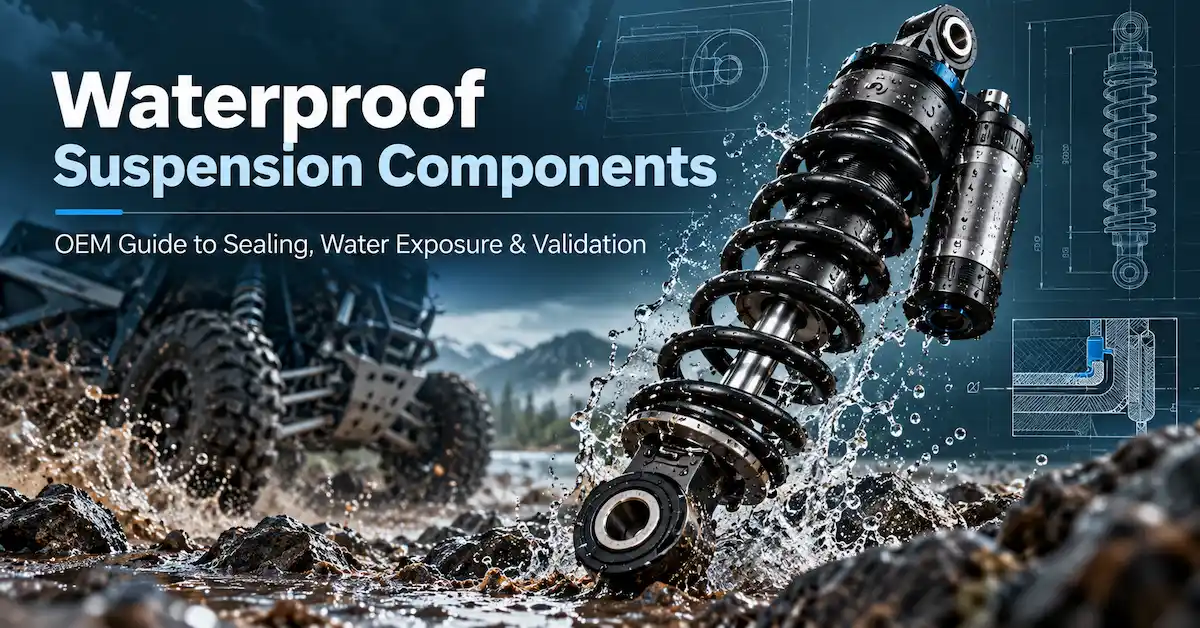
What Should “Waterproof Suspension Components” Mean to an OEM Buyer?
Direct answer: waterproof suspension components should not be specified with the word “waterproof” alone. An OEM specification should define the vehicle environment, which suspension components are exposed, possible water-ingress paths, sealing interfaces, immersion or splash conditions, cleaning methods, corrosion exposure, validation procedure, acceptance criteria, and production QC requirements.
A waterproof shock absorber may need protection against repeated splash and mud without being intended for prolonged underwater immersion. A water resistant suspension component may need external corrosion protection without requiring the same sealing strategy as a hydraulic damper. These requirements should be separated before suppliers are compared.
Waterproof, Water Resistant and Corrosion Resistant Are Different Requirements
The most important purchasing distinction is that waterproofing and corrosion resistance do not solve the same problem.
Water resistance concerns how a component manages exposure to water and how the design limits unwanted water entry into sensitive interfaces.
Corrosion resistance concerns how exposed materials and surfaces resist environmental deterioration after contact with water, moisture, salt, chemicals, or contaminants.
A component may perform well in one area and poorly in the other.
| Requirement | Main Question | Typical Risk |
|---|---|---|
| Water resistance | Can water reach a sensitive internal or moving interface? | Ingress, contamination, seal damage |
| Corrosion resistance | What happens to exposed materials after moisture contact? | Rust, coating breakdown, seized threads |
| Mud resistance | Can wet contamination remain around moving or sealing areas? | Abrasion, retained moisture, seal wear |
| Wash resistance | What happens during repeated cleaning? | Water forced toward seals and interfaces |
| Salt exposure | Can water carry aggressive salts to exposed surfaces? | Accelerated corrosion |
BEDO's existing corrosion-resistant shock absorber guide addresses corrosion as a separate purchasing issue. For a waterproof suspension project, that distinction should remain clear.
Procurement mistake to avoid: “waterproof,” “anti-rust,” “outdoor grade,” and “corrosion resistant” are not interchangeable acceptance criteria. If your project depends on one of these properties, define what must be protected and how it will be validated.
Which Suspension Components Are Most Vulnerable to Water Exposure?
A suspension system includes several components with different exposure mechanisms. Buyers should therefore assess waterproof suspension components by function rather than applying one generic waterproof claim to the entire system.
Shock Absorber
A hydraulic shock absorber combines external structural components with internal fluid and sealing systems.
Areas requiring attention may include:
- Piston rod and rod surface
- Rod seal area
- Dust or wiper protection
- Shock body
- Reservoir interfaces where applicable
- Adjustment mechanisms
- Mounting eyes
- Bushings and sleeves
- Threads and fasteners
Water on the external shock body is not automatically equivalent to water entering the hydraulic system.
That distinction is why a waterproof shock absorber specification should identify the actual sealing boundaries.
Suspension Spring
A coil spring does not normally have a hydraulic cavity to seal, so its environmental risk is different.
Typical concerns include:
- Coating damage
- Water retained between coils or seats
- Mud accumulation
- Stone damage
- Exposed spring ends
- Corrosion beneath damaged finish
For springs, the more useful requirement may therefore be environmental durability or corrosion protection rather than “waterproofing.”
Buyers can review BEDO's current suspension spring category when defining a project-specific spring requirement.
Ball Joints and Moving Interfaces
Where the vehicle suspension uses ball joints or similar articulated components, water may combine with dirt and grit around moving interfaces.
Relevant questions include:
- How is the joint protected?
- What prevents contamination entering the articulation area?
- How is the boot or protective interface retained?
- What happens after repeated articulation in wet conditions?
- How should damaged protective components be identified?
BEDO currently maintains a Ball Joints product category, but exact vehicle compatibility and waterproof performance should always be confirmed for the individual project.
Bushings, Sleeves and Mounting Hardware
These smaller components can be overlooked because they do not contain hydraulic fluid.
However, water exposure can affect:
- Corrosion of metal sleeves
- Contamination around bushings
- Fastener serviceability
- Thread condition
- Joint movement
- Removal during maintenance
A robust waterproof suspension specification should therefore include the surrounding mounting system rather than focusing only on the visible shock body.
Map Water Exposure Before Choosing Waterproof Suspension Components
The phrase “wet environment” is not precise enough for engineering development.
An OEM buyer should first classify how water reaches the suspension.
| Exposure Type | Example | Main Engineering Question |
|---|---|---|
| Rain | Outdoor vehicle operation | Can repeated wetting reach sensitive interfaces? |
| Wheel splash | Puddles and wet roads | Which surfaces receive continuous spray? |
| Mud splash | ATV/UTV trails | Can mud remain around seals and joints? |
| Shallow water crossing | Off-road utility vehicle | How high does water reach and for how long? |
| Standing water | Flooded farm track | Does the component experience partial immersion? |
| Cleaning | Fleet washdown | Can cleaning direct water into interfaces? |
| Snow and meltwater | Snowmobile or winter vehicle | How does repeated freeze/thaw exposure affect protection? |
| Coastal moisture | Beach or seaside operation | Are water and corrosion risks combined? |
This exposure map should be included in the RFQ because it changes what “waterproof suspension components” need to achieve.
Rain Exposure
Rain normally produces relatively low-pressure water exposure, but repeated wetting can still matter if water collects around threads, spring seats, boots, bushings, or seal areas.
Mud and Puddle Splash
Muddy water creates a combined contamination problem.
The water itself may not be the only concern. Fine particles can remain on the component after the water evaporates. If the piston rod repeatedly moves through contaminated areas, those particles may contribute to wear.
Water Crossing
A vehicle crossing shallow water introduces duration and water level as additional variables.
Buyers should define:
- Typical depth
- Maximum expected depth
- Exposure duration
- Vehicle speed
- Frequency of crossing
- Whether the vehicle stops in water
Without these values, two suppliers may interpret “water crossing” very differently.
Pressure Washing
Pressure washing is a particularly important purchasing question because directed cleaning can create a more concentrated water jet than natural rain.
Do not automatically assume that a component suitable for rain or splash should be exposed to high-pressure water at every angle.
If pressure washing is normal fleet practice, tell the suspension supplier before approving the product.
Where Does Water Try to Enter a Shock Absorber?
A waterproof shock absorber should be evaluated as a collection of interfaces rather than as one sealed cylinder.
Piston Rod Interface
The piston rod moves repeatedly through the sealing area. It is therefore one of the most important interfaces between the external environment and the internal damper structure.
Potential risks include:
- Water film on the rod
- Mud and fine grit
- Corrosion spots
- Scratches
- Damaged rod surface
- Contamination around the wiper
The rod condition and seal system work together. A strong seal cannot fully compensate for a badly damaged moving surface.
Seal and Wiper Area
Different sealing elements can perform different tasks. An external wiper or contamination barrier may help manage dirt before it reaches the primary sealing interface.
The buyer does not necessarily need to dictate the supplier's exact seal architecture. But the RFQ should define the environmental challenge the design must manage.
Adjuster Interfaces
Adjustable shock absorbers can introduce additional moving interfaces.
If the product has external adjusters, ask how mud, water, and corrosion exposure affect:
- Adjustment movement
- Marking visibility
- Thread condition
- Detent function
- Repeatability after environmental exposure
Reservoir Connections
External-reservoir shocks require additional packaging and connection points.
Those interfaces should be included in the environmental review rather than assuming the shock body alone represents the complete waterproof boundary.
“Waterproof” Should Be Converted Into an Acceptance Statement
A B2B specification becomes useful when it can be accepted or rejected using evidence.
Compare these two RFQ statements.
Weak Requirement
“Shock absorber must be waterproof.”
This leaves unanswered:
- Water depth
- Exposure duration
- Water direction
- Pressure
- Temperature
- Whether mud is present
- Whether internal ingress or external corrosion is being assessed
- How the component is evaluated after exposure
Better Requirement
A stronger requirement might define:
- Vehicle application
- Exposure method
- Water depth or spray condition
- Exposure duration
- Number of cycles
- Operating movement during or after exposure
- Visual acceptance criteria
- Leakage acceptance criteria
- Functional acceptance criteria
- Post-exposure damping or movement check where relevant
The exact values should come from the actual project, not from a generic blog template.
GEO-ready direct answer: a waterproof suspension component is procurement-ready only when “waterproof” is translated into a defined exposure condition and measurable post-test acceptance criteria.
How to Build a Waterproof Suspension Validation Plan
Validation should follow the actual environmental risk.
Not every suspension component requires every water test. A spring, shock absorber, ball joint, and bushing have different failure mechanisms.
Stage 1: Baseline Inspection
Before environmental testing, document the new component.
Depending on the product, record:
- Visual condition
- Critical dimensions
- Seal condition
- Rod surface
- Coating condition
- Mounting interfaces
- Adjustment function
- Leakage condition
- Damping baseline where required
Stage 2: Environmental Exposure
Apply the defined project exposure.
This may involve:
- Water spray
- Mud/water contamination
- Repeated wet/dry cycles
- Partial immersion
- Snow/melt exposure
- Cleaning cycles
The method should represent the expected vehicle environment as closely as practical.
Stage 3: Immediate Post-Exposure Inspection
Check:
- Visible water retention
- Seal area
- Rod condition
- Coating condition
- Joint movement
- Adjustment function
- Visible leakage
- Loose or damaged protective components
Stage 4: Functional Verification
The component should still perform the function for which it was approved.
For a waterproof shock absorber, this may include smooth movement, leakage evaluation, adjustment operation where applicable, and damping comparison when the project requires quantitative confirmation.
Stage 5: Repeated Cycle Evaluation
A single water exposure can miss cumulative problems.
Where the real vehicle repeatedly transitions between wet, dirty, dry, and cleaned conditions, the validation program may need multiple cycles.
BEDO'S shock absorber testing guide explains the broader principle that development tests should follow application requirements and defined acceptance criteria rather than one universal checklist.
Waterproof Testing and Corrosion Testing Should Not Be Merged Into One Claim
A wet-environment suspension program often needs both, but the tests answer different questions.
| Validation Area | Main Purpose | Possible Acceptance Focus |
|---|---|---|
| Water exposure | Assess sealing and interface behavior | Ingress, leakage, movement |
| Mud exposure | Assess contamination management | Seal area, rod, joints, adjusters |
| Wet/dry cycling | Assess repeated environmental change | Function after cycles |
| Corrosion exposure | Assess material and surface durability | Rust, coating damage, serviceability |
| Cleaning exposure | Assess maintenance environment | Seal/interface integrity |
If a supplier says a product is “waterproof and corrosion resistant,” ask for the evidence supporting each part of the statement.
Do not assume a coating test proves hydraulic sealing, or that a sealing test proves external metal will remain corrosion-free.
Material Selection Still Matters in Waterproof Suspension Components
Sealing receives most of the attention, but the materials surrounding the seal also influence wet-environment reliability.
Piston Rod Surface
The piston rod should remain suitable for repeated movement through the seal system.
Wet and muddy applications add risks such as:
- Surface corrosion
- Abrasive contamination
- Stone damage
- Scratching
- Damage during cleaning
This is why rod condition should be inspected during field-return analysis.
Shock Body
The shock body faces external water, mud, stone impact, and possible coating damage.
Material choice and finish should therefore be connected to the target environment.
BEDO's current shock absorber product category includes different hydraulic shock configurations for off-road and specialty vehicle applications.
Spring Finish
A spring can remain structurally functional while its coating gradually deteriorates.
For buyers, important questions include:
- What finish is specified?
- How are spring ends protected?
- How is coating damage inspected?
- Will the same finish be used in repeat production?
Fasteners and Threads
Wet-environment suspension systems should also remain serviceable.
A component that continues to function but develops seized adjustment threads or heavily corroded fasteners may still create maintenance problems for the customer.
Mud Is Often Harder on Suspension Than Clean Water
Clean-water exposure and mud exposure should not automatically be considered equivalent.
Mud can remain around:
- Rod seals
- Wipers
- Spring seats
- Mounting eyes
- Bushings
- Adjusters
- Threads
As the suspension cycles, contamination can move relative to these interfaces.
When the mud dries, fine particles may remain.
This is why water resistant suspension for ATV and UTV use should consider contamination as well as water itself.
For severe off-road applications, buyers can also review BEDO's extreme terrain shock absorber guide for the broader relationship between terrain, sealing, heat, impact, and durability.
Pressure Washing Needs Its Own Maintenance Rule
Many fleet and off-road vehicles are cleaned aggressively after muddy use.
A component may therefore encounter more concentrated water during maintenance than during normal driving.
OEMs and distributors should define whether their product is expected to tolerate:
- Garden-hose cleaning
- Low-pressure washdown
- Directed washing
- Commercial vehicle washing
- High-pressure cleaning
If high-pressure washing is expected, identify areas that should not receive direct concentrated spray unless the component was designed and validated for that condition.
This information can later become part of the vehicle service instructions.
Beach and Coastal Vehicles Need Water and Corrosion Requirements Together
For beach buggies, coastal ATVs, resort utility vehicles, and seaside equipment, water and corrosion risks overlap.
A coastal suspension requirement may need to consider:
- Salt-laden water
- Salt spray
- Sand abrasion
- Outdoor storage
- Repeated washing
- Coating damage
- Exposed threads
- Rod surface condition
This does not mean every beach application requires the same test program.
It means the buyer should state clearly that the vehicle faces a combined wet + salt + abrasive environment.
That information gives the supplier a more accurate basis for material, coating, seal, and maintenance decisions.
Snow and Winter Water Exposure Create a Different Risk Profile
Snow can accumulate around suspension components and later melt into water. The component may then experience repeated wet/dry or freeze/thaw conditions depending on how and where the vehicle is stored.
For winter suspension components, the RFQ may therefore include:
- Operating temperature
- Storage temperature
- Snow exposure
- Meltwater exposure
- Road salt where relevant
- Cleaning method
- Repeated temperature cycling
A waterproof shock absorber for a winter vehicle may consequently require a different validation plan from a waterproof shock absorber intended for a warm, wet agricultural environment.
What BEDO Product Pages Actually Say About Waterproof Performance
Selected BEDO shock absorber product pages currently use wording such as anti-corrosion, waterproof, rust-proof in their published Appearance Features fields.
Examples include:
- AU_HSA_02 ATV/UTV rear shock absorber
- AU_HSA_03 ATV/UTV rear shock absorber
- M_HSA_02 motorcycle rear shock absorber
For procurement purposes, those product-page descriptions should be treated as published manufacturer features, not as a substitute for a project-specific waterproof test method.
Important: do not convert the word “waterproof” on a product page into an unverified immersion depth, IP rating, wash-pressure capability, test duration, or universal vehicle guarantee. If your RFQ requires one of those conditions, request it explicitly and validate it.
This approach protects both buyer and supplier because it separates catalog positioning from contractual engineering acceptance.
Waterproof Suspension Components Need Production QC After Validation
A prototype passing an environmental test does not automatically prove that later production batches will be identical.
Once the project is approved, buyers should identify which production characteristics control waterproof performance.
Seal and Protective Component Control
Where sealing components are critical, production should maintain the approved:
- Seal specification
- Wiper or dust-protection structure
- Installation orientation
- Assembly condition
- Associated mating surfaces
Rod Surface Control
The rod should remain consistent with the approved product in relevant dimensions and surface condition.
Assembly Cleanliness
Contamination introduced during manufacturing can undermine an otherwise effective sealing design.
Coating Control
Where external protection matters, production inspection can include:
- Coverage
- Visual consistency
- Damaged areas
- Exposed edges
- Thread protection
End-of-Line Functional Check
The routine production inspection does not necessarily need to repeat every development test on every unit.
Development validation, pilot-batch verification, and routine production QC serve different purposes.
The correct production control plan should identify which characteristics need:
- 100% inspection
- Sampling inspection
- Periodic verification
- Supplier batch control
How to Audit a Waterproof Shock Absorber Sample
When receiving a prototype or supplier sample, do not evaluate only appearance.
A useful sample review can be organized into five groups.
1. Fitment
- Length
- Stroke
- Mounting dimensions
- Body clearance
- Spring clearance
2. Environmental Interfaces
- Rod and seal area
- Reservoir connections
- Adjusters
- Threads
- Bushings
- Mounts
3. Surface Protection
- Shock body
- Spring
- Mounting eyes
- Fasteners
- Exposed edges
4. Water Exposure Validation
- Approved exposure condition
- Duration
- Number of cycles
- Post-test inspection
- Functional test
5. Documentation
- Drawing revision
- Sample code
- Seal specification where controlled
- Surface treatment specification
- Test report
- Acceptance result
This structure turns a subjective “looks waterproof” review into a more repeatable engineering decision.
Common Waterproof Suspension Sourcing Mistakes
Mistake 1: Asking Only “Is It Waterproof?”
The question invites a yes/no marketing response rather than an engineering answer.
Ask instead:
“Which interfaces are protected, for what water exposure, and how has that condition been validated?”
Mistake 2: Confusing Waterproof With Anti-Corrosion
A good coating can protect external material while the sealing structure remains unsuitable for the intended water exposure.
The reverse can also occur.
Mistake 3: Testing Only Clean Water
If the real environment includes mud, grit, salt, or wash chemicals, clean water may not represent the actual contamination risk.
Mistake 4: Ignoring Maintenance Cleaning
Repeated washing can be part of the real duty cycle.
Mistake 5: Validating the Prototype but Not the Production Process
Waterproof performance may depend on assembly consistency as much as basic component design.
Mistake 6: Inventing an IP Rating
Do not publish an enclosure-style ingress rating for suspension components unless the specific product has actually been assessed under the applicable declared method and the rating is relevant to that product architecture.
Mistake 7: Assuming One Wet-Environment Product Fits Every Vehicle
Water resistance does not replace the need to verify fitment, spring rate, damping, load, stroke, and geometry.
How to Write an RFQ for Waterproof Suspension Components
A high-quality RFQ should tell the supplier what the vehicle experiences rather than simply request a “waterproof version.”
Vehicle Information
- Vehicle type and model
- Front or rear suspension position
- Vehicle mass
- Passenger and cargo load
- Suspension geometry where available
- Wheel/tire configuration
Component Information
- Shock absorber, spring, ball joint or other component
- Reference sample
- Drawing or CAD
- Length and stroke
- Mounting dimensions
- Spring specification
- Damping target where available
Water Exposure
- Rain
- Puddle splash
- Mud
- Water crossing
- Partial immersion
- Snow/meltwater
- Coastal or salt environment
- Cleaning method
Validation Requirement
- Exposure duration
- Water level or spray condition
- Cycle count
- Post-exposure inspection
- Leakage requirement
- Functional requirement
- Corrosion requirement where separate
Commercial Requirement
- Prototype quantity
- Pilot quantity
- Expected production quantity
- Private-label requirements
- Packaging requirements
- Target launch timing
If some fields are not known, mark them as TBC rather than inventing a number.
BEDO's current suspension product range can be used as a starting point before discussing project-specific environmental requirements.
Standard Waterproof Shock or Custom Development?
Not every wet-environment project requires a custom product.
A Standard Configuration May Be Enough When
- Vehicle fitment is already confirmed.
- The current shock dimensions are suitable.
- Spring and damping requirements are already satisfied.
- The environmental exposure matches the existing product scope.
- No special validation requirement exists.
Custom Development Becomes More Relevant When
- Water exposure is more severe.
- The component faces repeated immersion.
- Pressure washing is part of normal maintenance.
- Saltwater and sand exposure are combined.
- Existing seals show recurring failures.
- Vehicle geometry or load has changed.
- A specific test program is required.
- The buyer needs documented environmental acceptance criteria.
In those projects, the supplier may need to review the complete vehicle and shock specification rather than changing one seal in isolation.
BEDO'S custom suspension solutions guide explains how fitment, load, damping, spring requirements, environmental durability, prototypes, and production control can be handled as one development process.
How Field Returns Can Improve Waterproof Suspension Design
A returned component from a wet environment can provide useful engineering evidence.
Do not record only “water damage.”
Document:
- Vehicle model
- Shock position
- Production batch
- Operating environment
- Water exposure
- Cleaning method
- Operating duration
- Rod condition
- Seal condition
- Corrosion locations
- Mud contamination
- Leakage evidence
- Mounting condition
The failure pattern may reveal whether the problem involves:
- Water ingress
- Abrasion
- Corrosion
- Rod damage
- Seal wear
- Installation
- Wrong vehicle application
- Production variation
BEDO'S off-road shock absorber service-life guide discusses the value of tracing leakage, rod wear, contamination, and corrosion instead of immediately classifying every return as a generic defective shock.
Waterproof Suspension Components for Different Applications
| Application | Typical Water Risk | Buyer Priority |
|---|---|---|
| ATV trail riding | Mud, puddles, splash | Seal contamination protection |
| UTV farm work | Wet soil, washdown, repeated daily exposure | Durability and serviceability |
| Beach buggy | Water, salt, sand | Water sealing plus corrosion protection |
| Snowmobile | Snow, meltwater, freeze/thaw | Low-temperature environmental validation |
| Golf/utility cart | Rain, washdown, wet roads | Application-specific protection |
| Specialty vehicle | Project dependent | Custom exposure specification |
The table shows why “waterproof” cannot be treated as one universal suspension specification.
A wet farm vehicle, coastal buggy and snowmobile may all need waterproof suspension components, but the relevant failure mechanisms and validation conditions differ.
What Should Be Frozen Before Mass Production?
After prototype validation, waterproof performance should become part of the controlled product definition.
Depending on the project, freeze:
- Product model
- Drawing revision
- Critical dimensions
- Seal and wiper specification where controlled
- Rod specification
- Surface treatment
- Spring finish
- Mounting components
- Assembly requirements
- Environmental test method
- Acceptance criteria
- Approved sample
- Pilot-batch result
This prevents a later production change from unintentionally altering the environmental performance of the approved component.
FAQ: Waterproof Suspension Components
Are waterproof suspension components completely sealed from all water?
No universal assumption should be made. “Waterproof” must be defined by the intended exposure, component architecture, test method, and acceptance criteria. Splash resistance, partial immersion and pressure-wash resistance are different conditions.
Is a waterproof shock absorber the same as a corrosion-resistant shock absorber?
No. Waterproofing focuses on unwanted water ingress and sensitive interfaces. Corrosion resistance focuses on material and surface deterioration. A project may need both.
Can an ATV shock absorber be used in standing water?
Only if the specific product and application have been evaluated for the expected water level, duration and operating conditions. Do not assume ordinary off-road splash resistance equals immersion capability.
Can mud damage a waterproof shock absorber?
Yes. Mud can retain moisture and carry abrasive particles around piston rods, wipers, seals, mounts, adjusters and threads. Mud resistance should therefore be considered separately from clean-water exposure.
Should waterproof suspension components have an IP rating?
Not automatically. Do not assign or advertise an IP rating unless the specific product has been assessed under an applicable declared method and the rating is appropriate to that product architecture.
What should be tested after water exposure?
Depending on the component and project, buyers may inspect seals, rod condition, visible leakage, joint operation, adjustment function, coating condition and functional performance. Hydraulic shocks may also require post-exposure damping verification when specified.
Does powder coating make a suspension component waterproof?
No. A coating can contribute to external corrosion protection but does not by itself define the sealing capability of a shock absorber or moving joint.
Can pressure washing damage suspension seals?
Directed high-pressure water can create a different exposure from normal rain or splash. If pressure washing is normal vehicle maintenance, it should be considered in the project requirements and service guidance.
What information should I give a waterproof suspension supplier?
Provide the vehicle application, suspension position, load, component type, sample or drawing, fitment dimensions, water exposure, mud/salt conditions, cleaning method, operating temperature, test requirement, prototype quantity and production plan.
Can BEDO develop suspension components for wet off-road applications?
BEDO's public website describes customized suspension development and publishes shock absorber models whose listed Appearance Features include waterproof, anti-corrosion and rust-proof wording. Exact waterproof requirements should still be confirmed and validated for the specific project.
Conclusion
Waterproof suspension components should be specified by exposure and evidence, not by one marketing word. Define where water reaches the suspension, which interfaces require protection, how mud and corrosion differ from water ingress, and what the component must still do after testing.
For a waterproof shock absorber or wet-environment suspension project, review BEDO's shock absorber range and send your vehicle data, sample, drawings, exposure conditions and validation requirements through the BEDO Contact Us page.
Define Your Waterproof Suspension Requirement Before You Quote
Send BEDO the vehicle application, water or mud exposure, existing suspension sample, drawings, load condition and test requirements for project review.