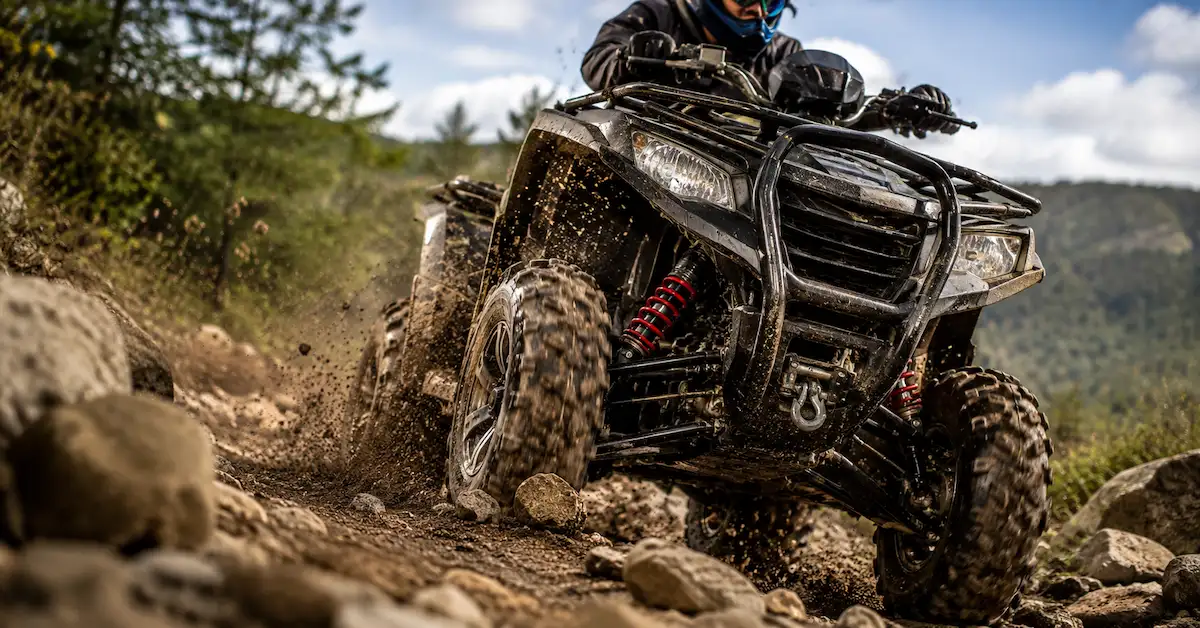

For UTV brands, importers, wholesalers, repair parts suppliers, and aftermarket sellers, UTV suspension parts are not simple replacement components. They directly affect ride comfort, vehicle stability, load support, impact absorption, and long-term durability.
UTVs are often used on farms, mountain trails, forest roads, muddy ground, rocky terrain, sand, and utility worksites. These environments create strong vibration, repeated impact, and changing load conditions. If the suspension parts are not matched correctly, the vehicle may feel unstable, too soft, too stiff, or uncomfortable.
For B2B buyers, sourcing UTV suspension parts is not only about price. Buyers need to confirm fitment, spring rate, damping force, material strength, surface treatment, small batch testing, OEM/ODM customization, and batch consistency before placing repeat orders.
Bedo Auto provides shock absorbers, suspension springs, and related suspension components for off-road and specialty vehicle applications. You can explore the product range on the Bedo Auto Products page.
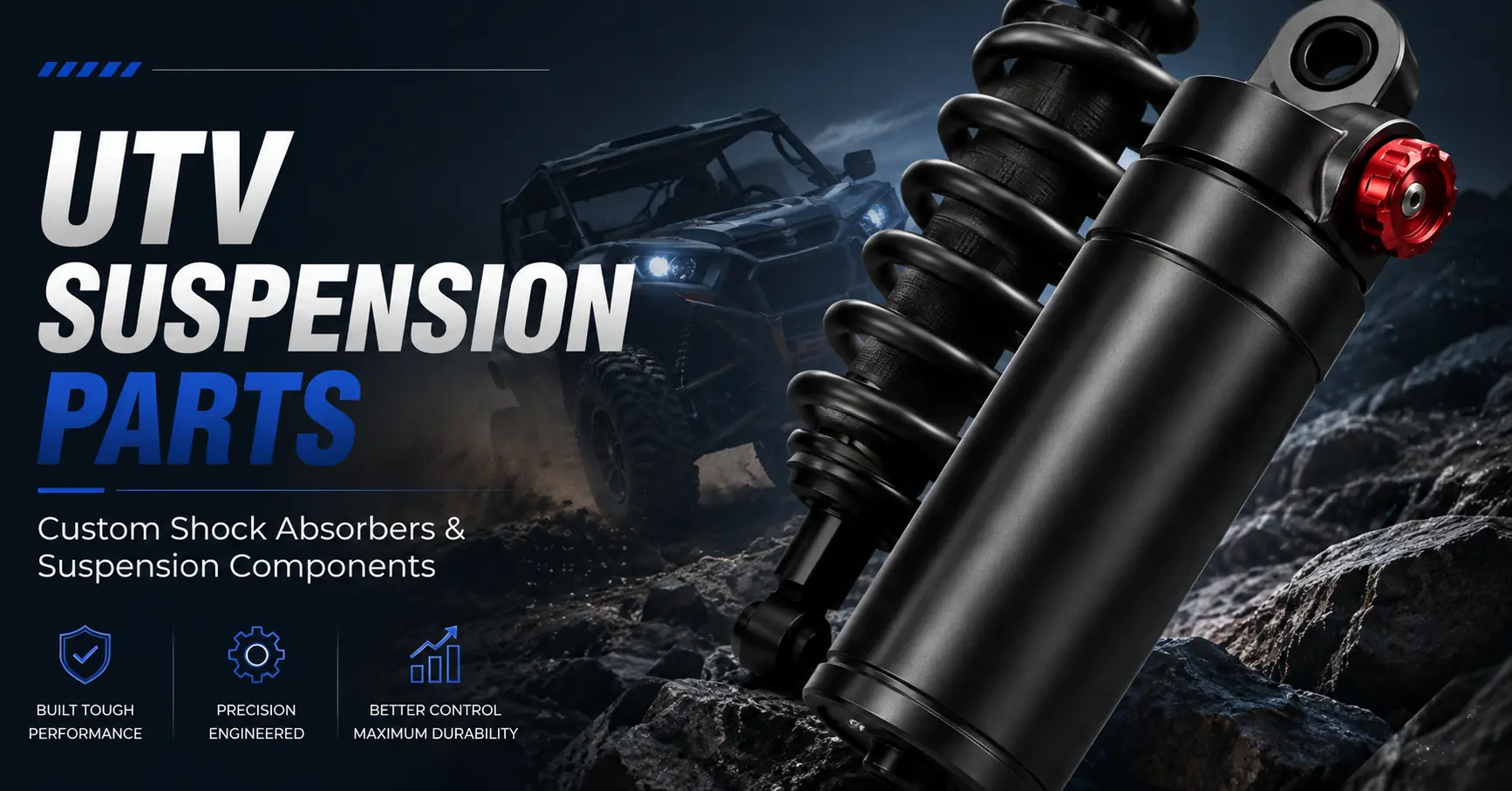
Why UTV Suspension Parts Matter
UTV suspension systems must handle much more than ordinary road vibration. A UTV may carry passengers, tools, cargo, farm equipment, or outdoor gear while driving across uneven ground. The suspension must absorb impact while keeping the vehicle stable and controllable.
Poor suspension parts can cause:
- Harsh ride comfort
- Weak load support
- Unstable handling
- Short suspension travel
- Spring sagging
- Poor rebound control
- Mounting failure
- Faster tire and component wear
- Oil leakage from shock absorbers
- Customer complaints after installation
For UTV brands and aftermarket sellers, these problems can lead to warranty claims, poor reviews, and repeat-order issues.
Reliable UTV suspension parts should provide accurate fitment, stable damping, correct spring support, and durable performance under real off-road conditions.
Main Types of UTV Suspension Parts
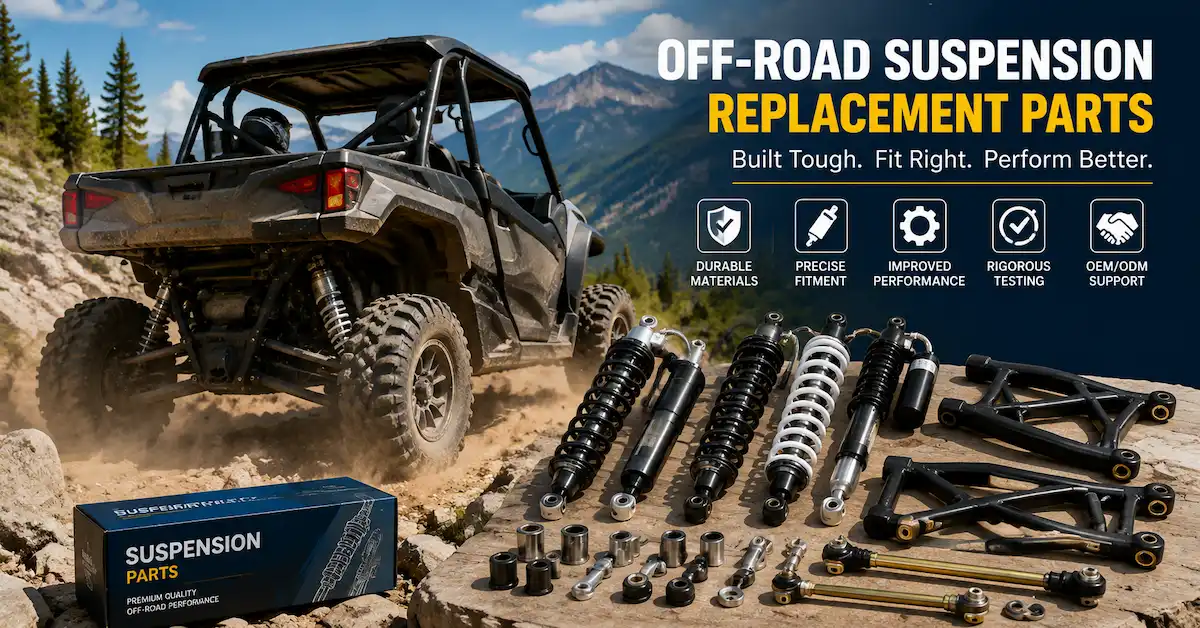
A complete UTV suspension product line can include different components. For most B2B buyers, the core products are shock absorbers, suspension springs, and related mounting components.
| Product Type | Function |
|---|---|
| UTV shock absorbers | Control compression, rebound, vibration, and impact response |
| Suspension springs | Support load, ride height, and comfort |
| Coil springs | Provide elastic support and impact absorption |
| Rear shock absorbers | Support rear load, passengers, cargo, and utility use |
| Front shock absorbers | Support steering stability and front suspension movement |
| Ball joints | Connect steering and suspension movement |
| Bushings and mounting parts | Reduce vibration and help secure installation |
For wholesalers and distributors, starting with fast-moving shock absorbers and suspension springs is usually the most practical way to build a UTV suspension parts product line.
Who Needs UTV Suspension Parts?
UTV suspension components are suitable for different B2B buyer groups.
| Buyer Type | Main Requirement |
| UTV brands | Develop suspension parts for new or existing models |
| Importers | Source stable replacement parts from China |
| Wholesalers | Build private-label UTV suspension product lines |
| Aftermarket sellers | Offer replacement or upgraded suspension parts |
| Repair parts suppliers | Provide fast-moving UTV suspension SKUs |
| Fleet operators | Maintain rental, farm, or utility UTV vehicles |
| Farm vehicle suppliers | Improve load support and durability |
| OEM/ODM buyers | Customize parts based on samples, drawings, or parameters |
For these buyers, the goal is not only to purchase suspension parts. The goal is to build products that fit correctly, perform reliably, and can be reordered with consistent quality.
Key Technical Details Buyers Should Check
Before sourcing UTV suspension parts, buyers should prepare basic technical information. This helps the supplier evaluate the project correctly and reduce repeated sample changes.
| Technical Parameter | Why It Matters |
| UTV model or application | Helps confirm suspension structure and use case |
| Installation position | Front and rear parts may need different settings |
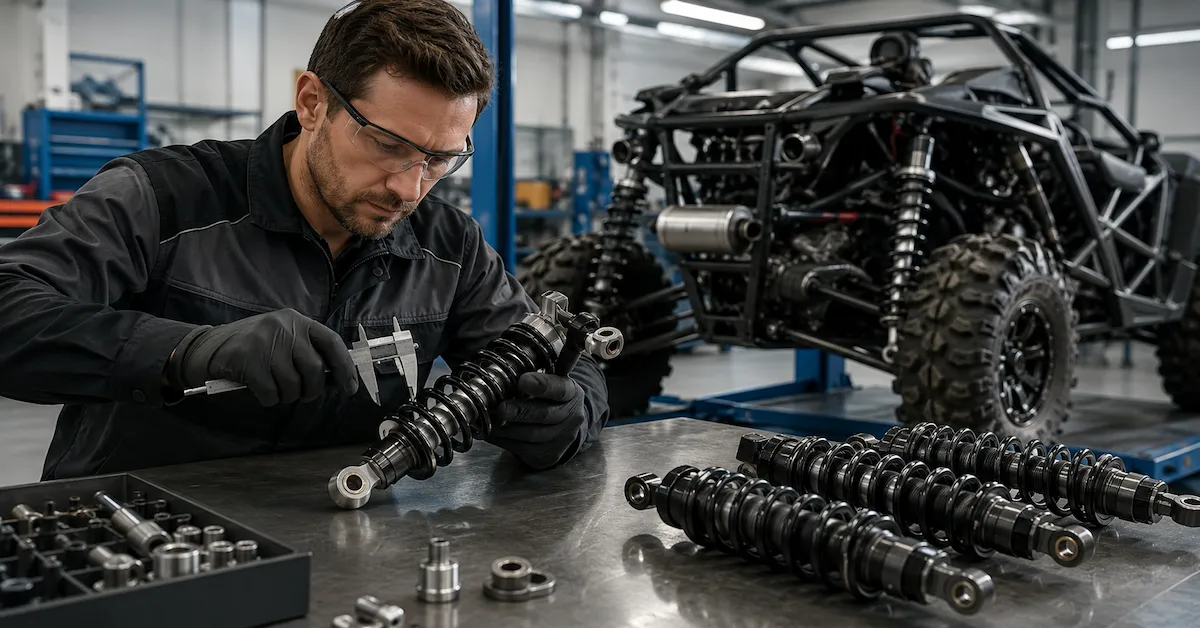
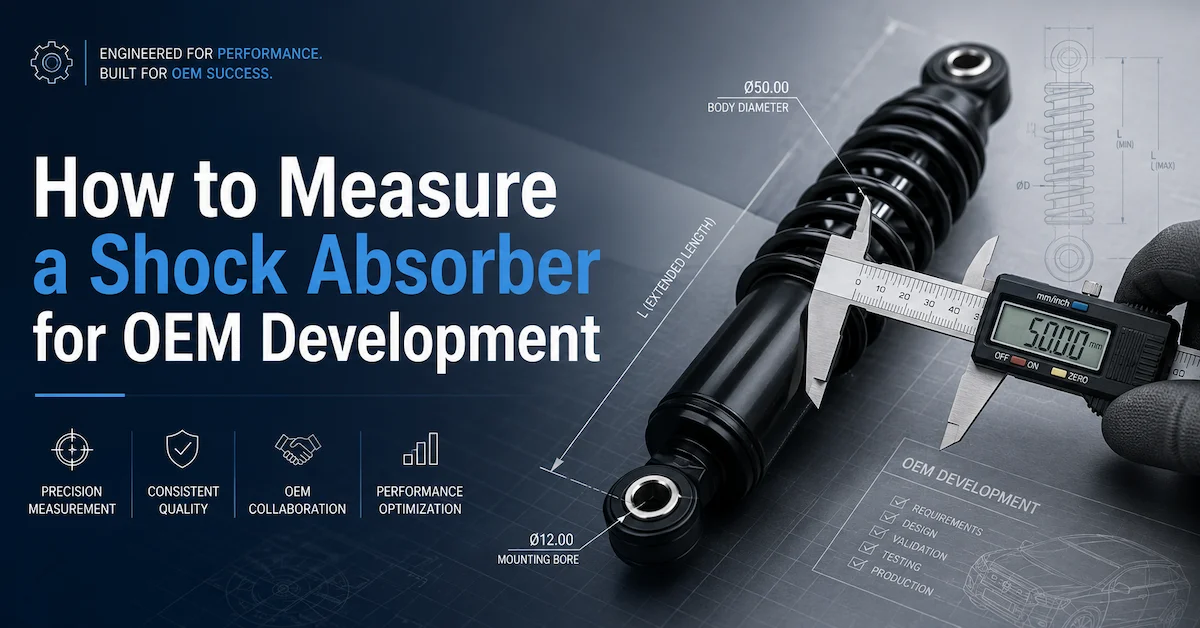
| Extended length | Defines the full open length of the shock absorber |
| Compressed length | Prevents interference during compression |
| Stroke length | Affects suspension travel and impact absorption |
| Mounting hole size | Ensures correct bolt and bracket fitment |
| Mounting width | Prevents looseness or installation failure |
| Spring rate | Controls ride height, load support, and comfort |
| Damping force | Affects rebound, compression, and stability |
| Load condition | Important for passengers, cargo, tools, and farm use |
| Terrain type | Mud, rocks, sand, trails, and farm roads need different settings |
| Surface treatment | Helps resist rust, water, mud, and corrosion |
If buyers only provide photos, the supplier may provide an early estimate. However, final production should be based on samples, drawings, or confirmed measurements.
Why Spring Rate Is Important
Spring rate is one of the most important factors in UTV suspension performance. It affects how much force is needed to compress the spring.
If the spring rate is too soft, the UTV may sag under cargo or passenger load, bottom out on rough roads, or feel unstable during turning. If the spring rate is too stiff, the ride may become harsh, and the tires may lose contact with uneven terrain.
Spring rate should be selected based on:
- Vehicle weight
- Passenger load
- Cargo or tool load
- Suspension travel
- Front or rear installation
- Terrain condition
- Utility or recreational use
- Comfort or performance target
For example, a farm UTV carrying tools and supplies may need stronger spring support than a recreational UTV used on light trails. This is why spring rate should be discussed before sample or batch production.
Damping Force and Ride Stability
Damping force controls how the shock absorber compresses and rebounds after impact. It directly affects ride comfort, vibration control, and handling stability.
For UTVs, damping should match real application conditions. A vehicle used on rocky trails may need stronger impact control, while a utility vehicle carrying cargo may need stable load response.
Buyers should discuss:
- Rebound control
- Compression response
- Impact absorption
- Low-speed comfort
- High-speed vibration control
- Heat stability
- Fixed or adjustable damping
- Long-term batch consistency
A UTV shock absorber may look correct from the outside but perform poorly if damping is not suitable. For OEM and aftermarket buyers, damping should be treated as a technical requirement, not only as a general feeling such as “soft” or “hard.”
Standard UTV Suspension Parts vs Custom UTV Suspension Parts
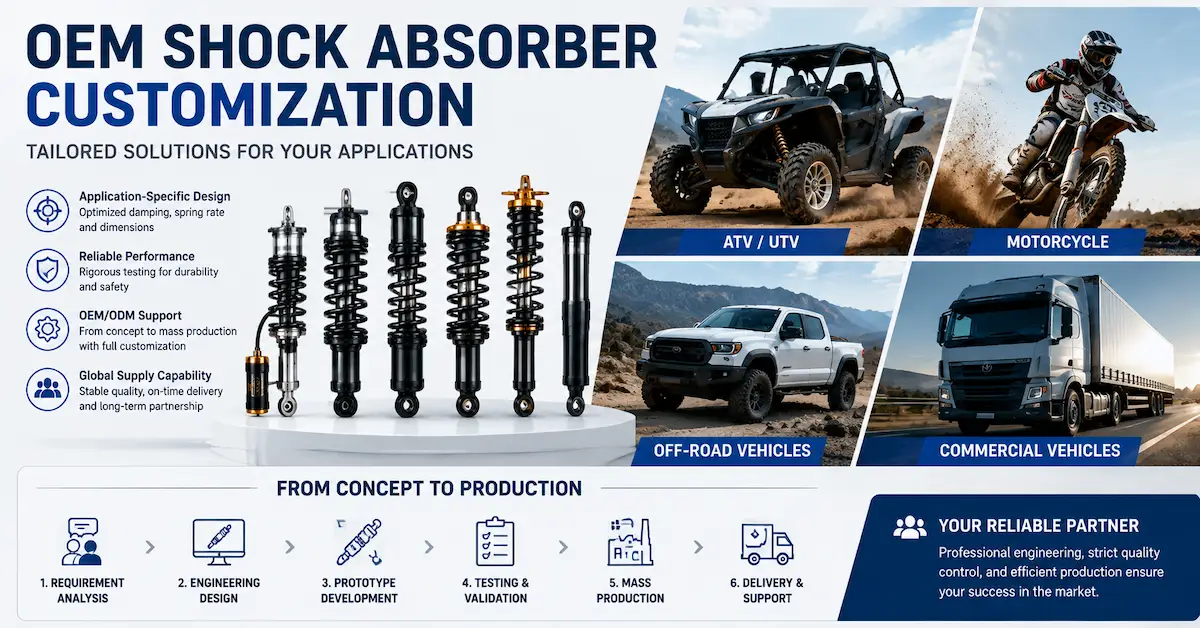
Some buyers only need standard replacement parts. Others need custom development for OEM, ODM, private-label, or upgraded aftermarket products.
| Item | Standard UTV Suspension Parts | Custom UTV Suspension Parts |
| Fitment | Based on common models | Based on sample, drawing, or measured data |
| Spring rate | Usually fixed | Can be adjusted for load and terrain |
| Damping | Standard setting | Can be matched to performance requirements |
| Appearance | Limited options | Color, logo, and packaging can be customized |
| MOQ | Depends on stock | Can support small batch development |
| Best for | Basic repair market | OEM, ODM, private label, upgraded products |
| Buyer control | Limited | Higher control over product and brand |
For wholesalers and aftermarket sellers, custom UTV suspension parts can help create stronger product differentiation and better long-term profit margins.
OEM and ODM Customization Options
UTV suspension customization can include both technical and commercial details.
| Custom Option | Purpose |
| Length customization | Match UTV frame and suspension geometry |
| Stroke adjustment | Improve travel and impact absorption |
| Spring rate customization | Match passenger load, cargo load, and terrain |
| Damping adjustment | Improve rebound, compression, and stability |
| Surface coating | Improve rust, water, mud, and corrosion resistance |
| Spring color | Support private-label product appearance |
| Body color | Match brand or product line identity |
| Logo marking | Support OEM branding |
| Packaging design | Support wholesale and retail sales |
| Small batch production | Test fitment and market demand before larger orders |
For UTV applications, technical performance should come before appearance. A good color or logo is useful, but fitment, spring rate, damping, and durability decide long-term customer satisfaction.
Small Batch Testing Before Bulk Orders
Large-volume production can be risky when the product has not been tested. If the UTV suspension parts do not fit correctly or the spring rate is unsuitable, the buyer may face returns, warranty issues, inventory pressure, and delayed sales.
Small batch testing helps buyers:
- Confirm mounting fitment
- Test spring rate and damping
- Review coating and appearance
- Reduce inventory pressure
- Check packaging and labeling
- Collect customer feedback
- Adjust specifications before bulk orders
- Build confidence in supplier cooperation
For new UTV suspension parts projects, small batch production is often the safest step before mass production.
How to Choose a UTV Suspension Parts Supplier
When comparing suppliers, buyers should not focus only on unit price. A low-cost product can become expensive if it causes fitment failure, poor performance, or customer complaints.
| Evaluation Point | Reliable Supplier | Risky Supplier |
| Technical communication | Asks about UTV model, load, terrain, and dimensions | Only asks for quantity and target price |
| Customization ability | Supports samples, drawings, spring rate, damping, color, and packaging | Offers only standard catalog products |
| Small batch support | Allows testing before mass production | Pushes bulk orders too early |
| Quality control | Checks dimensions, leakage, coating, and assembly | No clear inspection process |
| Batch consistency | Uses approved samples and specifications as standards | Quality varies between orders |
| Export support | Understands packaging and overseas buyer needs | Limited B2B export experience |
A reliable supplier should help buyers reduce sourcing risk and build a stronger UTV suspension product line.
What Buyers Should Prepare Before Requesting a Quote
To receive a faster and more accurate quotation, buyers should prepare basic project information.
| Information to Prepare | Example |
| Vehicle type | UTV, side-by-side vehicle, utility vehicle |
| Installation position | Front shock absorber or rear shock absorber |
| Existing sample | Original part, competitor sample, or damaged part |
| Drawing or measurement | Extended length, compressed length, stroke, mounting size |
| Load condition | Rider, passenger, cargo, tools, battery |
| Terrain | Farm road, mud, trail, rock, sand, snow |
| Target improvement | Better comfort, stronger support, lower cost, longer life |
| Custom needs | Spring rate, damping, color, logo, coating, packaging |
| Order plan | Sample, small batch, future mass production |
| Target market | North America, Europe, South America, Australia, etc. |
The more complete the information, the easier it is for the supplier to provide a practical UTV suspension parts solution.
How Bedo Auto Supports UTV Suspension Parts Projects
Bedo Auto focuses on shock absorbers, suspension springs, and related suspension components for off-road and specialty vehicle applications. For buyers looking for UTV suspension parts, Bedo Auto can support sample review, technical parameter discussion, custom development, small batch production, OEM/ODM customization, and future batch cooperation.
Bedo Auto can help buyers discuss:
- UTV application
- Front or rear shock absorber requirements
- Existing sample condition
- Mounting dimensions
- Stroke length
- Spring rate
- Damping preference
- Surface treatment
- Body and spring color
- Logo and packaging needs
- Small batch order planning
- Long-term production cooperation
You can learn more about the company’s manufacturing background on the About Bedo Auto page.
If you are planning a UTV suspension parts project, you can send your requirements through the Contact Us page.
FAQ
1. What are UTV suspension parts?
UTV suspension parts are components used in a UTV suspension system, including shock absorbers, suspension springs, coil springs, ball joints, bushings, and related mounting parts.
2. Can UTV suspension parts be customized?
Yes. Buyers can customize length, stroke, mounting size, spring rate, damping force, surface treatment, color, logo, and packaging.
3. Why is spring rate important for UTV suspension?
Spring rate affects ride height, load support, comfort, and stability. A wrong spring rate can make the UTV too soft, too stiff, or unstable under load.
4. Can buyers develop UTV suspension parts from samples?
Yes. A physical sample helps the supplier measure structure, mounting dimensions, spring size, and other important details for custom development.
5. Is small batch production available?
Yes. Many buyers start with samples or small batches to test fitment, damping, spring rate, appearance, and market response before larger orders.
6. What information should buyers provide?
Buyers should provide UTV model, installation position, sample or drawing, dimensions, load condition, terrain, customization needs, and order plan.
Conclusion
Reliable UTV suspension parts help brands, importers, wholesalers, and aftermarket sellers provide better ride comfort, stronger load support, and more stable off-road performance. For B2B buyers, the key is to confirm fitment, spring rate, damping force, surface treatment, quality control, and batch consistency before placing repeat orders.
Instead of relying only on standard parts, buyers can work with a supplier that supports samples, drawings, technical parameters, small batch testing, OEM customization, and long-term cooperation.
If you are looking for a custom UTV suspension parts supplier for OEM, ODM, or aftermarket projects, explore the Bedo Auto product range or contact the team through the Contact Us page to discuss your project requirements