
To upgrade UTV suspension for heavy payload applications, start with the vehicle's actual operating weight and front/rear load distribution. Then evaluate suspension sag, spring rate, remaining shock travel, compression and rebound damping, and the difference between loaded and unloaded operation.
Simply installing the stiffest spring or largest shock absorber available does not guarantee a better suspension.
A more reliable process is:
Operating Weight → Front/Rear Load → Sag → Spring Rate → Shock Travel → Damping → Vehicle Validation
The spring primarily supports the load. The shock absorber controls how that loaded suspension moves.
This distinction is important for utility UTVs carrying passengers, tools, agricultural supplies, construction materials, permanently installed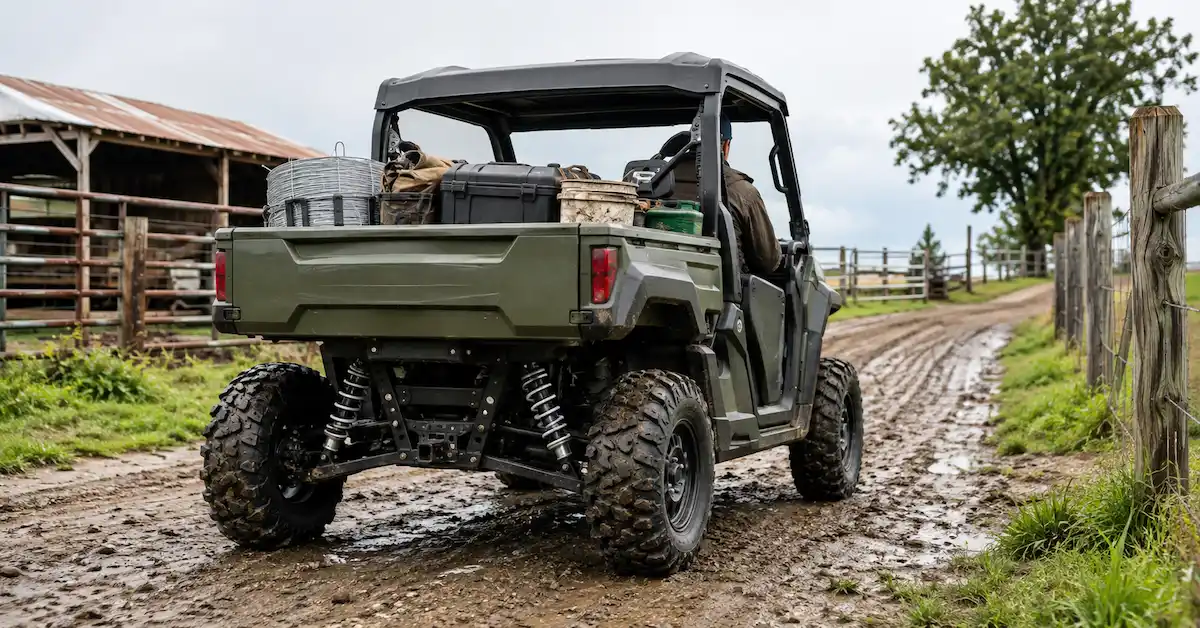 accessories, or other heavy payloads.
When Does a UTV Suspension Actually Need an Upgrade?
More cargo does not automatically mean that every UTV requires a complete suspension replacement.
First, evaluate how the current suspension behaves under normal working conditions.
Common signs that an upgrade should be investigated include:
- Excessive front or rear sag
- Noticeable loss of ride height
- Frequent suspension bottoming
- Very little compression travel remaining
- Poor control when carrying cargo
- Excessive body movement
- Poor rebound recovery
- Reduced stability on rough terrain
- Acceptable performance when empty but poor behavior when loaded
If the existing suspension retains appropriate ride height, travel, and control under the intended load, a major change may not be necessary.
The objective should be to solve a defined suspension problem rather than simply install components labeled "heavy-duty."
Start With the UTV's Actual Operating Weight
A useful suspension recommendation requires more information than the vehicle's published payload capacity.
The suspension must manage the weight that is actually present during operation.
Base Vehicle Weight
Start with the UTV in its normal working configuration.
Include permanent equipment such as:
- Roof systems
- Windshields
- Winches
- Heavy bumpers
- Storage boxes
- Tool racks
- Protective equipment
- Service bodies
These accessories create permanent suspension load.
Passenger Weight
Record both typical and maximum passenger conditions.
A vehicle operating most of the day with one driver has different requirements from a crew vehicle that frequently carries four people.
Cargo Weight
Examples may include:
- Tools
- Feed
- Maintenance equipment
- Construction materials
- Industrial supplies
- Spare parts
- Outdoor equipment
Record both normal cargo and the maximum intended working condition.
A useful starting relationship is:
Vehicle + Passengers + Cargo + Permanent Accessories = Actual Operating Weight
However, upgrading suspension does not automatically increase the vehicle manufacturer's payload rating or GVWR. Original vehicle load limits and other component ratings must still be respected.
Why Is Axle Load More Useful Than Payload Alone?
Two UTVs can carry the same additional weight while placing very different demands on their suspension.
Consider 250 kg of additional weight.
If it is spread between passengers in the cabin, the load may be distributed across the vehicle.
If the same weight is concentrated in the rear cargo bed, the rear suspension may experience a much larger change.
| Added Weight | Likely Suspension Effect |
|---|---|
| Front winch or bumper | Increased front load |
| Front passengers | Increased front and overall load |
| Rear passengers | Greater rear influence |
| Cargo bed | Strong rear suspension effect |
| Trailer tongue weight | Increased rear load |
| Permanent equipment | Constant suspension load |
For engineering projects, useful questions include:
- What is the total operating weight?
- What is the front axle load?
- What is the rear axle load?
- Where is the cargo located?
- Is the weight permanent or variable?
Payload tells you how much the vehicle carries; axle load tells you where the suspension has to carry it.
Measure Suspension Sag Before Selecting New Components
Suspension sag is one of the simplest ways to understand how load affects the existing setup.
Measure the UTV Unloaded
Use a repeatable reference point and record front and rear ride height.
Add the Normal Working Load
Load the vehicle with its typical:
- Passengers
- Cargo
- Tools
- Accessories
Measure again.
Evaluate the Maximum Intended Working Condition
Check how much further the suspension compresses.
Important observations include:
- Ride-height loss
- Remaining compression travel
- Rear/front imbalance
- Bottoming tendency
- Clearance
There is no universal sag percentage that is correct for every UTV.
Appropriate sag depends on:
- Vehicle architecture
- Suspension geometry
- Available travel
- Spring configuration
- Intended application
The important question is whether sufficient usable suspension movement remains after the normal load is applied.
Should I Increase Spring Preload First?
Sometimes.
Preload can be useful when the vehicle needs a moderate ride-height adjustment or experiences occasional changes in cargo weight.
It may help:
- Restore ride height
- Adjust stance
- Compensate for moderate load variation
- Fine-tune the suspension within its adjustment range
However:
Preload is an adjustment tool, not an unlimited substitute for the correct spring rate.
If a UTV needs very high preload just to maintain acceptable ride height during normal work, the existing spring may be too soft for the application.
Excessive preload can also affect:
- Available droop
- Suspension compliance
- Unloaded ride quality
When Should I Consider a Higher Spring Rate?
A different spring specification may be appropriate when the UTV regularly experiences:
- High cargo weight
- Permanent accessories
- Excessive loaded sag
- Repeated bottoming
- Reduced suspension travel
But a higher spring rate should not be interpreted as:
The stiffer, the better.
If the Spring Is Too Soft
Possible problems include:
- Excessive sag
- Poor cargo support
- Frequent bottoming
- Reduced ground clearance
- Limited available compression travel
If the Spring Is Too Stiff
Possible problems include:
- Harsh unloaded ride
- Reduced suspension compliance
- Poor tire contact
- Limited wheel articulation
- Unbalanced vehicle behavior
A heavy-payload spring should support the working load while still allowing the suspension to move through a useful operating range.
Does a Stronger Spring Require Different Shock Damping?
It should at least be evaluated.
Spring rate and shock damping perform different jobs.
Spring
The spring primarily determines:
- Load support
- Suspension displacement
- Static ride-height behavior
Shock Absorber
The shock primarily controls:
- Compression speed
- Rebound speed
- Body movement
- Oscillation
- Wheel control
Therefore:
Spring Upgrade → Damping Evaluation
If spring rate changes substantially but damping remains unchanged, the suspension may not remain balanced.
Possible symptoms include:
- Excessive rebound
- Repeated bouncing
- Harsh impact response
- Poor control over repeated terrain
How Does Compression Damping Affect a Heavy-Load UTV?
Compression damping controls the rate at which the shock compresses.
For a loaded utility UTV, it can influence:
- Bump response
- Body movement
- Bottoming tendency
- Control on rough work roads
A heavily loaded UTV may already sit farther into the suspension travel before hitting a bump.
That changes the operating condition of the shock absorber.
However, more payload does not automatically mean compression damping should simply be maximized.
Too much compression control may result in:
- Harsh response
- Reduced compliance
- Poor wheel movement
The target should be based on:
Load + Spring + Geometry + Terrain + Vehicle Use
Why Rebound Damping Matters After a Spring Upgrade
Rebound damping controls how quickly the suspension extends after compression.
It can influence:
- Tire contact
- Wheel recovery
- Vehicle stability
- Repeated-bump response
A stronger spring can release energy differently from the original spring.
If rebound control is insufficient, the vehicle may feel:
- Bouncy
- Unsettled
- Poorly controlled over repeated bumps
This is why a suspension supplier should evaluate spring and damping together rather than recommending them as unrelated components.
Why Is Shock Travel Critical for Heavy Payload Applications?
One of the biggest mistakes in a UTV suspension upgrade is focusing only on spring stiffness.
Shock travel still matters.
Important parameters include:
- Extended shock length
- Compressed shock length
- Shock stroke
- Loaded static shock position
- Remaining compression travel
- Droop
A UTV may have adequate total shock stroke when unloaded, but heavy cargo can consume a large portion of that stroke through sag.
The vehicle then has less travel available to absorb terrain impacts.
A suspension that supports the load but leaves too little usable shock travel is not a complete heavy-payload upgrade.
Should I Upgrade Only the Rear Suspension?
Not necessarily.
Rear suspension is often the first area affected because UTV cargo beds are typically positioned toward the back of the vehicle.
However, front suspension may also need evaluation when the UTV has:
- A heavy winch
- Front protection systems
- Added front equipment
- Additional passengers
- Other permanent accessories
The correct approach is:
Evaluate Front Load + Evaluate Rear Load → Upgrade Only What the Application Requires
Avoid assuming every heavy-load application needs the same front and rear modifications.
How Do Larger Tires and Vehicle Accessories Affect Suspension?
Payload is not the only factor.
Common UTV modifications can also change suspension behavior.
Examples include:
- Larger tires
- Lift kits
- Winches
- Heavy bumpers
- Armor
- Roof systems
- Cargo racks
Larger tires may add unsprung mass and alter how the suspension responds.
Permanent equipment changes the vehicle's baseline operating weight.
When several modifications are combined, suspension selection should consider the complete vehicle rather than cargo capacity alone.
Is Variable Cargo Different From Permanent Added Weight?
Yes.
Variable Cargo
A utility vehicle may carry:
- 50 kg today
- 200 kg tomorrow
- Almost nothing on the return trip
The suspension needs to work across a relatively broad range.
Permanent Equipment
A service box, tool system, utility body, or similar equipment may remain installed at all times.
In that case, the baseline spring requirement may need to account for the constant additional load.
| Load Type | Main Suspension Priority |
|---|---|
| Occasional cargo | Flexible operating range |
| Frequent heavy cargo | Greater load support |
| Permanent equipment | Constant-load spring match |
| Passenger + cargo | Front/rear balance |
| Heavy cargo + rough terrain | Load support + damping control |
What If the UTV Operates Loaded and Unloaded?
This is one of the most important questions in UTV suspension for heavy payload applications.
A utility vehicle may leave a facility carrying:
Passengers + Tools + Cargo
and return with:
Driver + Empty Cargo Bed
If the suspension is optimized only for maximum payload, unloaded performance may become:
- Harsh
- Less compliant
- Less comfortable
- Poorly balanced
If it is optimized only for empty operation,the loaded vehicle may:
- Sag excessively
- Bottom frequently
- Lose available travel
- Become harder to control
A suspension supplier should therefore ask:
What percentage of vehicle operation is loaded versus unloaded?
This information can affect:
- Spring rate
- Preload strategy
- Damping
- Adjustment requirements
- Prototype testing conditions
Does a Heavy-Payload UTV Need Reservoir Shocks?
Not automatically.
An external reservoir may be useful for certain shock architectures, operating cycles, or thermal requirements, but it is not a universal indicator of heavy-load capability.
Reservoir selection can depend on:
- Shock design
- Operating duration
- Terrain
- Heat management
- Vehicle speed
- Packaging space
A correctly engineered non-reservoir shock may be more appropriate than an unsuitable reservoir shock.
The complete suspension specification matters more than visual appearance.
Standard Suspension Upgrade vs Custom Development
Some applications can use an existing aftermarket suspension upgrade.
Others require project-specific engineering.
| Factor | Standard Upgrade | Custom Suspension |
|---|---|---|
| Vehicle fitment | Predefined | Project-specific |
| Spring rate | Available options | Can be evaluated |
| Damping | Fixed or preset | Project-based |
| Load target | Broad | Application-specific |
| Dimensions | Fixed | Can be reviewed |
| Prototype | Usually unnecessary | Recommended |
| OEM branding | Limited | Project-based |
| Engineering revision | Limited | Supported by project |
A Standard Upgrade May Be Suitable When
- A validated solution already exists
- Vehicle modifications are limited
- Payload conditions are typical
- No OEM differentiation is required
Custom Development May Be Better When
- The vehicle platform is new
- Cargo load is unusual
- Permanent equipment changes baseline weight
- Existing upgrades do not solve the problem
- OEM/private-label production is required
- Suspension geometry differs from common applications
How Should a Heavy-Payload Suspension Upgrade Be Validated?
Validation should reproduce the vehicle's real operating conditions.
Unloaded or Light-Load Condition
Check:
- Ride quality
- Suspension compliance
- Control
Normal Working Load
This is often the most important condition.
Evaluate:
- Ride height
- Sag
- Remaining shock travel
- Stability
- Clearance
- Compression/rebound behavior
Maximum Intended Operating Load
Confirm:
- Remaining travel
- Bottoming tendency
- Vehicle control
- Mechanical clearance
A dimensionally correct shock absorber is not automatically a successful vehicle suspension solution.
Vehicle-level validation is essential for custom development.
UTV Heavy-Payload Suspension Selection Checklist
Before requesting a recommendation,prepare this information:
| Item | What to Provide |
|---|---|
| UTV model | Exact vehicle/platform |
| Base weight | Normal working configuration |
| Passenger load | Typical and maximum |
| Cargo weight | Typical and maximum |
| Cargo position | Front, cabin, rear,bed |
| Accessories | Permanent additional weight |
| Front/rear load | If available |
| Suspension sag | Unloaded vs loaded |
| Shock dimensions | Extended/compressed/stroke |
| Current spring | Specification if available |
| Terrain | Farm, worksite, trail, construction |
| Main problem | Sag, bottoming,poor control |
| Usage pattern | Loaded vs unloaded |
This information allows the supplier to evaluate the application rather than simply recommend a generic "heavy-duty" shock.
Should I Buy Stronger Shocks or Work With a Suspension Supplier?
Off-the-shelf components can be suitable when the vehicle application is already well established.
A development-oriented supplier becomes more relevant when the project involves:
- A new UTV platform
- Fleet-specific requirements
- High or unusual cargo loads
- Permanent equipment
- OEM/private-label requirements
- Custom suspension geometry
- Repeated failure of standard upgrades
A capable supplier should ask more than:
What quantity do you need?
Relevant technical questions include:
- What UTV model?
- What is the vehicle weight?
- What are the front and rear loads?
- How much cargo is carried?
- Where is the cargo positioned?
- What suspension problem occurs?
- What shock is currently installed?
- How often is the vehicle loaded?
- What terrain does it operate on?
These questions are useful indicators that the project is being treated as an engineering application rather than a simple parts sale.
What Affects the Cost of a Heavy-Payload Suspension Upgrade?
Quotation differences can result from:
- Shock architecture
- Shock dimensions
- Spring specification
- Damping requirements
- Reservoir configuration
- Adjustment features
- Component selection
- Surface finish
- Prototype quantity
- Testing scope
- Engineering revisions
- Branding
- Packaging
- Production volume
Buyers should therefore compare quotations only after confirming that suppliers are quoting:
The Same Specification + The Same Development Scope + The Same Validation Scope
Otherwise, the lowest unit price may not represent the lowest project risk.
What Should I Include in an RFQ?
A detailed RFQ can significantly improve the technical quality of a supplier's response.
Vehicle Information
Provide:
- UTV brand/model/platform
- Vehicle application
- Base operating weight
Load Information
Provide:
- Typical passenger load
- Typical cargo weight
- Maximum intended cargo
- Cargo position
- Permanent accessories
- Front/rear load if available
Existing Suspension
Provide where possible:
- Shock photographs
- Physical samples
- Extended length
- Compressed length
- Stroke
- Mounting dimensions
- Spring information
Explain the Current Problem
Avoid vague statements such as:
We need stronger suspension.
A more useful explanation is:
The rear suspension loses too much ride height under our normal working cargo and has limited remaining compression travel on rough work roads.
Commercial Requirements
Also provide:
- Prototype quantity
- Pilot-order quantity
- Expected production quantity
- Target market
- OEM/private-label requirements
- Packaging requirements
Send your UTV model, operating weight, front/rear or cargo load data, current shock specifications, suspension problem, operating terrain, and expected order quantity for a heavy-payload suspension project evaluation.
How Bedo Auto Supports Heavy-Payload UTV Suspension Projects
Bedo Auto supports customized shock absorber and suspension development for UTV, ATV, off-road, and specialty vehicle applications.
For heavy-payload projects, buyers can provide:
- Vehicle information
- Load data
- Existing shock samples
- Technical drawings
- 3D CAD files
- Current suspension problems
- Target operating conditions
Depending on project requirements,discussions may cover:
- Shock dimensions
- Spring configuration
- Damping requirements
- Front/rear suspension setup
- Prototype development
- Vehicle validation feedback
- Engineering revision
- Pilot-batch evaluation
- OEM/private-label production preparation
Buyers can review Bedo Auto shock absorber products for relevant product directions.
Related reading can include:
- UTV Suspension for Passenger and Cargo Loads
- Custom UTV Rear Shocks for Utility Vehicles
- Which China Factory Can Manufacture Heavy-Duty UTV Shock Absorbers?
- Can a Shock Absorber Factory Customize Dimensions, Spring Rate, and Damping for My Vehicle?
For project evaluation, contact Bedo Auto with vehicle data and operating requirements rather than requesting only a generic price list.
FAQ
How do I upgrade UTV suspension for heavy payload applications?
Start with actual operating weight and front/rear load distribution. Then evaluate suspension sag, spring rate, available shock travel, damping, and loaded versus unloaded vehicle behavior.
Do heavier payloads require stiffer UTV springs?
A higher spring rate may be necessary when additional load causes excessive sag or bottoming, but the correct spring depends on load, suspension geometry, travel, and the vehicle's operating pattern.
Can preload fix a UTV that sags under cargo?
Preload can help adjust ride height within an appropriate range, but it may not replace the correct spring rate for substantial or permanent added weight.
Do stronger UTV springs require different shock absorbers?
A significant spring-rate change should trigger a damping evaluation because the shock absorber must appropriately control the suspension movement created by the new spring.
Should I upgrade only the rear UTV suspension?
Not necessarily. The correct solution depends on where additional weight is located and how it changes front and rear suspension loads.
How does cargo position affect UTV suspension?
Cargo concentrated in a rear bed can increase rear suspension demand much more than the same weight distributed throughout the vehicle.
Should heavy-payload UTV suspension be tested loaded?
Yes. Normal and maximum intended operating loads should be included during validation. If the UTV frequently operates unloaded, that condition should also be tested.
Do reservoir shocks automatically improve heavy-load performance?
No. Reservoir shocks may suit certain operating conditions, but spring rate, damping, shock travel, geometry, and overall suspension matching remain critical.
Does upgrading suspension increase UTV payload capacity?
No. Suspension modifications do not automatically increase the vehicle manufacturer's rated payload or GVWR.
What information should I send for a heavy-load suspension quotation?
Provide the UTV model, operating weight, passenger and cargo loads, load position, current shock specifications, suspension problem, operating terrain, and expected quantity.
Conclusion
Upgrading UTV suspension for heavy payload applications requires matching the complete suspension system to the vehicle's actual operating conditions.
The correct approach is not simply:
Heavy Payload → Stiffer Spring
A more reliable engineering process is:
Operating Weight → Axle Load → Sag → Spring Rate → Shock Travel → Damping → Loaded/Unloaded Validation → Final Specification
For UTV manufacturers, utility fleets, distributors, and aftermarket brands, the best suspension upgrade should provide the necessary load support while maintaining usable travel, controlled suspension movement, and acceptable performance across the vehicle's real working range.
When standard components cannot adequately address the load, geometry, or operating requirement, a project-specific suspension supplier can evaluate the vehicle data, existing shocks, spring requirements, damping targets, prototypes, and production needs before moving toward a controlled OEM solution.